
Kosevich A.M. The crystal lattice
Подождите немного. Документ загружается.

13.5 Dislocation Field in a Sample of Finite Dimensions
313
to the cylinder equilibrium equations should involve, apart from (13.3.3), additional
stresses compensating the twisting moment (13.5.1), i. e., creating an average moment
M
z
= −M
0
z
. These stresses (and also the corresponding displacements) are easily
obtained from a rod torsion theory. It is known that for a rod twisted under the action
of the moment M
z
, there arises a displacement vector component u
ϕ
providing a
torsion angle that is homogeneous along the rod length:
dθ
dz
=
∂
∂z
u
ϕ
r
=
1
r
∂u
ϕ
∂z
=
M
z
C
= constant,
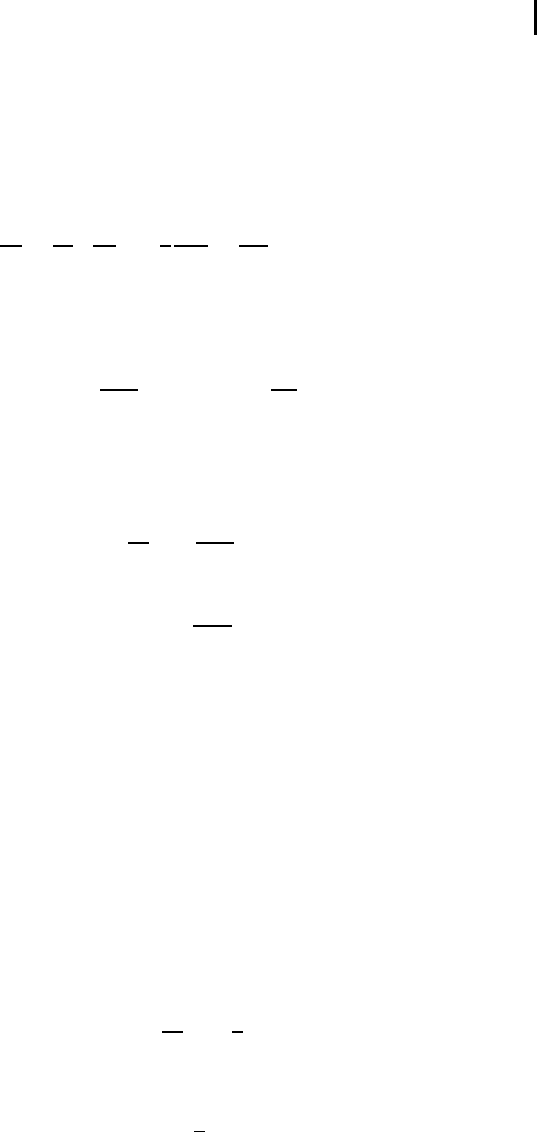
where C =(1/2)πGR
4
is the torsional rigidity of a rod.
Taking this into account, it is easy to write an equilibrium distribution of additional
displacements and stresses in a cylinder with a screw dislocation along its axis
u
ϕ
= −
br z
πR
2
, δσ
zϕ
= −
Gb
2π
R
2
r. (13.5.2)
The second term on the r.h.s. of (13.5.2) shows the role of finite dimensions of the
specimen in generating the elastic stresses around the dislocation. With increasing
cylinder radius R, the contribution of the last term decreases for r R. The torsion
angle also decreases:
dθ
dz
= −
b
πR
2
.
However, the total torsion of the cylindrical specimen
δθ = −
bL
πR
2
, (13.5.3)
for L R may be essential. Torsional deformation is observed in long and thin
thread-like crystals with a screw dislocation (whiskers).
Now consider a superstructure formed by a system of a large number of screw dislo-
cations oriented along the axis of the cylinder of radius R and we will be interested in
the macroscopic properties of such a superstructure. Then, in the main approximation
the distribution of the dislocations can be assumed continuous, characterized by the
density n
0
= 1/S
0
,whereS
0
is the average area o f the xy plane per dislocation.
The dislocation creates a stress (13.3.3) in an unbounded media (denote it as σ
0
).
But because the stress field of the screw dislocations is similar to the electric field of
linear charges, the stresses at a distance r from the axis of the cylinder are created by
all the dislocations intersecting an area S = πr
2
around the axis of the cylinder and
are equal to the stresses around one dislocation lying along the axis of the cylinder
(x = y = 0) and carrying the total “charge” (the Burgers vector bS/S
0
)ofallthose
dislocations:
σ
ϕ
≡ σ
ϕ
=
S
S
0
σ
0
=
1
2
Gbn
0
r. (13.5.4)
These stresses, first, create a force actin g on a d islocation lying a distance r from
the axis of the cylinder:
F
r
= bσ
ϕ
=
1
2
Gb
2
n
0
r . (13.5.5)
314
13 Elastic Field of Dislocations in a Crystal
Second, the dislocation field (13.5.4) creates the following moment of torque on the
end of the cylinder:
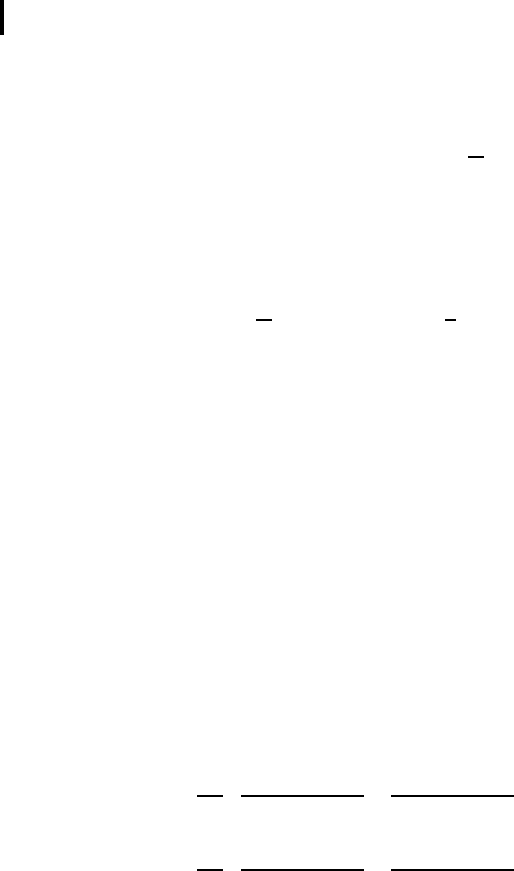
M
z
=
rσ
ϕ
dS = 2π
R
0
σ
ϕ
r
2
dr =
π
4
GbR
4
. (13.5.6)
One sees that (13.5.6) differs from (13.5.1) with the multiplier (1/2)πR
2
n
0
. Conse-
quently, in order to calculate strains and stresses produced by the dislocation system
in the cylinder it is sufficient to multiply (13.5.2) by this multiplier:
u
ϕ
= −
1
π
bn
0
rz, δσ
ϕ
= −
1
2
Gbn
0
r . (13.5.7)
The stresses described by the second relation in (13.5.7) can be looked upon as a
certain external field in relation to the dislocation system. Comparing (13.5.7) with
(13.5.4) and (13.5.5) one can see that the interaction force of a given dislocation with
remaining continuously distributed dislocations is exactly compensated by these “ex-
ternal stresses”. This means that the expected repulsion of discrete dislocations calcu-
lated according to formula (13.5.5) with the use of (13.3.3) is eliminated on average
when the boundary conditions and symmetry of the problem with a continuous distri-
bution of dislocations are correctly taken into account. In other words, the equilibrium
state of such a dislocation system is stabilized by the twisting of the sample.
Another more trivial example of the influence of boundary conditions for a free
crystal surface on the distribution of the elastic fields around the dislocation is the
problem of a screw dislocation parallel to the plane of a free surface of an isotropic
medium. Let the plane zOy coincide with a su rface of the solid, and the dislocation
parallel to the z-axis have the coordinates x = x
0
, y = 0. The stress field leaving
the free medium surface is described by the sum of dislocation fields and its mirror
reflection in the plane yO z as if they were in an unbounded medium
σ
zx
= −
Gb
2π
y
(x − x
0
)
2
+ y
2
−
y
(x + x
0
)
2
+ y
2
,
σ
xy
=
Gb
2π
x − x
0
(x − x
0
)
2
+ y
2
−
x + x
0
(x + x
0
)
2
+ y
2
.
(13.5.8)
The dependence of stresses (13.5.8) on the distance x
0
is typical for a ny linear dis-
location near the crystal surface and is very important in discussing various boundary
problems.
13.6
Long-Range Order in a Dislocated Crystal
According to (13.3.5), far from the dislocation an unexpected dependence of u
y
on r
(u
y
∼ b ln r) is observed. This dependence is quite natural, if we consider the dis-
13.6 Long-Range Order in a Dislocated Crystal
315
placement as a strain (or stress) field “potential” generated by a linear source. The
vector u has a simple physical meaning in a crystal with an isolated dislocation. It de-
termines the displacement of an atom in a dislocated crystal lattice with respect to its
equilibrium position in the same lattice without a dislocation. Thus, the displacements
of atoms extremely distant from the linear dislocation axis increase logarithmically
with increasing crystal dimension.
Although the relative displacements of the neighboring atoms, g iven by the defor-
mation tensor proportional to 1/r, are vanishingly small as r → ∞ , it is necessary
to specify more accurately the n otion of crystal order in a dislocated lattice since the
displacement vector increases at large distances from the dislocation. Since disloca-
tions can generate arbitrarily large atomic displacements without breaking the crystal
structure, it is unn ecessary to require in describing the crystalline ordering in a real
crystal that the same periodic spatial atomic network is preserved in the whole space.
To determine the crystal order, we consider the scheme of a deformed crystal
(Fig. 7.7) used to explain the effect of lattice deformation on the phonon spectrum.
A system of atoms has no space periodicity, and the “unit cells” in its different parts
differ in form and dimension, but it is nevertheless considered as a deformed crystal.
To make this system ordered, we introduce a curvilinear net describing at each point
of the space a quite definite crystal structure. Going along this net, it is possible to es-
tablish a relation between a local short-range order and that in any p art of the crystal.
The point defects do not break the general structure of the net.
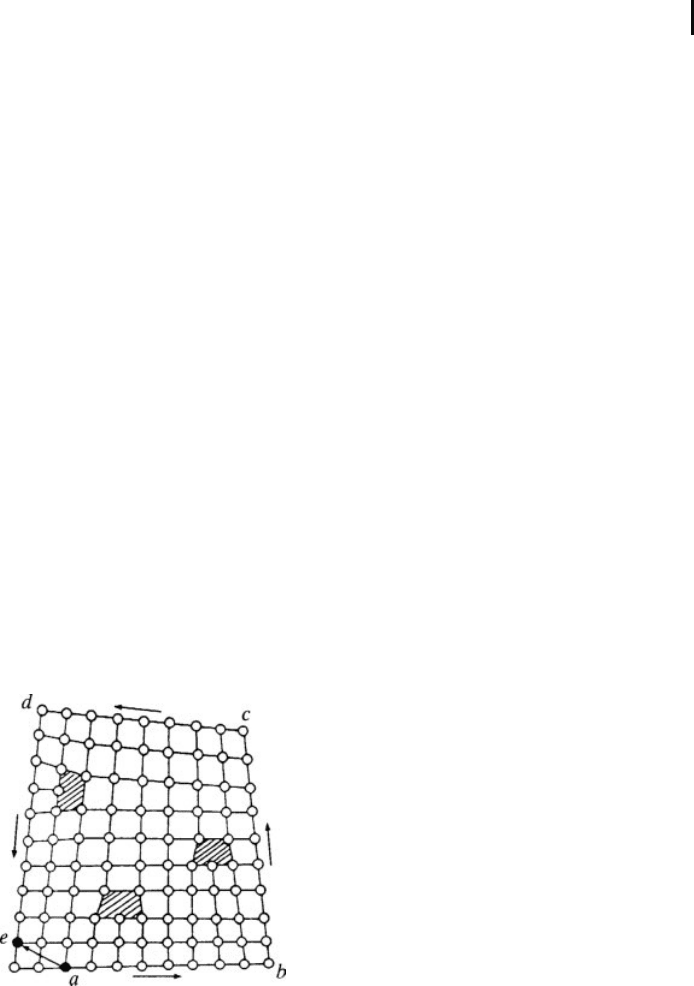
In a crystal that has several dislo cations (Fig. 13.6), in addition to local crystal net
distortions, there are “topological” faults of the spatial lattice that significantly deform
the long-range order.
Fig. 13.6 A dislocated crystal with topological long-range order.
The increase in the density of the opposite-sign dislocations makes the whole struc-
ture amorphous without breaking the short-range order. Thus, an amorphous solid can
be considered as the limiting state of a crystal with a large numbe r of dislocations such

316
13 Elastic Field of Dislocations in a Crystal
that the average distance between them is of a comparable order of magnitude as the
lattice period.
However, we are interested in the crystal state, whose existence implies that the
long-range order distortions induced by dislocations are small. These distortions can
be displayed during the following process of observation. Basing our treatment on the
local short-range order in a crystal, we pass around a macroscopic contour that would
be closed in an ideal crystal. For instance, if we pass an external contour in a counter-
clockwise direction (Fig. 13.6) starting from the point a, it will not be closed and we
will arrive at th e po int e noncoincident with the contour origin. The impossibility of
closing a similar contour characterizes the fault in the long-range order in the crystal.
The situation when continuous “short-range ordering” in passing around a closed
contour cannot result in a common short-range order at all contour points has been
called (in a theory of crystal singularities) frustration.
In the given case the degree of “frustration” in the structure produced is character-
ized by the vector (ae), which is equal to the total Burgers vector B of all dislocations
enveloped by tracing around a contour. Thus, a quantitative measure of breaking the
long-range order in a certain part of a dislocated crystal is the total Burgers vector of
dislocations coupled with a “closed” macroscopic contour that envelopes the crystal
part concerned.
We denote by L the length of the contour abcde (Fig. 13.6). For the system under
consideration, the in e quality B L is satisfied. If a similar inequality is satisfied for
any macroscopic contour in a dislocated crystal then the long-range order fault can be
assumed to be unessential.
For the atomic system concerned, in determining the crystal order we replace the
literal translational symmetry of an ordered system by a set of the following structural
properties.
1. The system has a short-range order given entirely by the crystallographic struc-
ture of substance. To formulate this p roperty, it is necessary to exclude the
vicinities of point defects or of certain specific lines–dislocation cores.
2. During a continuous motion from a spatial point to the neighboring one, it is
possible to establish a correspondence between equivalent atoms and crystallo-
graphic directions in the unit cells positioned close to one another.
3. The total Burgers vector coupled with any closed macroscopic contour inside
the system remains small compared to the length of this contour. A closed
contour is constructed by using the short-range order at each of its intermediate
points, and the Burgers vector coupled with it equals the displacement of an
atom at the end of the contour relative to an atom at its beginning.
It is natural to consider the atomic system characterized by these pr operties as a
crystal with long-range order. A real crystal has long-range order only in this sense.
13.6 Long-Range Order in a Dislocated Crystal
317
We note that the suggested definition of crystal long-range order does not give the
information about the smallness of atomic displacements with respect to their equi-
librium positions in the initial crystal lattice. Sometimes, the long-range order deter-
mined in this way is called topological order.
The vanishing of topological long-range order means the destruction o f a crystal
structure. When the absence of long-range order in a solid substance is not accompa-
nied by the loss of shear elasticity, we assume that a solid is in an amorphous state. If
the long-rang e order vanishes with increasing tem perature simultaneously with shear
elasticity (the substance starts leaking), we can speak of crystal melting. Unfortu-
nately, there is no systematic theory of 3D crystal melting.
The situation is opposite in a 2D case. In a 2D crystal, a dislocation is a point
defect, whose 2D displacement vector field u(u
x
, u
y
) is not different from that of
a linear edge dislocation in a 3D crystal (13.3.5). The energy of this defect can be
obtained by multiplying the linear dislocation energy per un it length by the lattice
constant a:
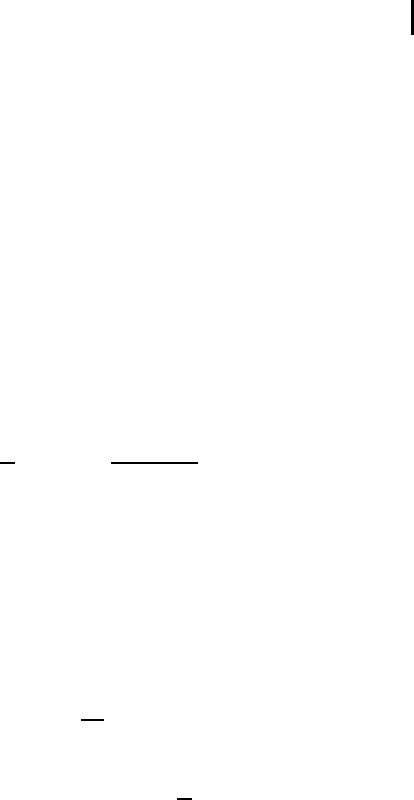
E = ε
0
ln
R
a
, ε
0
=
aGb
2
4π(1 −ν)
. (13.6.1)
Since the energy ε
0
is comparable with the atomic energy of a 2D crystal and the de-
pendence on crystal dimension (13.6.1) is very weak, a thermo-fluctuational initiation
of the dislocation can be assumed in a 2D crystal.
With given temperature T, the thermodynamic equilibrium condition is determined
by the minimum of the free energy of the solid F. We consider the change in F associ-
ated with the appearance of one dislocation and note that the dislocation contribution
to the configuration entropy in a 2D crystal is
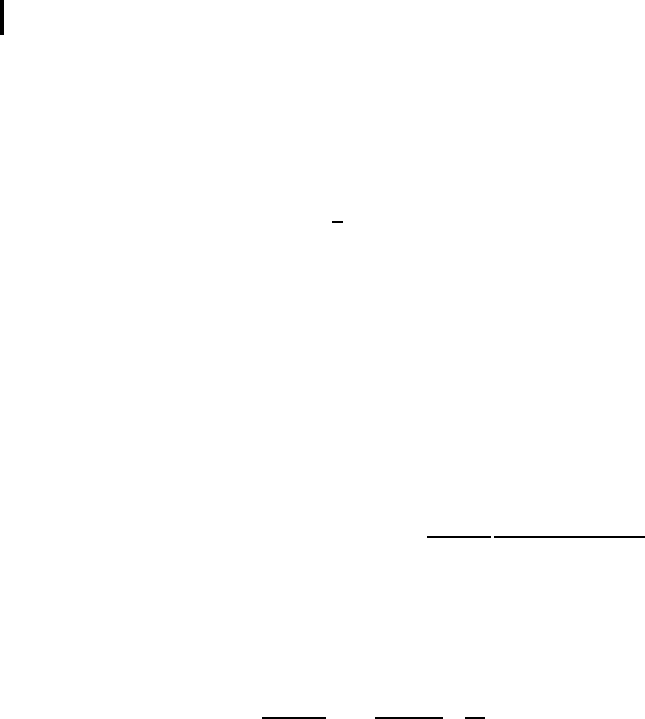
δS = ln
R
2
a
2
. (13.6.2)
Then
δF = E − TδS =(ε
0
−2T) ln
R
a
. (13.6.3)
It is clear that for T < (1/2)ε
0
the appearance of a dislocation increases the free
energy of the system and, thus, the dislocatio n initiated fluctuationally will inevitably
escape from the crystal. In total thermodynamic equilibrium there are no isolated free
dislocations.
For T > (1/2)ε
0
, the free energy of the system decreases with the appearance of
a dislocation and thus the pro cess of their initiation in a 2D crystal becomes advanta-
geous thermodynamically. Hence, with increasing temperature at T = T
0
=(1/2)ε
0
there occurs a phase transition of a 2 D crystal into a state with an arbitrary number of
free dislocations (Berezinsky, 1970, Kosterlits, Taules, 1973). As a result, the initial
long-range order in a 2D crystal is broken.
It is easy to follow what mechanism is responsible for breaking the 2D crystal long-
range order. At low (T < T
0
) but finite temperatures a certain equilibrium density
318
13 Elastic Field of Dislocations in a Crystal
of dislocation dipoles exists in a crystal. This is the case because the energy of an
opposite-sign dislocation pair, in contrast to (13.6.2) is independent of crystal dimen-
sion. Indeed, the dip ole en ergy can be written as E
D
= 2E + E
int
, where the inter-
action energy of a dislocation pair E
int
is determined by (13.6.7) shown in solving
Problem 2. In this formula it is necessary to put b
1
= b = −b
2
. Thus,
E
D
= 2ε
0
ln
r
a
+ sin
2
ϕ
+ 2U
0
, (13.6.4)
where the angle ϕ d e termines the dipole orientation and U
0
is the dislocation core
energy.
Since the energy (13.6.4) is bounded, there exists a finite density of dislocation
dipoles of the given dimension r, proportional to the Boltzmann factor exp(−βE
D
),
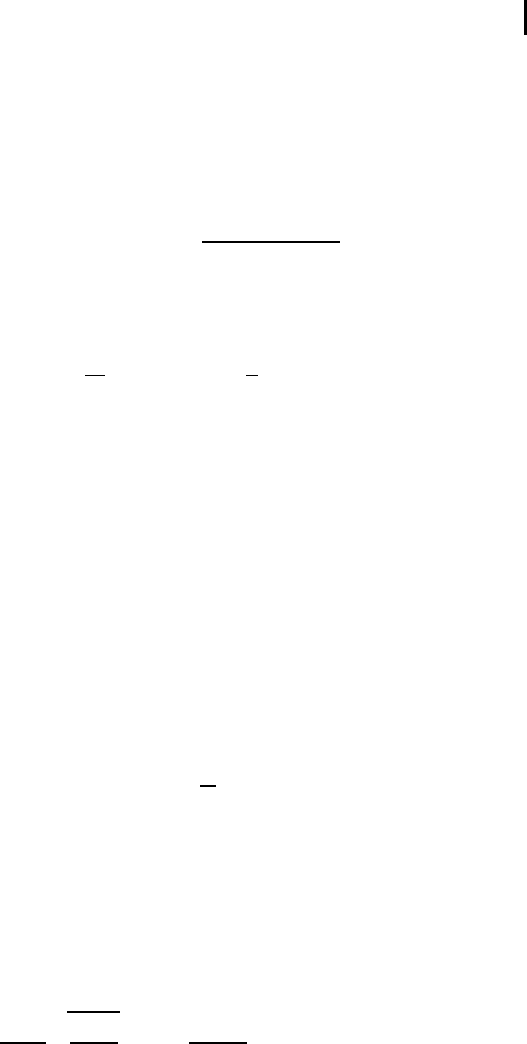
where β =(1/T). We calcu late the mean square of the dislocation dipole dimension:
r
2
=
R
a
r
2
e
−βE
D
rdrdϕ
R
a
e
−βE
D
rdrdϕ
−1
(13.6.5)
=
R
a
r
3−2βε
0
dr
R
a
r
1−2βε
0
dr
−1
=
1 − βε
0
2 − βε
0
R
4−2βε
0
− a
4−2βε
0
R
2−2βε
0
− a
2−2βε
0
.
Since we are interested in the limit R → ∞ (R a) the mean square (13.6.5) will
have different forms for 4 < 2βε
0
when T < T
0
, and with 4 > 2βε
0
when T > T
0
.
In the first case T < T
0
, in the limit R → ∞ we have
r
2
=
1 − βε
0
2 − βε
0
a
2
=
2T
0
− T
T
0
− T
a
2
2
2
. (13.6.6)
Thus, the average dimension of equilibrium d islocation dipoles in an ordered 2D
crystal is limited, but increases with increasing temperatu re and goes to infinity at the
phase transition point T = T
0
.
In the second case (T > T
0
), in the limit R → ∞ we get r
2
= ∞. Hence, it
follows that when T > T
0
the dislocation dipoles are broken down, on average, and a
phase with free 2 D dislocations is occurs. A more d etailed description of the prope r-
ties of the resulting phase requires taking into account the dislocation interaction and
a knowledge of how to treat disordered systems.
13.6 Long-Range Order in a Dislocated Crystal
319
13.6.1
Problems
1. Calculate the shear stresses generated by an infinitely extended dislocation wall
(Fig. 10.8c) at large distances.
Hint. Write down the total field of all dislocations
σ
xy
(x, y)=bMx
∞
∑
n=−∞
x
2
− (y −nh)
2
[x
2
+(y − nh)
2
]
and make use of the Poisson summation formula (9.4.3).
Solution.
σ
xy
= 4π
2
bM
x
h
2
e
−2πx/h
cos
2π
y
h
, x h.
2. Find the interaction energy of two linear edge dislocations lying in the parallel glide
planes.
Hint. Make use of the fact that the d esired energy is equal to the work done to remove
one dislocation in the glide plane from infinity (from crystal surface) to the line of its
location in the field of a fixed second dislocation. Thus, the interaction energy per unit
length of the dislocation equals
e
12
=
R
r cos ϕ
F
x
dx at R → ∞,
where F
x
is determined by an equation such as (13.3.10).
Solution.
E
21
= −b
1
b
2
M
ln
r
R
+ sin
2
ϕ
. (13.6.7)
3. Describe the distribution of straight dislocations near the obstacle under the action
of a homogeneous compressive stress.
Hint. Make use of (13.3.13), setting σ
e
xy
= σ
0
=constant, a
2
= 0,andfinda
1
= −L
from the condition
0
−L
ρ(x) dx = N.
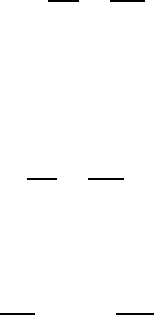
Solution.
ρ(x)=
σ
0
πbM
L + x
|x|
, L =
2NbM
σ
0
(−L < x < 0).
14
Dislocation Dynamics
14.1
Elastic Field of Moving Dislocations
Let us now elucidate what form the total system of equations of elasticity theory takes
that determines strains and stresses in a crystal when d islocations perform a given
motion.
Equation (13.1.6) is independent of whether the dislocations are at rest or in motion.
However, in the dynamic case the distortion tensor should change with time and this
will be determined by the character of dislocation motion.
If during the deformation of a medium the dislocations remain stationary the fol-
lowing equality is valid
∂v
k
∂x
k
=
∂u
ik
∂t
, (14.1.1)
where v = v(r, t) is the velocity of displacement of a medium element with a coordi-
nate r at time t.
If the dislocations move and their density changes with time, (14.1.1) is incompati-
ble with (13.1.6). Thus, we replace it with
∂v
k
∂x
k
=
∂u
ik
∂t
− j
ik
, (14.1.2)
where the tensor j
ik
should be chosen so that these equations are compatible. The
compatibility condition of (13.1.6), (13.1.2) has the form
∂α
ik
∂t
+ e
ilm
∇
l
∂j
mk
∂t
= 0. (14.1.3)
To associate the tensor j
ik
with dislocation motion, we note that the condition
(14.1.3) can be regarded as the differential form of the conservation law of the Burg-
ers vector in a medium. Indeed, we integrate both sides of (14.1.3) over the surface
The Crystal Lattice: Phonons, Solitons, Dislocations, Superlattices, Second Edition. Arnold M. Kosevich
Copyright
c
2005 WILEY-VCH Verlag GmbH & Co. KGaA, Weinheim
ISBN: 3-527-40508-9
322
14 Dislocation Dynamics
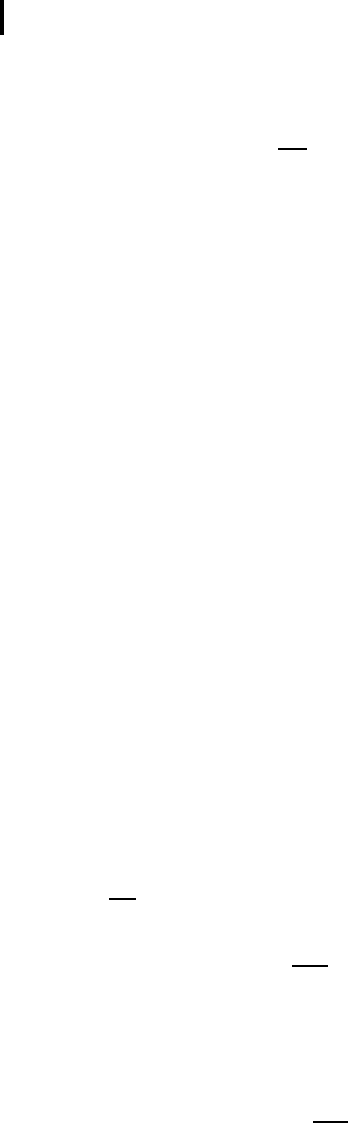
spanned on a certain closed line L and introduce the total Burgers vector b of the
dislocations enveloped by the contour L. Using Stokes’s theorem, we obtain
db
k
dt
= −
L
dx
i
j
ik
.
It is clear from th is equality that the integral on its r.h.s. determines the Burgers
vector “flowing” per unit time through the contour L, i. e., carried over by dislocations
that cross the line L. Thus, it is natural to consider j
ik
as the dislocation flux density
tensor, and (14.1.3) as an equation for the continuity of dislocation flow.
In particular, it is obvious that in the case of an isolated dislocation loop, the tensor
j
ik
has the form
j
ik
= e
ilm
τ
l
V
m
b
k
δ(ξ) , (14.1.4)
where V is the dislocation line velocity at a given point. The vector of the flux j
ik
dl
i
through an element dl of the contour is then proportional to dl [τV]=V [dlτ],i.e.,to
the projection velocity V onto the direction perpendicular both to dl and τ. It follows
from geometrical considerations that only this projection results in the dislocation
crossing the element d l.
If the dislocation distribution is described by the continuous functions α
s
ik
(14.1.4)
is generalized by
j
ik
= e
ilm ∑
s
α
s
ik
V
s
m
,
where the index s d e notes the densities of dislocations of various types (for in stan ce,
dislocations of different sign in the case of a system of parallel edge dislocations) and
the vector V
s
is equal to the average velocity of dislocations of the type s at a given
point in the crystal.
The tensor j
ik
has an independent meaning and is the principal characteristic of
dislocation motion.
Finally, we obtain a total system of differential equations describing the elastic
fields in a crystal with moving dislocations. This system consists of (13.1.6), (14.1.2)
and the equations of motion of a continuous medium:
ρ
∂v
i
∂t
= ∇
k
σ
ki
, σ
ik
= λ
iklm
u
lm
, e
ilm
∇
l
u
mk
= −α
ik
,
∇
i
v
k
−
∂u
ik
∂t
= −j
ik
.
(14.1.5)
In these equations the tensors α
ik
and j
ik
are the g iven functions of the coordinates
(and time) characterizing the dislocation distribution and motion.
The compatibility conditions for (14.1.5) are the conservation laws
∇
i
α
ik
= 0,
∂α
ik
∂t
+ e
ilm
∇
l
j
mk
= 0. (14.1.6)
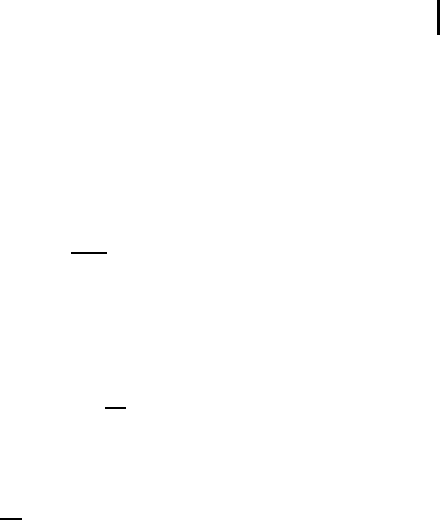
14.1 Elastic F ield of Moving Dislocations
323
Using the definition for the tensor of the dislocation flow density and the system of
(14.1.5), the dynamics of dislocations in an elastic medium can be developed (Kose-
vich, 1962; Mura, 1963).
The relation between the trace of the tensor j
ik
(j
0
≡ j
kk
) and the equation for con-
tinuity of a continuous medium is of special interest. The convolution j
0
is involved
in the equation obtained from (14.1.5):
div v −
∂ε
kk
∂t
= −j
0
. (14.1.7)
It is easy to explain the physical meaning of (14.1.7). Indeed, the convolution ε
kk
is a relative elastic change in the medium element volume obviously related with a
corresponding relative change in its density (ρ):
ε
kk
= −
δρ
ρ
. (14.1.8)
Substituting (14.1.8) into (14.1.7) and using the linearity of the theory, we get the
relation
∂ρ
∂t
+ div ρv = −ρj
0
. (14.1.9)
If, with a moving dislocation, the medium elements move without breaking continuity,
the l.h.s. of (14.1.9) vanishes due to the continuity equation and (14.1.10)
j
0
≡ j
kk
= 0. (14.1.10)
For linear dislocations (14.1.10) has a simple interpretation. Indeed, in the case of
an isolated linear dislocation, the convolution j
0
is proportional to [bτ] V, i. e., propor-
tional to the projection of the dislocation velocity onto the directional perpendicular
to the vectors τ and b, or in other words, onto the direction perpendicular to the dis-
location glide plane. Thus, (14.1.10) implies that with medium continuity preserved
the vector of the dislocation velocity V lies in the glide plane, so that the mechanical
motion of a dislocation can o nly take place in this plane.
If dislocation motion is accompanied by the formation of some discontinuities, for
instance, by a macroscopic cluster of vacancies along some part of the dislocation line,
the l.h.s. of (14.1.9) is nonzero and equals the velocity of a relative inelastic increase
or decrease o f the mass of some elementary volume of the medium.
The action of this mechanism amounts to a macroscopic clustering of vacancies
or interstitial atoms along the dislocation line. We denote by q(r) a relative increase
of the specific volume of a medium at the point r per unit time. According to the
formulae (14.1.4), (14.1.9), the motion of an isolated dislocation should then generate
the following value of q:
q(r)=V [bτ] δ(ξ), (14.1.11)
when ξ is a 2 D radius vector measured from the dislocation axis.