
Kosevich A.M. The crystal lattice
Подождите немного. Документ загружается.

324
14 Dislocation Dynamics
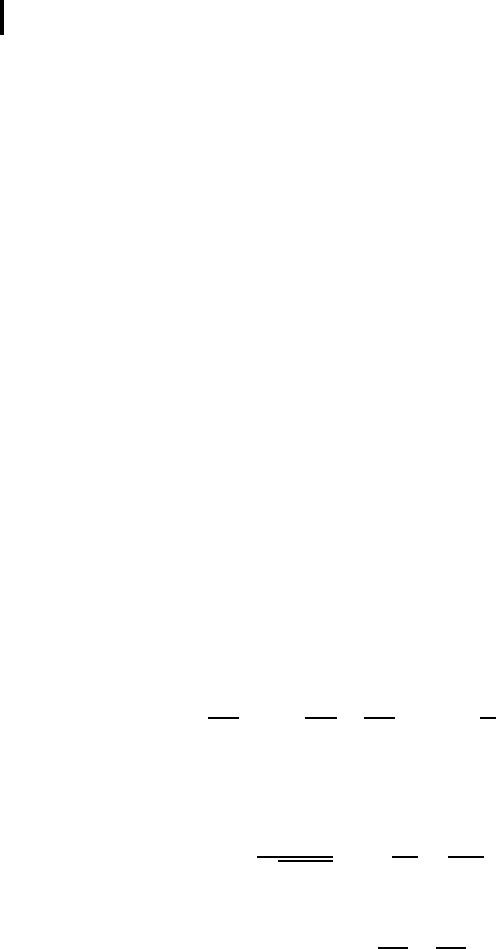
One of the methods of solving the system of equations (14.1.5) consists in replac-
ing an infinitely small displacement of the dislocation line element by an infinitely
small dislocation loop. This method is only fruitful when the time dependence of the
deformation field is studied.
We differentiate the equation of elastic medium motion with respect to time us-
ing (14.1.2). We then obtain a dynamic equation of elasticity theory for the velocity
vector v:
ρ
∂
2
v
i
∂t
2
− λ
iklm
∇
k
∇
l
v
m
= λ
iklm
∇
k
j
lm
. (14.1.12)
The role of the force density in this equation is played by th e vector f
D
i
= λ
iklm
∇
k
j
im
.
The solution to (15,1.12) can be written as
v
i
(r, t)=
dV
t
−∞
dt
G
ik
(r − r
, t −t
) f
D
k
(r
, t
) ,
where G
ik
(r, t) is the Green tensor of the elasticity theory dynamic equation. This
formula solves completely the problem of finding the displacement velocity and de-
termines the time dependence of the displacements.
We recall that the Green dynamic tensor for an isotropic medium is written explic-
itly as
G
ik
(r, t)=
1
4πρr
n
i
n
k
s
2
l
δ
t −
r
s
l
+
δ
ik
−n
i
n
k
s
2
t
δ
t −
r
s
t
+
t(δ
ik
−3n
i
n
k
)
4πρr
3
Θ
t −
r
s
t
− Θ
t −
r
s
l
,
where s
l
and s
t
are the longitudinal and transverse sound velocities; r = nr, Θ(x) is
the Heaviside discontinuity function.
The present Green tensor resembles the Green function for an electromagnetic field
in the medium. The equations for the dynamics of an elastic field with dislocations
are not very different from the dynamic equations for an electromagnetic field with
charges and currents. These are the differential equations in partial derivatives of the
type of wave equations with sources. Since nonstationary (accelerated) motion of
the sources generates a radiation field, the accelerated motion of dislocations induces
radiation of elastic (sound) waves. The description of acoustic radiation of disloca-
tions can be made by a standard scheme developed in field theory, but is somewhat
complicated by the tensor character of the deformation fields.
14.2 Dislocations as Plasticity Carriers
325
14.2
Dislocations as Plasticity Carriers
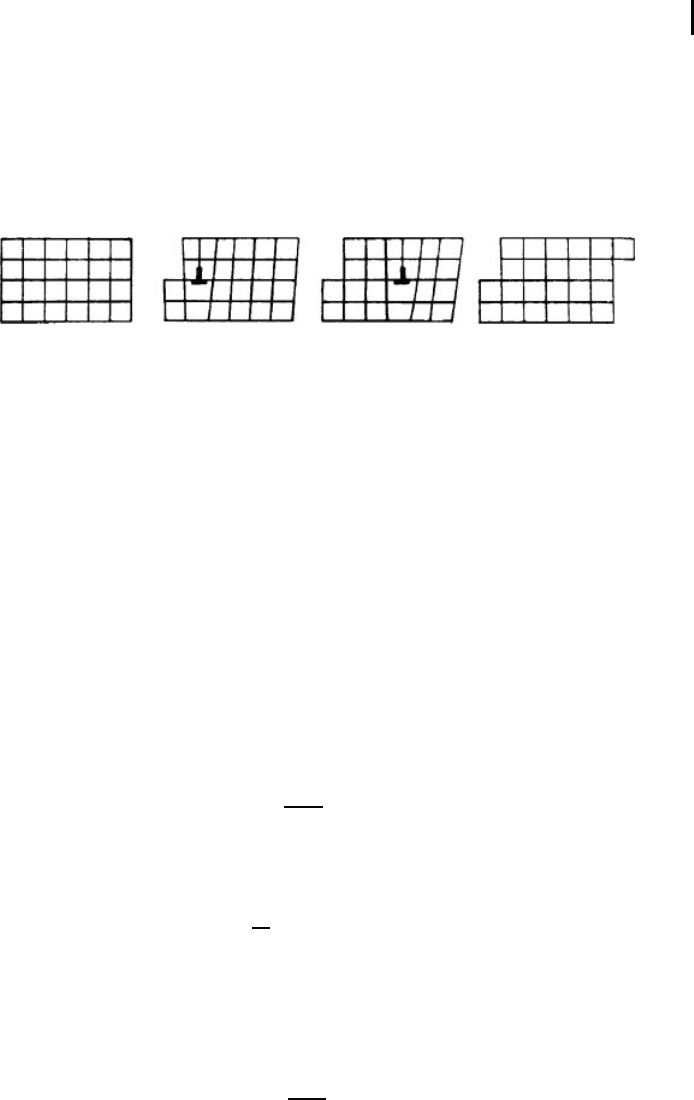
Dislocation motion is accompanied (apart from changes of elastic deformation) by
changes in the crystal not associated directly with stresses, i. e., plastic deformation
(Fig. 14.1). By a plastic deformation we understand a residual crystal deformation
that does not vanish after the process that generates it is over.
Fig. 14.1 Scheme of a residual atomic rearrangement resulting from the
motion of an edge dislocation.
Let an edge dislocation pass through a crystal from left to right. As a result, part of
the crystal above the glide plane is displaced by one lattice period . Since the lattice
at any point inside the specimen is regular after the dislocation has moved through
it, the crystal remains un stressed. Unlike the elastic deformation associated directly
with the thermal state of a solid, plastic deformation is a function of the process. (In
considering stationary dislocations the question of distinguishing between elastic and
plastic deformation does not arise. We are interested in stresses that are independent
of the previous crystal history.)
It is clear that the dislocation displacement is inevitably related to the occurrence of
plastic deformation: dislocations are elementary plasticity carriers.
For a quan titative description of dislocation elasticity, it is necessary to return to
(14.1.2). We introduce the vector of the total geometric displacement of the points of
the medium u measured from their position befo r e the deformation starts. The time
derivative of the vector u determines the displacement velocity of the medium element
v = ∂u/∂t. Therefore,
∂w
ik
∂t
= ∇
i
v
k
, (14.2.1)
where w
ik
is the total distortion tensor, w
ik
= ∇
i
u
k
.
Using (14.2.1) we rewrite (14.1.2) as
∂
∂t
(w
ik
−u
ik
)=−j
ik
.
The difference w
ik
−u
ik
determines the part of the total distortion tensor that is not
associated with elastic stresses and is generally called the plastic distortion of a solid.
We denote this quantity by u
pl
ik
and obtain
∂u
pl
ik
∂t
= −j
ik
. (14.2.2)
326
14 Dislocation Dynamics
Thus, the variation in the plastic distortion tensor at a certain point of the medium
for small time δt is equal to
δu
pl
ik
= −j
ik
δt.
A similar relation for the plastic strain tensor ε
pl
ik
has the form
δε
pl
ik
= −
1
2
(j
ik
+ j
ki
)δt. (14.2.3)
The relation between dislocation flow density and plastic deformation velocity, i. e.,
the relations equivalent to (14.2.2) or (14.2.3) were indicated by Kroener and Rider
(1956).
If, during the dislocation motion, the elements of the medium move without break-
ing the continuity, then j
kk
= 0. It then follows from (14.2.2) that ε
pl
kk
= 0. Thus,
we come to the assertion, known in plasticity theory, that a pur ely plastic deformation
taking place without breaking the medium continuity does not result in a hydrostatic
compression (which should be connected with internal stresses).
It is clear that (14.2.2), (14.2.3) are valid for any mechanism responsible for disloca-
tion migration, in particular, their nonconservative motion (climb). In the last case, as
shown above, the crystal volume changes locally, but the general scheme of plasticity
is not broken.
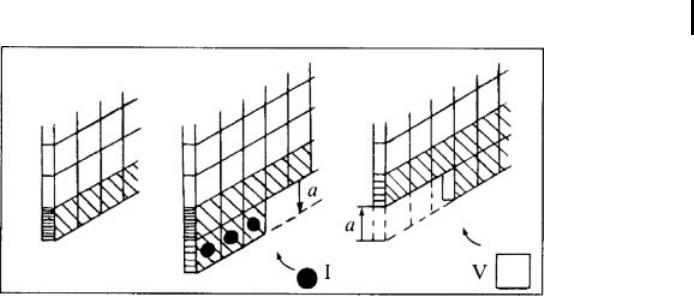
To evaluate the role of dislocation climb it is exp edient to imagine a semi-
microscopic scheme for this process. In Fig. 14.2, the edge of an extra atomic
half-plane coincident with the edge dislocation axis is shown. When the interstitial
atom gets attached to the edge of a half-plane inserted in a crystal, it becomes a “reg-
ular” atom , resulting in a protuberance of atomic dimensions on the dislocation line.
The dislocation line itself is determined up to atomic dimensions, so that its po sition
can only be affected by the “condensation” of a macroscopic number of interstitial
atoms. The change in position of an extra half-plane edge under the condensation of a
great number of interstitial atoms (I), when an extended row of extra atoms is formed
on the dislocation, is shown in the middle of Fig. 14.2. The appearance of an extra
row of atoms results in the displacement of a corresponding part of the dislocation line
by the value a in a direction perpend icular to the slip plane. The dislocatio n appears
to go down by one atomic layer; it goes to the next slip plane.
The condensation of vacancies (V) on the edge dislocation leads to similar results,
the difference being that the dislocation displacement is oppositely directed – the dis-
location line goe s up to a higher slip plane.
Both the glide and climb occur under the action of elastic stresses. The glide, when
viewed as a fast mechanical motion, differs from climb in its threshold character: it
only begins when the stress exceeds a defin ite value (the initiation stress). But in a
number of crystals (e. g., in many metals and quantum crystals) comparatively small
stresses are needed to start dislocation motion. If the crystal has a regular structure
the dislocations at the first stage of their motion glide easily and often travel large
14.3 Energy and Effective Mass of a Moving Dislocation
327
Fig. 14.2 Climb of an edge dislocation via elongation of an extra atomic
half-plane under the condensation of interstitial atoms (I) or shortening
of an extra half-plane under the condensation of vacancies (V).
distances in their slip planes. However, the process o f easy g liding is short since
obstacles decelerating the dislocation motion arise in a crystal.
The obstacles decelerating the dislocation are different. These may be defects such
as impurities, fixing the dislocation line at some points only. But sometimes the dislo-
cation stops gliding over an extended part of its line. This occurs when the dislocation
is retard ed by clusters of imp urities or macroscopic heteroge neous inclusions. Ob-
stacles of any kind retard the dislocation motion. As a result, the velocity of crystal
plastic deformation is determined by factors such as climb and glide, and whether the
dislocation can overcome the obstacles.
14.3
Energy and Effective Mass of a Moving Dislocation
The system of equations (14.1.5) determines the elastic distortion tensor u
ik
and the
vector v
α
of the medium displacement velocity using a given distribution of disloca-
tions and flows. The tensors α
ik
and j
ik
and, hence, the dislocation motion are assumed
to be given. For a system of equations to be completely closed and to determine a self-
consistent evolution of dislocations and elastic field, it is necessary to take into account
the changes in the dislocation d ensity and their flow under the action of elastic fields.
In other words, it is necessary to know the equation of dislocation motion.
Since separate dislocation loops represent lines of elastic field singularities, the
equation for dislocation motion is an equation for the motion of an elastic field singu-
larity. The physical idea of obtaining the equation of motion of a field singularity (in
the given case, a dislocation) is well known.
A dislocation is a source of internal stress, which creates stress and strain fields
in a crystal free of external loads. A definite elastic energy that can be regarded as
the dislocation energy is associated with this field. When the dislocation moves, the
elastic field induced by it also moves, but it always has inertia, because the dynamic
328
14 Dislocation Dynamics
elastic field energy is different from the static field energy. The inertia of the elastic
field of the dislocation can be interpreted as the inertia of the dislocation, which can
be described by an effective mass. With such an approach, the energy and the mass of
the dislocation and, hence, the equa tion of th e dislocation motion are of a pure field
origin.
Accordingly, to evaluate the dislocation dynamics, it is necessary to know the dislo-
cation e nergy. To calculate the latter it is necessary to express the elastic energy of the
field caused by a moving dislocation loop (or a system of loops) through the instanta-
neous coordinates an d velocities of d islocation line elements. In accordance with the
electromagnetic field theory of moving charges, this procedure is generally possible
using an approximation that is qua dratic in velocities (Section 3.6). Since the struc-
ture of the dynamical equations of an elastic field with dislocations is qualitatively the
same as that o f Maxwell’s eq uations, the difficulties in carrying out the a bove p ro-
cedure may be due to additional calculations only. The latter are rather cumbersome
(even in an isotropic approximation) for the general case of a dislocation loop moving
arbitrarily in a crystal. Taking this into account, we try, by analyzing a simple example
and its almost obvious generalizations, to explain the general features of deriving the
equation for dislocation motion.
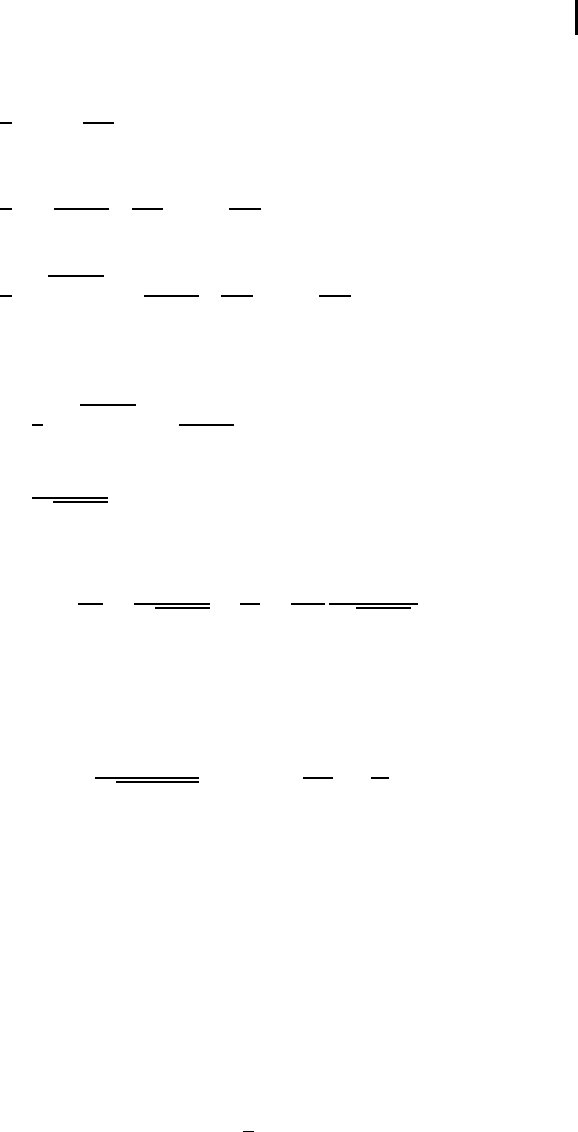
We consider th e uniform motion of a linear screw dislocation in an isotropic
medium. We choose the z-axis along the dislocation line and the x-axis parallel to
the direction of the d islocation velocity V. As in the static case (Section 3.14), the
elastic field of a screw dislocation is completely described by a single nonzero com-
ponent of the displacement vector u
z
= u(x, y, t) and the equations of the elastic
medium motion reduce to the 2D wave equation
∂
2
u
∂t
2
= s
2
∂
2
u
∂y
2
+
∂
2
u
∂y
2
, s
2
=
G
ρ
. (14.3.1)
The solution to (14.3.1) should have a standard dislocation singularity on the line
x = Vt, y = 0, and, thus it is convenient by changing the variables
ξ =
x −Vt
1 − β
2
, β
2
=
V
2
s
2
=
ρV
2
G
,
to write it as
∆u
0
= 0, ∆ ≡
∂
2
∂ξ
2
+
∂
2
∂y
2
, (14.3.2)
where u
0
(ξ, y)=u(x, y, t).
Equation (14.3.2) coincides with (13.3.1) and its solution has a d islocation singular-
ity at the point ξ = y = 0. Thus the function u
0
(ξ, y) is identical to the corresponding
static solution (13.3.2) if the following replacement x → ξ is made.
14.3 Energy and Effective Mass of a Moving Dislocation
329
The total field energy per the dislocation unit length is
E =
1
2
ρ
∂u
z
∂t
2
+ G
u
2
xz
+ U
2
yz
2
dx dy
=
1
2
1 + β
2
1 − β
2
∂u
0
∂ξ
2
+
∂u
0
∂y
2
dx dy
=
1
2
G
1 − β
2
1 + β
2
1 − β
2
∂u
0
∂ξ
2
+
∂u
0
∂y
2
dξ dy.
(14.3.3)
Using polar coordinates in the plane ξOy we obtain instead of (14.3.3) the following
expression:
E =
1
2
G
1 − β
2
1 + β
2
1 − β
2
sin
2
ϕ + cos
2
ϕ
u
2
ϕz
rdrdϕ
=
πG
1 − β
2
ε
2
ϕz
rdr.
Finally, we substitute the expression for ε
ϕz
that follows from (13.3.3):
E =
b
2π
2
πG
1 − β
2
dr
r
=
Gb
2
4π
log(R/r
0
)
1 − β
2
, (14.3.4)
where the parameters R and r
0
are chosen as in the static case.
Expressing in (14.3.4) the shear modulus G through the transverse sound wave
velocity (G = ρs
2
), we arrive at the following formula for the energy per unit length
of a screw dislocation
E =
m
∗
s
2
1 − v
2
/s
2
, m
∗
=
ρb
2
4π
log
R
r
0
. (14.3.5)
In spite of the “relativistic” form of (14.3.5) this formula is valid only for small dis-
location velocities, assuming V s. Such a “pseudodepletion” of (14.3.5) results
from the fact that the dislocation energy has the field as or igin and involves, in par-
ticular, the interaction energy of different elements of the same dislocation line. To
take into account the interaction of distant dislocation loop elements in the case of
nonstationary motion the elastic dislocation field at a certain time should be expressed
through its coordinates and velocities at the same time. In the general case, because
the elastic waves are retarded, this expression does not exist. As mentioned above for
a nonstationary motion this is possible within the approximation quadratic in V/s.
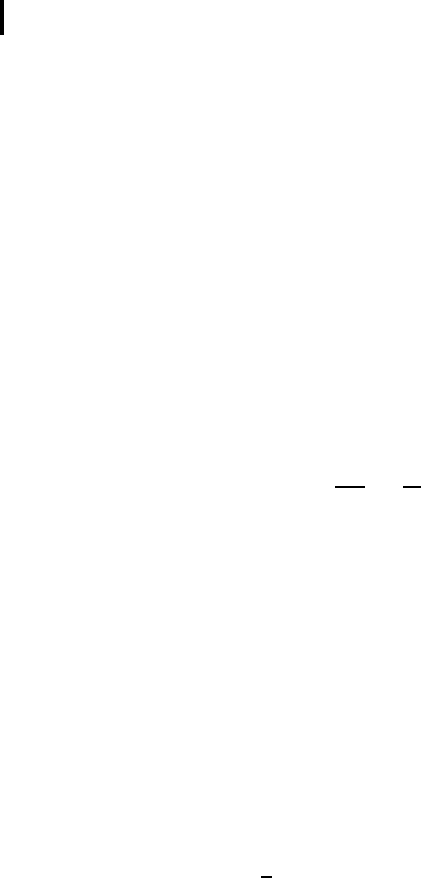
Thus an expression for E, valid for any time depend e nce of the screw dislocation
velocity V will be obtained using the condition V s and replacing (14.3.5) by
E = m
∗
s
2
+
1
2
m
∗
V
2
. (14.3.6)
330
14 Dislocation Dynamics
The first term in (14.3.6) coincides with the eigenenergy per unit length o f the dislo-
cation at rest (13.3.17), the second is assumed to be its kinetic energy. Therefore, m
∗
can be called the unit length effective mass of a screw dislocation. As in the case of a
rest energy, our assumption is justified, i. e., when a real dislocation moves in a crystal,
some atoms in the vicinity of the dislocation axis at a distance of the order of r
0
from
it also start moving. This generates an additional dislocation ine rtia due to the usual
atomic mass. The order of magnitude of the atomic mass inside tube of radius r
0
∼ b
per unit length of the dislocation can be estimated as ρr
2
0
∼ ρb
2
. Comparing this
estimate with (14.3.5) for m
∗
, the dislocation mass can be regarded with logarithmic
accuracy as the field mass.
The inertial p roperties o f an arbitrary weakly deformed dislocation loop are charac-
terized by some tensor of line density of the effective mass m
∗
ik
dependent on a point
on the dislocation line. It can be concluded that at a point where the radius of curva-
ture of the dislo cation loop R
curv
b, an estimate of the order of magnitude of the
effective mass is the same as that of the dislocation rest energy (13.3.18):
m
∗
∼
ρb
2
4π
log
R
r
0
. (14.3.7)
In the case o f translational motion of the linear dislocation, R
curv
is the dislocation
length. If the dislocatio n vibrates, R
curv
equals the wavelength of the dislocation
bending vibrations.
A very important physical conclusion follows from the previous comments con-
cerning the estimation o f the parameter R
curv
. By writing the dislocation energy in the
form of (14.3.6), we introduced the effective mass of unit length of the dislocation, but
characterized in fact the motion of the dislocation. This mass is not a local character-
istic of the dislocation. We recall that with the retardation of electromagnetic waves in
a 2D electron crystal taken into account, the mass of a vibrating atom has transformed
into a nonlocal characteristic of the inertial properties of the crystal. Analogously, the
inertial properties of a dislocation loop should be characterized by a nonlocal mass
density. This m eans that the energy of a moving dislocation loop can be written as
E = E
0
+
1
2
µ
ik
(l, l
)V
i
(l)V
k
(l
) dl dl
, (14.3.8)
where E
0
is the quasi-static dislocation energy, which is dependent only on the instan-
taneous form and th e instantaneous positio n of the dislocation and p lays the role of a
rest energy. The second term in (14.3.8) should b e considered as the kinetic energy of
the dislocation. V(l) is the velocity of a dislocation line element dl , and the double
integration is over the length of the entire dislocation loop. Then µ
ik
(l, l
) plays the
role of a nonlocal density of the effective mass of the dislocation.
Even in an isotropic medium, the effective mass density of the dislocation is
anisotropic. In view of the above expression for the effective mass of a screw dislo-
cation (14.3.5), it is easy to understand the general form of the tensor function of two
14.4 Equation for Dislocation Motion
331
variables µ
ik
(l, l
) for a dislocation moving in its slip plane in an isotropic medium.
This is, as follows (Kosevich, 1962):
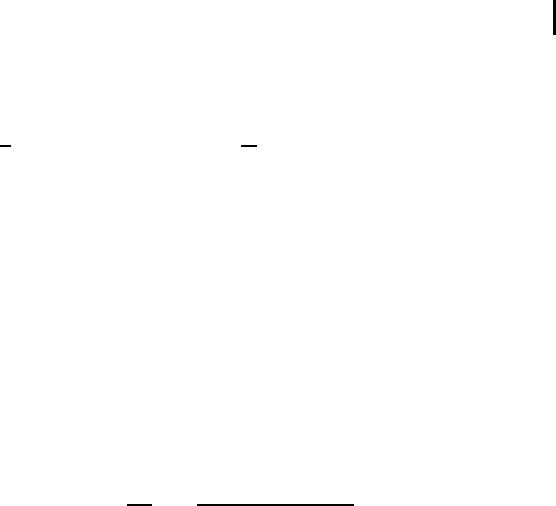
µ
ik
(l, l
)=
1
2
ρb
2
ττ
δ
ik
− τ
i
τ
k
1 +
s
t
s
l
2
sin
2
θ
K(l, l
) ,
b cos θ = nb , τ = τ(l) , τ
= τ(l
) ,
(14.3.9)
where n is the unit vector in the direction of a straight line linking two points l and l
on the dislocation: n =[r(l) −r(l
)] /(r − r
). The scalar function of two variables
K(l, l
) resembles the formula for the self-induction coefficient of a linear conductor
coincident with the dislocation loop. It is a purely geometrical characteristic of the
dislocation loop D, independent of the crystal properties and even of those physical
properties of the medium that are related with this line. This function c haracterizes the
self-action of any linear singularity of the classical field in a 3D space if the dynamic
field equations are differential equations in partial derivatives, such as wave equations
with sources. Its general form is
K(l, l
)=
1
4π
γ(ξ)γ(ξ
) d
2
ξ d
2
ξ
|r(l, ξ) −r(l
, ξ
)|
, (14.3.10)
where ξ is the two-dimensional radius vector measured from the dislocation axis in a
plane perpendicular to it; γ(ξ) is some smooth function localized in the vicinity of the
dislocation axis and describing the Burgers vector “distribution” in the cross section
of the dislocation core:
α
ik
= τ
i
b
k
γ(ξ) ,
γ(ξ) d
2
ξ = 1. (14.3.11)
The necessity of introducing such an arbitrary function is “payment” for changing to
a continuum description of the dislocation as a specific crystal d efect. If we replace
the function γ(ξ) by the delta-function γ(ξ)=δ(ξ), a two-fold integral (14.3.10)
will become meaningless. Thus, by introducing this function we avoid a nonphysical
divergence in elasticity theory. Since the dependence on the dislocation-core radius is
involved in the eigenenergy and the effective mass logarithmically, then arbitrariness
in choosing the function γ(ξ) does not affect the results. Generally, this function is
assumed to be constant and nonzero inside a cylinder of radius r
0
.
To obtain the expression (14.3.10) by direct calculation, it is necessary to calcu-
late the self-induction coefficient of a linear conductor and also to solve problems on
dislocation vortices in a scalar crystal model.
14.4
Equation for Dislocation Motion
Knowing the effective mass of the dislocation makes it possible to write its equation
of motion. The equatio n of motion of an element of a dislocation loop located at the
332
14 Dislocation Dynamics
point l on the d islocation line can be written similarly to Newton’s secon d law:
µ
ik
(l, l
)W
k
(l
)dl
= F
0
i
(l)+e
ikm
τ
k
(l)σ
mn
(l)b
n
+ S
i
(l, V ), (14.4.1)
where W (l)=∂V/∂t is the dislocation acceleration; F
0
is the force of a quasi-static
self-action of a distorted dislocation, generated by the energy density (13.3.18). In a
line tension approximation used with certain reservations the order of magnitude of
this force is evaluated when R b as
F
0
=
T
D
R
, T
D
∼ GB
2
. (14.4.2)
The last term on the r.h.s. of (14.4.1) is the retardation force experienced by the
dislocation in a real crystal (this has not been discussed yet). We distinguish two
physically different parts in the value of this force.
The first part of the force S is composed of forces that arise because the crystal
structure is discrete and the dislocation core is constructed of atoms. Among these
forces there is a static component (the Peierls force) and a component dependent on
the dislocation motion. The last force is related to lattice distortions moving together
with the dislocation on its axis and the induced reconstruction of the dislocation core
in motion . The dislocation -core reconstru ction involves, in particular, the formation
and migration (along the dislocation) of so-called steps (kinks) that link parts of the
same dislocation positioned in the neighboring “valleys” of the Peierls potential relief.
A similar defect (kink) was observed by us in studying solutions to the sine-Gordon
equation that, as a good model, can be applied to the kink dynamics on the dislocation.
In a number of cases the kink kinetics is the main mechan ism of dislocation motion.
The second part of the force S is due to various dynamic mechanisms responsible
for the energy dissipation of a moving dislocation. First, these are the microscopic
processes o f interaction between the dislocation and phonons and other e lementary
crystal excitations. Then, there are the macroscopic processes of energy losses in the
dynamic elastic dislocation field connected with the dispersion of the elastic moduli
of a real crystal. Both processes are greatly dependent on the defect structure of a real
crystal.
As well as with the equation of motion of a dislocation element (14.4.1) we can
consider the equation of motion of the entire dislocation loop:
m
ik
(l)W
k
(l) dl = e
ikm
b
n
τ
k
σ
mn
dl +
S
i
(l) dl , (14.4.3)
where
m
ik
=
µ
ik
(l, l
) dl
. (14.4.4)
When the integration is over the whole loop, the first term on the r.h.s. of (14.4.1)
is omitted, as the total force of the dislocation static self-action is zero.
14.4 Equation for Dislocation Motion
333
It follows from (14.4.3) that just m
ik
(l) can be considered as the value of the effec-
tive mass of a unit dislocation for the motion of the entire dislocation loop. But the
mass per unit length introduced in this way is not a local property of a given point on
the dislocation loop and is dependent on the dimensions and form of the entire loop.
Using (14.4.4) and the definition of the tensor µ
ik
it is easy to obtain the estimate
(14.3.7) for the effective mass per unit length of the dislocation.
The given estimate for m
ik
makes it possible to justify our assumption of a purely
field origin of the dislocation mass. When a real dislocation moves in a crystal, some
of the atoms in the vicinity of the dislocation a xis (at distances of the order of r
0
)
also start moving. This leads to the appearance of an additional dislocation energy
associated with the ordinary mass of these atoms. The order of magnitude of atomic
masses inside a tube of radius r
0
∼ b per unit length of the dislocation can be estimated
as ρr
2
0
∼ ρb
2
. Comparing this estimate with (14.3.7), we see that for log R
curv
/r
0
1, taking into account the mass of atoms moving near the dislocation axis practically
does not affect the dislocation energy and, up to a logarithmic accuracy, the dislocation
mass can be assumed to be the field mass.
For a linear dislocation, when the vectors τ and b remain unchanged along the
dislocation line, the tensor m
ik
is
m
ik
=
ρb
2
4π
(δ
ik
− τ
i
τ
k
)
1 +
s
t
s
l
4
sin
2
θ
ln
R
n
r
0
,
b
2
cos
2
θ =(τb)
2
,
(14.4.5)
where R
m
is the dislocation length (R
m
r
0
). In conclusion, we note that the inertia
term in the equation of motion is essential only for nonstationary motion of the dislo-
cation when its acceleration is too great. If the dislocation acceleration is small, the
action of retarding forces involving dissipative forces will be dominant. Their values
and the dependence on the dislocation velocity mainly determine the character of an
almost stationary motion of the dislocation.
The e quation of dislocation mo tion is often app lied in formulating a string model
where the dislocation line is considered as a heavy string possessing a certain tension
and lying in a “corrugated” surface. The corrugated surface relief is described by the
Peierls potential and the valleys on it correspond to the potential minima o n the slip
plane that are occupied by a straight dislocation in equilibrium (Fig. 14.3).
Let the Ox-axis b e directed along the equilib rium position of a straight disloca-
tion and the transverse dislocation displacement η be along the Oy-axis. In the string
model, this displacement as a function of x and t is described by the following equa-
tion of motion:
m
∂
2
η
∂t
2
− T
D
∂
2
η
∂x
2
+ bσ
P
sin 2π
η
a
= bσ, (14.4.6)
where m is the mass p er unit length o f the dislocation; T
D
is the line tension; σ
p
is
the Peierls stress; σ is the corresponding component of the stress tensor caused by
external loads.