
Kusse B.R., Westwig E.A. Mathematical Physics: Applied Mathematics for Scientists and Engineers
Подождите немного. Документ загружается.

DIFFERENTIAL EQUATIONS
366
solution of Equation 10.157
is
valid.
As
the temperature is raised above
Tcl,
there is
only a slight increase of the current density with temperature.
This
is called the space
charge limited
flow
region.
10.6
FOURIER
AND
LAPLACE TRANSFORM SOLUTIONS
Linear differential equations with constant coefficients can many times be solved
using Fourier or Laplace transform techniques.
If
the solutions are finite and asymp-
totically
go
to
zero, they can be obtained
using
Fourier transforms.
If
they grow
asymptotically, but the
growth
is exponentially limited, they can be handled with
Laplace transforms. Solutions that grow faster than any exponential cannot
be
solved
with these techniques.
10.6.1 Fourier
Transform
Solutions
We
will
consider the solutions to differential equations with space and time
as
the
independent variables.
If
the solutions are finite and integrable, Fourier transforms
with respect to
the
independent variables
can
be
taken. Consider
a
function
f(x,
t)
that depends on both a spatial dimension
n,
and the time
t.
The spatial-time transform
of
this
function
E(k,
o)
can
be
obtained by a two-step
process.
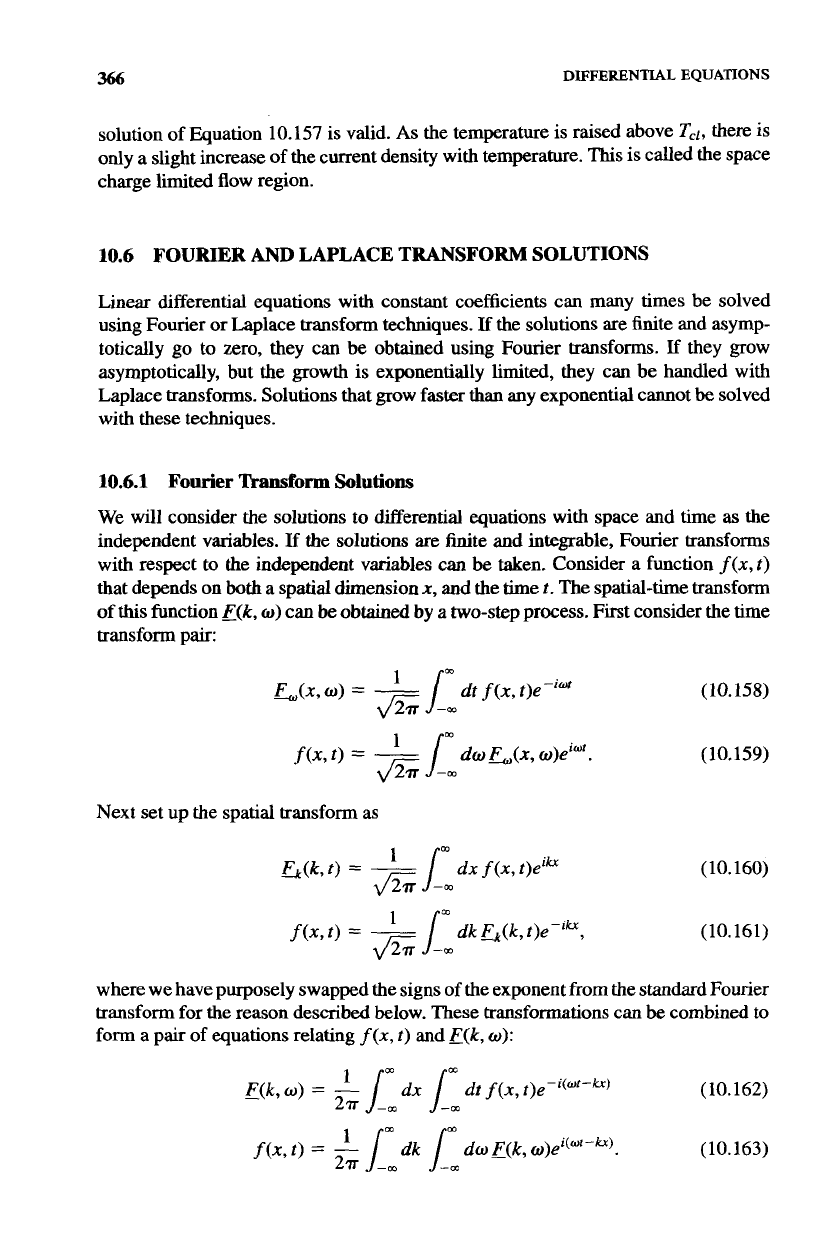
First consider the time
transform pair:
L(x,w)
=
-
1:
dt
f
(x,
t)e-jU
(
10.158)
Next set up the spatial transform
as
(10.159)
(10.160)
(10.161)
where we have purposely swapped the signs
of
the exponent
from
the standard Fourier
transform for the reason described below. These transformations can
be
combined to
form
a pair of equations relating
f(x,
t)
and
F(k,
w):
(10.162)
OURIER
AND
LAPLACE
SOLUTIONS
367
Jow you can see the purpose of the sign switch for the spatial transform. The various
omponents which make up
f(x,
r)
with positive
w
and positive
k
can be viewed
s
plane waves traveling in the positive
x
direction, with a positive phase velocity
if
w/k.
Many times, in physics and engineering problems, the dependent variable is a
rector quantity and there are three spatial dimensions.
This
complicates Equations
0.162 and 10.163 and motivates a shorthand notation for the transform pair, Consider
he vector electric field
E(x,
y,
z,
t)
3
E(?,
t),
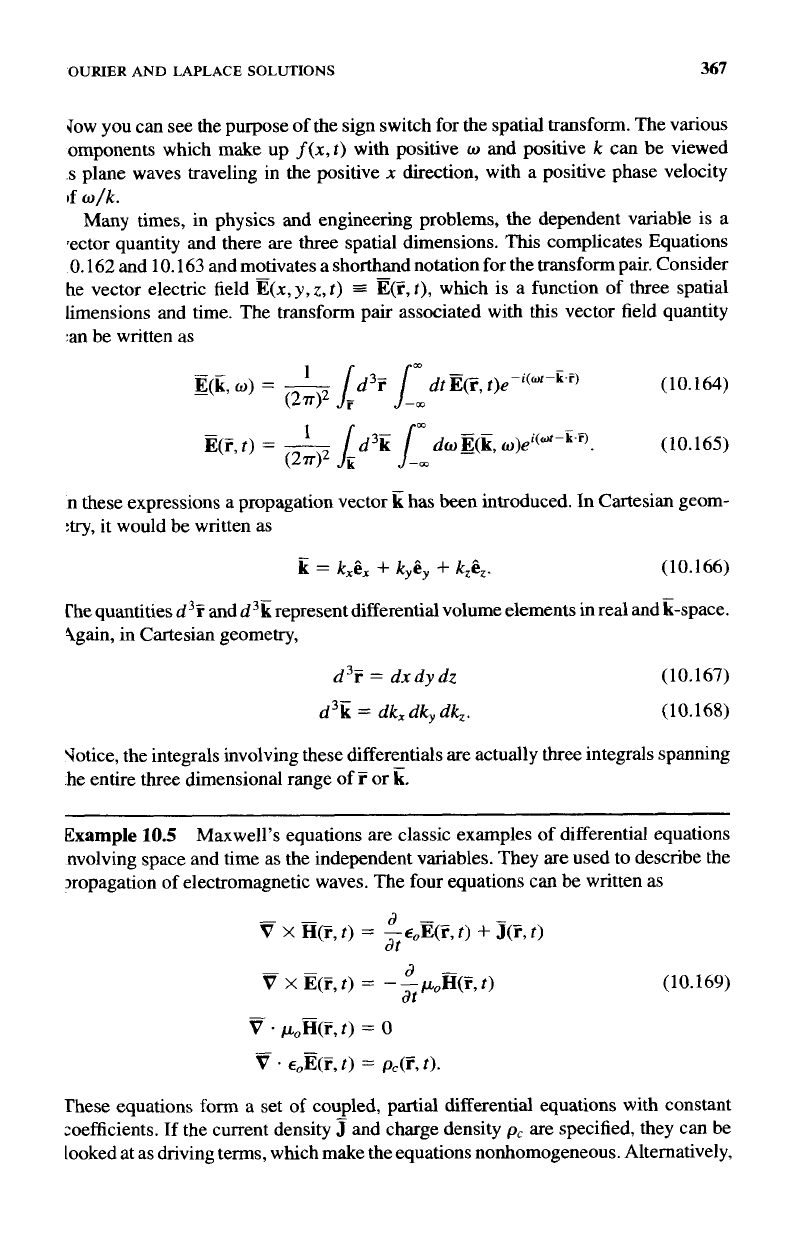
which is a function of three spatial
limensions and time. The transform pair associated with this vector field quantity
:an be written as
(10.164)
n these expressions a propagation vector
k
has
been
introduced. In Cartesian geom-
:try,
it would be written as
k
=
k,@,
+
k,@,
+
kZ&,.
(
10.166)
The quantities
d
3F
and
d
3k
represent differential volume elements in real andk-space.
Sgain, in Cartesian geometry,
d3F
=
dxdydz
(
10.167)
(10.168)
d3k
=
dk, dk, dk,.
Votice, the integrals involving these differentials are actually three integrals spanning
.he entire three dimensional range
of
F
or
k.
Example
10.5
Maxwell's equations are classic examples of differential equations
nvolving space and time as the independent variables. They are used to describe the
xopagation
of
electromagnetic waves. The four equations can be written as
d
-_
at
-
V
X
H(F,
t)
=
-eoE(r,
t)
+
J(F,
t)
(10.169)
d
at
-
v
x
E(F,
t)
=
-
-pOR(F,
t)
v
.
poH(F,
t)
=
0
v
.
E,E(F,t)
=
pc(F,t).
-
rhese equations
form
a set
of
coupled, partial differential equations with constant
:oefficients.
If
the current density
3
and charge density
pc
are specified, they can be
looked at as driving terms, which make the equations nonhomogeneous. Alternatively,
368
DIFFERENTIAL EQUATIONS
if the current density and charge density are proportional to the fields,
as
is the case
in linear dielectric media, the equations can be put into homogeneous form.
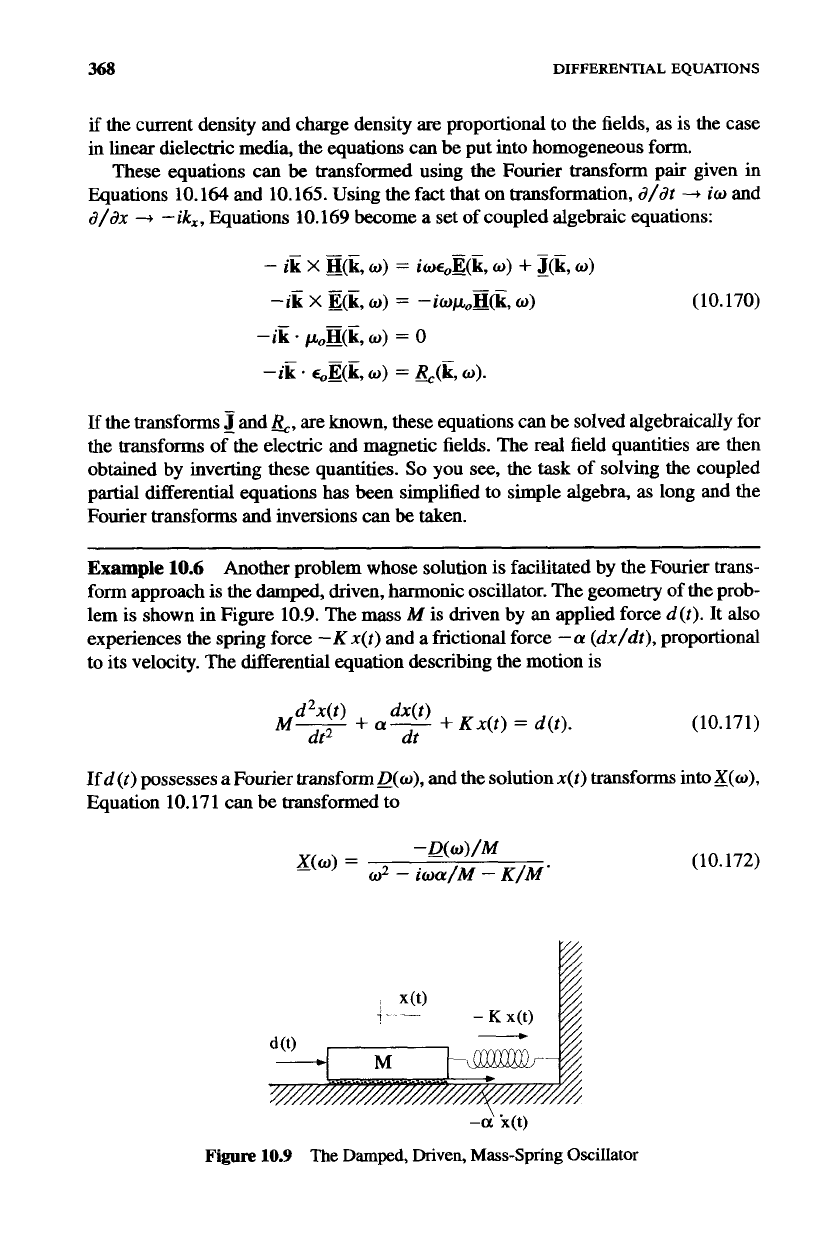
These equations can
be
transformed using the Fourier transform pair given in
Equations 10.164 and 10.165. Using the fact that on transformation,
d/dt
-+
iw
and
d/dx
--+
-ikz,
Equations 10.169 become a set
of
coupled algebraic equations:
-
__
-
ik
X
H(k,
w)
=
iwcoE(k,
0)
+
J(k,
-
0)
-iG
x
E(E,
0)
=
-iwkoH(k,
0)
(1 0.170)
-iK
*
p0E(k,
0)
=
0
-ik
€ojz(G,
0)
=
&(E,
0).
If
the transforms $and
&,
are known, these equations can be solved algebraically for
the transforms of the electric and magnetic fields. The real field quantities are then
obtained by inverting these quantities.
So
you
see,
the
task
of solving the coupled
partial differential equations has been simplified to simple algebra,
as
long and the
Fourier transforms and inversions can be taken.
Example
10.6
Another problem whose solution is facilitated by the Fourier trans-
form approach is the
damped,
driven, harmonic oscillator. The geometry
of
the prob-
lem is shown in Figure 10.9. The
mass M
is
driven by an applied force
d(t).
It also
experiences the spring force
-
K
x(t)
and a frictional force
-a
(dx/dt),
proportional
to its velocity. The differential equation describing the motion is
(10.171)
If
d
(t)
possesses
a
Fourier transform
@(
o),
and the solution
x(t)
transforms into
X(
o),
Equation 10.171 can be transformed to
(10.172)
\
-a
k(t)
Figure
10.9
The
Damped,
Driven,
Mass-Spring
Oscillator
FOURIER
AND
LAPLACE SOLUTIONS
369
The denominator
of
the
RHS
of Equation 10.172 can be factored, and the solution is
given by the Fourier inversion
where
(10.174)
The response
x(t)
can be obtained once
Q(o)
is determined. Let's consider the
particular case where
d(t)
is an ideal impulse,
d(t)
=
Zo8(t).
Its transform is simply
1
D(w)
=
I,-
&'
and the response becomes
(10.175)
(10.176)
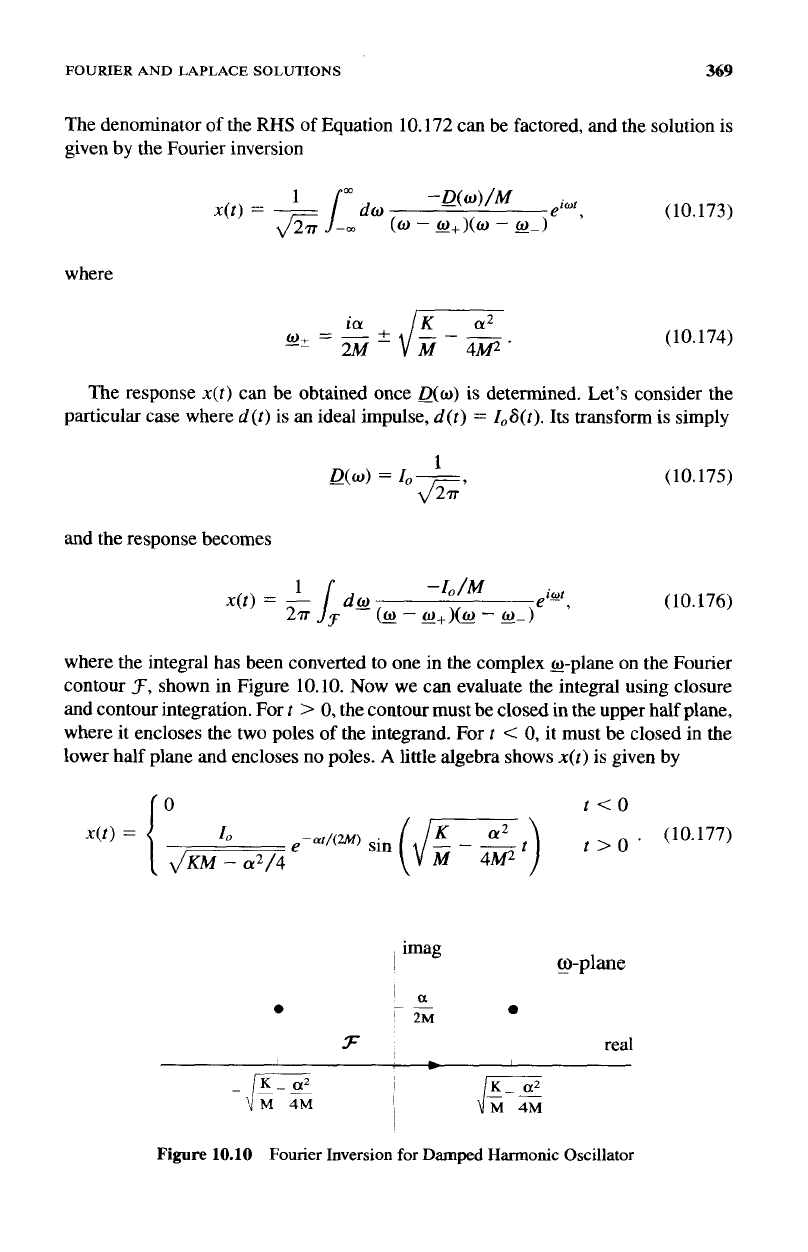
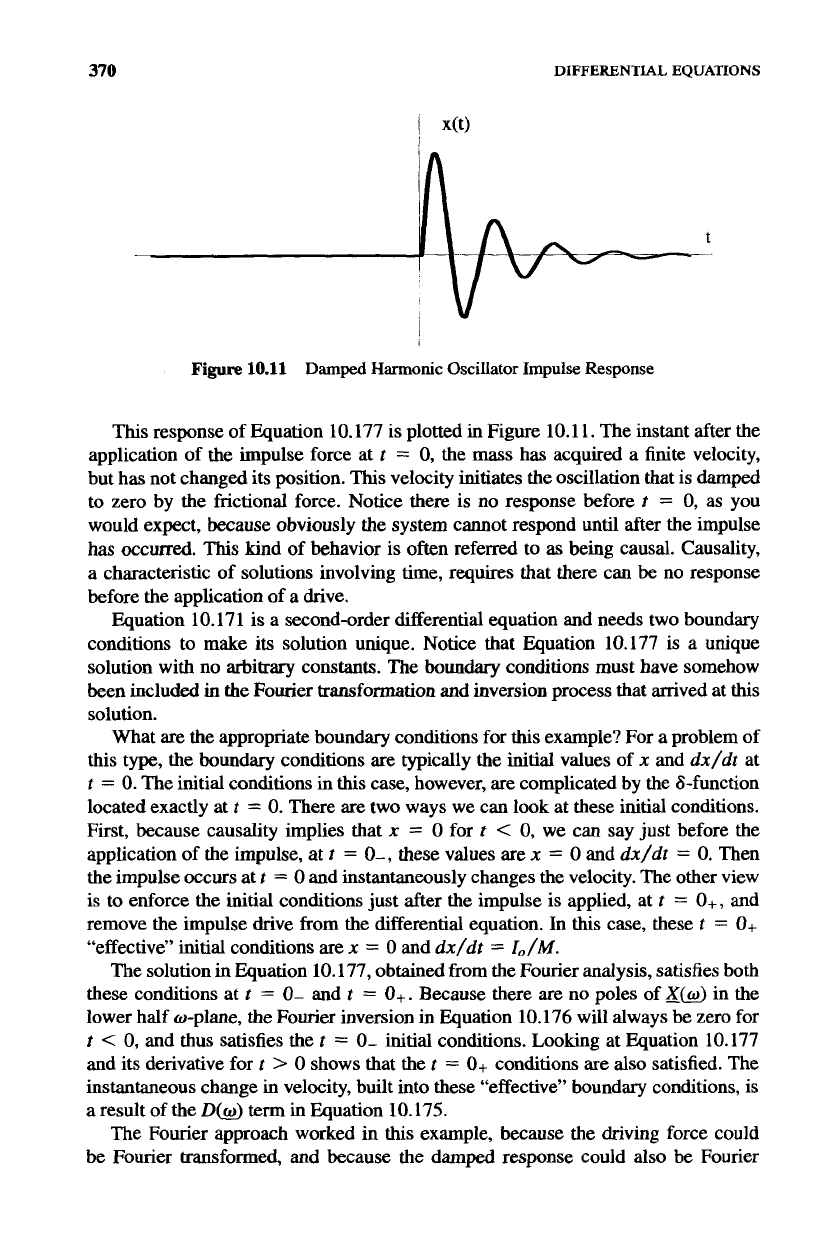
where the integral has been converted to one in the complex @-plane on the Fourier
contour
y,
shown in Figure 10.10. Now we can evaluate the integral using closure
and contour integration. For
t
>
0,
the contour must be closed in the upper
half
plane,
where it encloses the
two
poles
of
the integrand. For
t
<
0,
it must be closed in the
lower half plane and encloses no poles.
A
little algebra
shows
x(t)
is given by
lo
tco
imag
1
g-plane
la
0
__
2M
0
3
real
Figure
10.10
Fourier Inversion
for Damped
Harmonic
Oscillator
370
DIFFERENTIAL
EQUATIONS
Figure
10.11
Damped
Harmonic
Oscillator
Impulse Response
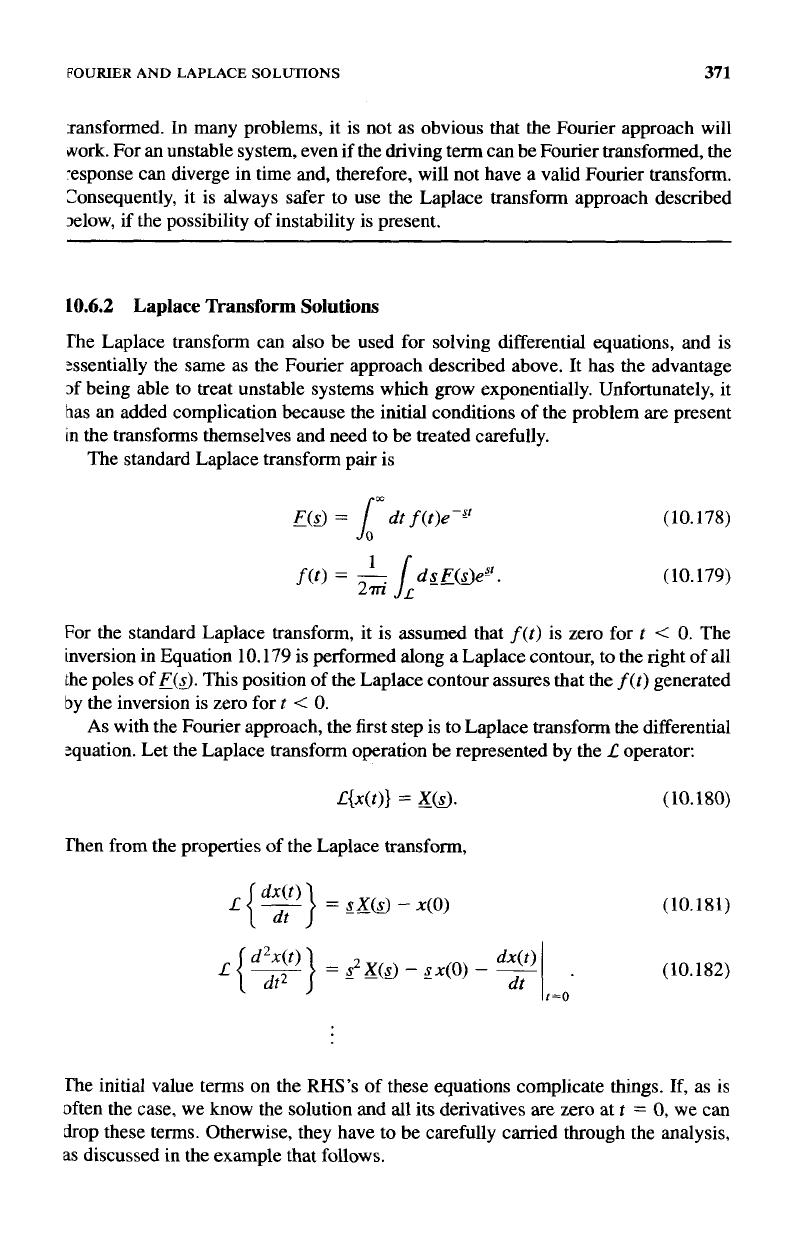
This response of Equation 10.177 is plotted in Figure 10.11. The instant after the
application of the impulse force at
r
=
0,
the mass has acquired a finite velocity,
but has not changed its position.
This
velocity initiates the oscillation that is damped
to zero by the frictional force, Notice there
is
no response before
t
=
0,
as
you
would expect, because obviously the system cannot respond until after the impulse
has occurred.
This
kind of behavior
is
often referred to
as
being causal. Causality,
a characteristic of solutions involving time, requires that there can be no response
before the application of a drive.
Equation 10.171
is
a second-order differential equation and needs two boundary
conditions to make
its
solution unique. Notice that Equation 10.177 is a unique
solution with no arbitrary constants. The
boundary
conditions must have somehow
been included in the Fourier transformation and inversion process that arrived at
this
solution.
What are the appropriate boundary conditions for
this
example? For a problem of
this type, the boundary conditions are typically the initial values of
x
and
dx/dt
at
t
=
0.
The initial conditions
in
this
case, however, are complicated by the &function
located exactly at
t
=
0.
There are two ways we can look at these initial conditions.
First, because causality implies that
x
=
0
for
t
<
0,
we can say just before the
application of the impulse,
at
t
=
0-,
these values are
x
=
0
and
dx/dt
=
0.
Then
the impulse occurs at
t
=
0
and instantaneously changes the velocity. The other view
is to enforce the initial conditions just after the impulse is applied, at
t
=
0+,
and
remove the impulse drive from the differential equation. In
this
case, these
t
=
O+
“effective” initial conditions are
x
=
0
and
dx/dt
=
I,,/M.
The solution
in
Equation 10.177, obtained from the Fourier analysis, satisfies both
these conditions at
t
=
0-
and
t
=
O+.
Because there are no poles of
2imJ
in the
lower half w-plane, the Fourier inversion in Equation 10.176 will always be zero for
t
<
0,
and thus satisfies the
r
=
0-
initial conditions.
Looking
at Equation 10.177
and
its derivative for
t
>
0
shows that the
t
=
O+
conditions are
also
satisfied.
The
instantaneous change
in
velocity, built into these “effective” boundary conditions, is
a result of the
00
term
in Equation 10.175.
The Fourier approach worked in
this
example, because the driving force could
be Fourier transformed, and because the damped response could also be Fourier
FOURIER AND LAPLACE SOLUTIONS
371
ransformed.
In
many problems, it is not as obvious that the Fourier approach will
work. For an unstable system, even if the driving term can be Fourier transformed, the
-esponse can diverge in time and, therefore, will not have a valid Fourier transform.
Zonsequently, it is always safer to use the Laplace transform approach described
3elow, if the possibility of instability
is
present.
10.6.2
Laplace Transform Solutions
The Laplace transform can also be used for solving differential equations, and is
%sentially the same as the Fourier approach described above. It has the advantage
3f being able to treat unstable systems which grow exponentially. Unfortunately, it
has an added complication because the initial conditions of the problem are present
in
the transforms themselves and need to be treated carefully.
The standard Laplace transform pair is
(10.178)
(10.179)
For the standard Laplace transform, it is assumed that
f(t)
is zero for
t
<
0.
The
inversion in Equation 10.179 is performed along a Laplace contour, to the right of all
the poles of
E(s).
This position of the Laplace contour assures that the
f(t)
generated
by the inversion is zero for
t
<
0.
As
with the Fourier approach, the first step is
to
Laplace transform the differential
quation. Let the Laplace transform operation be represented by the
L
operator:
L{x(t>}
=
x_(s).
(10.180)
rhen from the properties
of
the Laplace transform,
1
{
F}
=
.Tx_(sJ
-
x(0)
(10.181)
(10.182)
The initial value terms on the
RHS's
of these equations complicate things. If, as is
often the case, we know the solution and
all
its derivatives are zero at
t
=
0,
we
can
drop these terms. Otherwise, they have to be carefully carried through the analysis,
as
discussed in the example that follows.
372
DIFFERENTIAL EQUATIONS
-
Example10.7
As
an example of the Laplace transform approach, consider an
undamped harmonic oscillator, a simplified version of the example discussed in the
previous section. The system can
be
described by the configuration shown in Figure
10.9, with no frictional force, i.e.,
a
=
0.
The differential equation for
this
system
becomes
M*
+
Kx(t)
=
d(t).
dt
Applying the Laplace transformation to both sides gives
(
10.183)
(10.184)
As
before, let the driving force be equal to an impulse
of
magnitude
I,,
applied at
t
=
0:
d(t)
=
Z&t).
(10.185)
The solution should be causal, so
x(t)
=
0
for
all
t
<
0.
What values should be used
for
x
and
dx/dt
at
t
=
0
in Equation 10.184? As with the Fourier transform example
of the previous section, because of the b-function drive at
t
=
0,
there are two ways
to
think
about these initial conditions.
The first approach defines the initial conditions at
t
=
0-
and includes the
Laplace transform of the b-function drive
in
Equation 10.184.
At
t
=
0-,
x
=
0
and
dx/dt
=
0
so
that Equation 10.184 becomes
Ms2XsJ
+
KXsJ
=
I,.
(10.186)
Now
we
can solve for the transformed solution:
The final step
is
to invert
this
expression,
(1
0.187)
(
10.188)
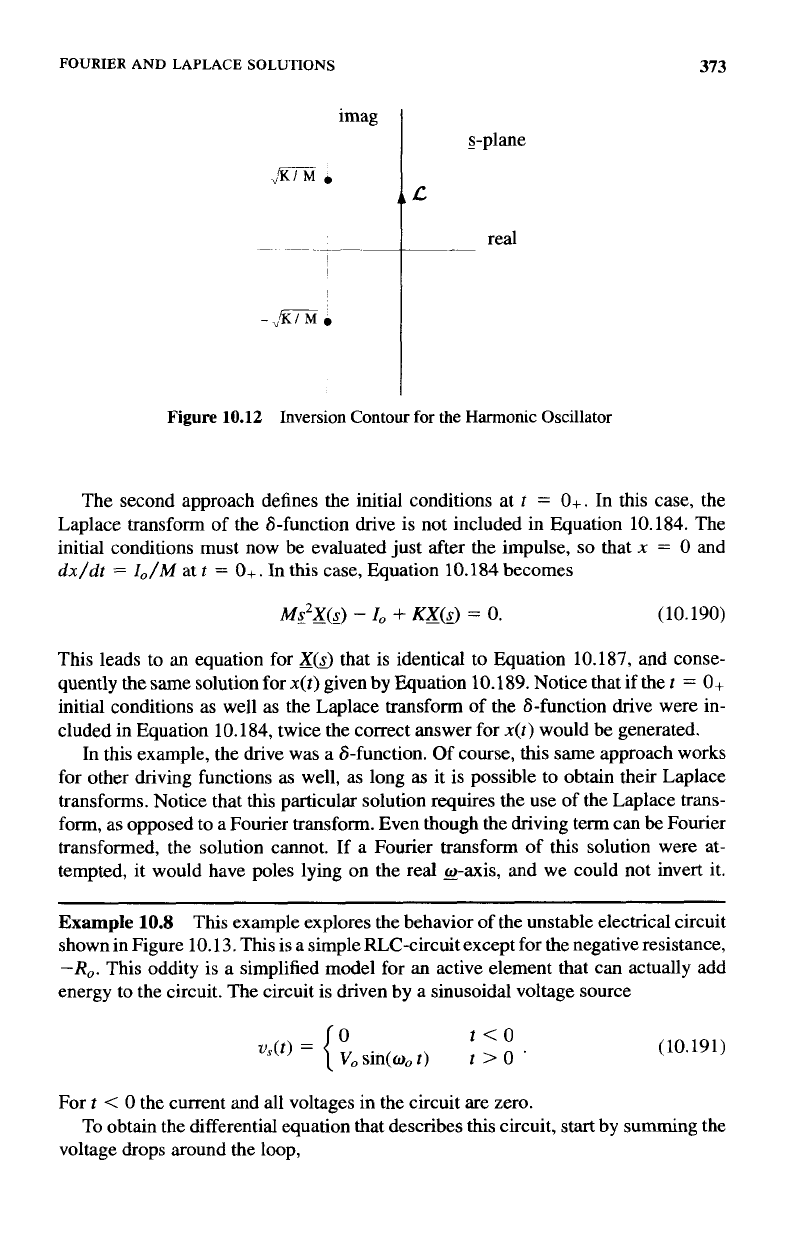
which can be evaluated using closure. The Laplace contour
L
is placed to the right
of the
two
poles located at
s
=
+im,
as
shown in Figure 10.12. For
t
<
0,
the contour must be closed to the right, and no poles are enclosed. When
t
>
0,
however, both poles are enclosed. The residue theorem and a little algebra give the
final solution:
(0
t<O
(10.189)
FOURIER
AND LAPLACE SOLUTIONS
373
imag
I-
s-plane
I
Figure
10.12
Inversion
Contour
for
the Harmonic Oscillator
The second approach defines the initial conditions at
r
=
O+.
In this case, the
Laplace transform of the &function drive is not included in Equation 10.184. The
initial conditions must now be evaluated just after the impulse,
so
that
x
=
0
and
dx/dt
=
Z,/M
at
t
=
O+.
In
this
case, Equation 10.184 becomes
(
10.190)
This leads to an equation for
X(s>
that is identical to Equation 10.187, and conse-
quently the same solution for
x(t)
given
by
Equation 10.189. Notice that if the
f
=
O+
initial conditions as well as the Laplace transform of the 6-function drive were in-
cluded in Equation 10.184, twice the correct answer for
x(t)
would be generated.
In this example, the drive was a &function. Of course,
this
same approach works
for other dnving functions as well,
as
long
as
it is possible to obtain their Laplace
transforms. Notice that this particular solution requires the use of the Laplace trans-
form, as opposed to a Fourier transform. Even though the driving term can be Fourier
transformed, the solution cannot. If a Fourier transform of this solution were at-
tempted, it would have poles lying on the real *-axis, and we could not invert
it.
Example
10.8
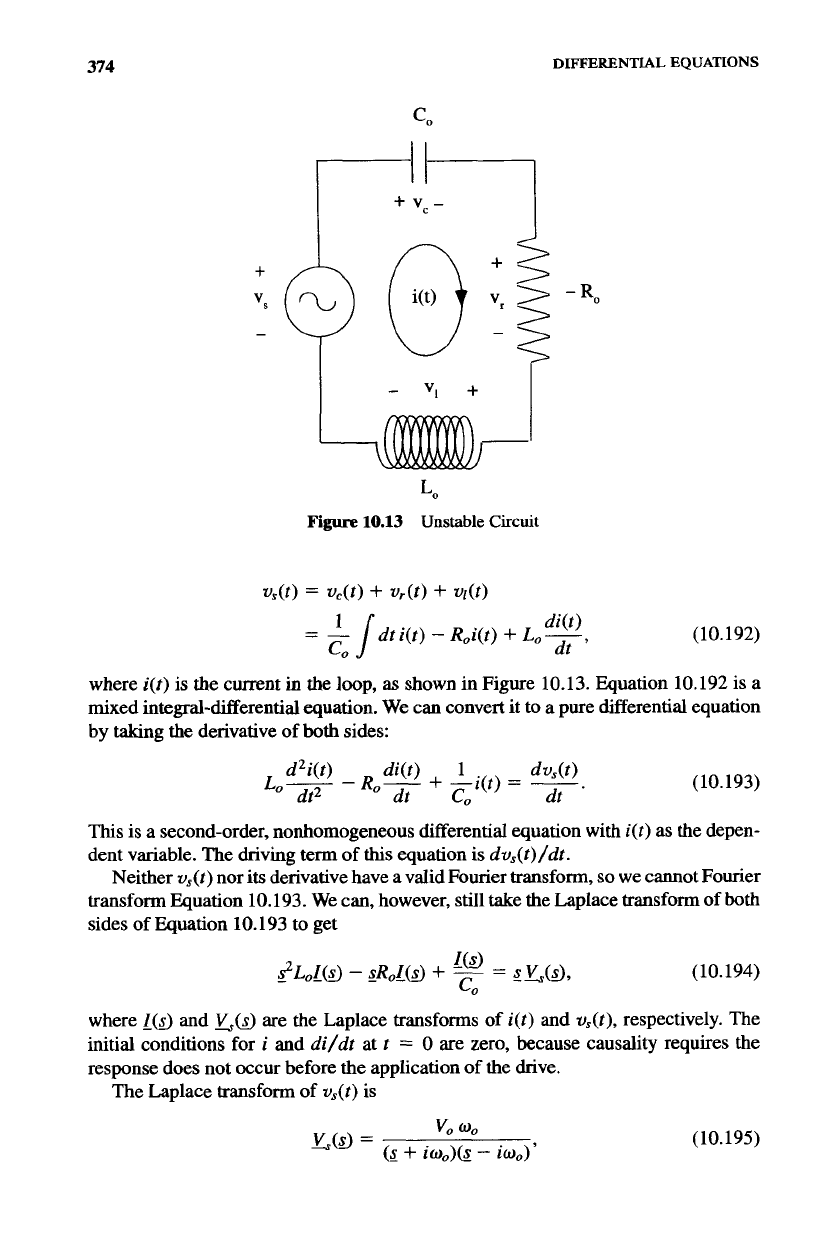
This example explores the behavior of the unstable electrical circuit
shown in Figure
10.13.
This is a simple RLC-circuit except for the negative resistance,
-Ro.
This oddity is a simplified model for an active element that can actually add
energy to the circuit. The circuit is driven by a sinusoidal voltage source
t<O
t
>
0
V,
sin(o,
t)
us@>
=
(10.191)
For
t
<
0
the current and all voltages in the circuit are zero.
voltage drops around the loop,
To obtain the differential equation that describes
this
circuit,
start
by summing the
374
DIFFERENTIAL EQUATIONS
l-
v1
f
I
LO
Figure
10.13
Unstable
Circuit
di(t)
1
dt
i(t)
-
Roi(t)
+
Lo
-
CO
dt
’
=
(10.192)
where
i(t)
is
the current in the loop,
as
shown
in
Figure
10.13.
Equation
10.192
is a
mixed integral-differential equation. We can convert it to a pure differential equation
by
taking the derivative of both sides:
d2i(t) di(t)
1
&(t)
Lo-
-
Ro-
+
-i(t)
=
-
dt2 dt
Co
dt
’
(10.193)
This
is a second-order, nonhomogeneous differential equation with
i(t)
as the depen-
dent variable. The driving term
of
this
equation is
dv,(t)/dt.
Neither
vs(t)
nor
its
derivative have a valid Fourier transform, so we cannot Fourier
transform Equation
10.193.
We can, however,
still
take the Laplace transform of both
sides of Equation
10.193
to get
where
I@
and
V&J
are the Laplace transforms of
i(t)
and
v,(t),
respectively. The
initial conditions for
i
and
di/dt
at
t
=
0
are zero, because causality requires the
response does not occur before the application of the drive.
The Laplace transform of
v,(t)
is
(
10.195)
375
FOURIER AND LAPLACE SOLUTIONS
so
the expression for
l(s)
becomes
VO
mos
(10.196)
(5
+
iw,)@
-
io,)(L,s2
-
R,s
+
l/Co)'
as)
=
The quadratic term in the denominator can be factored as
Los2
-
R,s
+
l/Co
=
Lo@
-
s+)(s
-
K),
(10.197)
where
(10.198)
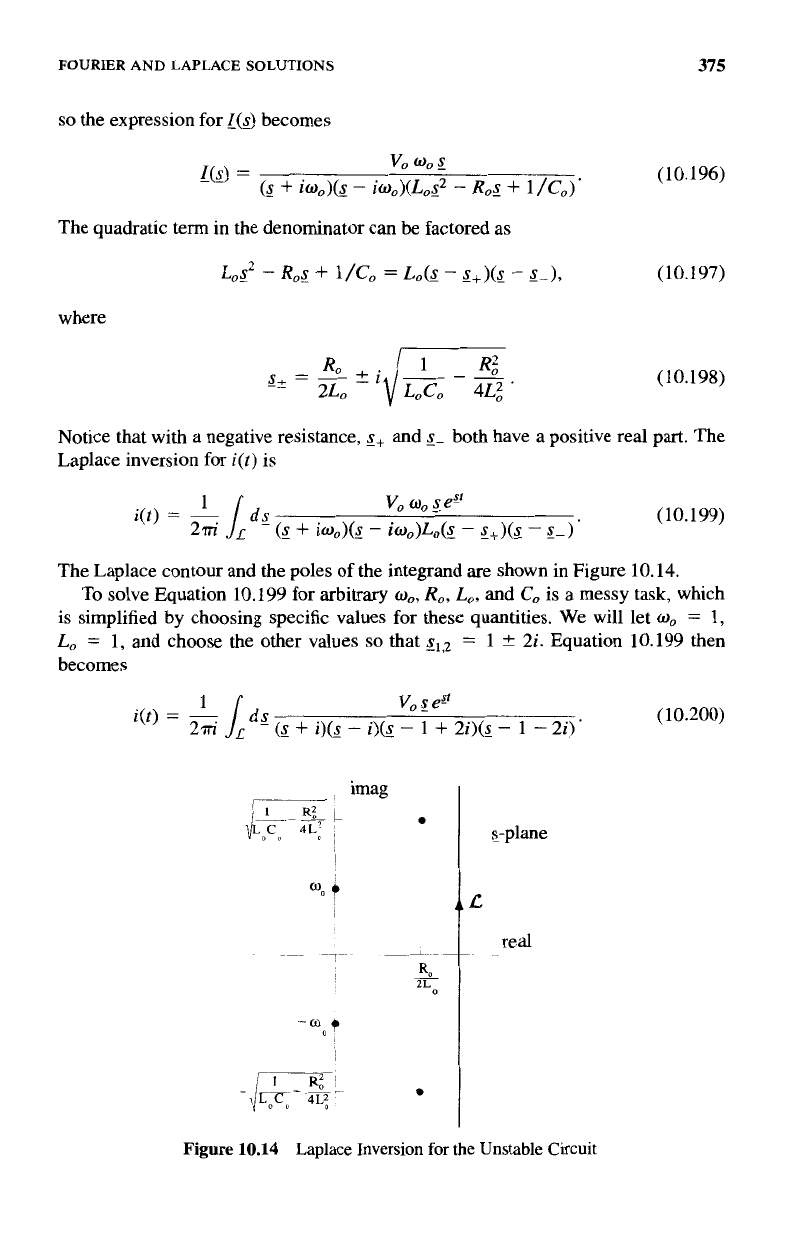
Notice that with a negative resistance,
5,
and
s-
both have a positive real part. The
Laplace inversion for
i(t)
is
The Laplace contour and the poles
of
the integrand are shown in Figure 10.14.
To
solve Equation 10.199 for arbitrary
o,,
R,,
Lo,
and
C,
is a messy task, which
is simplified by choosing specific values for these quantities. We will let
o,
=
1,
Lo
=
1, and choose the other values
so
that
sl,z
=
1
+-
2i.
Equation 10.199 then
becomes
imag
0
s-plane
C
real
Figure
10.14
Laplace
Inversion
for
the
Unstable Circuit