
Kusse B.R., Westwig E.A. Mathematical Physics: Applied Mathematics for Scientists and Engineers
Подождите немного. Документ загружается.

356
DIFFERENTIAL EQUATIONS
This
leads to two solutions for
s:
s
=
1
and
s
=
-2.
These two different values for
s
mean that Equation
10.104
really represents
two
solutions,
m
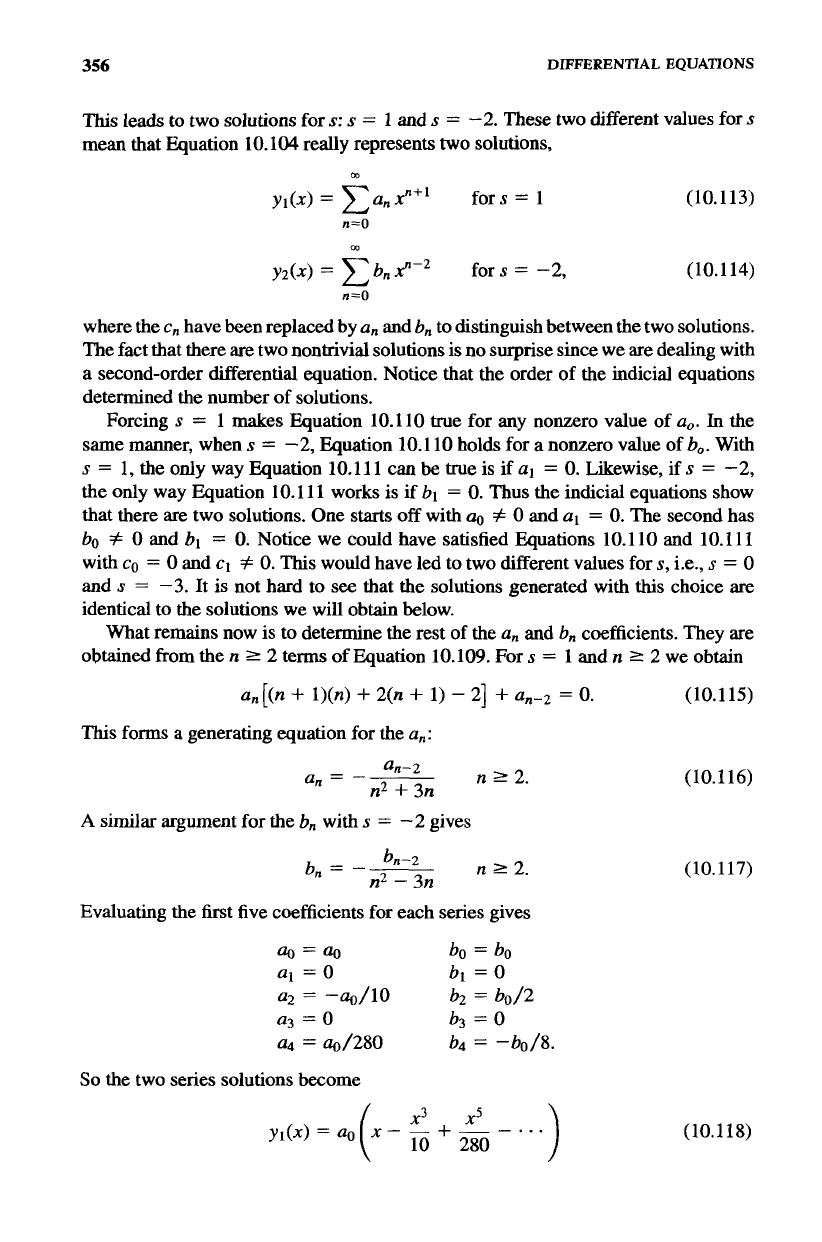
yl(x)
=
Ca,,xnf'
for
s
=
I
n=O
(10.1
13)
m
Y~(x)
=
C
b,,
xRP2
for
s
=
-2,
(10.1 14)
where the
c,
have been replaced by
a,
and
b,
to distinguish between the two solutions.
The fact that there are two nontrivial solutions is no surprise since we are dealing with
a second-order differential equation. Notice that the order of the indicial equations
determined the number of solutions.
Forcing
s
=
1
makes Equation
10.110
true for any nonzero value
of
a,.
In
the
same manner, when
s
=
-2,
Equation
10.110
holds for a nonzero value of
b,.
With
s
=
1,
the
only
way Equation
10.11
1
can be true is if
al
=
0.
Likewise, if
s
=
-2,
the only way Equation
10.11
1
works is if
bl
=
0.
Thus the indicial equations show
that there are two solutions. One
starts
off
with
q
#
0
and
a1
=
0.
The second has
bo
f
0
and
bl
=
0.
Notice we could have satisfied Equations
10.110
and
10.11
1
with
co
=
0
and
c1
#
0.
This
would have led to two different values for
s,
i.e.,
s
=
0
and
s
=
-3.
It
is
not hard to
see
that the solutions generated with
this
choice are
identical to the solutions we will obtain below.
What remains now is to determine the rest of the
a,
and
b,
coefficients. They are
obtained from the
n
2
2
terms
of
Equation
10.109.
For
s
=
1
and
n
B
2
we
obtain
a,,[(n
+
l)(n)
+
2(n
+
1)
-
21
+
an-2
=
0.
n=O
(10.1
15)
This
forms a generating equation for the
a,:
(
10.1
16)
4-2
an
=
---
n2
+
3n
n
5
2.
A
similar argument for the
b,
with
s
=
-2
gives
bn-2
n
2
2.
Evaluating the first five coefficients for each series gives
b,
=
-___
n2
-
3n
So
the two series solutions become
)
(
x3
x5
y1(x)
=
a0
x-
-
+
-
-
*.-
lo
280
(10.1
17)
(10.1
18)
357
THE
METHOD
OF
FROBENIUS
and
(10.1 19)
Now that these series solutions have been obtained, we must check to
see
if they
converge. For this example, convergence can be shown using the ratio test.
For
y1
(x),
convergence occurs if
From Equation 10.116, this condition is met because
(
10.120)
(10.121)
for
all
x
except
x
=
0.
We must check the
x
=
0
point specifically, because at
this
point there is a division by zero in Equation
10.120.
A
quick look back at Equation
10.1
18
with
x
=
0
shows that there are no problems here either.
So
y1 (x)
converges
for all values
of
x.
For
y2(x),
convergence occurs if
From Equation 10.1 17, we have
(10.122)
(
10.123)
for all
x
#
0.
Again, we need to return
to
the
original series in Equation 10.119 to
see what happens at
x
=
0.
Because
this
series contains a term with a negative power
of
x,
namely
bo/x2, yz(x)
will not converge at
x
=
0.
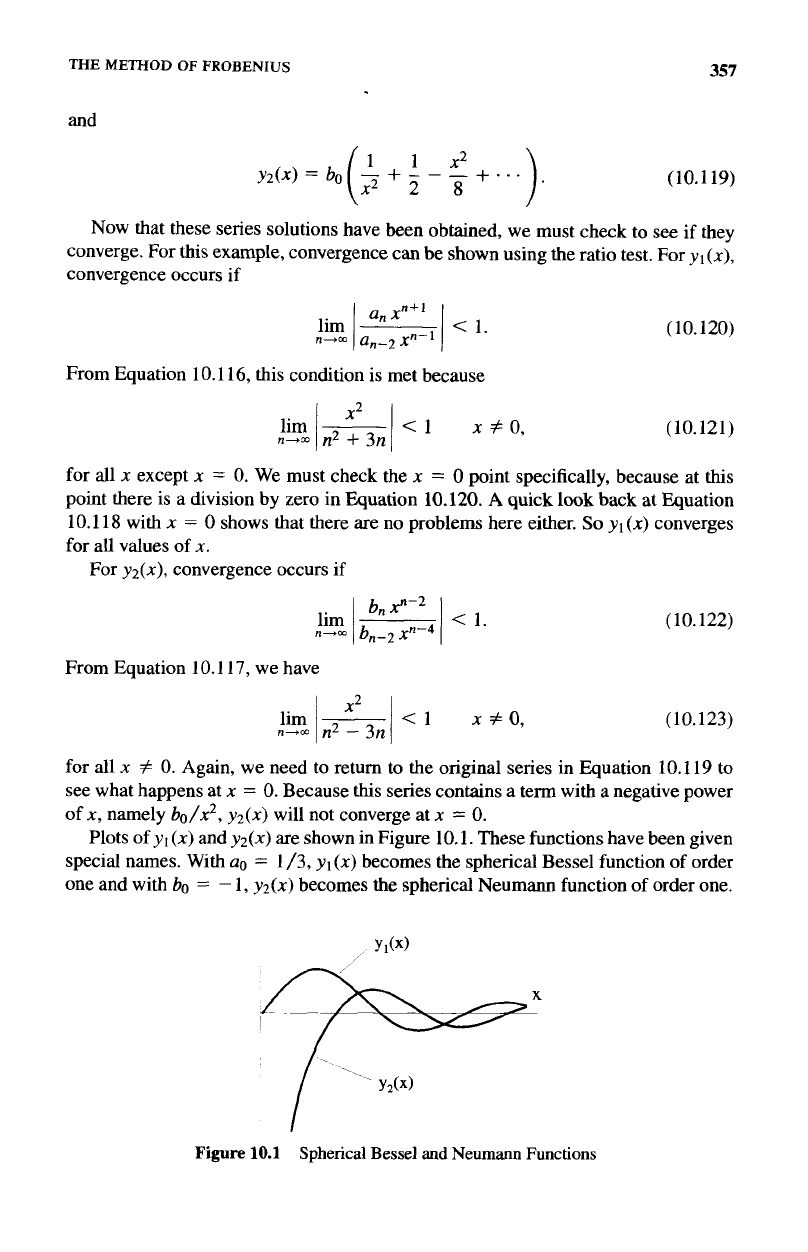
Plots of
y1
(x)
and
y&)
are shown in Figure 10.1. These functions have been given
special names. With
a0
=
1/3,
yl(x)
becomes the spherical Bessel function
of
order
one and with
bo
=
-
1,
yz(x)
becomes the spherical Neumann function of order one.
Figure
10.1
Spherical
Bessel
and
Neumann
Functions
358 DIFFERENTIAL
EQUATIONS
The example given above
is
one
of
the most straightforward applications of the
method
of
Frobenius. Complications can arise if the
two
indicial equations have a
common value for
s.
This
is
treated
in
one of the exercises at the end
of
this
chapter.
10.5
THE
METHOD OF
QUADRATURE
The method
of
quadratwe sometimes works
to
find solutions to nonlinear, second-
order differential equations of the
form
(
1 0.1 24)
where
f(4)
can be a nonlinear function
of
the dependent variable
9.
105.1
The General Method
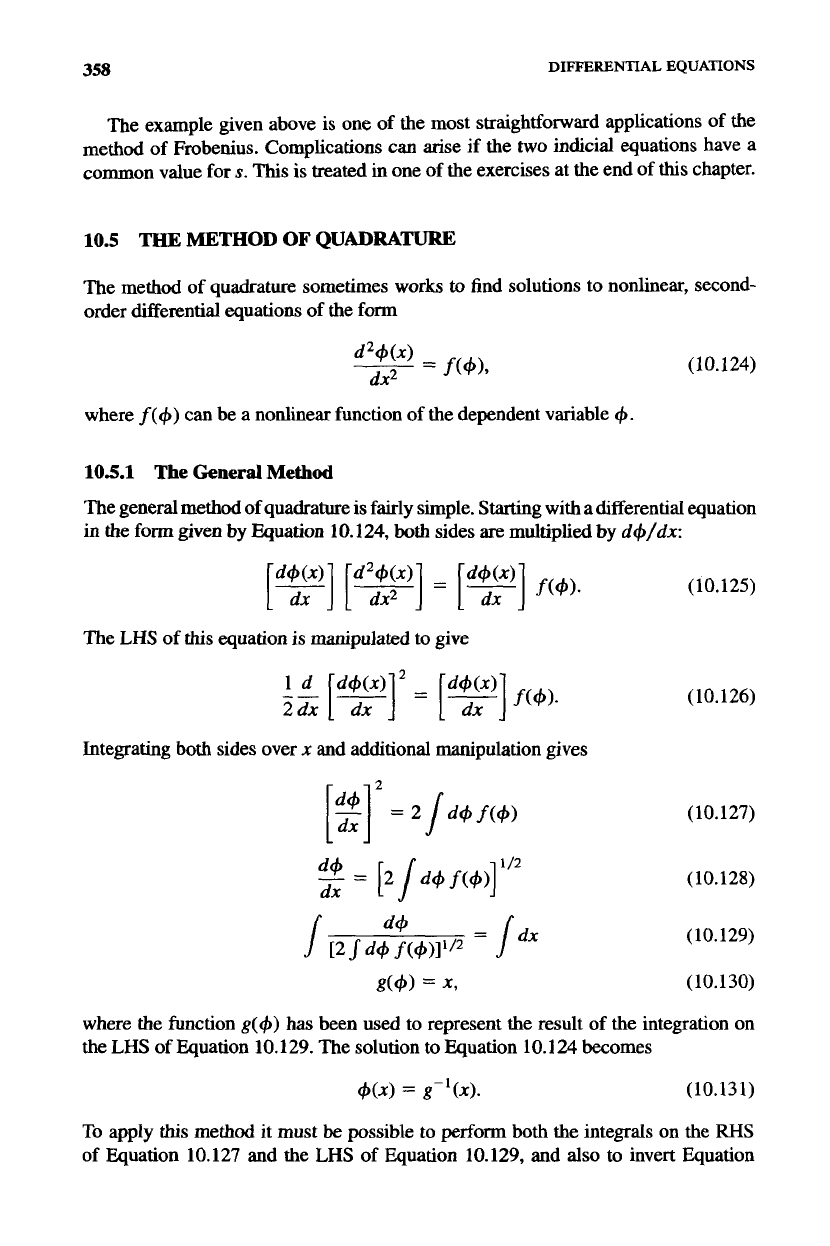
The general method of quadrature is fairly simple. Starting with a differential equation
in the
form
given by Equation
10.124,
both
sides
are
multiplied by
d+/dx:
The LHS
of
this
equation
is
manipulated
to
give
Integrating both sides over
x
and additional manipulation
gives
(1 0.125)
(
10.126)
(10.127)
(10.128)
(
10.129)
g(4)
=
x,
(10.130)
where the function
g(4)
has been used to represent the result
of
the integration on
the
LHS
of
Equation
10.129.
The solution to Equation
10.124
becomes
=
g-lw.
(10.131)
To
apply
this
method
it
must
be
possible
to
perform
both the integrals on the
RHS
of
Equation
10.127
and the
LHS
of
Equation
10.129,
and also to invert Equation
THE
METHOD
OF
QUADRATURE
359
10.130.
In this derivation, the integration constants have been ignored.
As
will be
shown in the following example, these constants must be accounted for and make the
application of this method more difficult than
the
steps above imply.
10.5.2
A
Detailed
Example: The
Child-Langmuir
Problem
The solution
of
the Child-Langmuir problem is a classic example of the use of the
method
of
quadrature. It also demonstrates the importance
of
the boundary conditions
for these types
of
solutions.
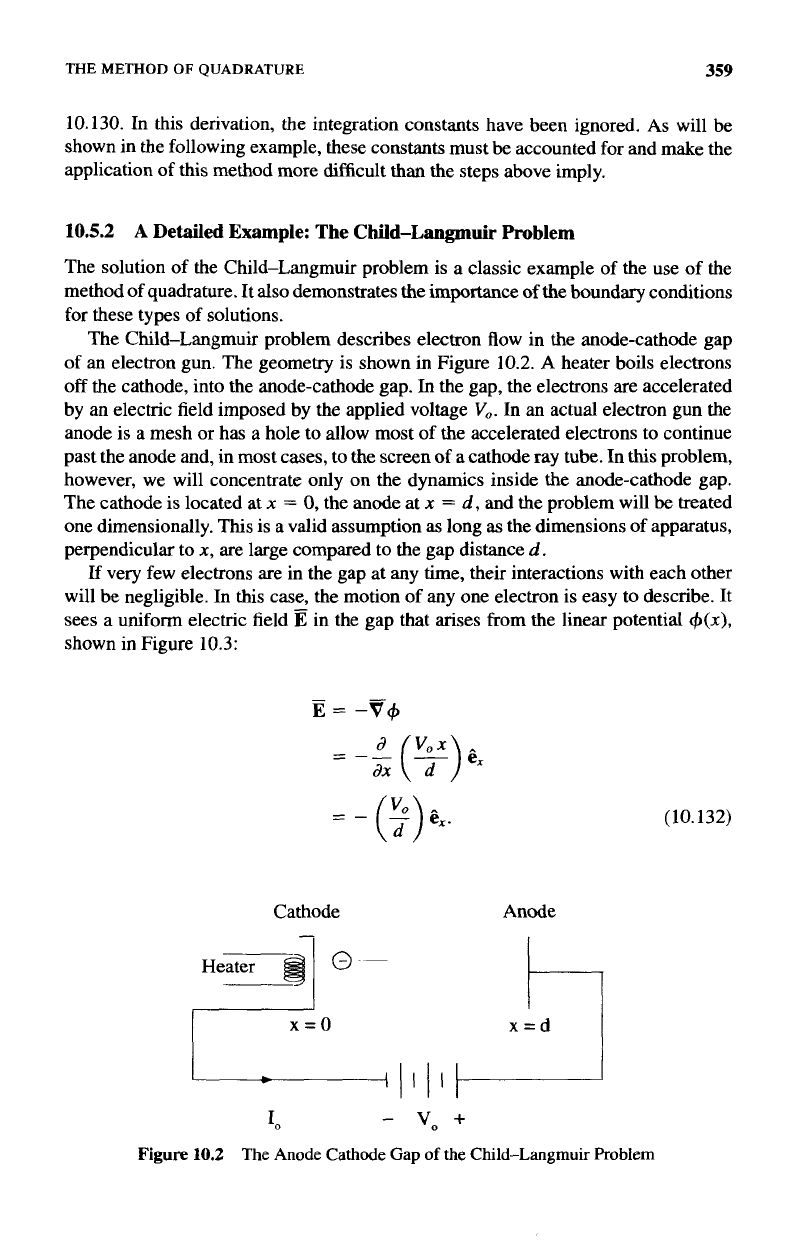
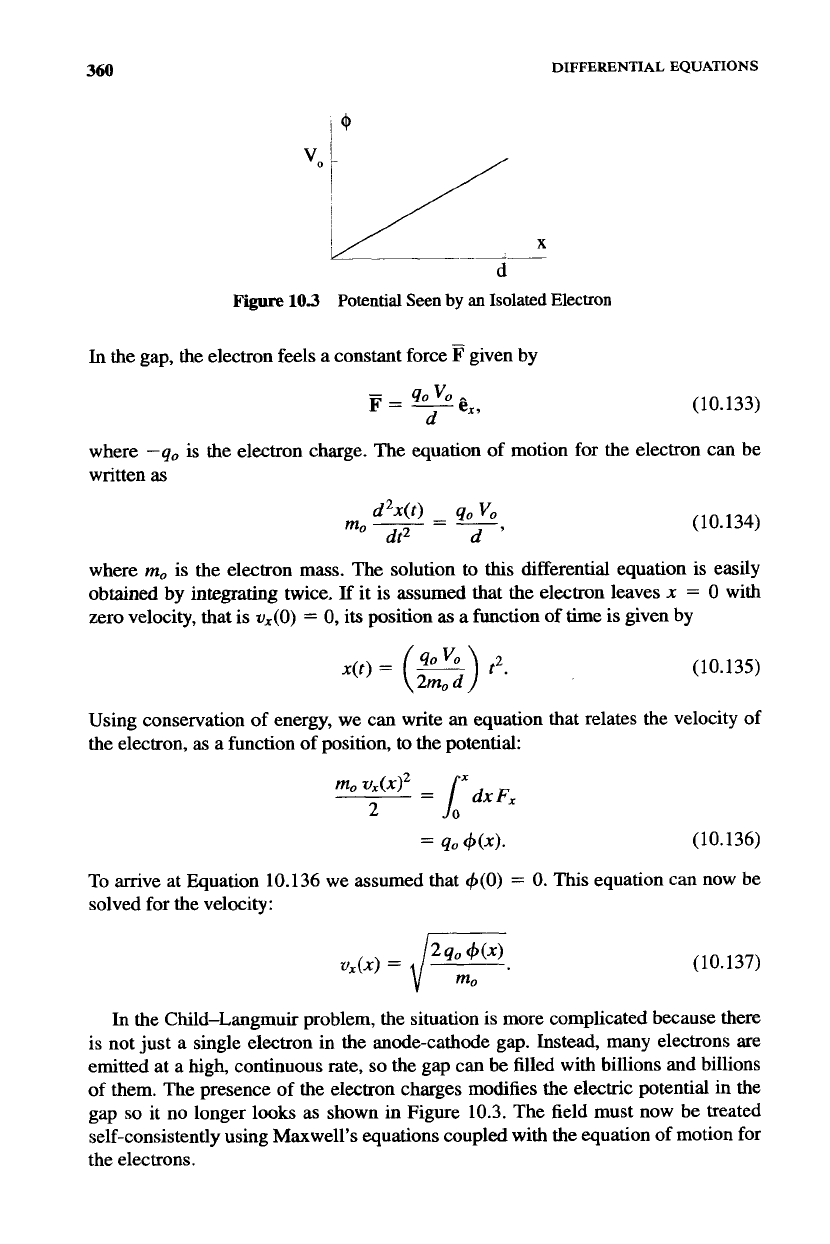
The Child-Langmuir problem describes electron flow in the anode-cathode gap
of
an electron gun. The geometry is shown
in
Figure 10.2.
A
heater boils electrons
off
the cathode, into the anode-cathode gap.
In
the gap, the electrons are accelerated
by an electric field imposed by the applied voltage
V,.
In an actual electron gun the
anode is a mesh
or
has
a
hole to allow most of the accelerated electrons to continue
past the anode and, in most cases, to the screen
of
a cathode ray tube. In
this
problem,
however, we will concentrate only on
the
dynamics inside the anode-cathode gap.
The cathode is located at
x
=
0,
the anode at
x
=
d,
and the problem will
be
treated
one dimensionally.
This
is a valid assumption
as
long
as
the dimensions
of
apparatus,
perpendicular to
x,
are large compared to the gap distance
d.
If
very few electrons are in the gap at any time, their interactions with each other
will be negligible. In this case, the motion of any one electron
is
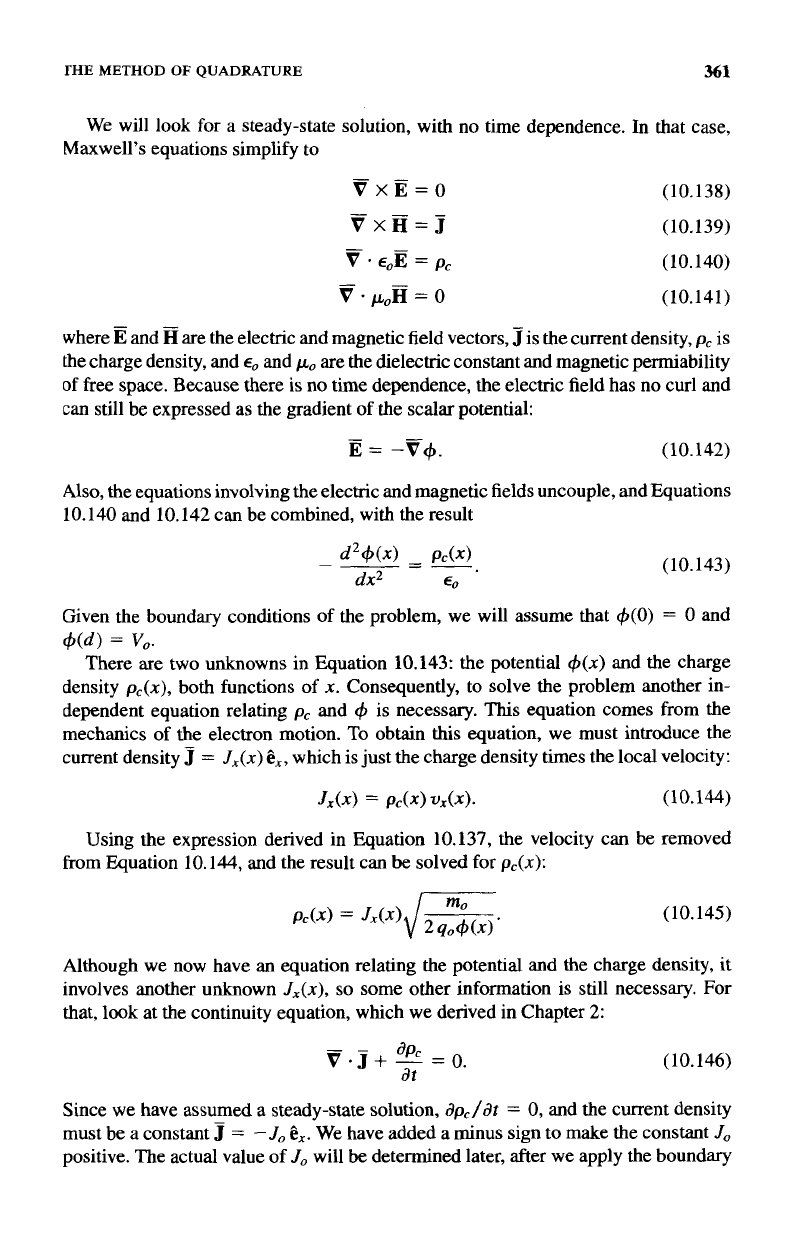
easy to describe. It
sees a uniform electric field
E
in the gap that arises
from
the linear potential
#(x),
shown in Figure
10.3:
=
-a.(;i-)G*
d
V,X
=
-
(2)
Q.
Cathode
-7
I
x=o
(10.132)
Anode
x=d
h
10
-
v,
+
Figure
10.2
The
Anode Cathode
Gap
of
the
Child-Langmuir
Problem
360
DIFFERENTIAL EQUATIONS
d
Figure
103
Potential
Seen
by
an
Isolated
Electron
In
the gap,
the
electron feels a constant force given by
(10.133)
where
-go
is the electron charge. The equation of motion for the electron can be
written
as
(10.134)
where
m,
is the electron mass. The solution
to
this
differential equation is easily
obtained
by integrating twice.
If
it
is
assumed that the electron leaves
x
=
0
with
zero velocity, that is
ux(0)
=
0,
its
position
as
a function of time is given by
x(t)
=
(")
2m,
d
t2.
(10.135)
Using conservation of energy, we can write
an
equation that relates the velocity
of
the electron, as a function of position, to the potential:
=
40
4(x).
(10.136)
To arrive at Equation 10.136 we assumed that
1$(0)
=
0.
This equation
can
now be
solved for the velocity:
(10.137)
In
the Child-Langmuir problem, the situation
is
more complicated because there
is
not just a single electron in the anode-cathode gap. Instead, many electrons are
emitted at a high, continuous rate,
so
the gap can be filled with billions and billions
of
them. The presence
of
the electron charges modifies the electric potential in the
gap
so
it no longer
looks
as shown
in
Figure 10.3. The field must now be treated
self-consistently using Maxwell's equations coupled with the equation
of
motion
for
the electrons.
rHE METHOD
OF
QUADRATURE
361
We will
look
for a steady-state solution, with no time dependence. In that case,
Maxwell’s equations simplify to
-
VXE=O
VxH=J
v
*
E0E
=
pc
-
(10.138)
(10.139)
(10.140)
V*poH=O
(10.141)
where
E
and Hare the electric and magnetic field vectors,
J
is
the
current density,
pc
is
the charge density, and
e0
and
po
are
the dielectric constant and magnetic permiability
of free space. Because there is no time dependence, the electric field has no curl and
can
still be expressed as the gradient
of
the scalar potential:
-
E
=
-V+.
(10.142)
Also, the equations involving the electric and magnetic fields uncouple, and Equations
10.140 and 10.142 can be combined, with the result
(10.143)
Given the boundary conditions of the problem, we will assume that
&(O)
=
0
and
There are two unknowns in Equation 10.143: the potential
+(x)
and the charge
density
pc(x),
both functions
of
x.
Consequently, to solve the problem another in-
dependent equation relating
pc
and
+
is necessary.
This
equation comes from the
mechanics of the electron motion.
To
obtain
this
equation, we must introduce the
current density
J
=
J,(x)
CX,
which is just the charge density times the local velocity:
d2W)
-
PAX)
dx2
€0
---
-
+(d)
=
vo.
J,(x)
=
pc(x)vx(x).
(10.144)
Using
the
expression derived in Equation 10.137, the velocity can be removed
from Equation
10.144,
and the result can
be
solved
for
pc(x):
(10.145)
Although we now have an equation relating
the
potential and the charge density, it
involves another unknown
J,(x),
so
some other information is still necessary. For
that, look at the continuity equation, which we derived in Chapter
2:
(10.146)
Since we have assumed a steady-state solution,
dpc/dr
=
0,
and
the
current density
must be a constant
J
=
-Jo
Q.
We have added a minus sign to make the constant
J,
positive. The actual value
of
Jo
will
be
determined later, after we apply the boundary
dPc
--
V*J+
-
=O.
at
DIFFERENTIAL
EQUATIONS
362
conditions. Equation 10.145 becomes
Inserting Equation 10.147 into 10.143 gives:
(10.147)
(10.148)
This
is a nonlinear differential equation in the form of Equation 10.124, whch can
now be solved using the method
of
quadrature. First, equation 10.148 is multiplied
by
d+/dx
to obtain
(10.149)
Integrating both sides from the cathode to some arbitrary point
n
gives
Because
4(0)
is zero, we can simpllfy
this
to
(10.151)
The other constant of integration,
(d+/d~)~I,=~,
still needs to be evaluated. In
order to do
this,
we must leave mathematics and
return
to the physics of the problem.
According to Equation 10.142,
this
constant is just the square of the electric field at
the cathode
(d4/dx>21x=o
=
&O).
(10.152)
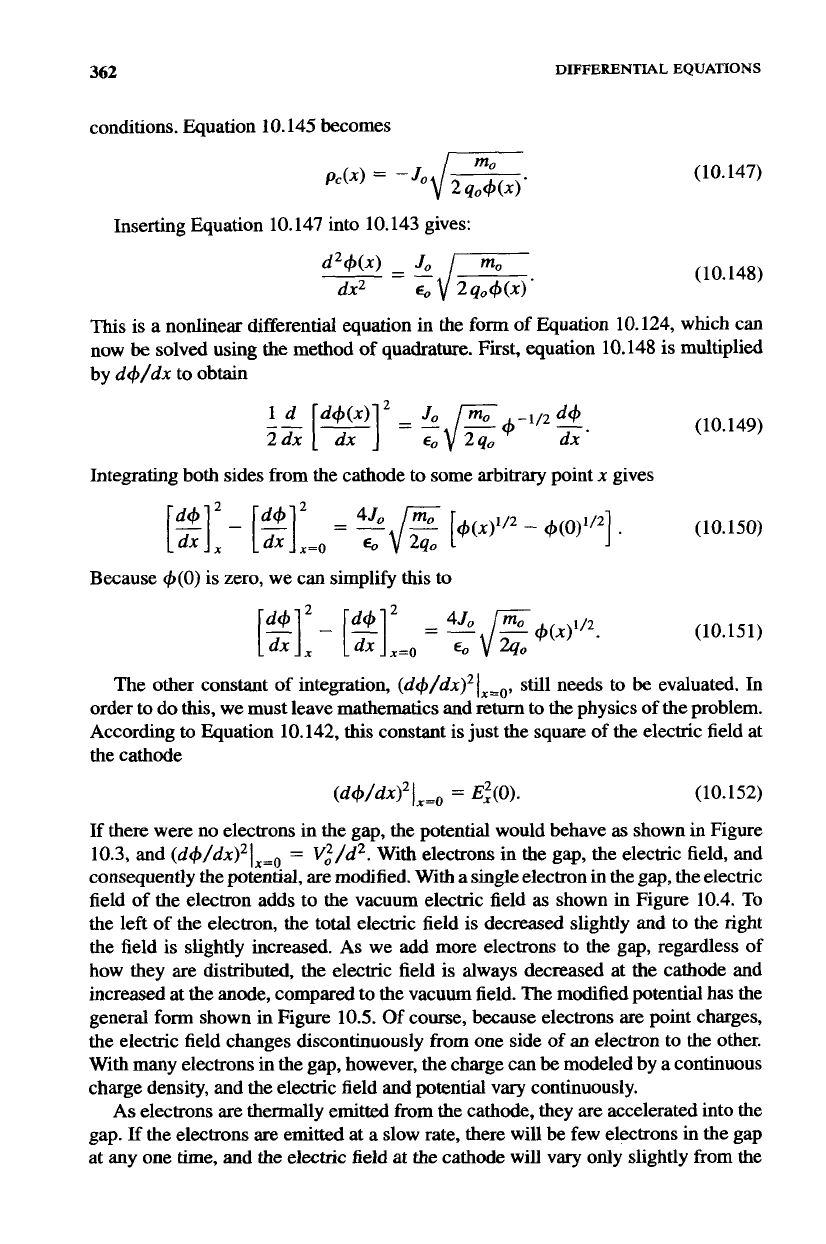
If there were no electrons
in
the gap, the potential would behave as shown
in
Figure
10.3, and
(d4/d~)~I~=,,
=
Vz/d2.
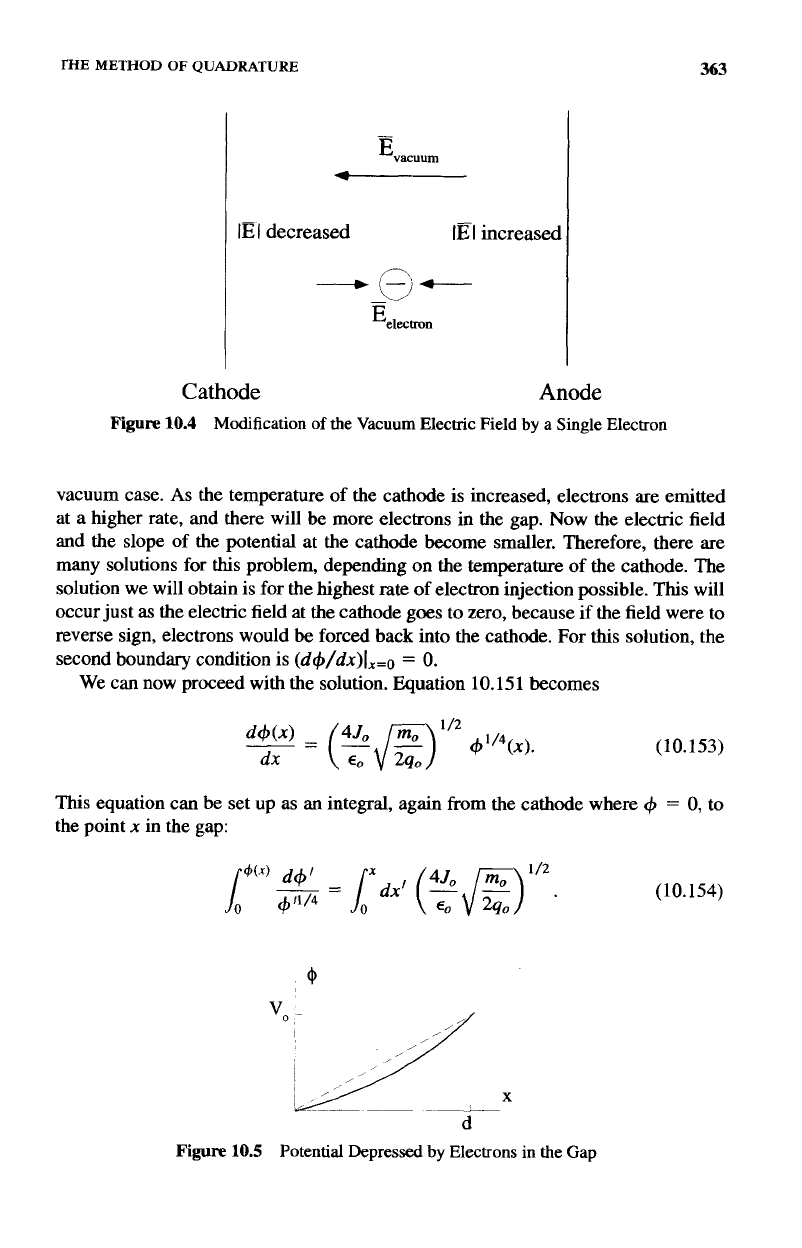
With electrons in the gap, the electric field, and
consequently the potenhal, are modified. With a single electron in the gap, the electric
field of the electron adds to the vacuum electric field
as
shown in Figure 10.4.
To
the left
of
the electron, the total electric field is decreased slightly and to the right
the field
is
slightly increased. As we add more electrons to the gap, regardless
of
how they are distributed, the electric field
is
always decreased at the cathode and
increased at the anode, compared to the vacuum field. The modified potential has the
general form shown in Figure
10.5.
Of course, because electrons are point charges,
the electric field changes discontinuously from one side of an electron to the other.
With many electrons in the gap, however, the charge can
be
modeled by a continuous
charge density, and the electric field and potential
vary
continuously.
As electrons are thermally emitted from the cathode, they are accelerated into the
gap.
If
the electrons
are
emitted at a slow rate, there will be few electrons in the gap
at any one time,
and
the electric field at the cathode will vary only slightly from the
THE
METHOD
OF
QUADRATURE
363
1
IEl
decreased
IBI
increased
Cathode
Anode
Figure
10.4
Modification
of
the Vacuum Electric Field
by
a Single Electron
vacuum case.
As
the temperature of the cathode
is
increased, electrons are emitted
at a higher rate, and there will be more electrons
in
the gap.
Now
the electric field
and the slope of the potential at the cathode become smaller. Therefore, there are
many solutions for
this
problem, depending on the temperature
of
the cathode. The
solution we will obtain is for the highest rate of electron injection possible.
This
will
occur just as the electric field at the cathode goes
to
zero, because if the field were to
reverse sign, electrons would
be
forced back into the cathode. For
this
solution, the
second boundary condition
is
(d+/dx)l,=o
=
0.
We can now proceed with the solution. Equation
10.15
1
becomes
(1
0.153)
This equation can
be
set up as an integral, again from the cathode where
+
=
0,
to
the point
x
in the gap:
d
Figure
10.5
Potential
Depressed
by
Electrons
in
the Gap
(10.154)
364
DIFFERENTIAL EQUATIONS
Performing the integration in Equation 10.154 gives the potential as a function
of
x:
(10.155)
The
RHS
of
this
equation still has the unknown quantity
J,.
but we have yet to impose
the boundary condition
+(d)
=
V,.
This
condition gives
Solving
this
for
Jo
gives
(
10.156)
(10.157)
The quantity
JCl
is referred to
as
the Child-Langmuir current density. It depends both
upon the gap distance and the applied voltage.
In
this
derivation, we assumed a particular cathode temperature,
so
that the electric
field at the cathode was
zero.
If
the cathode temperature is below
this
value, fewer
electrons
are
injected into the gap, and the current density
will
be
less
than
the Child-
Langmuir amount given by Equation 10.157. The current density is then limited by
the cathode temperature, and the gap
is
in what
is
called
temperature limited flow.
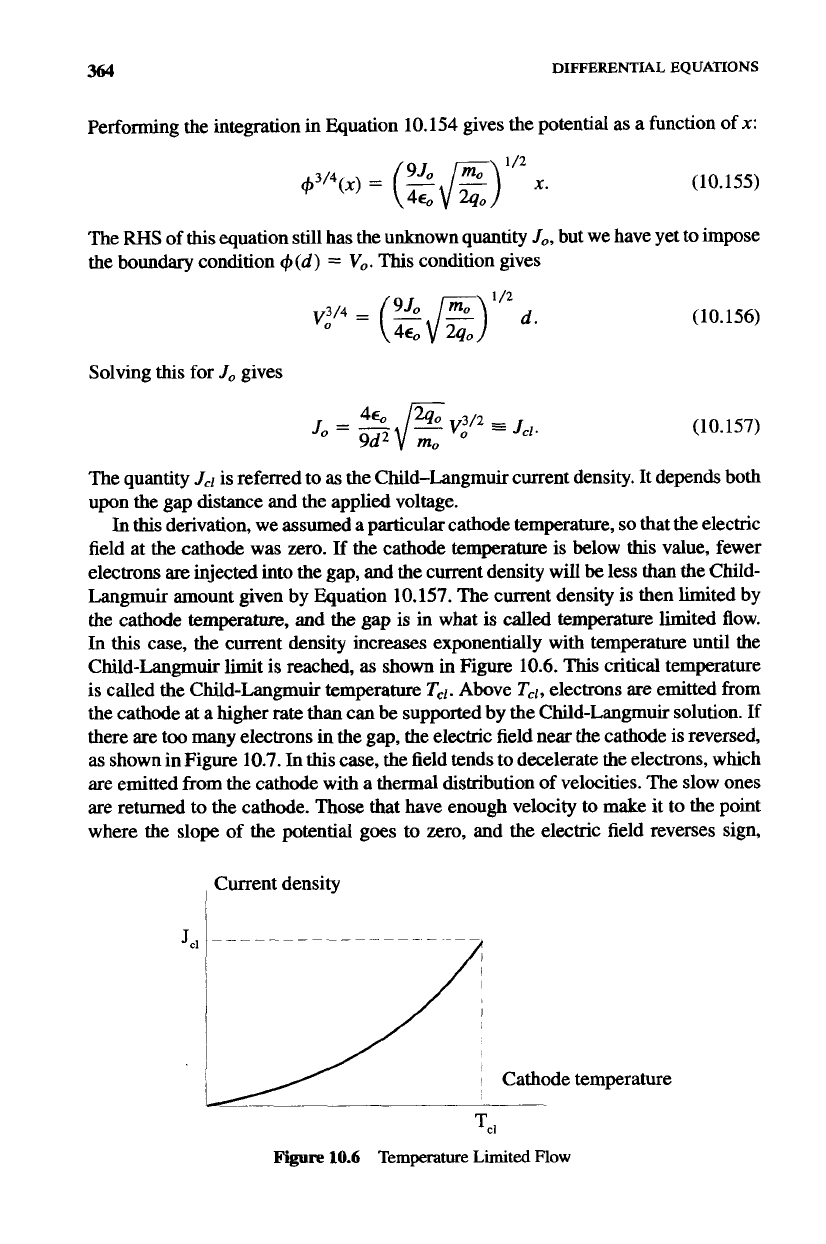
In
this
case, the current density increases exponentially with temperature until the
Child-Langmuir limit is reached,
as
shown
in Figure 10.6.
This
critical temperature
is
called the Child-Langmuir temperature
T,I.
Above
Tcl,
electrons are emitted
from
the cathode at a higher rate than can be supported by the Child-Langmuir solution. If
there are too many electrons
in
the gap, the electric field near the cathode
is
reversed,
as
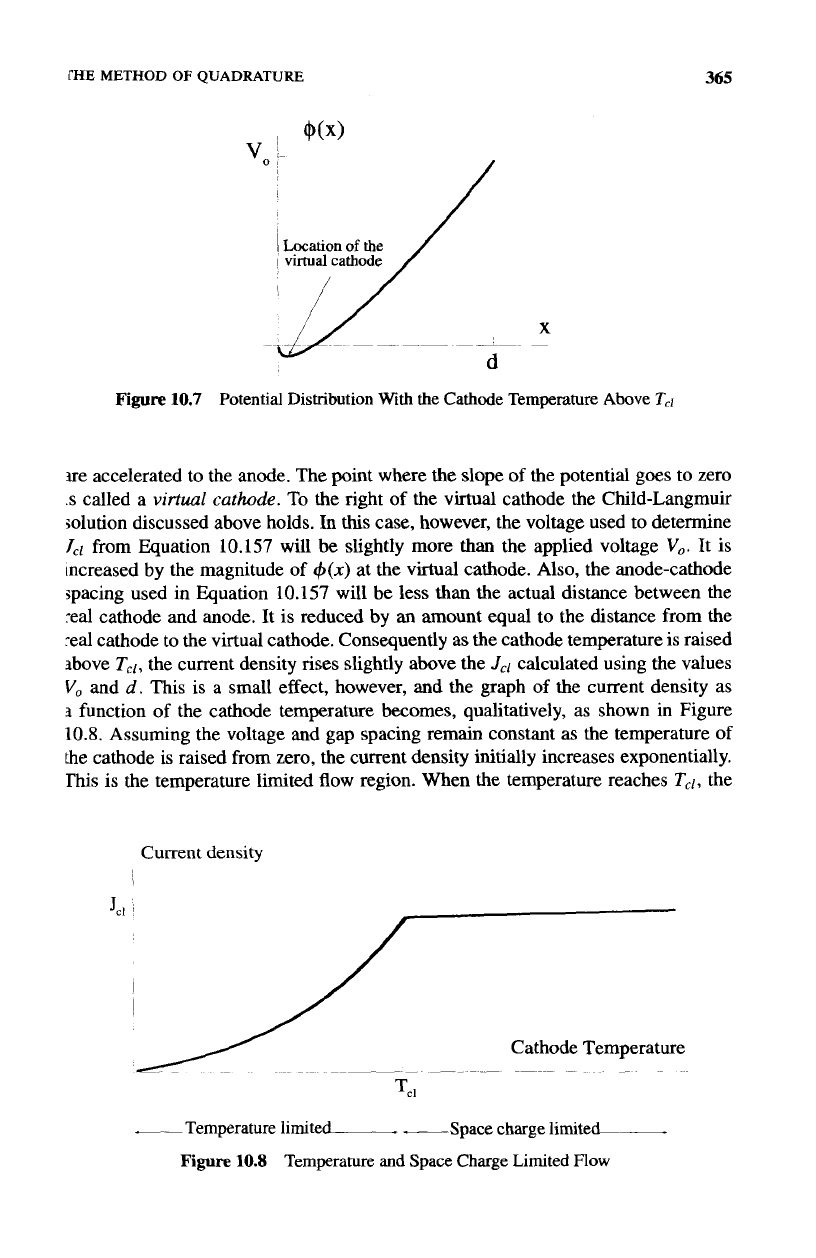
shown in Figure 10.7.
In
this
case, the field tends to decelerate the electrons, which
are emitted from the cathode with a thermal distribution
of
velocities. The slow ones
are returned to the cathode.
Those
that have enough velocity to make it to the point
where the slope
of
the potential goes to
zero,
and the electric field reverses sign,
Current density
J
_____
-
I
cl
Tc*
Figure
10.6
Temperature
Limited
How
THE
METHOD
OF
QUADRATURE
365
vo
/
1
*&on
of
the
I
virtual
cathode
a
Figure 10.7
Potential Distribution
With
the Cathode Temperature Above
T,l
ire accelerated to the anode. The point where the slope of the potential goes to zero
.s
called a
virtual
cathode.
To
the right of the virtual cathode the Child-Langmuir
jolution discussed above holds.
In
this
case, however, the voltage used to determine
Icl
from Equation
10.157
will
be
slightly more than the applied voltage
V,.
It
is
increased by the magnitude of
4(x)
at the virtual cathode. Also, the anode-cathode
spacing used in Equation
10.157
will be less
than
the actual distance between the
real cathode and anode. It is reduced by
an
amount equal to the distance from the
real cathode
to
the virtual cathode. Consequently as the cathode temperature is raised
above
Tcl,
the current density rises slightly above the
J,I
calculated using the values
V,
and
d.
This
is a small effect, however, and the graph
of
the current density
as
1
function of the cathode temperature becomes, qualitatively, as shown in Figure
10.8.
Assuming the voltage and gap spacing remain constant
as
the temperature
of
the cathode is raised from zero, the current density initially increases exponentially.
rhis
is
the temperature limited
flow
region. When the temperature reaches
Tcr,
the
Current
density
I
I
Cathode Temperature
-
~ ~
-
1
I
I
Cathode Temperature
-
Tc,
_-Temperature limiteL -Space charge limited--
Figure
10.8
Temperature
and
Space Charge Limited
Flow