
Kusse B.R., Westwig E.A. Mathematical Physics: Applied Mathematics for Scientists and Engineers
Подождите немного. Документ загружается.

3%
DIFFERENTIAL EQUATIONS
The Green’s function for this problem is the response of the rod to a &function
impulse at position
x
=
5
and time
t
=
7.
It obeys the partial differential equation:
(10.281)
The homogeneous boundary conditions
T(x,
1)
must satisfy are also applied to the
Green’s function,
so
g(x15,rlT)
--$
0
as
x
+
tw.
The causality condition requires
that
g(x15,?1T)
=
0
for
t
<
T.
To
solve Equation 10.281, we will take a Fourier
transform in space, and a Laplace transform in time. Taking these transforms of the
Green’s function in two steps gives
G&$.tIT)
=
-
hg(xlt,
tlr)e-ib (10.282)
i&L(klSr&)
=
1
dtG&15,t1T)e-”.
(10.283)
The Fourier-Laplace transform of Equation 10.281, the original differential equation,
gives the algebraic relation
m
(10.284)
This allows
us
to
solve for the Fourier-Laplace transform of the Green’s function
(10.285)
Now
all that remains
to
obtain the Green’s function is the double inversion
of
Equation 10.285. In principle, the inversions could be done in either order. In this
case, it is much easier to
do
the Laplace inversion
first.
The Laplace inversion can
be
evaluated from
(10.286)
There
is
a single pole at
g
=
-dk2.
Because the variable
k
is always on a Fourier
contour, it is pure real. The diffusion coefficient
D
is also pure real. Therefore, this
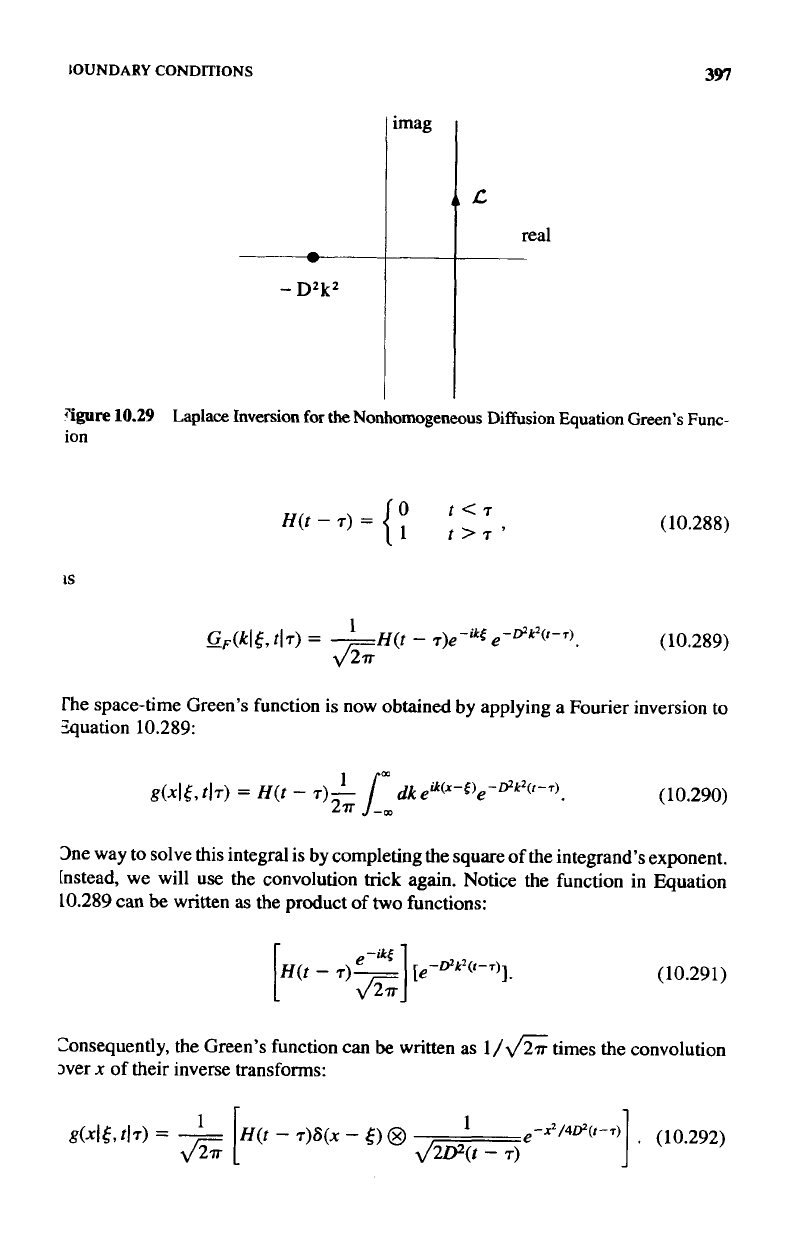
pole is always on the negative, real axis in the complex g-plane,
as
shown in Figure
10.29. The Laplace contour
is
always to the right of this pole. The integral in Equation
10.286 can be performed using closure, closing to the right
for
t
<
7
and to the left
fort
>
T,
with the result
(10.287)
Equation 10.287 can be written in more compact form using the Heaviside step
function,
IOUNDARY CONDlTIONS
imag
397
db
L
real
___c__
-
DZk2
?gum
10.29
Laplace
Inversion
for
the
Nonhomogeneous
Diffusion Equation Green’s
Func-
ion
0
t<7
1
f>T’
H(t
-
T)
=
1s
(10.288)
(10.289)
The space-time Green’s function is now obtained by applying a Fourier inversion to
Quation
10.289:
(10.290)
he way to solve this integral is by completing the square of the integrand’s exponent.
Instead, we will use the convolution trick again. Notice the function in Equation
10.289
can
be
written as the product of
two
functions:
(10.291)
Zonsequently, the Green’s function
can
be
written
as
1/&
times the convolution
xer
x
of their inverse transforms:
398
DIFFERENTIAL
EQUATIONS
i
g(
Figure
10.30
Green's
Function
for
the Diffusion
Equation
with
a
Distributed
Heat
Source
Because
of
the 6-function,
this
convolution easily evaluates to
(10.293)
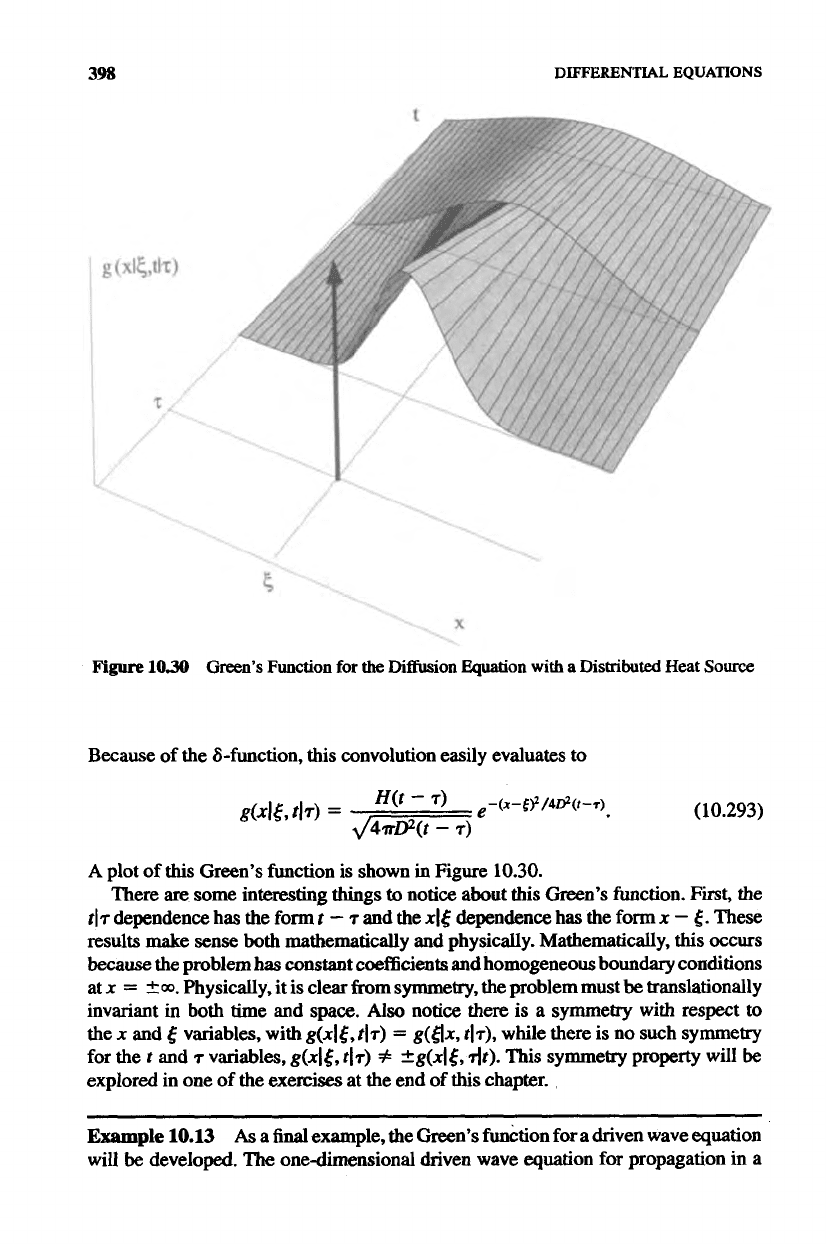
A
plot
of
this
Green's function
is
shown
in
Figure
10.30.
There
are
some interesting things
to
notice about this Green's function.
First,
the
tlr
dependence has
the
form
t
-
T
and the
XI(
dependence has the
form
x
-
5.
These
results make sense both mathematically and physically. Mathematically,
this
occurs
because the problem
has
constant coefficients and homogeneous boundary conditions
at
x
=
30.
Physically, it
is
clear from symmetry, the problem must
be
translationally
invariant in both time and space.
Also
notice there
is
a symmetry with respect
to
the
x
and
6
variables, with
g(x15,
tl~)
=
g(fln,
tIT),
while there
is
no
such symmetry
for
the
t
and
T
variables,
g(xl(,
t17)
f
?g(xl(,
dr).
This symmetry property will
be
explored in one
of
the exercises at the end of
this
chapter.
~~~
Example
10.13
As
a
final
example, the Green's function for a driven wave
equation
will
be
developed.
The
one-dimensional driven wave equation
for
propagation
in
a
BOUNDARY
CONDITIONS
399
uniform medium can be written as
1
d2U(X,t)
82u(x,t)
c;
dt2
8x2
=
s(x,
t).
(10.294)
The constant
c,
is the velocity of propagation of the wave.
This
is a nonhomogeneous
equation, with the response
u(x,
t)
generated by the distributed source term
s(x,
t).
This problem can be treated with a spatial Fourier transform and a temporal
Laplace transform, exactly like the diffusion equation of the previous example. There
is no problem with this approach. We will demonstrate a different approach, however,
because it is one commonly used in physics calculations.
To
avoid the tedious Laplace
transform, we will assume that the time behavior
of
both the driving term and the
response are in the
sinusoidal steady state,
so
all the time dependence occurs with a
constant amplitude at a fixed frequency
a,.
In
other words, we assume that
s(x,t)
=
Real
[S(x)eimo']
,
(10.295)
and the response has a similar time dependence
u(x,t)
=
Real
[U(x)eimo']
.
(10.296)
As
you will see, this is very much like taking a Fourier transform in time. Unfortu-
nately, you will also find out it presents a few problems!
In this sinusoidal steady state, the differential equation becomes
0,'
d2U4
-
-
U(x)
-
-
=
$(x).
c;
-
dx2
(10.297)
Notice the time dependence completely cancels out, and we have a linear, nonhomo-
geneous equation for
U(x).
Also,
we now are dealing with only a single independent
variable,
so
the partial derivative
has
been replaced by a regular derivative. The
solution for
_U(x)
can be formulated in terms of a Green's function,
where
g(x16)
satisfies the differential equation
We can take the Fourier transform of both sides of this equation to give
(10.298)
(10.299)
(10.300)
400
DIFFERENTIAL EQUATIONS
~
IFbg=
_real
Figure
1031
Fourier Inversion
for
the Driven Wave
Equation
so
that
(10.301)
The Green’s function is then obtained by the Fourier inversion
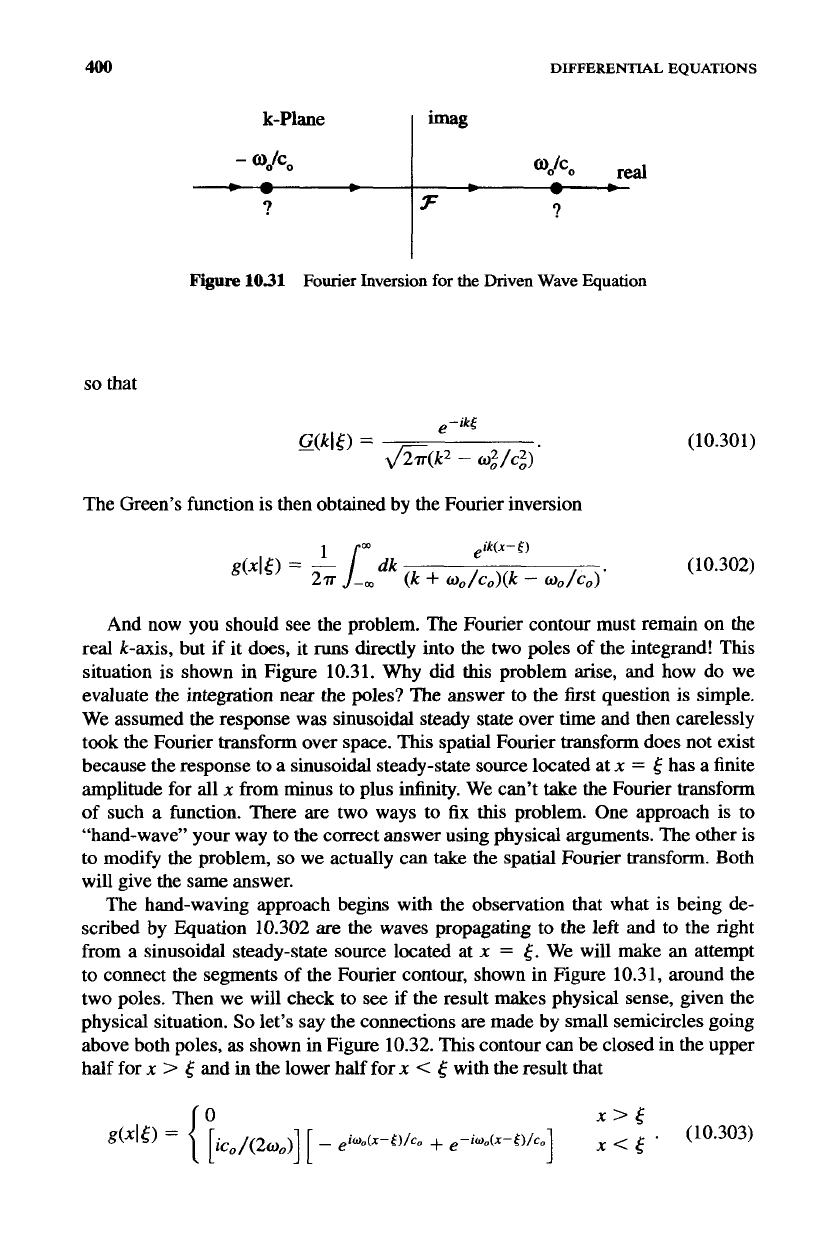
And now you should see the problem. The Fourier contour must remain on the
real
k-axis,
but
if
it does, it
runs
directly into the
two
poles
of
the integrand!
This
situation is shown in
Figure
10.31. Why did
this
problem arise, and how do we
evaluate the integration near the poles? The answer to the
first
question is simple.
We assumed the response was sinusoidal steady state over time and then carelessly
took the Fourier transform over space.
This
spatial Fourier transform does not exist
because the response to a sinusoidal steady-state source located at
x
=
5
has a finite
amplitude for
all
x
from minus to plus infinity. We can’t
take
the Fourier transform
of
such a function. There
are
two ways to
fix
this
problem. One approach is to
“hand-wave” your way to
the
correct answer using physical arguments. The other is
to modify the problem,
so
we actually can take the spatial Fourier transform. Both
will give the
same
answer.
The hand-waving approach begins with the observation that what is being de-
scribed by Equation 10.302
are
the waves propagating
to
the
left
and to the right
from a sinusoidal steady-state source located at
x
=
5.
We will make an attempt
to connect the segments of the Fourier contour, shown in Figure 10.31, around the
two poles. Then we will check to see if the result
makes
physical sense, given the
physical situation.
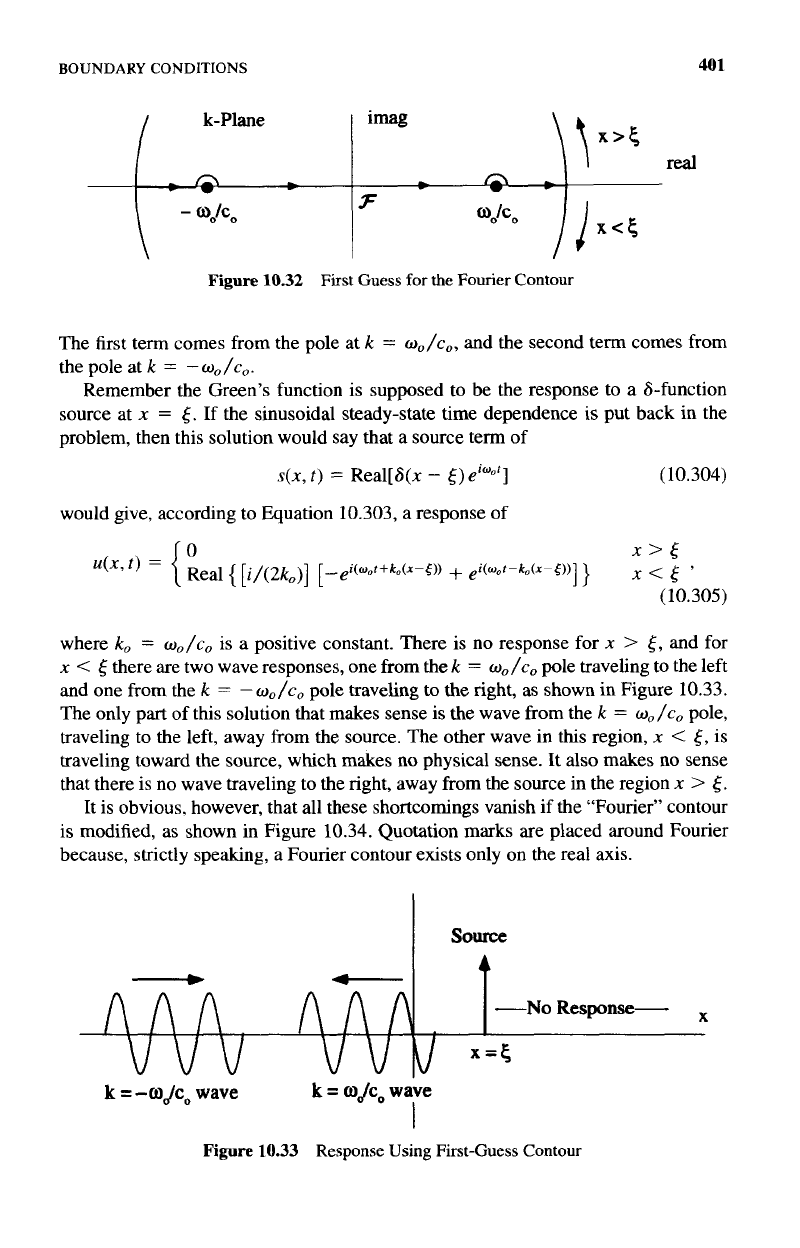
So
let’s say the connections are made by small semicircles going
above both poles,
as
shown in Figure 10.32.
This
contour can
be
closed in the upper
half for
x
>
5
and in the lower half for
x
<
5
with the result that
(10.303)
BOUNDARY
CONDITIONS
401
X
-No
Response-
Figure
10.32
First Guess for the Fourier Contour
The first term comes from the pole at
k
=
wo/co,
and the second term comes from
the pole at
k
=
-
wo/co.
Remember the Green’s function is supposed to be the response to a &function
source at x
=
5.
If the sinusoidal steady-state time dependence is put back in the
problem, then this solution would say that a source term of
s(x,
t)
=
Real[S(x
-
5)
eioofl
(10.304)
would give, according to Equation 10.303, a response of
where
k,
=
w,/co
is
a positive constant. There
is
no response for x
>
5,
and for
x
<
5
there are two wave responses, one from the
k
=
wo/co
pole traveling to the left
and one from the
k
=
-wo/co
pole traveling to the right, as shown in Figure 10.33.
The only part of this solution that makes sense is the wave from the
k
=
wo/co
pole,
traveling to the left, away from the source. The other wave in this region,
x
<
5,
is
traveling toward the source, which makes
no
physical sense. It also makes no sense
that there is no wave traveling to the right, away from the source in the region x
>
5.
It is obvious, however, that
all
these shortcomings vanish if the “Fourier” contour
is modified, as shown in Figure 10.34. Quotation
marks
are placed around Fourier
because, strictly speaking, a Fourier contour exists only on the real axis.
Figure
10.33
Response Using
First-Guess
Contour
402
-
k-Plane
L
-
-w
-
OJCO
DIFFERENTIAL EQUATIONS
x>s
imag
real
-
-
-
OO’CO
3
x<5
We can reach the same conclusion about how to modLfy the “Fourier” contour, a
little more rigorously,
if
we introduce a damping
krm
into the original differential
equation.
If
the wave decays
as
it propagates, we
will
be able to legitimately take the
Fourier transform over
x.
A
simple modification of Equation
10.294
does the trick
(10.306)
1
d2U(X,t)
d2U(X,t)
du(x
t)
c;
at2
dX2
dt
+
a2
=
s(x,t).
Now, if
a!
is positive, the waves are attenuated
as
they move away from the source. The
calculation proceeds
as
before, except now the damping term modifies the positions
of the &plane poles
of
Equation
10.302
and, for small positive
a,
places them
as
shown in Figure
10.35.
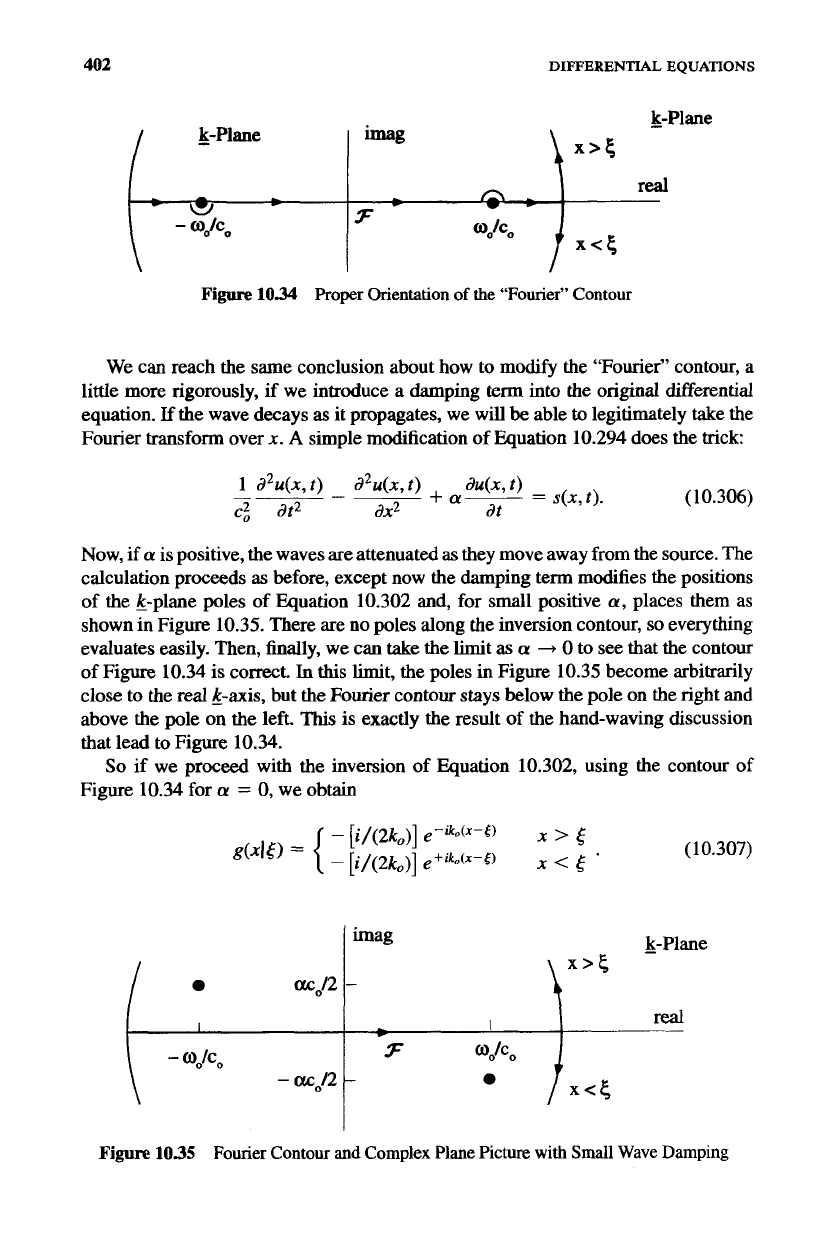
There are no poles along the inversion contour,
so
everything
evaluates easily. Then, finally, we can take the limit
as
a
+
0
to see that the contour
of Figure
10.34
is
correct.
In
this
limit, the poles
in
Figure
10.35
become arbitrarily
close to the real &axis, but the Fourier contour stays
below
the pole on the right
and
above the pole on the left.
This
is exactly the result of the hand-waving discussion
that lead to Figure
10.34.
So
if
we proceed with the inversion
of
Equation
10.302,
using the contour of
Figure
10.34
for
a!
=
0,
we obtain
(1
0.307)
acJ2
1.
imag k-Plane
Figure
1035
Fourier
Contour
and
Complex Plane Picture with Small Wave Damping
BOUNDARY
CONDITIONS
403
1
Source
f--
't
-
Figure
10.36
Undamped
Waves
Moving
Away
from
Source
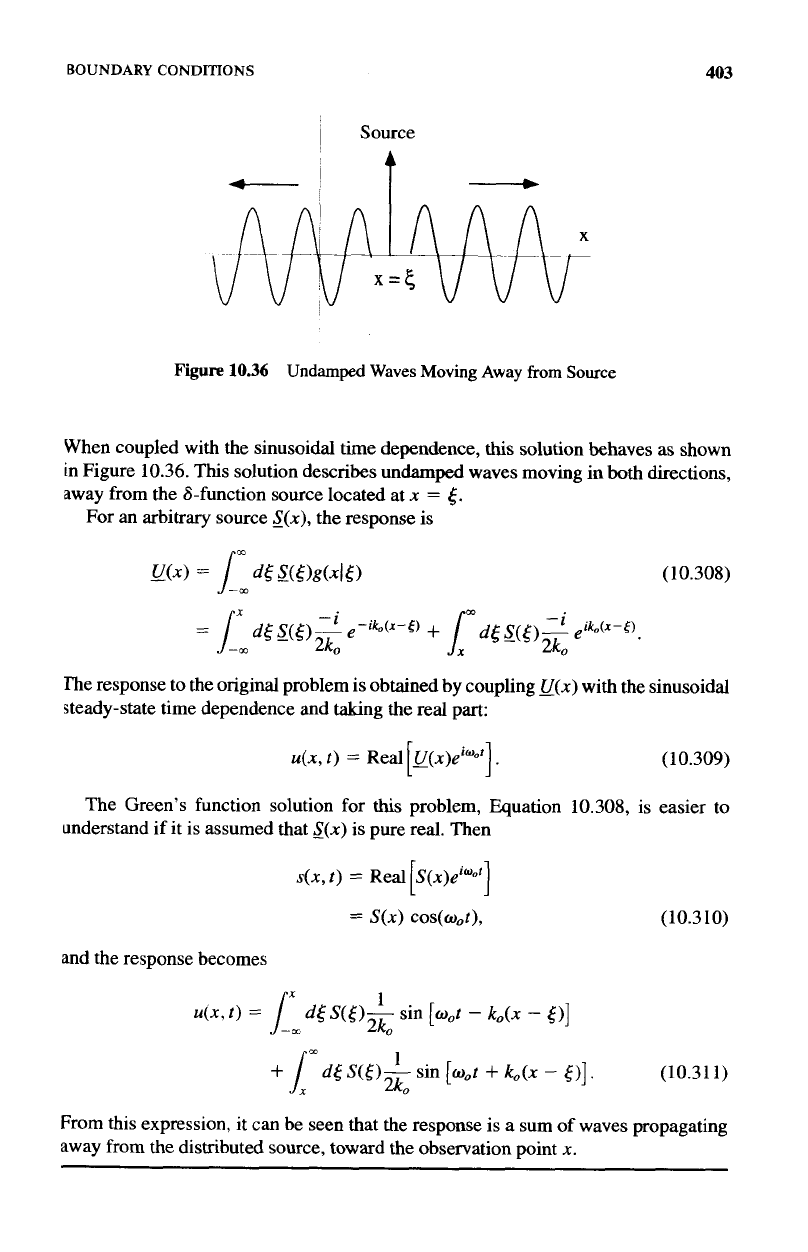
When coupled with
the
sinusoidal time dependence,
this
solution behaves as shown
in Figure 10.36.
This
solution describes undamped waves moving in both directions,
away from the &function source located at
x
=
5.
For an arbitrary source
S(x),
the response
is
(10.308)
me response to the original problem
is
obtained
by
coupling
_U(x)
with the sinusoidal
steady-state time dependence and taking the real part:
u(x,t)
=
Real
_U(x)eiWo'
.
(10.309)
The Green's function solution for
this
problem, Equation
10.308,
is easier to
[I
understand if it is assumed that
S(x)
is pure real. Then
s(n,t)
=
Real
S(x)eiwo'
11
=
S(X)
cos(o,t), (10.310)
and the response becomes
(10.311)
From this expression, it can be seen that the response is a sum of waves propagating
away from the distributed source, toward
the
observation point
x.
1.
+
Lrn
4
stoz
[coot
+
ko(n
-
5)].
404
DIFFERENTIAL
EQUAlTONS
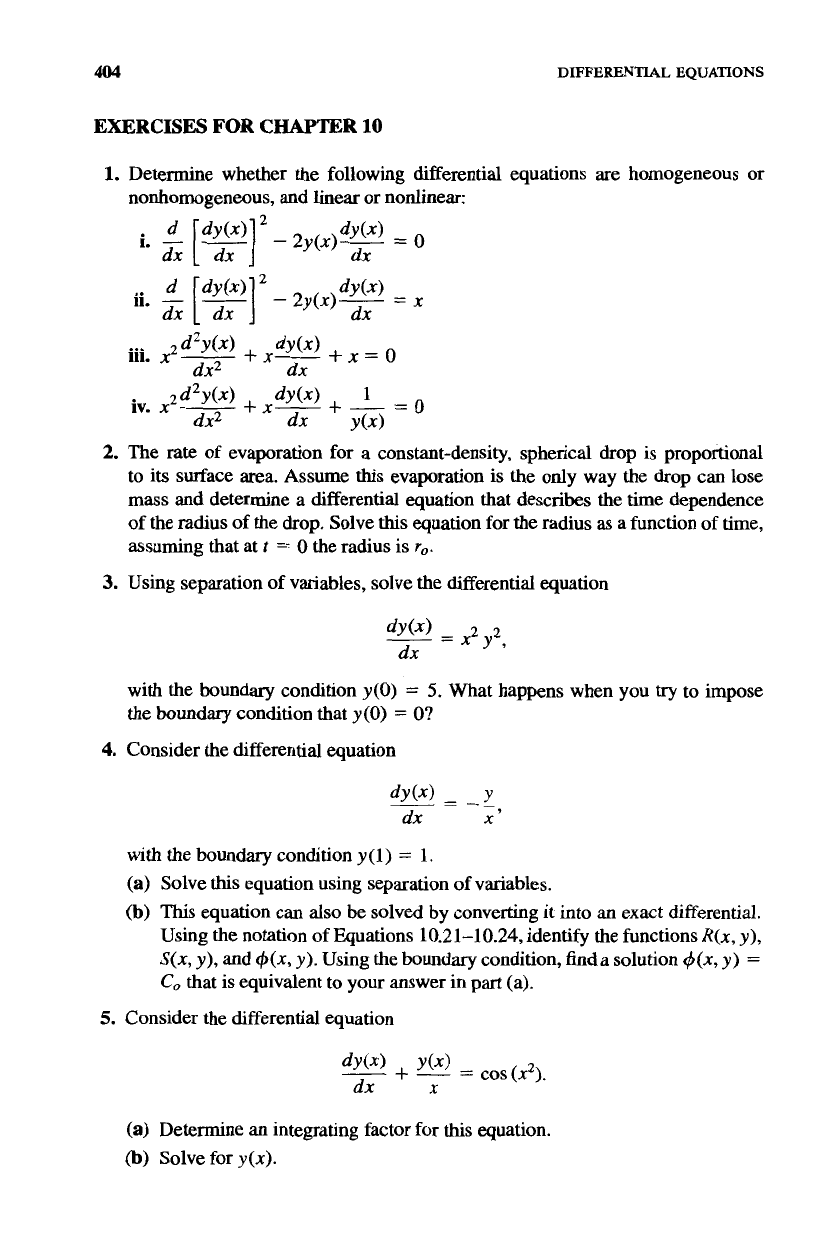
EXERCISES FOR CHAPTER
10
1.
Determine whether the following differential equations are homogeneous or
nonhomogeneous, and linear
or
nonlinear:
2.
The rate of evaporation for a constant-density, spherical drop is proportional
to its surface area. Assume
this
evaporation is the only way the drop can lose
mass
and detennine a differential equation that describes the time dependence
of
the
radius
of the drop. Solve
this
equation for the radius
as
a function of time,
assuming that at
t
=
0
the radius is
r,.
3.
Using separation of variables, solve the differential equation
dyo
22
=xy,
dx
with the boundary condition
y(0)
=
5.
What happens when you
try
to impose
the boundary condition that
y(0)
=
O?
4.
Consider the differential equation
dY(X)
- -
y
dx
X’
with the boundary condition
y(
1)
=
1.
(a)
Solve
this
equation using separation of variables.
(b)
This
equation can also be solved
by
converting it into an exact differential.
Using the notation of Equations
10.21-10.24,
identify the functions
R(x,
y),
S(x,
y),
and
4(x,
y).
Using the boundary condition, find a solution
#(x,
y)
=
C,
that is equivalent to your answer in
part
(a).
5.
Consider the differential equation
dyo
YG)
+
-
=
cos(x2).
dx
X
(a)
Determine an integrating factor for
this
equation.
(b)
Solve for
y(x).
EXERCISES
405
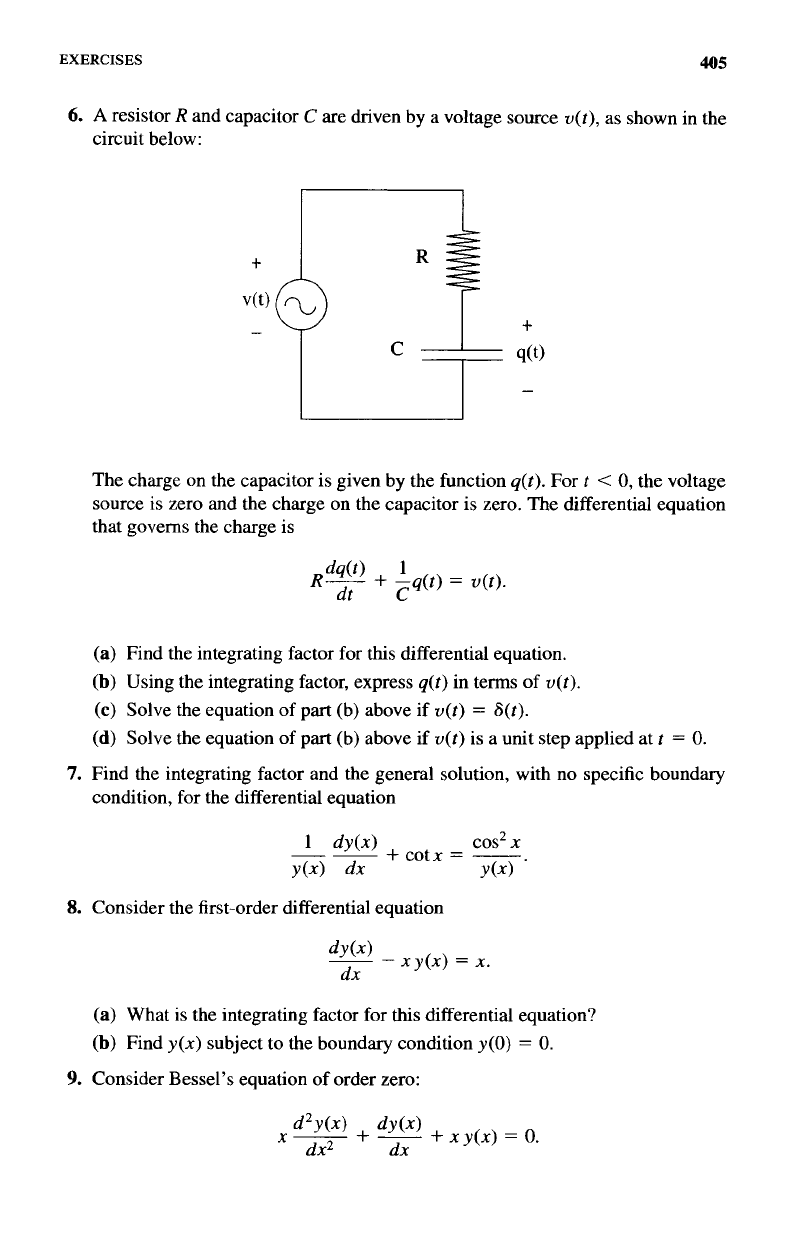
6.
A
resistor
R
and capacitor
C
are driven by a voltage source
v(t),
as shown in the
circuit below:
The charge on the capacitor is given by the function
q(t).
For
t
<
0,
the voltage
source is zero
and
the charge on the capacitor is zero. The differential equation
that governs the charge
is
1
R-
+
-q(t)
=
v(t).
dt
C
(a)
Find the integrating factor for this differential equation.
(b)
Using the integrating factor, express
q(t)
in terms of
v(t).
(c)
Solve the equation of part (b) above if
v(t)
=
&t).
(d)
Solve the equation
of
part (b) above
if
v(t)
is a unit step applied at
t
=
0.
7.
Find the integrating factor and the general solution, with no specific boundary
condition, for the differential equation
8.
Consider the first-order differential equation
(a)
What is the integrating factor for
this
differential equation?
(b)
Find
y(x)
subject to the boundary condition
y(0)
=
0.
9.
Consider Bessel’s equation of order zero:
d2Y(X)
x
-
+
+
xy(x)
=
0.
dx2 dx