
Kusse B.R., Westwig E.A. Mathematical Physics: Applied Mathematics for Scientists and Engineers
Подождите немного. Документ загружается.

406
DIFFERENTIAL EQUATIONS
10.
11.
12.
13.
14.
15.
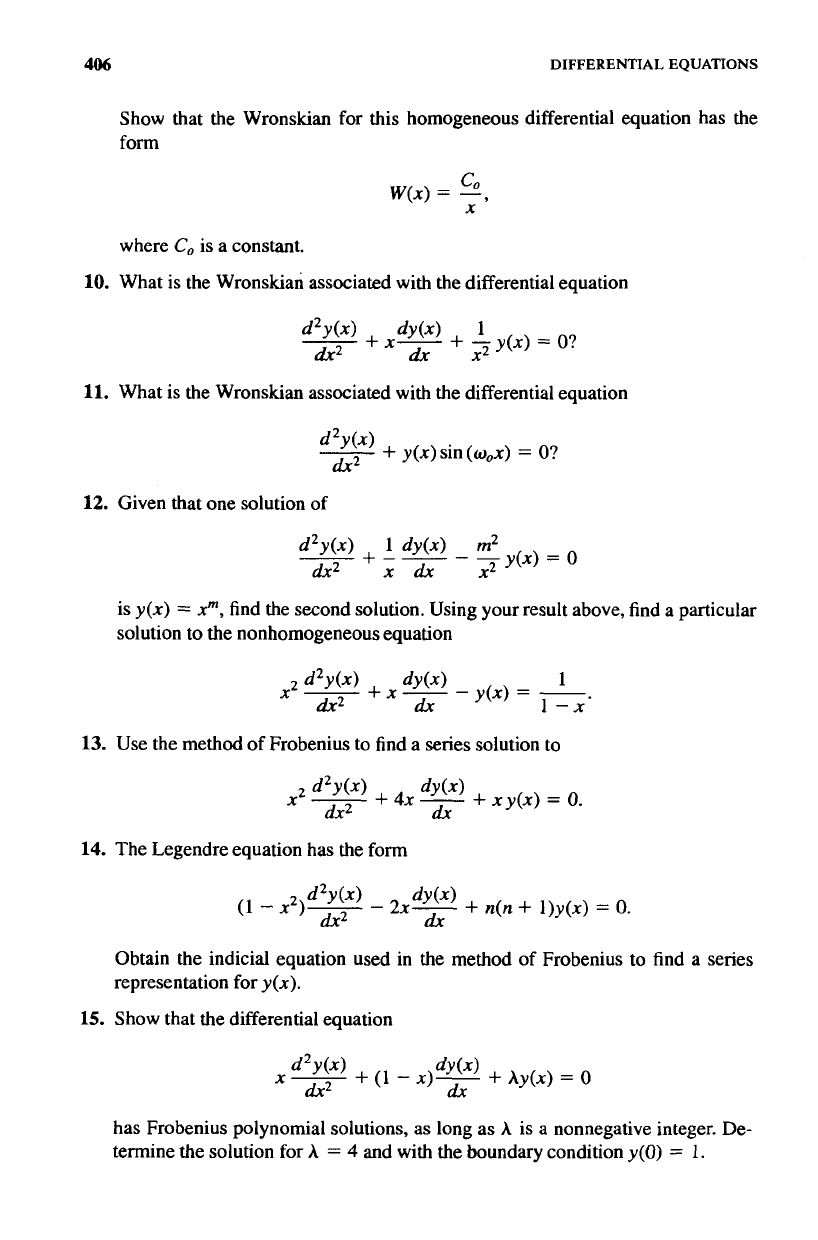
Show that the Wronskian for this homogeneous differential equation has the
form
co
W(x)
=
-,
X
where
C,
is a constant.
What is the Wronskian associated with the differential equation
What is the Wronskian associated with the differential equation
Given that one solution of
is
y(x)
=
xm,
find the second solution. Using your result above, find a particular
solution to the nonhomogeneous equation
d2YW
dy(x)
1
x2
-
+
x
-
-
y(x)
=
-
dx2
dx
1
-x‘
Use the method
of
Frobenius to find a series solution to
The Legendre equation has the form
(l-x)--2x-
d2y(x)
dy(x)
+
n(n
+
l)y(x)
=
0.
dx2
dx
Obtain the indicial equation used in the method of Frobenius to find a series
representation for
y(x).
Show that the differential equation
has Frobenius polynomial solutions, as long as
A
is a nonnegative integer. De-
termine the solution for
A
=
4
and with the boundary condition
y(0)
=
1.
EXERCISES
407
16.
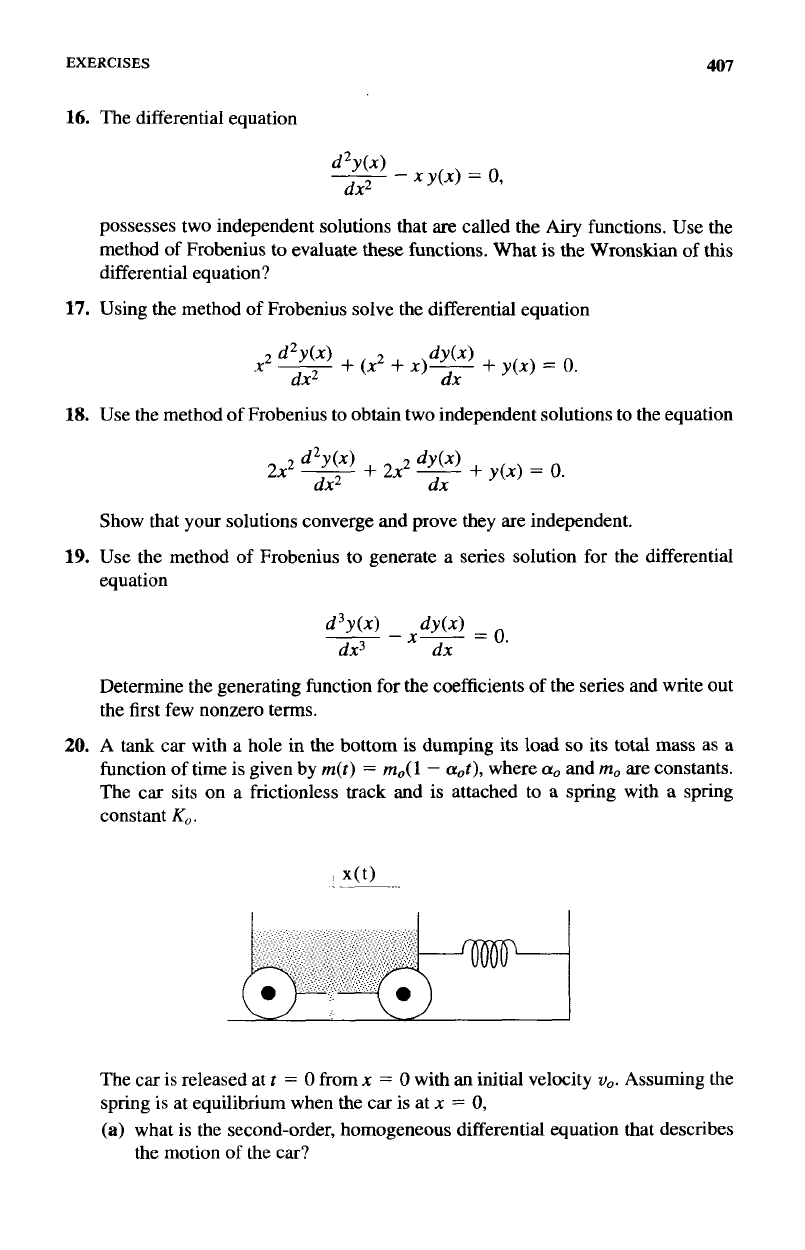
The differential equation
possesses two independent solutions that
are
called the
Auy
functions. Use the
method of Frobenius
to
evaluate these functions.
What
is
the Wronskian of
this
differential equation?
17.
Using the method
of
Frobenius solve the differential equation
18.
Use the method of Frobenius to obtain two independent solutions to the equation
Show that your solutions converge and prove they are independent.
19.
Use the method of Frobenius to generate
a
series solution for the differential
equation
d3YW
dY(X)
-x-
=o.
dx3 dx
Determine the generating function for the coefficients of the series and write out
the first few nonzero terms.
20.
A
tank car with a hole
in
the bottom
is
dumping its load
so
its total mass
as
a
function of time is given by
m(t)
=
m,(
1
-
sot),
where
a,
and
m,
are constants.
The car sits on a frictionless track and is attached to
a
spring with
a
spring
constant
KO.
The car
is
released
at
t
=
0
from
x
=
0
with an initial velocity
v,.
Assuming the
spring
is
at equilibrium when the car is at
x
=
0,
(a)
what
is
the second-order, homogeneous differential equation that describes
the motion
of
the car?
408
DIFFERENTIAL EQUATIONS
(b)
is
this
a linear or nonlinear differential equation?
(c)
use the method of Frobenius to solve for x(t) over the interval
0
<
r
<
1
/a,.
(d)
check the convergence of your solution.
(e)
what happens at
r
=
l/a,?
21.
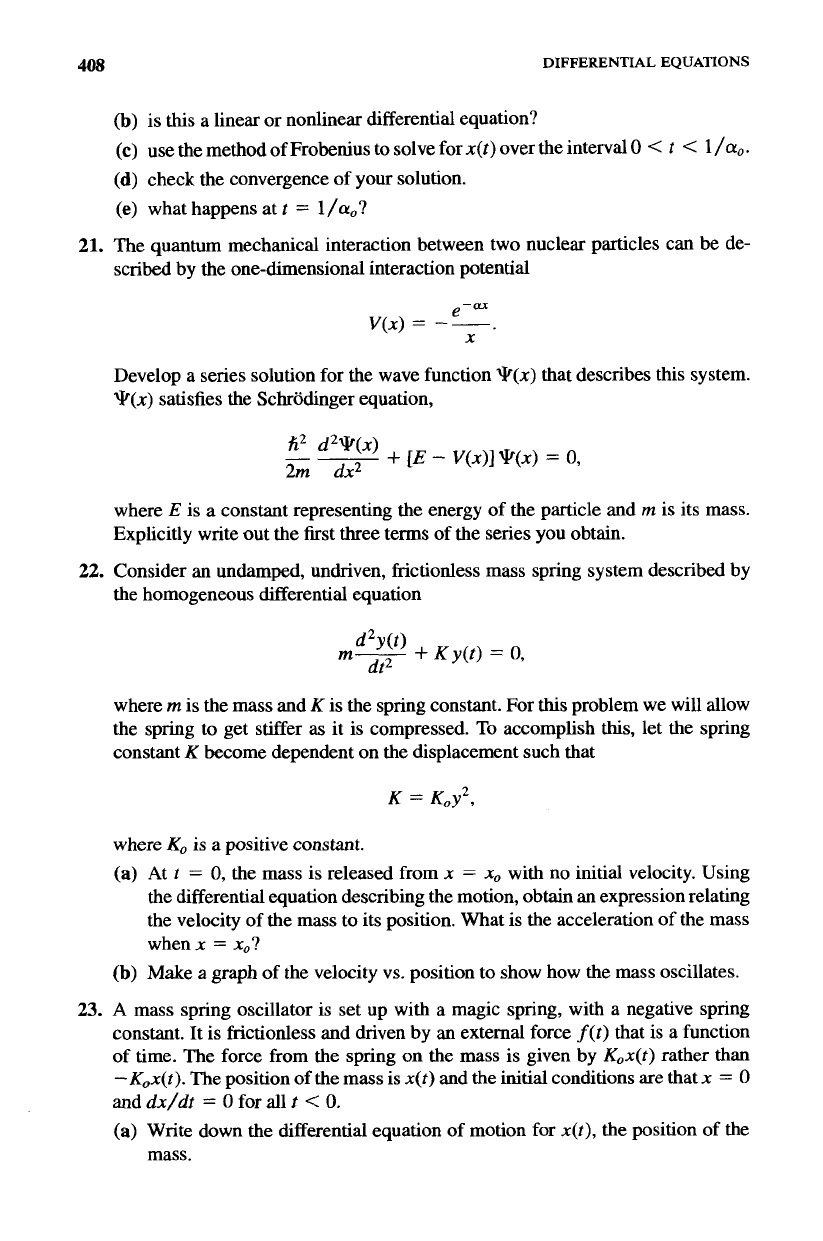
The quantum mechanical interaction between two nuclear particles can be de-
scribed by the one-dimensional interaction potential
ePQ*
V(x)
=
X
Develop a series solution for the wave function q(x) that describes this system.
"(x) satisfies the Schrodinger equation,
-~
ti2
d2"(x)
+
[E
-
V(x)]
"(x)
=
0,
2m
dx2
where
E
is
a constant representing the energy
of
the particle and
m
is its mass.
Explicitly write out the first three terms of
the
series you obtain.
22.
Consider
an
undamped, undriven, frictionless mass spring system described by
the homogeneous differential equation
m-
d2y(t)
+
Ky(t)
=
0,
dt2
where
m
is the
mass
and K is the spring constant. For
this
problem we will allow
the
spring
to get stiffer
as
it is compressed.
To
accomplish
this,
let the spring
constant
K
become dependent on the displacement such that
K
=
Koy2,
where
KO
is
a
positive constant.
(a)
At
t
=
0,
the mass is released from x
=
x, with no initial velocity. Using
the differential equation describing the motion,
obtain
an
expression relating
the velocity of the mass to its position.
What
is the acceleration
of
the mass
whenx
=
x,?
(b)
Make a graph
of
the velocity vs. position to show how the mass oscillates.
23.
A
mass spring oscillator is set up with
a
magic spring, with a negative spring
constant. It is frictionless and driven by an external force
f(t)
that is a function
of time. The force from the spring on the mass
is
given by K,x(t) rather than
-
Kox(t).
The position
of
the mass is
x(t)
and the initial conditions are that x
=
0
and dx/dt
=
0
for all
t
<
0.
(a)
Write down the differential equation of motion for x(t), the position of the
mass.
EXERCISES
409
(b)
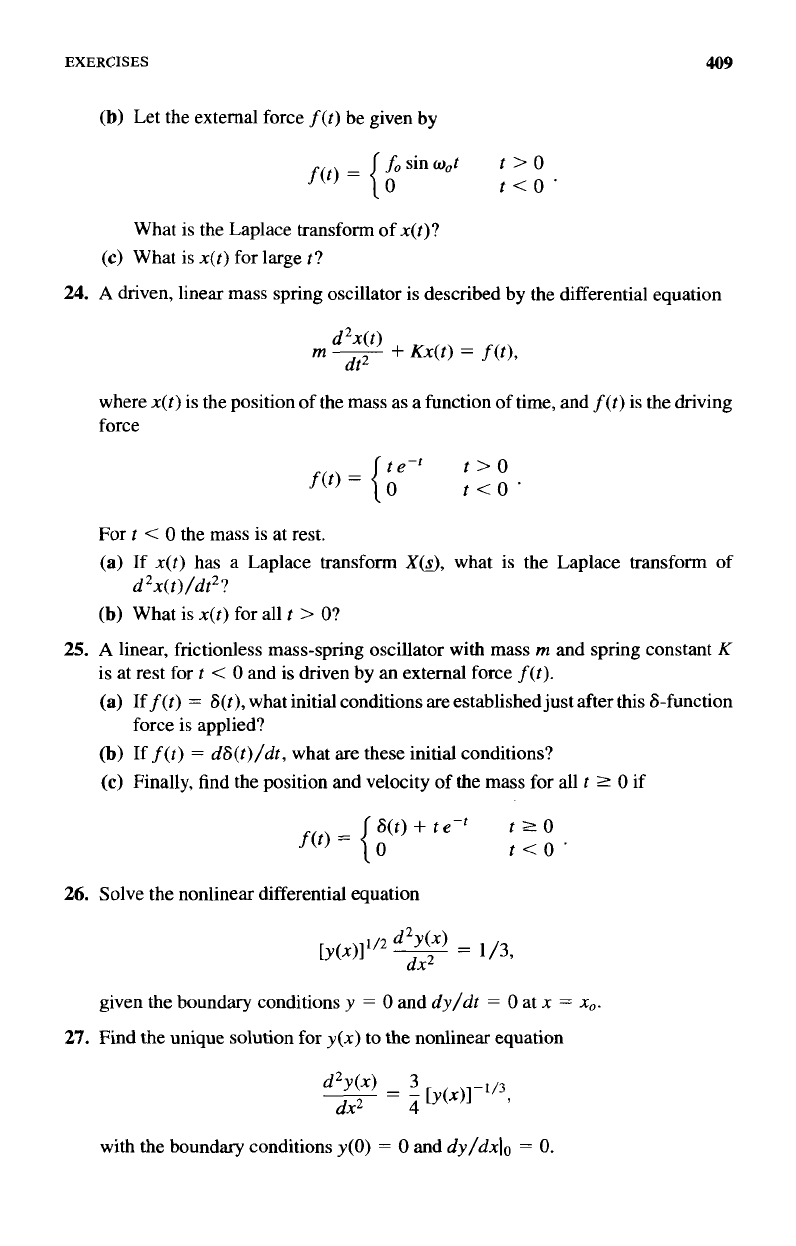
Let the external force
f
(t)
be given by
What is the Laplace transform of
x(t)?
(c)
What is
x(t)
for large
t?
24.
A
driven, linear mass spring oscillator is described by the differential equation
where
x(t)
is the position of the
mass
as a function of time, and
f(t)
is the driving
force
For
t
<
0
the mass is at rest.
(a)
If
x(t)
has a Laplace transform
Xu,
what is the Laplace transform of
(b)
What is
x(t)
for all
t
>
O?
d2x(t)/dt2?
25.
A
linear, frictionless mass-spring oscillator with mass
rn
and spring constant
K
is at rest for
t
<
0
and is driven by
an
external force
f
(t).
(a)
Iff
(t)
=
&(t),
what initial conditions
are
establishedjust after this &function
(b)
If
f(t)
=
d6(t)/dt,
what are these initial conditions?
(c)
Finally, find the position and velocity of the mass for all
t
2
0
if
force is applied?
26.
Solve the nonlinear differential equation
given the boundary conditions
y
=
0
and
dy/dt
=
0
at
x
=
x,.
27.
Find the unique solution for
y(x)
to the nonlinear equation
with the boundary conditions
y(0)
=
0
and
dy/dxl0
=
0.
410
DIFFERENTIAL EQUATIONS
28.
Use the method of quadrature to solve the equation
d2y(x>
-
[y(x)]3
=
0,
dx2
if
y(0)
=
1
and
dy/dxlo
=
1/&.
29.
Use the method of quadrature to solve the nonlinear equation
-
cos
y
sin
y,
d2YW
-
dx2
given the boundary conditions
y(0)
=
0
and
dy/dxIo
=
1.
30.
Use the method of quadrature
to
solve the differential equation
d2y(x)
-
siny
dx2
c0s3y
for
y(x).
Show, by substituting
it
back into the equation, that your solution works.
Choose the constants of integration to give the simplest possible answer.
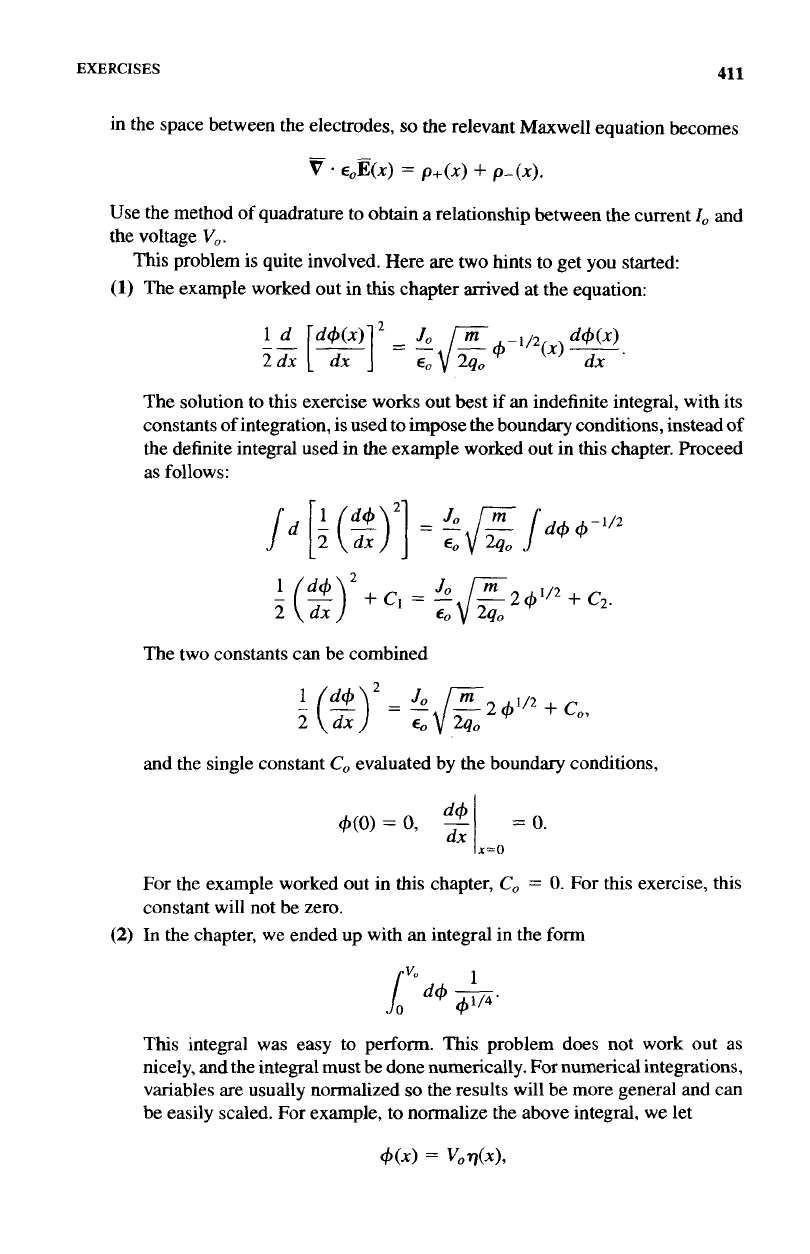
31.
This
problem involves a Child-Langmuir solution for a two-component, anode-
cathode gap. The geometry is described
in
the figure below.
A
large source
of electrons exists at the cathode, and we assume the cathode temperature is
sufficient for the electric field to
be
zero
at
t
=
0.
The same is true at
the
anode,
except the particles there
are
positively charged ions. Let the electron have a
mass of
m-
and a charge
-qo,
while the ion has a mass
m+
and charge
+qo.
Electron
Ion
cloud cloud
Look for a steady-state solution such that
d/dt
of all quantities are zero. Both
electrons of charge density
p-
(x)
and ions of charge density
p+
(x)
will be present
EXERCISES
411
in the space between the electrodes,
so
the relevant Maxwell equation becomes
v
.
€,E(X)
=
p+(x)
+
p-(x).
Use the method of quadrature to obtain a relationship between the current
I,
and
the voltage
V,.
(1)
The example worked out in
this
chapter arrived at the equation:
This
problem
is
quite involved. Here are two hints to get you started:
The solution to this exercise works out best if an indefinite integral, with its
constants of integration, is used to impose the boundary conditions, insteadof
the definite integral used
in
the example worked out in this chapter. Proceed
as follows:
The two constants can be combined
and the single constant
Co
evaluated by
the
boundary conditions,
b(0)
=
0,
=
0.
x=o
For
the example worked out
in
this chapter,
C,
=
0.
For this exercise, this
constant will
not
be zero.
In
the chapter, we ended up with an integral in the form
This integral was easy to perform.
This
problem does not work out as
nicely, and the integral must be done numerically. For numerical integrations,
variables are usually normalized
so
the results will be more general
and
can
be easily scaled. For example, to normalize the above integral, we let
412
DIFFERENTIAL EQUATIONS
so
that the normalized form becomes
The quantity in the brackets is referred to as a normalized integral because
the variable
q
is
dimensionless and the
limits
are
from
zero to one. The
normalized
integral
for
this
exercise should come out to be
Done numerically
this
integral has a value of about
(4/3)d1.86.
32.
For
the string problem worked out in
this
chapter, we found that the Green’s
function solution took the
form
Show that the derivative of
y(x)
can
be
expressed as
33.
For the string problem worked out
in
this
chapter, the displacement of the string
was governed by
the
differential equation
d2YW
T
-
=
f(x).
dx2
Assume the homogeneous boundary conditions
y(0)
=
y(L)
=
0,
and use the
Green’s function to find the displacement of the string if
f
(x)
=
F,
[(x
-
L/2)’
-
L2/4]
0
<
x
<
L.
34.
Derive the Green’s function for the string problem again, using the boundary
conditions
(a)
Y(0)
=
Y1;
Y(L)
=
Y2.
(b)
y(0)
=
0;
dy/dx(r.
=
0.
(c)
y(0)
=
0;
dy/dxlr.
=
A,.
Show,
with drawings, how the string
can
be
fastened at its end points to impose
the
three
different boundary conditions described above. Why do the boundary
conditions
dy/d~(o
=
0
dy/dx(r.
=
0
cause problems with the Green’s function derivation?
EXERCISES
413
35.
Poisson‘s equation can
be
viewed
as
a multidimensional form of the string
problem. Two spatial derivatives of the dependent variable generate a function
proportional to the drive
PC(Q
V2@(F)
=
-
-.
Eo
In this expression,
@(F)
is the electrostatic potential generated by
a
charge dis-
tribution
p@).
Express
a
point charge in two dimensions using polar coordinates
p
and
4.
Find the Green’s function for the two-dimensional Poisson’s equation using
the polar coordinates. What boundary condition does this Green’s function
satisfy?
Using your Green’s function, find a solution for
@(@
for an arbitrary
pc(f).
Repeat the above steps for a three-dimensional solution using spherical
coordinates.
Using your answer to part (d) above, find the solution for the potential of
the dipole charge distribution shown below, where
+q
are point charges
separated by a distance
d.
36.
If time dependence is included in the description
of
an infinitely long, stretched
string, the differential equation for its displacement becomes a wave equation
=
0.
d2y(x,t)
--
1
a2y(x,t)
3x2
~2
at2
--
The string
is
stretched in the x-direction,
and
this equation describes perpen-
dicular displacements in the y-direction. If there are no driving forces along the
string, the differential equation is homogeneous, and excitations are established
by the initial conditions at
t
=
0,
which then propagate for
t
>
0.
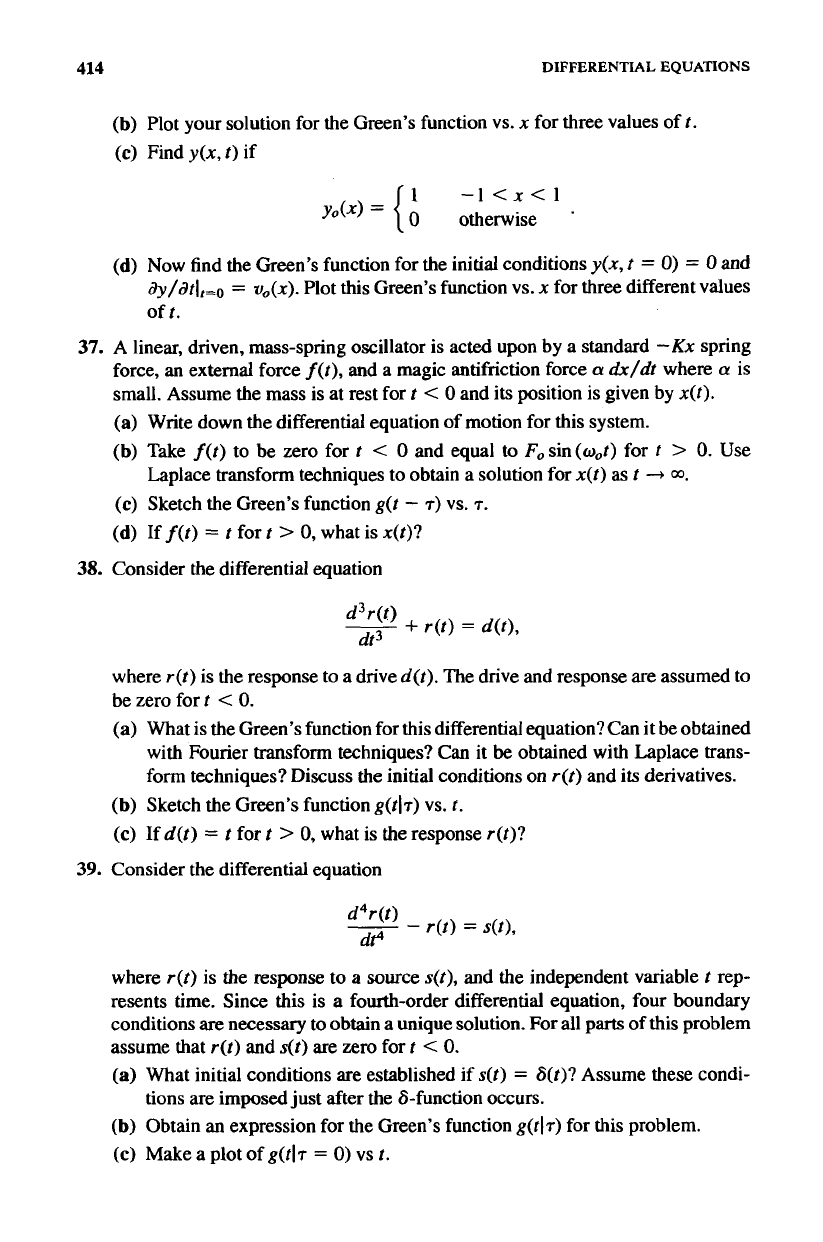
(a)
Assume that the initial conditions are y(x,
t
=
0)
=
yo(x) and
dy/dtl,=o
=
0.
Find the Green’s function that allows the displacement of the string
to
be
written as
414
DIFFERENTIAL
EQUATIONS
(b)
Plot your solution for the Green’s function vs.
x
for three values oft.
(c)
Find
y(x.
t)
if
(d)
Now find the Green’s function for the initial conditions
y(x,
t
=
0)
=
0
and
tly/atl,=o
=
vo(n).
Plot this Green’s function
vs.
x
for three different values
oft.
37.
A
linear, driven, mass-spring oscillator is acted upon by a standard
-
Kx
spring
force, an external force
f
(c),
and a magic antifriction force
a
&/dt
where
a
is
small. Assume the mass is at rest for
t
<
0
and its position is given by
x(f).
(a)
Write down the differential equation of motion for this system.
(b)
Take
f(t)
to be zero for
t
<
0
and equal to
Fo
sin
(wet)
for
t
>
0.
Use
(c)
Sketch the Green’s function
g(t
-
T)
vs.
T.
(d)
If
f(t)
=
t
for
t
>
0,
what is
x(t)?
Laplace transform techniques to obtain a solution for
x(t)
as
t
4
m.
38.
Consider the differential equation
+
r(t)
=
d(t),
d3r(t)
dt3
where
r(t)
is
the response to a drive
d(t).
The drive and response are assumed to
be zero fort
<
0.
(a)
What is the Green’s function for this differential equation?Can it be obtained
with Fourier transform techniques?
Can
it be obtained with Laplace trans-
form techniques? Discuss the initial conditions on
r(t)
and its derivatives.
(b)
Sketch the Green’s function
g(t)T)
vs.
f.
(c)
If
d(t)
=
t
for
t
>
0,
what is the response
r(t)?
39.
Consider the differential equation
where
r(t)
is
the response to a source
s(t),
and the independent variable
t
rep-
resents time. Since this is a fourth-order differential equation, four boundary
conditions
are
necessary to obtain a unique solution.
For
all
parts
of
this
problem
assume that
r(t)
and
s(c)
are
zero
fort
C
0.
(a)
What initial conditions are established if
s(t)
=
a(?)?
Assume these condi-
(b)
Obtain an expression for the Green’s function
g(h)
for this problem.
(c)
Make a plot of
g(tlT
=
0)
vs
t.
tions are imposed just after the &function occurs.
EXERCISES
415
40.
41.
42.
43.
Find the Green’s function for the differential equation
d2yo
+
y(x)
=
f(x)
dx2
over the interval
0
<
x
<
1,
with the boundary conditions
y(0)
=
y(1)
=
0.
Solve for
y(x)
if
f(x)
=
sin
(m).
Consider the linear operator
d2
dx2
Lop
=
-
+
1
and the differential equation
LpY(4
=
f(x).
For the initial conditions set
y(0)
=
0
and
dy/dxl,=,
=
0.
(a)
What is the Green’s function
g(x15)
for this operator and what are its bound-
(b)
Obtain the Green’s function solution for
y(x)
as specifically as you can,
(c)
Now set
f(x)
=
6(x
-
x,)
and, using your answer to part
(b),
determine
The equation of motion for a damped harmonic oscillator, driven
by
a force f(t),
takes the form
ary conditions?
while still leaving
f(x)
arbitrary.
Y(X>.
d2x(r)
+
aw
+
Kx(t)
=
f(t)
dt
m-
dt2
where the damping constant
a
is greater than zero, and
K
is the positive spring
constant. Assume
the
drive and response are zero fort
<
0.
(a)
Use Laplace transform techniques to obtain the Green’s function for this
problem.
(b)
What is
x(t)
if
F,
O<t<T,?
f(t)
=
{
0
otherwise
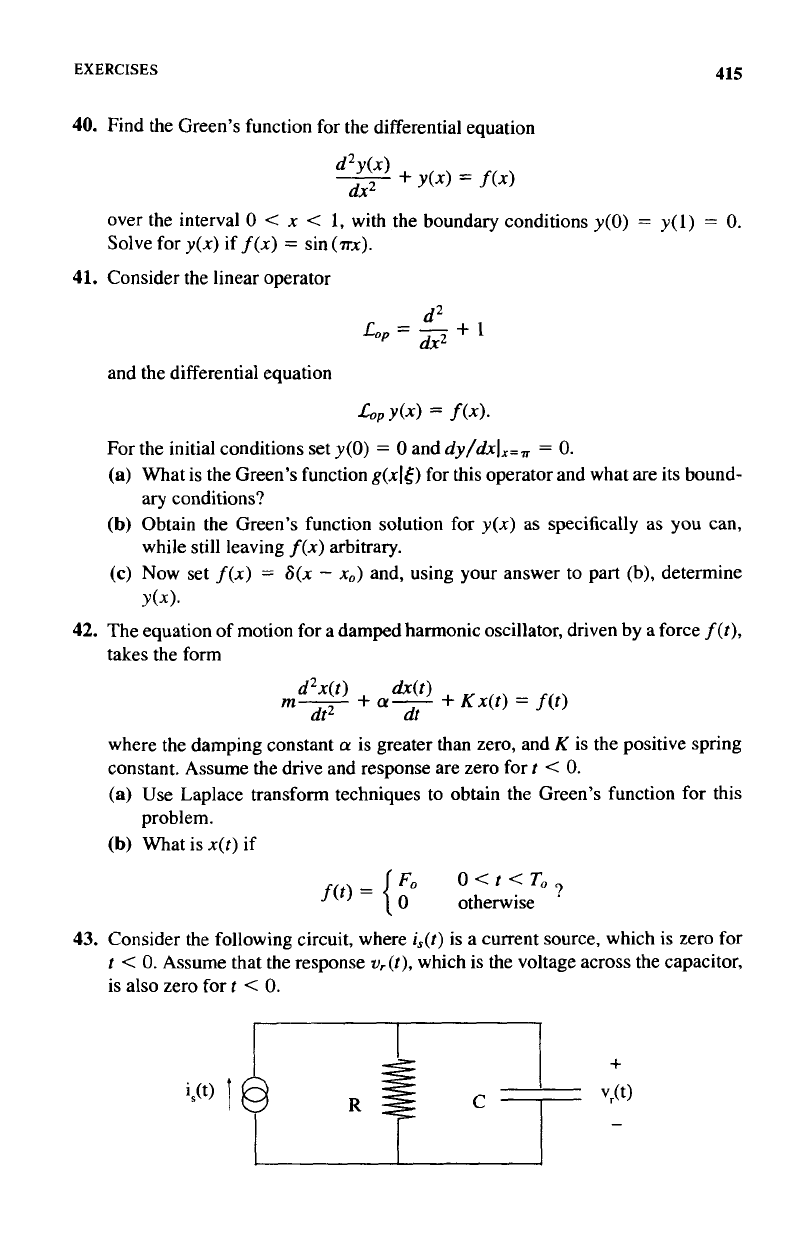
Consider the following circuit, where is(t) is a current source, which is zero for
t
<
0.
Assume that the response
vr(t),
which is the voltage across the capacitor,
is also
zero
for
t
<
0.