
Kusse B.R., Westwig E.A. Mathematical Physics: Applied Mathematics for Scientists and Engineers
Подождите немного. Документ загружается.

DIFFERENTIAL
EQUATIONS
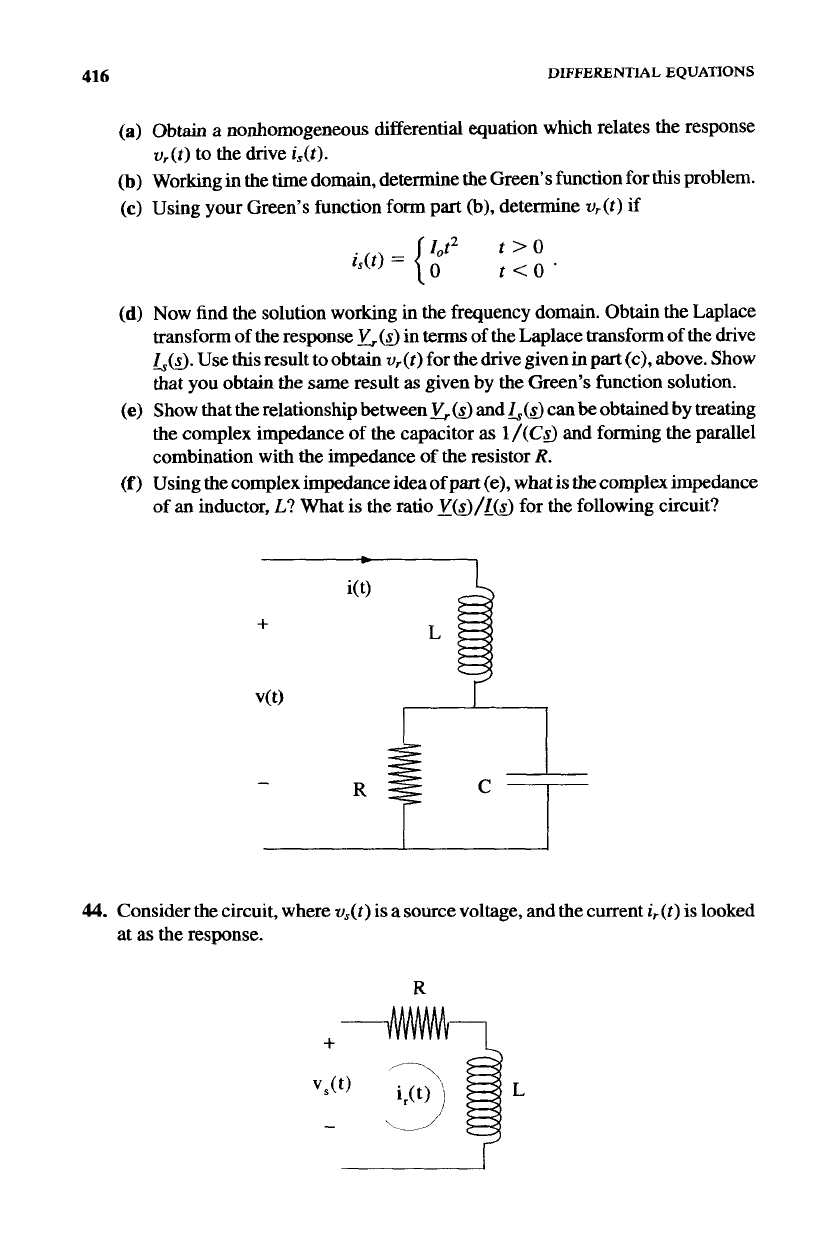
Obtain a nonhomogeneous differential equation which relates the response
v,(t)
to the drive
is(t).
Working
in
the time domain, determine the Green’s function for
this
problem.
Using your Green’s function form part
(b),
determine
vr(t)
if
Now find the solution working
in
the frequency domain. Obtain the Laplace
transform of the response
in
terms
of the Laplace transform of the drive
Z&J.
Use
this
result to obtain
v,(t)
for the drive given
in
part
(c),
above.
Show
that
you
obtain the same result
as
given by the Green’s function solution.
Show that the relationship between
V-,O
and
L(sJ
can
be
obtained
by
treating
the complex impedance
of
the capacitor
as
1
/(C$
and forming the parallel
combination with the impedance
of
the resistor
R.
Using the complex impedance idea
of
part
(e). what
is
the complex impedance
of
an
inductor,
L?
What
is
the ratio
vsJ/L(sJ
for the following circuit?
+
L
44.
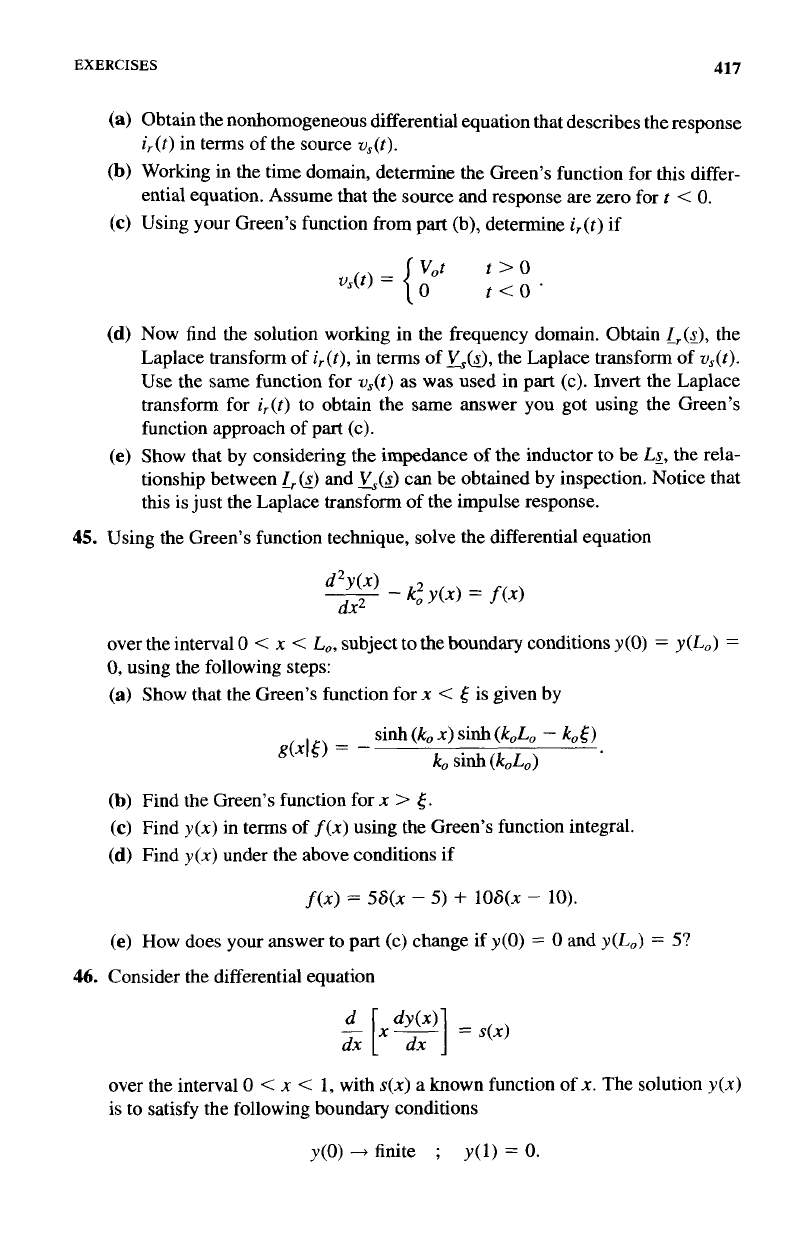
Consider the circuit, where
vs(t)
is a source voltage, and the current
i,(t)
is
looked
at
as
the response.
R
EXERCISES
417
Obtain the nonhomogeneous differential equation that describes the response
i,(t)
in terms of the source
vs(t).
Working in the time domain, determine the Green’s function for
this
differ-
ential equation. Assume that the source and response are zero for
t
<
0.
Using your Green’s function from part (b), determine
i,(t)
if
Now find the solution working in the frequency domain. Obtain
L,(S),
the
Laplace transform of
i,(t),
in terms of
VJs),
the Laplace transform of
vs(t).
Use the same function for
vs(t)
as was used in part (c). Invert the Laplace
transform for
i,(t)
to obtain the same answer you got using the Green’s
function approach of part (c).
Show that by considering the impedance
of
the inductor to be
Ls,
the rela-
tionship between
I,@)
and
VJsJ
can be obtained by inspection. Notice that
this
is
just the Laplace transform of the impulse response.
45.
Using the Green’s function technique, solve the differential equation
--
d2y(x)
k,’
y(x)
=
f(x)
dx2
over the interval
0
<
x
<
Lo,
subject to the boundary conditions
y(0)
=
y(Lo)
=
0,
using the following steps:
(a)
Show that the Green’s function for
x
<
5
is given by
(b)
Find the Green’s function for
x
>
6.
(c)
Find
y(x)
in terms of
f(x)
using the Green’s function integral.
(d)
Find
y(x)
under the above conditions if
f(x)
=
56(x
-
5)
+
106(x
-
10).
(e)
How does your answer to part (c) change if
y(0)
=
0
and
y(Lo)
=
5?
46.
Consider the differential equation
over the interval
0
<
x
<
1,
with
s(x)
a
known function of
x.
The solution
y(x)
is to satisfy the following boundary conditions
y(0)
+
finite
;
y(1)
=
0.
DIFFERENTIAL EQUATIONS
418
(a)
What differential equation must be satisfied by
&XI(),
the Green’s function
(b)
What is the general form of
&I{)
for
x
<
{
and
x
>
t?
(c)
What conditions must
g(x&
and
its
derivative with respect to
x
satisfy at
(d)
Using
your
results from
part
(c) and the boundary conditions, determine
(e)
Sketch
g(x1.E)
vs.
x
for a fixed
5,
over the range
0
<
x
<
1.
for
this
problem?
x
=
5?
&I&)
in
the range
0
<
x
<
1.
47.
Find the Green’s function for the differential equation
subject to the boundary conditions
y(0)
=
y(
1)
=
0.
The Green’s function must
satisfy
g(x/{)
=
6(x
-
5).
dx2
dx
It may be easier, however, to solve for the Green’s function from
48. This
problem involves the diffusion of magnetic field into an electrically conduct-
ing material. The material is characterized
by
a constant electrical conductivity
mo
and magnetic susceptibility
po
and
exists in the half-plane
x
>
0.
Free space
fills the region
x
<
0.
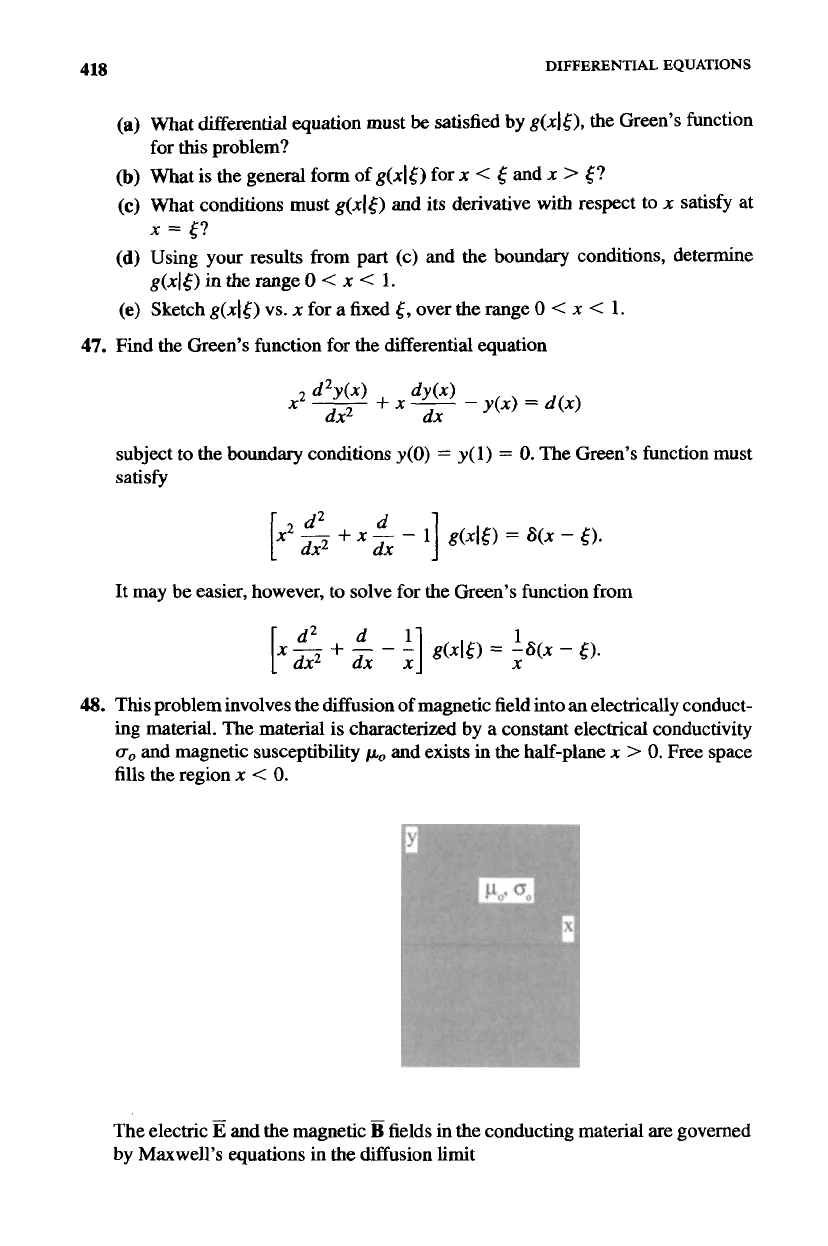
The electric
E
and the magnetic
B
fields in the conducting material are governed
by
Maxwell’s equations in the diffusion limit
EXERCISES
419
Treat the material
as
if it were one-dimensional (i.e., all quantities have
a/&
=
0
and
d/dy
=
0)
and use these equations to obtain the diffusion equation
a2B(x,t)
-
dB(x,
t)
=,Po
7.
____
dX2
Now consider the situation where the magnetic field is controlled in the free
space region
so
that
B(x,
t)
=
B,(t)C,
for
x
<
0.
A
Green’s function solution for
B(x,
t)
in the region
x
2
0
is sought,
so
that the solution for the magnetic field
can be placed in the following form:
dTB,(T)g(x,
t)T)&.
(a)
What differential equation and what boundary conditions at
x
=
0
must
(b)
Determine
G(x,
WIT),
the Fourier transform of
g(x,
t1~).
(c)
Describe the restrictions that must be placed
on
the function
B,(t)
in
order
g(n,
t)~)
satisfy?
for the above solution to
be
valid.
49.
Consider the one-dimensional wave equation
-
-
Z]
r(x,
t)
=
s(x,
t).
[;:2
c:
at2
where the source term
s(x,
t)
and the response
r(x,
t)
are both zero for
t
<
0.
(a)
Obtain the Green’s function
g(x15,
t)T)
for this problem that allows the re-
sponse to be written as
r(x,
t)
=
/:
d5
dTs(8,
T>g(x15,
tb).
(b)
Plot
g(x16,
r)T)
vs.
x
for three different values oft, one value less than
T
and
Note that if
f(x)
is a unit step from
-a
<
x
<
a,
the Fourier transform of
f(x)
is
two values greater
than
T.
DIFFERENTIAL
EQUATIONS
420
50.
In
the chapter, we derived the Green’s function for the wave equation in Equation
10.307.
(a)
How
is
g(x15)
modified if we have the additional boundary condition
(b)
Make a plot
of
this Real[g(x(&eioJ
J
for several different times-as many as
(c)
What physical situation does this new boundary condition represent?
g(x
=
015)
=
O?
are
needed
to
show its character.
51.
In free space, electromagnetic waves propagate according to Maxwell’s equations
d€&(;Ci,
t)
v
x
E(F,t)
=
+
at
’
which can be combined
to
give the wave equation
If, instead of free space, the wave is propagating in a dielectric medium that is
spatially dependent, i.e.,
€0
--f
€0
+
em,
(a)
Show that the wave equation becomes
(b)
Consider a wave propagating at a pure real frequency
w,,
so
that
E(F,
t)
+
-
E(F)
e“’’.’. This is like taking
a
Fourier transform in time. Show that the wave
equation becomes
-
-
V
2-
E(r)
-
-
w~poeo&~)
=
+
w,~~~E(F)&F).
Now
let
e(F)
=
6(x)
to model a sheet of infinite dielectric in the
x
=
0
plane.
Assume there is
no
variation of the electric field
in
the y-direction,
and
that the
spatial dependence of the field can
be
expressed as
-
4
e
eY*
-
E(F)
=
E
eikIx
ik,z
A
This
is
like taking Fourier transforms in the two spatial directions.
(c)
Find
k,
and
k,
for
x
>
0
and
x
<
0.
(d)
Can
this solution for the electric field be used as a Green’s function for
finding the solution for
an
arbitrary
E(x)?
EXERCISES
421
52.
53.
54.
This problem
looks
at the diffusion of heat along an infinite rod with the temper-
ature at
x
=
0
controlled for all time,
t>O
t<O’
T(x
=
0,t)
=
{P
The standard diffusion equation applies
d2T(x,
t)
dT(x,
t)
D2-
-
=
0,
dX2
dt
which, with the above boundary condition and the assumption that
T(x,
t)
----f
0
as
1x1
-+
m,
uniquely determines
T(x,r)
for all
x
and
r
>
0.
The solution for
T(x,
r)
can be obtained from a Green’s function integral
(a)
Identify the differential equation
and
boundary conditions that
g(x,
t1~)
must
(b)
Determine
g(x,
t1~).
The following Laplace transform will probably be of
satisfy.
help:
k
_-
e-k2/(4t)
C-f
e-kfi
2J.ITt3
(k
>
0).
A differential equation is said to be
in
Sturm-Liouville form if it can be written
as
where
a(x),
b(x),
and
s(x)
are known functions of the independent variable.
All linear, second-order differential equations can be placed in this form. This
particular form has many advantages, as will be shown in the next chapter. The
differential equation
x2
d2y(x)
___
+
(x2
cos
x
+
2x)-
dy(x)
+
xy(x)
=
d(x)
dx2
dx
can be placed in Sturm-Liouville form by multiplying both sides of this equation
by a function
f(.x).
(a)
What
f(x)
will accomplish this?
(b)
What is the final Sturm-Liouville form for this equation?
If a particular differential equation is not in Sturm-Liouville form (see Exercise
10.53),
the Green’s function for the equation in the non-Stunn-Liouville form
will be different from the Green’s function for the equation in Sturm-Liouville
422 DIFFERENTIAL
EQUATIONS
form. Consider the differential equation:
with the
boundary
conditions
y(0)
=
y(1)
=
0.
(a)
What
is
the Green’s function for
this
problem
as
described by the differential
(b)
Place the differential equation in Sturm-Liouville form.
(c)
What
is
the Green’s function for the differential equation
in
Sturm-Liouville
form?
(d)
Formulate the response of the system to a drive
d(t)
using the Green’s
functions obtained for parts (a) and (c) above and show that these responses
are identical.
55.
In
this
chapter, we have seen cases where the Green’s function was symmetric
equation given above?
with respect to
x
and
5.
That is to say,
In
this
problem you are being asked
to
show the general conditions that are
necessary for
this
symmetry to hold. Prove that
if
the differential equation
is
in Sturm-Liouville form (see Exercise
10.53)
and the boundary conditions
are
homogeneous, the Green’s function will always have
this
symmetry.
To
show
that
this
is
the
case, begin by writing the differential equation that
satisfies for
two
different values
of
5:
51
and
52.
Multiply the first by
g(&)
and the second by
g(x151)
and subtract to obtain:
Show that
this
expression becomes
Now
if
the solution is to be valid over the range
x1
<
x
<
x2,
and the boundary
conditions are such that the function or its derivative must go to zero at
x
=
xl
and
x
=
x2,
show that the above equation can
be
integrated to give
EXERCISES
423
56.
Using the steps outlined in the previous problem, determine the symmetry prop-
erties of the Green’s function that satisfies the differential equation
x3
-
d2y(x)
+
x2
dyo
-
xy(x)
=
d(x),
dx2 dx
with the boundary conditions
y(0)
=
y(1)
=
0.
Note that
this
differential
equation is not in Sturm-Liouville form.
11
SOLUTIONS
TO
LAPLACE'S EQUATION
It would
be
impossible to discuss all the different types of differential equations
encountered in physics and engineering problems.
In
this
chapter, we will concentrate
on just one, Laplace's equation, because it occurs in
so
many types
of
practical
problems.
In
vector notation, valid in any coordinate system, Laplace's equation is
V2@
=
0.
(11.1)
We will investigate methods of its solution
in
the three most common coordinate
systems: Cartesian, cylindrical, and spherical. The solution methods we present here
will also
be
applicable to many other differential equations.
11.1
CARTESIAN
SOLUTIONS
In Cartesian coordinates, Laplace's equation becomes
(1
1.2)
A
standard
approach to solving
this
equation is
to
use the method
of
separation
of
variables.
In
this method,
we
assume
@(x,
y,
z)
can
be
written
as
the product
of
three
functions, each of which involves only one of the independent variables. That is,
@(n,
y, z)
=
X(X)Y (Y)Z(Z).
(11.3)
It
is important to note that not all the possible solutions of Laplace's equation
in
Cartesian coordinates have the special separated form
of
Equation
11.3.
As
it turns
424
CARTESIAN
SOLUTIONS
425
out, however, all solutions can
be
written as a linear sum (of potentially infinite
number of terms) of these separable solutions.
You
will
see
examples of this as the
chapter progresses. Using
this
form
for
@(x,
y,
z),
Laplace’s equation becomes
(11.4)
Each of the three
terms
on the
LHS
of
Equation 11.4 is a function of only one
of the independent variables.
This
means that,
for
example,
the
sum
of
the last two
terms
(1
1.5)
cannot depend
on
x.
A
quick look back at Equation
1
1.4 shows that this implies the
first term, itself, also cannot be a function of
x.
It obviously
is
not a function
of
y
or
z
either,
so
it must be equal to a constant:
Similar arguments can be made to isolate the other terms:
(11.6)
(11.7)
(11.8)
The
three
quantities
c,,
cy,
and
cz
are called separation constants. Notice that they
are not completely independent of one another, because Laplace’s equation requires
c,
+
cy
+
c,
=
0.
(11.9)
Consequently, only two
can
be chosen arbitrarily.
11.1.1
Each
of
the three separated equations (Equations 11.6-1 1.8) is the same linear,
second-order differential equation. The solution to Equation
1
1.6,
for a particular,
nonzero value
of
c,,
is
simply
Solutions
of
the Separated
Equations
X(x)
=
x+e+@
+
x-e-fi,
c,
#
0,
(11.10)
where
X+
and
X-
are arbitrary amplitudes, which are determined only when we apply
the boundary conditions. When
this
general solution is combined with
Y
(y)
and
Z(z),
these constants combine with the corresponding
Yt
and
Zt
constants to
form
other
constants.
For
this reason, we will ignore these amplitude constants until the final