
Kusse B.R., Westwig E.A. Mathematical Physics: Applied Mathematics for Scientists and Engineers
Подождите немного. Документ загружается.

436
SOLUTIONS
TO
LAPLACE’S
EQUATION
In
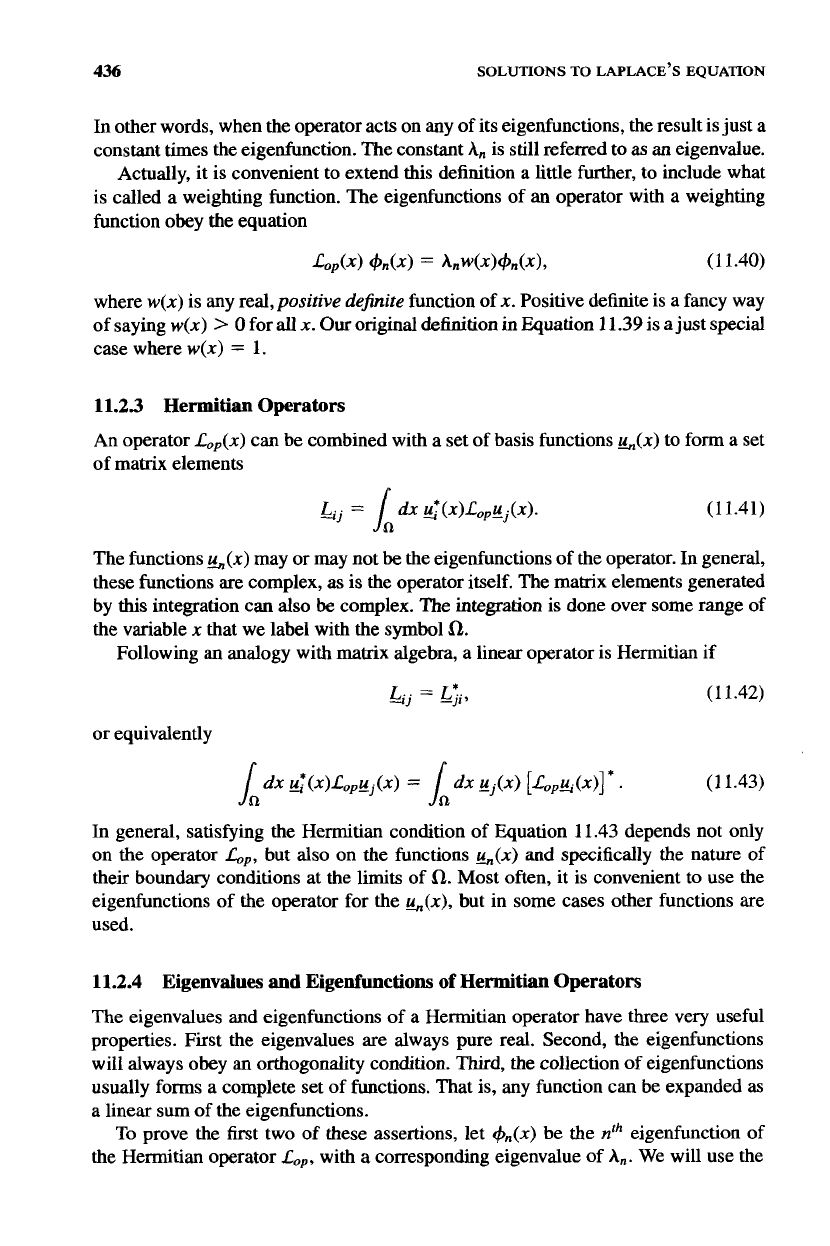
other words, when the operator acts on any of its eigenfunctions, the result is just a
constant times the eigenfunction. The constant
A,
is still referred to
as
an
eigenvalue.
Actually, it is convenient to extend
this
definition a little further, to include what
is called
a
weighting function. The eigenfunctions of an operator with a weighting
function
obey
the equation
-Lp(x> b(x)
=
Lw(x)4+l(x),
(11.40)
where
w(x)
is any real,
positive definite
function of
x.
Positive definite is a fancy way
of saying
w(x)
>
0
for
all
x.
Our original
definition
in Equation 11.39 is a just special
case
where
w(x)
=
1.
11.23
Hermitian Operators
An operator
Lop(x)
can be combined with a set of basis functions
h(x)
to form a set
of
matrix elements
hi
=
ldx g(x)LoPgj(x).
(11.41)
The functions
%(x)
may or may not
be
the eigenfunctions of the operator.
In
general,
these functions
are
complex, as
is
the operator itself. The matrix elements generated
by
this
integration can also
be
complex.
The
integration is done over some range of
the
variable
x
that we label with
the
symbol
M.
Following
an
analogy with matrix algebra, a linear operator is Hermitian if
hj
=
LJi,
(11.42)
or equivalently
(1 1.43)
In general, satisfying the Hermitian condition of Equation 11.43 depends not only
on the operator
GP,
but also on the functions
&(x)
and specifically the nature
of
their boundary conditions at the limits of
M.
Most often, it is convenient to use the
eigenfunctions of
the
operator for the
&(x),
but in some cases other functions are
used.
11.2.4
Eigenvalues and Eigenfunctions
of
Hermitian
Operators
The eigenvalues and eigenfunctions of a Hermitian operator have three very useful
properties. First the eigenvalues are always pure real. Second,
the
eigenfunctions
will always obey an orthogonality condition.
Third,
the collection
of
eigenfunctions
usually forms a complete set of functions. That is, any function can be expanded as
a linear
sum
of the eigenfunctions.
To
prove the
first
two of these assertions, let
&(x)
be the
nth
eigenfunction of
the Hermitian operator
.Lop,
with
a
corresponding eigenvalue of
A,.
We will use the
EXPANSIONS WITH
EIGENFUNCTIONS
437
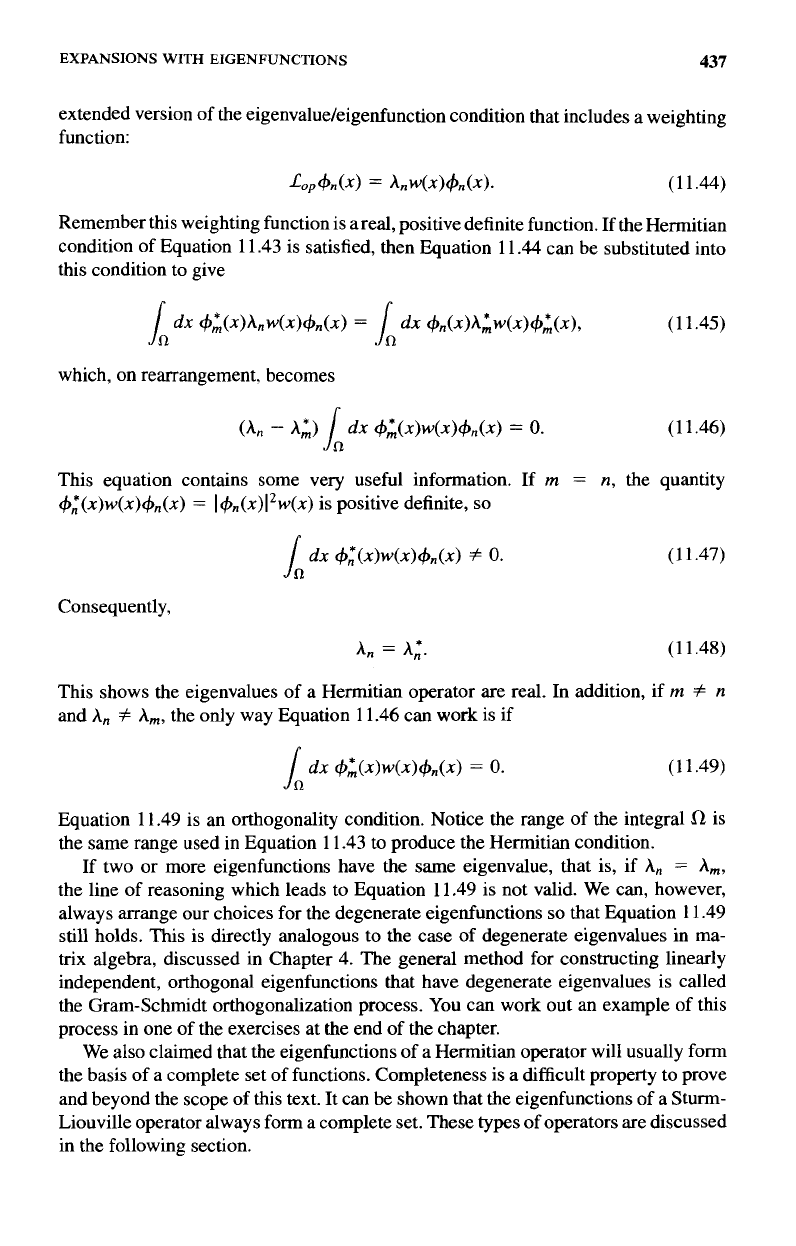
extended version of the
eigenvalueleigenfunction
condition that includes a weighting
function:
Remember this weighting function is areal, positive definite function. If the Hermitian
condition of Equation 1 1.43 is satisfied, then Equation 1 1.44 can be substituted into
this condition to give
which, on rearrangement. becomes
(11.45)
(1
1.46)
This equation contains some very useful information. If
m
=
n,
the
quantity
4~(x)w(x>4,(x)
=
I+,(x)12w(x)
is positive definite,
so
(I
1.47)
Consequently,
A,
=
A,*.
(11.48)
This shows the eigenvalues of a Hermitian operator
are
real. In addition, if
m
#
n
and
A,
#
A,,
the only way Equation 11.46 can work is if
(1
1.49)
Equation 11.49
is
an orthogonality condition. Notice the range of the integral
fl
is
the same range used in Equation 1 1.43 to produce the Hermitian condition.
If two or more eigenfunctions have the same eigenvalue, that is, if
A,
=
A,,,,
the line of reasoning which leads to Equation 11.49 is not valid. We can, however,
always arrange our choices for the degenerate eigenfunctions
so
that Equation 1 1.49
still holds. This is directly analogous to the case of degenerate eigenvalues in ma-
trix
algebra, discussed in Chapter 4. The general method for constructing linearly
independent, orthogonal eigenfunctions that have degenerate eigenvalues is called
the Gram-Schmidt orthogonalization process.
You
can work out an example of this
process in one
of
the exercises at the end of the chapter.
We also claimed that the eigenfunctions of a Hermitian operator will usually form
the basis of a complete set of functions. Completeness is a difficult property to prove
and beyond the scope of this text. It can be shown that the eigenfunctions of a Sturm-
Liouville operator always form a complete set. These types of operators are discussed
in the following section.
438
SOLUTIONS
TO
LAPLACE’S EQUATION
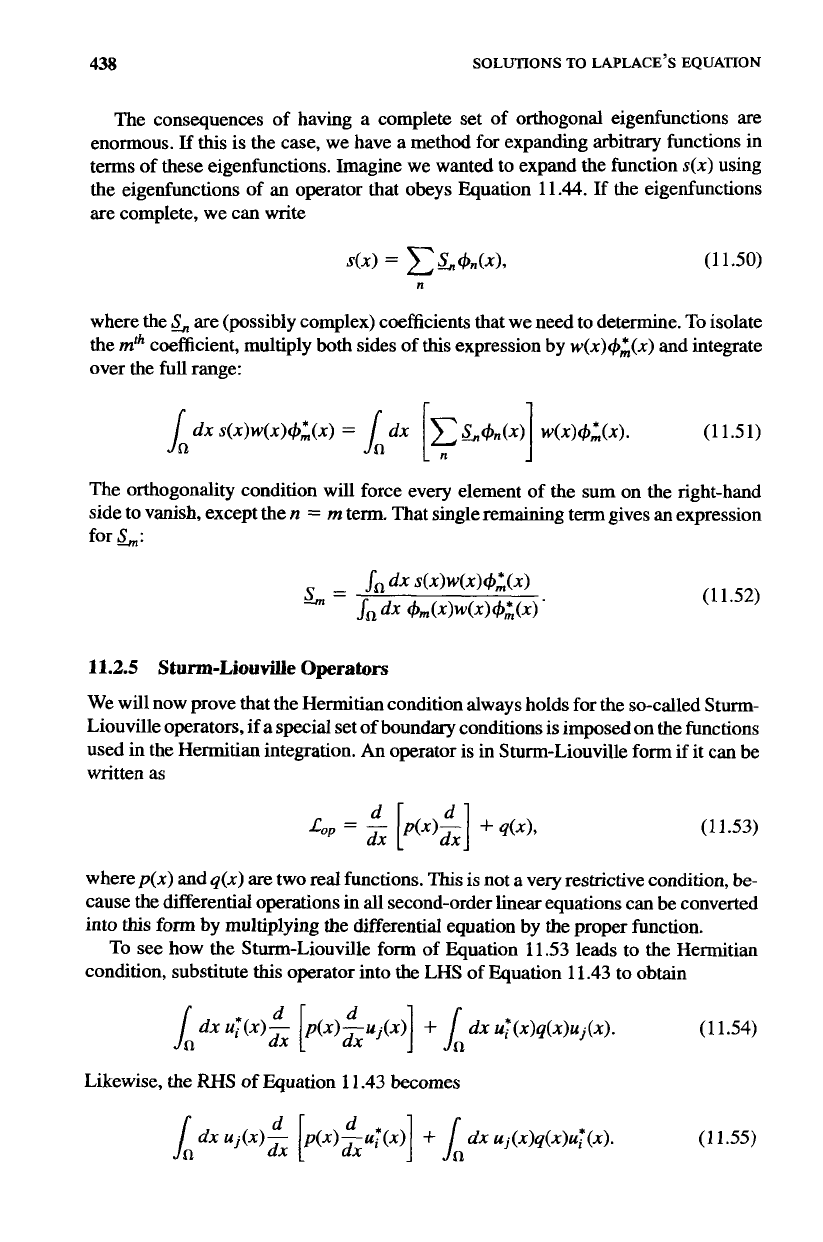
The consequences of having a complete set of orthogonal eigenfunctions are
enormous.
If
this
is the case, we have a method for expanding arbitrary functions in
terms of these eigenfunctions. Imagine we wanted to expand the function
s(x)
using
the eigenfunctions of an operator that obeys Equation 11.44. If the eigenfunctions
are complete, we can write
s(x)
=
CS,
ACxX
(11.50)
n
where the
S,
are (possibly complex) coefficients that we need to determine.
To
isolate
the
mth
coefficient, multiply both sides of
this
expression by
w(x)~&)
and integrate
over the full range:
The orthogonality condition will force every element of the sum on the right-hand
side to vanish, except the
n
=
m
term. That single remaining term gives an expression
for
S-:
(11.52)
11.2.5 Sturn-Liouville
Operators
We will now prove that the Hermitian condition always holds for the so-called Sturm-
Liouville operators, if a
special
set
of
boundary conditions is imposed on the functions
used in the Hermitian integration.
An
operator is in Sturm-Liouville form
if
it can be
written
as
(1
1.53)
where
p(x)
and
q(n)
are two real functions.
This
is not a very restrictive condition,
be-
cause the differential operations in all second-order linear equations can be converted
into
this
form by multiplying the differential equation by the proper function.
To
see how the Sturm-Liouville form
of
Equation 11.53 leads to the Hermitian
condition, substitute
this
operator into the LHS
of
Equation 1 1.43 to obtain
Likewise, the
RHS
of
Equation 11.43 becomes
(1
1.54)
(1
1.55)
EXPANSIONS
WITH
EIGENFUNCTIONS
439
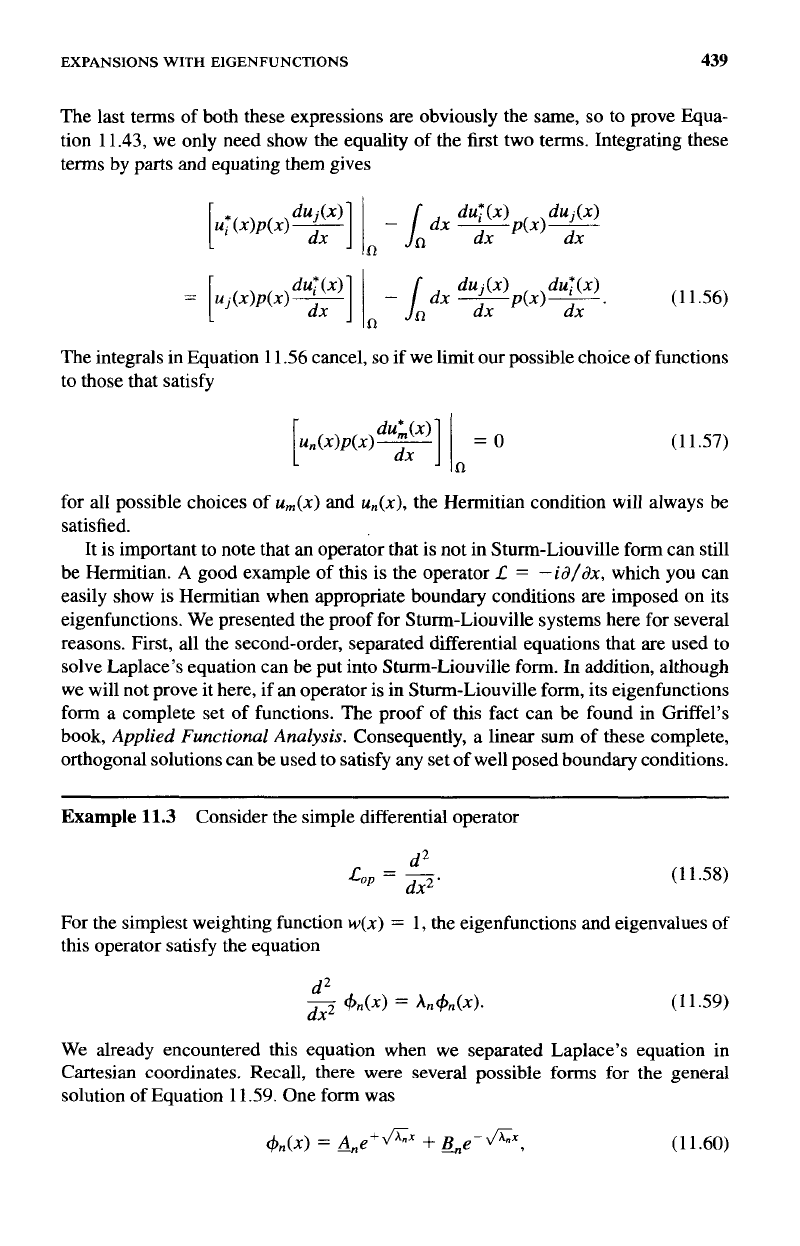
The last terms of both these expressions
are
obviously the same,
so
to prove Equa-
tion 11.43, we only need show the equality of the first two terms. Integrating these
terms by parts and equating them gives
The integrals in Equation
1
1.56 cancel,
so
if we limit our possible choice of functions
to those that satisfy
(1
1.57)
for all possible choices of
u,(x)
and
u,(x),
the Hermitian condition will always be
satisfied.
It is important to note that
an
operator that is not in Sturm-Liouville form can still
be Hermitian.
A
good example of this is the operator
L
=
-iJ/dx,
which you can
easily show is Hermitian when appropriate boundary conditions are imposed on its
eigenfunctions. We presented the proof for Sturm-Liouville systems here for several
reasons. First, all the second-order, separated differential equations that are used to
solve Laplace's equation can be put into Sturm-Liouville form.
In
addition, although
we will not prove it here, if an operator is in Sturm-Liouville
form,
its eigenfunctions
form a complete set of functions. The proof
of
this
fact can be found in Griffel's
book,
Applied Functional Analysis.
Consequently, a linear sum of these complete,
orthogonal solutions can be used to satisfy any set of well posed boundary conditions.
Example
11.3
Consider the simple differential operator
d2
dx2
Lop
=
-.
(1 1.58)
For the simplest weighting function
w(x)
=
1,
the eigenfunctions and eigenvalues of
this operator satisfy the equation
(11.59)
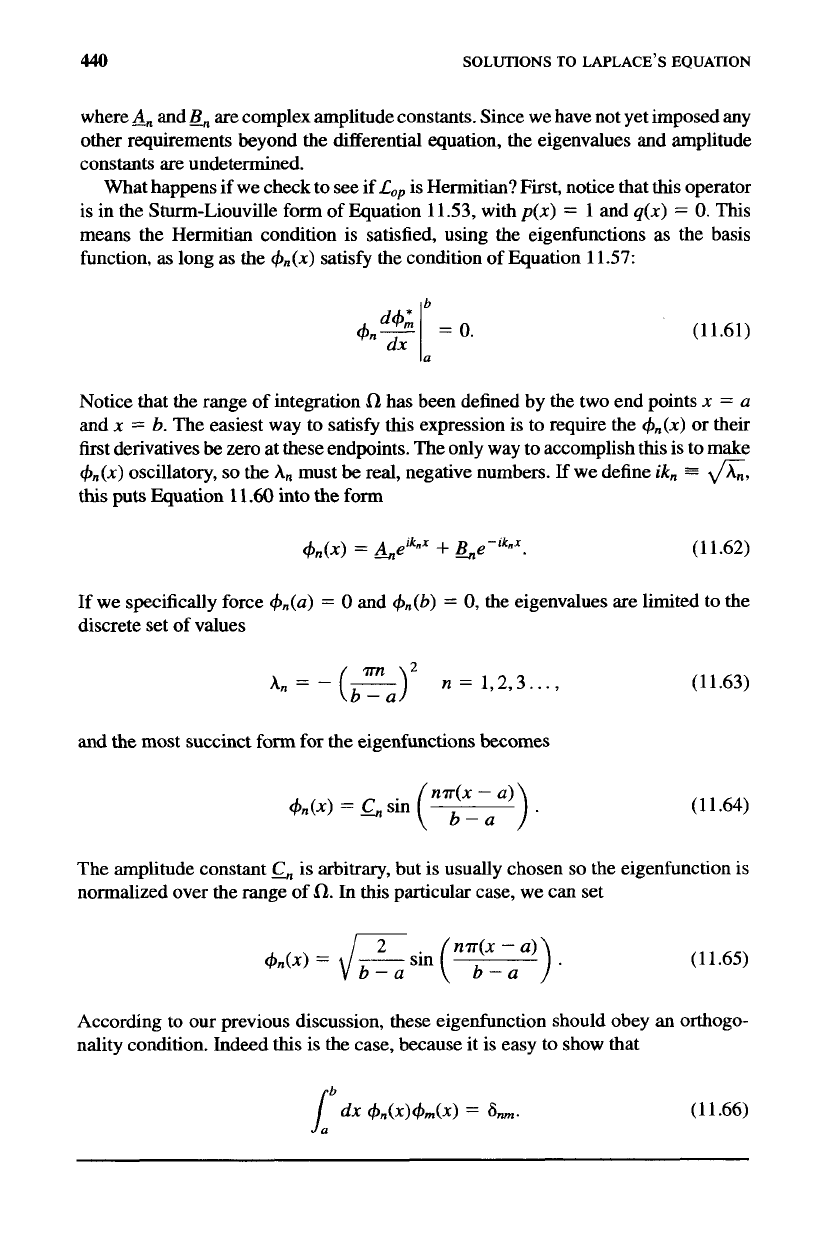
We already encountered this equation when we separated Laplace's equation in
Cartesian coordinates. Recall, there were several possible forms for the general
solution of Equation 1 1.59. One form was
440
SOLUTIONS
TO
LAPLACE'S
EQUATION
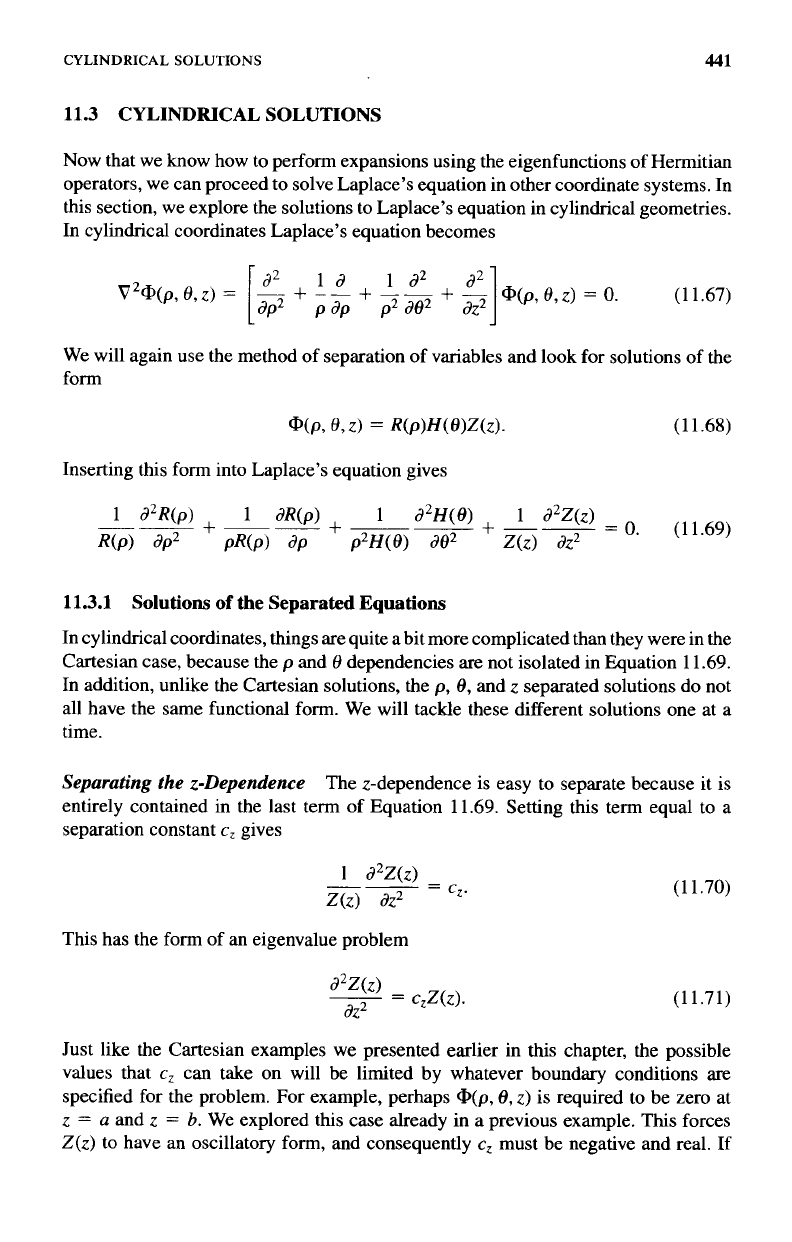
where
A,,
and
B,,
are
complex amplitude constants. Since we have not yet imposed any
other requirements beyond the differential equation, the eigenvalues and amplitude
constants are undetermined.
What happens if we check to see
if
Lop
is Hermitian? First, notice that
this
operator
is in
the
Sturm-Liouville form
of
Equation 11.53, with
p(x)
=
1 and
4(x)
=
0.
This
means the Hermitian condition is satisfied, using the eigenfunctions as the basis
function, as long as the
+,,(x)
satisfy the condition
of
Equation
11.57:
(11.61)
Notice that the range of integration
a
has been defined by the two end points
x
=
a
and
x
=
b.
The easiest way to satisfy
this
expression
is
to require
the
+,,(x)
or their
first derivatives
be
zero at these endpoints. The only way to accomplish this
is
to make
+,,(x)
oscillatory,
so
the
A,,
must
be
real, negative numbers.
If
we define
ik,,
E
6,
this
puts Equation
1
1.0
into
the form
If we specifically force
+,,(a)
=
0
and
+,,(b)
=
0,
the
eigenvalues are limited to the
discrete set
of
values
A,,
=
-
(">z
n
=
1,2,3
...,
b-a
and the most succinct form for the eigenfunctions becomes
(11.63)
(1 1.64)
The amplitude constant
C-
is
arbitrary, but is usually chosen
so
the
eigenfunction is
normalized over the range of
a.
In
this
particular case, we can set
(1
1.65)
According to our previous discussion, these eigenfunction should obey
an
orthogo-
nality condition. Indeed
this
is the case, because it is easy
to
show that
(1
1.66)
CYLINDRICAL
SOLUTIONS
441
11.3
CYLINDRICAL
SOLUTIONS
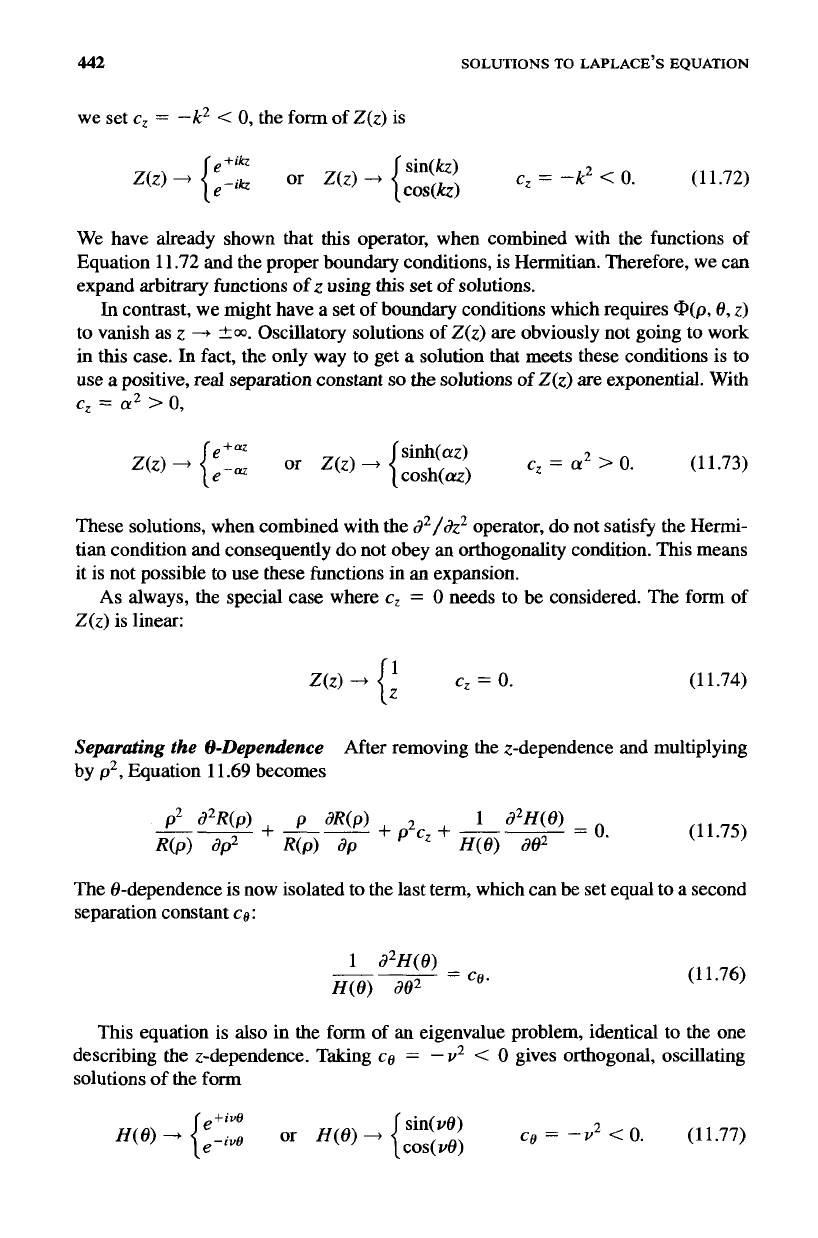
Now that we know how to perform expansions using the eigenfunctions of Hennitian
operators, we can proceed
to
solve Laplace’s equation in other coordinate systems. In
this section, we explore the solutions
to
Laplace’s equation in cylindrical geometries.
In
cylindrical coordinates Laplace’s equation becomes
We will again use the method
of
separation
of
variables and look for solutions of the
form
Inserting this form into Laplace’s equation gives
11.3.1
In cylindrical coordinates, things are quite a bit more complicated than they were in the
Cartesian case, because the
p
and
8
dependencies
are
not isolated in Equation 11.69.
In addition, unlike the Cartesian solutions, the
p,
8,
and
z
separated solutions do not
all have the same functional form. We will tackle these different solutions one at
a
time.
Solutions
of
the Separated Equations
Separating
the
z-Dependence
The z-dependence is easy to separate because it is
entirely contained in the last term
of
Equation 11.69. Setting this term equal to a
separation constant
c,
gives
This has the form of an eigenvalue problem
--
a2z(z)
-
CzZ(Z).
822
(1
1.70)
(11.71)
Just like the Cartesian examples we presented earlier in
this
chapter, the possible
values that
cz
can take
on
will be limited by whatever boundary conditions are
specified
for
the problem. For example, perhaps
Q(p,
8,
z)
is required to be zero at
z
=
a
and
z
=
b.
We explored this case already in a previous example. This forces
Z(z) to have an oscillatory form, and consequently
c,
must be negative and real. If
442
SOLUTIONS
TO
LAPLACE’S EQUATION
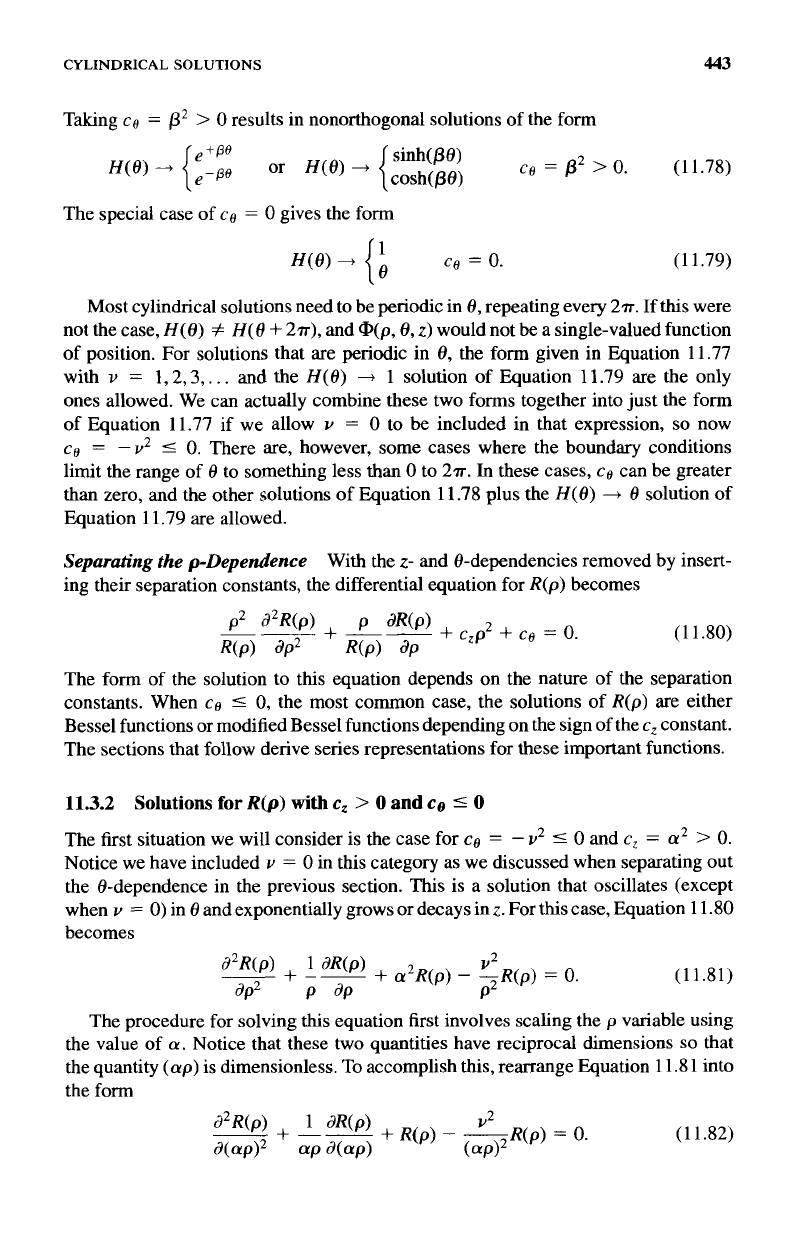
we set
c,
=
-k2
<
0,
the form of
Z(z)
is
We have already shown that
this
operator, when combined with the functions of
Equation
1
1.72 and the proper boundary conditions,
is
Hermitian. Therefore, we can
expand arbitrary functions of
z
using
this
set of solutions.
In
contrast, we might have
a
set of boundary conditions which requires
@(p,
8,
z)
to vanish
as
z
--+
203.
Oscillatory solutions of
Z(z)
are obviously not going to work
in
this
case.
In
fact,
the
only way to get
a
solution that meets these conditions is to
use
a
positive, real separation constant
so
the solutions of
Z(z)
are exponential. With
c,
=
a2
>
0,
These solutions, when combined with the
d2/dz2
operator, do not satisfy the Hermi-
tian condition and consequently do not obey an orthogonality condition.
This
means
it is not possible to use these functions in an expansion.
As
always, the special case where
c,
=
0
needs to be considered. The form of
Z(z)
is linear:
c,
=
0.
(1 1.74)
Separating
the
@-Dependence
by
p2,
Equation 11.69 becomes
After removing the 2-dependence and multiplying
The @-dependence is now isolated
to
the last term, which can be set equal to a second
separation constant
co:
(1 1.76)
This
equation is also in the form of
an
eigenvalue problem, identical to the one
describing
the
z-dependence. Taking
co
=
-v2
<
0
gives orthogonal, oscillating
solutions of the
form
CYLINDRICAL SOLUTIONS
443
Taking
ce
=
p2
>
0
results in nonorthogonal solutions of the
form
The special case of
ce
=
0
gives the
form
cg
=
0.
(1 1.79)
Most cylindrical solutions need to be periodic
in
8,
repeating every
27r.
If
this
were
not the case,
H(8)
#
H(8
+
27r),
and
@(p,
8,
z)
would not be a single-valued function
of position. For solutions that are periodic in
6,
the
form
given in Equation 11.77
with
v
=
1,2,3,.
.
.
and the
H(0)
+
1
solution
of
Equation 11.79
are
the only
ones allowed. We can actually combine these two
forms
together into just the form
of
Equation 11.77 if we allow
v
=
0
to be included in that expression,
so
now
ce
=
-v2
5
0.
There are, however, some cases where the boundary conditions
limit the range of
8
to something less than
0
to
27r.
In
these cases,
cg
can be greater
than zero, and the other solutions
of
Equation
11.78
plus the
H(8)
+
8
solution of
Equation 1 1.79 are allowed.
Separating the p-Dependence
With the
z-
and 6-dependencies removed by insert-
ing their separation constants, the differential equation for
R(p)
becomes
(11.80)
The
form
of
the solution to this equation depends on the nature
of
the separation
constants. When
c~
I
0,
the most common case, the solutions of
R(p)
are either
Bessel functions or modified Bessel functions depending on the sign
of
the
c,
constant.
The sections that follow derive series representations for these important functions.
11.3.2 Solutions
for
R(p)
with
c,
>
0
and
Cg
I
0
The first situation we will consider is the case
for
ce
=
-
v2
zs
0
and
cz
=
a2
>
0.
Notice we have included
v
=
0
in
this
category as we discussed when separating out
the 8-dependence in the previous section.
This
is a solution that oscillates (except
when
v
=
0)
in
8
and exponentially grows or decays in
z.
For
this case, Equation 1 1.80
becomes
(11.81)
The procedure for solving
this
equation first involves scaling the
p
variable using
the value
of
a.
Notice that these two quantities have reciprocal dimensions
so
that
the quantity
(ap)
is dimensionless. To accomplish
this,
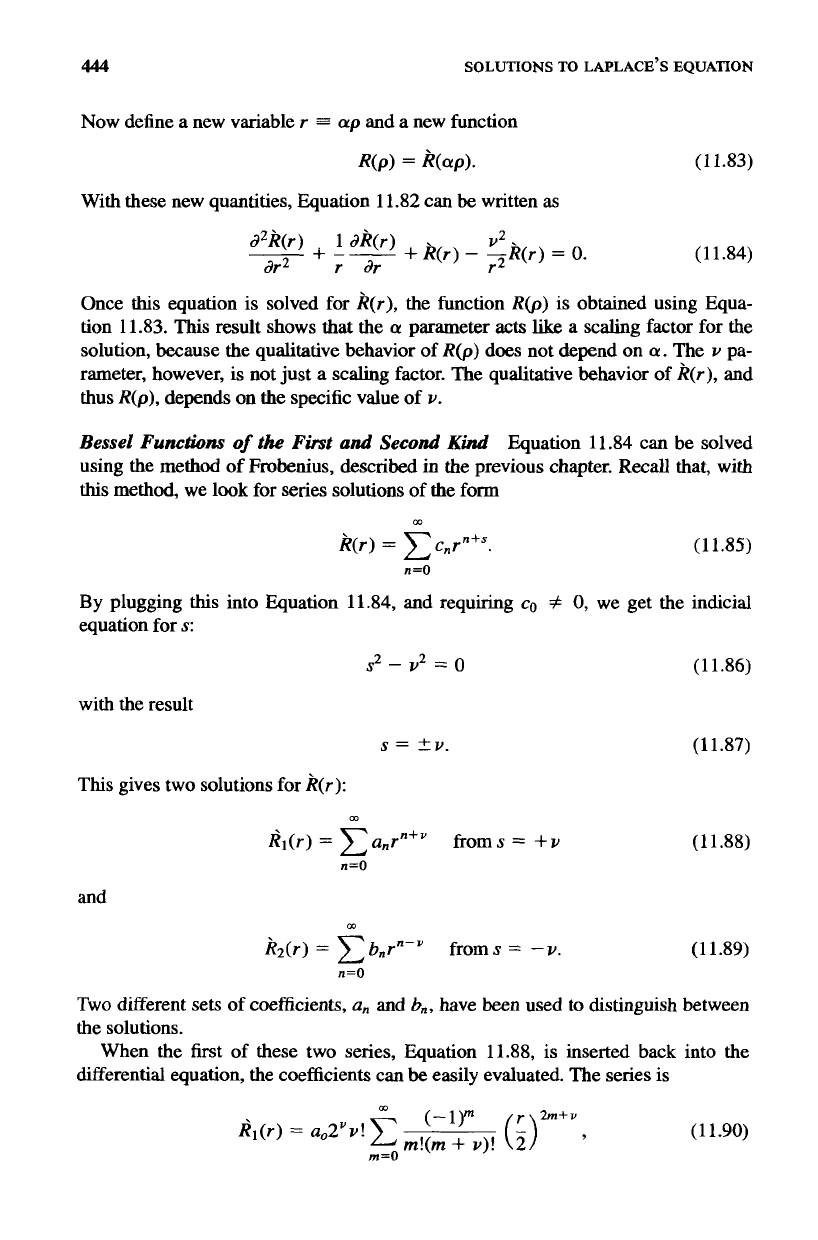
rearrange Equation 11.8 1 into
the form
(11.82)
444
SOLUTIONS
TO
LAPLACE’S
EQUATION
Now define a new variable
r
=
cup
and a new function
NP)
=
&cup).
(1 1.83)
With these new quantities, Equation 11.82 can be written
as
(11.84)
Once
this
equation is solved for
k(r),
the function
R@)
is obtained using Equa-
tion 11.83.
This
result shows
that
the
cu
parameter acts
like
a scaling factor for the
solution, because the qualitative behavior of
R(p)
does not depend on
a.
The
v
pa-
rameter, however,
is
not just a scaling factor. The qualitative behavior of
&r),
and
thus
R(p),
depends on the specific value of
u.
Bessel Functions
of
the
First
and Second
Kind
Equation 11.84 can be solved
using the method
of
Frobenius, described
in
the previous chapter. Recall that, with
this
method, we look for series solutions of the form
n=O
By
plugging
this
into Equation 11.84, and requiring
co
#
equation for
s:
s2
-
y2
=
0
with the result
s=
+v.
This gives two solutions for
k(r):
03
dl(r)
=
Canrn+y
froms
=
tv
n=O
and
m
&(r)
=
Cbnrn-u
from
s
=
-
v.
n=O
(1 1.85)
0,
we get the indicial
(11.86)
(1 1.87)
(11.88)
(11.89)
Two different sets of coefficients,
a,,
and
b,,
have
been
used to distinguish between
the solutions.
When the
first
of these two series, Equation 11.88,
is
inserted back into the
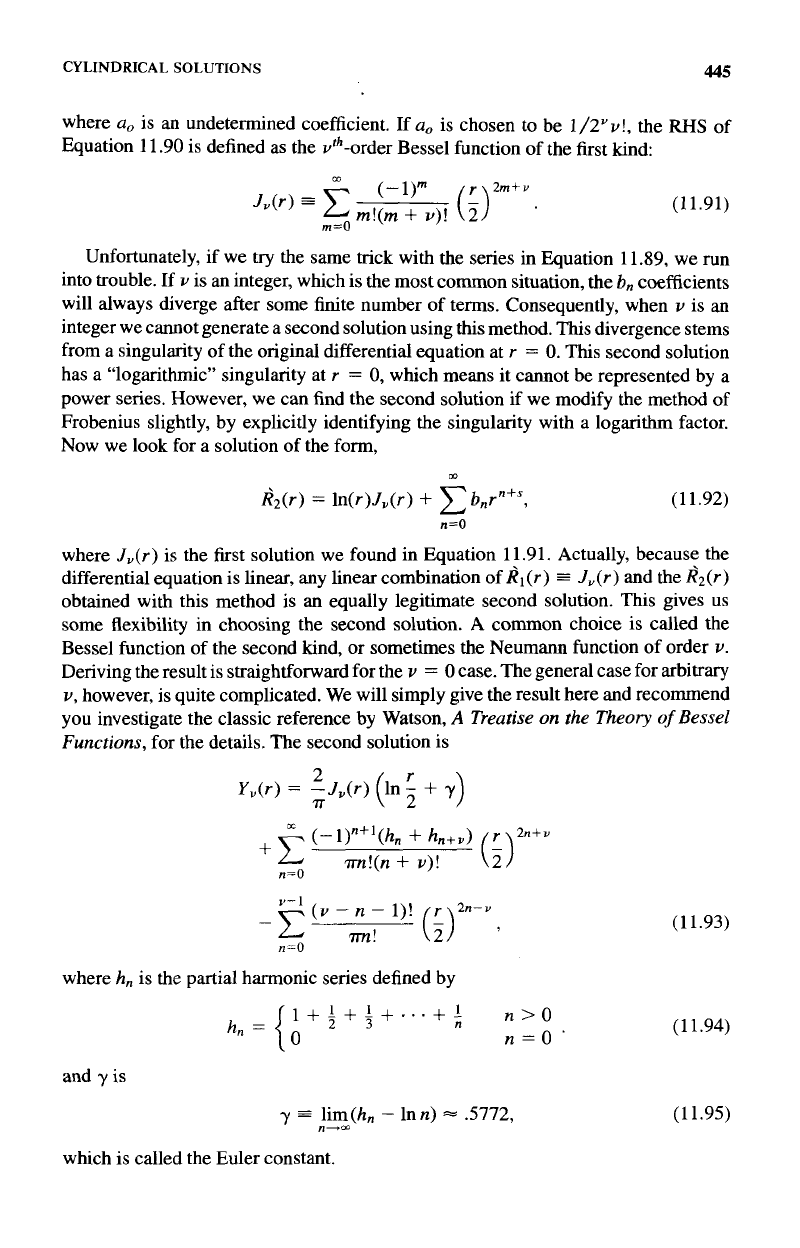
differential equation, the coefficients can be easily evaluated. The series is
(11.90)
CYLINDRICAL
SOLUTIONS
445
where
a,
is
an
undetermined coefficient. If
a,
is chosen to be
1/2’u!,
the
RHS
of
Equation
1
1.90 is defined as the vth-order Bessel function of the first kind:
(11.91)
Unfortunately, if we
try
the same trick with the series in Equation
1
1.89, we run
into trouble. If
u
is an integer, which
is
the most common situation, the
b,
coefficients
will always diverge after some finite number of terms. Consequently, when
v
is
an
integer we cannot generate a second solution using
this
method.
This
divergence stems
from a singularity of the original differential equation at
r
=
0.
This second solution
has a “logarithmic” singularity at
r
=
0,
which
means it cannot be represented by a
power series. However, we can find the second solution if we modify the method of
Frobenius slightly, by explicitly identifying the singularity with a logarithm factor.
Now we look for a solution of the form,
co
&(r)
=
ln(r)J,(r>
+
b,r”+s,
(1
1.92)
where
J,(r)
is the first solution we found in Equation 11.91. Actually, because the
differential equation is linear,
any
linear combination of
kl(r)
=
J,(r)
and the
k*(r)
obtained with this method
is
an
equally legitimate second solution.
This
gives
us
some flexibility in choosing the second solution.
A
common choice
is
called the
Bessel function of the second kind, or sometimes the Neumann function of order
u.
Deriving the result is straightforward for the
v
=
0
case. The general case for arbitrary
v,
however, is quite complicated. We will simply give the result here and recommend
you investigate the classic reference by Watson,
A
Treatise
on
the Theory
of
Bessel
Functions,
for the details. The second solution
is
n=O
where
h,
is the partial harmonic series defined by
and
y
is
y
=
lim
(h,
-
Inn)
=
.5772,
n-m
(11.93)
(1
1.94)
(11.95)
which
is
called the Euler constant.