
Kusse B.R., Westwig E.A. Mathematical Physics: Applied Mathematics for Scientists and Engineers
Подождите немного. Документ загружается.

446
SOLUTIONS
TO LAPLACE’S EQUATION
Figure
11.11
Bessel
Functions
of
the
First
and
Second
Kind
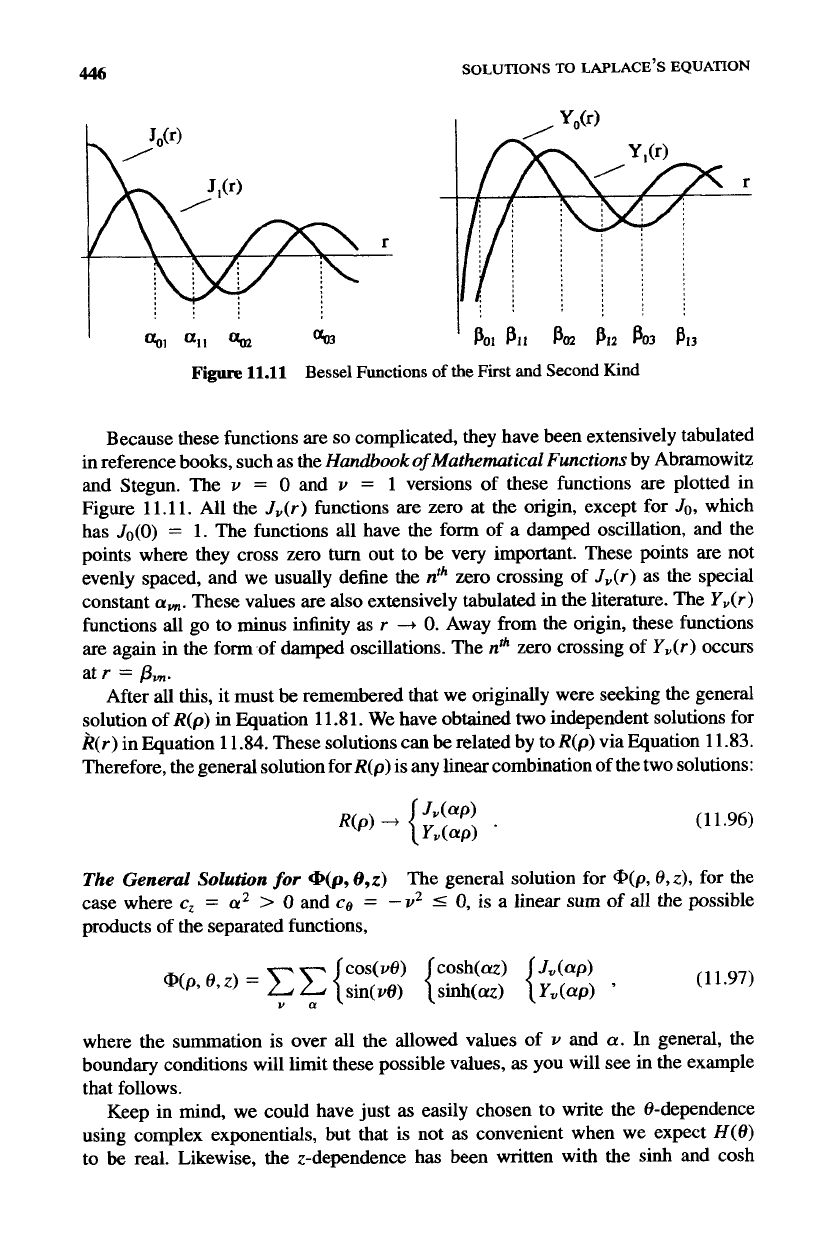
Because these functions are
so
complicated, they have been extensively tabulated
in reference books, such as the
Handbook
of
Mathematical
Functions
by Abramowitz
and Stegun. The
u
=
0
and
Y
=
1 versions of these functions are plotted in
Figure 11.11. All the
Jv(r)
functions are zero at
the
origin, except for
Jo,
which
has
Jo(0)
=
1. The functions all have the form of a damped oscillation, and the
points where they cross zero
turn
out to be very important. These points are not
evenly spaced, and we usually define the
nth
zero crossing of
Jv(r)
as the special
constant
am.
These values
are
also extensively tabulated
in
the
literature. The
Yv(r)
functions all go to minus infinity as
r
--+
0.
Away
from
the origin, these functions
are again in the form of
damped
oscillations. The
nth
zero crossing
of
Yv(r)
occurs
at
r
=
&,,.
After
all
this,
it must be remembered that we origindy were seeking the general
solution of
R(p)
in
Equation 1 1.8
1.
We have obtained
two
independent solutions for
k(r)
in Equation 11.84. These solutions can
be
related by to
R(p)
via Equation 1 1.83.
Therefore, the general solution forR(p) is any linear combination of the two solutions:
(11.96)
The
General
Solution
for
@(p,
6,z)
The general solution for
@(p,
0,
z),
for
the
case where
c,
=
a2
>
0
and
ce
=
-u2
5
0,
is
a
linear sum
of
all the possible
products of the separated functions,
(11.97)
where the summation is over all the allowed values of
v
and
a.
In
general,
the
boundary conditions will Emit these possible values,
as
you will
see
in the example
that follows.
Keep in mind, we could have just
as
easily chosen to write the @-dependence
using complex exponentials, but that
is
not as convenient when we expect
H(0)
to
be
real. Likewise, the z-dependence has been written with the sinh and cosh
CYLINDRICAL SOLUTIONS
447
functions, but could just as easily have been expressed with growing or decaying
exponential functions. Computational convenience dictates which choice makes more
sense. Notice the &dependence is periodic, while the z-dependence is exponential.
This confirms the general rule for separated solutions we declared at the beginning of
the chapter.
If
a solution oscillates in one direction, it must exponentiate in another.
Applying
the
Boundary
Conditions
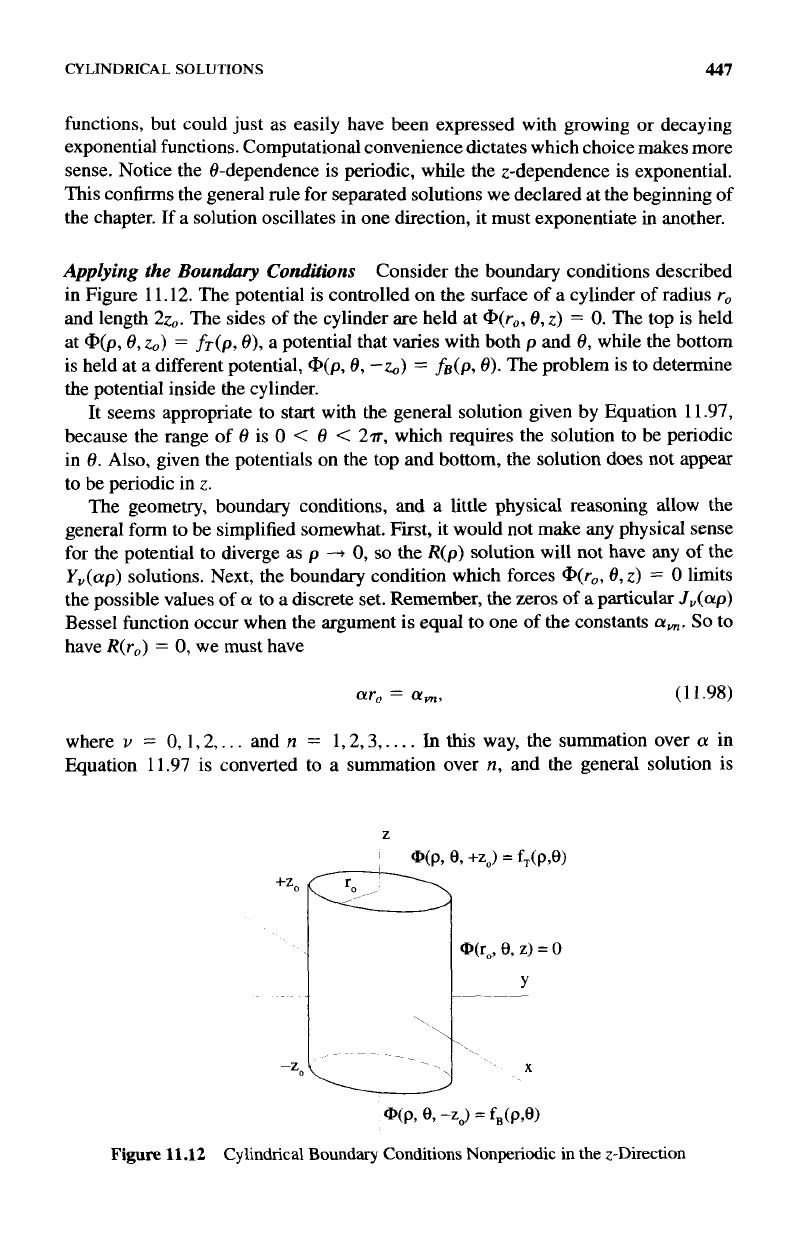
Consider the boundary conditions described
in Figure
1
1.12. The potential is controlled
on
the surface
of
a cylinder
of
radius
r,
and length
22,.
The sides of the cylinder are held at
@(To,
8,~)
=
0.
The top is held
at
@(p,
8,
z,)
=
f~(p,
O),
a potential that varies with both
p
and
8,
while the bottom
is held at a different potential,
@(p,
8,
-z,J
=
f&,
8).
The problem is to determine
the potential inside the cylinder.
It seems appropriate to start with the general solution given by Equation 11.97,
because the range of
8
is
0
<
8
<
2.n,
which requires the solution to be periodic
in
8.
Also, given the potentials
on
the top and bottom, the solution does
not
appear
to be periodic in
z.
The geometry, boundary conditions, and a
little
physical reasoning allow the
general form to be simplified somewhat. First, it would not make
any
physical sense
for the potential
to
diverge
as
p
t
0,
so
the
R(p)
solution will
not
have any
of
the
YJap)
solutions. Next, the boundary condition which forces
@(T,,
8,z)
=
0
limits
the possible values of
a
to a discrete set. Remember, the zeros of a particular
J,(ap)
Bessel function occur when the argument is equal
to
one
of
the constants
a,.
SO
to
have
R(r,)
=
0,
we must have
ar0
=
am,
(11.98)
where
u
=
0,1,2,.
.
.
and
n
=
1,2,3,.
.
.
.
In
this
way, the summation over
a
in
Equation 11.97 is converted to a summation over
n,
and the
general solution is
WP,
0,
-zo)
=
f,(p,e)
Figure
11.12
Cylindrical
Boundary
Conditions
Nonperiodic in
the
z-Direction
448
SOLUTIONS
TO
LAPLACE’S EQUATION
reduced to
Notice that the value of
LY
in the argument of the hyperbolic functions is determined
by a boundary condition associated with the Bessel function.
If the shorthand notation on the
RHS
of
Equation 11.99
is
expanded, it is nec-
essary to introduce four amplitude constants.
In
order
to
determine these constants,
the top and bottom boundary conditions, yet unused, need to
be
introduced. These
amplitude constants can
be
determined much like we found the amplitude constants
in the Cartesian problems at the
beginning
of the chapter. By applying orthogonality
conditions, we can isolate and evaluate one of the constants associated with a partic-
ular
v
and a particular
n.
This
will require two different orthogonality relations, one
to isolate values of
v.
and one to isolate values of
n.
OrthogonaCity Relations
We already know that the sin and cos functions which
describe the &dependence obey
an
orthogonality condition, while the sinh and cosh
functions do not.
To
evaluate all the amplitude constants, we need an additional
orthogonality relation, which we can
obtain
from the Bessel functions. We can derive
it by putting Bessel’s equation in the form of an eigenvalue, eigenfunction problem,
identify a Hermitian operator, and then determine the orthogonality properties
of
its
eigenfunctions.
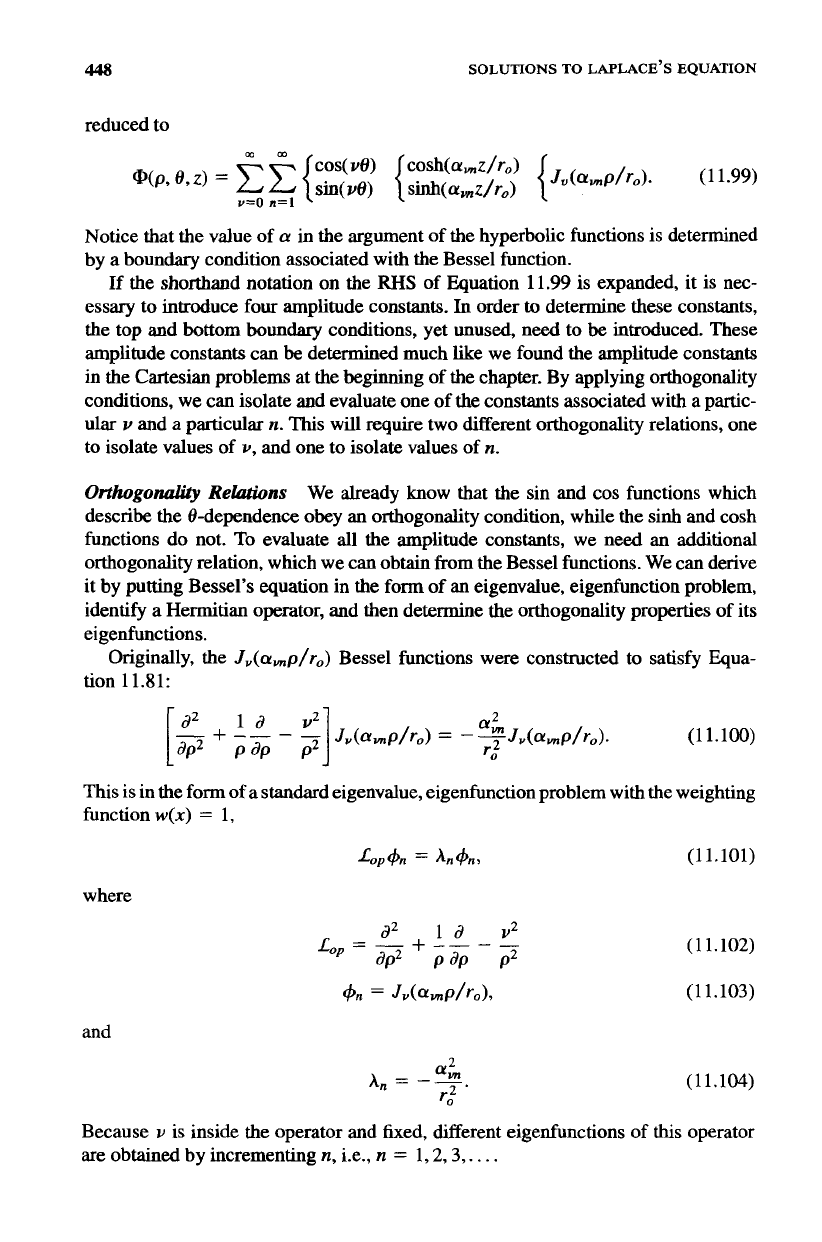
Originally, the
Jv(a,p/ro)
Bessel functions were constructed to satisfy Equa-
tion 11.81:
(11.100)
This is in the form of a standard eigenvalue, eigenfunction problem with the weighting
functionw(x)
=
1,
where
d2
1
d
u2
L
=--+----
OP
dp2 pap p2
(1
1.102)
and
2
A,
=
-2.
(11.104)
Because
u
is inside the operator and fixed, different eigenfunctions
of
this
operator
are obtained by incrementing
n,
i.e.,
n
=
1,2,3,.
.
.
.
CYLINDRICAL
SOLUTIONS
449
These functions will obey an orthogonality condition if, when they are combined
with
Lop,
they satisfy the Hermitian condition, that is, if
dP
JU("
m
p/ro)Lop Ju("m P/ro>
equals
.I,
dp
Ju
(a
,p/ro
)Lop
Ju
(am
p/r0
1.
Unfortunately, it turns out that these two integrals are not equal and the Bessel
functions, by themselves, are not orthogonal.
We know, from our proof in the previous section, that an operator in Sturm-
Liouville form, combined with the appropriate boundary conditions, will automati-
cally lead to
the
Hermitian condition. The operator in Equation 11.102 is not, itself,
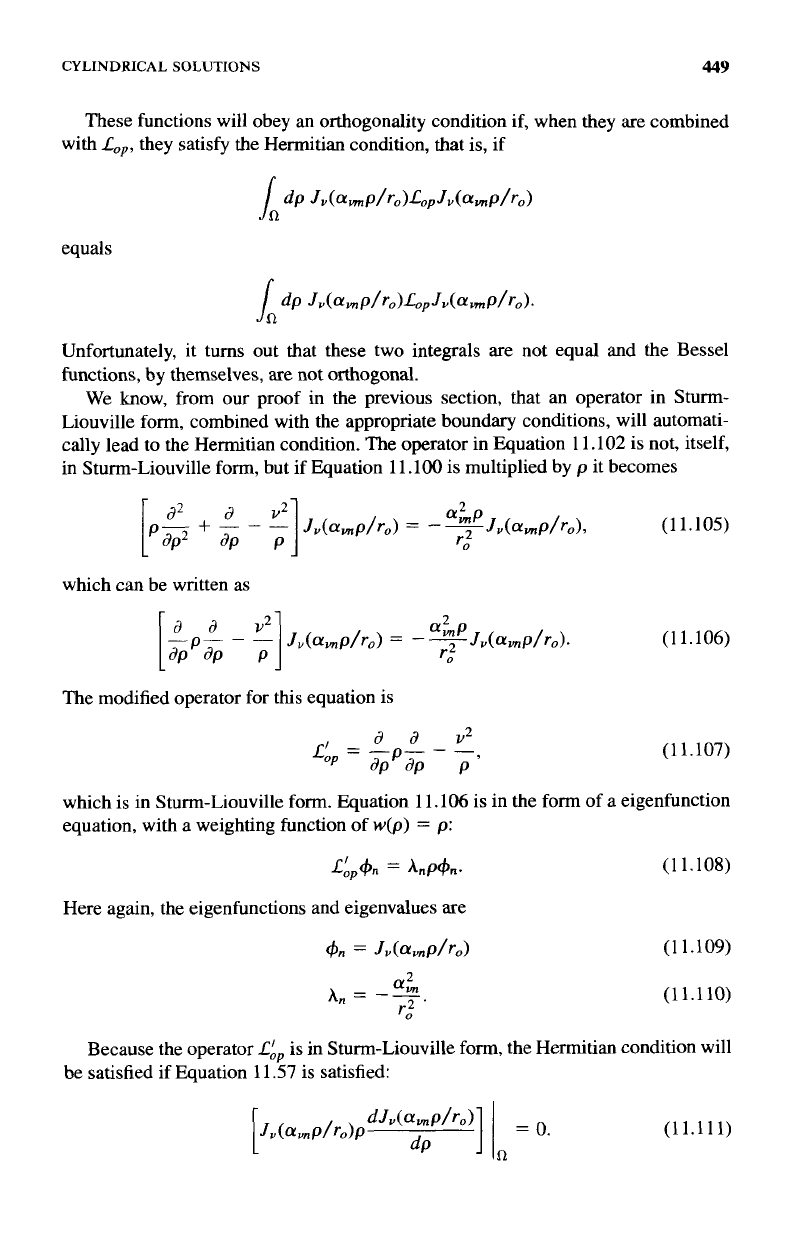
in Sturm-Liouville form, but if Equation 11.100 is multiplied by
p
it becomes
which can be written as
The modified operator for this equation is
(
1 1.106)
(1 1.107)
which is in Sturm-Liouville form. Equation 1 1.106 is in the form of a eigenfunction
equation, with a weighting function of
w(p)
=
p:
=
AnP4n-
(1
1.108)
Here again, the eigenfunctions and eigenvalues are
+n
=
Ju(aunp/ro)
2
An
=
-2.
(1
1.109)
(11.110)
Because the operator
LLp
is in Sturm-Liouville form, the
Hermitian
condition will
be satisfied if Equation 11 57 is satisfied:
(1 1.1 11)
450
SOLUTIONS TO LAPLACE'S
EQUATION
Because the range of interest for
this
problem
has
an obvious lower limit of
p
=
0
and
an upper limit of
p
=
r,,
this condition is easily satisfied. The lower limit vanishes
due to the presence of the
p
term, and the upper limit vanishes because
Jv(av,)
is by
definition zero. Thus with
fl
covering the range
0
<
p
<
r,,
the modified operator
of Equation 11.107 is indeed Hermitian.
This
means the Bessel functions form a
complete set of functions and obey the orthogonality condition of Equation 1 1.49:
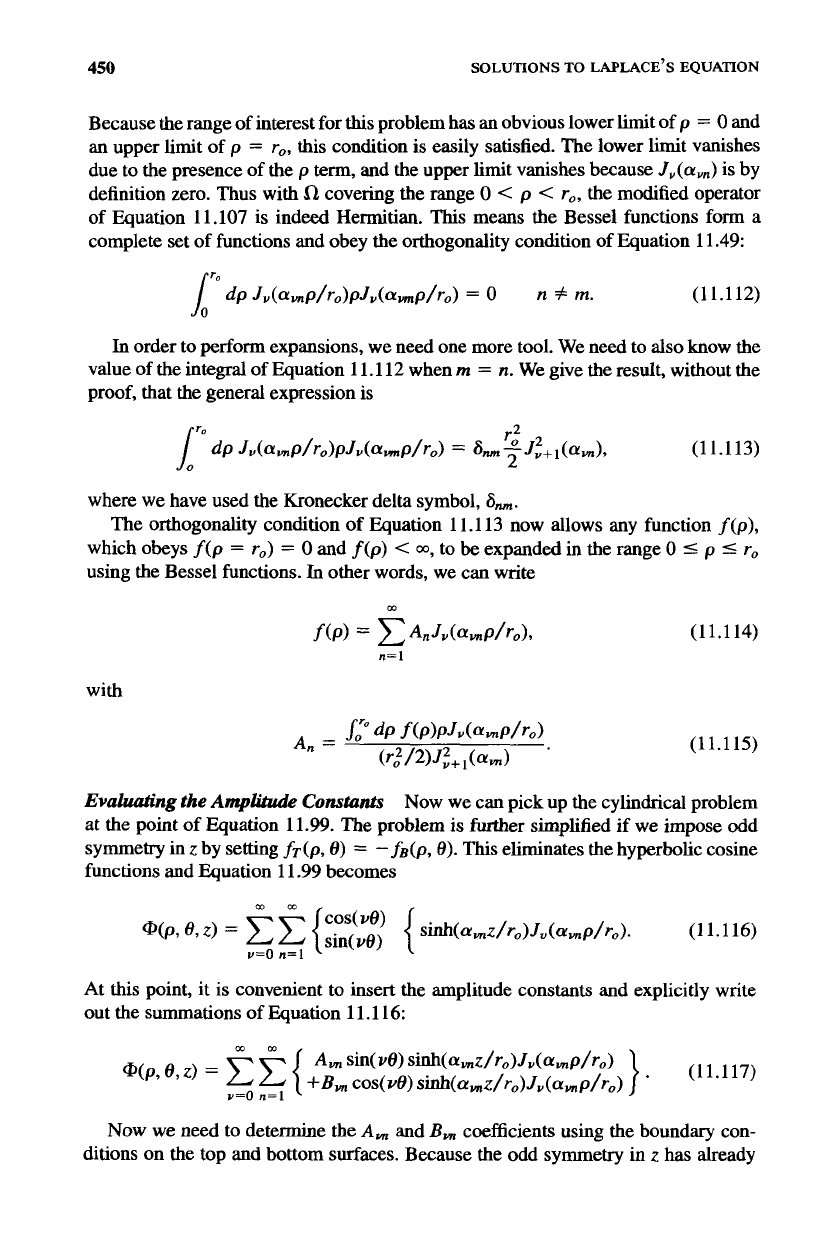
(
1
I.
1 12)
In
order to
perform
expansions, we need one more tool. We need to
also
know the
value of the integral
of
Equation
1
1.1 12 when
m
=
n.
We give the result, without the
proof, that the general expression is
where we have used the Kronecker delta symbol,
a,,,,,.
The orthogonality condition
of
Equation 11.113 now allows any function
f(p),
which obeys
f(p
=
ro)
=
0
and
f(p)
<
a,
to
be
expanded in the range
0
5
p
I
r,
using the Bessel functions.
In
other words, we can write
with
(
1 1.1 14)
(1
1.1
15)
Evaluating
the
Amplitude
Constants
Now we can pick up the cylindrical problem
at the point
of
Equation 11.99. The problem is further simplified if we impose odd
symmetry in
z
by setting
f&,
0)
=
-f&,
0).
This
eliminates the hyperbolic cosine
functions and Equation 11.99 becomes
At
this
point, it is convenient to insert the amplitude constants and explicitly write
out the summations of Equation 11.116:
mm
}.
(11.117)
A,
sin(v6)
sinh(a,z/ro)Jv(a,p/ro,)
+B,
cos(v0)
sWa,z/ro)Jda,p/r0)
wpm)
=
xx{
v=O
n=l
Now we need
to
determine the
A,
and
B,
coefficients using the boundary con-
ditions
on
the top and bottom surfaces. Because the odd symmetry in
z
has already
CYLINDRICAL SOLUTIONS
451
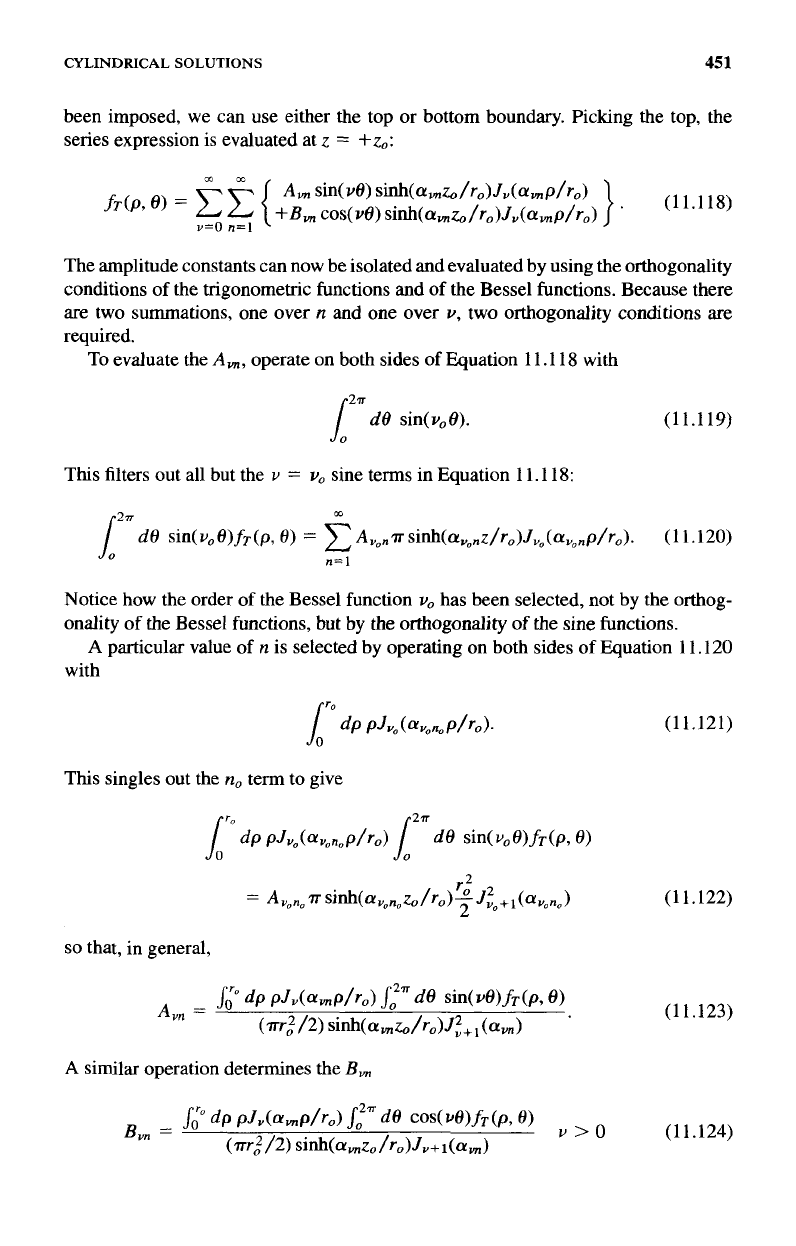
been imposed, we can use either the top or bottom boundary. Picking the top, the
series expression is evaluated at
z
=
+zo:
The amplitude constants can
now
be isolated and evaluated by using the orthogonality
conditions of the trigonometric functions and
of
the Bessel functions. Because there
are
two
summations, one over
n
and
one
over
u,
two
orthogonality conditions are
required.
To
evaluate the
A,,
operate
on
both
sides of Equation
1
1.1
18
with
12nd0 sin(u,0).
This filters out all but the
v
=
u,
sine terms
in
Equation 1 1.1
18:
(1 1.1 19)
Notice how the order
of
the Bessel function
u,
has been selected, not by the orthog-
onality
of
the Bessel functions,
but
by
the
orthogonality
of
the sine
functions.
A
particular value
of
n
is selected by operating
on
both sides of Equation 1 1.120
with
(1
1.121)
This
singles out the
n,
term to give
452
and
SOLUTIONS
TO
LAPLACE'S
EQUATION
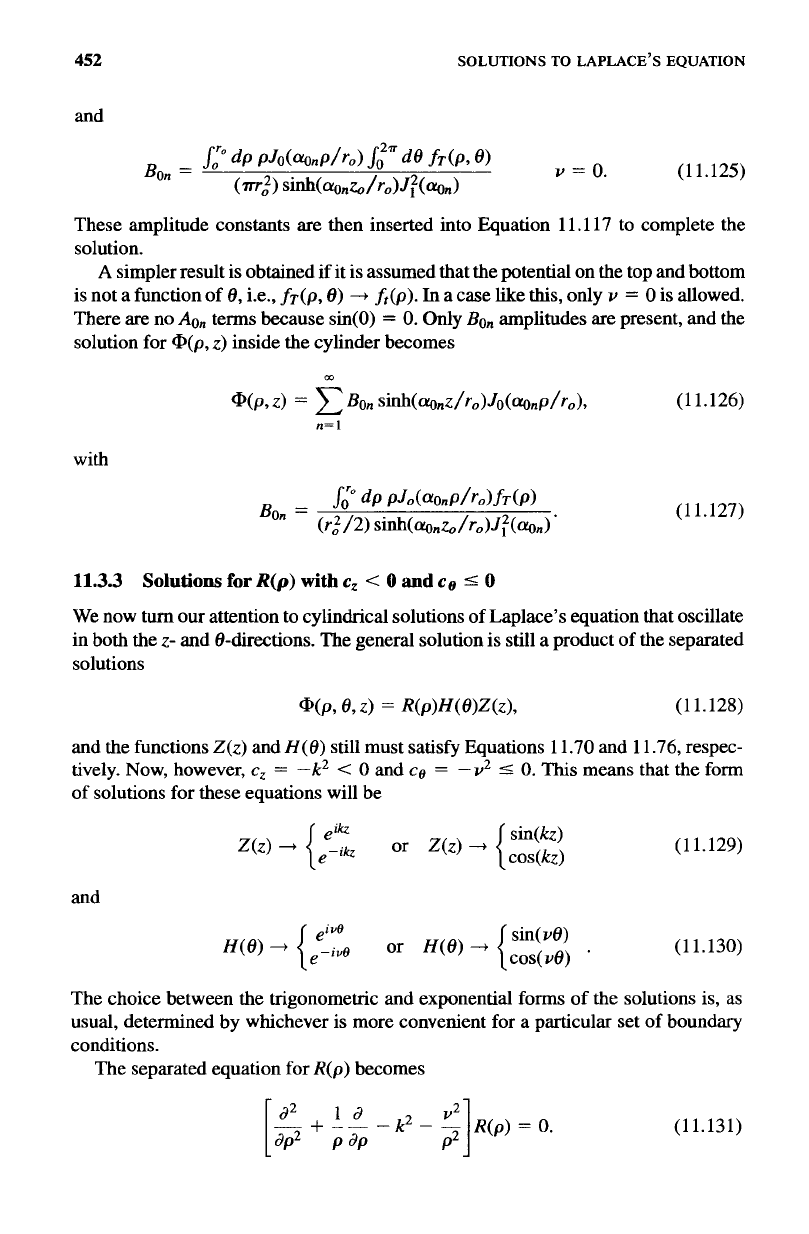
These amplitude constants
are
then inserted into Equation 11.117
to
complete the
solution.
A
simpler result is obtained
if
it is assumed that the potential on the top and bottom
is not a function of
8,
i.e.,
f~(p,
8)
-+
f,(p).
In
a case like
this,
only
v
=
0
is allowed.
There
are
no
Aon
terms because
sin(0)
=
0.
Only
Bg,
amplitudes
are
present, and the
solution for
@(p,
z) inside the cylinder becomes
m
@(P-
Z>
=
C
BOn
si~(~~z/r~)Jo(~.p/r,),
(1 1.126)
n=
1
with
(1 1.127)
11.3.3
We now turn
our
attention to cylindrical solutions of Laplace's equation that oscillate
in both the
z-
and 8-directions. The general solution is still a product of the separated
solutions
Solutions
for
R(p)
with
c,
<
0
and
cg
5
0
WP,
8,
Z)
=
R(p)ww(z),
(1 1.128)
and the functions
Z(z)
and
H(
8)
still must satisfy Equations 1 1.70 and
1
1.76, respec-
tively.
Now,
however,
c,
=
-k2
<
0
and
ce
=
-v2
5
0.
This
means that the
form
of
solutions for these equations will be
and
(1
1.129)
(1 1.130)
The choice between the trigonometric and exponential forms of the solutions is,
as
usual, determined by whichever is more convenient for a particular set
of
boundary
conditions.
The separated equation for
R(p)
becomes
P2
"I
d2
1
d
-
+
--
-
k2
-
-
R(p)
=
0.
dP2 PdP
(1 1.131)
CYLINDRICAL
SOLUTIONS
453
Equation 11.131 is identical to Equation 11.81 with
a2
--j
-k2
or
a
-+
ik.
The
solutions to Equation 1 1.8
1
were found to be Bessel functions of the first and second
kind:
Ju(w)
and
Y,(ap).
The
solutions to Equation 1 1.13
1
can therefore be written as
(
1 1.1 32)
The imaginary arguments in the Bessel functions have a similar effect
as
imaginary
arguments in the sine
and
cosine functions. These functions no longer oscillate, but
they grow or decay with
p.
We might have expected
this,
because the general rule for
the separated solutions
of
Laplace’s equation in Cartesian systems was that at least
one separated solution was growing or decaying.
The functions in Equation 11.132 are not
in
the most convenient form, how-
ever, because they are not pure real functions of
p.
We can correct
this
problem by
constructing two different solutions which are pure real:
I,(kp)
=
i-”J,(ikp)
(1 1.133)
K,(kp)
=
(~r/2)i’+~[J~(ikp)
+
iY,(ikp)].
(1 1.134)
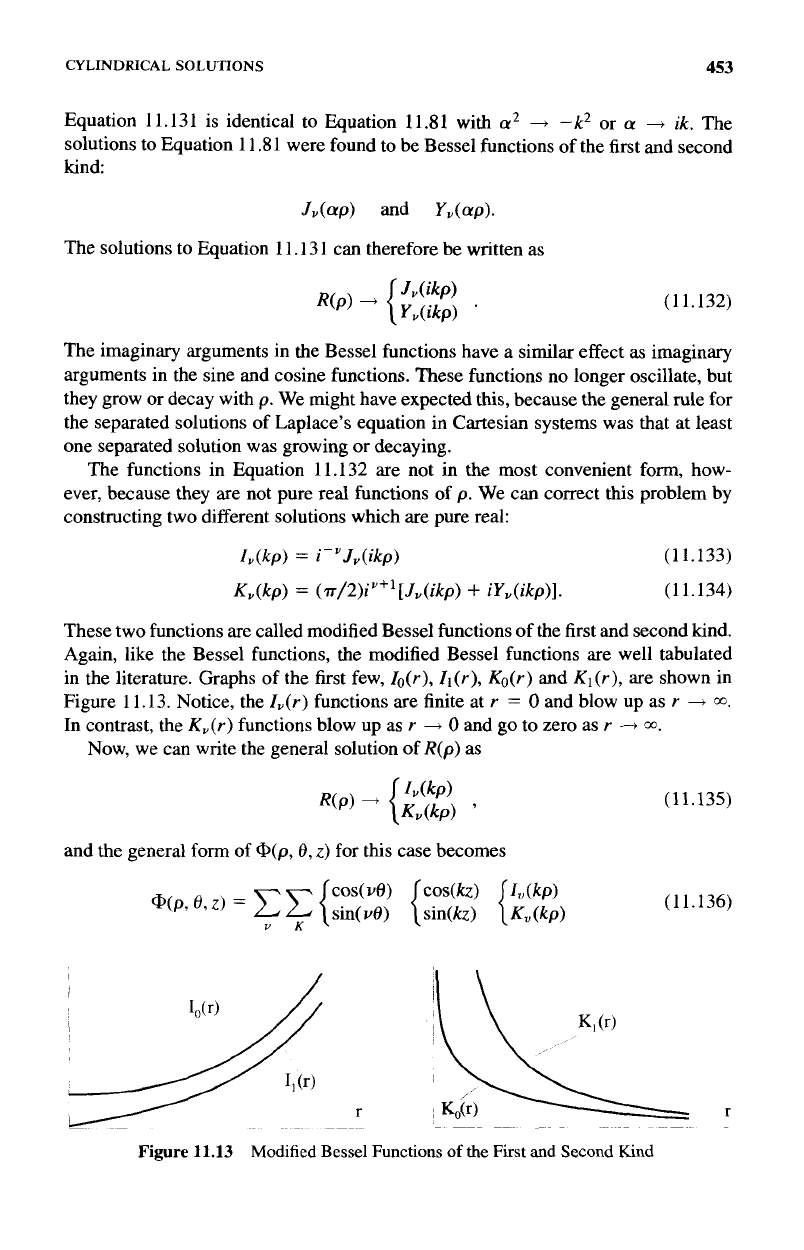
These two functions are called modified Bessel functions of the first and second kind.
Again, like the Bessel functions, the modified Bessel functions are well tabulated
in the literature. Graphs
of
the first few,
Zo(r), Zl(r), Ko(r)
and
Kl(r),
are shown in
Figure 11.13. Notice, the
Z,(r)
functions are finite at
r
=
0
and blow up as
r
+
m.
In contrast, the
K,(r)
functions blow up as
r
-+
0
and go to zero as
r
50.
Now, we can write the general solution of R(p) as
and the general
form
of
@(p,
8,
z)
for
this case becomes
cos(v8)
cos(kz)
Z,(kp)
{
sin(v8)
{
sin(kz)
{
K,(kp)
”‘)
=
c
uK
(1
1.135)
(
1 1.1
36)
Figure
11.13
Modified
Bessel
Functions
of
the
First
and
Second
Kind
454
SOLUTIONS
TO
LAPLACE’S
EQUATION
In
this
expression, sine and cosine functions have been
used
for the
z-
and
8-
depen-
dencies.
As
always, complex exponential functions could have been used instead, but
the sine-cosine functions are
better
when we expect the final answer to be pure real.
Again
notice the presence
of
at least one oscillating factor and one growingldecaying
factor
in
each term.
Example
11.4
As
an
example of an electrostatic problem that uses the type of
solution given
in
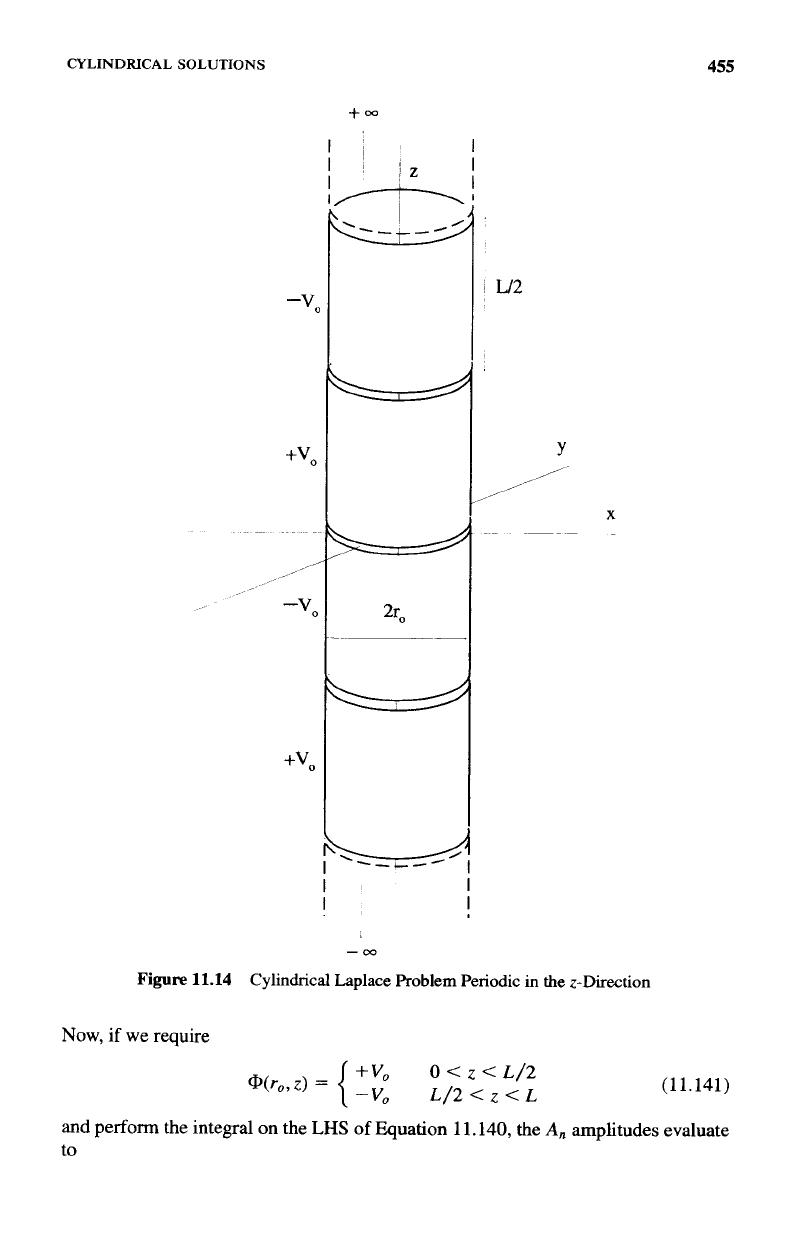
Equation 11.136, consider the geometry shown
in
Figure 11.14.
This
is quite
similar
to the problem discussed
in
Figure 11.7, which described a
periodic boundary condition in Cartesian coordinates.
In
this
problem, the potential
is controlled
on
the
p
=
r,
surface of the cylinder. Its value is
+V,
for
0
<
z
<
L/2
and
-
V,
for L/2
<
z
<
L. We are interested in a solution for
@(To,
8,
z)
inside the
cylinder where
p
<
r,.
Notice that the
boundary
condition is periodic,
so
@(To.
8,
z)
=
@(I,,
8,
z
+
L)
for all
z.
Consequently, the solution for
this
problem must also
be
periodic in
z,
and
so
the
solution to Laplace’s equation
for
p
<
r,
must fall into the general form of
Equation 11.136. The symmetry of these particular boundary conditions allows
us
to simplify
this
general
form
tremendously. First of
all,
there is no 6-variation,
so
we can set
H(8)
=
1,
and the
sum
over
v
only uses the
v
=
0
term. Second, the
solution must
be
finite
for
p
=
0,
so
there are no
Ko(kp)
terms,
because they diverge
as
p
--+
0.
Next, because the
boundary
conditions have odd symmetry about
z,
all the
cos(kz) terms vanish, because they
are
all even functions. Finally, the periodicity
of
the boundary conditions forces
k
to
be
limited
to the discrete set of values:
(1 1.137)
2m
k-+k,,=-
L
where
n
=
0,1,2,.
.
. .
With these simplifications, Equation 11.136 reduces to
=
2
A,,
sin
(F)
10
(7)
2mP
n=l
(
1 1.1 38)
(1 1.139)
Notice the value
of
k
appears not
only
as
an argument
of
the sin&) term,
but
also in
the argument of the modified Bessel function.
As
always, the
A,,
coefficients can
be
determined using an orthogonality condition
and the boundary conditions at
p
=
r,.
Operate on both sides of Equation 11.138 by
1‘
dz
sin
(F)
to obtain
(1 1.140)
CYLINDRICAL
SOLUTIONS
+m
455
Y
X
I
I
--oo
Figure
11.14
Cylindrical Laplace Problem Periodic in the z-Direction
Now,
if
we require
(1 1.141)
and perform the integral
on
the
LHS
of
Equation
1 1.140,
the
A,
amplitudes evaluate
to