
Kusse B.R., Westwig E.A. Mathematical Physics: Applied Mathematics for Scientists and Engineers
Подождите немного. Документ загружается.

466
In terms of
8:
SOLUTIONS
TO LAPLACE’S
EQUATION
11.43
Solutions
Valid
off
the
z-Axis
If
a spherical problem excludes the
z-axis
from consideration, the requirement that the
solutions
be
finite at
8
=
0
and
8
=
T
(x
=
21) can
be
relaxed.
A
set
of
boundary
conditions which leads to
this
type
of
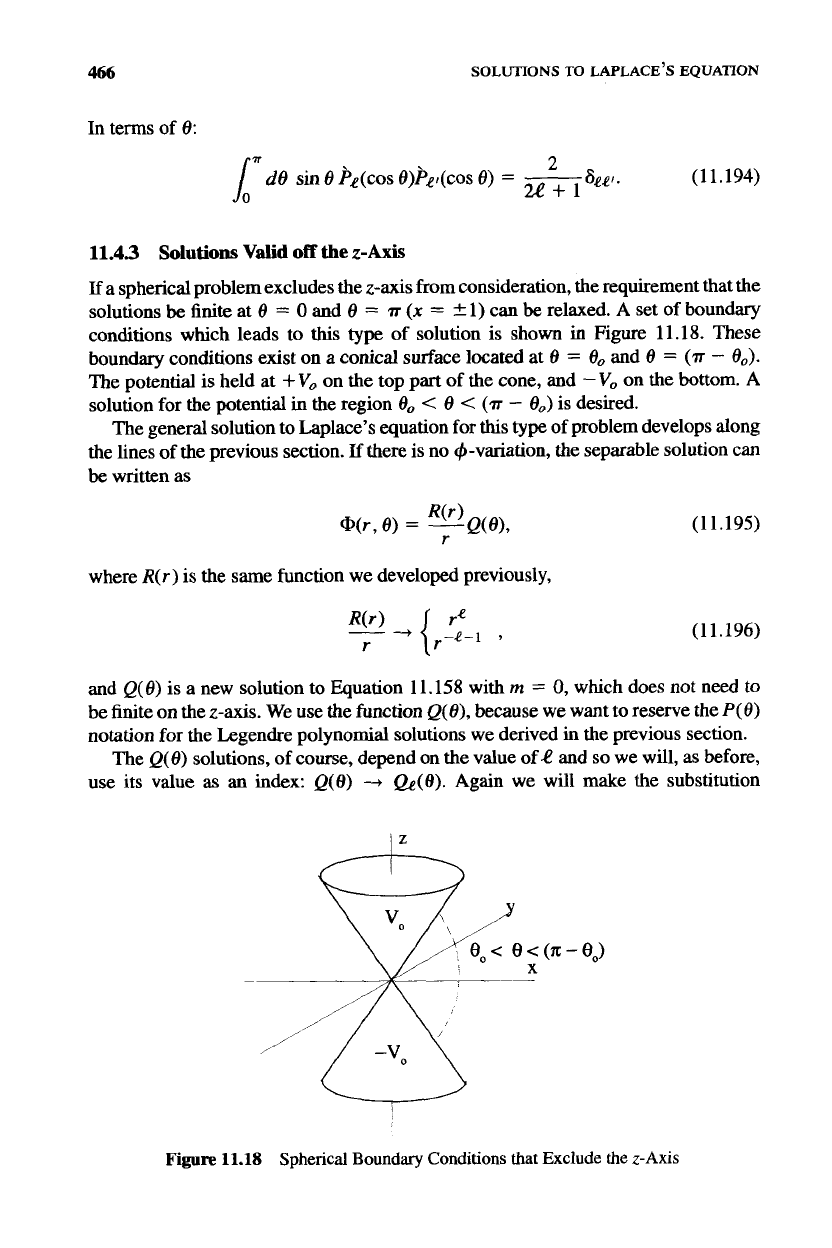
solution is shown
in
Figure 11.18. These
boundary conditions exist on
a
conical surface located at
8
=
8,
and
8
=
(m
-
8,).
The potential
is
held at
+
V,
on the top part of the cone, and
-
V,
on the
bottom.
A
solution for the potential
in
the region
8,
<
8
<
(T
-
8,)
is
desired.
The general solution to Laplace’s equation for
this
type
of
problem develops along
the lines
of
the previous section.
If
there
is
no +-variation, the separable
solution
can
be
written as
where
R(r)
is the same function we developed previously,
re
r
(1 1.195)
(1 1.196)
and
Q(
8)
is
a
new solution to Equation 11.158 with
m
=
0,
which does
not
need to
be finite on the
z-axis.
We use the function
Q(8).
because we want to reserve the
P(
8)
notation for the Legendre polynomial solutions we derived
in
the previous section.
The
Q(
8)
solutions, of course, depend on the value of
4?
and
so
we will,
as
before,
use its value
as
an index:
Q(8)
---f
a(@.
Again we will make the substitution
Z
/
/’
Figure
11.18
Spherical
Boundary
Conditions
that
Exclude
the
z-Axis
467
SPHERICAL
SOLUTIONS
x
=
cos
0
and Qg(cos
0)
=
a(@.
The method of Frobenius can be used to develop
the two solutions for
&(x),
and they will be identical in form to Equations 1 1.172
and 11.173. The difference now, however, is that we must include the series solutions
that do not terminate, the very ones we removed from the
pt(6)
solutions because
they did not converge at
x
=
5
1.
Fore
=
0,
we will define
&ow
=
Ao(4,
(1
1.197)
where
Adx)
is the Frobenius series of Equation 11.172 which we previously found
unacceptable:
&O(X)
=
x
+
(1 /3)x3
+
(1
/3x5
+
.
*
.
.
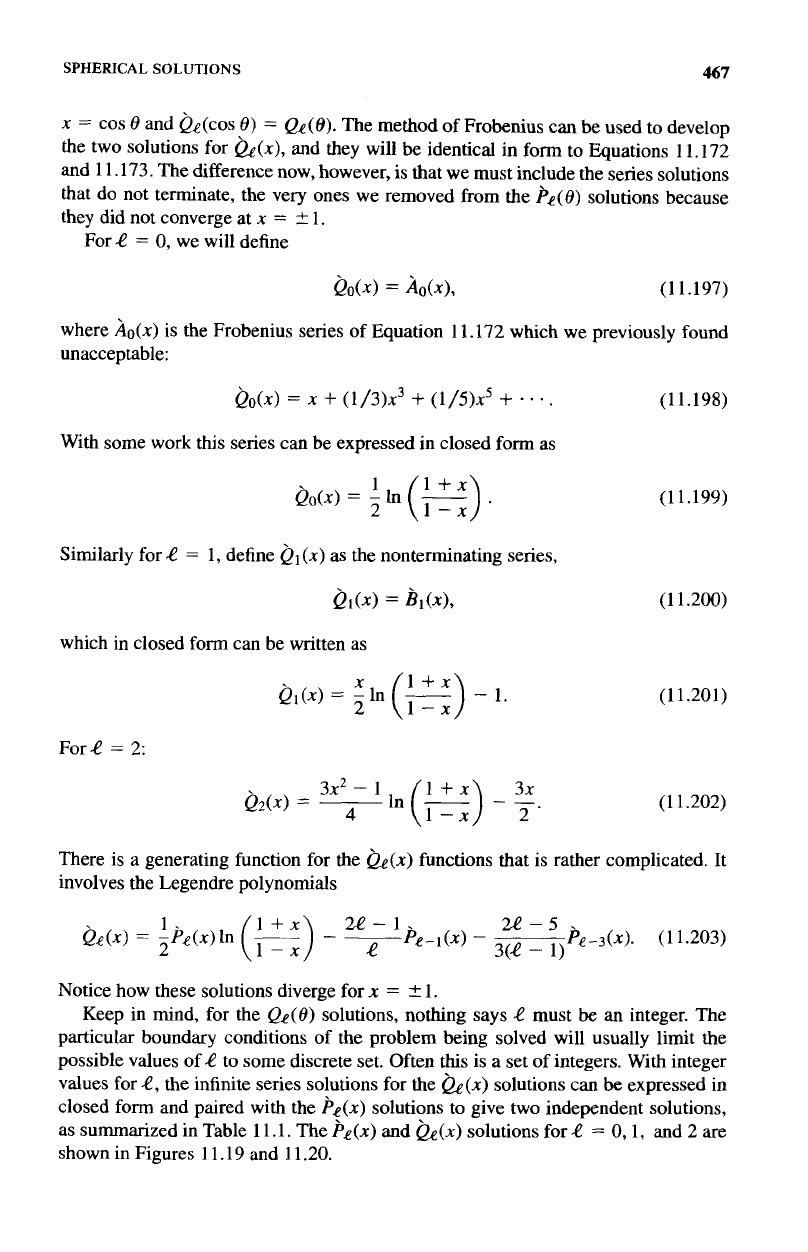
With some work this series can be expressed in closed form as
(1
1.198)
(1 1.199)
Similarly for
4
=
1, define
Q1
(x)
as the nonterminating series,
which in closed form can be written as
Fore
=
2:
(1 1.201)
(1 1.202)
There is
a
generating function for the
&(x)
functions that is rather complicated. It
involves the Legendre polynomials
Notice how these solutions diverge for
x
=
2
1.
Keep in mind, for the
Qt(6)
solutions, nothing says
4
must
be
an
integer.
The
particular boundary conditions
of
the problem being solved will usually limit the
possible values of
4
to some discrete set. Often
this
is a set of integers. With integer
values for
4,
the infinite series solutions for the
&(x)
solutions can
be
expressed in
closed
form
and paired with the
&t(x)
solutions to give two independent solutions,
as summarized in Table
1
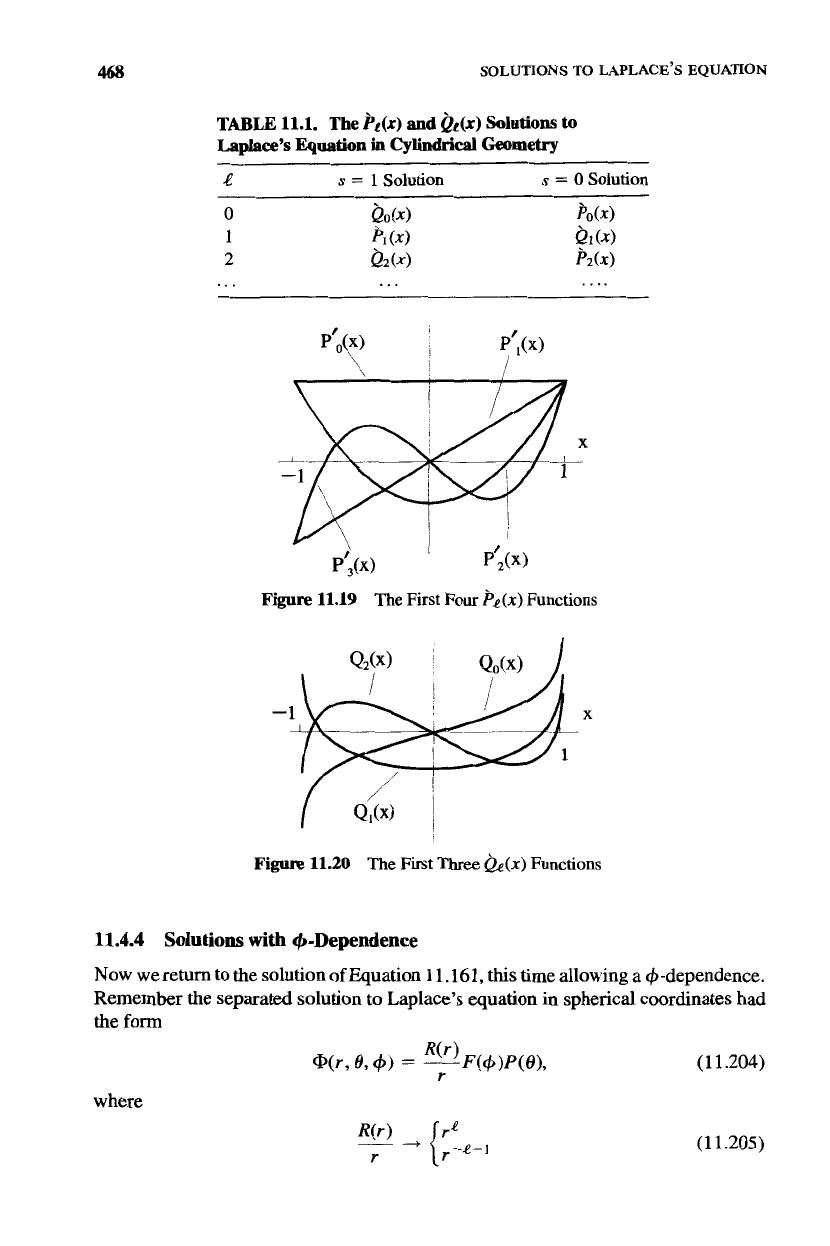
1.1. The
i)e(x)
and
&(x)
solutions for
4
=
0,
1, and 2 are
shown in Figures 1 1.19 and 1 1.20.
468
SOLUTIONS TO LAPLACE’S EQUATION
TABLE
11.1.
The
i)((x)
and
Q&)
Solutions
to
Laplace’s
Equation
in
Cylindrical
Geometry
e
s
=
1
Solution
s
=
0
Solution
0
1
2
..,
X
I
Figure
11.19
The
First
Four
P&)
Functions
-1
X
I
Figure
11.20
The
First
Three
&(x)
Functions
11.4.4
Solutions
with
+Dependence
Now we return
to
the solution
of
Equation
1
1.161,
this
time allowing
a
+-dependence.
Remember the separated solution to Laplace’s equation
in
spherical coordinates had
the
form
(1
1.204)
m-1
W.
e,+)
=
---F(4)P(eh
r
where
-e-
1
r
(1
1.205)
SPHERICAL
SOLUTIONS
and
469
(1
1.206)
A
substitution
of
x
=
cos
0
made
P(0)
=
~(COS
0),
and
P(x)
solved the equation
+4(4
+
I)
P(x)
=
0.
I
m2
(I
1.207)
From the form of Equation 11.207, it is clear that
P(x)
depends on both
rn
and
4,
so
we will label the solutions
of
P(x)
with two indices:
P(x)
-+
Ptm(x).
A
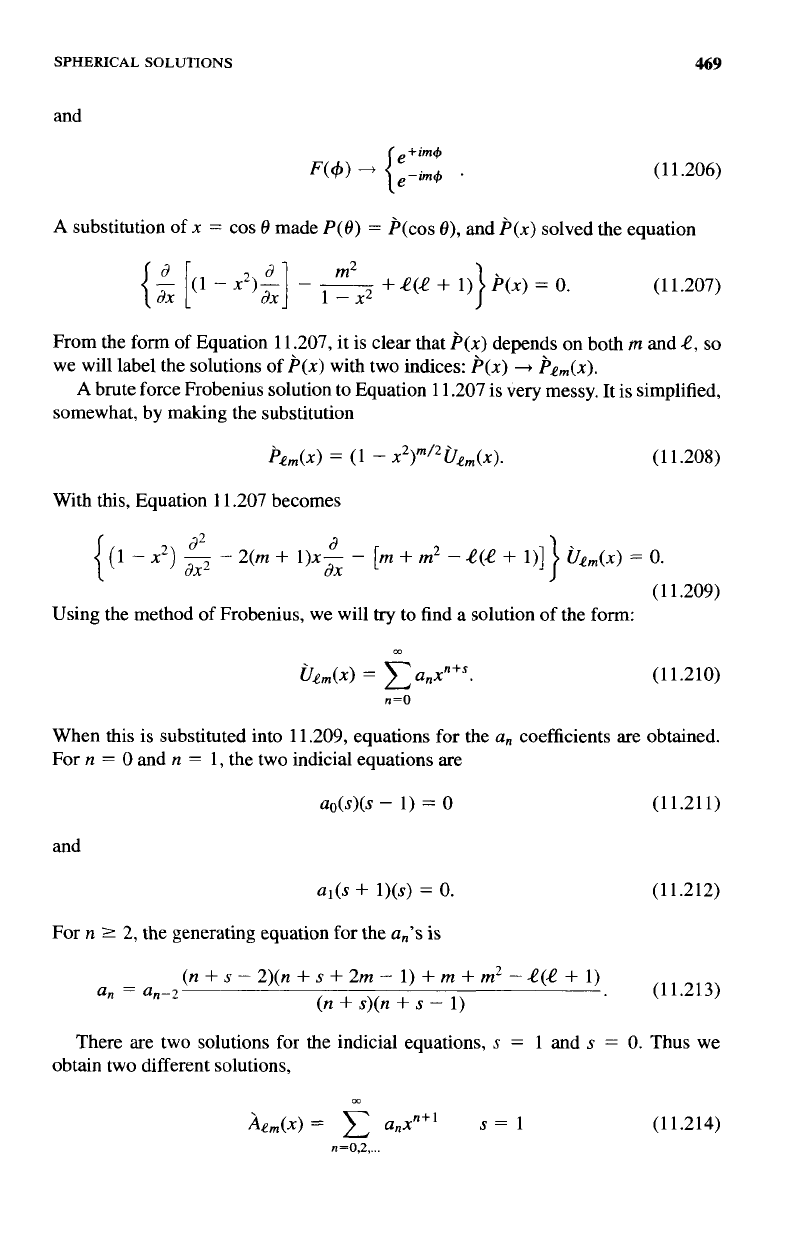
brute force Frobenius solution to Equation 11.207 is very messy.
It
is simplified,
somewhat, by making the substitution
(1
1.208)
2
m/20
Pte,(x>
=
(1
-
x
With this, Equation
1
1.207 becomes
Using the method
of
Frobenius, we will
try
to find a solution of the form:
m
Ut,(X)
=
Cu,xn+s.
(
1 1.2
10)
When this
is
substituted into
11.209,
equations
for
the
a,,
coefficients are obtained.
For
n
=
0
and
n
=
1, the two indicial equations are
n=O
ao(s)(s
-
1)
=
0
(1
1.21
1)
and
al(s
+
l)(s)
=
0.
(
1
1.2
12)
For
n
2
2,
the generating equation for the
an's
is
(n
+
s
-
2)(n
+
s
+
2m
-
1)
+
m
+
m2
--t(-t
+
I)
(n
+
s)(n
+
s
-
1)
a,
=
an-2
.
(11.213)
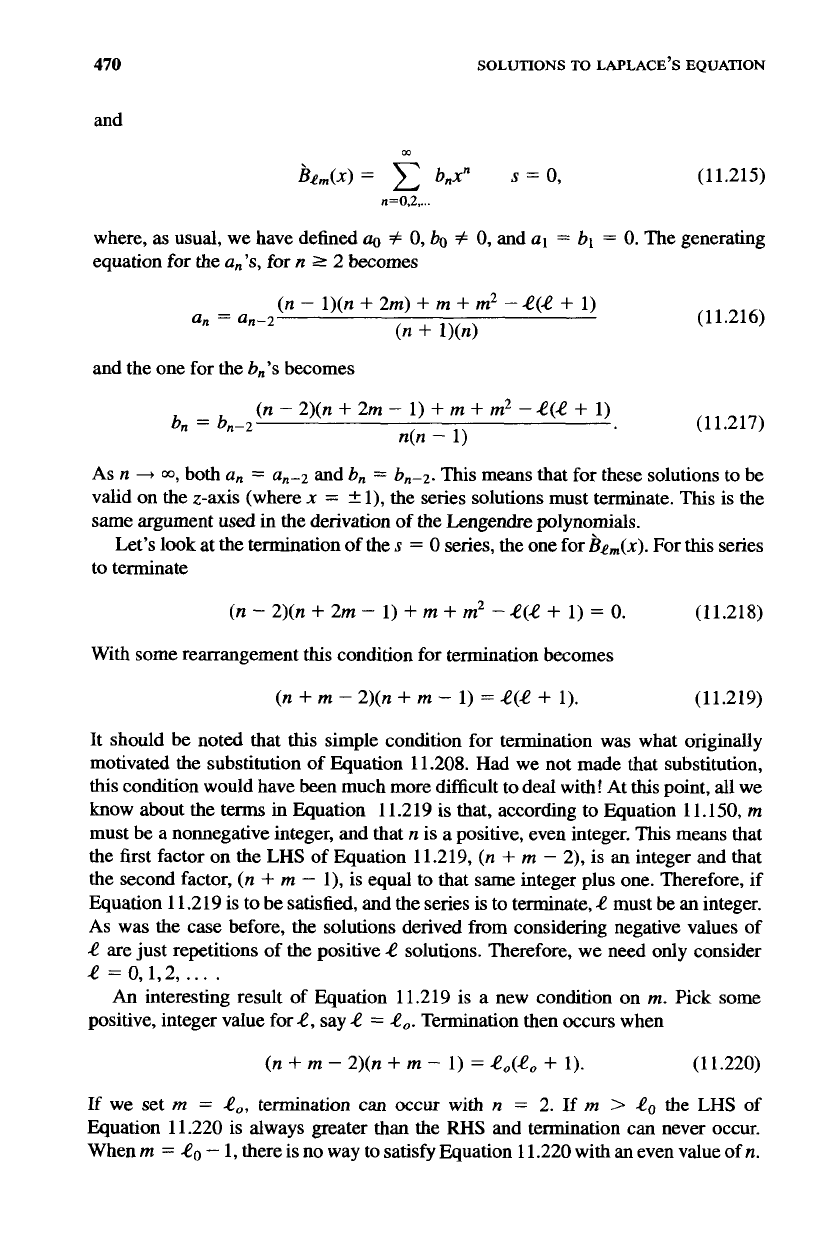
There are two solutions for the indicial equations,
s
=
1
and
s
=
0.
Thus we
obtain two different solutions,
m
A&&)
=
c
U,X"+l
s
=
1
(
1
1.2
14)
n=0,2,
...
470
SOLUTIONS
TO
LAPLACE'S EQUATION
and
m
B~,,,(x)
=
C
b,x"
s
=
0,
(11.215)
where,
as
usual, we have defined
q,
#
0,
bo
#
0,
and
a1
=
bl
=
0.
The generating
equation for the
an's,
for
n
2
2
becomes
n=0,2,
...
(
1 1.21
6)
(n
-
l)(n
+
2rn)
+
m
+
m2
-
t(t
+
1)
a,,
=
an-2
(n
+
and the one for the
bn's
becomes
(n
-
2)(n
+
2m
-
1)
+
m
+
rn2
-
t(4
+
1)
b,,
=
bn-2
(1 1.217)
n(n
-
1)
As
n
+
m,
both
a,,
=
an-2
and
b,
=
bn-2.
This means that for these solutions to be
valid
on
the z-axis (where
x
=
2
l),
the series solutions must terminate.
This
is the
same argument used in the derivation of the Lengendre polynomials.
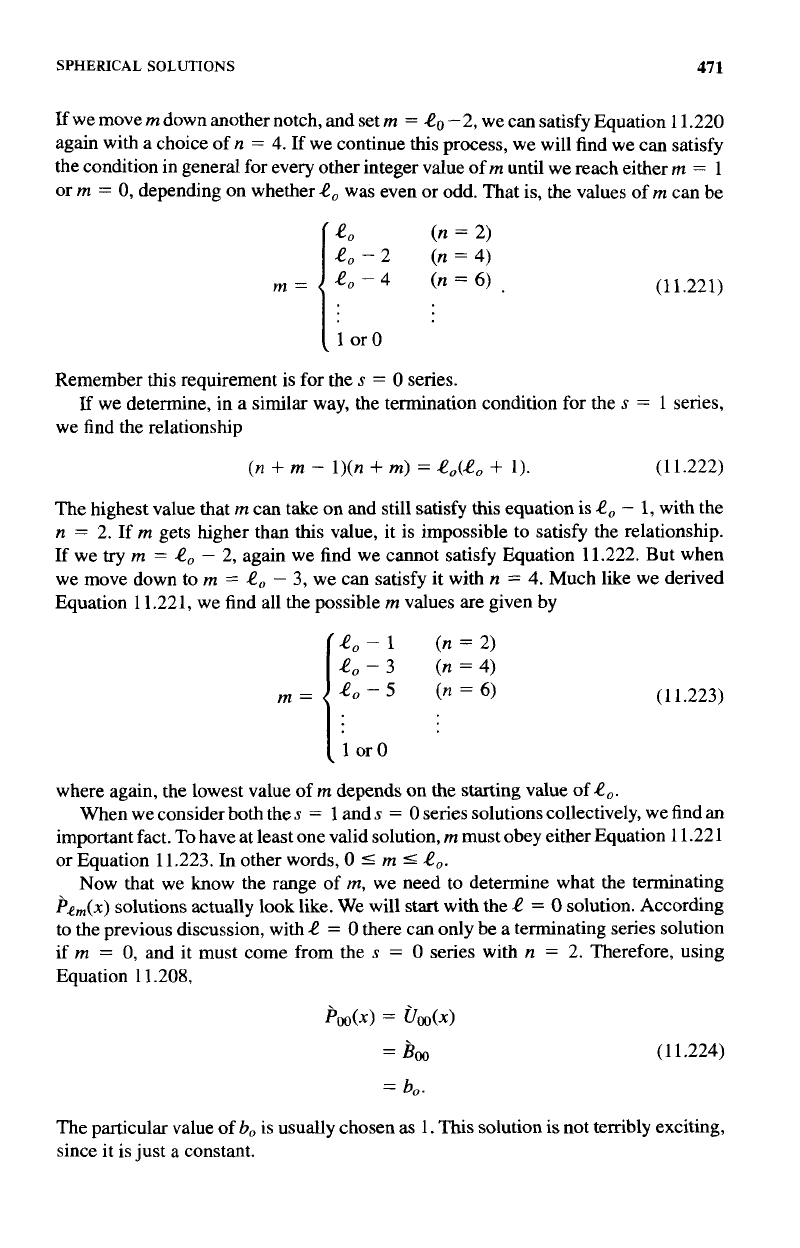
Let's look at the termination of the
s
=
0
series, the one for
&,,,(x).
For
this
series
to terminate
(n
-
2)(n
+
2rn
-
1)
+
rn
+
m2
-
t(4
+
1)
=
0.
(1 1.21
8)
With
some rearrangement
this
condition for termination becomes
(n
+
m
-
2)(n
+
m
-
1)
=
t(t
+
1). (11.219)
It should be noted that
this
simple condition for termination was what originally
motivated the substitution of Equation 11.208. Had we not made that substitution,
this
condition would have been much more difficult to deal with!
At
this
point, all we
know about the terms in Equation 11.219
is
that, according to Equation 11.150,
m
must be a nonnegative integer, and that
n
is a positive, even integer.
This
means that
the first factor on the LHS of Equation 11.219,
(n
+
rn
-
2), is an integer and that
the second factor,
(n
+
rn
-
I), is equal to that same integer plus one. Therefore, if
Equation 11.219 is to be satisfied, and the series is to terminate,
4
must be
an
integer.
As
was the case before, the solutions derived
from
considering negative values of
4
are just repetitions of the positive
t
solutions. Therefore, we need only consider
e
=0,1,2
,...
.
An
interesting result of Equation 11.219 is a new condition on
m.
Pick some
positive, integer value fort, say
t
=
4,.
Termination then occurs when
(n
+
m
-
2)(n
+
m
-
1)
=
t,(4,
+
1).
(1 1.220)
If
we set
m
=
-to,
termination can occur with
n
=
2.
If
m
>
4,
the
LHS
of
Equation 11.220 is always greater than the
RHS
and termination can never occur.
When
m
=
40
-
1, there is no way to satisfy Equation 11.220 with
an
even value
of
n.
SPHERICAL
SOLUTIONS
471
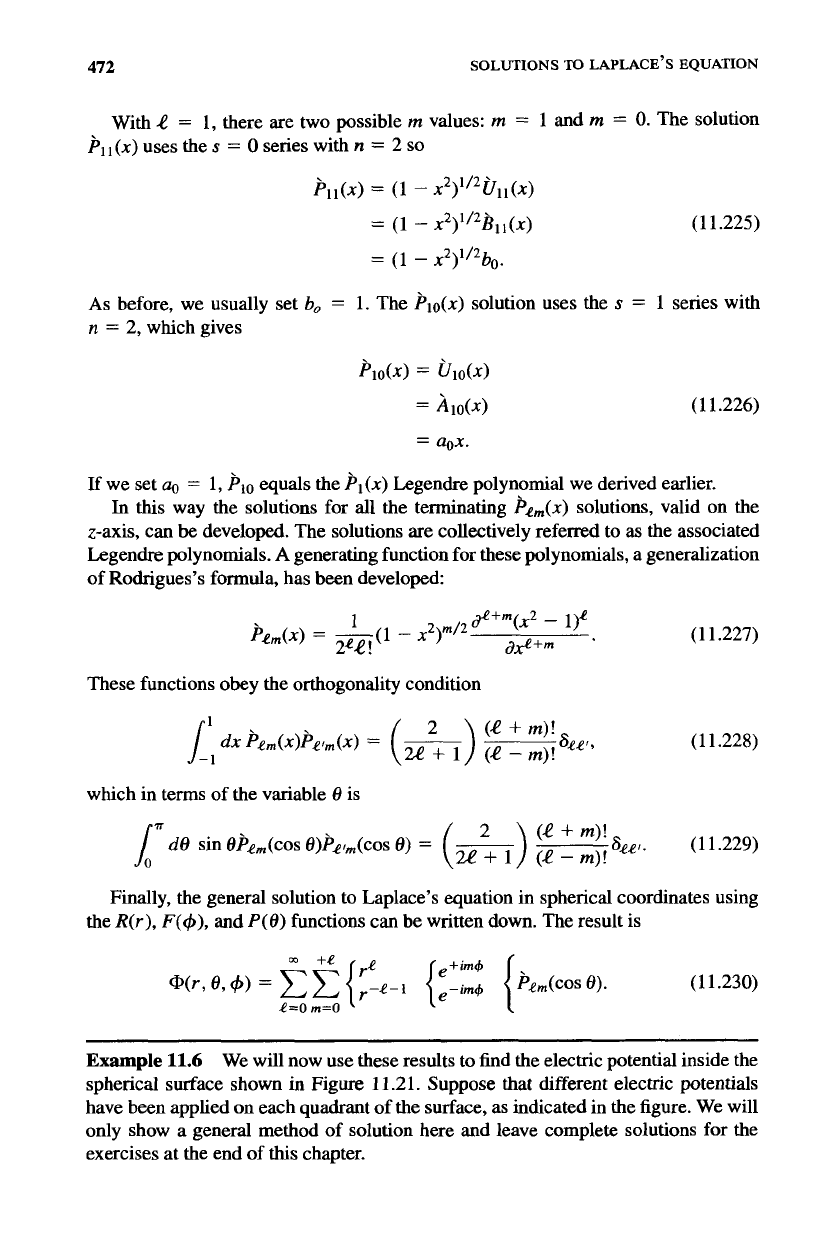
If we move
m
down another notch, and set
m
=
4,
-
2, we can satisfy Equation 1 1.220
again with a choice of
n
=
4. If we continue
this
process, we will find we can satisfy
the condition in general for every other integer value of
m
until we reach either
rn
=
1
or
rn
=
0,
depending on whether
4,
was even
or
odd. That is, the values of
m
can be
(n
=
2)
4,
-2
(n
=
4)
(1
1.221)
1 or0
(1
1.222)
Remember this requirement is for the
s
=
0
series.
we find the relationship
If
we determine, in a similar way, the termination condition for the
s
=
1 series,
(n
+
m
-
l)(n
+
rn)
=
4&?,
+
1).
The highest value that
m
can take on and still satisfy this equation is
4,
-
1,
with the
n
=
2. If
m
gets higher than
this
value, it is impossible to satisfy the relationship.
If we
try
m
=
t,
-
2, again we find we cannot satisfy Equation 11.222. But when
we move down
to
m
=
4,,
-
3,
we can satisfy it with
n
=
4.
Much like we derived
Equation 11.221, we find all the possible
m
values are given by
4,
-
1
(n
=
2)
(n
=
4)
I
4,
-
3
m=
{
4,-5
(n
=6)
(1 1.223)
where again, the lowest value of
rn
depends on the starting value
of
4,.
When we consider both the
s
=
1 and
s
=
0
series solutions collectively, we find an
important fact.
To
have at least one valid solution,
m
must obey either Equation 1 1.221
or
Equation 11.223. In other words,
0
I
m
5
4,.
Now that we know the range of
m,
we need to determine what the terminating
plm(x)
solutions actually look like.
We
will start with the
l
=
0
solution. According
to the previous discussion, with
t
=
0
there can only be a terminating series solution
if
rn
=
0,
and it must come from the
s
=
0
series with
n
=
2. Therefore, using
Equation
1
1.208,
PI&)
=
Uw(x)
=
Boo
(1 1.224)
=
b,.
The particular value of
b,
is usually chosen
as
1.
This
solution
is
not terribly exciting,
since it is just a constant.
472
SOLUTIONS
TO
LAPLACE'S
EQUATION
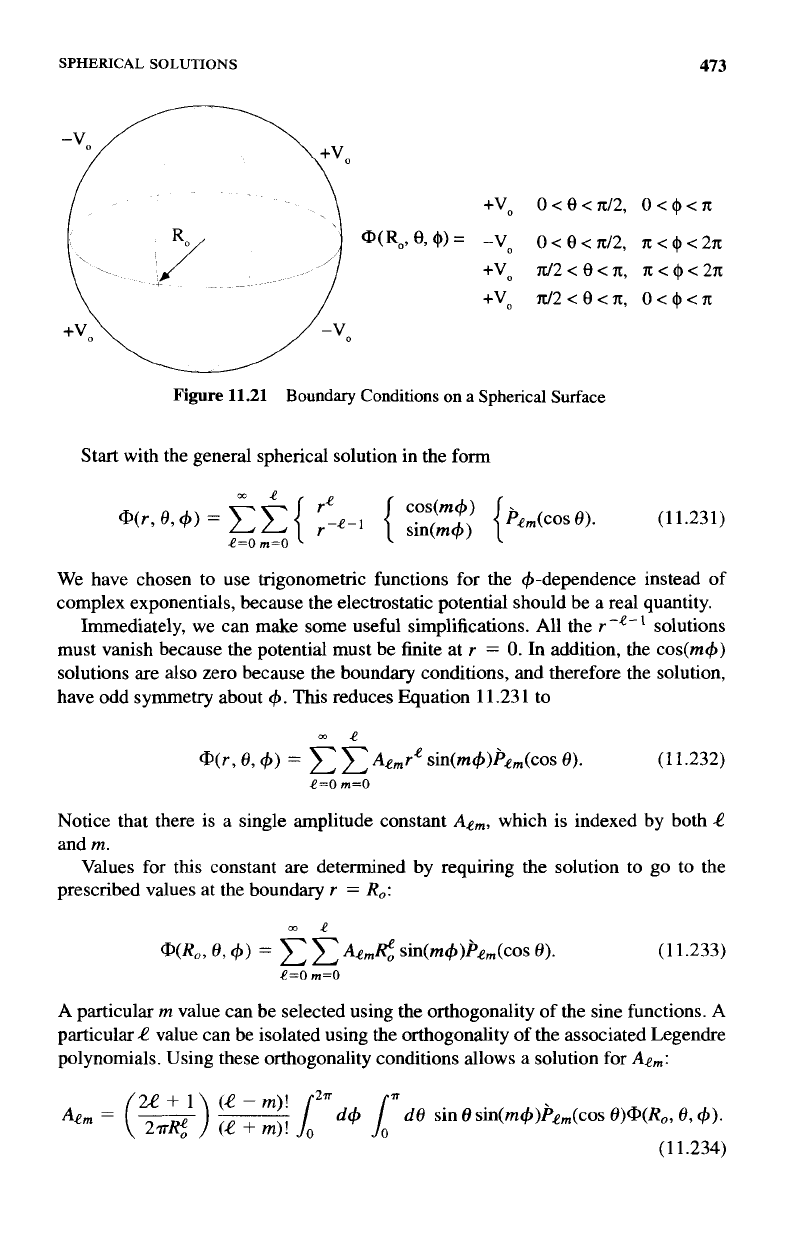
With
4
=
1, there are two possible
m
values:
m
=
1 and
m
=
0.
The solution
PI
1
(x)
uses the
s
=
o
series with
n
=
2
so
2
1/20
+ll(X)
=
(1
-
x
1
11b)
=
(1
-
X2)'/2Bll(X)
(1 1.225)
=
(1
-
x2)lI2b0.
As
before, we usually set
b,
=
1.
The
Plo(x)
solution uses the
s
=
1
series with
n
=
2, which gives
(1 1.226)
=
aox.
If
we set
In
this
way the solutions for
all
the terminating
pem(x)
solutions, valid on the
z-axis, can
be
developed. The solutions
are
collectively referred
to
as
the associated
Legendre polynomials.
A
generating function for these polynomials, a generalization
of Rodrigues's formula, has been developed:
=
1,
Pl,
equals the
&'1(x)
Legendre polynomial we derived earlier.
These functions obey the orthogonality condition
(1 1.227)
(1
1.228)
which in terms
of
the variable
6
is
Finally, the general solution
to
Laplace's equation in spherical coordinates using
the
R(r),
F(+),
and
P(8)
functions can be written down. The result is
Example
11.6
We will now use these results to find the electric potential inside the
spherical surface shown
in
Figure 11.21. Suppose that different electric potentials
have been applied on each quadrant of the surface, as indicated in the figure. We will
only show a general method of solution here and leave complete solutions for the
exercises at the end of
this
chapter.
SPHERICAL SOLUTIONS
473
+vo
0<0<d2,
O<@<R
Q(Ro,eY40=
-vo
0<0<iT12, x<l$<2n:
+Vo
M2<8<7c,
R<@<~TI
+vo
M2<0<lc,
O<l$<?K
Figure
11.21
Boundary
Conditions
on
a Spherical Surface
Start with the general spherical solution in the form
me
(1
1.231)
sin(m4J)
4=0
m=O
We have chosen to use trigonometric functions for the +-dependence instead of
complex exponentials, because the electrostatic potential should be a real quantity.
Immediately, we can make some useful simplifications. All the
r-'-'
solutions
must vanish because the potential must be finite at
r
=
0.
In
addition, the cos(rn4)
solutions
are
also
zero because the boundary conditions, and therefore the solution,
have odd symmetry about
4.
This
reduces Equation
1
1.23
1
to
me
D(r,
o,+)
=
sin(rn+)Pt,(cos
e).
(1
1.232)
O=O
m=O
Notice that there is a single amplitude constant
Atrn,
which is indexed by both
4
and
m.
Values for this constant are determined by requiring the solution to go to the
prescribed values at the boundary
r
=
R,:
A
particular
m
value can be selected using the orthogonality of the sine functions.
A
particular
4
value can be isolated using the orthogonality of the associated Legendre
polynomials. Using these orthogonality conditions allows a solution for
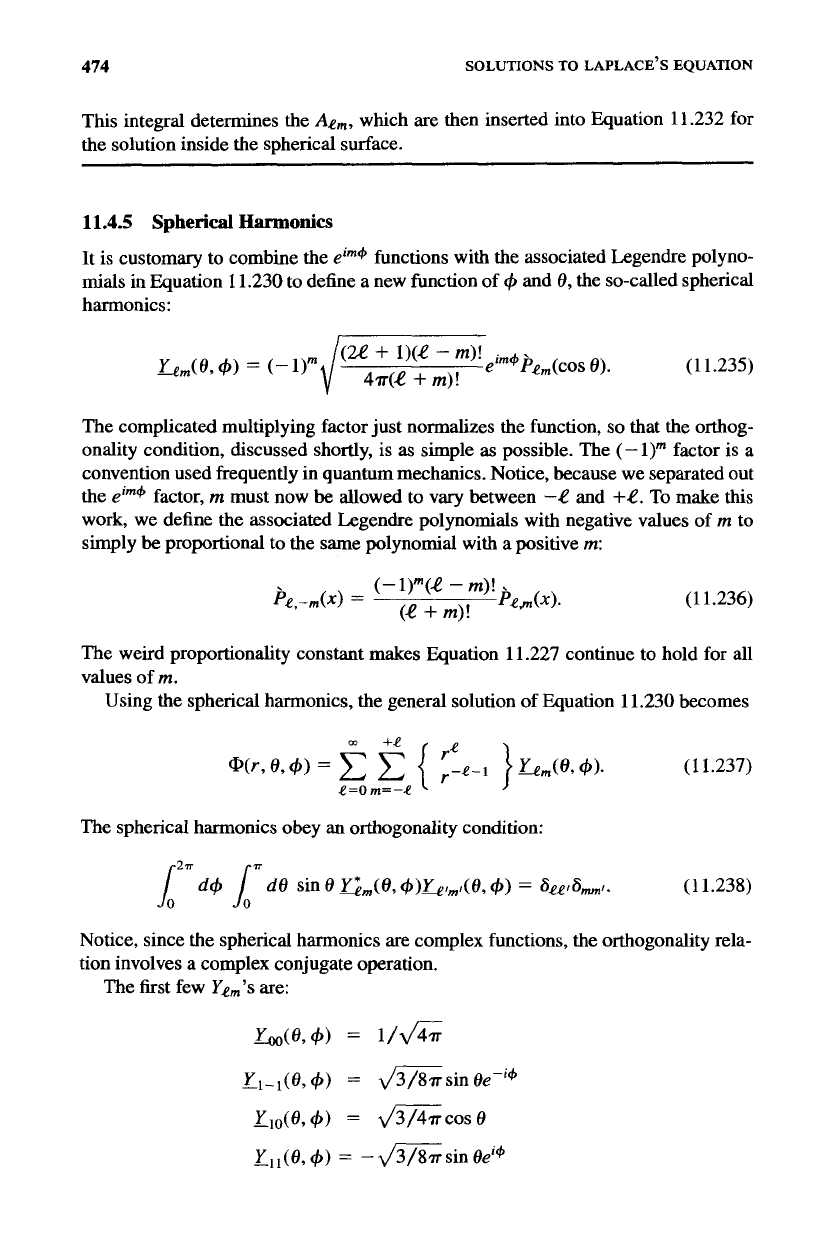
Atrn:
474
SOLUTIONS TO LAPLACE'S EQUATION
This integral determines the
Aem,
which are then inserted into Equation
11.232
for
the solution inside the spherical surface.
11.4.5
Spherical
Harmonics
It is customary
to
combine the eim$ functions with the associated Legendre polyno-
mials in Equation
1
1.230
to define a new function of
c$
and
8,
the
so-called spherical
harmonics:
The complicated multiplying factor just normalizes the function,
so
that the
orthog-
onality condition, discussed shortly, is
as
simple
as
possible. The
(-
1)"'
factor is a
convention used frequently in quantum mechanics. Notice, because we separated out
the eim$ factor, m must now be allowed to vary between
-4
and
+4.
To
make this
work, we define
the
associated Legendre polynomials with negative values of
m
to
simply
be
proportional
to
the
same polynomial with a positive m:
(-
l)"(.e
-
m)!
.
(4
+
m)!
Pem
(x).
Pe,-rn(X>
=
(11.236)
The weird proportionality constant makes Equation
11.227
continue to hold for all
values
of
m.
Using the spherical harmonics, the general solution of Equation
11.230
becomes
The spherical harmonics obey
an
orthogonality condition:
[*&#J
lTd8
sin
8
zm(8,
+)&,,f(8,
4)
=
6eedrn,.
(1
1.238)
Notice, since the spherical harmonics are complex functions, the orthogonality rela-
tion involves a complex conjugate operation.
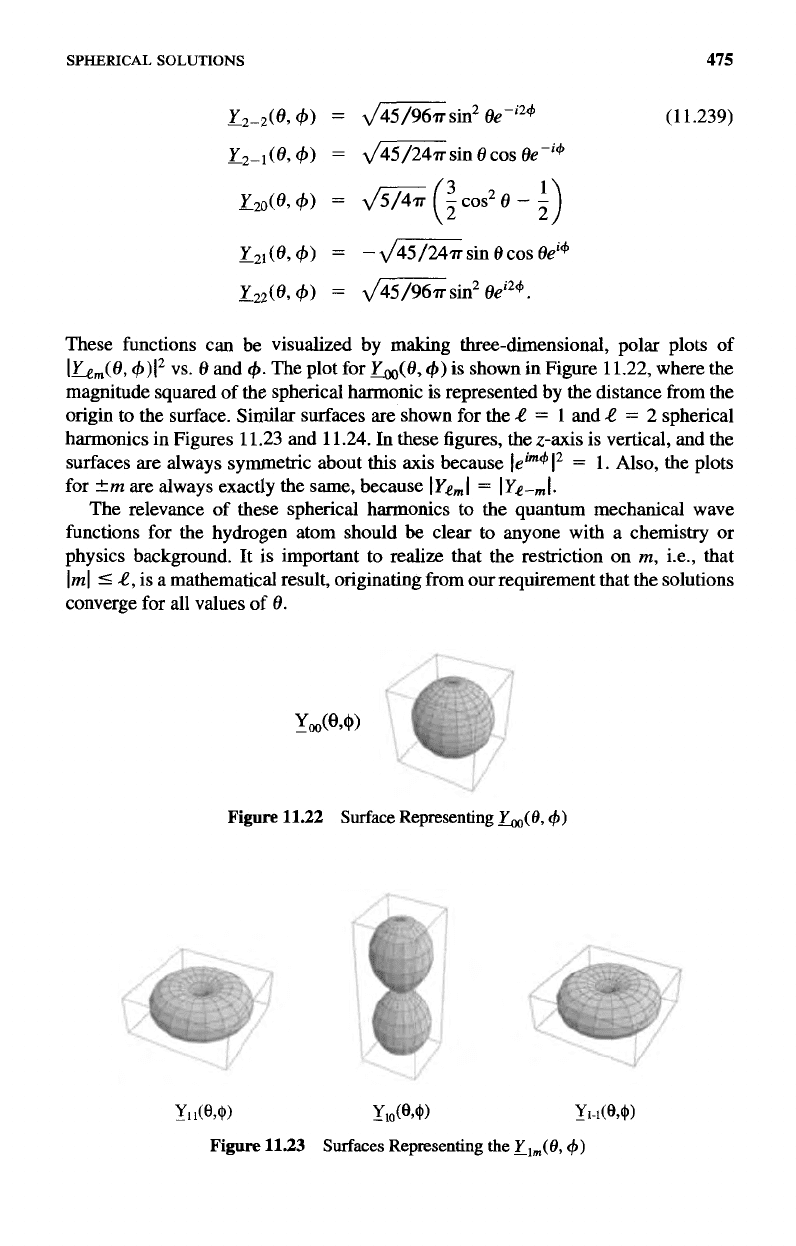
The first few
Ytm's
are:
&)(@,4>
=
xl-l(e,
4)
=
*sin
oci+
k'lo(8,4)
=
mcos
8
SPHERICAL
SOLUTIONS
475
These functions can be visualized by making three-dimensional, polar plots of
1Gm(8,
+)I2
vs.
8
and
4.
The plot for
&((I,
4)
is
shown
in
Figure 11.22, where the
magnitude squared of the spherical harmonic
is
represented by the distance from the
origin to the surface. Similar surfaces are shown for the
4
=
1
and
4
=
2 spherical
harmonics in Figures 11.23 and 11.24.
In
these figures,
the
z-axis
is vertical, and the
surfaces are always symmetric about
this
axis
because le'"+l2
=
1.
Also,
the plots
for
+m
are always exactly the same, because
I
Ye,,,
I
=
I
Ye-m
I.
The relevance of these spherical harmonics to the quantum mechanical wave
functions for the hydrogen atom should
be
clear
to
anyone with a chemistry or
physics background. It
is
important to realize that the restriction on
m,
i.e., that
Iml
5
4,
is a mathematical result, originating from
our
requirement that the solutions
converge for all values
of
8.
Figure
11.22
Surface
Representing
&,(&
4)