
Kusse B.R., Westwig E.A. Mathematical Physics: Applied Mathematics for Scientists and Engineers
Подождите немного. Документ загружается.

456
SOLUTIONS TO LAPLACE’S EQUATION
(0
n
even
(
1
1.142)
The final solution to this problem for
p
<
r,
becomes
In this example, the modified Bessel functions did not combine with the
p-
dependent operator to satisfy a Hermitian condition. Consequently, they were not
orthogonal functions and could not be used to select a particular value of
n.
Instead,
we used the orthogonality of the sine functions to perform the expansion.
Example
11.5
As
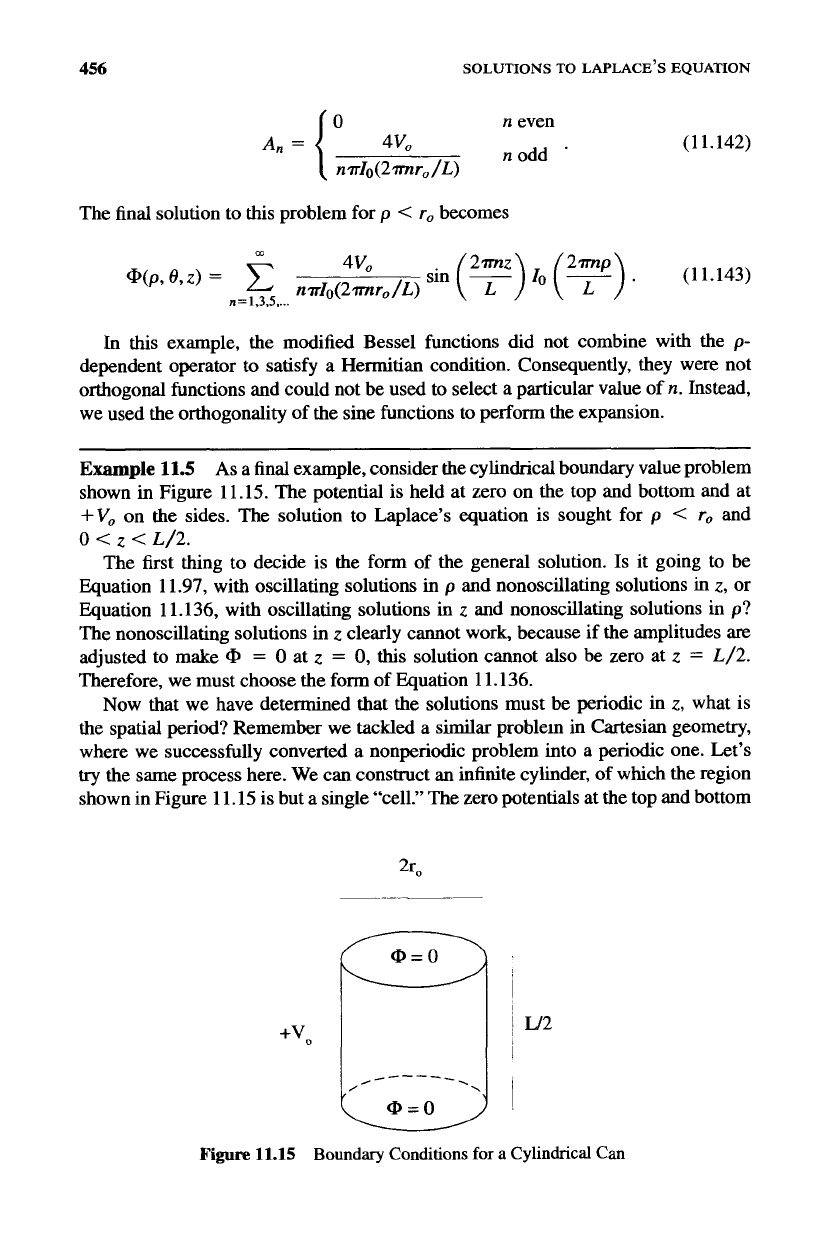
a final example, consider the cylindrical boundary value problem
shown in Figure
11.15.
The potential is held at zero on the top and bottom
and
at
+V,
on the sides. The solution to Laplace’s equation is sought for
p
<
r,
and
The first thing to decide is the form of the general solution.
Is
it going to be
Equation
11.97,
with oscillating solutions in
p
and nonoscillating solutions
in
z,
or
Equation
1
1.136,
with oscillating solutions
in
z
and nonoscillating solutions
in
p?
The nonoscillating solutions in
z
clearly cannot work, because
if
the amplitudes are
adjusted to make
@
=
0
at
z
=
0,
this solution cannot also be zero at
z
=
L/2.
Therefore, we must choose the form of Equation
1
1.136.
Now that we have determined that the solutions must be periodic in
z,
what is
the spatial period? Remember we tackled
a
similar problem in Cartesian geometry,
where we successfully converted a nonperiodic problem into a periodic one. Let’s
try
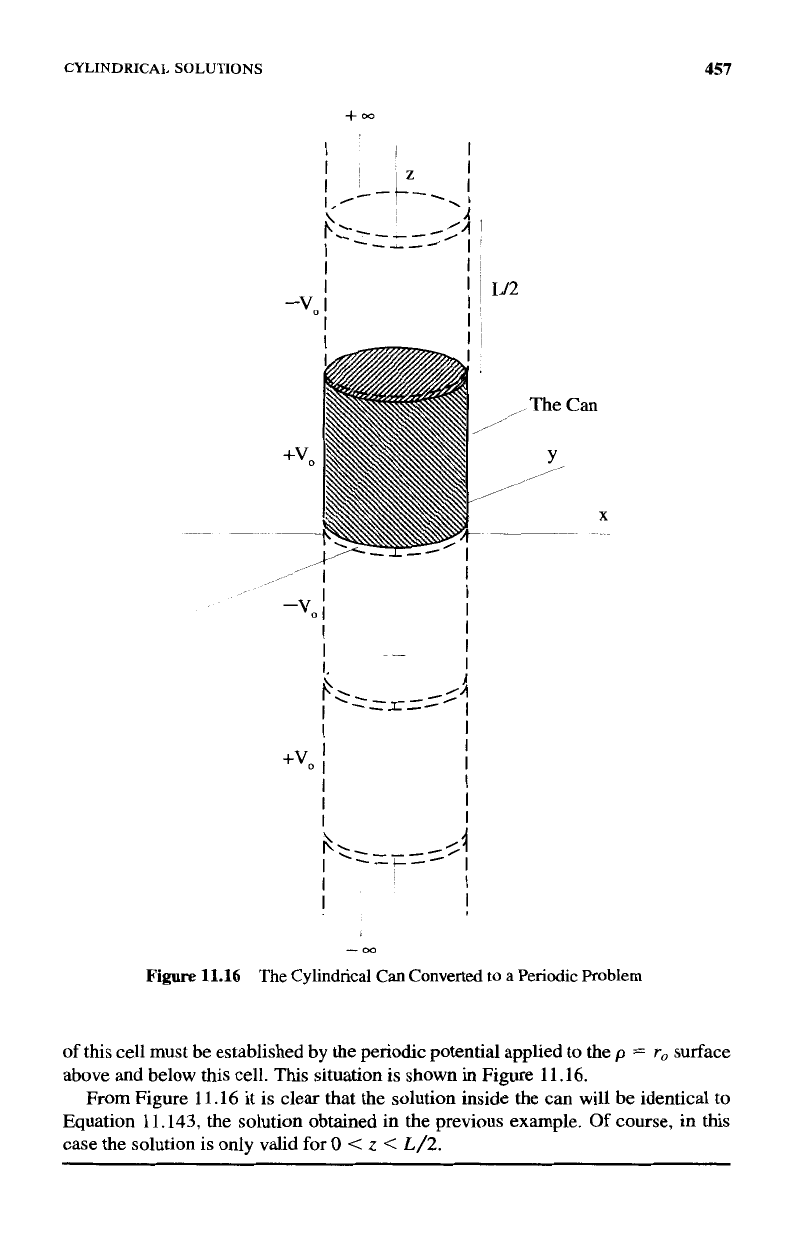
the same process here. We can construct an infinite cylinder,
of
which the region
shown in Figure
1
1.15
is but a single “cell.” The zero potentials at the top and bottom
0
<
z
<
L/2.
1
w2
i
+vo
~~
,/-----
@=O
Figure
11.15
Boundary Conditions
for
a
Cylindrical
Can
CYLINDRICAL SOLUTIONS
I
,
I
457
-vo
I
I
I’
I
I
L/2
1,
I
The Can
,’
Y
I’
,
,-
X
”
I
I
-vo
I
+vo
I
I I
I
I
I
I
I
I
-00
Figure
11.16
The Cylindrical Can Converted
to
a
Periodic Problem
of
this cell must be established by the periodic potential applied
to
the
p
=
r,
surface
above and below this cell.
This
situation is shown
in
Figure
11.16.
From Figure
11.16
it is clear that the solution inside the can will be identical
to
Equation
11.143,
the solution obtained in the previous example.
Of
course, in this
case the solution is only valid
for
0
<
t
<
L/2.
458
SOLUTIONS
TO
LAPLACE’S EQUATION
11.4
SPHERICAL
SOLUTIONS
The solutions to Laplace’s equation in spherical geometry are fairly complicated, but
they are
important
to understand because of their frequent use in quantum mechanics.
The organization of the
periodic
table of elements
is
due primarily to the nature of
these types of solutions. We will take the same approach we did with the other
coordinate systems and look for separable solutions.
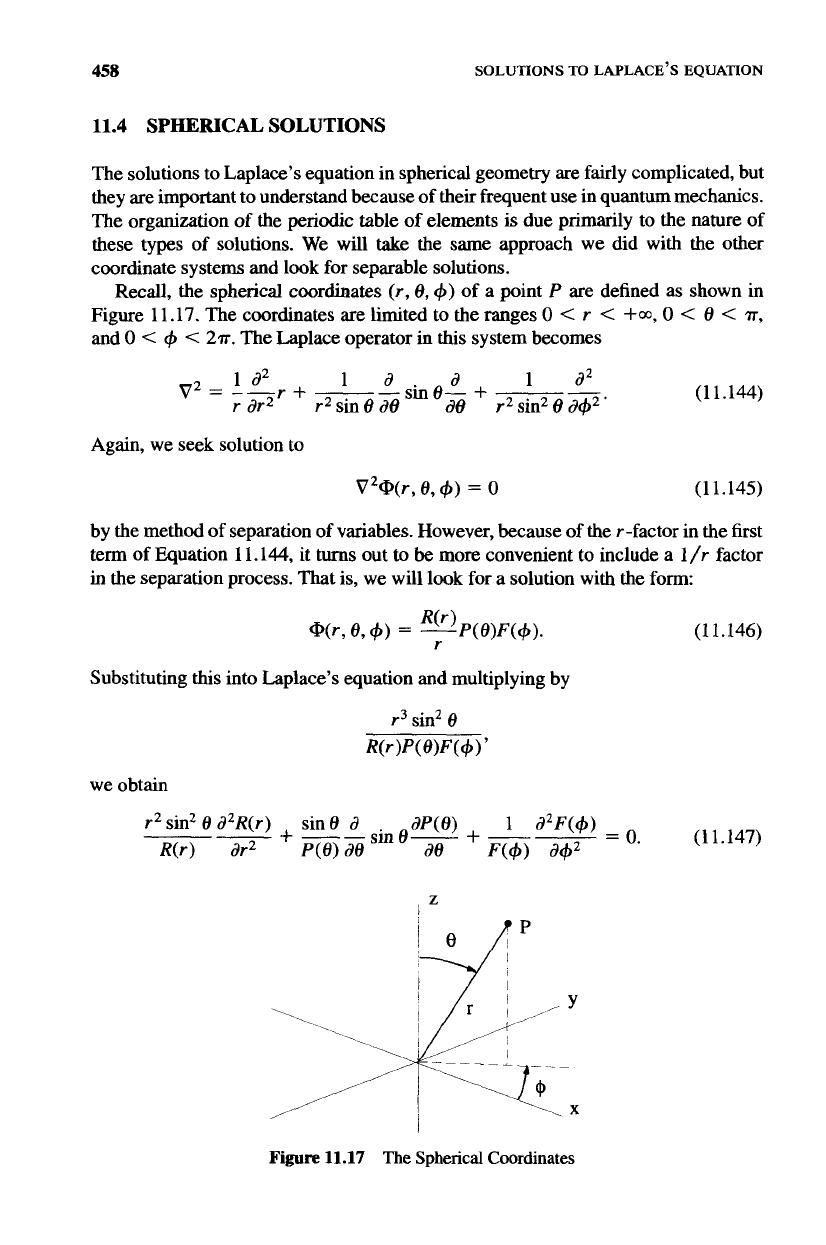
Recall, the spherical coordinates (r, 8,4) of a point
P
are defined as shown in
Figure
11.17.
The coordinates are limited to the ranges
0
<
r
<
+m,
0
<
6
<
T,
and
0
<
4
<
2rr.
The Laplace operator in
this
system becomes
1
a2
la
a
1
a2
sine-
+
--
r
dr2
r2
sin
8
at3
30
r2
sin2
8
aC$2
*
v2
=
--r
+
____
(
1 1.144)
Again, we seek solution to
V2cP(r,
e,4)
=
o
(
1
1.145)
by the method
of
separation of variables. However, because of the r-factor in the first
term of muation
11.144,
it
turns
out to
be
more
convenient
to
include a
l/r
factor
in the separation process. That is, we will look for a solution with the
form:
(1 1.146)
R(r)
w.
e,$)
=
---PWF(+).
r
Substituting
this
into Laplace’s equation and multiplying by
r3
sin2
8
R(r)P(e)F(4)
’
we obtain
r2
sin2
e
a2R(r)
sin8
a
aP(e)
1
a2~(4)
___-
+--
sine-
+--
=
0.
R(r)
dr2
P(e)ae
69
F(4)
d42
(
1
1.147)
Z
Figure
11.17
The
Spherical Coordinates
SPHERICAL
SOLUTIONS
459
Separating the +-Dependence
Because the last term on the
LHS
of Equation
1
1.147
contains all the +-dependence, it can be set equal to a separation constant. In the most
common spherical problems, the range of
+
is
0
<
+
<
2~,
and to keep the po-
tential single-valued, we must have @(r,
8,+)
=
@(r,
8,+
+
27-r).
This means the
F(+)
solutions must be periodic, and thus the separation constant cannot be positive.
We will stick with the convention used by most scientists and define this separation
constant as
(1
1 .l48)
We have discussed the solutions to
this
equation already.
F(+)
can take either of two
forms:
(11.149)
In electrostatics, where the solutions need to be pure real, the second form of
Equation 11.149 is usually preferred. In quantum mechanics, the solutions can be
complex, and the first form is frequently used. Regardless
of
the
form, the periodicity
over the range
0
<
4
<
27-r forces
m
to
take
on the discrete values
m=0,1,2
,....
(1
1.150)
Separating the r-Dependence
Now we can proceed to separate the
r
-dependence.
Substituting
-m2
for the +-dependent term, Equation 11.147 reduces to
r2 sin2
e
d2R(r) sin
8
d
.
dp(e)
+--
sm8-
-
m2
=
0.
~-
R(r) dr2
P(e)ae
ae
(1
1.151)
After dividing this entire equation by sin2
8,
the r-dependence is confined to the first
term, which can be set equal to a second separation constant. For reasons that will
become clear later, we will give
this
constant a rather peculiar form:
r2
d2R(r)
=
4(4
+
1).
--
R(r) dr2
(
1
1.1
52)
What is the general solution for R(r)? One could go through the entire method
of Frobenius to generate series solutions for this equation, but in this case, it is not
difficult to see that the series will collapse to a single term. If we look for a solution
with the form
R(r)
0~
rn,
(1
1.153)
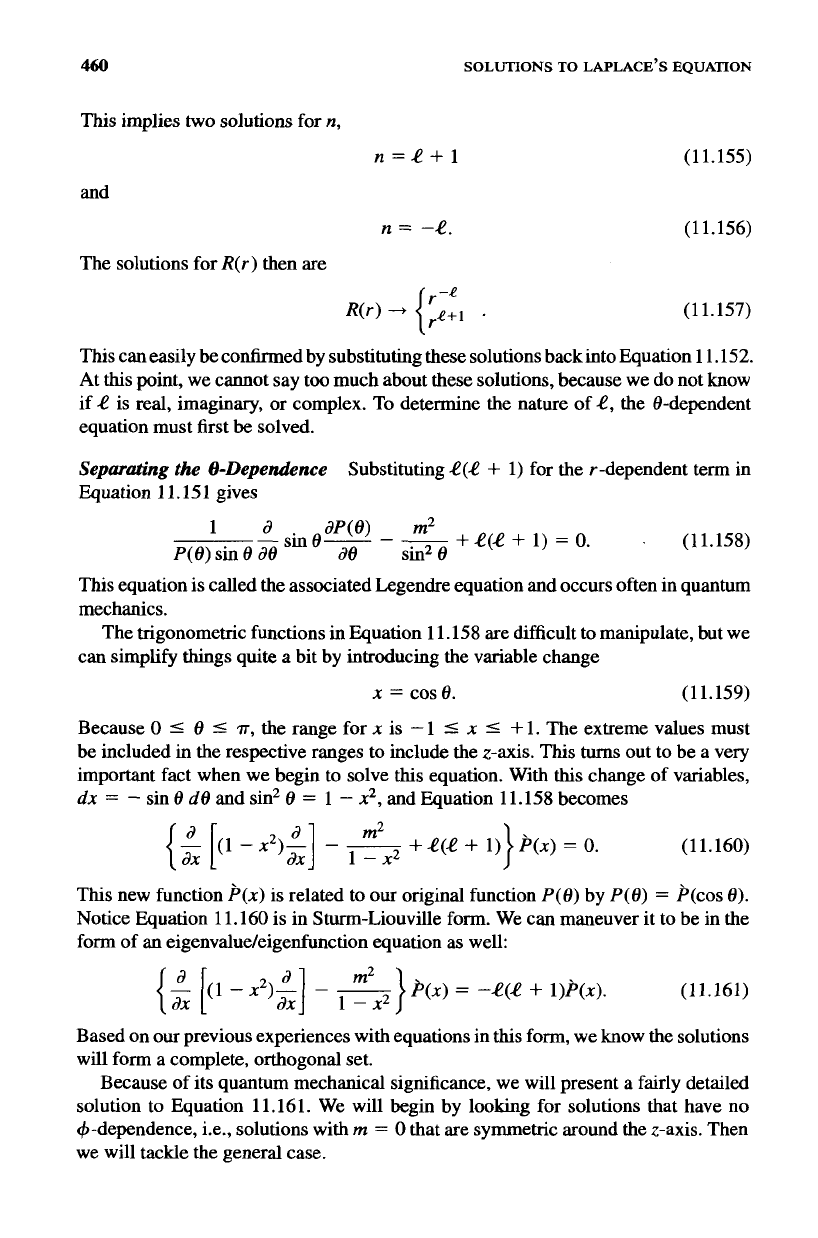
Equation 11.152 is satisfied if
n
satisfies the algebraic expression
(n)(n
-
1)
=
4(4
+
1).
(
1
1.154)
460
SOLUTIONS
TO
LAPLACE’S
EQUATION
This
implies two solutions for
n,
n=4+l
and
n
=
-4.
The solutions for R(r) then are
(1 1.155)
(
1
1.156)
(1 1.157)
This
can easily be confirmed by substituting these solutions backinto Equation
1
1.152.
At
this
point, we cannot say too much about these solutions, because we do not know
if
4
is
real, imaginary, or complex. To determine the nature of
4,
the &dependent
equation must first
be
solved.
Separating the 8-Dependence
Substituting
4(4
+
1) for the r-dependent term in
Equation 11.151 gives
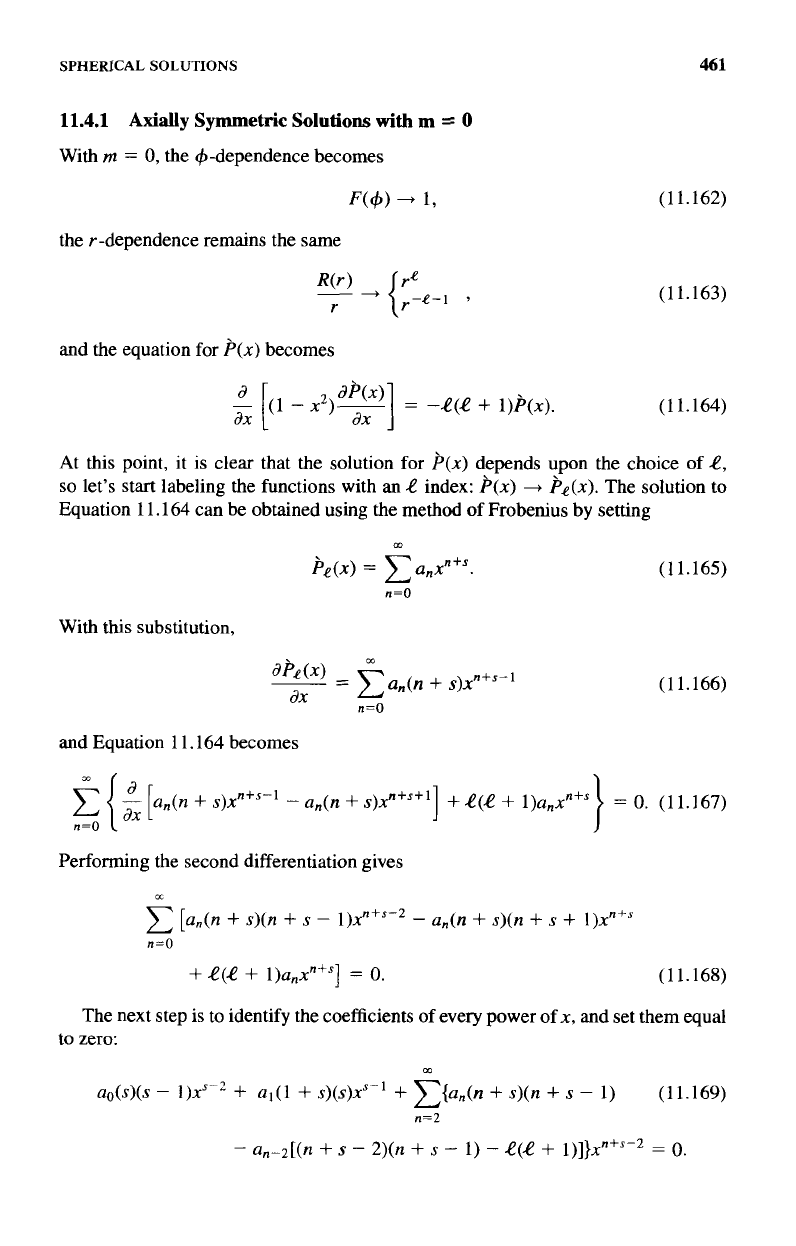
(
1 1.158)
This
equation is called the associated Legendre equation and occurs often in quantum
mechanics.
The trigonometric functions
in
Equation 1 1.158 are difficult to manipulate, but we
can simplify things quite
a
bit by introducing the variable change
x
=
COS~. (1 1.159)
Because
0
I
6
I
T,
the range for
x
is
-
1
5
x
5
+
1. The extreme values must
be included
in
the respective ranges to include the
z-axis.
This
turns
out to be a very
important fact when we begin to solve
this
equation. With
this
change of variables,
dx
=
-
sin
8
de
and sin2
8
=
1
-
x2,
and Equation 11.158 becomes
m2
(
1
1.160)
This
new function
P(x)
is
related to
our
original function
P(6)
by
P(0)
=
~(COS
6).
Notice Equation 11.160 is in Sturm-Liouville form. We can maneuver it to be in the
form of an
eigenvalueleigenfunction
equation as well:
m2
{
1
[(I
-
x2)-4
-
.--.)
P(x)
=
-4(4
+
l)P(x).
(1 1.161)
Based on
our
previous experiences with equations in
this
form, we
know
the solutions
will form a complete, orthogonal set.
Because of its quantum mechanical significance, we will present a fairly detailed
solution to Equation 11.161. We will begin by looking for solutions that have no
+dependence, i.e., solutions with
m
=
0
that are symmetric around the z-axis. Then
we will tackle the general case.
SPHERICAL
SOLUTIONS
461
11.4.1
Axially
Symmetric
Solutions
with
m
=
0
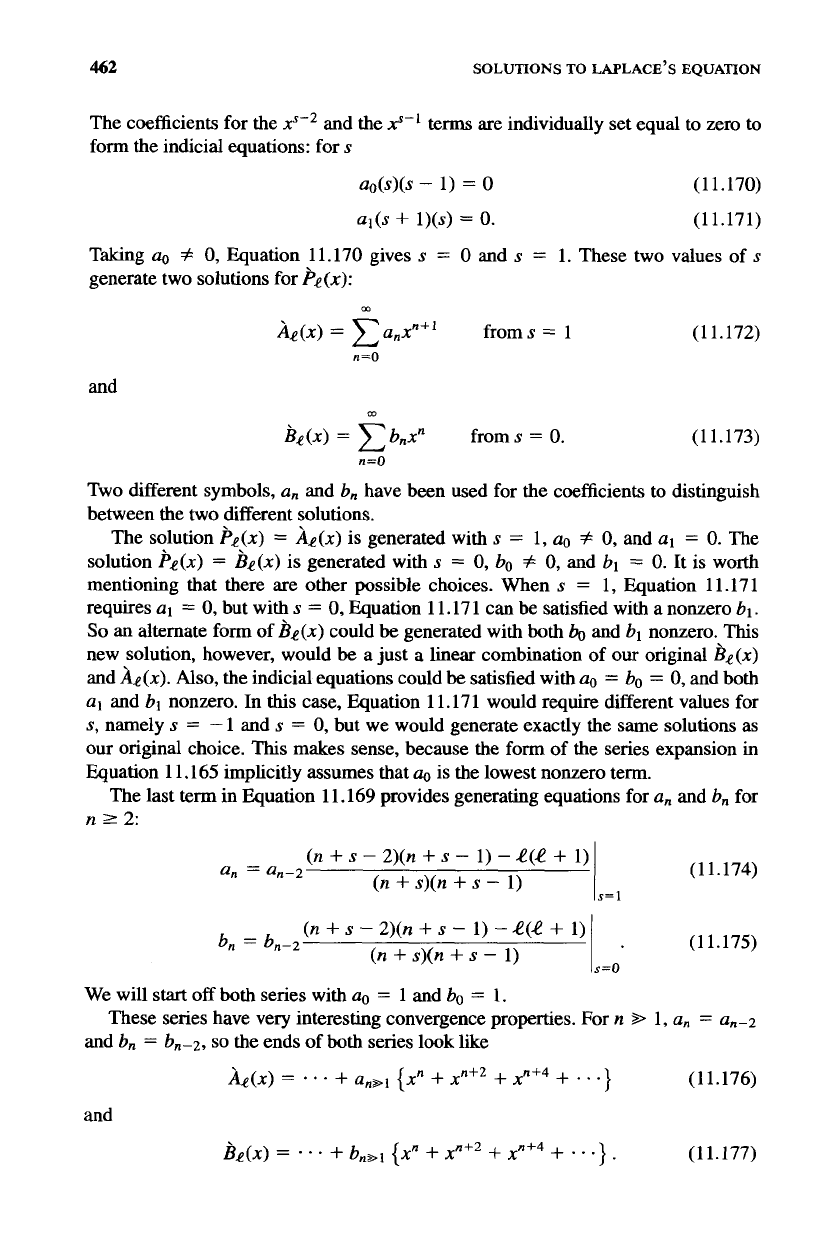
With
m
=
0,
the +-dependence becomes
F(+)
+
1,
the r-dependence remains the same
and the equation for
P(x)
becomes
-
(1
-
x
)-
=
-4(4
+
l)P(X).
dX
[
dP(x)l
dX
(1 1.162)
(1 1.163)
(1
1.164)
At this point, it is clear that the solution for
P(x)
depends upon the choice of
4,
so
let's start labeling the functions with an
4
index:
P(x)
-+
P&).
The
solution
to
Equation
1
1.164
can be obtained using the method
of
Frobenius by setting
m
P&)
=
xanxn+s.
(1
1.165)
n=O
With this substitution,
(1
1.166)
and Equation
1
1.164
becomes
2
{
&
[a,(n
+
s)xnfs-'
-
a,(n
+
S)X~+~+'
+4(4
+
I)u,x~+~
1
n=O
Performing the second differentiation gives
a
[a&
+
s)(n
+
s
-
1)xn+s-2
-
a,(n
+
s)(n
+
s
+
l)Xn+s
n=O
+
.e(4
+
l)anXn+s]
=
0.
(1
1.168)
The next step is to identify the coefficients of every power
of
x,
and set them equal
to zero:
m
ao(s)(s
-
I)Y2
+
al(l
+
s)(s)x'-'
+
Zen(.
+
s)(I~
+
s
-
1)
(11.169)
n=2
-
an-2[(n
+
s
-
2)(n
+
s
-
1)
-
4(4
+
l)]}X*+s-2
=
0.
462
SOLUTIONS
TO
LAPLACE'S
EQUATION
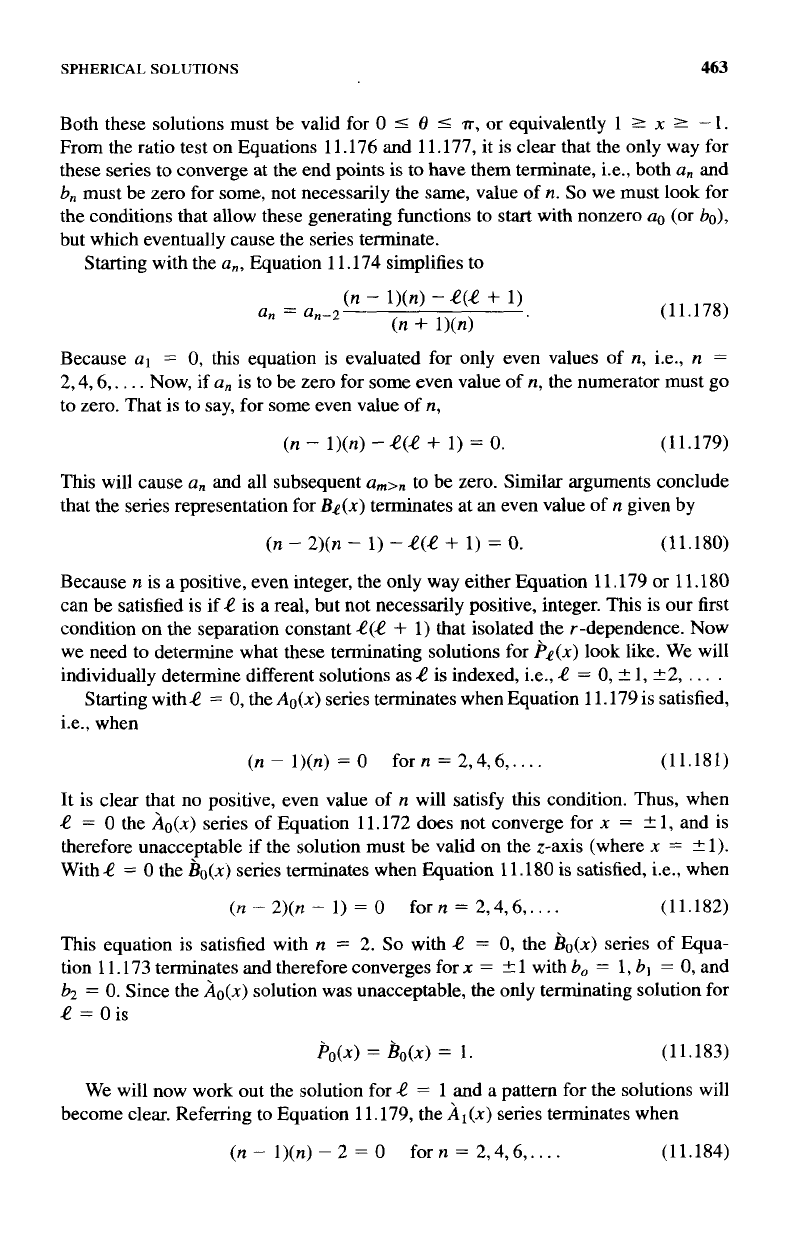
The coefficients for the
form the indicial equations: for
s
and the
9-'
terms are individually set equal to zero to
ao(s)(s
-
1)
=
0
(1 1.170)
a,(s
+
l)(s)
=
0.
(1 1.171)
Taking
q,
#
0,
Equation 11.170 gives
s
=
0
and
s
=
1. These two values of
s
generate two solutions for
Pt<x):
m
Ap(x)
=
Cu,xn+I
froms
=
1 (1 1.172)
n=O
and
m
&(x)
=
b,xn
from
s
=
0.
n=O
(1 1.173)
Two different symbols,
a,
and
b,
have been used for the coefficients to distinguish
between the
two
different solutions.
The solution
Pt(x)
=
At(x)
is generated with
s
=
1,
a0
#
0,
and
a1
=
0.
The
solution
Pt(x)
=
b(x)
is generated with
s
=
0,
bo
#
0,
and
61
=
0.
It
is
worth
mentioning that there are other possible choices. When
s
=
1, Equation 11.171
requires
a1
=
0,
but with
s
=
0,
Equation 11.171 can be satisfied with a nonzero
bl.
So
an alternate form
of
&(x)
could
be
generated with both
bo
and
bl
nonzero.
This
new solution, however, would
be
a just a
linear
combination of
our
original
h(x)
and
A&).
Also,
the indicial equations could
be
satisfied with
a0
=
bo
=
0,
and both
a1
and
bl
nonzero.
In
this
case, Equation 11.171 would require different values for
s,
namely
s
=
-
1
and
s
=
0,
but we would generate exactly the same solutions as
our original choice.
This
makes sense, because the form of the series expansion
in
Equation 1 1.165 implicitly assumes that
Q
is the lowest nonzero term.
The last term
in
Equation 1 1.169 provides generating equations for
an
and
b,
for
n
z
2:
(n
+
s
-
2)(n
+
s
-
1)
-
.e(&
+
1)
(n
+
s)(n
+
s
-
1)
(n
+
s
-
2)(n
+
s
-
1)
-
.e(X
+
1)
(n
+
s)(n
+
s
-
1)
a,
=
4-2
(
1 1.174)
IL
Is=;
b,
=
bn-2
(11.175)
We will
start
off
both series with
a0
=
1 and
bo
=
1.
and
b,
=
bn-2, so
the ends of both series look like
These series have very interesting convergence properties. For
n
S
1,
a,
=
an-2
Ag(x)
=
*
*.
+
unsl
{x"
+
xn+2
+
xn+4
+
*
*
*}
(1 1.176)
and
=
. . .
+
bnsl
{x"
+
X"+2
+
xni4
+
. .
.}
.
(11.177)
SPHERICAL
SOLUTIONS
463
Both these solutions must be valid for
0
I
8
I
T,
or
equivalently
1
2
x
2
-
1.
From the ratio test on Equations
11.176
and
11.177,
it is clear that the only way
for
these series to converge at the end points
is
to have them terminate, i.e., both
a,
and
b,
must be zero for some, not necessarily the same, value of
n.
So
we must
look
for
the conditions that allow these generating functions to
start
with nonzero
a0
(or
bo),
but which eventually cause the series terminate.
Starting with the
a,,
Equation
11.174
simplifies to
(n
-
l)(n)
-
C(C
+
1)
a,
=
an-2
(n
+
(1 1.178)
Because
a1
=
0, this equation is evaluated for only even values of
n,
i.e.,
n
=
2,4,6,.
.
. .
Now, if
a,
is
to
be zero for some even value of
n,
the numerator must go
to zero. That is to say, for some even value
of
n,
(n
-
l)(n)
-
C(C
+
1)
=
0.
(1
1.179)
to be zero. Similar arguments conclude
This
will cause
a,
and all subsequent
that the series representation for
B&)
terminates at an even value of
n
given by
(n
-
2)(n
-
1)
-
C(C
+
1)
=
0.
(1 1.180)
Because
n
is a positive, even integer, the only way either Equation
1
1.179
or
1 1.180
can be satisfied is if
4
is a real, but not necessarily positive, integer. This is our first
condition on the separation constant
C(X
+
1)
that isolated the r-dependence. Now
we need to determine what these terminating solutions for
k&)
look like. We will
individually determine different solutions as
C
is indexed, i.e.,
4
=
0,
?
1,
22,
.
.
. .
Starting with
X
=
0,
the
A&)
series terminates when Equation
1
1.179
is satisfied,
i.e., when
(n
-
l)(n)
=
0
for
n
=
2,4,6,.
.
.
.
(1 1.181)
It is clear that no positive, even value of
n
will satisfy this condition. Thus, when
4
=
0
the
A&)
series of Equation
1
1.172
does
not converge for
x
=
2
1, and
is
therefore unacceptable if the solution must be valid on the z-axis (where
x
=
2
1).
With
4
=
0
the
&(x)
series terminates when Equation 11.180 is satisfied, i.e., when
(1
1.182)
This equation
is
satisfied with
n
=
2.
So
with
C
=
0, the
&(x)
series of Equa-
tion
1 1.173
terminates and therefore converges for
x
=
t
1
with
b,
=
1,
bl
=
0, and
bz
=
0.
Since the
A&)
solution was unacceptable, the only terminating solution for
4
=
0is
P&)
=
$(x)
=
1.
(n
-
2)(n
-
1)
=
0
for
n
=
2,4,6,.
.
.
.
(1
1.183)
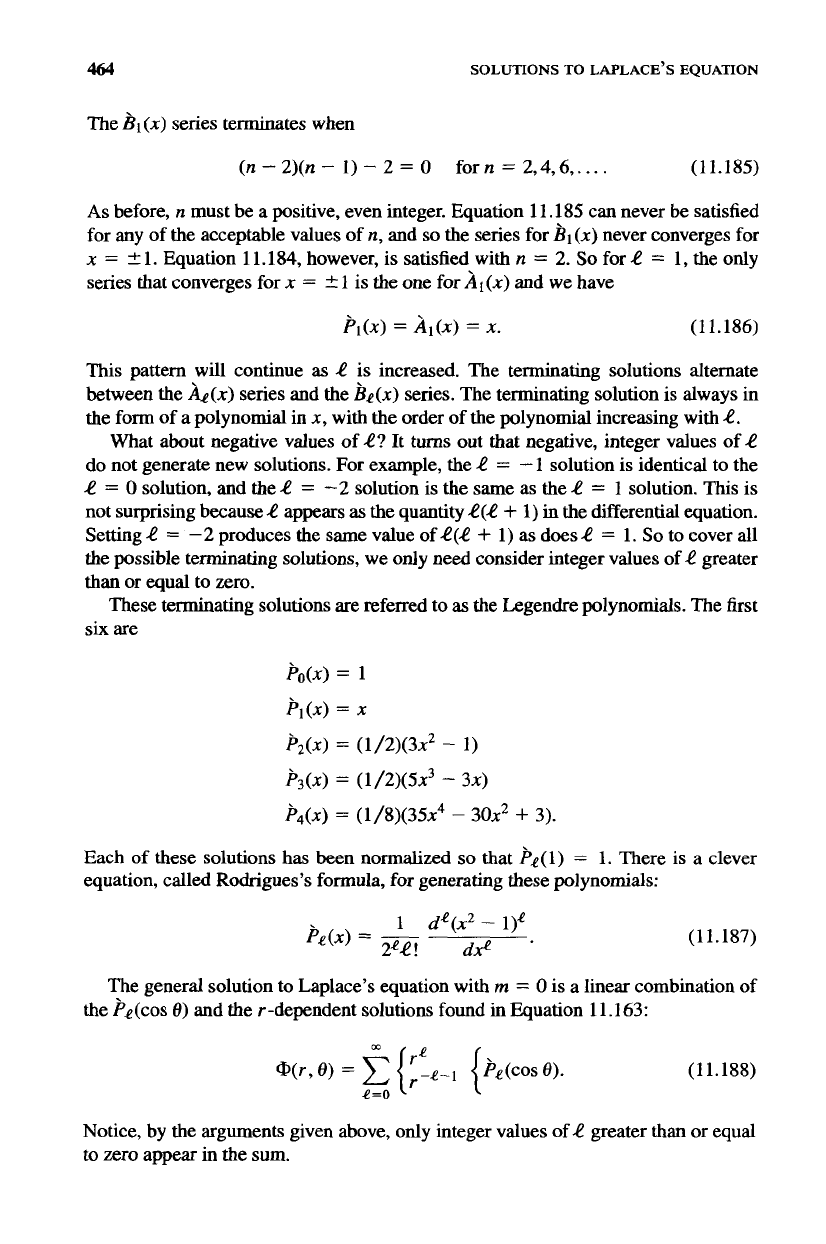
We will now work out the solution for
4
=
1
and a pattern for the solutions will
become clear. Refemng to Equation
1
1.179,
the
A,
(x)
series terminates when
(n
-
I)(n)
-
2
=
0
for
n
=
2,4,6,.
. .
.
(1 1.184)
464
SOLUTIONS
TO
LAPLACE'S EQUATION
The
Bl(x)
series terminates when
(n
-
2)(n
-
1)
-
2
=
0
forn
=
2,4,6
,....
(1 1.185)
As
before,
n
must be a positive, even integer. Equation
11.185
can never be satisfied
for
any
of the acceptable values of
n,
and
so
the series for
h1
(x)
never converges for
x
=
5
1.
Equation
1
1.184,
however, is satisfied with
n
=
2.
So
for
4
=
1,
the
only
series that converges for
x
=
t
1
is the one for
A,(x)
and we have
PI(X)
=
A,(x>
=
x.
(1 1.186)
This pattern will continue
as
4
is increased. The terminating
solutions
alternate
between the
A&)
series and the
h&)
series. The terminating solution is always in
the form of a polynomial in
x,
with the order of the polynomial increasing with
4.
What about negative values of
4?
It
turns
out that negative, integer values of
4
do
not generate new solutions. For example, the
4
=
-
1
solution is identical to the
4
=
0
solution, and the
4
=
-2
solution is the same as the
4
=
1
solution.
This
is
not
surprising because
4
appears
as
the quantity
4(4
+
1)
in the differential equation.
Setting
4
=
-2
produces the same value
of
l(4
+
1)
as does
4
=
1.
So
to cover all
the possible terminating solutions, we
only
need consider integer values of
4
greater
than or equal to zero.
These terminating
solutions
are referred to
as
the Legendre polynomials. The first
six are
Po($
=
1
Pl(X)
=
x
P~(x)
=
(1/2)(3x2
-
1)
P~(x)
=
(1
/2)(5x3
-
3~)
P~(x)
=
(l/8)(35x4
-
30x2
+
3).
Each
of
these
solutions
has
been
normalized
so
that
Pt(l)
=
1.
There is a clever
equation, called Rodrigues's formula, for generating these polynomials:
1
d'(x2
-
1)'
P'(X)
=
-
2'4!
d.x?
'
(1 1.187)
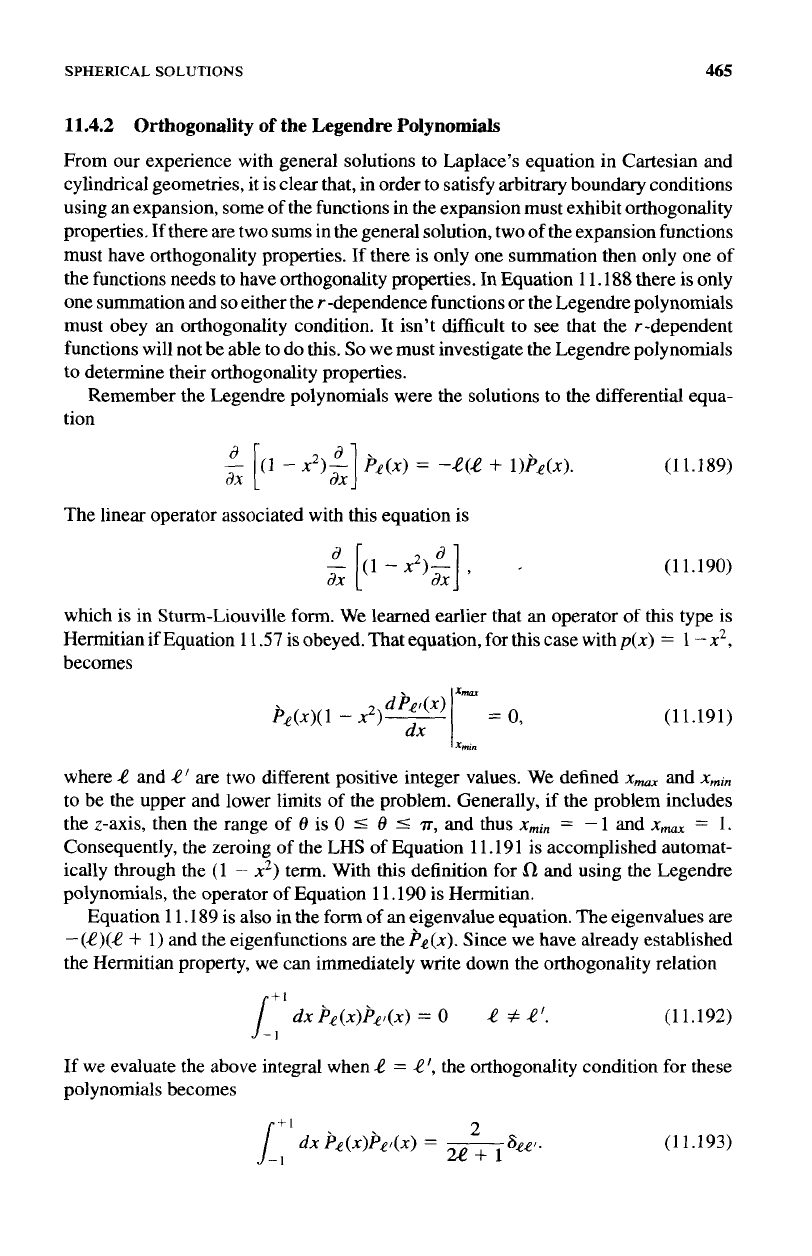
The general solution to Laplace's equation with
m
=
0
is a linear combination of
the ~~(COS
0)
and the r-dependent solutions found in Ekpation
11.163:
(
1
1.1
88)
Notice,
by
the arguments given above, only integer values of
4
greater than or equal
to zero appear in
the
sum.
SPHERICAL
SOLUTIONS
465
11.4.2
Orthogonality
of
the Legendre
Polynomials
From our experience with general solutions to Laplace's equation in Cartesian and
cylindrical geometries, it is clear that, in order to satisfy arbitrary boundary conditions
using an expansion, some of the functions in the expansion must exhibit orthogonality
properties. If there are two sums in the general solution, two of the expansion functions
must have orthogonality properties.
If
there
is
only one summation then only one
of
the functions needs to have orthogonality properties. In Equation 11.188 there
is
only
one summation and
so
either the r-dependence functions or the Legendre polynomials
must obey an orthogonality condition. It isn't difficult to
see
that the r-dependent
functions will not be able to do
this.
So
we must investigate the Legendre polynomials
to determine their orthogonality properties.
Remember the Legendre polynomials were the solutions to the differential equa-
tion
The linear operator associated with
this
equation
is
(11.189)
(1 1.190)
which
is
in Sturm-Liouville form. We learned earlier that an operator
of
this
type is
Hermitian
if
Equation 11.57
is
obeyed. That equation, for this case with p(x)
=
1
-x2,
becomes
jx-
=
0,
d
P~,(x)
&(x)( 1
-
2)-
dx
(1
1.191)
I
Xm,,
where
4
and
4'
are two different positive integer values. We defined x,, and x,i,
to be the upper and lower limits
of
the problem. Generally, if the problem includes
the z-axis, then the range of
8
is
0
5
8
5
T,
and thus xmi,
=
-
1
and x-
=
1.
Consequently, the zeroing of the LHS of Equation 11.191 is accomplished automat-
ically through the
(1
-
x2> term. With
this
definition for
fl
and using the Legendre
polynomials, the operator
of
Equation 11.190 is Hermitian.
Equation 11.189 is also in the
form
of
an eigenvalue equation. The eigenvalues are
-(X)(k'
+
1)
and the eigenfunctions are the
pt(x).
Since we have already established
the Hermitian property, we can immediately write down the orthogonality relation
dx P~(X>?~/(X)
=
0
4
#
4'.
(11.192)
If we evaluate the above integral when
4
=
4',
the orthogonality condition for these
polynomials becomes
P+l
(1
1.193)