
Kusse B.R., Westwig E.A. Mathematical Physics: Applied Mathematics for Scientists and Engineers
Подождите немного. Документ загружается.

476
SOLUTIONS
TO
LAPLACE’S
EQUATION
EXERCISES FOR CHAPTER
11
1.
Find
a
series solution
for
the electric potential inside a two-dimensional square
box,
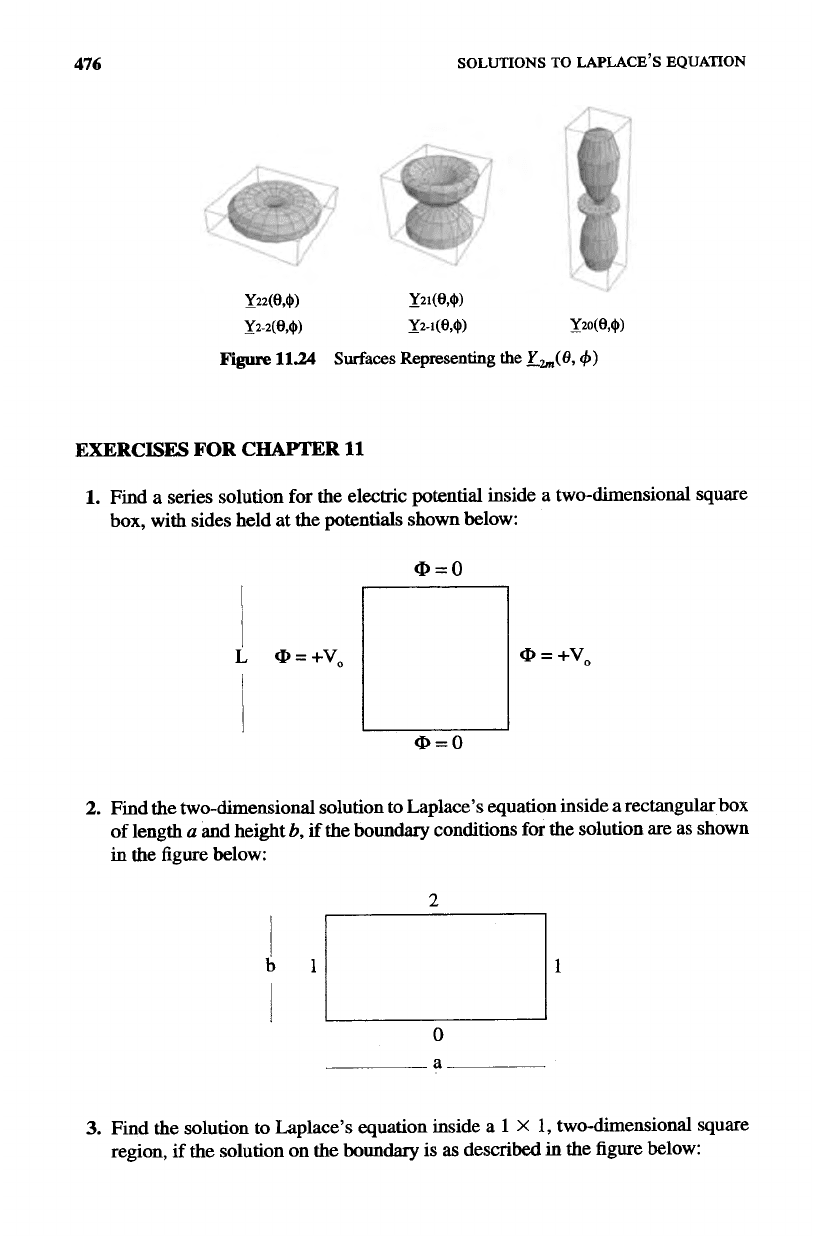
with sides held at the potentials shown below:
I
I
L
@=+V,
Q,
=
+V,
2.
Find the two-dimensional solution
to
Laplace’s equation inside
a
rectangular
box
of
length
Q
and height
b,
if
the
boundary
conditions for the solution are as shown
in
the figure below:
2
~
b1
0
1
a
3.
Find the solution
to
Laplace’s equation inside a
1
X
1,
two-dimensional square
region,
if
the solution on the
boundary
is
as
described
in
the figure below:
EXERCISES
477
Y
@=Y
X
4.
Consider the
L
X
3L
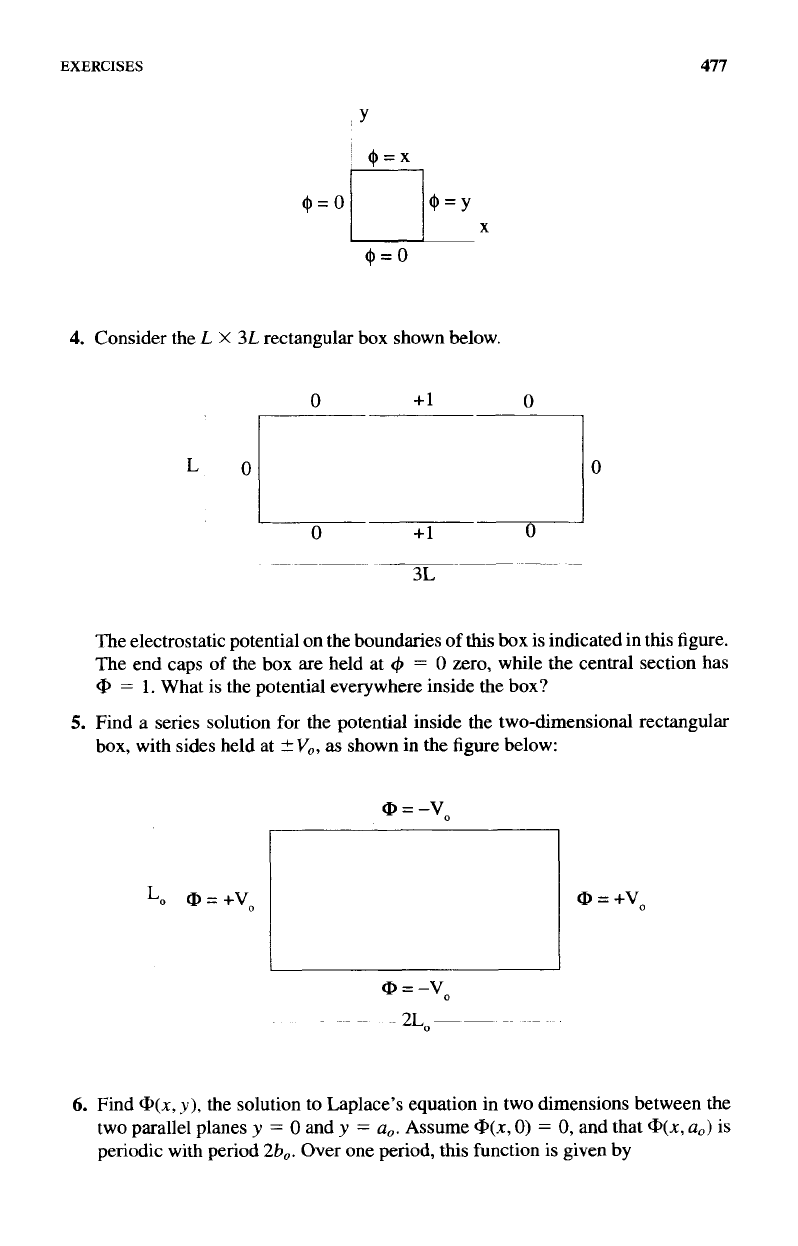
rectangular box shown below.
01
L
0
+1
0
___
3L
0
The electrostatic potential
on
the boundaries
of
this
box
is indicated in this figure.
The end caps
of
the box are held at
4
=
0
zero, while the central section has
Q,
=
1.
What
is
the potential everywhere inside the box?
5.
Find a series solution for the potential inside the two-dimensional rectangular
box, with sides held at
t-
V,,
as
shown in the figure below:
Q,
=
-Vo
Lo
Q,=+vo
Q,
=
+Vo
a,
=
-Vo
2L0 ~
6.
Find
@(x,
y),
the solution to Laplace’s equation in two dimensions between the
two parallel planes
y
=
0
and
y
=
a,.
Assume
@(x,
0)
=
0,
and that
@(x,
a,)
is
periodic with period
2b,.
Over one period,
this
function is given
by
478
SOLUTIONS
TO
LAPLACE’S
EQUATION
+1
O<x<bo
-1 bo
<
x
<
2b0
’
and is periodic with period
2b0
for all
x.
7.
Find the two-dimensional solutions to Laplace’s equation inside the two isosceles
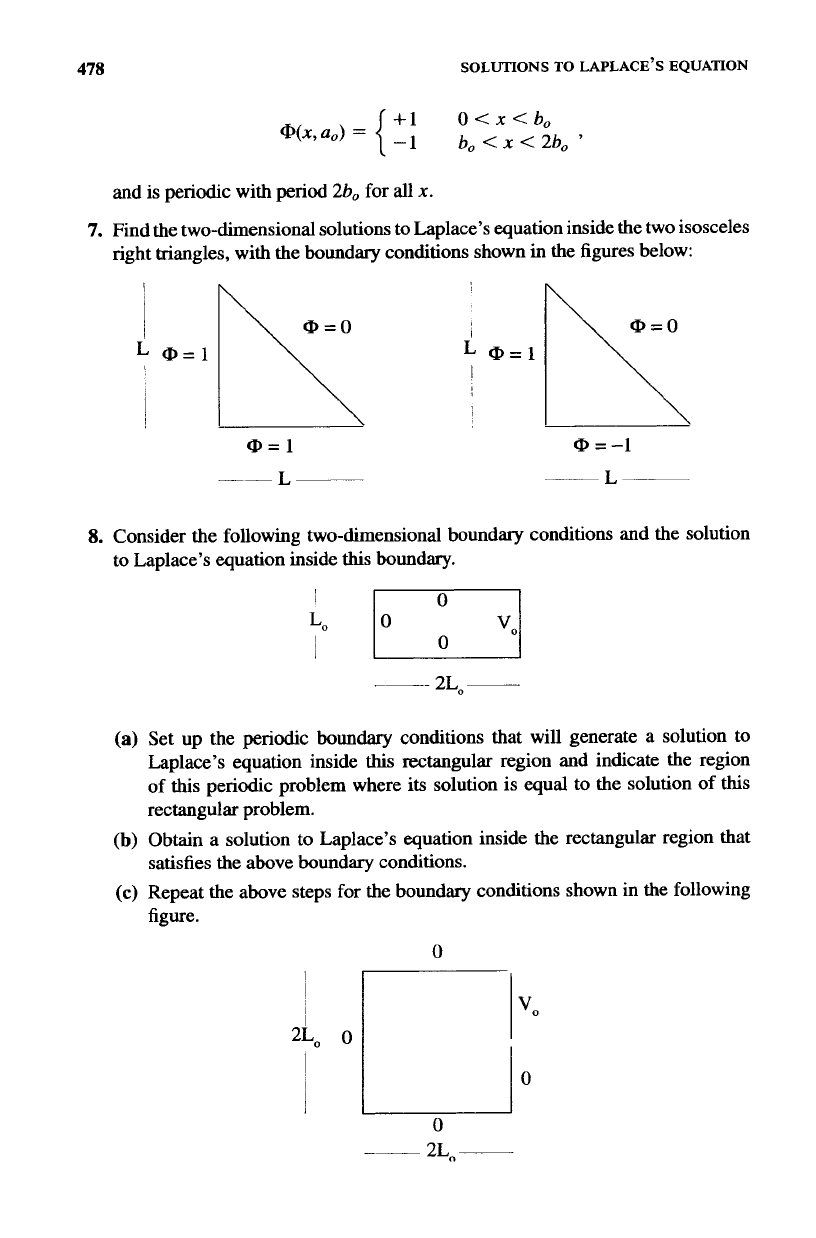
right triangles, with the boundary conditions shown in the figures below:
8.
Consider the following two-dimensional boundary conditions and the solution
to Laplace’s equation inside
this
boundary.
(a)
Set up the
periodic
boundary
conditions that will generate a solution to
Laplace’s equation inside
this
rectangular region and indicate the region
of
this
periodic problem where its solution is equal
to
the solution of
this
rectangular problem.
(b)
Obtain a solution to Laplace’s equation inside the rectangular region that
satisfies the above boundary conditions.
(c) Repeat the above steps for the boundary conditions shown in the following
figure.
0
VO
0
EXERCISES
479
9.
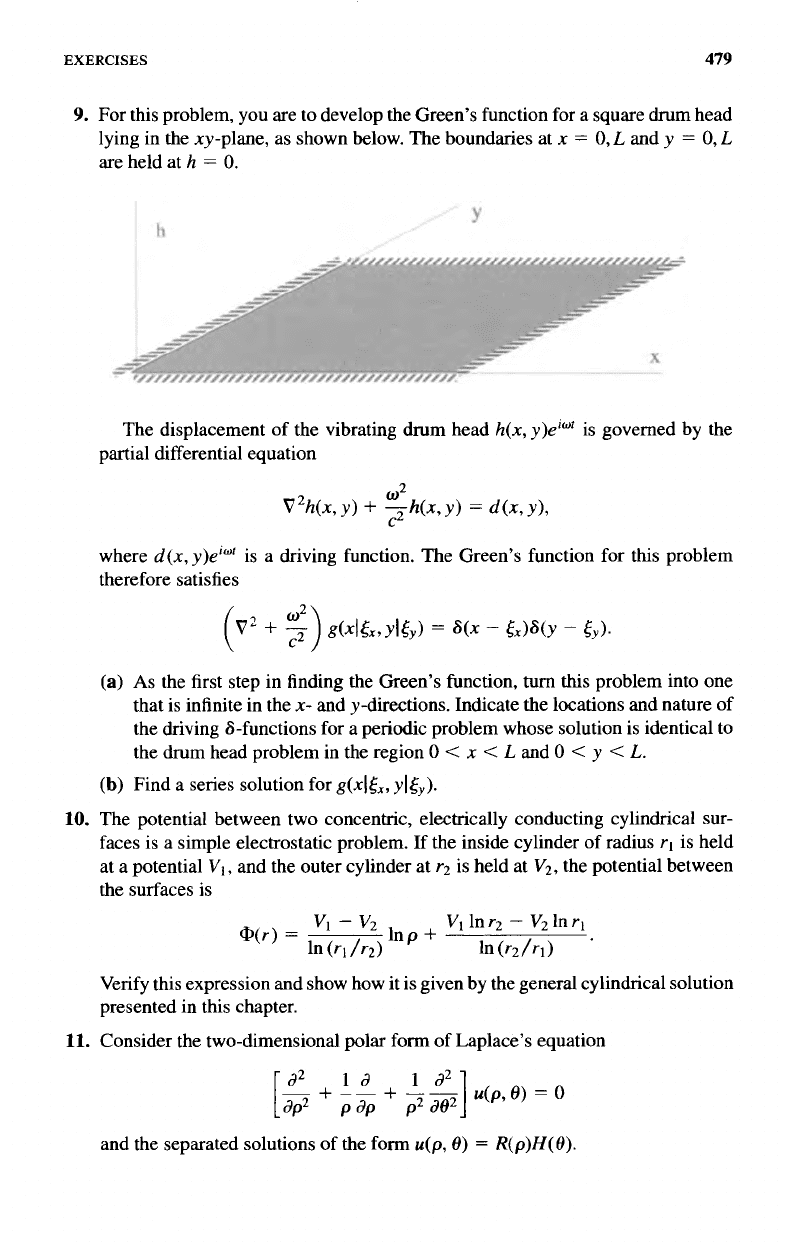
For this problem, you are to develop the Green's function for a square drum head
lying in the xy-plane, as shown below. The boundaries at
x
=
0,
L
and
y
=
0,
L
are held at
h
=
0.
The displacement of the vibrating drum head
h(x,
y)eiW'
is governed by the
partial differential equation
where
d(x,
y)ei""
is a driving function. The Green's function for this problem
therefore satisfies
(a)
As
the first step in finding the Green's function,
turn
this
problem into one
that is infinite in the
x-
and y-directions. Indicate the locations and nature
of
the driving &functions for a periodic problem whose solution is identical to
the drum head problem in the region
0
<
x
<
L
and
0
<
y
<
L.
(b)
Find a series solution for
&I&,
ylty).
10.
The potential between two concentric, electrically conducting cylindrical sur-
faces is a simple electrostatic problem. If the inside cylinder of radius
rl
is held
at a potential
V1
,
and the outer cylinder at
r2
is held at
V2,
the potential between
the surfaces is
Verify this expression and show how it is given by the general cylindrical solution
presented in this chapter.
11.
Consider the two-dimensional polar form
of
Laplace's equation
"'1
[apz pap p2ae2
a*
1
d
-
+
--
+
--
u(p,e)
=
o
and the separated solutions of the form
u(p,
0)
=
R(p)H(B).
480
SOLUTIONS
TO
LAPLACE’S
EQUATION
(a)
What
are
solutions for
H(8)?
(b)
Determine the two independent solutions for
R(p).
(c)
Using the results from parts (a) and (b), determine the two-dimensional
solution to Laplace’s equation inside a
circle
of radius
r,,
if on the circle,
the
solution goes to
u(ro,
0)
=
V,
sin
8.
What is the potential outside this
circle, for
p
>
r,?
What assumptions have to be
made
to get the answer for
p
>
r,?
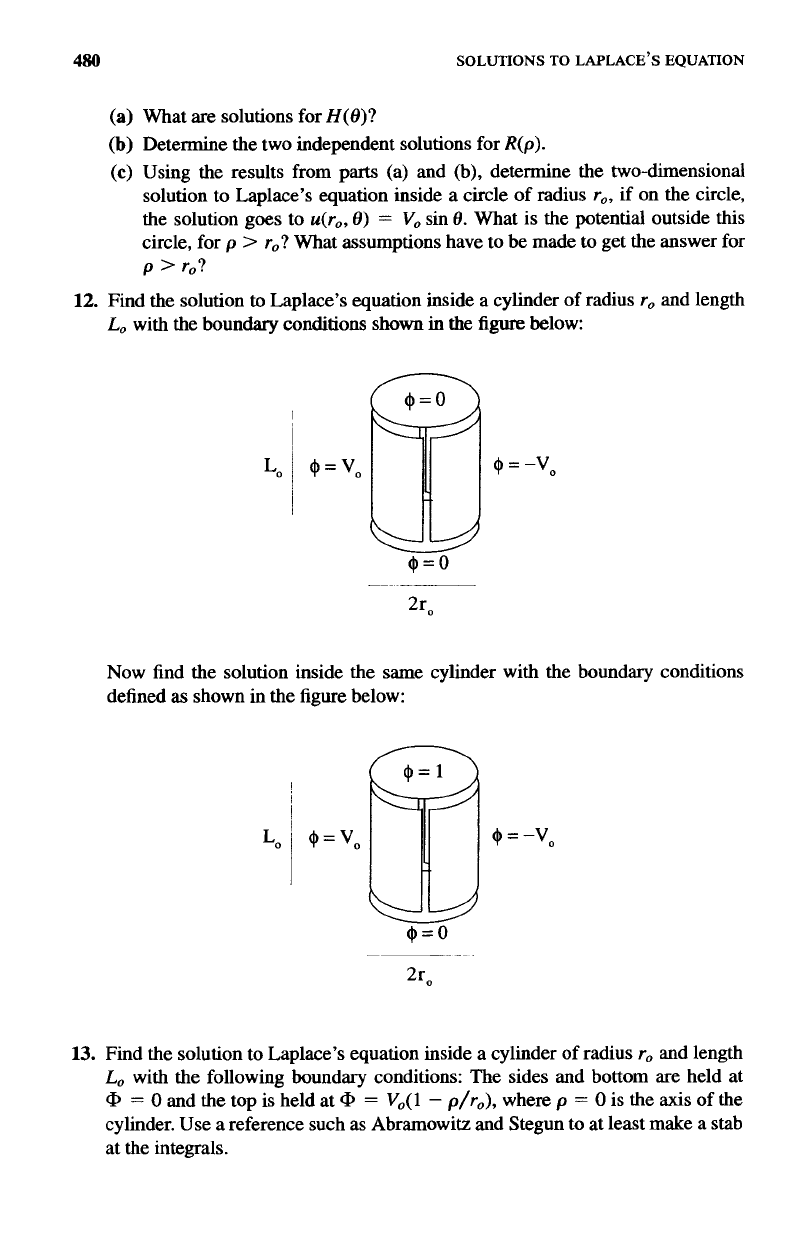
12.
Find the solution
to
Laplace’s equation inside a cylinder of radius
r,
and length
Lo
with the boundary conditions
shown
in
the
figure
below:
VO
~
g=0
$=
-V0
Now find the solution inside the same cylinder with the boundary conditions
defined
as
shown in
the
figure below:
Lo/
$=
VO
B
g=0
13.
Find the solution to Laplace’s equation inside a cylinder of radius
r,
and length
Lo
with the following boundary conditions: The sides and bottom are held at
@
=
0
and the top
is
held at
@
=
V,(1
-
p/r,),
where
p
=
0
is the
axis
of
the
cylinder. Use a reference such as Abramowitz and Stegun to at least make a stab
at the integrals.
EXERCISES
481
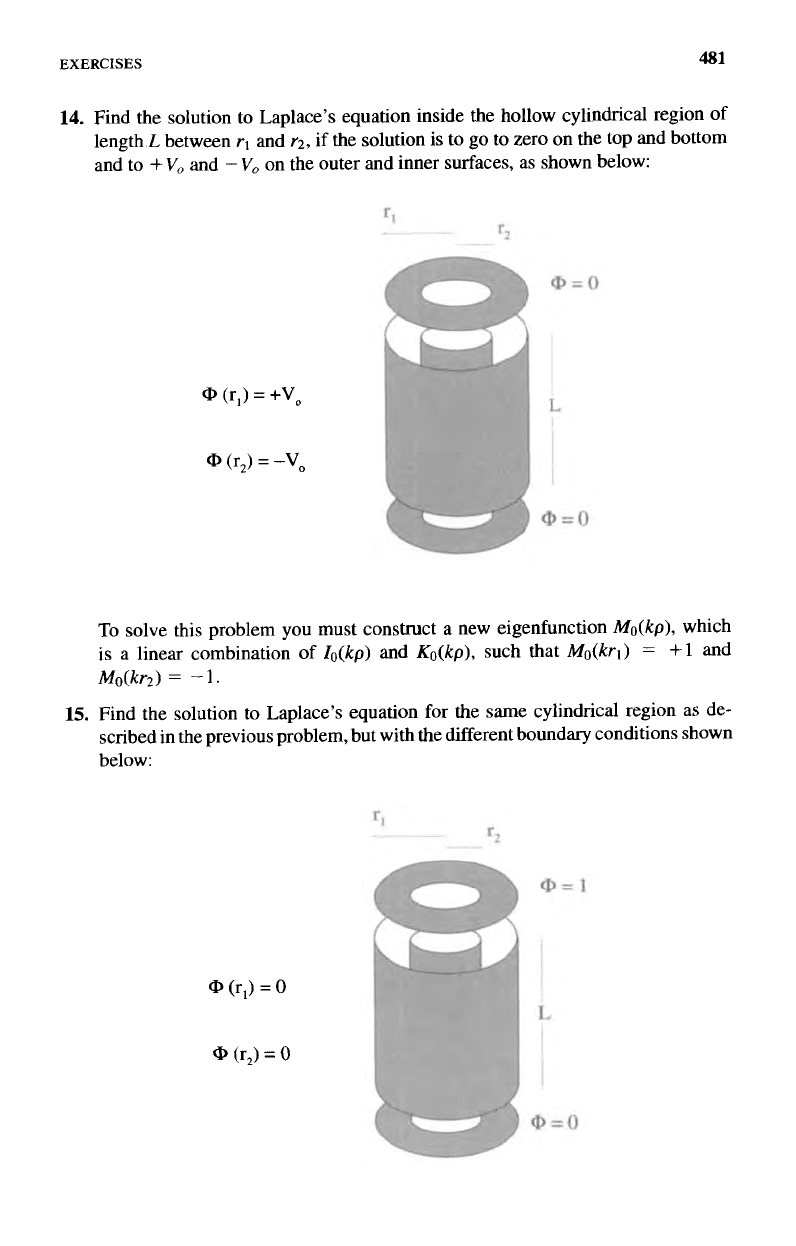
14.
Find the solution to Laplace’s equation inside the hollow cylindrical region
of
length
L
between
rl
and
12,
if
the
solution
is
to
go
to zero on the top and bottom
and to
+
V,
and
-
V,
on the outer and inner surfaces, as shown below:
cf,
(rl)
=
+V,
cf,
(r2)
=
-Vo
@=O
@=O
To
solve this problem you must construct a new eigenfunction
Mo(kp),
which
is a linear combination
of
Z&p)
and
K~(kp),
such that
Mo(kr1)
=
+1
and
15.
Find the solution to Laplace’s equation for the same cylindrical region as de-
scribed in the previous problem, but with the different boundary conditions shown
below:
Mo(kr-2)
=
-
1.
Q
(rl)
=
0
(r2)
=
0
482
SOLUTIONS
TO
LAPLACE’S
EQUATION
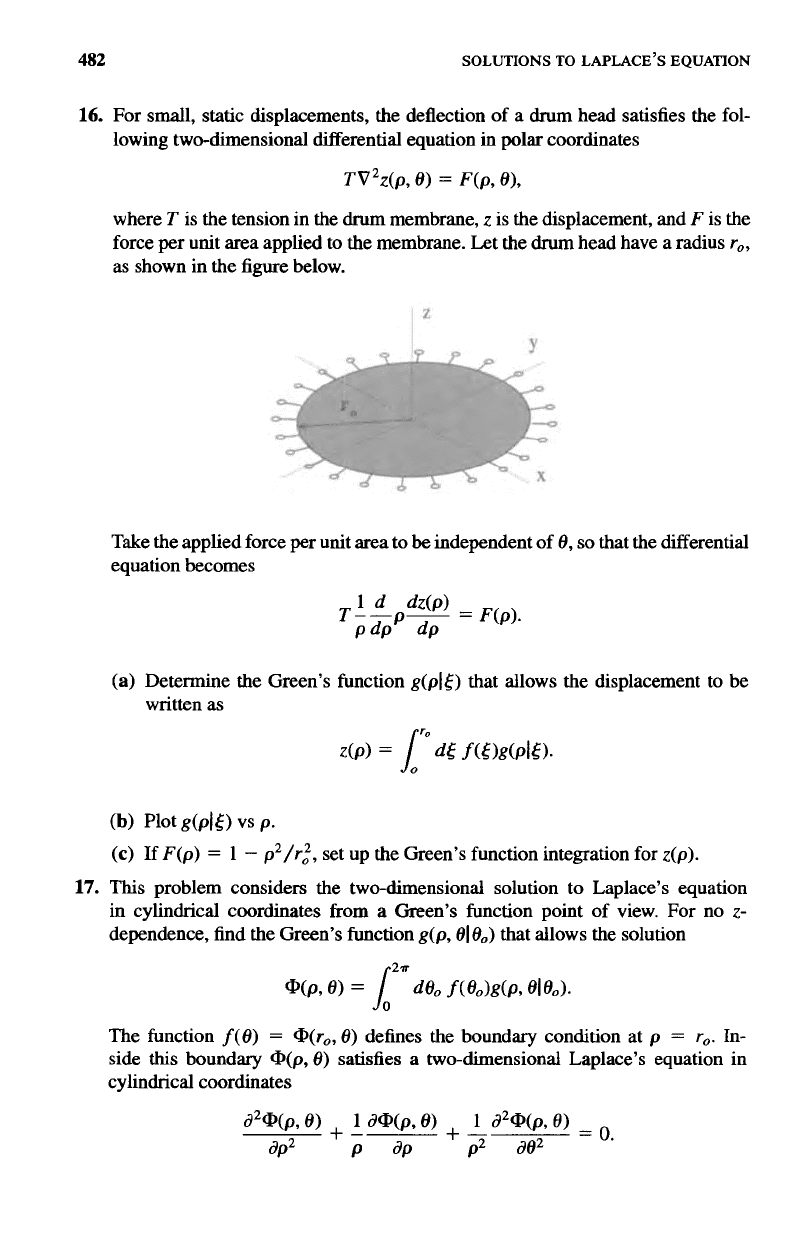
16.
For
small,
static displacements, the deflection
of
a drum head satisfies the
fol-
lowing two-dimensional differential equation in polar coordinates
TV~Z(P,
8)
=
F(P,
e),
where T is the tension in the
drum
membrane,
z
is the displacement, and
F
is the
force per unit area applied to the membrane. Let the drum head have a radius
r,,
as shown in the figure below.
Take the applied force per unit area to
be
independent
of
8,
so
that the differential
equation becomes
(a)
Determine the Green’s function g(p15) that allows the displacement to be
written
as
(b)
Plot APIO
vs
p.
(c)
If F(p)
=
1
-
p2/r:, set up the Green’s function integration for z(p).
17.
This
problem considers the two-dimensional solution to Laplace’s equation
in cylindrical coordinates from a Green’s function point
of
view. For no
z-
dependence, find the Green’s function g(p,
81
8,)
that allows the solution
2?r
wp.
0)
=
do,
.m,)g(p,
m,).
The function
f(8)
=
@(r,,
0)
defines the boundary condition at
p
=
r,.
In-
side
this
boundary @(p,
0)
satisfies a two-dimensional Laplace’s equation in
cylindrical coordinates
EXERCISES
483
18.
19.
20.
21.
The standard way to solve
this
problem sets
@(p,
0)
up
as
a series which must
be shown to converge.
Using similar steps to those in the previous problem, find the Green’s function
for the two-dimensional homogeneous equation
V~U(~,
e)
+
k2u(p,
e)
=
o
inside a circle
of
radius
p
=
R,,
with the boundary condition that
u(R,,
0)
=
.Lo(@>.
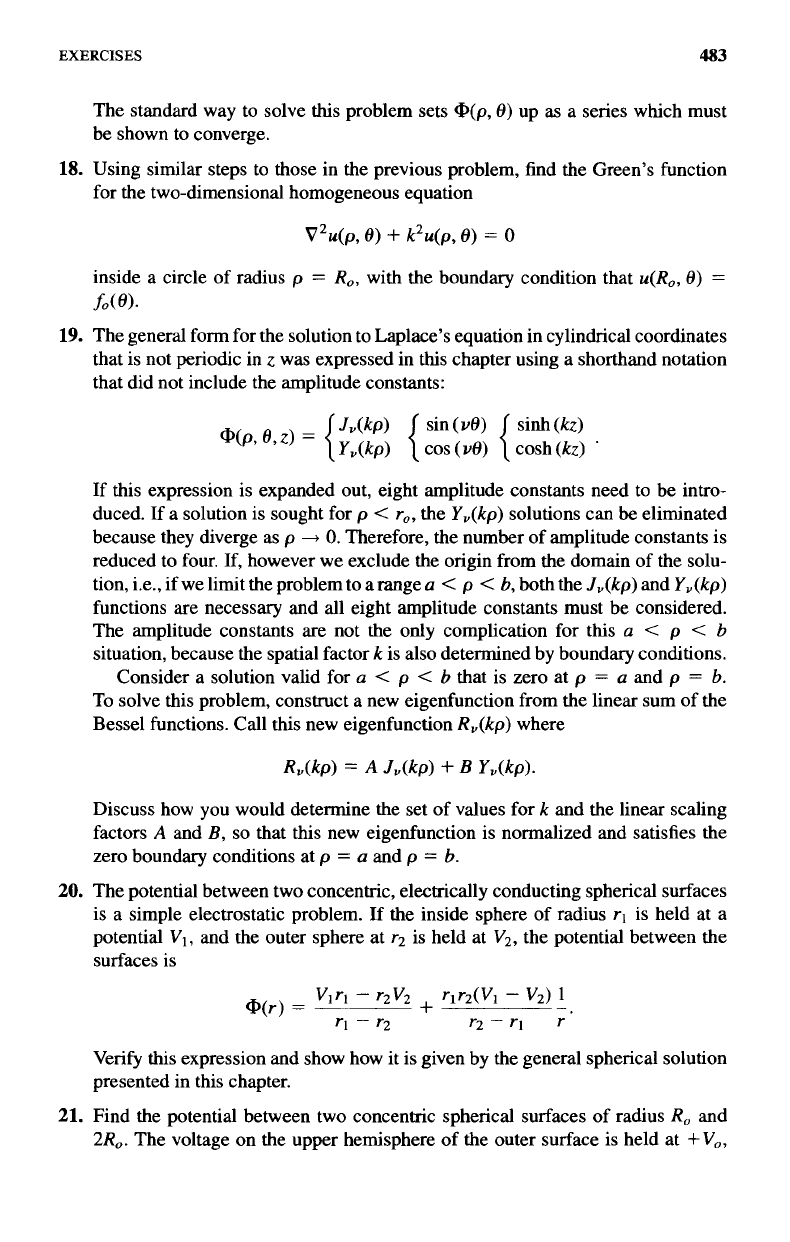
The general form for the solution to Laplace’s equation in cylindrical coordinates
that is not periodic in
z
was expressed in this chapter using a shorthand notation
that did not include the amplitude constants:
J,(kp)
sin
(ve)
sinh
(kz)
@(”
e’z)
=
{
Y,(kp)
{
cos(v0)
{
cosh(kz)
‘
If this expression is expanded out, eight amplitude constants need to be intro-
duced. If a solution is sought for
p
<
r,,
the
Y,,(kp)
solutions can
be
eliminated
because they diverge as
p
+
0.
Therefore, the number of amplitude constants is
reduced to four. If, however we exclude the origin from the domain
of
the solu-
tion, i.e., if we limit the problem to a range
u
<
p
<
b,
both the
J,(kp)
and
Y,(kp)
functions are necessary and all eight amplitude constants must be considered.
The amplitude constants are not the only complication for this
a
<
p
<
b
situation, because the spatial factor
k
is also determined by boundary conditions.
Consider a solution valid for
u
<
p
<
b
that is zero at
p
=
a
and
p
=
b.
To solve this problem, construct a new eigenfunction from the linear sum
of
the
Bessel functions. Call this new eigenfunction
R,(kp)
where
R,(kp)
=
A
J,(kp)
+
B
Y,(kp).
Discuss how you would determine the set of values for
k
and the linear scaling
factors
A
and
B,
so
that
this
new eigenfunction is normalized and satisfies the
zero boundary conditions at
p
=
a
and
p
=
b.
The potential between two concentric, electrically conducting spherical surfaces
is a simple electrostatic problem.
If
the inside sphere of radius
rl
is held at a
potential
V1,
and the outer sphere at
r2
is held at
V2,
the potential between the
surfaces is
Verify this expression and show how it is given by the general spherical solution
presented in this chapter.
Find the potential between two concentric spherical surfaces
of
radius
R,
and
2R,.
The voltage
on
the upper hemisphere of the outer surface is held at
+
V,,
484
SOLUTIONS
TO
LAPLACE’S EQUATION
and the voltage on the lower hemisphere of the outer surface is held at
-
V,.
The
voltage on the upper hemisphere of the inner surface is held at
-V,,
and the
voltage
on
the lower hemisphere
of
the inner surface is held at
+
.
V,.
22.
A
hemispherical shell of radius
Ro,
held at
@
=
+V,
is positioned on top of
an
infinite conducting ground plane held at
@
=
0.
Use symmetry, in this case
sometimes referred to
as
the method of images, to find the solution to Laplace’s
equation both inside and outside the hemisphere that satisfies these boundary
conditions.
23.
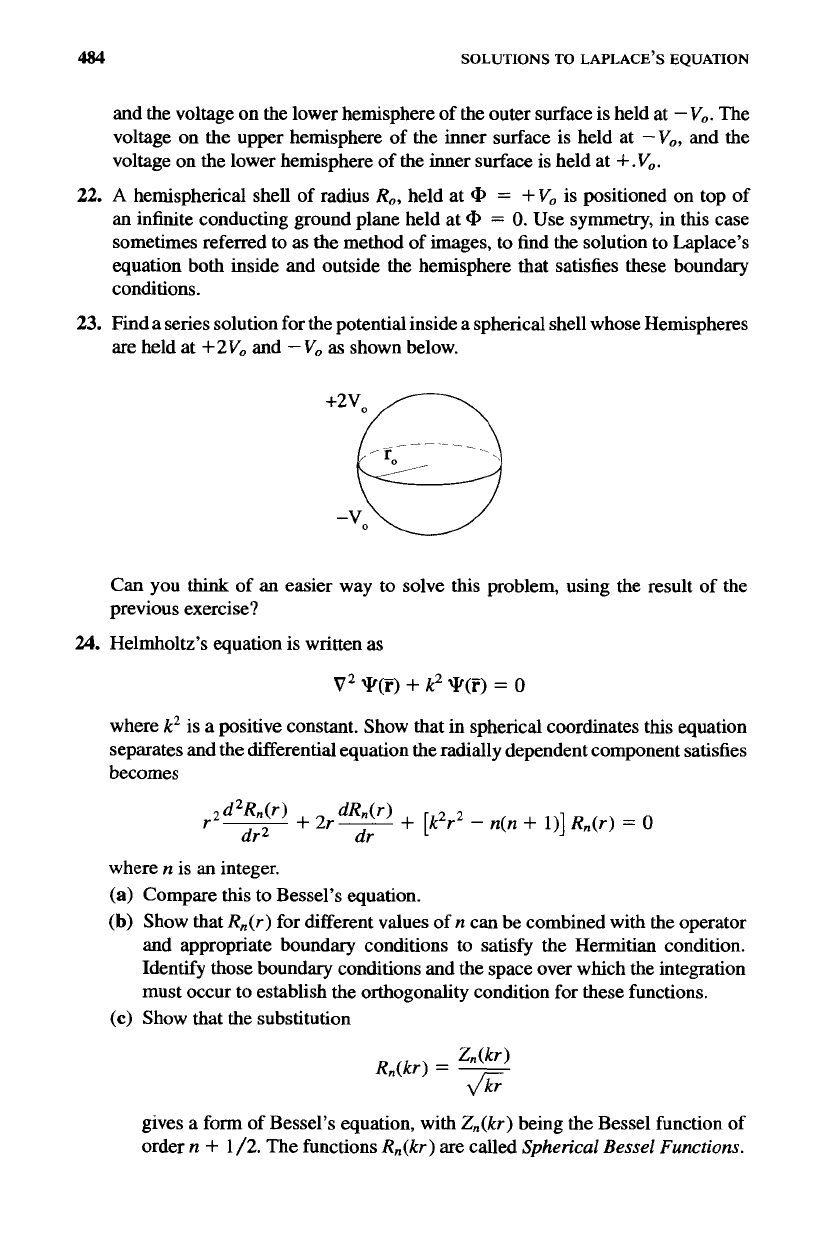
Find
a
series solution for the potential inside a spherical shell whose Hemispheres
are
held at
+2V,
and
-V,
as
shown below.
Can
you
think
of
an easier way to solve
this
problem, using the result of the
previous exercise?
24.
Helmholtz’s equation is written
as
V2
*@)
+
k2
W(F)
=
0
where
k2
is
a
positive constant. Show that
in
spherical coordinates this equation
separates and the differential equation the radially dependent component satisfies
becomes
where
n
is
an
integer.
(a)
Compare
this
to Bessel’s equation.
(b)
Show that
R,(r)
for different values of
n
can
be combined with
the
operator
and appropriate boundary conditions to satisfy the Hermitian condition.
Identlfy those boundary conditions and the space over which the integration
must occur to establish
the
orthogonality condition for these functions.
(c)
Show that the substitution
gives
a
form of Bessel’s equation, with
Zn(kr)
being
the
Bessel function
of
order
n
+
1
/2.
The functions
R,(kr)
are
called
Spherical Bessel Functions.
EXERCISES
485
25.
The quantum mechanical operators
L+
and
L-
are given
by
and
The spherical
harmonics
Ye,(B,
4)
are not eigenfunctions
of
these operators.
However, interesting things happen when these operators work on the
Yxm(8,
4).
Show that
and
Because
of
this property,
L+
and
L-
are called raising and lowering operators.
26.
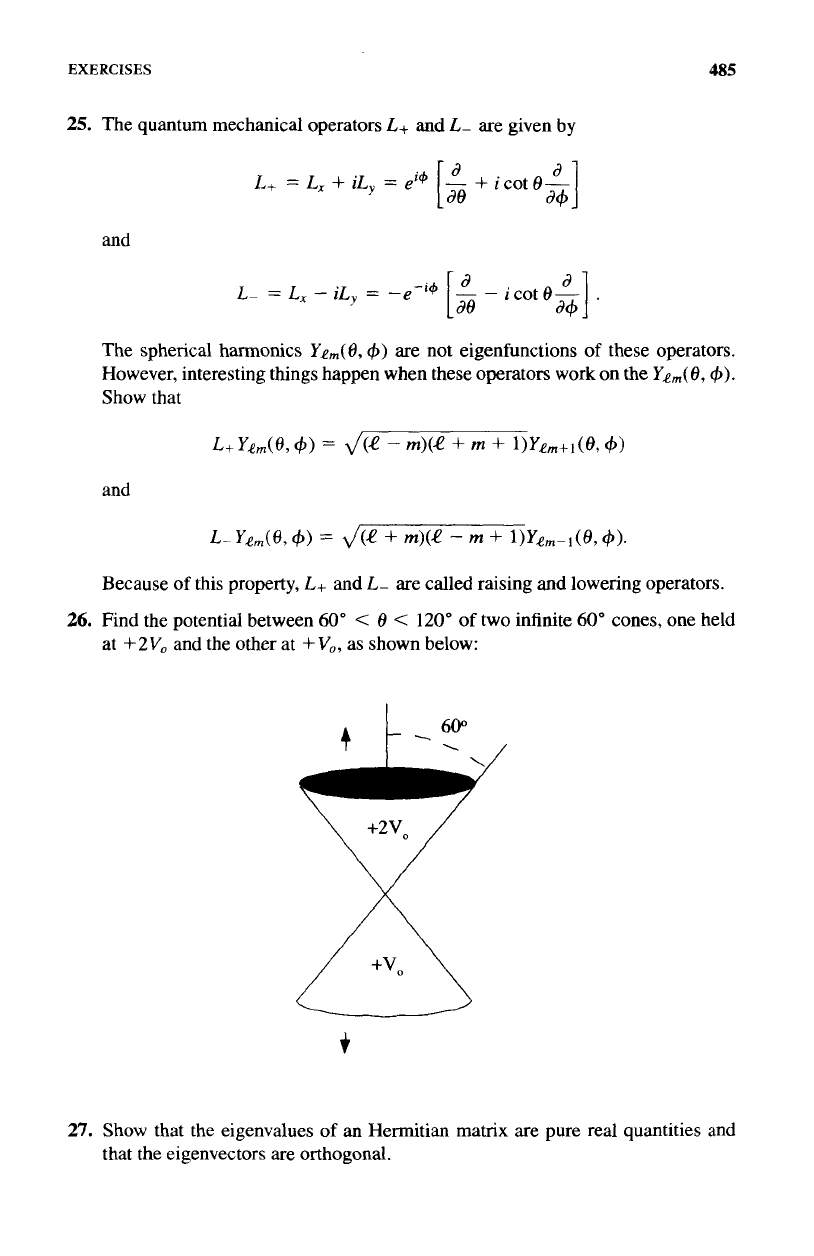
Find the potential between
60"
<
8
<
120" of
two infinite
60"
cones, one held
at
+2V0
and the other at
+V,,
as shown below:
27.
Show that the eigenvalues
of
an Hennitian matrix are pure real quantities and
that the eigenvectors are orthogonal.