
Lopes H.S., Cruz L.M. (eds.) Computational Biology and Applied Bioinformatics
Подождите немного. Документ загружается.

Analysis of Transcriptomic and Proteomic Data in Immune-Mediated Diseases
407
applied interactome methods for the analysis of common upstream regulation of the two
datasets at the level of transcription factors. First, we defined the sets of the most influential
transcription factors using two recently developed methods of interactome analysis
[Nikolsky Y et al., 2008] and the "hidden nodes" algorithm [Nikolskaya T et al., 2009]. The
former method ranks TFs based on their one-step overconnectivity with the dataset of
interest compared to randomly expected number of interactions. The latter approach takes
into account direct and more distant regulation, calculating the p-values for local
subnetworks by an aggregation algorithm [Nikolskaya T et al., 2009]. We calculated and
ranked the top 20 TFs for each data type and added several TFs identified by network
analysis approaches (data not shown). The TFs common for both data types were taken as
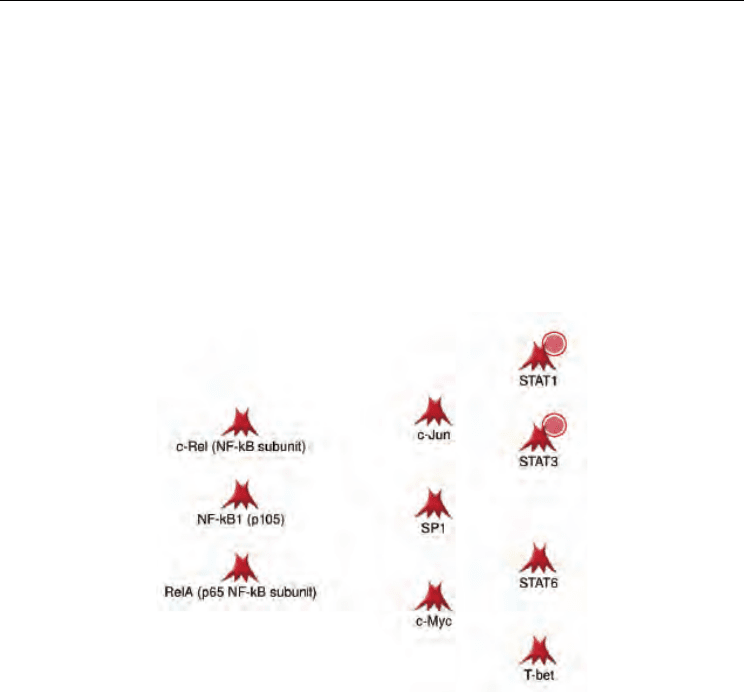
set of 'important pathological signal transducers' (Figure 6). Noticeably, they closely
resemble the set of TFs regulating the protein network on Figure 5.
Fig. 6. Common transcriptional factors important for regulation of objects at both
transcriptomics and proteomic levels. Objects in MetaCore database representing
transcriptional factors found to be important regulators of pathology-related genes. Red
circles denote that corresponding gene is upregulated in psoriatic lesion.
In the next step, we applied "hidden nodes" algorithm to identify the most influential
receptors that could trigger maximal possible transcriptional response. In total, we found
226 membrane receptors significantly involved into regulation of 462 differentially
expressed genes ('hidden nodes' p-value < 0.05). Assuming that topological significance
alone does not necessarily prove that all receptors are involved in real signaling or are even
expressed in the sample; we filtered this list by expression performance. The receptors used
were those whose encoding genes or corresponding ligands were overexpressed greater
than 2.5 fold. We assumed that the pathways initiated by over-expressed receptors and
ligands are more likely to be activated in psoriasis. Here we assumed that expression
alterations and protein abundance are at least collinear. An additional criterion was that the
candidate receptors had to participate in the same signaling pathways with at least one of
the common TFs. No receptor was rejected based on this criterion. In total, 44 receptors passed

Computational Biology and Applied Bioinformatics
408
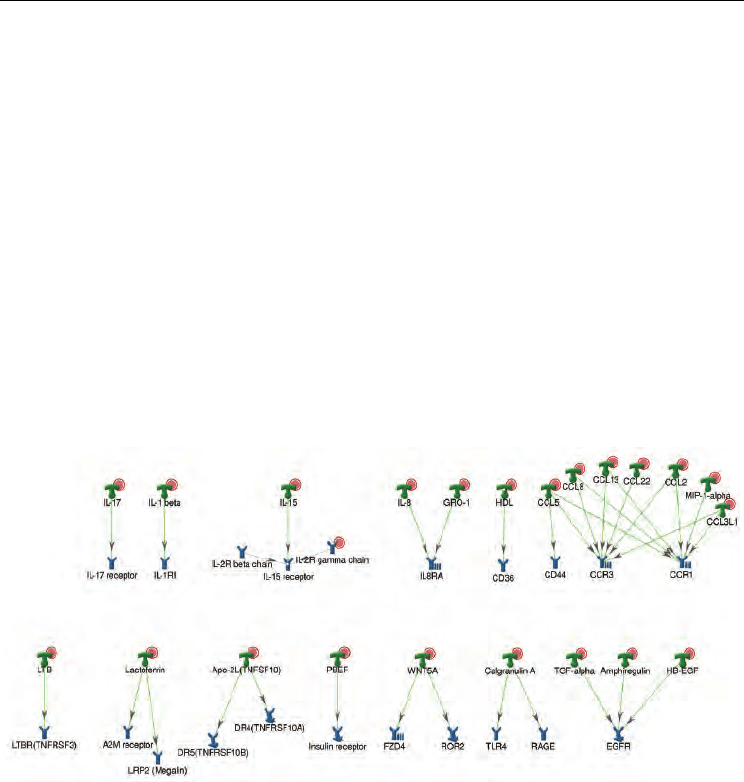
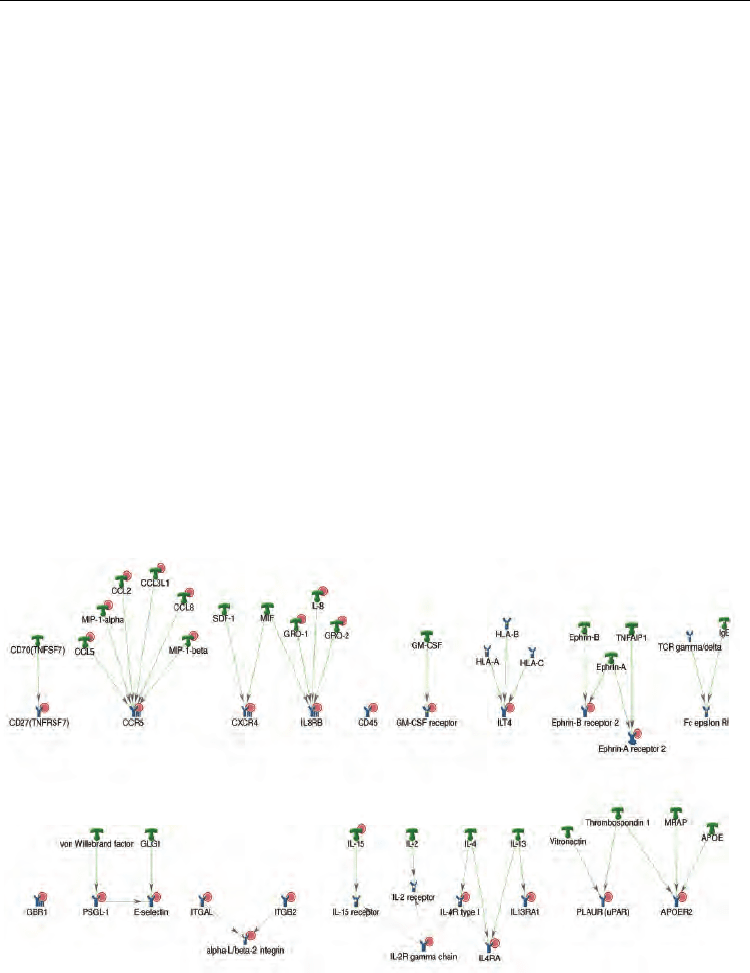
the transcription cut-off. Of these 24 receptor genes were overexpressed; 23 had overexpressed
ligands and 3 cases had overexpression of both ligands and receptors (IL2RB, IL8RA and
CCR5; see Figures 7 and 8). Interestingly, for several receptors, more than one ligand was
overexpressed (Figure 7). Several receptors are composed of several subunits, only one of
which was upregulated (for example, IL-2 receptor has only gamma subunit gene significantly
upregulated). Out of 44 receptors we identified by topology analysis, 21 were previously
reported as psoriasis markers (they are listed in Table 3 with corresponding references). The
other 23 receptors were not reported to be linked to psoriasis or known to be implicated in
other inflammatory diseases. These receptors belong to different cellular processes
(development, cell adhesion, chemotaxis, apoptosis and immune response) (Table 6).
Gene Connection to psoriasis Gene Connection to psoriasis
EPHA2 No AGER Yes [Foell D et al., 2003]
EPHB2 No CCR1 Yes [Horuk R, 2005]
FCER1G No CCR2 Yes [Vestergaard C et al., 2004]
INSR No CCR3 Yes [Rottman JB et al., 2001]
LTBR No CCR5 Yes [de Groot M et al., 2007]
PLAUR No CD2 Yes [Ellis CN & Krueger GG., 2001]
TNFRSF10A No CD27 Yes [De Rie MA et al., 1996]
TNFRSF10B No CD36 Yes [Prens E et al., 1996]
CD44 Possible [Reichrath J et al,
1997]
CD3D Yes [Haider AS, et al., 2007]
CSF2RB Possible [Kelly R et al., 1993] EGFR Yes [Castelijns FA et al., 1999]
CXCR4 Possible [Gu J et al., 2002] IL17RA Yes [Johansen C et al., 2009]
FZD4 Possible[Reischl J et al., 2007] IL1R1 Yes [Debets R et al., 1997]
GABBR1 Possible[Shiina T et al., 2009] IL8RA Yes [Schulz BS et al., 1993]
IL10RA Possible [Asadullah K et al.,
1998]
IL8RB Yes [Schulz BS et al., 1993]
IL13RA1 Possible [Cancino-Diaz JC et
al., 2002]
ITGAL Yes [Guttman-Yassky E et al., 2008]
IL2RB Possible [Pietrzak A et al.,
2008]
ITGB2 Yes [Sjogren F et al., 1999]
IL2RG Possible [Pietrzak A et al.,
2008]
LRP1 Yes [Curry JL et al., 2003]
IL4R Possible [Martin R, 2003] PTPRC Yes [Vissers WH et al., 2004]
LILRB2 Possible [Penna G et al., 2005] SDC3 Yes [Patterson AM et al., 2008]
LRP2 Possible [Fu X et al., 2009] SELE Yes [Wakita H &Takigawa M, 1994]
LRP8 Possible [Fu X et al., 2009] SELPLG Yes [Chu A et al., 1999]
ROR2 Possible [Reischl J et al., 2007] TLR4 Yes [Seung NR et al., 2007]
Table 3. Receptors identified in our study and not yet studied in connection to psoriasis
('Possible' term was used if protein name co-occurred with psoriasis in articles, but no clear
evidence of its implication was shown. In some cases, ligands are associated with psoriasis
(i.e, IL-10)).
Analysis of Transcriptomic and Proteomic Data in Immune-Mediated Diseases
409
Meta-analysis of multiple OMICs data types and studies is becoming an important research
tool in understanding complex diseases. Several methods were developed for correlation
analysis between the datasets of different type, such as mRNA and proteomics [Hack CJ,
2004; Le Naour F et al., 2001; Steiling K et al., 2009; Conway JP & Kinter M, 2005; Di Pietro C
et al., 2009]. However, there are many technological challenges to resolve, including
mismatching protein IDs and mRNA probes, fundamental differences in OMICs
technologies, differences in experimental set-ups in studies done by different groups etc
[Mijalski T et al., 2005]. Moreover, biological reasons such as differences in RNA and protein
degradation processes also contribute to variability of different data types. As a result,
transcriptome and proteome datasets usually show only weak positive correlation although
were considered as complimentary. More recent studies focused on functional similarities
and differences observed for different levels of cellular organization and reflected in
different types of OMICs data [Habermann JK et al., 2007; Chen YR et al., 2006; Shachaf CM
et al., 2008; Zhao C et al., 2009]. For example, common interacting objects were found for
distinct altered transcripts and proteins in type 2 diabetes [Gerling IC et al., 2006]. In one
leukemia study [Zheng PZ et al., 2005] authors found that distinct alterations at
transcriptomics and proteomic levels reflect different sides of the same deregulated cellular
processes.
Fig. 7. Candidate receptors with their respective upregulated ligands. Initial steps of
pathways presumably activated in lesions (ligands, overexpressed at transcriptional level
and their corresponding receptors) Red circles denote that corresponding gene is
upregulated in psoriatic lesion.
The overall concordance between mRNA and protein expression landscapes was addressed
in earlier studies, although the data types were compared mostly at the gene/protein level
with limited functional analysis [Cox B et al., 2005; Mijalski T et al., 2005]. Later, ontology
enrichment co-examination of transcriptomics and proteomic data has shown that the two
data types affect similar biological processes and are complimentary [Chen YR, et al., 2006;
Zheng PZ et al., 2005; Zhao C et al., 2009]. However, the key issue of biological causality and
functional consequences of distinct regulation events at both mRNA and protein levels of
cellular organization were not yet specifically addressed. These issues cannot be resolved by
Computational Biology and Applied Bioinformatics
410
low resolution functional methods like enrichment analysis. Instead, one has to apply more
precise computational methods such as topology and biological networks, which take into
consideration directed binary interactions and multi-step pathways connecting objects
between the datasets of different types regardless of their direct overlap at gene/protein
level [Ideker T & Sharan R, 2008; Chuang HY et al., 2007]. For example, topology methods
such as "hidden nodes" [Dezso Z et al., 2009; Nikolsky Y et al., 2008] can identify and rank
the upstream regulatory genes responsible for expression and protein level alterations while
network tools help to uncover functional modules most affected in the datasets, identify the
most influential genes/proteins within the modules and suggest how specific modules
contribution to clinical phenotype [Nikolsky Y et al., 2005; Gerling IC et al., 2006].
In this study, we observed substantial direct overlap between transcriptomics and
proteomics data, as 7 out of 10 over-abundant proteins in psoriasis lesions were encoded by
differentially over-expressed genes. However, the two orders of magnitude difference in
dataset size (462 genes versus 10 proteins) made the standard correlation methods
inapplicable. Besides, proteomics datasets display a systematic bias in function of abundant
proteins, favoring "effector" proteins such as structural, inflammatory, core metabolism
proteins but not the transiently expressed and fast degradable signaling proteins. Therefore,
we applied topological network methods to identify common regulators for two datasets
such as the most influential transcription factors and receptors. We have identified some key
regulators of the "proteomics" set among differentially expressed genes, including
transcription factors, membrane receptors and extracellular ligands, thus reconstructing
upstream signaling pathways in psoriasis. In particular, we identified 24 receptors
previously not linked to psoriasis.
Fig. 8. Upregulated candidate receptors with their respective ligands. Initial steps of
pathways presumably activated in lesions (receptors, overexpressed at transcriptional level
and their corresponding ligands) Red circles denote that corresponding gene is upregulated
in psoriatic lesion.

Analysis of Transcriptomic and Proteomic Data in Immune-Mediated Diseases
411
Importantly, many ligands and receptors defined as putative starts of signaling pathways
were activated by transcription factors at the same pathways, clearly indicating on positive
regulatory loops activated in psoriasis. The versatility and the variety of signaling pathways
activated in psoriasis is also impressive, which is evident from differentially overexpression
of 44 membrane receptors and ligands in skin lesions. This complexity and redundancy of
psoriasis signaling likely contributes to the inefficiency of current treatments, even novel
therapies such as monoclonal antibodies against TNF-α and IL-23. Thus, the key regulator,
RAGE receptor, triggers multiple signaling pathways which stay activated even when
certain immunological pathways are blocked. Our study suggests that combination therapy
targeting multiple pathways may be more efficient for psoriasis (particularly considering
feasibility for topical formulations). In addition, the 24 receptors we identified by topology
analysis and previously not linked with psoriasis can be tested as potential novel targets for
disease therapy. The functional machinery of psoriasis is still not complete and additional
studies can be helpful in "filling the gaps" of our understanding of its molecular
mechanisms. For instance, kinase activity is still unaccounted for, as signaling kinases are
activated only transiently and are often missed in gene expression studies. Topological
analysis methods such as "hidden nodes" [Dezso Z et al., 2004] may help to reconstruct
regulatory events missing in the data. Also, the emerging phosphoproteomics methodology
may prove to become a helpful and complimentary OMICs technology. The network
analysis methodology is not dependent on the type of data analyzed and or any
gene/protein content overlap between the studies and is well applicable for functional
integration of multiple data types.
3. Conclusion
Thus, we succeeded in comparing the molecular processes characteristic of psoriasis and
Crohn’s disease and detecting the candidate genes involved in the processes common for
both pathologies and critical for their development. Identification of the proteins encoded
by these genes is an important aspect of the research performed, because the proteins are
particular targets for elaborating new approaches to treating psoriasis and Crohn’s disease.
Our data obtained by analyzing expression of the candidate genes for psoriasis and Crohn’s
disease can enhance the search for new biological targets for the corresponding therapeutics.
In order to gain insight into molecular machinery underlying the disease, we conducted a
comprehensive meta-analysis of proteomics and transcriptomics of psoriatic lesions from
independent studies. Network-based analysis revealed similarities in regulation at both
proteomics and transcriptomics level. We identified a group of transcription factors
responsible for overexpression of psoriasis genes and a number of previously unknown
signaling pathways that may play a role in this process. We also evaluated functional
synergy between transcriptomics and proteomics results.
We have successfully applied network-based methods to integrate and explore two distinct
high-throughput disease data sets of different origin and size. Through identification of
common regulatory machinery that is likely to cause overexpression of genes and proteins,
we came to the signaling pathways that might contribute to the altered state of regulatory
network in psoriatic lesion. Our approach allows easy integrative investigation of different
data types and produces biologically meaningful results, leading to new potential therapy
targets. We have demonstrated that pathology can be caused and maintained by a great
amount of various cascades, many previously not described as implicated in psoriasis;
therefore, combined therapies targeting multiple pathways might be effective in treatment.

Computational Biology and Applied Bioinformatics
412
4. Acknowledgment
This work was supported by grants 16.512.11.2049 from Ministry of Education and Science
of the Russian Federation, grant from Russian Academy of Sciences ("Fundamental Sciences
to Medicine" program), and grant P1309 from Ministry of Education and Science of the
Russian Federation (Federal Special Program "Scientific and Educational Human Resources
of Innovative Russia" for 2009 - 2013)
5. Reference
Arnold I, Watt FM: c-Myc activation in transgenic mouse epidermis results in mobilization
of stem cells and differentiation of their progeny. Curr Biol 2001, 11(8):558-68.
Asadullah K, et al.: IL-10 is a key cytokine in psoriasis. Proof of principle by IL-10 therapy: a
new therapeutic approach. J Clin Invest 1998, 101(4):783-94.
Benjamini Y., Hochberg Y. 1995. Controlling the false discovery rate: A practical and
powerful approach to multiple testing. J. Royal Stat. Soc. Ser. B, Methodol. 57, 289–
300.
Bhavnani SK, et al.: Network analysis of genes regulated in renal diseases: implications for a
molecular-based classification. BMC Bioinformatics 2009, 10(Suppl 9):S3.
Binder V. 2004. Epidemiology of IBD during the twentieth century: An integrated view. Best
Pract. Res. Clin. Gastroenterol. 18, 463–479.
Boehncke WH, et al.: Pulling the trigger on psoriasis. Nature 1996, 379(6568):777.
Bowcock A., Cookson W. 2004. The genetics of psoriasis, psoriatic arthritis and atopic
dermatitis. Hum. Mol. Genet. 13, 43–55.
Bowcock AM, et al.: Insights into psoriasis and other inflammatory diseases from large-scale
gene expression studies. Hum Mol Genet 2001, 10(17):1793-805.
Cancino-Diaz JC, et al.: Interleukin-13 receptor in psoriatic keratinocytes: overexpression of
the mRNA and underexpression of the protein. J Invest Dermatol 2002, 119(5):1114-
20.
Castelijns FA, et al.: The epidermal phenotype during initiation of the psoriatic lesion in the
symptomless margin of relapsing psoriasis. J Am Acad Dermatol 1999, 40(6 Pt
1):901-9.
Chen YR, et al.: Quantitative proteomic and genomic profiling reveals metastasis-related
protein expression patterns in gastric cancer cells. J Proteome Res 2006, 5(10):2727-
42.
Chu A, et al.: Tissue specificity of E- and P-selectin ligands in Th1- mediated chronic
inflammation. J Immunol 1999, 163(9):5086-93.
Chuang HY, et al.: Network-based classification of breast cancer metastasis. Mol Syst Biol
2007, 3:140.
Conway JP, Kinter M: Proteomic and transcriptomic analyses of macrophages with an
increased resistance to oxidized low density lipoprotein (oxLDL)-induced
cytotoxicity generated by chronic exposure to oxLDL. Mol Cell Proteomics 2005,
4(10):1522-40.
Cox B, Kislinger T, Emili A: Integrating gene and protein expression data: pattern analysis
and profile mining. Methods 2005, 35(3):303-14.
Crohn B., Ginzburg L., Oppenheimer G. 1932. Regional ileitis: A pathological and clinical
entity. J. Actinomycetes. Med. Assoc. 251, P73–P79 (1984).

Analysis of Transcriptomic and Proteomic Data in Immune-Mediated Diseases
413
Curry JL, et al.: Innate immune-related receptors in normal and psoriatic skin. Arch Pathol
Lab Med 2003, 127(2):178-86.
de Groot M, et al.: Expression of the chemokine receptor CCR5 in psoriasis and results of a
randomized placebo controlled trial with a CCR5 inhibitor. Arch Dermatol Res
2007, 299(7):305-13.
De Rie MA, et al.: Expression of the T-cell activation antigens CD27 and CD28 in normal and
psoriatic skin. Clin Exp Dermatol 1996, 21(2):104-11.
Debets R, et al.: The IL-1 system in psoriatic skin: IL-1 antagonist sphere of influence in
lesional psoriatic epidermis. J Immunol 1997, 158(6):2955-63.
Dezso Z, et al.: Identifying disease-specific genes based on their topological significance in
protein networks. BMC Syst Biol 2009, 3:36
Di Pietro C, et al.: The apoptotic machinery as a biological complex system: analysis of its
omics and evolution, identification of candidate genes for fourteen major types of
cancer, and experimental validation in CML and neuroblastoma. BMC Med
Genomics 2009, 2(1):20.
Draghici S., Khatri P., Tarca A.L., Amin K., Done A., Voichita C., Georgescu C., Romero R.
2007. A systems biology approach for pathway level analysis. Genome Res. 17,
1537–1545.
Ellis CN, Krueger GG: Treatment of chronic plaque psoriasis by selective targeting of
memory effector T lymphocytes. N Engl J Med 2001, 345(4):248-55.
Foell D, et al.: Expression of the pro-inflammatory protein S100A12 (ENRAGE) in
rheumatoid and psoriatic arthritis. Rheumatology (Oxford) 2003, 42(11):1383-9.
Fu X, et al.: Estimating accuracy of RNA-Seq and microarrays with proteomics. BMC
Genomics 2009, 10(1):161.
Gandarillas A, Watt FM: c-Myc promotes differentiation of human epidermal stem cells.
Genes Dev 1997, 11(21):2869-82.
Gerling IC, et al.: New data analysis and mining approaches identify unique proteome and
transcriptome markers of susceptibility to autoimmune diabetes. Mol Cell
Proteomics 2006, 5(2):293-305.
Ghavami S, et al.: S100A8/A9 at low concentration promotes tumor cell growth via RAGE
ligation and MAP kinase-dependent pathway. Journal of leukocyte biology 2008,
83(6):1484-1492
Ghoreschi K, Mrowietz U, Rocken M: A molecule solves psoriasis? Systemic therapies for
psoriasis inducing interleukin 4 and Th2 responses. J Mol Med 2003, 81(8):471-80.
Ghosh D, et al.: Statistical issues and methods for meta-analysis of microarray data: a case
study in prostate cancer. Funct Integr Genomics 2003, 3(4):180-8.
Gisondi P, Girolomoni G: Biologic therapies in psoriasis: a new therapeutic approach.
Autoimmun Rev 2007, 6(8):515-9.
Gravel P, Golaz O: Two-Dimensional PAGE Using Carrier Ampholyte pH Gradients in the
First Dimension. The Protein Protocols Handbook 1996:127-132.
Gu J, et al.: A 588-gene microarray analysis of the peripheral blood mononuclear cells of
spondyloarthropathy patients. Rheumatology (Oxford) 2002, 41(7):759-66
Guttman-Yassky E, et al.: Blockade of CD11a by efalizumab in psoriasis patients induces a
unique state of T-cell hyporesponsiveness. J Invest Dermatol 2008, 128(5):1182-91.
Habermann JK, et al.: Stage-specific alterations of the genome, transcriptome, and proteome
during colorectal carcinogenesis. Genes Chromosomes Cancer 2007, 46(1):10-26.

Computational Biology and Applied Bioinformatics
414
Hack CJ: Integrated transcriptome and proteome data: the challenges ahead. Brief Funct
Genomic Proteomic 2004, 3(3):212-9.
Haider AS, et al.: Novel insight into the agonistic mechanism of alefacept in vivo:
differentially expressed genes may serve as biomarkers of response in psoriasis
patients. J Immunol 2007, 178(11):7442-9.
Horuk R: BX471: a CCR1 antagonist with anti-inflammatory activity in man. Mini Rev Med
Chem 2005, 5(9):791-804.
Ideker T, Sharan R: Protein networks in disease. Genome Res 2008, 18(4):644-52.
Johansen C, et al.: Characterization of the interleukin-17 isoforms and receptors in lesional
psoriatic skin. Br J Dermatol 2009, 160(2):319-24.
Kelly R, Marsden RA, Bevan D: Exacerbation of psoriasis with GM-CSF therapy. Br J
Dermatol 1993, 128(4):468-9.
Le Naour F, et al.: Profiling changes in gene expression during differentiation and
maturation of monocyte-derived dendritic cells using both oligonucleotide
microarrays and proteomics. J Biol Chem 2001, 276(21):17920-31.
Leigh IM, et al.: Keratins (K16 and K17) as markers of keratinocyte hyperproliferation in
psoriasis in vivo and in vitro. The British journal of dermatology 1995, 133(4):501-
511.
Lohwasser C, et al.: The receptor for advanced glycation end products is highly expressed in
the skin and upregulated by advanced glycation end products and tumor necrosis
factor-alpha. J Invest Dermatol 2006, 126(2):291-9.
Madsen P, et al.: Molecular cloning, occurrence, and expression of a novel partially secreted
protein "psoriasin" that is highly up-regulated in psoriatic skin. The Journal of
investigative dermatology 1991, 97(4):701-712.
Martin R: Interleukin 4 treatment of psoriasis: are pleiotropic cytokines suitable therapies for
autoimmune diseases? Trends Pharmacol Sci 2003, 24(12):613-6.
Menezes R, et al.: Integrated analysis of DNA copy number and gene expression microarray
data using gene sets. BMC Bioinformatics 2009, 10(1):203.
Mijalski T, et al.: Identification of coexpressed gene clusters in a comparative analysis of
transcriptome and proteome in mouse tissues. Proceedings of the National
Academy of Sciences of the United States of America 2005, 102(24):8621-8626
Mortz E, et al.: Improved silver staining protocols for high sensitivity protein identification
using matrix-assisted laser desorption/ionization-time of flight analysis.
Proteomics 2001, 1(11):1359-63
Nikolskaya T, et al.: Network analysis of human glaucomatous optic nerve head astrocytes.
BMC Med Genomics 2009, 2:24.
Nikolsky Y, et al.: Genome-wide functional synergy between amplified and mutated genes
in human breast cancer. Cancer research 2008, 68(22):9532-9540.
Nikolsky Y, et al.: Functional analysis of OMICs data and small molecule compounds in an
integrated "knowledge-based" platform. Methods in molecular biology (Clifton,
N.J.) 2009, 563:177-196.
Nikolsky Y, Nikolskaya T, Bugrim A: Biological networks and analysis of experimental data
in drug discovery. DrugDiscov Today 2005, 10(9):653-62.
Oestreicher JL, et al.: Molecular classification of psoriasis diseaseassociated genes through
pharmacogenomic expression profiling. Pharmacogenomics J 2001, 1(4):272-87.
Ortonne JP: Aetiology and pathogenesis of psoriasis. Br J Dermatol 1996, 135(Suppl 49):1-5.

Analysis of Transcriptomic and Proteomic Data in Immune-Mediated Diseases
415
Pastore S, et al.: Biological drugs targeting the immune response in the therapy of psoriasis.
Biologics 2008, 2(4):687-97.
Patterson AM, et al.: Differential expression of syndecans and glypicans in chronically
inflamed synovium. Ann Rheum Dis 2008, 67(5):592-601.
Penna G, et al.: Expression of the inhibitory receptor ILT3 on dendritic cells is dispensable
for induction of CD4+Foxp3+ regulatory T cells by 1,25-dihydroxyvitamin D3.
Blood 2005, 106(10):3490-7.
Pietrzak A, et al.: Genes and structure of selected cytokines involved in pathogenesis of
psoriasis. Folia Histochem Cytobiol 2008, 46(1):11-21.
Pihur V, Datta S: RankAggreg, an R package for weighted rank aggregation. BMC
Bioinformatics 2009, 10:62.
Piruzian E.S., Nikolskaya T.A., Abdeev R.M., Bruskin S.A. 2007. Transcription factor AP-1
components as candidate genes involved in the development of psoriatic process.
Mol. Biol. 41, 1069–1080.
Piruzian ES, et al.: [The comparative analysis of psoriasis and Crohn disease molecular-
genetical processes under pathological conditions]. Mol Biol (Mosk) 2009, 43(1):175-
9.
Prens E, et al.: Adhesion molecules and IL-1 costimulate T lymphocytes in the autologous
MECLR in psoriasis. Arch Dermatol Res 1996, 288(2):68-73.
Quekenborn-Trinquet V, et al.: Gene expression profiles in psoriasis: analysis of impact of
body site location and clinical severity. Br J Dermatol 2005, 152(3):489-504.
Reichrath J, et al.: Expression of integrin subunits and CD44 isoforms in psoriatic skin and
effects of topical calcitriol application. J Cutan Pathol 1997, 24(8):499-506.
Reischl J, et al.: Increased expression of Wnt5a in psoriatic plaques. J Invest Dermatol 2007,
127(1):163-9.
Rottman JB, et al.: Potential role of the chemokine receptors CXCR3, CCR4, and the integrin
alphaEbeta7 in the pathogenesis of psoriasis vulgaris. Lab Invest 2001, 81(3):335-47.
Sano S, Chan KS, DiGiovanni J: Impact of Stat3 activation upon skin biology: a dichotomy of
its role between homeostasis and diseases. J Dermatol Sci 2008, 50(1):1-14.
Santilli F, et al.: Soluble forms of RAGE in human diseases: clinical and therapeutical
implications. Curr Med Chem 2009, 16(8):940-52.
Sartor R. 2006. Mechanisms of disease: Pathogenesis of Crohn’s disease and ulcerative
colitis. Nature Clin. Pract. Gastroenterol. Hepatol. 3, 390–407.
Schreiber J, et al.: Coordinated binding of NF-kappaB family members in the response of
human cells to lipopolysaccharide. Proc Natl Acad Sci USA 2006, 103(15):5899-904
Schreiber S., Rosenstiel P., Albrecht M., Hampe J., Krawczak M. 2005. Genetics of Crohn
disease, an archetypal inflammatory barrier disease. Nature Rev. Genet. 6, 376–388.
Schulz BS, et al.: Increased expression of epidermal IL-8 receptor in psoriasis. Down-
regulation by FK-506 in vitro. J Immunol 1993, 151(8):4399-406.
Seung NR, et al.: Comparison of expression of heat-shock protein 60, Toll-like receptors 2
and 4, and T-cell receptor gammadelta in plaque and guttate psoriasis. J Cutan
Pathol 2007, 34(12):903-11.
Shachaf CM, et al.: Genomic and proteomic analysis reveals a threshold level of MYC
required for tumor maintenance. Cancer Res 2008, 68(13):5132-42.
Shiina T, et al.: The HLA genomic loci map: expression, interaction, diversity and disease. J
Hum Genet 2009, 54(1):15-39.

Computational Biology and Applied Bioinformatics
416
Sjogren F, et al.: Expression and function of beta 2 integrin CD11B/CD18 on leukocytes from
patients with psoriasis. Acta Derm Venereol 1999, 79(2):105-10.
Steiling K, et al.: Comparison of proteomic and transcriptomic profiles in the bronchial
airway epithelium of current and never smokers. PLoS One 2009, 4(4):e5043.
Takeda A, et al.: Overexpression of serpin squamous cell carcinoma antigens in psoriatic
skin. J Invest Dermatol 2002, 118(1):147-54.
Tsuruta D: NF-kappaB links keratinocytes and lymphocytes in the pathogenesis of psoriasis.
Recent Pat Inflamm Allergy Drug Discov 2009, 3(1):40-8.
Turpaev K.T. 2006. Role of transcription factor AP-1in integration of intracellular signal
pathways. Mol. Biol. 40, 945–961.
Vestergaard C, et al.: Expression of CCR2 on monocytes and macrophages in chronically
inflamed skin in atopic dermatitis and psoriasis. Acta Derm Venereol 2004,
84(5):353-8.
Vissers WH, et al.: Memory effector (CD45RO+) and cytotoxic (CD8+) T cells appear early in
the margin zone of spreading psoriatic lesions in contrast to cells expressing natural
killer receptors, which appear late. Br J Dermatol 2004, 150(5):852-9.
Vorum H, et al.: Expression and divalent cation binding properties of the novel chemotactic
inflammatory protein psoriasin. Electrophoresis 1996, 17(11):1787-96.
Wakita H, Takigawa M: E-selectin and vascular cell adhesion molecule-1 are critical for
initial trafficking of helper-inducer/memory T cells in psoriatic plaques. Arch
Dermatol 1994, 130(4):457-63.
Warnat P, Eils R, Brors B: Cross-platform analysis of cancer microarray data improves gene
expression based classification of phenotypes. BMC Bioinformatics 2005, 6:265.
Welch B.L. 1947. The generalization of “student’s” problem when several different
population variances are involved. Biometrika. 34, 28–35.
Wise LH, Lanchbury JS, Lewis CM: Meta-analysis of genome searches. Ann Hum Genet
1999, 63(Pt 3):263-72.
Yao Y., Richman L., Morehouse C., de los Reyes M., Higgs B.W., Boutrin A., White B., Coyle
A., Krueger J., Kiener P.A., Jallal B. 2008. Type I interferon: Potential therapeutic
target for psoriasis? PLoS ONE. 3, e2737.
Zhao C, et al.: Identification of Novel Functional Differences in Monocyte Subsets Using
Proteomic and Transcriptomic Methods. Journal of Proteome Research 2009,
8(8):4028-4038
Zheng PZ, et al.: Systems analysis of transcriptome and proteome in retinoic acid/arsenic
trioxide-induced cell differentiation/apoptosis of promyelocytic leukemia. Proc
Natl Acad Sci USA 2005, 102(21):7653-8.
Zhou X, et al.: Novel mechanisms of T-cell and dendritic cell activation revealed by profiling
of psoriasis on the 63,100-element oligonucleotide array. Physiol Genomics 2003,
13(1):69-78.