
Lopes H.S., Cruz L.M. (eds.) Computational Biology and Applied Bioinformatics
Подождите немного. Документ загружается.

22
Emergence of the Diversified Short ORFeome
by Mass Spectrometry-Based Proteomics
Hiroko Ao-Kondo, Hiroko Kozuka-Hata and Masaaki Oyama
Medical Proteomics Laboratory, Institute of Medical Science, University of Tokyo
Japan
1. Introduction
In proteomics analyses, protein identification by mass spectrometry (MS) is usually
performed using protein sequence databases such as RefSeq (NCBI;
http://www.ncbi.nlm.nih.gov/RefSeq/), UniProt (http://www.uniprot.org/) or IPI
(http://www.ebi.ac.uk/IPI/IPIhelp.html). Because these databases usually target the
longest (main) open reading frame (ORF) in the corresponding mRNA sequence, whether
shorter ORFs on the same mRNA are actually translated still shrouds in mystery. In the first
place, it had been considered that almost all eukaryotic mRNAs contains only one ORF and
functions as monocistronic mRNAs. It is now known, however, that some eukaryotic
mRNAs had multiple ORFs, which are recognized as polycistronic mRNAs. One of the well-
known extra ORFs is an upstream ORF (uORF) and it functions as regulators of mRNA
translation (Diba et al., 2001; Geballe & Morris, 1994; Morris & Geballe, 2000; Vilela &
McCarthy, 2003; Zhang & Dietrich, 2005). For getting clues to the mystery of diversified
short ORFs, full-length mRNA sequence databases with complete 5‘-untranslated regions
(5‘-UTRs) were essentially needed (Morris & Geballe, 2000; Suzuki et al., 2001).
The oligo-capping method was developed to construct full-length cDNA libraries
(Maruyama & Sugano, 1994) and the corresponding sequence were stored into the database
called DBTSS (DataBase of Transcriptional Start Site; http://dbtss.hgc.jp/) (Suzuki et al.,
1997, 2002, 2004; Tsuchihara et al., 2009; Wakaguri et al., 2008; Yamashita et al., 2006).
Comparing the dataset of DBTSS with the corresponding RefSeq entries, it was found that
about 50 % of the RefSeq entries had at least one upstream ATG (uATG) except the
functional ATG initiator codon (Yamashita et al., 2003). Although it had been suggested that
upstream AUGs (uAUGs) and uORFs play important roles for translation of the main ORF,
none of the proteins from these uORFs was detected in biological experiments in vivo. Our
previous proteomics analysis focused on small proteins revealed the first evidence of the
existence of four novel small proteins translated from uORFs in vivo using highly sensitive
nanoflow liquid chromatography (LC) coupled with the electrospray ionization-tandem
mass spectrometry (ESI-MS/MS) system (Oyama et al., 2004). Large-scale analysis based on
in-depth separation by two-dimensional LC also led to the identification of additional eight
novel small proteins not only from uORFs but also from downstream ORFs and one of them
was found to be translated from a non-AUG initiator codon (Oyama et al., 2007). Finding of
these novel small proteins indicate the possibility of diverse control mechanisms of
translation initiation.
Computational Biology and Applied Bioinformatics
418
In this chapter, we first introduce widely-recognized mechanism of translation initiation and
functional roles of uORF in translational regulation. We then review how we identified
novel small proteins with MS and lastly discuss the progress of bioinformatical analyses for
elucidating the diversification of short coding regions defined by the transcriptome.
2. Translational regulation by short ORFs
It is well known that 5‘-UTRs of some mRNAs contain functional elements for translational
regulation defined by uAUG and uORF. In this section, we show how uAUG and uORF
have biological consequences for protein synthesis on eukaryotic mRNAs.
2.1 Outline of translation initiation
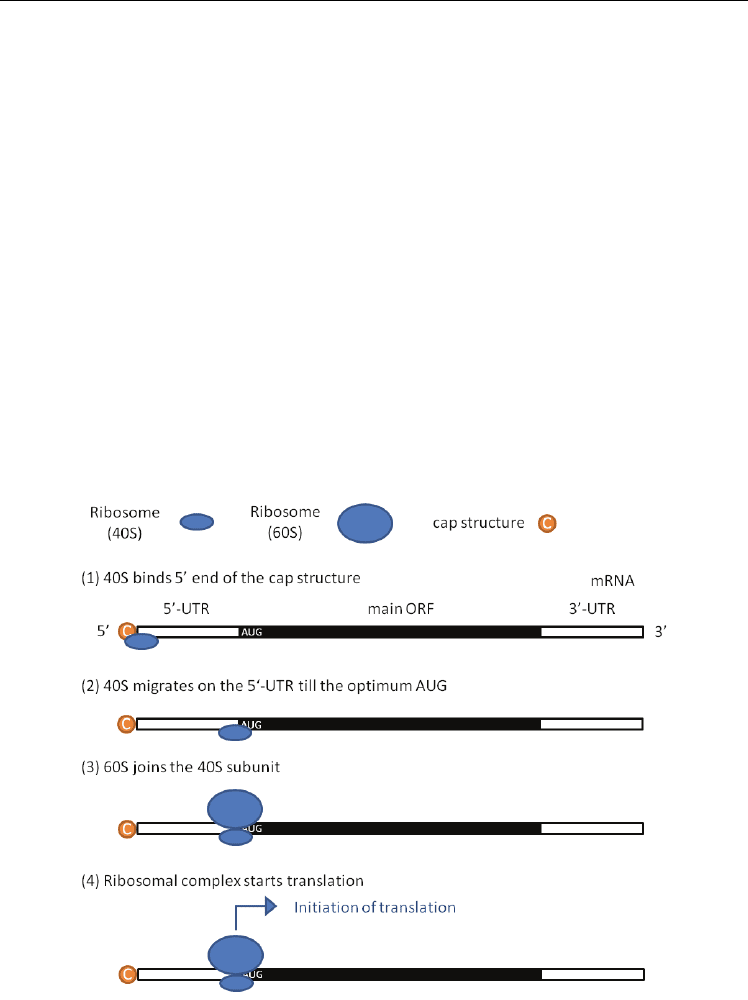
Initiation of translation on eukaryotic mRNAs occurs roughly as follows (Fig. 1) (Kozak,
1989, 1991, 1999).
1. A small (40S) ribosomal subunit binds near the 5‘-end of mRNA, i.e. the cap structure.
2. The 40S subunit migrates linearly downstream of the 5‘-UTR until it encounters the
optimum AUG initiator codon.
3. A large (60S) ribosomal subunit joins the paused 40S subunit.
4. The complete ribosomal complex (40S + 60S) starts protein synthesis.
Fig. 1. The proposed procedure for initiation of translation in eukaryotes. The black region
indicates the main ORF of the mRNA.
Emergence of the Diversified Short
ORFeome by Mass Spectrometry-Based Proteomics
419
In addition to the above mechanism, initiation of translation without the step of ribosome
scanning is also known. It is called “internal initiation”, which depends on some particular
structure on an mRNA termed internal ribosome entry site (IRES).
2.2 The relationship between uORF and main ORF
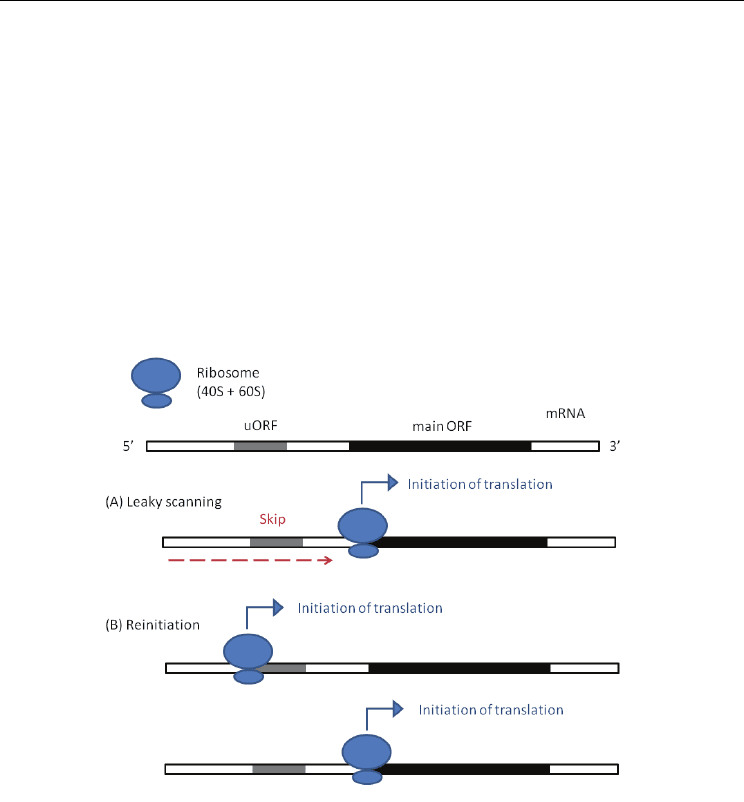
In case that an mRNA contains a uORF, two models for the initiation of translation are
suggested (Fig. 2) (Hatzigeorgiou, 2002). One is called ”leaky scanning” and the other
is ”reinitiation”. If the first AUG codon is in an unfavorable sequence context defined by
Kozak (see the section 3.2), a small ribosomal subunit (40S) ignores the first AUG and
initiates translation from a more favorable AUG codon downstream located. This
phenomenon is known as ”leaky scanning” (Fig. 2-(A)). In case that a complete ribosomal
complex translates a main ORF after termination of translation of the uORF on the same
mRNA, it is termed ”reinitiation” (Fig. 2-(B)).
Fig. 2. The irregular models of ribosome scanning on eukaryotic mRNAs.
(A) Leaky scanning and (B) Reinitiation.
Gray regions indicate uORFs on the mRNA,
whereas black ones represent the main ORFs.
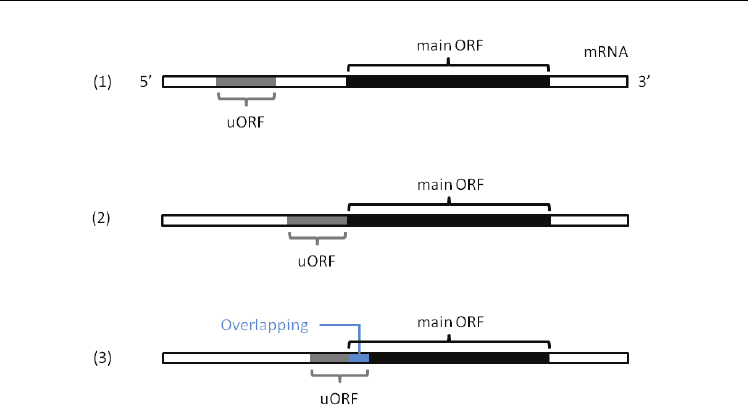
The relations between two ORFs are classified into three types as follows; (1) A distant type;
in-frame/out-of-frame, (2) A contiguous type; in-frame and (3) An overlapped type; in-
frame/out-of-frame (Fig. 3). In-frame means that a uORF and the main ORF are on the same
frame of the mRNA sequence, whereas out-of-frame means that they are on the different
frame. According to the previous analysis of the accumulated 5‘-end sequence data, the
average size of uORF was estimated at 31 amino acids and 20 % of ORFs were categorized
into Type (3) (Yamashita et al., 2003).
Computational Biology and Applied Bioinformatics
420
Fig. 3. The location of a uORF and the main ORF on the mRNA.
(1) A distant type, (2) A contiguous type and (3) An overlapped type. Types (1) and (3) have
two subtypes based on the frames of two ORFs. One is defined by the same reading frame
(in-frame) and the other is by the different one (out-of-frame). Gray and black regions
indicate uORFs and the main ORFs on mRNAs, respectively, whereas a blue one represents
an overlap.
These different relations might bring about different events in initiating translation. In
eukaryotes, it has a tendency to increase an efficiency of reinitiation if the distance between
a uORF and the main ORF is long (Kozak, 1991; Meijer & Thomas, 2002; Morris & Geballe,
2000). Therefore, the ORFs classified as Types (2) and (3) would be difficult to be regulated
by reinitiation. It is also said that reinitiation occurs only when the length of uORF is short
(Kozak, 1991), whereas the sequence context of an inter-ORF‘s region, that of upstream of
uORF, uORF itself and even the main ORF can also affect reinitiation (Morris & Geballe,
2000). On the contrary, the ORFs of Type (3) might easily cause leaky scanning (Geballe &
Morris, 1994; Yamashita et al., 2003). As a special case, when a termination codon of the
uORF is near the AUG initiator codon of the downstream ORF, within about 50 nucleotides,
ribosomes could scan backwards and reinitiate translation from the AUG codon of the
downstream ORF (Peabody et al., 1986).
2.3 The role of short ORFs in translation regulation
The 5‘-UTR elements such as uAUGs and uORFs are well known as important regulators for
translation initiation. In case of some genes that have multiple uORFs, considerably different
effects can be generated on the translation of the main ORF depending on which
combination of uORFs is translated. Some uORFs seem to promote reinitiation of the main
ORFs and the others seem to inhibit it. It is supposed that these effects are caused by the
nucleotide sequences of the 3‘ ends of the uORFs, that of uORFs or protein products
encoded by uORFs. Such differential enhancement of translation are considered to be one of
the responses of adaptation to the environment (Altmann & Trachsel, 1993; Diba et al., 2001;

Emergence of the Diversified Short
ORFeome by Mass Spectrometry-Based Proteomics
421
Geballe & Morris, 1994; Hatzigeorgiou, 2002; Iacono et al., 2005; Meijer & Thomas, 2002;
Morris & Geballe, 2000; Vilela & McCarthy, 2003; Wang & Rothnagel, 2004; Zhang &
Dietrich, 2005). In addition to that, various factors or events are known to influence on the
translational inhibition of the main ORF; the presence of arginine, a stalling of a ribosomal
complex at the termination or an interaction between a ribosomal complex and the peptide
encoded by the uORF, which indicates that down-regulated controls by uORFs are general
(Diba et al., 2001; Geballe & Morris, 1994; Iacono et al., 2005; Meijer & Thomas, 2002; Morris
& Geballe, 2000; Vilela & McCarthy, 2003; Zhang & Dietrich, 2005).
As for downstream ORFs, there is also a report that a peptide encoded in the 3‘-UTR may be
expressed (Rastinejad & Blau, 1993). However, whether and how the peptides control the
translation initiation of the main ORF is still unknown.
3. Variability of translation start sites
How a ribosomal complex (40S + 60S) recognizes an initiator codon on the mRNA is a
matter of vital importance for defining the proteome. Here we present a part of already
proposed elements for regulation of translation initiation.
3.1 The first-AUG rule
Traditionally, the first-AUG rule is widely recognized for initiation of translation (Kozak,
1987, 1989, 1991). It states that ribosomes start translation from the first-AUG on the
corresponding mRNA. Although this rule is not absolute, 90-95 % of vertebrate ORFs was
established by the first AUG codon on the mRNA (Kozak, 1987, 1989, 1991). Our previous
proteomics analysis of small proteins also indicated that about 84 % of proteins in RefSeq
were translated from the first AUG of the corresponding mRNAs (Oyama et al., 2004). On
the other hand, there are also many negative reports concerning the rule; 29 % of cDNA
contained at least one ATG codon in their 5‘-UTR (Suzuki et al., 2000); 41 % of transcripts
had more than one uAUG and 24 % of genes had more than two uAUGs (Peri & Pandey,
2001); about 50 % of the RefSeq entries had at least one uAUG (Yamashita et al., 2003); about
44 % of 5‘-UTRs had uAUGs and uORFs (Iacono et al., 2005). There are also some reports
that the first AUG is skipped if it is too close to the cap structure, within 12 (Kozak, 1991) to
14 (Sedman et al., 1990) nucleotides (see the section 3.3). In this chapter, we cited a variety of
statistical data on the UTRs. Because they are based on different versions or generations of
sequence databases, the data vary widely (Meijer & Thomas, 2002), which is the point to be
properly considered.
3.2 Kozak’s consensus sequence
The strongest bias for initiation of translation in vertebrates is the sequence context called
“Kozak’s sequence”, known as GCCA/GCCATGG (Kozak, 1987). The nucleotides in
positions -3 (A or G) and +4 (G) are highly conserved and greatly effective for a ribosomal
complex to start translation (Kozak, 1987, 2002; Matsui et al., 2007; Suzuki et al., 2001; Wang
& Rothnagel, 2004). The context of an AUG codon in position -3 is the most highly
conserved and functionally the most important; it is regarded as strong or optimal only
when this position matches A or G, and that in position +4 is also highly conserved (Kozak,
2002). Some reports mentioned that only 0.86 % (Kozak, 1987) to 6 % (Iacono et al., 2005) of
functional initiator codons lacked Kozak’s sequence in positions -3 and +4, whereas 37 %
Computational Biology and Applied Bioinformatics
422
(Suzuki et al., 2000) to 46 % (Kozak, 1987) of uATGs would be skipped because of
unfavorable Kozak’s sequence in both of the positions. On the contrary, another report
mentioned that most initiator codons were not in close agreement with Kozak’s consensus
sequence (Peri & Pandey, 2001).
3.3 The length of the 5'-UTR
The length of 5'-UTR is also effective when translation occurs from an AUG codon near the 5’
end of the mRNA (Kozak, 1991; Sedman et al., 1990). About half of ribosomes skip an AUG
codon even in an optimal context if the length of 5‘-UTR is less than 12 nucleotides (mentioned
in the section 3.1) and this type of leaky scanning can be reduced if the length of 5‘-UTR is
more than or equal to 20 nucleotides (Kozak, 1991). In the traditional analysis based on
incomplete 5‘-UTR sequences, the distance from the 5' end to the AUG initiator codon in
vertebrate mRNAs was generally from 20 and 100 nucleotides (Kozak, 1987). The previous
analysis using RefSeq human mRNA sequences indicated that 85 % of 5‘-UTR sequences less
than 100 nucleotides contain no uAUGs (Peri & Pandey, 2001). The evidence convinced us that
the first-AUG rule was widely supported in eukaryotes. In the recent analysis based on full-
length 5‘-UTR sequences, it is 125 nucleotides long on average (Suzuki et al., 2000) and
transcriptional start sites (TSSs) vary widely (Carninci et al., 2006; Kimura et al., 2006; Suzuki
et al., 2001). The average scattered length of 5'-UTR was more than 61.7 nucleotides, with a
standard deviation of 19.5 nucleotides (Suzuki et al., 2001) and 52 % of the human RefSeq
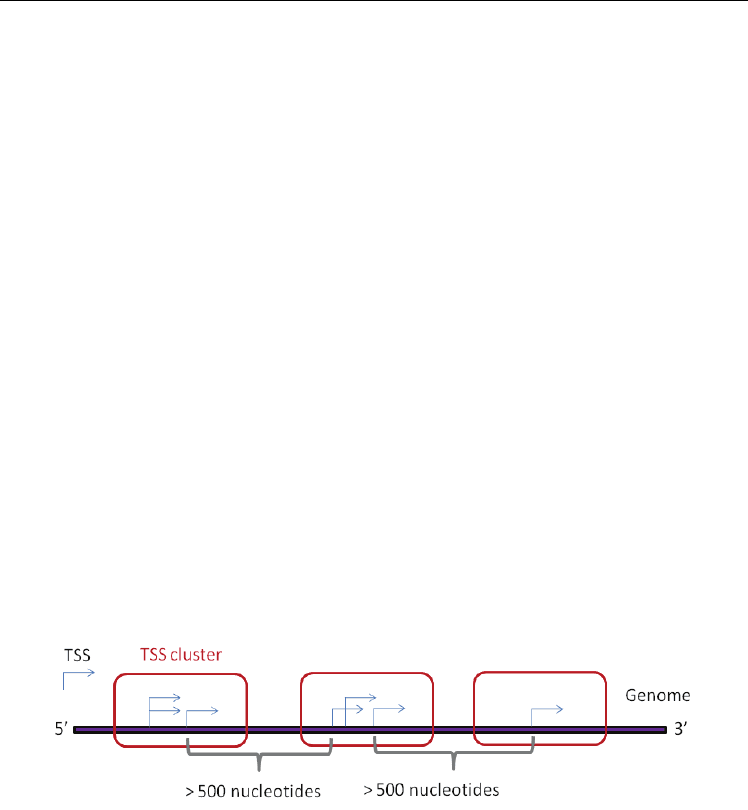
genes contained 3.1 TSS clusters on average (Kimura et al., 2006), which has an over 500
nucleotides interval (Fig. 4). In protein-coding genes, differentially regulated alternative TSSs
are common (Carninci et al., 2006). Because the diversity of transcription initiation greatly
affects the length of the 5'-UTR, there remain some doubts whether the length of the 5'-UTR
contributes to the efficiency of translation initiation. There is also a report that the degree of
leaky scanning is not affected by the length of 5‘-UTR (Wang & Rothnagel, 2004).
Fig. 4. The schematic representation of the 5‘ ends of the TSSs.
Each TSS cluster consists of at least one TSS and has an over 500 nucleotides interval.
3.4 non-AUG initiator codon
In the general translation model, a non-AUG codon is considered to be ignored by
ribosomes unless a downstream AUG codon is in a relatively weak context (Geballe &
Morris, 1994; Kozak, 1999). In case that an upstream non-AUG codon, such as ACG, CUG or
GUG, satisfies Kozak’s consensus sequence, it possibly functions as an initiator of
translation in addition to the first AUG initiator codon (Kozak, 1999, 2002). Besides Kozak’s
consensus sequence, downstream stem-and-loop and highly structured GC-rich context in
the 5‘-UTR could enhance translation initiation from a non-AUG codon (Kozak, 1991, 2002).
Emergence of the Diversified Short
ORFeome by Mass Spectrometry-Based Proteomics
423
4. Protein identification by MS
The recent progress of proteomic methodologies based on highly sensitive liquid
chromatography-tandem mass spectrometry (LC-MS/MS) technology have enabled us to
identify hundreds or thousands of proteins in a single analysis.
We succeeded in the discovery of novel small proteins translated from short ORFs using direct
nanoflow LC-MS/MS system (Oyama et al., 2004, 2007). Among 54 proteins less than 100
amino acids that were identified by retrieving several sequence databases with a
representative search engine, Mascot (Matrix Science; http://www.matrixscience.com/),
four ones were turned out to be encoded in 5‘-UTRs (Oyama et al., 2004). This showed the first
direct evidence of peptide products from the uORFs actually translated in human cells. In the
subsequent analysis using more sophisticated two-dimensional LC system, we also discovered
eight novel small proteins (Oyama et al., 2007), five of which were encoded in the 5‘-UTR and
three were encoded in the 3‘-UTR of the corresponding mRNA. Even based on the
accumulated DBTSS data, two ORFs had no putative AUG codon, which indicated the
possibility that they were translated from non-AUG initiator codon. In the article above, 197
proteins less than 20 kDa were identified by Mascot. The procedure for identifying novel
proteins by MS is described as follows.
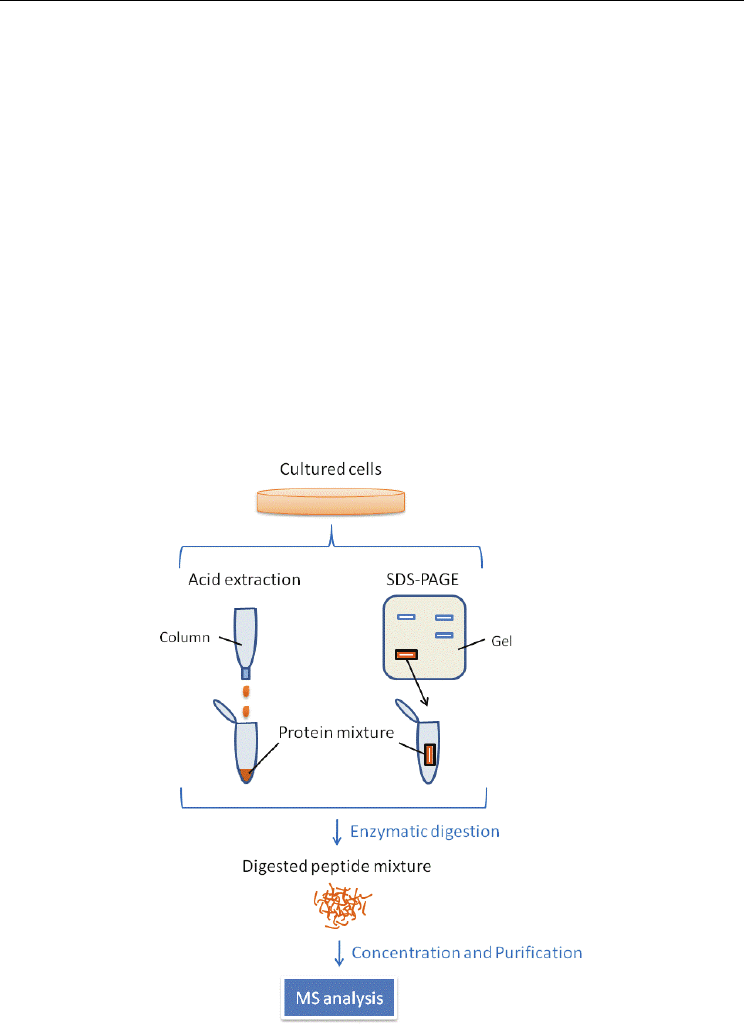
Fig. 5. The procedure for preparing samples for proteomic analyses of small proteins.
Computational Biology and Applied Bioinformatics
424
4.1 Materials and methods
The proteins included in cultured cell lysates were first separated according to their size.
Small protein-enriched fraction through acid extraction and SDS-PAGE were treated with
enzymes. In case of SDS-PAGE, the digested peptides were extracted from the gel. The
samples were desalted and concentrated to introduce into the MS system. The schematic
procedure is shown in Fig. 5.
4.2 Protein identification
The samples were analyzed using nanoflow LC-MS/MS system. The purified peptides were
eluted with a linear gradient of acetonitrile and sprayed into the high-resolution tandem
mass spectrometer. Acquired tandem mass (MS/MS) spectra were then converted to text
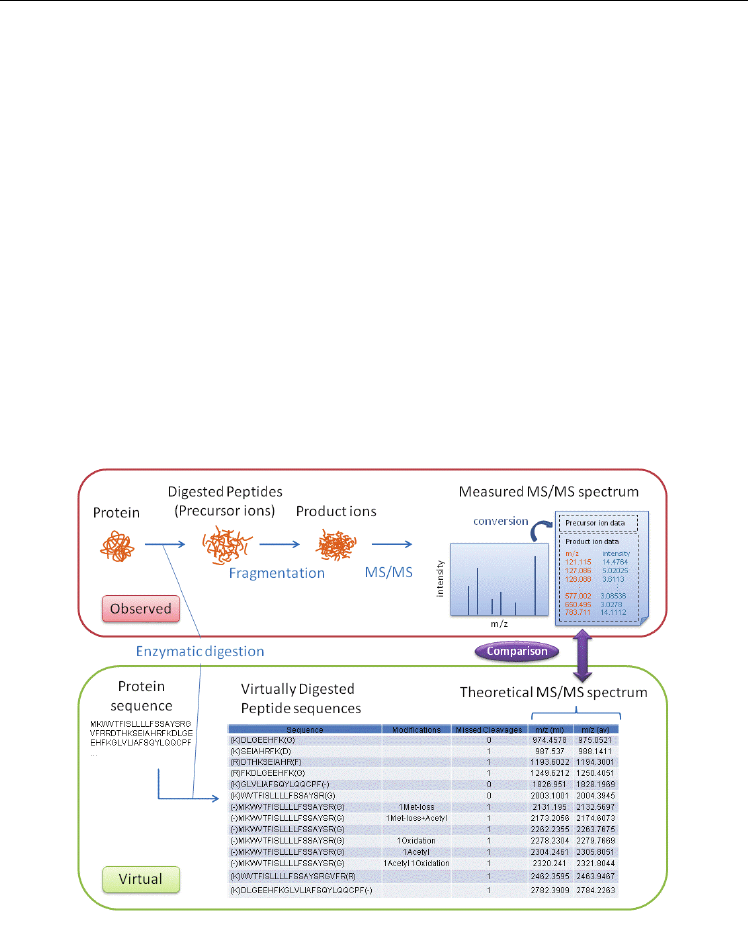
files and processed against sequence databases using Mascot. Based on the principle that
each peptide has a MS/MS spectrum with unique characteristics, the search engine
compares measured data on precursor/product ions with those theoretically calculated
from protein sequence data (Fig. 6). The MS/MS spectrum file contains mass to charge ratio
(m/z) values of precursor and product ions along with their intensity. The measured
spectrum lists are searched against sequence databases to identify the corresponding
peptide in a statistical manner. The theoretical spectrum lists are totally dependent on the
contents of sequence databases themselves.
Fig. 6. The principle of protein identification.
A search engine compares measured MS/MS spectrum lists with theoretical ones. The
acquired MS/MS spectra are converted into a text file that is composed of precursor ion data
and product ion data, in a format defined by the search engine. Product ion data usually
consist of multiple pairs of m/z and its intensity. The theoretical m/z values are calculated
virtually.
Emergence of the Diversified Short
ORFeome by Mass Spectrometry-Based Proteomics
425
4.3 Finding of novel small proteins
For exploring novel small proteins, two types of sequence databases were used; one was an
artificial database computationally translated from the cDNA sequences in all the reading
frames and the other was an already established protein database. In order to process the
comparison of the large-scale protein identification data from the two kinds of databases,
several Perl scripts have been developed based on the definition that candidates of novel
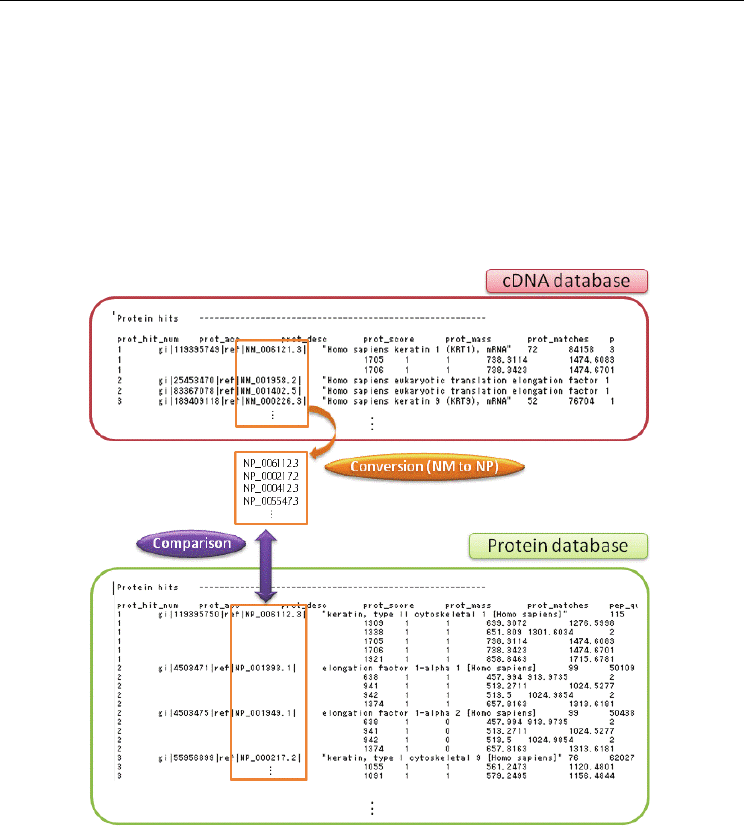
small proteins were identified only in the cDNA database(s) (Fig. 7). In a result datasheet
using RefSeq sequences, each protein was annotated with NM numbers for the cDNA
database and with NP numbers for the protein database. The Perl scripts then exchanged
NM to NP numbers and evaluated them.
Fig. 7. The algorithm to compare the lists of search results using RefSeq cDNA and protein
databases.
The proteins identified from the cDNA database are annotated with NM numbers, whereas,
those from the protein database are with NP numbers. To compare these results, it is needed
to exchange NM to NP numbers. The NP numbers annotated only from the cDNA database
are considered to be candidates of novel proteins.
5. Bioinformatics approach
In order to forward MS-based identification of novel coding regions of mRNAs, MS systems,
sequence databases and bioinformatics methodologies are required to improve together.

Computational Biology and Applied Bioinformatics
426
Regarding bioinformatics, two aspects seem to be demanded; one is for retrieving target
proteins from an enormous size of database searching results, the other is for constructing
platforms to predict novel coding sequences (CDSs).
5.1 Contribution of sequence databases & bioinformatics to MS-based proteomics
The recent advances in MS-based proteomics technology have enabled us to perform large-
scale protein identification with high sensitivity. The accumulation of well-established
sequence databases also made a great contribution to efficient identification in proteomics
analyses. One of the representative databases is a specialized 5‘-end cDNA database like
DBTSS and the other is a series of whole genome sequence databases for various species. To
investigate the mechanisms in transcriptional control, DBTSS has lately attracted considerable
attention because it contains accumulated information on the transcriptional regulation of each
gene (Suzuki et al., 2002, 2004; Tsuchihara et al., 2009; Wakaguri et al., 2008; Yamashita et al.,
2006). Based on the accumulated data, the diverse distribution of TSSs was clearly indicated
(Kimura et al., 2006; Suzuki et al., 2000, 2001). On the other hand, many whole genome
sequencing projects are progressing all over the world (GOLD: Genomes Online Database;
http://www.genomesonline.org/). Complement and maintenance of sequence databases for
various species must help to find more novel proteins across the species. For example, there
are several reports that conducted bioinformatical approaches to explore novel functional
uORFs by comparing the 5'-UTR regions of orthologs based on multiple sequence alignments
(Zhang & Dietrich, 2005), using ORF Finder (http://bioinformatics.org/sms/orf find.html)
and a machine learning technique, inductive logic programming (ILP) with biological
background knowledge (Selpi et al., 2006), or applying comparative genomics and a heuristic
rule-based expert system (Cvijovic et al., 2007). Using advanced sequence databases, new
protein CDSs were added as a result of the prediction by various algorithms (e.g.
Hatzigeorgiou, 2002; Ota et al., 2004). Based on the well-established cDNA databases, MS
could evaluate whether these CDSs are actually translated in a high-throughput manner.
Construction of more detailed sequence databases will lead to detection of more novel small
proteins in the presumed 5'-UTRs (Oyama et al., 2004). To make good use of those exhaustive
sequence databases, bioinformatical techniques, especially data mining tools such as search
engines to retrieve target proteins from an enormous size of database search results, are
obviously indispensable.
5.2 Contribution of MS-based proteomics to sequence databases & bioinformatics
In addition to the technological progress of MS, sequence databases and data mining tools,
development of other bioinformatical techniques called prediction tools, are also important.
Ad-hoc algorithms for predicting new CDSs, as mentioned above, could be improved by
using MS-based novel protein data. Those novel ones can be applied to play a role in a
collection of supervised training data for machine learning, pattern recognition or rule-
based manual approach. There is an interesting bioinformatical report which hypothesized
that a uORF in the transcript down-regulates transcription of the corresponding RNA via
RNA decay mechanisms (Matsui et al., 2007). They obtained human and mouse transcripts
from RefSeq and UniGene (http://www.ncbi.nlm.nih.gov/unigene) and classified the
transcripts into Level 0 (not containing uORF) and Level 1-3 (containing uORF). Then, they
prepared the data of expression intensities and half-lives of mRNA transcripts mainly from
SymAtlas (now linked to BioGPS; http://biogps.gnf.org/#goto=welcome) and Genome
Research website (http://genome.cshlp.org/). Although they suggested that not only the