
Mann U. Principles of Chemical Reactor Analysis and Design: New Tools for Industrial Chemical Reactor Operations
Подождите немного. Документ загружается.


We select the forward reaction as the independent reaction and the reverse reaction
as the dependent rea ction. Hence, the inde x of the independent reaction is m ¼ 1,
the index of the dependent reaction is k ¼ 2. Since Reaction 2 is the reverse of
Reaction 1, a
21
¼ 21. The stoichiometric coefficients of the independent r eaction ar e
s
A1
¼1 s
B1
¼ 1 D
1
¼ 0
Using Eq. 6.1.1, and selecting the initial sta te as the refer ence s ta te, for a cons tant-
volume reaction
dZ
1
dt
¼ (r
1
r
2
)
t
cr
C
0
(6:3:1)
Using Eq. 6.1.12 to expr ess the species concentr a tions, the two reaction rates are
r
1
¼ k
1
C
0
[ y
A
(0) Z
1
]
r
2
¼ k
2
C
0
[ y
B
(0) þ Z
1
]
We define the characteristic reaction time on the basis of Reaction 1:
t
cr
¼
1
k
1
Substituting these rela tions into Eq. 6.3.1, the design equa tion r educes to
dZ
1
dt
¼ [ y
A
(0) Z
1
]
k
2
k
1
[ y
B
(0) þ Z
1
](6:3:2)
To simplify the design equa tion, we rearr ange Eq. 6.3.2 and notice that, a t equilibrium,
(dZ
1
/dt ¼ 0),
Z
1
eq
¼
y
A
(0) (k
2
=k
1
)y
B
(0)
1 þ (k
2
=k
1
)
(6:3:3)
where Z
1
eq
is the dimensionless extent at equilibrium. Using Eq. 6.3.3, the design
equation becomes
dZ
1
dt
¼
k
1
þ k
2
k
1
(Z
1
eq
Z
1
)(6:3:4)
Separating the variables and integrating, we obtain
Z(t) ¼ Z
1
eq
1 exp
k
1
þ k
2
k
1
t
(6:3:5)
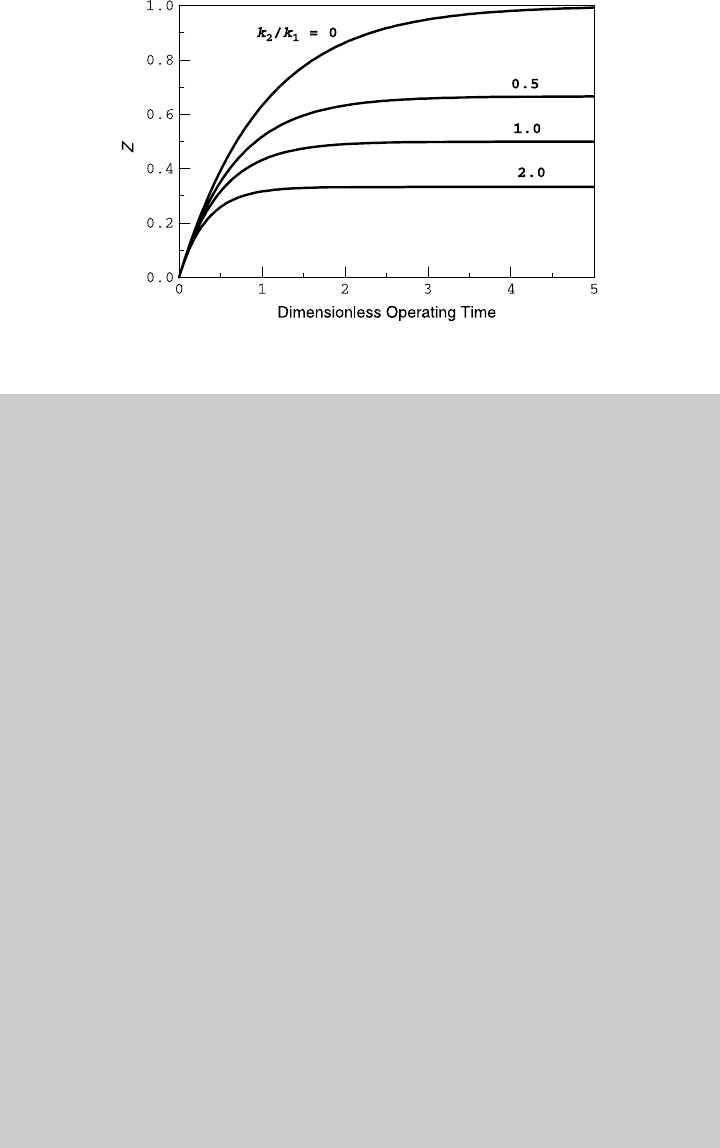
Figure 6.8 showsthe reaction operating curve for different values of k
2
/k
1
. Note that the
design equation for batch reactors with single reversible reactions has two parameters
(k
1
and k
2
), whereas the design equation for reactors with an irreversible reaction has
only one parameter. Also note that for an irreversible rea ction, k
2
¼ 0, and, from
Eq. 6.3.3, Z
1
eq
¼ y
A
(0).
200 IDEAL BATCH REACTOR
Example 6.8 The reversible gas-phase chemical reaction
A
2B
takes place in an isothermal batch reactor. The forward reaction is first order, and
the backward reaction is second order. We charge 100 mol of reactant A into the
reactor that operates at 1208C. The initial pressure is 2 atm. At the operating con-
ditions (1208C), k
1
¼ 0.1 min
21
and k
2
¼ 0.322 L mol
21
min
21
.
a. Derive the design equation and plot the reaction curve for a constant-volume
batch reactor.
b. Determine the equilibrium composition at 1208C in a constant-volume
reactor.
c. Determine the operating time to obtain 90% of the equilibrium conversion?
d. Derive the design equation and plot the reaction curve for an isobaric, vari-
able-volume batch reactor.
e. Determine the equilibrium composition at 1208C in an isobaric variable-
volume reactor.
f. What is the operating time to obtain 90% of the equilibrium conversion?
Solution We write the reversible reaction as two separate reactions:
Reaction 1: A ! 2B
Reaction 1: 2B ! A
whose stoichiometric coefficients are
s
A
1
¼1 s
B
1
¼ 2 D
1
¼ 1
s
A
2
¼ 1 s
B
2
¼2 D
2
¼1
Figure 6.8 Reaction operating curves for single reversible reaction.
6.3 ISOTHERMAL OPERATIONS WITH MULTIPLE REACTIONS 201

We have here one independent reaction, and select Reaction 1 as the independent
reaction; hence, the reaction indices are m ¼ 1 and k ¼ 2, and, for a reversible
reaction, a
21
¼ 2 1. We select the initial state as the reference state, and the
reference concentration is
C
0
¼
P
0
RT
0
¼
2 atm
(82:06 10
3
L atm=mol K)(393 K)
¼ 0:062 mol=L (a)
Since only reactant A is charged to the reactor, y
A
(0) ¼ 1 and y
B
(0) ¼ 0.
a. We use Eq. 6.1.1; for a constant-volume batch reactor the design equation is
dZ
1
dt
¼ (r
1
r
2
)
t
cr
C
0
(b)
We define the characteristic reaction time on the basis of reaction 1:
t
cr
¼
1
k
1
¼ 10 min (c)
Equation 6.1.12 expresses the species concentrations; the reaction rates of the
two reactions are
r
1
¼ k
1
C
0
(1 Z
1
) r
2
¼ k
2
C
0
2
(2Z
1
)
2
Substituting the rates and (c) into (b), the design equation reduces to
dZ
1
dt
¼ 1 Z
1
k
2
C
0
k
1
4Z
1
2
(d)
Once we solve the design equation, we use Eq. 2.7.4 to obtain the species
curves:
N
A
(t)
(N
tot
)
0
¼ 1 Z
1
(t) (e)
N
B
(t)
(N
tot
)
0
¼ 2Z
1
(t)(f)
Using Eq. 2.7.6
N
tot
(t)
(N
tot
)
0
¼ 1 þ Z
1
(t) (g)
For the given data, k
2
C
0
/k
1
¼ 0.2, and we solve (d) subject to the initial
condition that Z
1
(0) ¼ 0. Figure E6.8.1 shows the reaction operating curve
202 IDEAL BATCH REACTOR
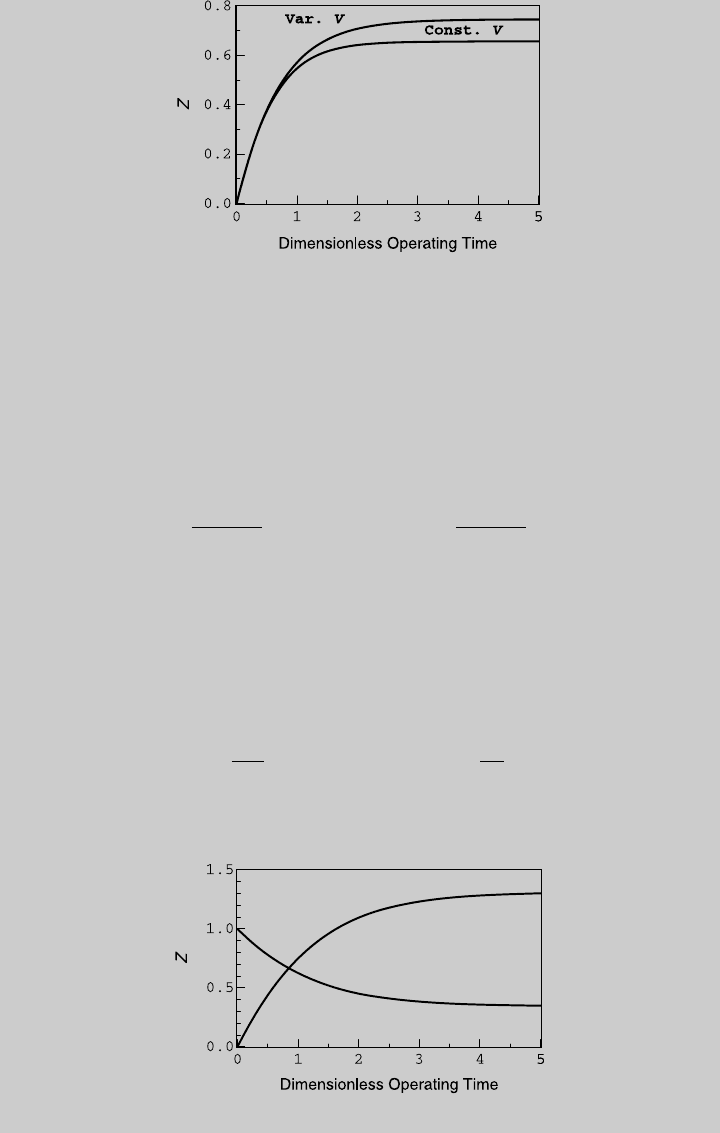
and compares it to the reaction curve obtained on a variable-volume batch
reactor. Using (e) and (f), we determine the species curves shown in
Figure E6.8.2.
b. At equilibrium, dZ
1
/dt ¼ 0, and, the equilibrium extent is Z
1eq
¼ 0:6563.
Using (e), (f), and (g), the species molar fractions at equilibrium are
y
A
eq
¼
1 Z
1
eq
1 þ Z
1
eq
¼ 0:2075 y
B
eq
¼
2Z
1
eq
1 þ Z
1
eq
¼ 0:7925
c. A level of 90% equilibrium conversion corresponds to Z ¼ 0.5907, and, from
the reaction curve, it is reached at t ¼ 1.26. Using (c), the operating time is
t ¼ t
cr
t ¼ 12:6 min
d. For an isobaric, variable-volume batch reactor, the design equation Eq. 6.1.1 is
dZ
1
dt
¼ (r
1
r
2
)(1 þ D
1
Z
1
)
t
cr
C
0
(h)
Figure E6.8.1 Reaction curves.
Figure E6.8.2 Species curves.
6.3 ISOTHERMAL OPERATIONS WITH MULTIPLE REACTIONS 203

Using Eq. 6.1.16 to express the species concentrations, the reaction rates are
r
1
¼ k
1
C
0
1 Z
1
1 þ Z
1
r
2
¼ k
2
C
0
2
2Z
1
1 þ Z
1
2
(i)
Substituting the rates and (c) into (h), the design equation becomes
dZ
1
dt
¼ 1 Z
1
k
2
C
0
k
1
4Z
1
2
1 þ Z
1
(j)
We solve ( j) subject to the initial condition that Z
1
(0) ¼ 0. The reaction curve
is shown in Figure E6.8.1.
e. At equilibrium, dZ
1
/dt ¼ 0, and, from ( j), the equilibrium extent is
Z
1
eq
¼ 0.7455. Using (e), (f), and (g), the species molar fractions at equili-
brium are
y
A
eq
¼
1 Z
1
eq
1 þ Z
1
eq
¼ 0:1458 y
B
eq
¼
2 Z
1
eq
1 þ Z
1
eq
¼ 0:8542
f. A level of 90% equilibrium conversion corresponds to Z ¼ 0.671 and, from
the operating curve, it is reached at t ¼ 1.56; using (c), the operating time is
15.6 min.
Next, we consider series (consecutive) chemical reactions. These are reactions
where the product of one reaction reacts to form undesirable species. In such
cases, it is important to consider the amount of desirable and undesirable products
formed in addition to the conversion of the reactant. In many instances, the yield of
the desirable product provides a measure of the reactor performance.
Example 6.9 A valuable product B is produced in a batch reactor where the
following liquid-phase reactions take place:
Reaction 1: A ! 2B
Reaction 2: B ! C þ D
Each chemical reaction is first order. The reactor is charged with 200 L of an
organic solution with a concentration of 4 mol A/L. The reactor is operated at
1208C. At the reactor temperature, k
1
¼ 0.05 min
21
and k
2
¼ 0.025 min
21
.
a. Derive the design equations and plot the reaction and species curves.
b. Derive an expression for the yield of product B, and plot it as a function of the
operating time.
204 IDEAL BATCH REACTOR

c. Determine the operating time when the production of product B is
maximized.
d. Determine the conversion of reactant A and the yield and selectivity of
product B at optimal operating time.
Solution This is an example of series (sequential) chemical reactions. The
stoichiometric coefficients of the chemical reactions are
s
A
1
¼1 s
B
1
¼ 2 s
C
1
¼ 0 s
D
1
¼ 0 D
1
¼ 1
s
A
2
¼ 0 s
B
2
¼1 s
C
2
¼ 1 s
D
2
¼ 1 D
2
¼ 1
Since each reaction has a species that does not participate in the other, the two
reactions are independent, and there is no dependent reaction.
a. We write Eq. 6.1.1 for each independent reaction:
dZ
1
dt
¼ r
1
t
cr
C
0
(a)
dZ
2
dt
¼ r
2
t
cr
C
0
(b)
We select the initial state as the reference sate; hence, C
0
¼ C
A
(0), and
(N
tot
)
0
¼ V
R
(0)C
0
¼ 800 mol
Since only reactant A is charged into the reactor, y
A
(0) ¼ 1, and
y
B
(0) ¼ y
C
(0) ¼ y
D
(0) ¼ 0. We use Eq. 6.1.12 to express the species concen-
trations, and the rates of the two reactions are
r
1
¼ k
1
C
0
(1 Z
1
) (c)
r
2
¼ k
2
C
0
(2Z
1
Z
2
) (d)
We select reaction 1, the desirable reaction, to define the characteristic reac-
tion time
t
cr
¼
1
k
1
¼ 20 min (e)
Substituting (c), (d), and (e) into (a) and (b), the two design equations reduce to
dZ
1
dt
¼ 1 Z
1
(f)
dZ
2
dt
¼
k
2
k
1
(2Z
1
Z
2
) (g)
6.3 ISOTHERMAL OPERATIONS WITH MULTIPLE REACTIONS 205
After we solve the design equa tions, we use Eq. 2.7.4, to determine the species
curves,
N
A
(N
tot
)
0
¼ 1 Z
1
(h)
N
B
(N
tot
)
0
¼ 2Z
1
Z
2
(i)
N
C
(N
tot
)
0
¼
N
D
(N
tot
)
0
¼ Z
2
(j)
In this case, the two design equations are not coupled, and we can obtain
analytical solutions. We solve (f) subject to the initial condition that
Z
1
(0) ¼ 0, and obtain
Z
1
(t) ¼ 1 e
t
(k)
W e substitute (k) into (g), and the second design equa tion reduces to
dZ
2
dt
þ
k
2
k
1
Z
2
¼ 2
k
2
k
1
(1 e
t
) (l)
This is a first-order linear differ ential equation tha t can be solved analytically
by using an integra ting factor. W e solv e (l) subject to the initial condition
that Z
2
(0) ¼ 0, and obtain
Z
2
(t) ¼ 21
k
1
k
1
k
2
e
(k
2
=k
1
)t
þ
k
2
k
1
k
2
e
t
(m)
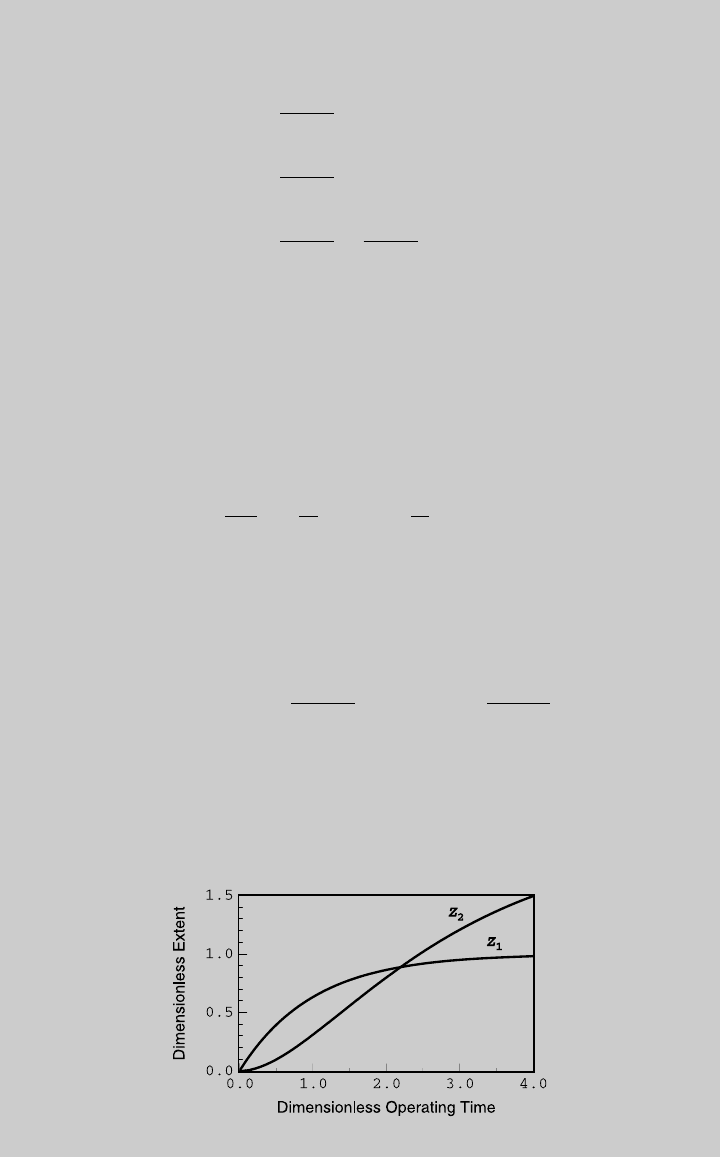
For the given data, k
2
=k
1
¼ 0:5, we plot Z
1
(t)andZ
2
(t) in Figure E6.9.1. Once
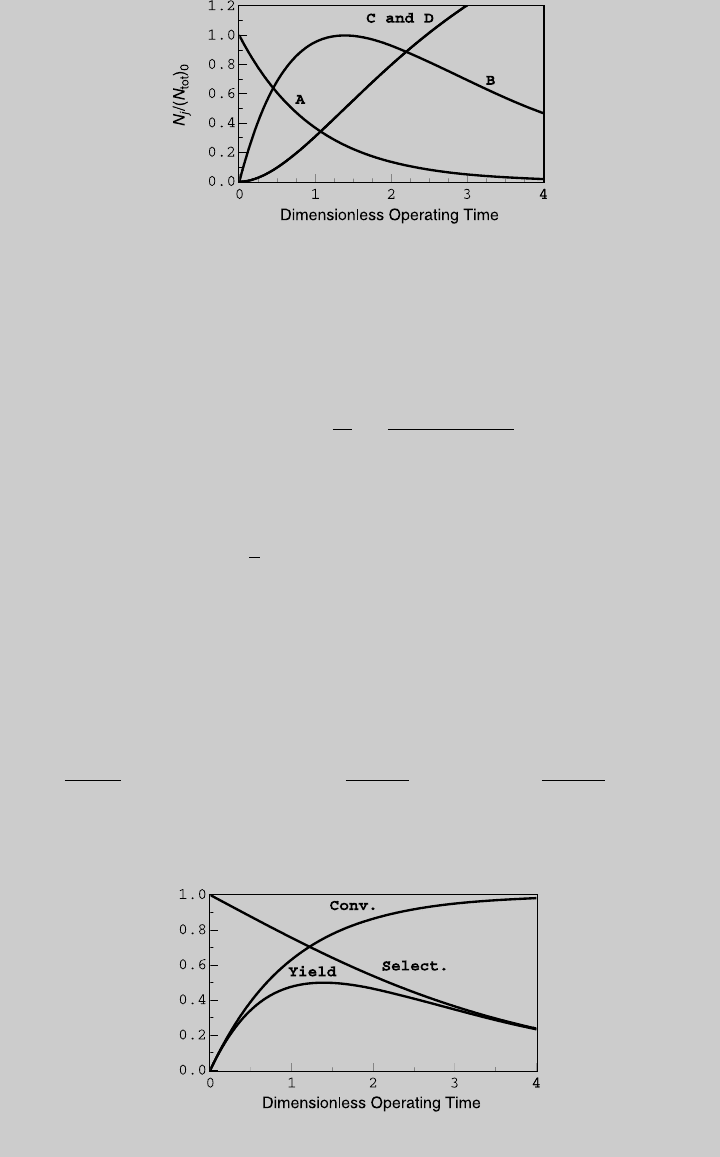
we have Z
1
(t)andZ
2
(t), we use (h) through ( j) to plot the species curves,
shown in Figure E6.9.2.
Figure E6.9.1 Reaction curves.
206 IDEAL BATCH REACTOR
b. The desirable chemical reaction is Reaction 1, and using Eq. 2.6.12, the yield
of product B is
h
B
(t) ¼
s
A
s
B
1
N
B
(t) N
B
(0)
N
A
(0)
and, using (i),
h
B
(t) ¼
1
2
[2Z
1
(t) Z
2
(t)] ¼ Z
1
(t) 0:5Z
2
(t) (n)
Figure E6.9.3 shows the yield curve.
c. To determine the optimal operating time, we use either the curve of product B
or the analytical solutions. From the graph, maximum N
B
is reached at
t ¼ 1.39. Alternatively, using (i), (k), and (m),
N
B
(t)
N
tot
(0)
¼ 2(1 e
t
) 21
k
1
k
1
k
2
e
(k
2
=k
1
)t
þ
k
2
k
1
k
2
e
t
(o)
Figure E6.9.2 Species curves.
Figure E6.9.3 Yield and selectivity.
6.3 ISOTHERMAL OPERATIONS WITH MULTIPLE REACTIONS 207

To determine the maximum, we take the derivative of (o) with respect to t
and equate it to zero
t
max
B
¼
k
1
k
1
k
2
ln
k
1
k
1
k
2
(q)
For k
2
/k
1
¼ 0.5, t
max
B
¼ 1.39. Using (e), the optimal operating time is
t ¼ tt
cr
¼ 27:6 min
d. For t ¼ 1.39, the solutions of (l) and (n) are Z
1
¼ 0.751 and Z
2
¼ 0.502.
Using (i) and (j), the species amounts are: N
A
¼ 199.2 mol. Using (h), the
conversion of reactant A is
f
A
(
t
) ¼
N
A
(0) N
A
(
t
)
N
A
(0)
¼ 0:751
Using (n), the yield of product B is 0.5. To calculate the selectivity of product
B, we use Eq. 2.6.17, (h), and (i),
s
B
(
t
) ¼
1
2
2Z
1
(
t
) Z
2
(
t
)
Z
1
(
t
)
¼ 0:666
The selectivity curve is shown in Figure E6.9.3.
Next, we consider parallel chemical reactions. These are reactions in which a
reactant of the desirable reaction also reacts in another reaction to form undesirable
species. In such cases, it is important to consider not only the conversion of the
reactant but also the amount of desirable and undesirable products formed. The
yield of the desirable product provides a measure of the reactor performance.
Example 6.10 The catalytic oxidation of propylene on bismuth molybdate to
produce acrolein is investigated in a constant-volume batch reactor. The follow-
ing chemical reactions take place in the reactor:
Reaction 1: C
3
H
6
þ O
2
! C
3
H
4
O þ H
2
O
Reaction 2: C
3
H
4
O þ 3:5O
2
! 3O
2
þ 2H
2
O
Reaction 3: C
3
H
6
þ 4:5O
2
! 3CO
2
þ 3H
2
O
208 IDEAL BATCH REACTOR

The rate of each reaction is second order (first order with respect to each reac-
tant), and the reaction rate constants at 4608Carek
1
¼ 0.5 L mol
21
s
21
, k
2
/
k
1
¼ 0.25, k
3
/k
1
¼ 0.10. A gas mixture consisting of 60% propylene and 40%
oxygen is charged into a 4-L isothermal reactor operated at 4608C. The initial
pressure is 1.2 atm.
a. Derive the design equations, and plot the reaction and species operating
curves.
b. Determine the operating time needed for 75% conversion of oxygen.
c. Determine the reactor composition at 75% conversion of oxygen.
Solution The reactor design formulation of these chemical reactions was dis-
cussed in Example 4.2. Recall that there are two independent reactions and one
dependent reaction, and, following the heuristic rule, we select Reactions 1 and 2
as a set of independent reactions; hence, m ¼ 1, 2, and k ¼ 3. The stoichiometric
coefficients of the independent reactions are
(s
C
3
H
6
)
1
¼1(s
O
2
)
1
¼1(s
C
3
H
4
O
)
1
¼1(s
H
2
O
)
1
¼1(s
CO
2
)
1
¼0 D
1
¼0
(s
C
3
H
6
)
2
¼0(s
O
2
)
2
¼3:5(s
C
3
H
4
O
)
2
¼1(s
H
2
O
)
2
¼2(s
CO
2
)
2
¼3 D
2
¼0:5
Recall from Example 4.2 that the multipliers a
km
’s of the dependent reaction
(Reaction 3) and the two independent reactions (Reactions 1 and 2) are
a
31
¼ 1 and a
32
¼ 1. We select the initial state as the reference state; hence,
C
0
¼
P
0
RT
0
¼0:02mol=L (a)
(N
tot
)
0
¼V
R
(0)C
0
¼0:08mol
The initial composition is
y
C
3
H
6
(0)¼0:6 y
O
2
(0)¼0:4 y
C
3
H
4
O
(0)¼y
H
2
O
(0)¼y
CO
2
(0)¼0
a. We write Eq. 6.1.1 with V
R
(t) ¼ V
R
(0) ¼ V
R
0
for each the independent
reaction,
dZ
1
dt
¼ (r
1
þ r
3
)
t
cr
C
0
(b)
dZ
2
dt
¼ (r
2
þ r
3
)
t
cr
C
0
(c)
6.3 ISOTHERMAL OPERATIONS WITH MULTIPLE REACTIONS 209