
Mann U. Principles of Chemical Reactor Analysis and Design: New Tools for Industrial Chemical Reactor Operations
Подождите немного. Документ загружается.

6.5 SUMMARY
In this chapter, we analyzed the operation of ideal batch reactors. We covered the
following topics:
1. The underlying assumptions for ideal batch reactor operations and when they
are applied in practice.
2. Derived the dimensionless design equation for isothermal operation with
single reactions and obtained the reaction operating curve.
3. Discussed the operation of constant-volume batch reactors.
4. Discussed the operation of gaseous, variable-volume batch reactors.
5. Discussed methods to determine the rate expression and its parameters.
6. Discussed the design of isothermal operations with multiple chemical
reactions.
7. Discussed the design of nonisothermal operations with multiple chemical
reactions.
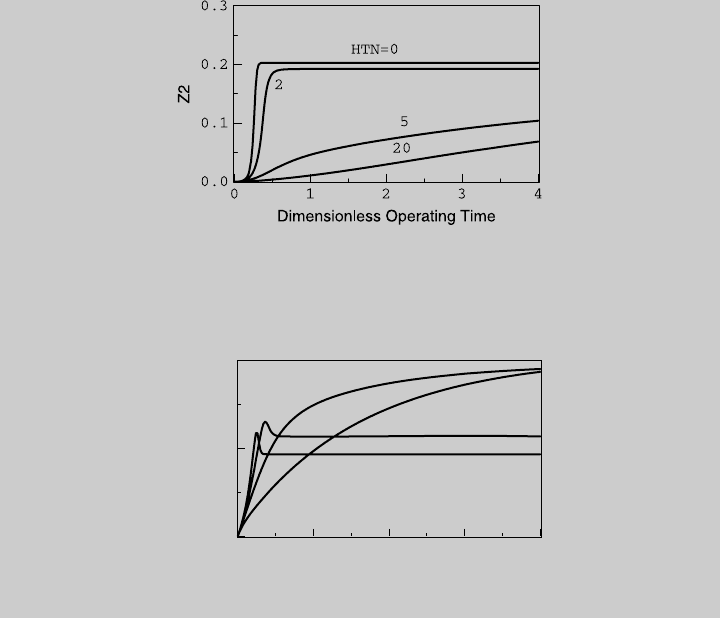
Figure E6.13.9 Effect of HTN on Reaction 2.
Dimensionless Operating Time
40123
N
c
/(N
tot
)
0
0.2
0.0
0.1
4
HTN=0
2
20
Figure E6.13.10 Effect of HTN on the production of product C.
230 IDEAL BATCH REACTOR
PROBLEMS*
6.1
2
The gas-phase decomposition of ethylene oxide, described by the reaction
C
2
H
4
O(g) ! CH
4
(g) þ CO(g)
has been investigated in a constant-volume batch reactor at 4008C. The
reaction is assumed to be first order. Based on the data below, determine:
a. Is the first-order assumption valid?
b. What is the reaction rate constant at 4008C?
c. What operating time is required for 50% conversion?
Data:
Time (min) 0 7 12 18
Pressure (mm Hg) 119 130.7 138.2 146.4
6.2
2
Reactant A decomposes according to the reaction
A ! 2B þ C
in an aqueous solution containing a homogeneous catalyst. The measured
relation between r and C
A
is given in the table below. We want to run this
reaction in a batch reactor at the same catalyst concentration as used in
obtaining the data. Develop a graphical method to design the reactor with-
out deriving the rate expression. Determine:
a. The time needed to lower the concentration of A from C
A
(0) ¼ 10 mol/
LtoC
A
(t) ¼ 2 mol/L.
b. The final concentration after 10 h of operation if the reactor is charged
with a solution of C
A
(0) ¼ 7 mol/L.
Data:
C
A
(t) (mol/L)1 2467912
r (mol/L h) 0.06 0.1 0.25 1.0 2.0 1.0 0.5
6.3
2
The chemical reaction
A ! Products
is investigated in a constant-volume batch reactor. After 8 min in a batch
reactor, 80% of reactant A is converted. After 18 min, 90% of A is
*Subscript 1 indicates simple problems that require application of equations provided in the text.
Subscript 2 indicates problems whose solutions require some more in-depth analysis and modifi-
cations of given equations. Subscript 3 indicates problems whose solutions require more comprehen-
sive analysis and involve application of several concepts. Subscript 4 indicates problems that require
the use of a mathematical sofware or the writing of a computer code to obtain numerical solutions.
PROBLEMS 231

converted. If C
A
(0) ¼ 1 mol/L, determine the rate expression of this
reaction.
6.4
2
Dvorko and Shilov (Kinetics and Catalysis, 4, 212, 1964) studied the
iodine-catalyzed addition reaction between HI and cyclohexene in benzene
solution,
HI þ C
6
H
10
! C
6
H
11
I
The reaction is believed to be first order with respect to each reactant. An
experiment was conducted at 208C in a benzene solution with an
iodine concentration of 4.22 10
24
mol/L. The initial concentration
of cyclohexene was 0.123 mol/L. Based on the data below,
determine:
a. Is the assumed rate expression valid?
b. What is the reaction rate constant at 208C?
Data:
Time (s) C
HI
(mol/L)
0 0.106
150 0.090
480 0.087
870 0.076
1500 0.062
2280 0.050
6.5
2
Huang and Dauerman (Ind. Eng. Chem. Process. Des. Develop., 8, 227,
1969) studied the reaction between benzyl chloride and sodium acetate in
dilute aqueous solution at 1028C:
NaAc þ C
6
H
5
CH
2
Cl ! C
6
H
5
CH
2
Ac þ Na
þ
þ Cl
Initially, the concentration of both sodium acetate and benzyl chloride is
0.757 mol/L. The fraction of unconverted benzyl as a function of time is
given below. Assuming the reaction is first order with respect to each reac-
tant, determine:
a. Is the assumed rate expression valid?
b. The reaction rate constant at 1028C.
232 IDEAL BATCH REACTOR

Data:
Time (ks) C
B
(t)/C
B
(0)
10.80 0.945
24.48 0.912
46.08 0.846
54.72 0.809
69.48 0.779
88.56 0.730
109.44 0.678
126.72 0.638
133.74 0.619
140.76 0.590
6.6
2
The dimerization second-order reaction 2A ! R takes place in a liquid sol-
ution. When the reactor is charged with a solution with C
A
(0) ¼ 1 mol/L,
50% conversion is reached after 1 h. What will the conversion be after 1 h if
the initial concentration of A is 10 mol/L?
6.7
2
Enzyme E catalyzes the chemical reaction
A ! P þ R
in aqueous solution. The reaction rate expression is
(r
A
) ¼
200C
A
C
E
2 þ C
A
(mol=L min)
If we charge a solution with C
E
¼ 0.001 mol/L and C
A
(0) ¼ 10 mol/L into
a batch reactor, find the time it takes for the concentration of A to drop to
0.025 mol/L. Note that the concentration of the enzyme remains
unchanged during the operation. Plot the dimensionless operating curve.
6.8
2
The reaction of cyclohexanol and acetic acid in dioxane solution as cata-
lyzed by sulfuric acid was studied by McCracken and Dickson (Ind. Eng.
Chem. Proc. Des. and Dev., 6, 286, 1967). The esterification reaction
can be represented by the following stoichiometric reaction:
A þ B ! C þ W
(aceticacid þ cyclohexanol ! cyclohexylacetate þ water)
PROBLEMS 233

The reaction is carried out in a well-stirred batch reactor at 408C. Under
these conditions, the esterification reaction can be considered as irreversible
at conversions less than 70%. The following data were obtained using iden-
tical sulfuric acid concentrations in both runs.
Run 1: C
A
(0) ¼ C
B
(0) ¼ 2.5 kmol/m
3
Run 2: C
A
(0) ¼ 1; C
B
(0) ¼ 8 kmol/m
3
C
A
(t) (kmol/m
3
) Time, t (ks) C
A
(t) (kmol/ m
3
) Time, t (ks)
2.070 7.2 0.885 1.8
1.980 9.0 0.847 2.7
1.915 10.8 0.769 4.5
1.860 12.6 0.671 7.2
1.800 14.4 0.625 9.0
1.736 16.2 0.544 12.6
1.692 18.0 0.500 15.3
1.635 19.8 0.463 18.0
1.593 21.6
1.520 25.2
1.460 28.8
Determine the order of the reaction with respect to each reactant and the rate con-
stant for the forward reaction under the conditions of the two runs. The rate constant
should differ between runs, but the conditions are such that the order will not differ.
The individual and overall orders are integers.
6.9
2
The elementary, gas-phase, dimerization reaction
2A ! P
is carried out in an isobaric, isothermal batch reactor. Pure A is charged into
the reactor, which operates at 5 atm and 3008C. Based on the data below,
determine:
a. The time needed for 80% conversion of A.
b. The volume of the reactor at that time.
c. Plot the performance curve.
Data: The reaction rate constant at 3008C, k ¼ 1 min
21
(mol/L)
21
Initial volume of the reactor: 500 L.
6.10
2
The following data are typical of the pyrolysis of dimethylether at 5048C:
CH
3
OCH
3
! CH
4
þ H
2
þ CO
The reaction takes place in the gas phase in an isothermal constant-volume
reactor. Determine the order of the reaction and the reaction rate constant.
The order may be assumed to be an integer.
234 IDEAL BATCH REACTOR

Data:
Time (s) P (kPa)
0 41.6
390 54.4
777 65.1
1195 74.9
3155 103.9
1 124.1
6.11
1
For the chemical reaction
2A þ 3B ! 2C
the following data were obtained:
Run Concentration (mol/L) Rate
A B (mol/L min)
1 0.50 1.00 0.1
2 0.50 2.00 0.3
3 1.00 1.00 0.4
Determine the form of the rate expression. What is the value of the reaction
rate constant?
6.12
2
For the following data:
Concentration (mol/L) Rate
A B C (mol/L min)
0.01 0.20 0.10 2.8
0.01 0.40 0.10 5.6
0.01 0.80 0.05 5.6
0.02 0.10 0.10 2.8
Determine:
a. The order of the reaction with respect to A, B, and C.
b. The value of the reaction rate constant.
6.13
2
At 800 K, di-methyl ether decomposes according to the reaction
CH
3
OCH
3
(g) ! CH
4
(g) þ CO(g) þ H
2
(g)
PROBLEMS 235

Ether is charged into a constant-volume batch reactor, and the progress of
the reaction is monitored measuring the reactor pressure.
Based on the data below, determine:
a. The order of the reaction (use the differential method).
b. The reaction rate constant at 800 K (use the integral method).
c. The operating time for 50% conversion.
Data:
Time (min) 0 390 780 1200 3160
Pressure (mm Hg) 310 410 490 560 780
6.14
2
The gas-phase dimerization of trifluorochloroethylene ma y be represented by
2C
2
F
3
Cl ! C
4
F
6
Cl
2
The following data are typical of this rea ction at 4408C as it occurs in a constant-
v olume reactor:
Time, t (s) Total Pressure (kPa)
0 82.7
100 71.1
200 64.0
300 60.4
400 56.7
500 54.8
Determine the order of the reaction and the reaction rate constant under
these conditions. Assume the order is an integer.
6.15
4
The elementary liquid-phase reactions
A þ B ! C
C þ B ! D
take place in a 200-L batch reactor. A solution [C
A
(0) ¼ 2 mol/L, C
B
(0) ¼
2 mol/L] at 808C is charged into the reactor. Based on the data below,
derive the reaction operating curves and the temperature curve for each
of the operations below. For each case, determine the operating time
required for maximum production of C and the amount of C and D
formed at that time.
a. Isothermal operation at 808C.
b. The heating/cooling load on the reactor in (a).
236 IDEAL BATCH REACTOR
c. Determine the instantaneous and average isothermal HTN (T
F
¼ 708C).
d. Adiabatic operation. What is the reactor temperature at the end of the
operation?
e. Non-isothermal operation with the value of HTN 30% of the average
isothermal HTN.
Data:At808C, k
1
¼ 0:1 L mol
1
min
1
, E
a
1
¼ 6000 cal=mol
At 808C, k
2
¼ 0:2 L mol
1
min
1
E
a
2
¼ 8000 cal=mol
At 808C, DH
R
1
¼15,000 cal=mol extent DH
R
2
¼10,000 cal=mol
extent
Density of the solution ¼ 1000 g=L Heat capacity of the solution ¼
1 cal=g8C
6.16
2
The irreversible gas-phase reactions (both are first order):
A ! 2V
V ! 2W
are carried out in a constant-volume batch reactor. Species A is charged
into a 100-L reactor, and initially P ¼ 3 atm and T ¼ 731 K (C
A0
¼ 0.05
mol/L). Based on the data below, calculate,
a. For isothermal operation, the time needed for 40% conversion of A.
b. The production rate of V in (a).
c. The heating/cooling load in (a).
d. For adiabatic operation, the time needed for 40% conversion of A.
e. The production rate of V in (d).
f. Determine the instantaneous and average isothermal HTN (T
F
¼ 750 K).
Data: At 731 K,
k
1
¼ 2 min
1
k
2
¼ 0:5 min
1
E
a
1
¼ 8000 cal=mol E
a
2
¼ 12,000 cal=mol
At 731 K, DH
R
1
¼ 3000 cal=mol of V DH
R
2
¼ 4:500 cal=mol of W
^
c
p
A
¼ 65 cal=mol K
^
c
p
V
¼ 40 cal=mol K
^
c
p
W
¼ 25 cal=mol K
6.17
4
The first-order gas-phase reaction
A ! B þ C
takes place in a constant-volume batch reactor. Species A is charged into a
200-L reactor, and the initial conditions are 731 K and 10 atm. Based on the
data below, derive the reaction operating curves and the temperature curve
PROBLEMS 237
for each of the operation below. For each case, determine the operating time
required for 80% conversion.
a. Isothermal operation at 731 K.
b. The heating/cooling load in (a).
c. Estimate the isothermal HTN (T
F
¼ 750 K).
d. Adiabatic operation.
e. Operation with HTN 25% of the value of the isothermal HTN, and T
F
¼
750 K.
Data: At 731 K, k ¼ 0:2s
1
, E
a
¼ 12,000 cal=mol
DH
R
¼ 10,000 cal=mol extent
^
c
p
A
¼ 25 cal=mol K
^
c
p
B
¼ 15 cal=mol K
^
c
p
C
¼ 18 cal=mol K
BIBLIOGRAPHY
Information on the mechanical design of well-mixed reactors is available in:
J. Y. Oldshue, Fluid Mixing Technology, McGraw Hill, New York, 1983.
G. B. Tatterso n, Fluid Mixing and Gas Dispersion in Agitating Tanks, McGraw Hill,
New York, 1991.
G. B. Tatterson, Scale-up and Design of Industrial Mixing Processes, McGraw Hill,
New York, 1994.
238 IDEAL BATCH REACTOR

7
PLUG-FLOW REACTOR
The plug-flow reactor (PFR) is a mathematical model that depicts a certain type of
continuous reactor operation. The model is based on three assumptions:
†
The reactor is operated at steady state.
†
The fluid moves in a flat (pistonlike or “plug”) velocity profile.
†
There is no spatial variation in species concentrations or temperature at any
cross section in the reactor.
Chemical reactions take place along the reactor and, consequently, species compo-
sitions, and temperature, vary from point to point along the reactor.
In practice, the fluid velocity profile is rarely flat, and spatial gradients of con-
centration and temperature do exist, especially in large-diameter reactors. Hence,
the plug-flow reactor model (Fig. 7.1) does not describe exactly the conditions in
industrial reactors. However, it provides a convenient mathematical means to esti-
mate the performance of some reactors. As will be discussed below, it also provides
a measure of the most efficient flow reactor—one where no mixing takes place in
the reactor. The plug-flow model adequately describes the reactor operation when
one of the following two conditions is satisfied:
†
Tubular reactors whose lengths are much larger than their diameter. The
acceptable length-to-diameter ratio (L/D) depends on the flow conditions in
the reactor. Typically, for turbulent flows, L/D . 20, and, for laminar
flows, L/D . 200.
Principles of Chemical Reactor Analysis and Design, Second Edition. By Uzi Mann
Copyright # 2009 John Wiley & Sons, Inc.
239