
Mann U. Principles of Chemical Reactor Analysis and Design: New Tools for Industrial Chemical Reactor Operations
Подождите немного. Документ загружается.

†
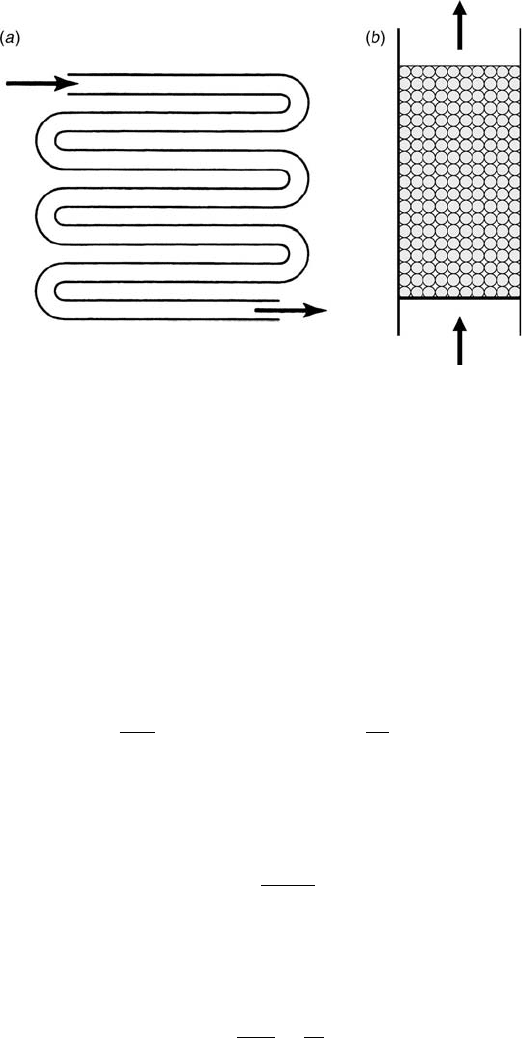
Packed-bed reactors (the packing disperses the fluid laterally across the bed
resulting in a near uniform flow).
7.1 DESIGN EQUATIONS AND AUXILIARY RELATIONS
The design equation of a plug-flow reactor was derived in Chapter 4. The design
equation, written for the mth-independent reaction, is
dZ
m
dt
¼ r
m
þ
X
n
D
k
a
km
r
k
!
t
cr
C
0
(7:1:1)
where Z
m
is the dimensionless extent, defined by Eq. 2.7.2:
Z
m
;
_
X
m
(F
tot
)
0
(7:1:2)
and t is the dimensionless space time (dimensionless volume), defined by
Eq. 4.4.8:
t ;
V
R
v
0
t
cr
¼
t
sp
t
cr
(7:1:3)
where t
cr
is a conveniently selected characteristic reaction time, defined by
Eq. 3.5.1, and C
0
is the concentration of a conveniently selected reference
Figure 7.1 Schematic description of plug-flow reactor: (a) tubular reactor and ( b) packed-
bed reactor.
240 PLUG-FLOW REACTOR

stream, defined by
C
0
;
(F
tot
)
0
v
0
(7:1:4)
where (F
tot
)
0
and v
0
are, respectively, the molar flow rate and the volumetric flow
rate of the reference stream. As discussed in Chapter 4, to describe the operation of
a reactor with multiple reactions, we have to write Eq. 7.1.1 for each independent
chemical reaction. The solutions of the design equations (the relationships between
Z
m
’s and t) provide the reaction operating curves that describe the progress of the
chemical reactions along the volume of the reactor.
To solve the design equations, we have to express the rates of all the chemical
reactions in terms of Z
m
’s and t. Below, we derive the auxiliary relations that
relate the species concentrations to Z
m
’s and t.
The volume-based rate of the ith chemical reaction (from Eq. 3.3.1 and
Eq. 3.3.6) is
r
i
¼ k
i
(T
0
)e
g
i
(u1)=u
h
i
(C
j
’s) (7:1:5)
where k
i
(T
0
) is the reaction rate constant at reference temperature T
0
, g
i
is the
dimensionless activation energy (g
i
¼ Ea
i
/RT
0
), and h
i
(C
j
’s) is a function of the
species concentrations, given by the rate expression.
To express the rates of the chemical reactions in terms of the reaction extents, we
have to relate the species concentrations to Z
m
’s and t. For plug-flow reactors, the
concentration of species j at a given point in the reactor is
C
j
¼
F
j
v
(7:1:6)
where F
j
is the local molar flow rate of species j, and v is the local volumetric flow
rate. Using Eq. 2.7.7,
F
j
¼ (F
tot
)
0
(F
tot
)
in
(F
tot
)
0
y
j
in
þ
X
n
I
m
(s
j
)
m
Z
m
()
(7:1:7)
where (F
tot
)
in
and y
j
in
are, respectively, the total molar flow rate and the molar frac-
tion of species j at the reactor inlet. Substituting Eq. 7.1.7 into Eq. 7.1.6, the local
concentration of species j is
C
j
¼
(F
tot
)
0
v
(F
tot
)
in
(F
tot
)
0
y
j
in
þ
X
n
I
m
(s
j
)
m
Z
m
()
(7:1:8)
7.1 DESIGN EQUATIONS AND AUXILIARY RELATIONS 241

When the inlet stream is selected as the reference stream, as done in most appli-
cations, (F
tot
)
0
¼ (F
tot
)
in
and y
j
in
¼ y
j
0
, and Eq. 7.1.8 reduces to
C
j
¼
(F
tot
)
0
v
y
j
0
þ
X
n
I
m
(s
j
)
m
Z
m
!
(7:1:9)
For most liquid-phase reactions, the density of the reacting fluid is almost con-
stant; hence, v ¼ v
in
, and Eq. 7.1.8 becomes
C
j
¼
(F
tot
)
0
v
in
(F
tot
)
in
(F
tot
)
0
y
j
in
þ
X
n
I
m
(s
j
)
m
Z
m
()
(7:1:10)
When the inlet stream is selected as the reference stream, v
0
¼ v
in
, and Eq. 7.1.10
reduces to
C
j
¼ C
0
y
j
0
þ
X
n
I
m
(s
j
)
m
Z
m
!
(7:1:11)
Equation 7.1.11 is used in most applications with liquid-phase reactions (when the
inlet stream is selected as the reference stream).
For gas-phase reactions, the volumetric flow rate may vary along the reactor due
to changes in molar flow rate, temperature, and pressure. Assuming ideal-gas beha-
vior, the local volumetric flow rate is
v ¼ v
0
F
tot
(F
tot
)
0
T
T
0
P
0
P
(7:1:12)
Using Eq. 2.7.9 to express the total molar flow rate in terms of the extents of the
independent reactions,
F
tot
¼ (F
tot
)
0
(F
tot
)
in
(F
tot
)
0
þ
X
n
I
m
D
m
Z
m
"#
Equation 7.1.12 becomes
v ¼ v
0
(F
tot
)
in
(F
tot
)
0
þ
X
n
I
m
D
m
Z
m
"#
u
P
0
P
(7:1:13)
where u is the dimensionless temperature, T/T
0
. Substituting Eq. 7.1.13 into Eq.
7.1.9, the local concentration is
C
j
¼ C
0
[(F
tot
)
in
=(F
tot
)
0
]y
j
in
þ
P
n
I
m
(s
j
)
m
Z
m
[(F
tot
)
in
=(F
tot
)
0
þ
P
n
I
m
D
m
Z
m
]u
P
P
0
(7:1:14)
242 PLUG-FLOW REACTOR

When the inlet stream is selected as the reference stream, Eq. 7.1.14 reduces to
C
j
¼ C
0
y
j
0
þ
P
n
I
m
(s
j
)
m
Z
m
1 þ
P
n
I
m
D
m
Z
m
u
P
P
0
(7:1:15)
Equation 7.1.15 is used in most plug-flow reactor applications with gas-phase reac-
tions (when the inlet stream is selected as the reference stream).
Since Eqs. 7.1.5 and 7.1.15 contain another dependent variable, u, the dimen-
sionless temperature, we should solve the energy balance equation simultaneously
with the design equations. For plug-flow reactors with negligible viscous work, the
energy balance equation (derived in Section 5.2) is
du
dt
¼
1
CF(Z
m
, u)
HTN(u
F
u)
X
n
I
m
DHR
m
dZ
m
dt
"#
(7:1:16)
where HTN is the dimensionless local heat-transfer number, defined by Eq. 5.2.22,
HTN ;
Ut
cr
C
0
^
c
p
0
S
V
(7:1:17)
DHR
m
is the dimensionless heat of reaction of the mth-independent chemical reac-
tion, defined by Eq. 5.2.23,
DHR
m
;
DH
R
m
(T
0
)
^
c
p
0
T
0
(7:1:18)
and CF(Z
m
, u) is the correction factor of the heat capacity of the reacting fluid,
determined by Eq. 5.2.54. The first term inside the bracket of Eq. 7.1.16 is the
dimensionless local heat-transfer rate:
d
dt
_
Q
(F
tot
)
0
^
c
p
0
T
0
¼ HTN(u
F
u)(7:1:19)
The second term inside the bracket of Eq. 7.1.16 represents the heat generated (or
consumed) by the chemical reactions.
The specific molar specific heat capacity of the reference state,
^
c
p
0
, is defined
differently for gas-phase and liquid-phase reactions. For gas-phase reactions, it is
defined by Eq. 5.2.58,
^
c
p
0
;
X
J
j
y
j
0
^
c
p
j
(T
0
)(7:1:20)
and for liquid-phase reactions, it is defined by Eq. 5.2.60,
^
c
p
0
;
_
m
c
p
(F
tot
)
0
(7:1:21)
7.1 DESIGN EQUATIONS AND AUXILIARY RELATIONS 243

To solve Eq. 7.1.16, we have to specify the value of HTN. However, its value
depends on the heat-transfer coefficient, U, which depends on the flow conditions
in the reactor, the properties of the fluid, and the heat-transfer area per unit volume,
(S/V). These parameters are not known a priori. Therefore, we develop a procedure
to estimate the range of HTN. For isothermal operation (du/dt ¼ 0), we can deter-
mine the local HTN from Eq. 7.1.16 (taking the reactor temperature as the reference
temperature, u ¼ 1):
HTN
iso
(t) ¼
1
u
F
1
X
n
I
m
DHR
m
dZ
m
dt
(7:1:22)
Since dZ
m
/dt varies along the reactor, the value of HTN also varies from point to
point. We define an average HTN for isothermal operation by
HTN
ave
;
1
t
tot
ð
t
tot
0
HTN(t) dt (7:1:23)
where t
tot
is the total dimensionless space time of the reactor. Recall that for
adiabatic operation HTN ¼ 0. In practice in most cases, the heat-transfer number
would be
0 , HTN HTN
ave
(7:1:24)
Equation 7.1.24 provides only an estimate on the range of the value of HTN. We
select a specific value after examining the reactor performance with different values
of HTN. When multiple reactions take place, it is important to examine the reactor
performance for different values of HTN, since it is difficult to predict the effect of
the heat transfer on the relative rates of the individual reactions. Once the physical
reactor has been designed, it is necessary to verify that the flow conditions in the
reactor actually provide the specified value of HTN.
For convenience, Tables A.3a and A.3b in Appendix A provide the design
equations and auxiliary relations used in the design of plug-flow reactors.
Table A.4 provides the energy balance equation.
In the remainder of the chapter, we discuss how to apply the design equations
and the energy balance equation to determine various quantities related to the oper-
ations of plug-flow reactors. In Section 7.2, we examine isothermal operations with
single reactions to illustrate how the rate expressions are incorporated into the
design equation and how rate expressions are determined. In Section 7.3, we
expand the analysis to isothermal operations with multiple chemical reactions. In
Section 7.4, we consider nonisothermal operations with multiple reactions. In all
these cases, we assume that the pressure drop along the reactor is negligible. In
Section 7.5, we consider the effect of pressure drop on the operations of plug-
flow reactors with gas-phase reactions.
244 PLUG-FLOW REACTOR

7.2 ISOTHERMAL OPERATIONS WITH SINGLE REACTIONS
We start the analysis of plug-flow reactors by considering isothermal operations
with single reactions. For isothermal operations, du/dt ¼ 0, and we have to
solve only the design equations. The energy balance equation provides the heating
(or cooling) load necessary to maintain isothermal conditions. Furthermore, for iso-
thermal operations, the reaction rate depends only on the species concentrations,
and Eq. 7.1.5 reduces to
r ¼ k(T
0
)h(C
j
’s) (7:2:1)
When a single chemical reaction takes place in the reactor, the operation is
described by one design equation, and Eq. 7.1.1 reduces to
dZ
dt
¼ r
t
cr
C
0
(7:2:2)
where Z is the dimensionless extent of the reaction and r is its rate. The solution of
the design equation [Z(t) versus t] provides the reaction operating curve that
describes the progress of the chemical reaction along the reactor. Once Z(t)is
known, we can apply Eq. 7.1.7 to obtain the species operating curves, indicating
the species molar flow rates at any point along the reactor. Also, if one prefers to
express the design equation in terms of the reactor volume, rather than the dimen-
sionless space time t, using Eq. 7.1.3, the design equation becomes
dZ
dV
R
¼
r
(F
tot
)
0
(7:2:3)
We have to solve Eq. 7.2.2 subject to the initial condition that at t ¼ 0, Z(0) is
specified (Z at the inlet of the reactor). In some cases, the design equation can be
solved by separating the variables and integrating
t ¼
C
0
t
cr
ð
Z
out
Z
in
dZ
r
(7:2:4)
where Z
in
and Z
out
are, respectively, the extent at the reactor inlet and outlet.
Equation 7.2.4 is the integral form of the design equation of plug-flow reactors
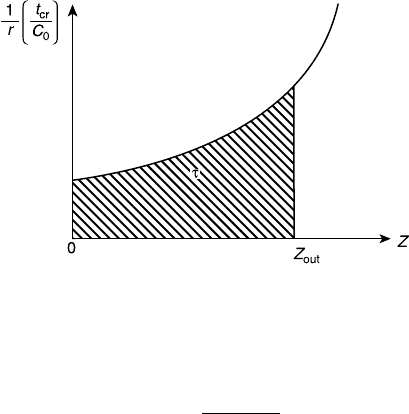
with a single chemical reaction. Figure 7.2 shows graphically the relationship
among Z
in
, Z
out
, and t.
To solve Eq. 7.2.2 or 7.2.4, we have to express the reaction rate r in terms of the
dimensionless extent Z. To do so, we express the species concentrations in terms of
Z. Selecting the inlet stream as the reference stream, Z
in
¼ 0, and for liquid-phase
reactions, Eq. 7.1.11 reduces to
C
j
¼ C
0
( y
j
0
þ s
j
Z)(7:2:5)
7.2 ISOTHERMAL OPERATIONS WITH SINGLE REACTIONS 245
For gaseous reactions, assuming negligible pressure drop, Eq. 7.1.15 reduces to
C
j
¼ C
0
y
j
0
þ s
j
Z
1 þ D Z
(7:2:6)
Note that for given inlet conditions, Eqs. 7.2.2 and 7.2.4 have three variables: the
dimensionless space time (or dimensionless reactor volume), t, the reaction extent
at the reactor outlet, Z
out
, and the reaction rate, r. We apply the design equation to
determine any one of these three variables when the other two are provided. In a
typical design problem, we have to determine the reactor volume needed to
obtain a specified extent (or conversion) for a given feed rate and given reaction
rate. A second application of the design equation is to determine the extent (or con-
version) at the reactor outlet for a given reactor volume and given reaction rate. The
third application is to determine the reaction rate when the extent (or conversion) at
the reactor outlet is provided for different feed rates.
Below, we analyze the operation of isothermal plug-flow reactors with single
reactions for different types of chemical reactions. For convenience, we divide
the analysis into two sections: (i) design and (ii) determination of the rate
expression. In the former, we determine the size of the reactor for a known reaction
rate, specified feed rate, and specified extent (or conversion). In the second section,
we determine the rate expression and its parameters from reactor operating data.
7.2.1 Design
First, consider the application of the design equation when the reaction rate is pro-
vided in the form of an algebraic expression. We start with a first-order, gaseous,
chemical reaction of the general form
A ! Products
whose rate expression is r ¼ kC
A
. For this reaction, s
A
¼ 21, and D is determined
by the stoichiometry. We select the inlet stream as the reference stream; hence,
Figure 7.2 Graphical presentation of the PFR design equation for a single reaction.
246 PLUG-FLOW REACTOR
y
A
0
, y
B
0
, y
C
0
, and so on are specified. For a gas-phase reaction, the species concen-
tration is given by Eq. 7.2.6, and the reaction rate expression is
r ¼ kC
0
y
A
0
Z
1 þ D Z
(7:2:7)
Substituting Eq. 7.2.7 into Eq. 7.2.2, the design equation becomes
dZ
dt
¼ kC
0
y
A
0
Z
1 þ D Z
t
cr
C
0
(7:2:8)
Using Eq. 3.5.4, for first-order reaction,
t
cr
¼
1
k
(Note this characteristic reaction time is the same as the one obtained by the pro-
cedure described in Section 3.5.) When only reactant A is fed ( y
A
0
¼ 1), the
design equation reduces to
dZ
dt
¼
1 Z
1 þ D Z
(7:2:9)
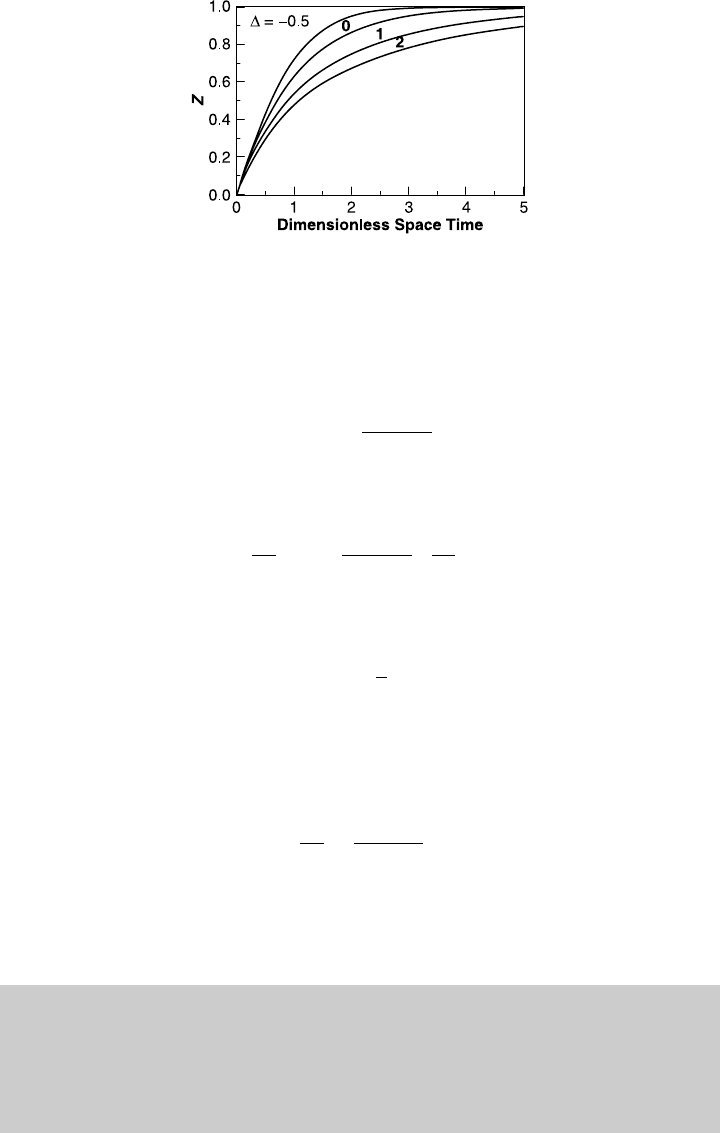
We solve this equation, subject to the initial condition that at t ¼ 0, Z ¼ 0. The
solution of this design equation for different values of D is shown in Figure 7.3.
Example 7.1 The first-order, gas-phase, decomposition reaction
A ! B þC
is carried out in an isothermal, plug-flow reactor. A stream of reactant A is fed to
the reactor at a rate of 10 mol/min. At the feed conditions, the concentration of A
Figure 7.3 Reaction operating curves for a single first-order reaction of the form A !
Products.
7.2 ISOTHERMAL OPERATIONS WITH SINGLE REACTIONS 247

is C
A
in
¼ 0:04 mol=L. At the reactor operating temperature, the reaction rate con-
stant is k ¼ 0.1 s
21
.
a. Derive and plot the reaction and species curves.
b. Determine the volume of the reactor needed to achieve 80% conversion.
c. Determine the volume of the reactor needed to achieve 80% conversion if, by
mistake, we take D ¼ 0.
d. Determine the conversion if the volume calculated in (c) is used.
e. Determine the feed flow rate to achieve 80% conversion in a reactor with the
volume calculated in (c).
Solution The stoichiometric coefficients of the chemical reaction are
s
A
¼1 s
B
¼ 1 s
C
¼ 1 D ¼ 1
We select the inlet stream as the reference stream, and since only reactant A is
fed to the reactor, y
A
0
¼ 1, y
B
0
¼ y
C
0
¼ 0, C
0
¼ C
A
in
¼ 0:04 mol=L, and
10 mol=min 10 mol=min. The volumetric flow rate of the reference stream is
v
0
¼
(F
tot
)
0
C
0
¼ 250 L=min
a. For a plug-flow reactor with a single chemical reaction, the design equation is
dZ
dt
¼ r
t
cr
C
0
(a)
For gas-phase reactions, C
A
is expressed by Eq. 7.2.6, and the reaction rate is
r ¼ kC
0
1 Z
1 þ Z
(b)
Substituting (b) into (a), the design equation becomes
dZ
dt
¼ kC
0
1 Z
1 þ Z
t
cr
C
0
(c)
Selecting the characteristic reaction time to be
t
cr
¼
1
k
¼ 10 s ¼ 0:167 min (d)
and substituting (d) into (c), the design equation reduces to
dZ
dt
¼
1 Z
1 þ Z
(e)
We solve (e) numerically, subject to the initial condition that at t ¼ 0, Z ¼ 0.
248 PLUG-FLOW REACTOR
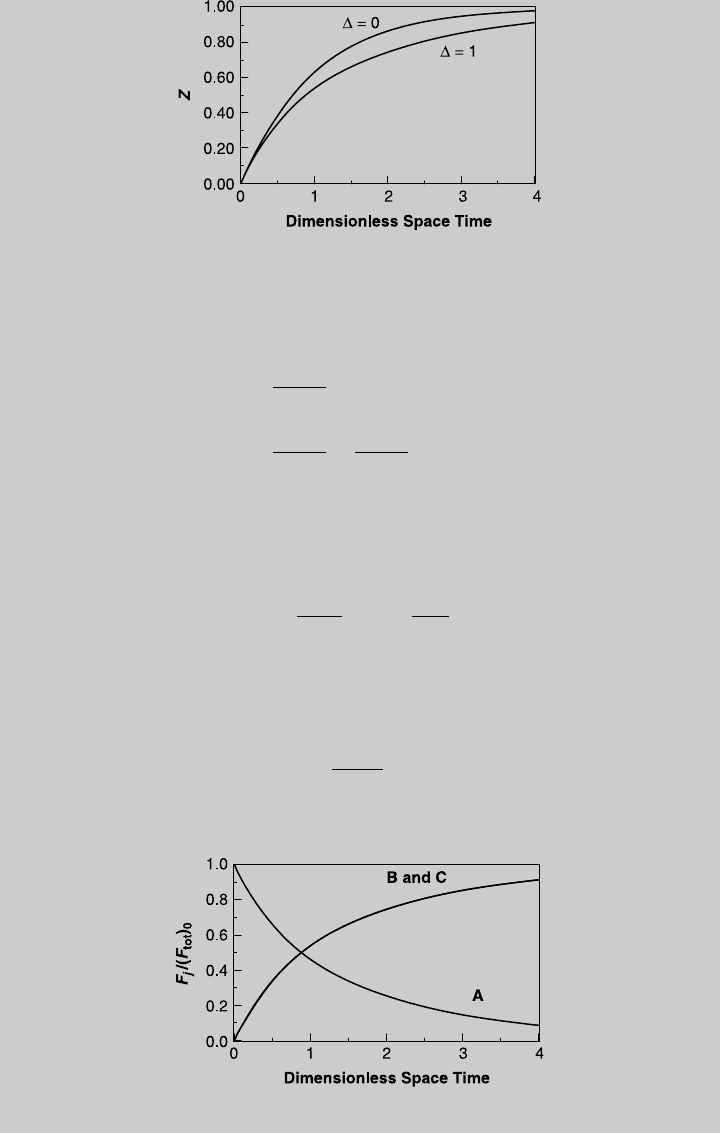
Figure E7.1.1 shows the reaction curve. Using Eq. 7.1.7, the species curves are
F
A
(t)
(F
tot
)
0
¼ 1 Z(t)
F
B
(t)
(F
tot
)
0
¼
F
C
(t)
(F
tot
)
0
¼ Z(t)
Figure E7.1.2 shows the species curves.
b. Using Eq. 2.6.5, the relation between the conversion and extent for a single
reaction,
Z ¼
y
A
(0)
s
A
f
A
¼
1
(1)
f
A
¼ f
A
For Z
out
¼ 0.8, from the reaction curve, t ¼ 2.42. Note in this case we can
determine t by separating the variables and integrating (e),
t ¼
ð
0:8
0
1 þ Z
1 Z
dZ ¼ 2:42
Figure E7.1.1 Reaction operating curves.
Figure E7.1.2 Species operating curves.
7.2 ISOTHERMAL OPERATIONS WITH SINGLE REACTIONS 249