
Mann U. Principles of Chemical Reactor Analysis and Design: New Tools for Industrial Chemical Reactor Operations
Подождите немного. Документ загружается.


Substituting (f) through (i) and (e) into (b), (c), and (d), the design equations
become
dZ
1
dt
¼
(0:5 4Z
1
4Z
2
)(0:5 5Z
1
3Z
2
Z
3
)
2
(1 þ Z
1
þ Z
2
Z
3
)
3
1:5
k
4
k
1
C
4=3
0
!
(0:5 4Z
1
4Z
2
)
2=3
(4Z
1
2Z
3
)
(1 þ Z
1
þ Z
2
Z
3
)
5=3
(j)
dZ
2
dt
¼
k
2
k
1
C
0
(0:5 4Z
1
4Z
2
)(0:5 5Z
1
3Z
2
Z
3
)
(1 þ Z
1
þ Z
2
Z
3
)
2
þ 2:5
k
4
k
1
C
4=3
0
!
(0:5 4Z
1
4Z
2
)
2=3
(4Z
1
2Z
3
)
(1 þ Z
1
þ Z
2
Z
3
)
5=3
(k)
dZ
3
dt
¼
k
3
k
1
(0:5 5Z
1
3Z
2
Z
3
)(4Z
1
2Z
3
)
2
(1 þ Z
1
þ Z
2
Z
3
)
3
(l)
For the given data, the parameters of the dimensionless design equations are
k
2
k
1
C
0
¼ 0:05
k
3
k
1
¼ 2
k
4
k
1
C
0
4=3
¼ 0:1
We substitute these values into ( j), (k), and (l), and solve them numerically
for Z
1
, Z
2
, and Z
3
, subject to the initial conditions that at t ¼ 0,
Z
1
¼ Z
2
¼ Z
3
¼ 0. Figure E7.9.1 shows the reaction curves. Now that we
have the reaction curves, we use Eq. 2.7.8 to obtain the species curves:
F
NH
3
(F
tot
)
0
¼ 0:5 4Z
1
4Z
2
(m)
F
O
2
(F
tot
)
0
¼ 0:5 5Z
1
3Z
2
Z
3
(n)
Figure E7.9.1 Reaction operating curves.
280 PLUG-FLOW REACTOR

F
NO
(F
tot
)
0
¼ 4Z
1
2Z
3
(o)
F
H
2
O
(F
tot
)
0
¼ 6Z
1
þ 6Z
2
(p)
F
N
2
(F
tot
)
0
¼ 2Z
2
(q)
F
NO
2
(F
tot
)
0
¼ 2Z
3
(r)
Figure E7.9.2 shows the reaction curves.
b. From the NO curve (or the table of calculated data), the maximum production
is F
NO
/(F
tot
)
0
¼ 0.1373, and it is achieved at t ¼ 1.36. Using Eq. 7.1.3 and
(e), the required reactor volume is
V
R
¼ tv
0
t
cr
¼ 10,200 L
At t ¼ 1.36, Z
1
¼ 0.0388, Z
2
¼ 0.0232, and Z
3
¼ 0.0089. Substituting these
values into (m) through (r), the species molar flow rates in the reactor
outlet are
F
NH
3
out
¼ 2:42 F
O
2
out
¼ 2:19 F
NO
out
¼ 1:32 F
H
2
O
out
¼ 3:57
F
N
2
out
¼ 0:445 F
NO
2
out
¼ 0:171 mol=min
7.4 NONISOTHERMAL OPERATIONS
The design formulation of nonisothermal plug-flow reactors with multiple reactions
follows the same procedure outlined in the previous section—we write design
Figure E7.9.2 Species operating curves.
7.4 NONISOTHERMAL OPERATIONS 281
equation Eq. 7.1.1 for each independent reaction. Since the temperature varies
along the reactor, we should solve the design equations simultaneously with the
energy balance equation, Eq. 7.1.16.
The energy balance equation contains another variable—the temperature of the
heating (or cooling) fluid, u
F
, which may also vary along the reactor. (Note that u
F
is constant only when the fluid either evaporates or condenses.) We distinguish
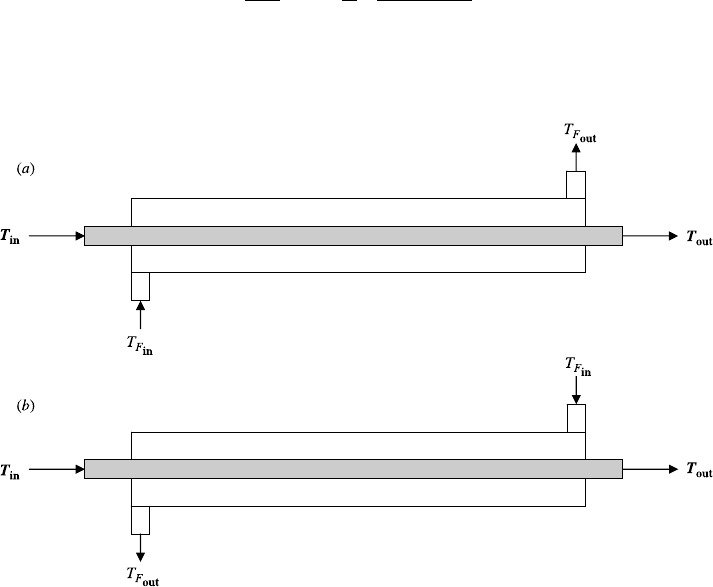
between two configurations: co-current flow, shown in Figure 7.5a, and countercur-
rent flow, shown in Figure 7.5b.
To derive an equation for u
F
, we write the energy balance equation over the heat-
ing fluid in the shell element. For co-current flow,
d
_
Q ¼ U(T
F
T) dS ¼
_
m
F
c
p
F
dT
F
(7:4:1)
where
_
m
F
and
c
p
F
are, respectively, the mass flow rate and the heat capacity of the
heating fluid. Using Eq. 5.2.51, dS ¼ (S/V ) dV
R
, and Eq. 7.4.1 reduces to
dT
F
dV
R
¼
S
V
U(T
F
T)
_
m
F
c
p
F
(7:4:2)
Figure 7.5 Configuration of heating of PFR; (a) co-current, (b) countercurrent.
282 PLUG-FLOW REACTOR

To convert Eq. 7.4.2 to dimensionless form, we use the definition of the dimension-
less space time, Eq. 7.1.3, and divide both sides by the reference thermal energy,
du
F
dt
¼HTN
(F
tot
)
0
^
c
p
0
_
m
F
c
p
F
(u
F
u)(7:4:3)
where HTN is the heat-transfer number, defined by Eq. 7.1.17. For countercurrent
flow, the energy balance over the heating fluid is
d
_
Q ¼ U(T
F
T) dS ¼
_
m
m
^
c
p
F
dT
F
(7:4:4)
Following a similar procedure to the one we used for co-current flow, Eq. 7.4.4
reduces to
du
F
dt
¼ HTN
(F
tot
)
0
^
c
p
0
_
m
m
c
p
F
(u
F
u)(7:4:5)
Hence, when designing a plug-flow reactor with a heating/cooling fluid whose
temperature varies, we have to solve either Eq. 7.4.3 or 7.4.5 simultaneously
with the design equations and the energy balance equation of the reactor.
We adopt the following procedure for setting up the energy balance equation:
1. Select and define the temperature of the reference stream, T
0
.
2. Determine the specific molar heat capacity of the reference stream,
^
c
p
0
.
3. Determine the dimensionless activation energies, g
i
’s, of all chemical
reactions.
4. Determine the dimensionless heat of reactions, DHR
m
’s, of the independent
reactions.
5. Determine the correction factor of the heat capacity of the reacting fluid,
CF(Z
m
, u).
6. Specify the dimensionless heat-transfer number, HTN (using Eq. 7.1.24).
7. Determine (or specify) the inlet temperature, u
in
.
8. Determine (or specify) the inlet dimensionless temperature of the heating/
cooling fluid.
9. Solve the design equations simultaneously with the energy balance equation,
and, if necessary, the energy balance equation of the heating/cooling fluid to
obtain Z
m
’s, u, and u
F
as functions of the dimensionless space time, t.
The design formulation of nonisothermal plug-flow reactors consists of n
Iþ2
nonlinear first-order differential equations. Note that usually the inlet temperature
of the heating/cooling fluid, T
F
in
, is known. Hence, the case of co-current
7.4 NONISOTHERMAL OPERATIONS 283

configuration can be readily solved, but the countercurrent configuration is solved
iteratively by trial and error. In the latter, we guess the value of T
F
out
as an initial
value and solve the formulation equations. We then check if the value of T
F
in
at
the end of the reactor is in agreement with the given value of T
F
in
. If not, we
guess another value of T
F
out
and repeat the calculation.
Example 7.10 The first-order, gas-phase reaction
A ! B þC
takes place in a tubular (plug-flow) reactor. The reactor is made of a 20-cm tube,
and it operates at 2 atm. A stream consisting of 80% reactant A and 20% inert I
(by mole) is fed into the reactor at 450 K at the rate of 30 L/min.
a. Determine the needed reactor length for isothermal operation at 450 K.
b. Determine the overall heating (or cooling) load in (a).
c. Determine the local and estimate the average isothermal HTN.
d. Determine the needed reactor length for adiabatic operation.
e. Examine the effect of HTN on the temperature profile along the reactor and
the production of product B.
Data: At 450 K,
k(T
0
) ¼ 15:0hr
1
DH
R
(T
0
) ¼ 8000 cal=mol extent E
a
=R ¼ 2000 K
^
c
p
A
¼ 20 cal=mol K
^
c
p
B
¼ 15 cal=mol K
^
c
p
C
¼ 12 cal=mol K
^
c
p
I
¼ 10 cal=mol K
The temperature of the reactor wall is maintained at 470 K.
Solution The stoichiometric coefficients are
s
A
¼1 s
B
¼ 1 s
C
¼ 1 s
I
¼ 0 D ¼ 1
Using Eq. 7.1.1, the design equation is
dZ
dt
¼ r
t
cr
C
0
(a)
We select the inlet stream as the reference stream, Z
in
¼ 0, and T
0
¼ 450 K.
C
0
¼
P
RT
0
¼
2
(0:08206)(450)
¼ 0:0542 mol=L
(F
tot
)
0
¼ v
0
C
0
¼ 1:626 mol=min
(b)
284 PLUG-FLOW REACTOR

For the given feed composition, y
A
0
¼ 0:80, y
I
0
¼ 0:20, and y
B
0
¼ y
C
0
¼ 0. We
use Eq. 7.1.15 to express the species concentrations, and the reaction rate is
r ¼ k(T
0
)e
g(u1)=u
C
0
0:8 Z
(1 þ Z)u
(c)
Using Eq. 3.3.5, the dimensionless activation energy is
g ¼
E
a
RT
0
¼ 4:44
We define a characteristic reaction time,
t
cr
¼
1
k(T
0
)
¼ 4 min (d)
Substituting (c) and (d) into (a), the design equation reduces to
dZ
dt
¼
0:8 Z
(1 þ Z)u
e
g(u1)=u
(e)
Using Eq. 7.1.16, the energy balance equation becomes
du
dt
¼
1
CF(Z
m
, u)
HTN(u
F
u) DHR
dZ
dt
(f)
We have to solve (e) and (f) simultaneously. Using Eq. 7.1.20, the specific molar
heat capacity of the reference stream is
^
c
p
0
¼
X
J
j
y
j
0
^
c
p
j
(T
0
) ¼ y
A
0
^
c
p
A
(T
0
) þ y
I
0
^
c
p
I
(T
0
) ¼ 18 cal=mol K (g)
Using Eq. 7.1.18, the dimensionless heat of reaction is
DHR ¼
DH
R
(T
0
)
T
0
^
c
p
0
¼ 0:9877 (h)
Using Eq. 5.2.61, the correction factor of the heat capacity of the reacting fluid is
CF(Z
m
, u) ¼ 1 þ
1
^
c
p
0
[
^
c
p
A
(u)(Z) þ
^
c
p
B
(u)Z þ
^
c
p
C
(u)Z] ¼
18 þ 7Z
18
(i)
7.4 NONISOTHERMAL OPERATIONS 285

Once we solve the design equation, we use Eq. 2.7.8 to determine the species
operating curves:
F
A
(F
tot
)
0
¼ 0:8 Z (j)
F
B
(F
tot
)
0
¼ Z (k)
F
C
(F
tot
)
0
¼ Z (m)
a. For isothermal operation, u ¼ 1, and (e) reduces to
dZ
dt
¼
0:8 Z
1 þ Z
(n)
We solve (n) analytically. Using Eq. 2.6.5, for 60% conversion, the extent is
Z ¼
y
A
0
s
A
f
A
¼ 0:48
From the solution, Z ¼ 0.48 is reached at t ¼ 1.17. Using (d) and Eq. 7.1.3,
the required reactor volume is
V
R
¼ v
0
tt
cr
¼ 140:4 L (o)
The length of the reactor is 4.46 m.
b. For isothermal operation, du/dt ¼ 0. Combining Eqs. 7.1.16 and 7.1.19, the
local dimensionless heat-transfer rate along the reactor is
d
dt
_
Q
T
0
(F
tot
)
0
^
c
p
0
¼
DH
R
(T
0
)
T
0
^
c
p
0
dZ
dt
(p)
Integrating (p), the total heating load is
_
Q ¼ (F
tot
)
0
DH
R
(T
0
)Z
out
¼ 6:24 kcal=min
c. Using 7.1.22, the local isothermal HTN is
HTN
iso
(t) ¼
1
u
F
1
DHR
dZ
dt
(q)
286 PLUG-FLOW REACTOR
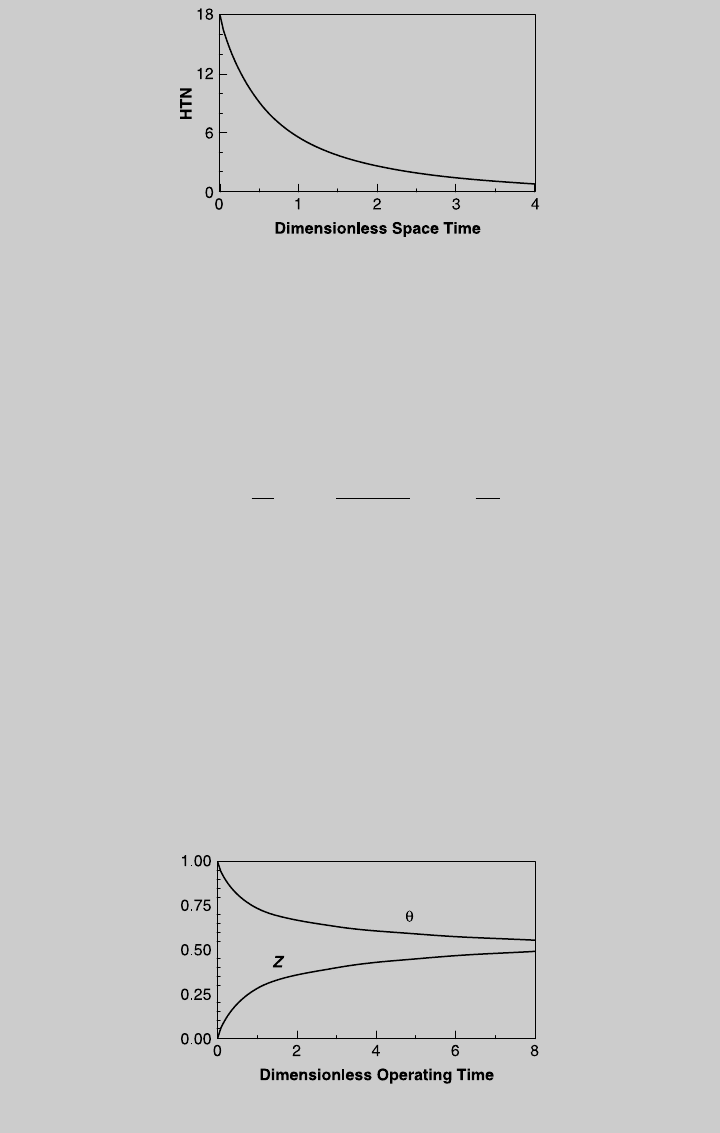
where u
F
¼ 470/450 ¼ 1.044, and dZ/dt is given by (n). Figure E7.10.1
shows the local isothermal HTN. Using Eq. 7.1.23, the average isothermal
HTN for 0 t 1.17 is 8.78.
d. For adiabatic operation, HTN ¼ 0, and using (i), the energy balance equation,
(f), reduces to
du
dt
¼
18
18 þ 7Z
DHR
dZ
dt
(r)
We solve (e) and (r) simultaneously, subject to the initial conditions that at
t ¼ 0, Z ¼ 0 and u ¼ 1. Figure E7.10.2 shows the reaction curve and the
temperature curve, and Figure E7.10.3 shows the species curves determined
by ( j) through (m). From the calculated data, an extent of Z ¼ 0.48 is reached
at t ¼ 6.96, and, at that space time, u ¼ 0.565. Using (g) and Eq. 7.1.3, the
required reactor volume is
V
R
¼ v
0
tt
cr
¼ 835 L
The length of the reactor is 26.5 m. The exit temperature is
T ¼ T
0
u ¼ 295 K
Figure E7.10.1 The local isothermal HTN.
Figure E7.10.2 Reaction and temperature curves—adiabatic operation.
7.4 NONISOTHERMAL OPERATIONS 287
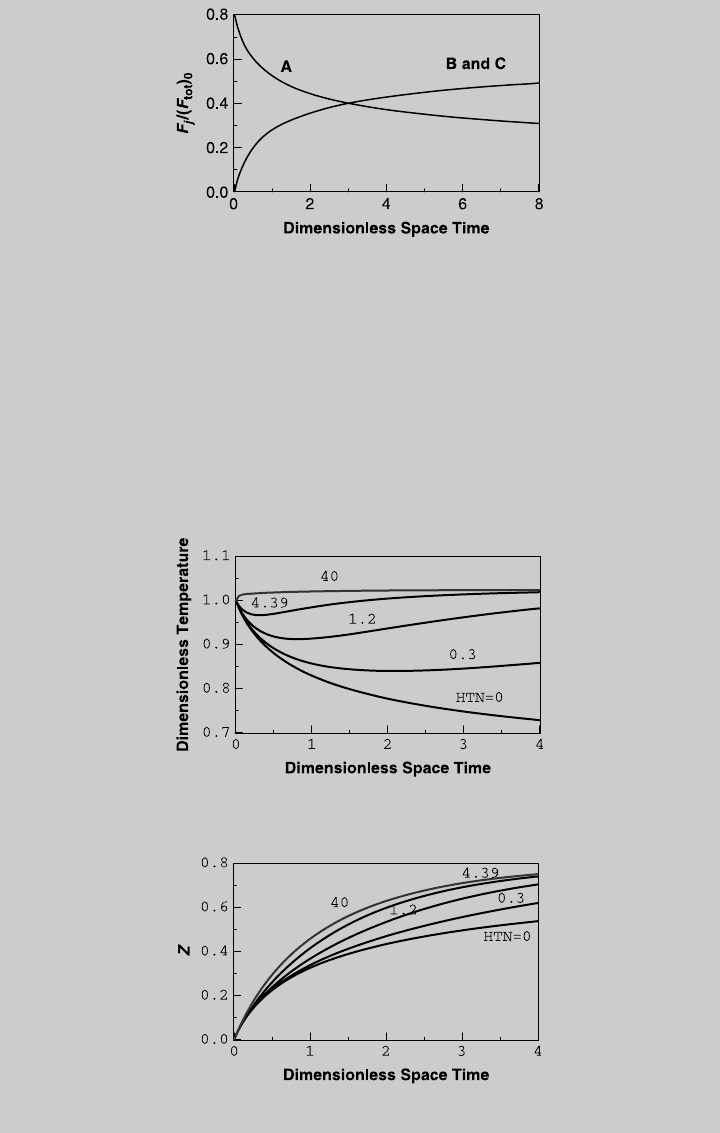
e. To examine the effect of HTN on the reactor operation, we solve (e) and (f)
for different values of HTN. Figure E7.10.4 shows the effect on the reactor
temperature, Figure E7.10.5 shows the effect of HTN on the reaction
extent (and from (k), on the production rate of product B). Note that when
HTN !1, the temperature of the reactor is the same as the wall temperature
(470 K, u ¼ 1.025).
Figure E7.10.3 Species curves—adiabatic operation.
Figure E7.10.4 Effect of HTN on the temperature profile along the reactor.
Figure E7.10.5 Effect of HTN on the reaction extent.
288 PLUG-FLOW REACTOR

Example 7.11 The gas-phase elementary chemical reactions
Reaction 1: A þ B ! V
Reaction 2: V þ B ! W
take place in a tubular reactor (plug flow). A gas mixture of 40% A, 40% B, and
20% I (inert) is fed to the reactor at a rate of 400 L/min. The inlet temperature is
1508C, and the reactor operates at a constant pressure of 2 atm. It is desirable to
maximize the production of product V. The temperature of the cooling fluid is
1308C.
a. Determine the reactor volume for maximum production of product V for iso-
thermal operation.
b. Determine the heating/cooling load for isothermal operation.
c. Determine the local and average HTN for isothermal operation.
d. Determine the reactor volume for maximum production of product V for
adiabatic operation.
e. Examine the effect of HTN on the temperature profile along the reactor, the
two reactions, and the production of product V.
Data: At 1508C, k
1
¼ 0:2L=mol s
1
k
2
¼ 0:2L=mol s
1
DH
R
1
¼12,000 cal=mol extent DH
R
2
¼9000 cal=mol extent
E
a
1
¼ 4950 cal=mol E
a
2
¼ 7682 cal=mol
^
c
p
A
¼ 16 cal=mol K
^
c
p
B
¼ 8 cal=mol K
^
c
p
V
¼ 20 cal=mol K
^
c
p
W
¼ 26 cal=mol K
^
c
p
I
¼ 10 cal=mol K
Solution The purpose of this example is to illustrate the effect of heat transfer
on the production rate and product distribution. The two chemical reactions are
independent, and there is no dependent reaction. The stoichiometric coefficients
of the reactions are
s
A
1
¼1 s
B
1
¼1 s
C
1
¼ 1 s
D
1
¼ 0 D ¼1
s
A
2
¼ 0 s
B
2
¼1 s
C
2
¼1 s
D
2
¼ 1 D ¼1
We write Eq. 7.1.1 for each reaction:
dZ
1
dt
¼ r
1
t
cr
C
0
(a)
dZ
2
dt
¼ r
2
t
cr
C
0
(b)
7.4 NONISOTHERMAL OPERATIONS 289