
Masters G.M. Renewable and Efficient Electric Power Systems
Подождите немного. Документ загружается.

xviii PREFACE
power, and increased attention being paid to the environmental impacts of power
production are all leading to the need for new books, new courses, and a new
generation of engineers who will find satisfying, productive careers in this newly
transformed industry.
This book has been written primarily as a textbook for new courses on renew-
able and efficient electric power systems. It has been designed to encourage
self-teaching by providing numerous completely worked examples throughout.
Virtually every topic that lends itself to quantitative analysis is illustrated with
such examples. Each chapter ends with a set of problems that provide added
practice for the student and that should facilitate the preparation of homework
assignments by the instructor.
While the book has been written with upper division engineering students in
mind, it could easily be moved up or down in the curriculum as necessary. Since
courses covering this subject are initially likely to have to stand more or less
on their own, the book has been written to be quite self-sufficient. That is, it
includes some historical, regulatory, and utility industry context as well as most
of the electricity, thermodynamics, and engineering economy background needed
to understand these new power technologies.
Engineering students want to use their quantitative skills, and they want to
design things. This text goes well beyond just introducing how energy tech-
nologies work; it also provides enough technical background to be able to do
first-order calculations on how well such systems will actually perform. That is,
for example, given certain windspeed characteristics, how can we estimate the
energy delivered from a wind turbine? How can we predict solar insolation and
from that estimate the size of a photovoltaic system needed to deliver the energy
needed by a water pump, a house, or an isolated communication relay station?
How would we size a fuel cell to provide both electricity and heat for a building,
and at what rate would hydrogen have to be supplied to be able to do so? How
would we evaluate whether investments in these systems are rational economic
decisions? That is, the book is quantitative and applications oriented with an
emphasis on resource estimation, system sizing, and economic evaluation.
Since some students may not have had any electrical engineering background,
the first chapter introduces the basic concepts of electricity and magnetism needed
to understand electric circuits. And, since most students, including many who
have had a good first course in electrical engineering, have not been exposed to
anything related to electric power, a practical orientation to such topics as power
factor, transmission lines, three-phase power, power supplies, and power quality
is given in the second chapter.
Chapter 3 gives an overview of the development of today’s electric power
industry, including the regulatory and historical evolution of the industry as well
as the technical side of power generation. Included is enough thermodynamics to
understand basic heat engines and how that all relates to modern steam-cycle, gas-
turbine, combined-cycle, and cogeneration power plants. A first-cut at evaluating
the most cost-effective combination of these various types of power plants in an
electric utility system is also presented.
PREFACE xix
The transition from large, central power stations to smaller distributed gen-
eration systems is described in Chapter 4. The chapter emphasizes combined
heat and power systems and introduces an array of small, efficient technolo-
gies, including reciprocating internal combustion engines, microturbines, Stirling
engines, concentrating solar power dish and trough systems, micro-hydropower,
and biomass systems for electricity generation. Special attention is given to under-
standing the physics of fuel cells and their potential to become major power
conversion systems for the future.
The concept of distributed resources, on both sides of the electric meter, is
introduced in Chapter 5 with a special emphasis on techniques for evaluating
the economic attributes of the technologies that can most efficiently utilize these
resources. Energy conservation supply curves on the demand side, along with the
economics of cogeneration on the supply side, are presented. Careful attention
is given to assessing the economic and environmental benefits of utilizing waste
heat and the technologies for converting it to useful energy services such as air
conditioning.
Chapter 6 is entirely on wind power. Wind turbines have become the most
cost-effective renewable energy systems available today and are now completely
competitive with essentially all conventional generation systems. The chapter
develops techniques for evaluating the power available in the wind and how
efficiently it can be captured and converted to electricity in modern wind tur-
bines. Combining wind statistics with turbine characteristics makes it possible to
estimate the energy and economics of systems ranging from a single, home-size
wind turbine to large wind farms of the sort that are being rapidly built across
the United States, Europe, and Asia.
Given the importance of the sun as a source of renewable energy, Chapter 7
develops a rather complete set of equations that can be used to estimate the solar
resource available on a clear day at any location and time on earth. Data for actual
solar energy at sites across the United States are also presented, and techniques
for utilizing that data for preliminary solar systems design are presented.
Chapters 8 and 9 provide a large block of material on the conversion of solar
energy into electricity using photovoltaics (PVs). Chapter 8 describes the basic
physics of PVs and develops equivalent circuit models that are useful for under-
standing their electrical behavior. Chapter 9 is a very heavily design-oriented
approach to PV systems, with an emphasis on grid-connected, rooftop designs,
off-grid stand-alone systems, and PV water-pumping systems.
I think it is reasonable to say this book has been in the making for over
three and one-half decades, beginning with the impact that Denis Hayes and
Earth Day 1970 had in shifting my career from semiconductors and computer
logic to environmental engineering. Then it was Amory Lovins’ groundbreaking
paper “The Soft Energy Path: The Road Not Taken?” (Foreign Affairs, 1976)
that focused my attention on the relationship between energy and environment
and the important roles that renewables and efficiency must play in meeting the
coming challenges. The penetrating analyses of Art Rosenfeld at the University
of California, Berkeley, and the astute political perspectives of Ralph Cavanagh
xx PREFACE
at the Natural Resources Defense Council have been constant sources of guidance
and inspiration. These and other trailblazers have illuminated the path, but it has
been the challenging, committed, enthusiastic students in my Stanford classes
who have kept me invigorated, excited and energized over the years, and I am
deeply indebted to them for their stimulation and friendship.
I specifically want to thank Joel Swisher at the Rocky Mountain Institute for
help with the material on distributed generation, Jon Koomey at Lawrence Berke-
ley National Laboratory for reviewing the sections on combined heat and power
and Eric Youngren of Rainshadow Solar for his demonstrations of microhydro
power and photovoltaic systems in the field. I especially want to thank Bryan
Palmintier for his careful reading of the manuscript and the many suggestions he
made to improve its readability and accuracy. Finally, I raise my glass, as we do
each evening, to my wife, Mary, who helps the sun rise every day of my life.
G
ILBERT M. MASTERS
Orcas, Washington
April 2004

CHAPTER 1
BASIC ELECTRIC
AND MAGNETIC CIRCUITS
1.1 INTRODUCTION TO ELECTRIC CIRCUITS
In elementary physics classes you undoubtedly have been introduced to the fun-
damental concepts of electricity and how real components can be put together
to form an electrical circuit. A very simple circuit, for example, might consist
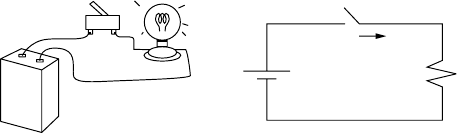
of a battery, some wire, a switch, and an incandescent lightbulb as shown in
Fig. 1.1. The battery supplies the energy required to force electrons around the
loop, heating the filament of the bulb and causing the bulb to radiate a lot of heat
and some light. Energy is transferred from a source, the battery, to a load,the
bulb. You probably already know that the voltage of the battery and the electrical
resistance of the bulb have something to do with the amount of current that will
flow in the circuit. From your own practical experience you also know that no
current will flow until the switch is closed. That is, for a circuit to do anything,
the loop has to be completed so that electrons can flow from the battery to the
bulb and then back again to the battery. And finally, you probably realize that it
doesn’t much matter whether there is one foot or two feet of wire connecting the
battery to the bulb, but that it probably would matter if there is a mile of wire
between it and the bulb.
Also shown in Fig. 1.1 is a model made up of idealized components. The
battery is modeled as an ideal source that puts out a constant voltage, V
B
,no
matter what amount of current, i, is drawn. The wires are considered to be perfect
Renewable and Efficient Electric Power Systems. By Gilbert M. Masters
ISBN 0-471-28060-7
2004 John Wiley & Sons, Inc.
1
2 BASIC ELECTRIC AND MAGNETIC CIRCUITS
(a) (b)
V
B
R
i
+
Figure 1.1 (a) A simple circuit. (b) An idealized representation of the circuit.
conductors that offer no resistance to current flow. The switch is assumed to be
open or closed. There is no arcing of current across the gap when the switch is
opened, nor is there any bounce to the switch as it makes contact on closure.
The lightbulb is modeled as a simple resistor, R, that never changes its value,
no matter how hot it becomes or how much current is flowing through it.
For most purposes, the idealized model shown in Fig. 1.1b is an adequate
representation of the circuit; that is, our prediction of the current that will flow
through the bulb whenever the switch is closed will be sufficiently accurate
that we can consider the problem solved. There may be times, however, when
the model is inadequate. The battery voltage, for example, may drop as more
and more current is drawn, or as the battery ages. The lightbulb’s resistance
may change as it heats up, and the filament may have a bit of inductance and
capacitance associated with it as well as resistance so that when the switch is
closed, the current may not jump instantaneously from zero to some final, steady-
state value. The wires may be undersized, and some of the power delivered by
the battery may be lost in the wires before it reaches the load. These subtle effects
may or may not be important, depending on what we are trying to find out and
how accurately we must be able to predict the performance of the circuit. If we
decide they are important, we can always change the model as necessary and
then proceed with the analysis.
The point here is simple. The combinations of resistors, capacitors, inductors,
voltage sources, current sources, and so forth, that you see in a circuit diagram
are merely models of real components that comprise a real circuit, and a certain
amount of judgment is required to decide how complicated the model must be
before sufficiently accurate results can be obtained. For our purposes, we will be
using very simple models in general, leaving many of the complications to more
advanced textbooks.
1.2 DEFINITIONS OF KEY ELECTRICAL QUANTITIES
We shall begin by introducing the fundamental electrical quantities that form the
basis for the study of electric circuits.
1.2.1 Charge
An atom consists of a positively charged nucleus surrounded by a swarm of nega-
tively charged electrons. The charge associated with one electron has been found
DEFINITIONS OF KEY ELECTRICAL QUANTITIES 3
to be 1.602 ×10
−19
coulombs; or, stated the other way around, one coulomb can
be defined as the charge on 6.242 × 10
18
electrons. While most of the electrons
associated with an atom are tightly bound to the nucleus, good conductors, like
copper, have free electrons that are sufficiently distant from their nuclei that their
attraction to any particular nucleus is easily overcome. These conduction elec-
trons are free to wander from atom to atom, and their movement constitutes an
electric current.
1.2.2 Current
In a wire, when one coulomb’s worth of charge passes a given spot in one
second, the current is defined to be one ampere (abbreviated A), named after the
nineteenth-century physicist Andr
´
eMarieAmp
`
ere. That is, current i is the net
rate of flow of charge q past a point, or through an area:
i =
dq
dt
(1.1)
In general, charges can be negative or positive. For example, in a neon light,
positive ions move in one direction and negative electrons move in the other.
Each contributes to current, and the total current is their sum. By convention, the
direction of current flow is taken to be the direction that positive charges would
move, whether or not positive charges happen to be in the picture. Thus, in a
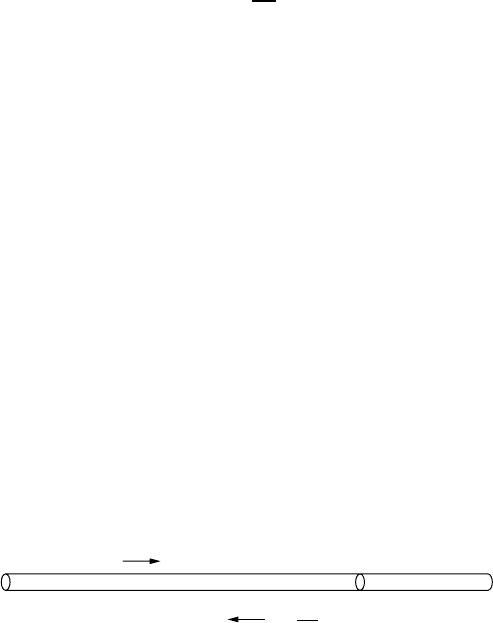
wire, electrons moving to the right constitute a current that flows to the left, as
showninFig.1.2.
When charge flows at a steady rate in one direction only, the current is said
to be direct current,ordc. A battery, for example, supplies direct current. When
charge flows back and forth sinusoidally, it is said to be alternating current,or
ac. In the United States the ac electricity delivered by the power company has
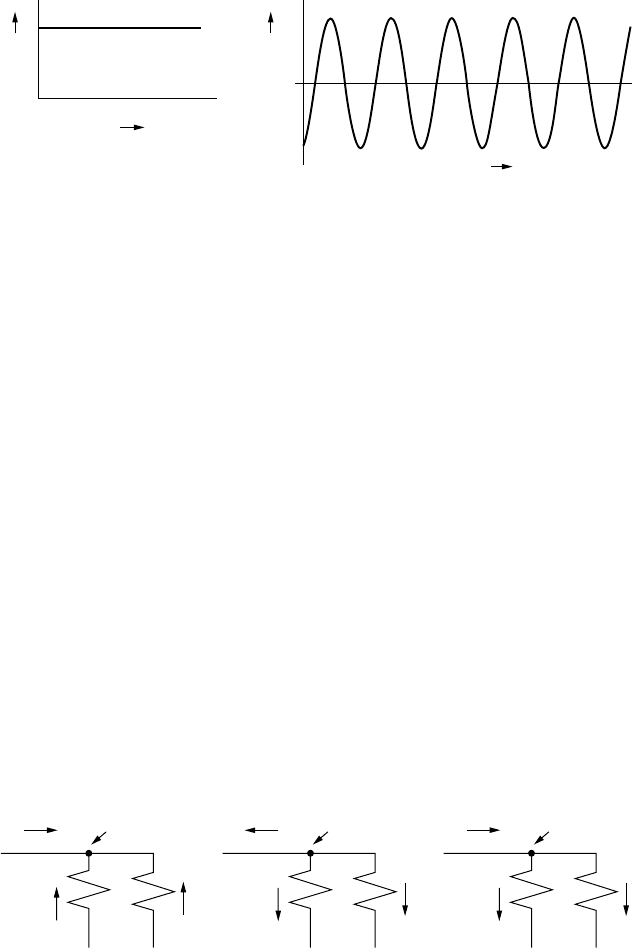
a frequency of 60 cycles per second, or 60 hertz (abbreviated Hz). Examples of
ac and dc are shown in Fig. 1.3.
1.2.3 Kirchhoff’s Current Law
Two of the most fundamental properties of circuits were established experimen-
tally a century and a half ago by a German professor, Gustav Robert Kirchhoff
(1824–1887). The first property, known as Kirchhoff’s current law (abbreviated
e
−
i
=
dq
dt
Figure 1.2 By convention, negative charges moving in one direction constitute a positive
current flow in the opposite direction.
4 BASIC ELECTRIC AND MAGNETIC CIRCUITS
Time
(a) Direct current (b) Alternating current
Time
ii
Figure 1.3 (a) Steady-state direct current (dc). (b) Alternating current (ac).
KCL), states that at every instant of time the sum of the currents flowing into any
node of a circuit must equal the sum of the currents leaving the node,wherea
node is any spot where two or more wires are joined. This is a very simple, but
powerful concept. It is intuitively obvious once you assert that current is the flow
of charge, and that charge is conservative—neither being created nor destroyed
as it enters a node. Unless charge somehow builds up at a node, which it does
not, then the rate at which charge enters a node must equal the rate at which
charge leaves the node.
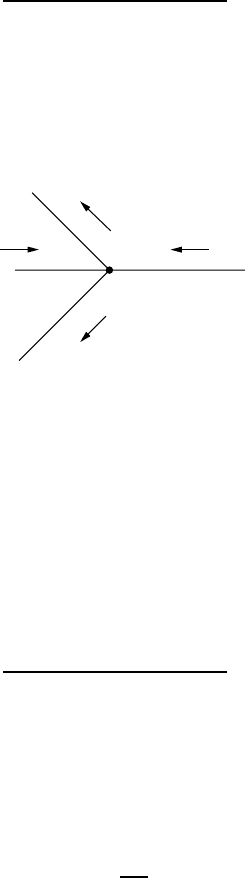
There are several alternative ways to state Kirchhoff’s current law. The most
commonly used statement says that the sum of the currents into a node is zero
as shown in Fig. 1.4a, in which case some of those currents must have negative
values while some have positive values. Equally valid would be the statement
that the sum of the currents leaving a node must be zero as shown in Fig. 1.4b
(again some of these currents need to have positive values and some negative).
Finally, we could say that the sum of the currents entering a node equals the sum
of the currents leaving a node (Fig. 1.4c). These are all equivalent as long as we
understand what is meant about the direction of current flow when we indicate
it with an arrow on a circuit diagram. Current that actually flows in the direction
shown by the arrow is given a positive sign. Currents that actually flow in the
opposite direction have negative values.
(b)
i
1
+
i
2
+
i
3
= 0
node
i
3
i
2
i
1
(c)
i
1
=
i
2
+
i
3
node
i
3
i
2
i
1
(a)
i
1
+
i
2
+
i
3
= 0
node
i
3
i
2
i
1
Figure 1.4 Illustrating various ways that Kirchhoff’s current law can be stated. (a) The
sum of the currents into a node equals zero. (b) The sum of the currents leaving the node
is zero. (c) The sum of the currents entering a node equals the sum of the currents leaving
the node.
DEFINITIONS OF KEY ELECTRICAL QUANTITIES 5
Note that you can draw current arrows in any direction that you want—that
much is arbitrary—but once having drawn the arrows, you must then write Kirch-
hoff’s current law in a manner that is consistent with your arrows, as has been
done in Fig. 1.4. The algebraic solution to the circuit problem will automati-
cally determine whether or not your arbitrarily determined directions for currents
were correct.
Example 1.1 Using Kirchhoff’s Current Law. A node of a circuit is shown
with current direction arrows chosen arbitrarily. Having picked those directions,
i
1
=−5A,i
2
= 3A,andi
3
=−1 A. Write an expression for Kirchhoff’s current
law and solve for i
4
.
i
1
i
2
i
3
i
4
Solution. By Kirchhoff’s current law,
i
1
+ i
2
= i
3
+ i
4
−5 + 3 =−1 +i
4
so that
i
4
=−1A
That is, i
4
is actually 1 A flowing into the node. Note that i
2
, i
3
,andi
4
are all
entering the node, and i
1
is the only current that is leaving the node.
1.2.4 Voltage
Electrons won’t flow through a circuit unless they are given some energy to
help send them on their way. That “push” is measured in volts, where voltage is
defined to be the amount of energy (w, joules) given to a unit of charge,
v =
dw
dq
(1.2)
6 BASIC ELECTRIC AND MAGNETIC CIRCUITS
A 12-V battery therefore gives 12 joules of energy to each coulomb of charge
that it stores. Note that the charge does not actually have to move for voltage to
have meaning. Voltage describes the potential for charge to do work.
While currents are measured through a circuit component, voltages are mea-
sured across components. Thus, for example, it is correct to say that current
through a battery is 10 A, while the voltage across that battery is 12 V. Other
ways to describe the voltage across a component include whether the voltage
rises across the component or drops. Thus, for example, for the simple circuit
in Fig. 1.1, there is a voltage rise across the battery and voltage drop across
the lightbulb.
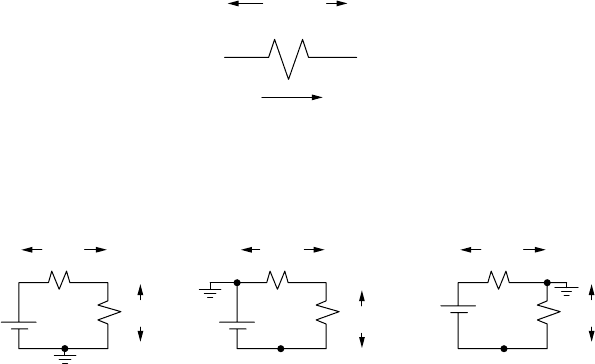
Voltages are always measured with respect to something. That is, the voltage
of the positive terminal of the battery is “so many volts” with respect to the
negative terminal; or, the voltage at a point in a circuit is some amount with
respect to some other point. In Fig. 1.5, current through a resistor results in a
voltage drop from point A to point B of V
AB
volts. V
A
and V
B
are the voltages
at each end of the resistor, measured with respect to some other point.
The reference point for voltages in a circuit is usually designated with a
ground symbol. While many circuits are actually grounded—that is, there is a
path for current to flow directly into the earth—some are not (such as the battery,
wires, switch, and bulb in a flashlight). When a ground symbol is shown on a
circuit diagram, you should consider it to be merely a reference point at which
the voltage is defined to be zero. Figure 1.6 points out how changing the node
labeled as ground changes the voltages at each node in the circuit, but does not
change the voltage drop across each component.
V
A
V
AB
V
B
I
+−
Figure 1.5 The voltage drop from point A to point B is V
AB
,whereV
AB
= V
A
− V
B
.
R
2
R
1
3 V
12 V
+
−
12 V
+
−
12 V
+
−
R
2
R
1
3 V
9 V
R
2
R
1
0 V
12 V
9 V
−3 V
0 V
−12 V
0 V
−9 V
3 V
+−
−
+
+
9 V
−
+
9 V
−
+
−
3 V
+−
Figure 1.6 Moving the reference node around (ground) changes the voltages at each
node, but doesn’t change the voltage drop across each component.

DEFINITIONS OF KEY ELECTRICAL QUANTITIES 7
1.2.5 Kirchhoff’s Voltage Law
The second of Kirchhoff’s fundamental laws states that the sum of the voltages
around any loop of a circuit at any instant is zero. This is known as Kirchhoff’s
voltage law (KVL). Just as was the case for Kirchhoff’s current law, there are
alternative, but equivalent, ways of stating KVL. We can, for example, say that
the sum of the voltage rises in any loop equals the sum of the voltage drops
around the loop. Thus in Fig. 1.6, there is a voltage rise of 12 V across the
battery and a voltage drop of 3 V across R
1
and a drop of 9 V across R
2
. Notice
that it doesn’t matter which node was labeled ground for this to be true. Just as
was the case with Kirchhoff’s current law, we must be careful about labeling and
interpreting the signs of voltages in a circuit diagram in order to write the proper
version of KVL. A plus (+) sign on a circuit component indicates a reference
direction under the assumption that the potential at that end of the component
is higher than the voltage at the other end. Again, as long as we are consistent
in writing Kirchhoff’s voltage law, the algebraic solution for the circuit will
automatically take care of signs.
Kirchhoff’s voltage law has a simple mechanical analog in which weight is
analogous to charge and elevation is analogous to voltage. If a weight is raised
from one elevation to another, it acquires potential energy equal to the change
in elevation times the weight. Similarly, the potential energy given to charge is
equal to the amount of charge times the voltage to which it is raised. If you
decide to take a day hike, in which you start and finish the hike at the same spot,
you know that no matter what path was taken, when you finish the hike the sum
of the increases in elevation has to have been equal to the sum of the decreases in
elevation. Similarly, in an electrical circuit, no matter what path is taken, as long
as you return to the same node at which you started, KVL provides assurance
that the sum of voltage rises in that loop will equal the sum of the voltage drops
in the loop.
1.2.6 Power
Power and energy are two terms that are often misused. Energy can be thought
of as the ability to do work, and it has units such as joules or Btu. Power, on
the other hand, is the rate at which energy is generated or used, and therefore it
has rate units such as joules/s or Btu/h. There is often confusion about the units
for electrical power and energy. Electrical power is measured in watts, which
isarate(1J/s= 1 watt), so electrical energy is watts multiplied by time—for
example, watt-hours. Be careful not to say “watts per hour,” which is incorrect
(even though you will see this all too often in newspapers or magazines).
When a battery delivers current to a load, power is generated by the battery and
is dissipated by the load. We can combine (1.1) and (1.2) to find an expression
for instantaneous power supplied, or consumed, by a component of a circuit:
p =
dw
dt
=
dw
dq
·
dq
dt
= vi (1.3)