
Masters G.M. Renewable and Efficient Electric Power Systems
Подождите немного. Документ загружается.

8 BASIC ELECTRIC AND MAGNETIC CIRCUITS
Equation (1.3) tells us that the power supplied at any instant by a source, or
consumed by a load, is given by the current through the component times the
voltage across the component. When current is given in amperes, and voltage in
volts, the units of power are watts (W). Thus, a 12-V battery delivering 10 A to
a load is supplying 120 W of power.
1.2.7 Energy
Since power is the rate at which work is being done, and energy is the total
amount of work done, energy is just the integral of power:
w =
pdt (1.4)
In an electrical circuit, energy can be expressed in terms of joules (J), where 1
watt-second = 1 joule. In the electric power industry the units of electrical energy
are more often given in watt-hours, or for larger quantities kilowatt-hours (kWh)
or megawatt-hours (MWh). Thus, for example, a 100-W computer that is operated
for 10 hours will consume 1000 Wh, or 1 kWh of energy. A typical household
in the United States uses approximately 750 kWh per month.
1.2.8 Summary of Principal Electrical Quantities
The key electrical quantities already introduced and the relevant relationships
between these quantities are summarized in Table 1.1.
Since electrical quantities vary over such a large range of magnitudes, you will
often find yourself working with very small quantities or very large quantities. For
example, the voltage created by your TV antenna may be measured in millionths
of a volt (microvolts, µV), while the power generated by a large power station
may be measured in billions of watts, or gigawatts (GW). To describe quantities
that may take on such extreme values, it is useful to have a system of prefixes that
accompany the units. The most commonly used prefixes in electrical engineering
are given in Table 1.2.
TA BLE 1.1 Key Electrical Quantities and Relationships
Electrical Quantity Symbol Unit Abbreviation Relationship
Charge q coulomb C q =
∫
idt
Current i ampere A i = dq/dt
Voltage v volt V v = dw/dq
Power p joule/second J/s p = dw/dt
or watt W
Energy w joule J w =
∫
pdt
or watt-hour Wh
IDEALIZED VOLTAGE AND CURRENT SOURCES 9
TA BLE 1.2 Common Prefixes
Small Quantities Large Quantities
Quantity Prefix Symbol Quantity Prefix Symbol
10
−3
milli m 10
3
kilo k
10
−6
micro µ 10
6
mega M
10
−9
nano n 10
9
giga G
10
−12
pico p 10
12
tera T
1.3 IDEALIZED VOLTAGE AND CURRENT SOURCES
Electric circuits are made up of a relatively small number of different kinds of
circuit elements,orcomponents, which can be interconnected in an extraordinarily
large number of ways. At this point in our discussion, we will concentrate on
idealized characteristics of these circuit elements, realizing that real components
resemble, but do not exactly duplicate, the characteristics that we describe here.
1.3.1 Ideal Voltage Source
An ideal voltage source is one that provides a given, known voltage v
s
, no matter
what sort of load it is connected to. That is, regardless of the current drawn from
the ideal voltage source, it will always provide the same voltage. Note that an
ideal voltage source does not have to deliver a constant voltage; for example, it
may produce a sinusoidally varying voltage—the key is that that voltage is not
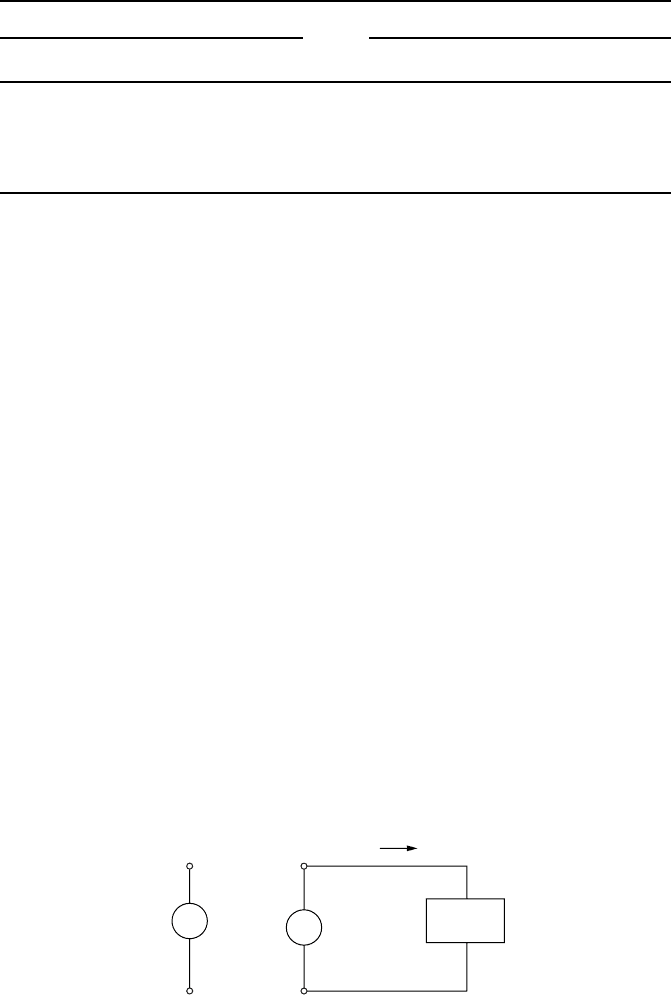
a function of the amount of current drawn. A symbol for an ideal voltage source
isshowninFig.1.7.
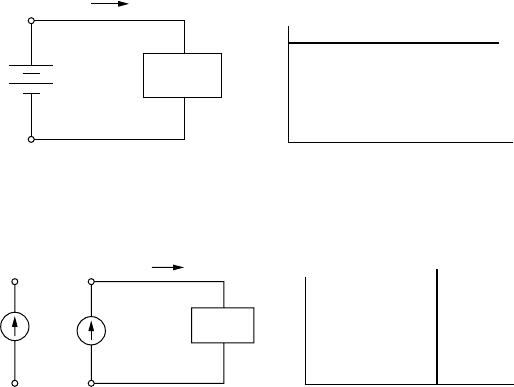
A special case of an ideal voltage source is an ideal battery that provides a
constant dc output, as shown in Fig. 1.8. A real battery approximates the ideal
source; but as current increases, the output drops somewhat. To account for that
drop, quite often the model used for a real battery is an ideal voltage source in
series with the internal resistance of the battery.
i
Load
v
=
v
s
v
s
v
s
+
+
+
Figure 1.7 A constant voltage source delivers v
s
no matter what current the load draws.
The quantity v
s
can vary with time and still be ideal.
10 BASIC ELECTRIC AND MAGNETIC CIRCUITS
Load
v
s
v
s
v
+
+
i
i
v
0
Figure 1.8 An ideal dc voltage.
i
Load
0
ii
s
i
s
i
s
v
v
+
Figure 1.9 The current produced by an ideal current source does not depend on the
voltage across the source.
1.3.2 Ideal Current Source
An ideal current source produces a given amount of current i
s
no matter what
load it sees. As shown in Fig. 1.9, a commonly used symbol for such a device is
circle with an arrow indicating the direction of current flow. While a battery is a
good approximation to an ideal voltage source, there is nothing quite so familiar
that approximates an ideal current source. Some transistor circuits come close to
this ideal and are often modeled with idealized current sources.
1.4 ELECTRICAL RESISTANCE
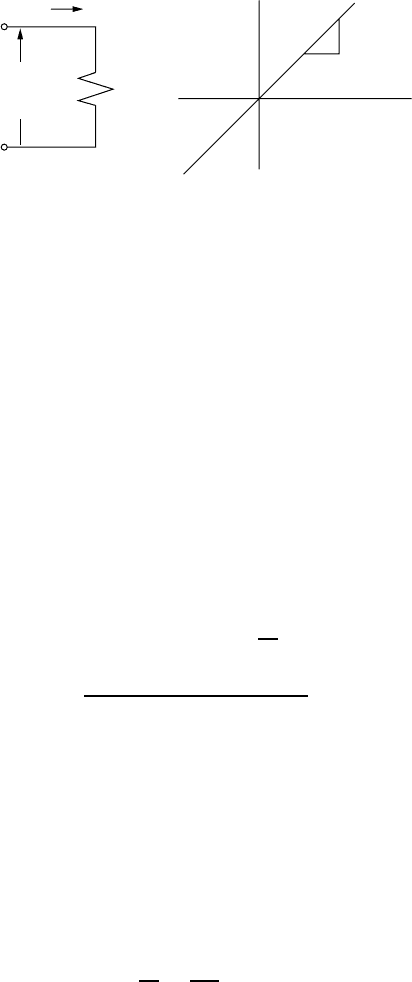
For an ideal resistance element the current through it is directly proportional to
the voltage drop across it, as shown in Fig. 1.10.
1.4.1 Ohm’s Law
The equation for an ideal resistor is given in (1.5) in which v is in volts, i is in
amps, and the constant of proportionality is resistance R measured in ohms ().
This simple formula is known as Ohm’s law in honor of the German physi-
cist, Georg Ohm, whose original experiments led to this incredibly useful and
important relationship.
v = Ri (1.5)
ELECTRICAL RESISTANCE 11
(a) (b)
i
R
0
1
v
R
i
B
+
−
A
v
Figure 1.10 (a) An ideal resistor symbol. (b) voltage–current relationship.
Notice that voltage v is measured across the resistor. That is, it is the voltage at
point A with respect to the voltage at point B. When current is in the direction
shown, the voltage at A with respect to B is positive, so it is quite common to
say that there is a voltage drop across the resistor.
An equivalent relationship for a resistor is given in (1.6), where current is
given in terms of voltage and the proportionality constant is conductance G with
units of siemens (S). In older literature, the unit of conductance was mhos.
i = Gv (1.6)
By combining Eqs. (1.3) and (1.5), we can easily derive the following equiv-
alent relationships for power dissipated by the resistor:
p = vi = i
2
R =
v
2
R
(1.7)
Example 1.2 Power to an Incandescent Lamp. The current–voltage rela-
tionship for an incandescent lamp is nearly linear, so it can quite reasonably be
modeled as a simple resistor. Suppose such a lamp has been designed to consume
60 W when it is connected to a 12-V power source. What is the resistance of
the filament, and what amount of current will flow? If the actual voltage is only
11 V, how much energy would it consume over a 100-h period?
Solution. From Eq. (1.7),
R =
v
2
p
=
12
2
60
= 2.4
and from Ohm’s law,
i = v/R = 12/2.4 = 5A
12 BASIC ELECTRIC AND MAGNETIC CIRCUITS
Connected to an 11-V source, the power consumed would be
p =
v
2
R
=
11
2
2.4
= 50.4W
Over a 100-h period, it would consume
w = pt = 50.4W× 100 h = 5040 Wh = 5.04 kWh
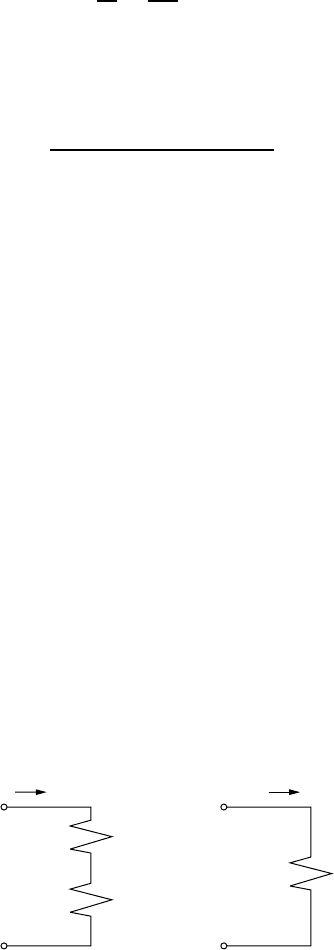
1.4.2 Resistors in Series
We can use Ohm’s law and Kirchhoff’s voltage law to determine the equivalent
resistance of resistors wired in series (so the same current flows through each
one) as shown in Fig. 1.11.
For R
s
to be equivalent to the two series resistors, R
1
and R
2
, the volt-
age–current relationships must be the same. That is, for the circuit in Fig. 1.11a,
v = v
1
+ v
2
(1.8)
and from Ohm’s law,
v = iR
1
+ iR
2
(1.9)
For the circuit in Fig. 1.11b to be equivalent, the voltage and current must be
the same:
v = iR
s
(1.10)
By equating Eqs. (1.9) and (1.10), we conclude that
R
s
= R
1
+ R
2
(1.11)
And, in general, for n-resistances in series the equivalent resistance is
R
s
= R
1
+ R
2
+···+R
n
(1.12)
(a) (b)
−
+
v
ii
R
s
=
R
1
+
R
2
−
+
+
+
R
2
v
2
v
v
1
R
1
Figure 1.11 R
s
is equivalent to resistors R
1
and R
2
in series.
ELECTRICAL RESISTANCE 13
(a) (b)
v
+
R
1
R
2
i
2
i
1
i
v
+
i
R
p
=
R
1
+
R
2
R
1
R
2
Figure 1.12 Equivalent resistance of resistors wired in parallel.
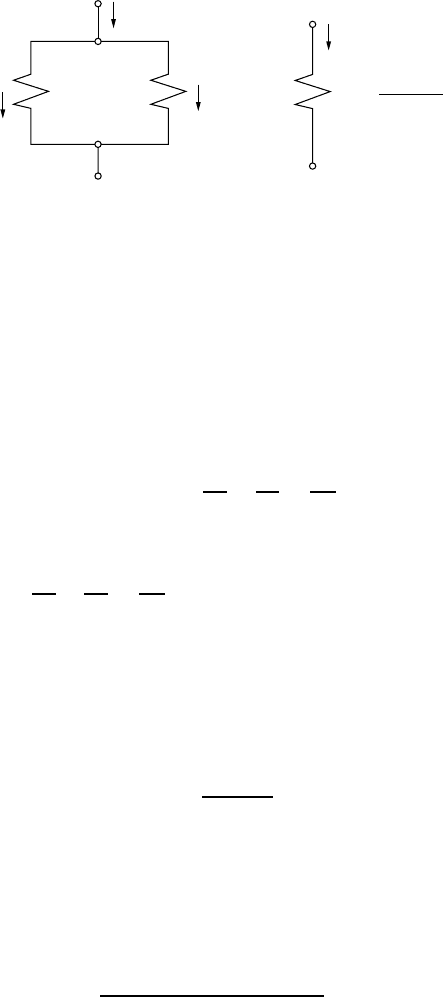
1.4.3 Resistors in Parallel
When circuit elements are wired together as in Fig. 1.12, so that the same voltage
appears across each of them, they are said to be in parallel.
To find the equivalent resistance of two resistors in parallel, we can first
incorporate Kirchhoff’s current law followed by Ohm’s law:
i = i
1
+ i
2
=
v
R
1
+
v
R
2
=
v
R
p
(1.13)
so that
1
R
1
+
1
R
2
=
1
R
p
or G
1
+ G
2
= G
p
(1.14)
Notice that one reason for introducing the concept of conductance is that the con-
ductance of a parallel combination of n resistors is just the sum of the individual
conductances.
For two resistors in parallel, the equivalent resistance can be found from
Eq. (1.14) to be
R
p
=
R
1
R
2
R
1
+ R
2
(1.15)
Notice that when R
1
and R
2
are of equal value, the resistance of the parallel
combination is just one-half that of either one. Also, you might notice that the
parallel combination of two resistors always has a lower resistance than either
one of those resistors.
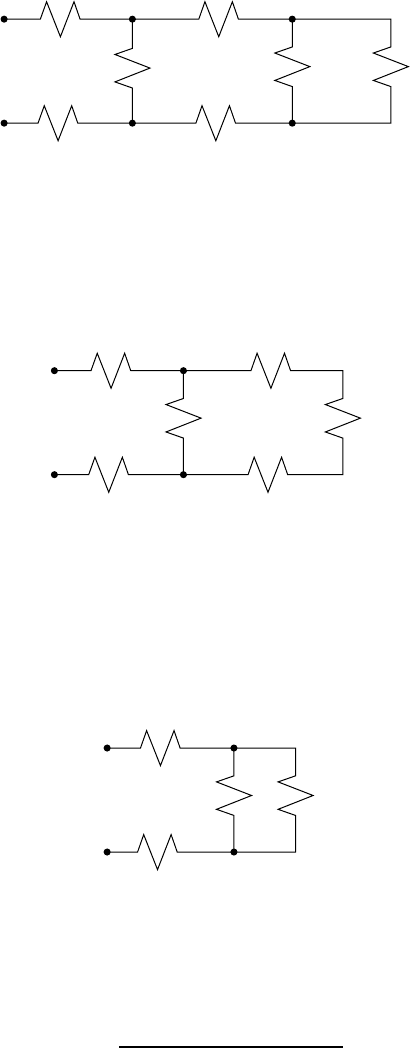
Example 1.3 Analyzing a Resistive Circuit. Find the equivalent resistance of
the following network.
14 BASIC ELECTRIC AND MAGNETIC CIRCUITS
800 Ω400 Ω
800 Ω
800 Ω 800 Ω
2 kΩ
800 Ω
Solution. While this circuit may look complicated, you can actually work it out
in your head. The parallel combination of the two 800- resistors on the right
end is 400 , leaving the following equivalent:
400 Ω
400 Ω 800 Ω
800 Ω800 Ω
2 kΩ
The three resistors on the right end are in series so they are equivalent to a
single resistor of 2 k (=800 + 400 + 800 ). The network now looks
like the following:
400 Ω
800 Ω
2 kΩ 2 kΩ
The two 2-kW resistors combine to 1 k, which is in series with the 800-
and 400- resistors. The total resistance of the network is thus 800 + 1k +
400 = 2.2k.
ELECTRICAL RESISTANCE 15
1.4.4 The Voltage Divider
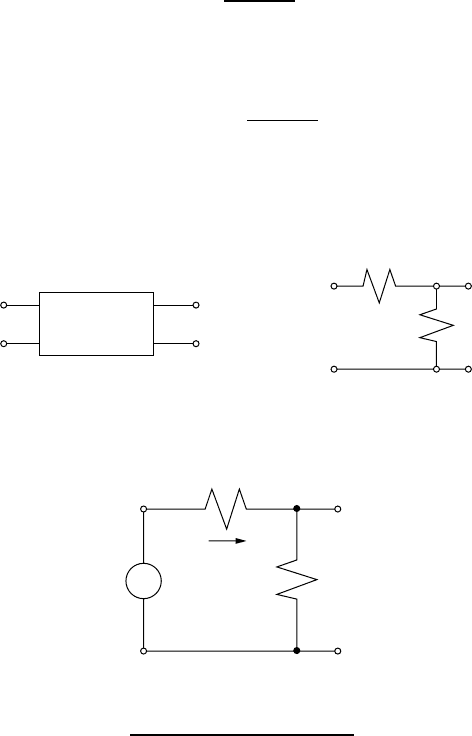
A voltage divider is a deceptively simple, but surprisingly useful and important
circuit. It is our first example of a two-port network. Two-port networks have a
pair of input wires and a pair of output wires, as shown in Fig. 1.13.
The analysis of a voltage divider is a straightforward extension of Ohm’s law
and what we have learned about resistors in series.
As shown in Fig. 1.14, when a voltage source is connected to the voltage
divider, an amount of current flows equal to
i =
v
in
R
1
+ R
2
(1.16)
Since v
out
= iR
2
, we can write the following voltage-divider equation:
v
out
= v
in
R
2
R
1
+ R
2
(1.17)
Equation (1.17) is so useful that it is well worth committing to memory.
+
−
v
in
v
out
v
in
v
out
R
2
Two-port
network
R
1
Figure 1.13 A voltage divider is an example of a two-port network.
i
v
in
v
out
R
2
R
1
+
+
−
Figure 1.14 A voltage divider connected to an ideal voltage source.
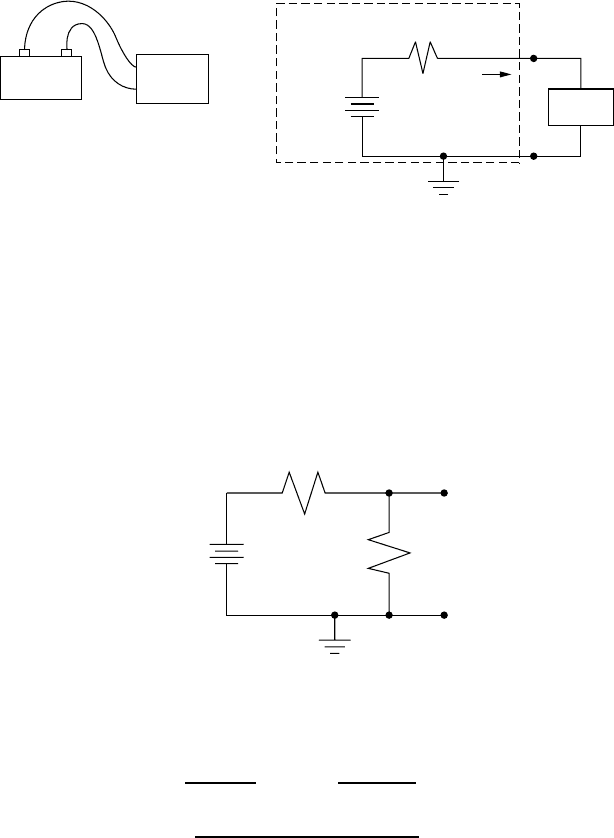
Example 1.4 Analyzing a Battery as a Voltage Divider. Suppose an auto-
mobile battery is modeled as an ideal 12-V source in series with a 0.1- inter-
nal resistance.
16 BASIC ELECTRIC AND MAGNETIC CIRCUITS
a. What would the battery output voltage drop to when 10 A is delivered?
b. What would be the output voltage when the battery is connected to a
1- load?
Battery
Load
Battery
+−
=
Load12 V
V
out
+
+
R
i
= 0.1 Ω
10 A
Solution
a. With the battery delivering 10 A, the output voltage drops to
V
out
= V
B
− IR
i
= 12 − 10 × 0.1 = 11 V
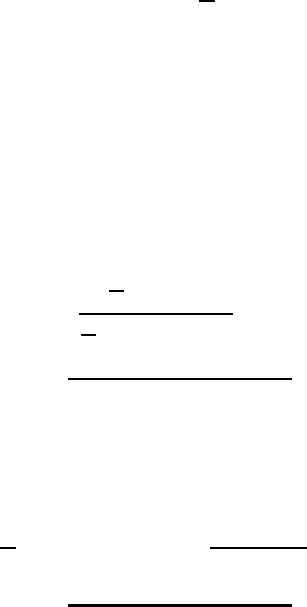
b. Connected to a 1- load, the circuit can be modeled as shown below:
V
out
+
0.1 Ω
1 Ω
12 V
We can find V
out
from the voltage divider relationship, (1.17):
v
out
= v
in
R
2
R
1
+ R
2
= 12
1.0
0.1 + 1.0
= 10.91 V
1.4.5 Wire Resistance
In many circumstances connecting wire is treated as if it were perfect—that is,
as if it had no resistance—so there is no voltage drop in those wires. In circuits
ELECTRICAL RESISTANCE 17
delivering a fair amount of power, however, that assumption may lead to serious
errors. Stated another way, an important part of the design of power circuits is
choosing heavy enough wire to transmit that power without excessive losses. If
connecting wire is too small, power is wasted and, in extreme cases, conductors
can get hot enough to cause a fire hazard.
The resistance of wire depends primarily on its length, diameter, and the mate-
rial of which it is made. Equation (1.18) describes the fundamental relationship
for resistance ():
R = ρ
l
A
(1.18)
where ρ is the resistivity of the material, l is the wire length, and A is the wire
cross-sectional area.
With l in meters (m) and A in m
2
, units for resistivity ρ in the SI system are
-m (in these units copper has ρ = 1.724 × 10
−8
-m). The units often used in
the United States, however, are tricky (as usual) and are based on areas expressed
in circular mils. One circular mil is the area of a circle with diameter 0.001 in.
(1 mil = 0.001 in.). So how can we determine the cross-sectional area of a wire
(in circular mils) with diameter d (mils)? That is the same as asking how many
1-mil-diameter circles can fit into a circle of diameter d mils.
A =
π
4
d
2
sq mil
π
4
· 1
2
sq mil/cmil
= d
2
cmil (1.19)
Example 1.5 From mils to Ohms. The resistivity of annealed copper at 20
◦
C
is 10.37 ohm-circular-mils/foot. What is the resistance of 100 ft of wire with
diameter 80.8 mils (0.0808 in.)?
Solution
R = ρ
l
A
= 10.37 −cmil/ft ·
100 ft
(80.8)
2
cmil
= 0.1588
Electrical resistance of wire also depends somewhat on temperature (as tem-
perature increases, greater molecular activity interferes with the smooth flow of
electrons, thereby increasing resistance). There is also a phenomenon, called the
skin effect, which causes wire resistance to increase with frequency. At higher
frequencies, the inherent inductance at the core of the conductor causes current
to flow less easily in the center of the wire than at the outer edge of conductor,
thereby increasing the average resistance of the entire conductor. At 60 Hz, for
modest loads (not utility power), the skin effect is insignificant. As to materials,
copper is preferred, but aluminum, being cheaper, is sometimes used by pro-
fessionals, but never in home wiring systems. Aluminum under pressure slowly