
Masters G.M. Renewable and Efficient Electric Power Systems
Подождите немного. Документ загружается.

48 BASIC ELECTRIC AND MAGNETIC CIRCUITS
annual energy saved. This is the cost of conserved energy (CCE) and is
described more carefully in Section 5.4. CCE is defined as follows
CCE =
annual cost of saved electricity($/yr)
annual electricity saved (kWhr/yr)
=
P · CRF(i, n)
kWhr/yr
where P is the extra cost of the conservation feature (heavier duty
wire in this case), and CRF is the capital recovery factor (which means
your annual loan payment on $1 borrowed for n years at interest rate i.
What would be the “cost of conserved energy” CCE (cents/kWhr) if
the building (and wiring) is being paid for with a 7-%, 20-yr loan with
CRF = 0.0944/yr. How does that compare with the cost of electricity
that you don’t have to purchase from the utility at 10¢ /kWhr?
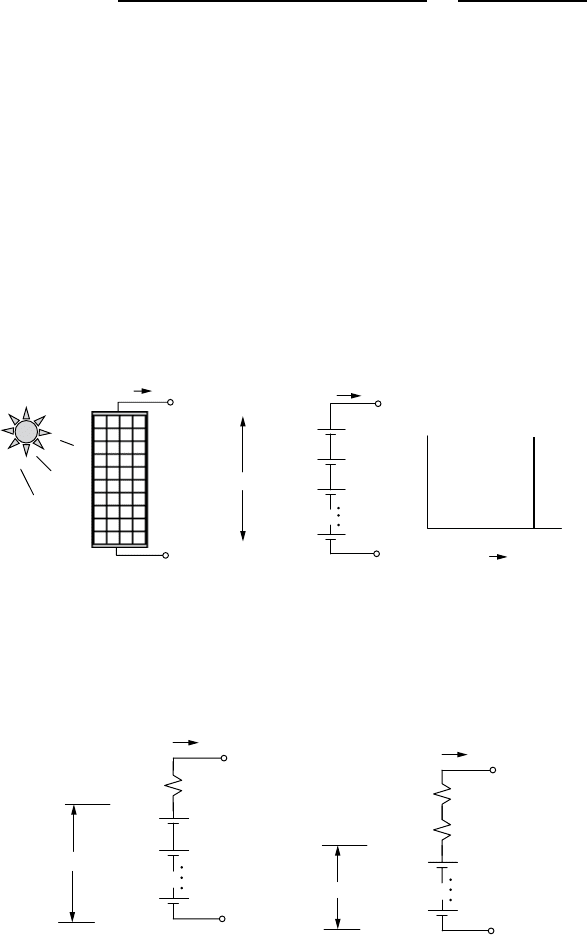
1.11. Suppose a photovoltaic (PV) module consists of 40 individual cells wired
in series, (a). In some circumstances, when all cells are exposed to the sun
it can be modeled as a series combination of forty 0.5-V ideal batteries, (b).
The resulting graph of current versus voltage would be a straight, vertical
20-V line as shown in (c).
(a) 40-cell PV module
I
V
+
+
+
+
0.5 V
0.5 V
0.5 V
40 cells
V
I
(b) 40 cells in sun
I
V
20 V
(c) full-sun I-V curve
Figure P1.11
a. When an individual cell is shaded, it looks like a 5- resistor instead
of a 0.5-V battery, as shown in (d). Draw the I-V curve for the PV
module with one cell shaded.
(d) one cell shaded
+
+
0.5 V
0.5 V
5 Ω
V
I
0.5 V
39 cells
1 cell
shaded
+
0.5 V
V
I
0.5 V
+
38 cells
2 cells
shaded
(e) two cells shaded
5 Ω
5 Ω
Figure P1.11
PROBLEMS 49
b. With two cells shaded, as in (e), draw the I-V curve for the PV module
on the same axes as you have drawn the full-sun and 1-cell shaded
I-V lines.
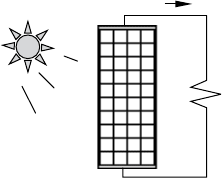
1.12. If the photovoltaic (PV) module in Problem 1.11 is connected to a 5-
load, find the current, voltage, and power that will be delivered to the load
under the following conditions:
PV module
I
V
5 Ω
Load
+
−
Figure P1.12
a. Every cell in the PV module is in the sun.
b. One cell is shaded.
c. Two cells are shaded.
Use the fact that the same current and voltage flows through both the PV
module and the load so solve for I, V, and P.
1.13. When circuits involve a source and a load, the same current flows through
each one and the same voltage appears across both. A graphical solution
can therefore be obtained by simply plotting the current-voltage (I-V) rela-
tionship for the source onto the same axes that the I-V relationship for the
load is plotted, and then finding the crossover point where both are sat-
isfied simultaneously. This is an especially powerful technique when the
relationships are nonlinear.
For the photovoltaic module supplying power to the 5-W resistive load
in Problem 1.12, solve for the resulting current and voltage using the
graphical approach:
a. For all cells in the sun.
b. For one cell shaded
c. For two cells shaded

CHAPTER 2
FUNDAMENTALS OF ELECTRIC POWER
2.1 EFFECTIVE VALUES OF VOLTAGE AND CURRENT
When voltages are nice, steady, dc, it is intuitively obvious what is meant when
someone says, for example, “this is a 9-V battery.” But what does it mean to say
the voltage at the wall outlet is 120-V ac? Since it is ac, the voltage is constantly
changing, so just what is it that the “120-V” refers to?
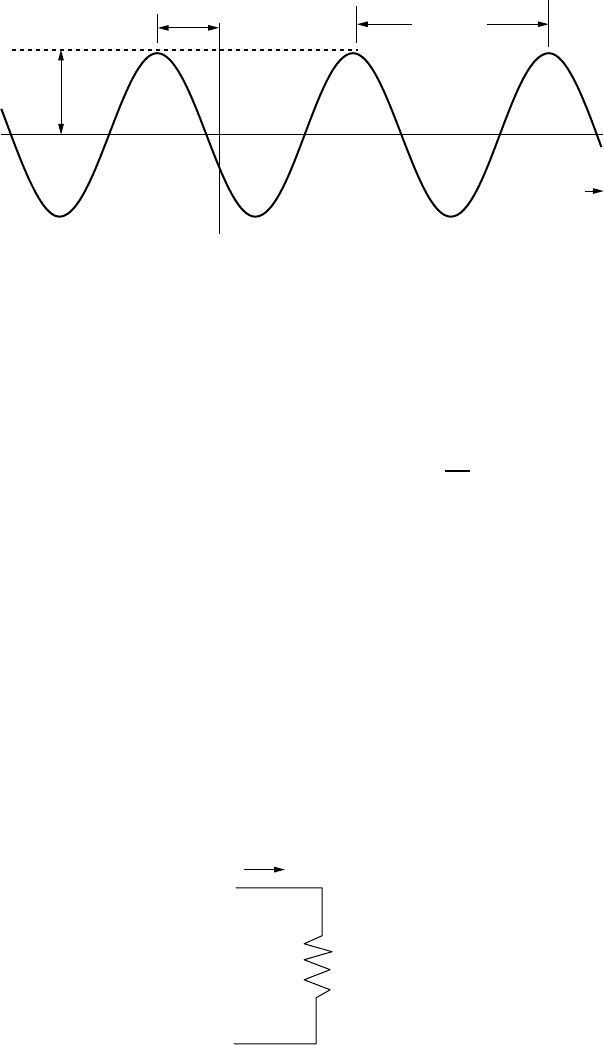
First, let us describe a simple sinusoidal current:
i = I
m
cos(ωt + θ) (2.1)
where i is the current, a function of time; I
m
is the magnitude, or amplitude, of the
current; ω is the angular frequency (radians/s); and θ is the phase angle (radians).
Notice that conventional notation uses lowercase letters for time-varying voltages
or currents (e.g., i and v), while capitals are used for quantities that are constants
(or parameters), (e.g., I
m
or V
rms
). Also note that we just as easily could have
described the current with a sine function instead of cosine. A plot of (2.1) is
showninFig.2.1.
The frequency ω in (2.1) is expressed in radians per second. Equally common
is to express the frequency f in hertz (Hz), which are “cycles per second.” Since
there are 2π radians per cycle, we can write
ω = 2π
(
radians/cycle
)
· f
(
cycles/s
)
= 2πf (2.2)
Renewable and Efficient Electric Power Systems. By Gilbert M. Masters
ISBN 0-471-28060-7
2004 John W iley & Sons, Inc.
51
52 FUNDAMENTALS OF ELECTRIC POWER
Magnitude,
amplitude
q
w
t
w
T
= 2p
i
I
m
Figure 2.1 Illustrating the nomenclature for a sinusoidal function.
The sinusoidal function is periodic—that is, it repeats itself—so we can also
describe it using its period, T :
T = 1/f ( 2.3)
Thus, the sinusoidal current can have the following equivalent representations:
i = I
m
cos(ωt + θ) = I
m
cos(2πf t + θ) = I
m
cos
2π
T
t +θ
(2.4)
Suppose we have a portion of a circuit, consisting of a current i passing
through a resistance R asshowninFig.2.2.
The instantaneous power dissipated by the resistor is
p = i
2
R(2.5)
In (2.5), power is given a lowercase symbol to indicate that it is a time-varying
quantity. The average value of power dissipated in the resistance is given by
P
avg
= (i
2
)
avg
R = I
eff
2
R(2.6)
In (2.6) an effective value of current, I
eff
, has been introduced. The advantage
of defining the effective value this way is that the resulting equation for average
i
R
Figure 2.2 A time-varying current i through a resistance R.
EFFECTIVE VALUES OF VOLTAGE AND CURRENT 53
power dissipated looks very similar to the instantaneous power described by (2.5).
This leads to a definition of the effective value of current given below:
I
eff
=
(i
2
)
avg
= I
rms
(2.7)
The effective value of current is the square root of the mean value of cur-
rent squared. That is, it is the root-mean-squared, or rms, value of current. The
definition given in (2.7) applies to any current function, be it sinusoidal or oth-
erwise.
To find the rms value of a function, we can always work it out formally using
the following:
I
rms
=
(i
2
)
avg
=
1
T
T
0
i
2
(t)dt (2.8)
Oftentimes, however, it is easier simply to graph the square of the function and
determine the average by inspection, as the following example illustrates.
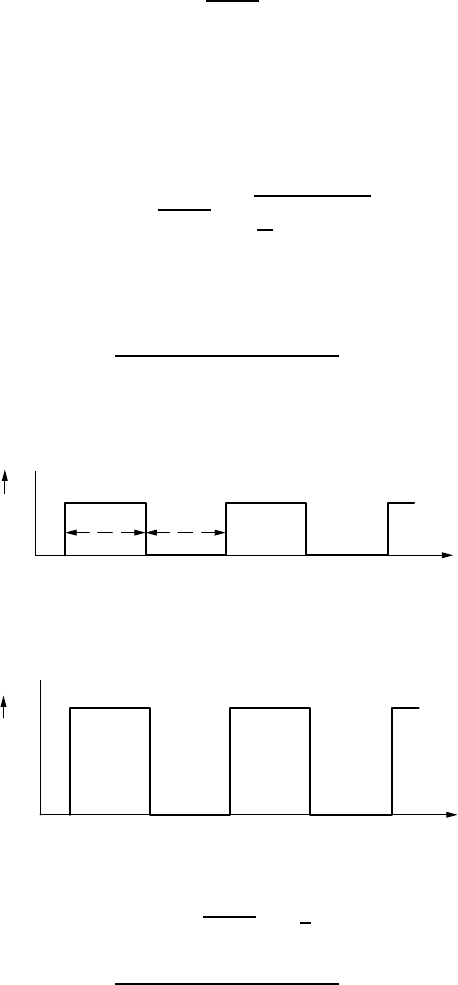
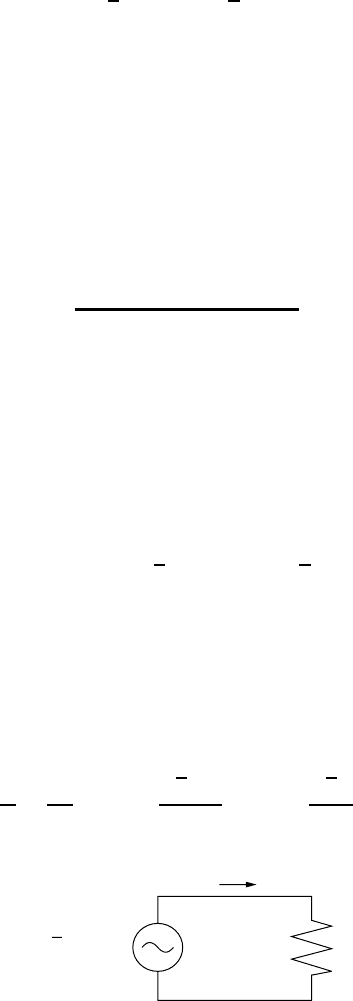
Example 2.1 RMS value of a Square Wave. Find the rms value of a square-
wave current that jumps back and forth from 0 to 2 A as shown below:
0
2
i
T
2
T
2
Solution We need to find the square root of the average value of the square of
the current. The waveform for current squared is
0
4
i
2
The average value of current squared is 2 by inspection (half the time it is zero,
half the time it is 4):
I
rms
=
(i
2
)
avg
=
√
2A
54 FUNDAMENTALS OF ELECTRIC POWER
y
= cos
t
y
= cos
2
t
1
0
−1
1
0.5
0
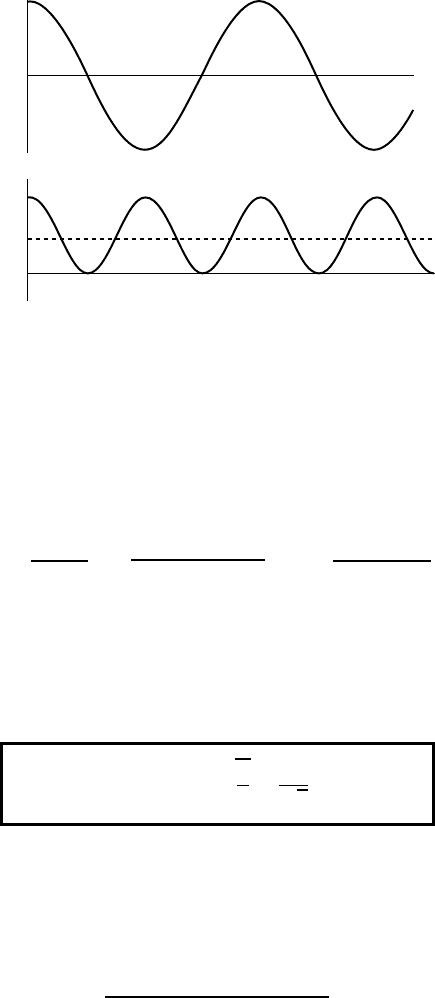
Figure 2.3 The average value of the square of a sinusoid is 1/2.
Let us derive the rms value for a sinusoid by using the simple graphical
procedure. If we start with a sinusoidal voltage
v = V
m
cos ωt (2.9)
The rms value of voltage is
V
rms
=
(v
2
)
avg
=
(V
m
2
cos
2
ωt)
avg
= V
m
(cos
2
ωt)
avg
(2.10)
Since we need to find the average value of the square of a sine wave, let us graph
y = cos
2
ωt as has been done in Fig. 2.3.
By inspection of Fig. 2.3, the mean value of cos
2
ωt is 1/2. Therefore, using
(2.10), the rms value of a sinusoidal voltage is
V
rms
= V
m
1
2
=
V
m
√
2
(2.11)
This is a very important result:
The rms value of a sinusoid is the amplitude divided by the square root of 2.
Notice this conclusion applies only to sinusoids! When an ac current or voltage
is described (e.g., 120 V, 10 A), the values specified are always the rms values.
Example 2.2 Wall outlet voltage. Find an equation like (2.1) for the 120-V,
60-Hz voltage delivered to your home.
IDEALIZED COMPONENTS SUBJECTED TO SINUSOIDAL VOLTAGES 55
Solution From (2.11), the amplitude (magnitude, peak value) of the voltage is
V
m
=
√
2V
rms
= 120
√
2 = 169.7V
The angular frequency ω is
ω = 2πf = 2π60 = 377 rad/s
The waveform is thus
v = 169.7 cos 377t
It is conventional practice to treat the incoming voltage as having zero phase
angle, so that all currents will have phase angles measured relative to that refer-
ence voltage.
2.2 IDEALIZED COMPONENTS SUBJECTED TO SINUSOIDAL
VOLTAGES
2.2.1 Ideal Resistors
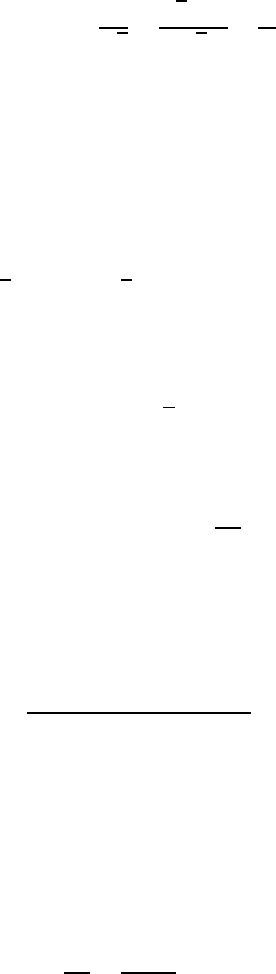
Consider the response of an ideal resistor to excitation by a sinusoidal voltage
as shown in Fig. 2.4.
The voltage across the resistance is the same as the voltage supplied by
the source:
v = V
m
cos ωt =
√
2V
rms
cos ωt =
√
2V cos ωt (2.12)
Notice the three ways that the voltage has been described: using the amplitude
of the voltage V
m
, the rms value of voltage V
rms
, and the symbol V which, in
this context, means the rms value. We will consistently use current I or voltage
V (capital letters, without subscripts) to mean the rms values of that current
or voltage.
The current that will pass through a resistor with the above voltage imposed
will be
i =
v
R
=
V
m
R
cos ωt =
√
2V
rms
R
cos ωt =
√
2V
R
cos ωt (2.13)
i
v
=√2
V
cos w
t
R
+
−
Figure 2.4 A sinusoidal voltage imposed on an ideal resistance.
56 FUNDAMENTALS OF ELECTRIC POWER
Since the phase angle of the resulting current is the same as the phase angle of
the voltage (zero), they are said to be in phase with each other. The rms value
of current is therefore
I
rms
= I =
I
m
√
2
=
√
2V/R
√
2
=
V
R
(2.14)
Notice how simple the result is: The rms current I is equal to the rms voltage V
divided by the resistance R. We have, in other words, a very simple ac version
of Ohm’s law:
V = RI (2.15)
where V and I are rms quantities.
Now let’s look at the average power dissipated in the resistor.
P
avg
= (vi)
avg
= [
√
2 V cos ωt ·
√
2 I cos ωt]
avg
= 2VI(cos
2
ωt)
avg
(2.16)
The average value of cos
2
ωt is 1/2. Therefore,
P
avg
= 2VI ·
1
2
= VI (2.17)
In a similar way, it is easy to show the expected alternative formulas for average
power are also true:
P
avg
= VI = I
2
R =
V
2
R
(2.18)
Notice how the ac problem has been greatly simplified by using rms values
of current and voltage. You should also note that the power given in (2.18) is
the average power and not some kind of rms value. Since ac power is always
interpreted to be average power, the subscript in P
avg
is not usually needed.
Example 2.3 ac Power for a Lightbulb. Suppose that a conventional incan-
descent lightbulb uses 60 W of power when it supplied with a voltage of 120 V.
Modeling the bulb as a simple resistance, find that resistance as well as the
current that flows. How much power would be dissipated if the voltage drops
to 110 V?
Solution Using (2.18), we have
R =
V
2
P
=
(120)
2
60
= 240
IDEALIZED COMPONENTS SUBJECTED TO SINUSOIDAL VOLTAGES 57
and
I =
P
V
=
60
120
= 0.5A
When the voltage sags to 110 V, the power dissipated will be
P =
V
2
R
=
(110)
2
240
= 50.4W
2.2.2 Idealized Capacitors
Recall the defining equation for a capacitor, which says that current is propor-
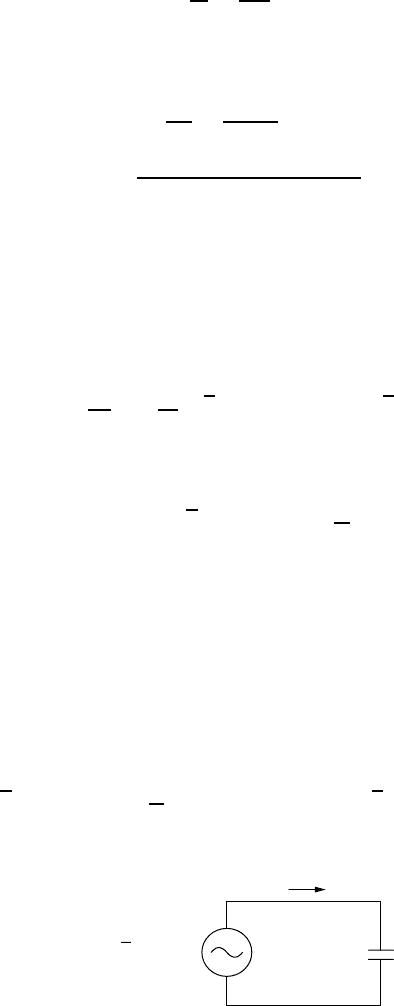
tional to the rate of change of voltage across the capacitor. Suppose we apply an
ac voltage of V volts (rms) across a capacitor, as shown in Fig. 2.5.
The resulting current through the capacitor will be
i = C
dv
dt
= C
d
dt
(
√
2V cos ωt) =−ωC
√
2V sin ωt (2.19)
If we apply the trigonometric identity that sin x =−cos(x + π/2),weget
i =
√
2ωCV cos
ωt +
π
2
(2.20)
There are several things to note about (2.20). For one, the current waveform
is a sinusoid of the same frequency as the voltage waveform. Also note that there
is a 90
◦
phase shift (π/2 radians) between the voltage and current. The current is
said to be leading the voltage by 90
◦
. That the current leads the voltage should
make some intuitive sense since charge must be delivered to the capacitor before
it shows a voltage. The graph in Fig. 2.6 also suggests the idea that the current
peaks 90
◦
before the voltage peaks.
Finally, writing (2.20) in terms of (2.1) gives
i =
√
2ωCV cos
ωt +
π
2
= I
m
cos(ωt + θ) =
√
2I cos(ωt + θ) (2.21)
i
v
=√2
V
cos w
t
C
+
−
Figure 2.5 An ac voltage V , applied across a capacitor.