
Masters G.M. Renewable and Efficient Electric Power Systems
Подождите немного. Документ загружается.


28 BASIC ELECTRIC AND MAGNETIC CIRCUITS
Another important quantity of interest in magnetic circuits is the magnetic flux
density, B. As the name suggests, it is simply the “density” of flux given by
the following:
Magnetic flux density B =
φ
A
webers/m
2
or teslas (T)(1.32)
When flux is given in webers (Wb) and area A is given in m
2
, units for B are
teslas (T). The analogous quantity in an electrical circuit would be the current
density, given by
Electric current density J =
i
A
(1.33)
The final magnetic quantity that we need to introduce is the magnetic field
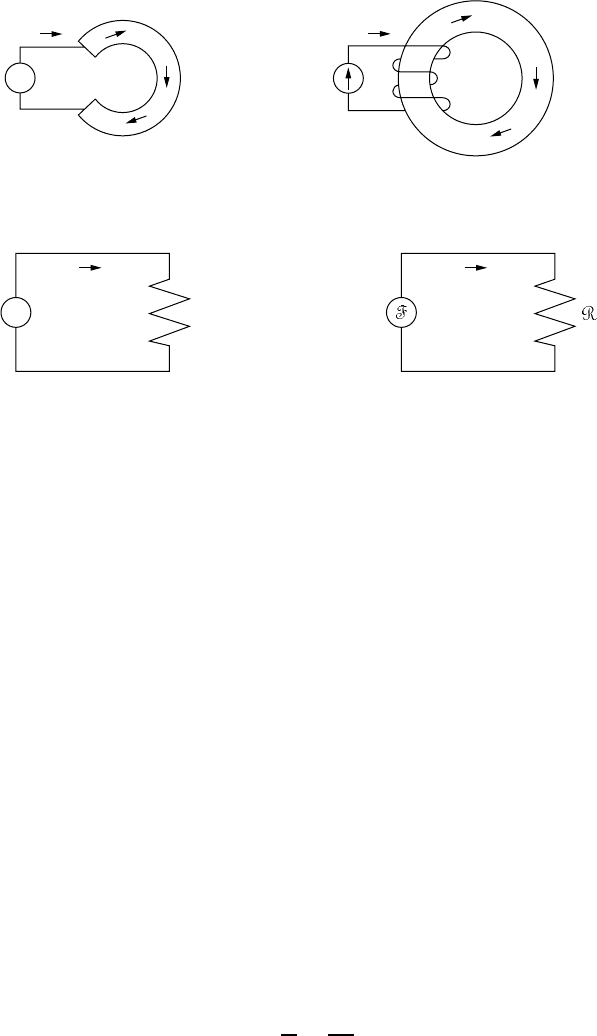
intensity, H . Referring back to the simple magnetic circuit shown in Fig. 1.20b,
the magnetic field intensity is defined as the magnetomotive force (mmf) per unit
of length around the magnetic loop. With N turns of wire carrying current i,the
mmf created in the circuit is Ni ampere-turns. With l representing the mean path
length for the magnetic flux, the magnetic field intensity is therefore
Magnetic field intensity H =
Ni
l
ampere-turns/meter (1.34)
An analogous concept in electric circuits is the electric field strength, which is
voltage drop per unit of length. In a capacitor, for example, the intensity of the
electric field formed between the plates is equal to the voltage across the plates
divided by the spacing between the plates.
Finally, if we combine (1.27), (1.28), (1.29), (1.32), and (1.34), we arrive at
the following relationship between magnetic flux density B and magnetic field
intensity H:
B = µH (1.35)
Returning to the analogies between the simple electrical circuit and magnetic
circuit shown in Fig. 1.20, we can now identify equivalent circuits, as shown in
Fig. 1.21, along with the analogs shown in Table 1.4.
TA BLE 1.4 Analogous Electrical and Magnetic Circuit Quantities
Electrical Magnetic Magnetic Units
Voltage v Magnetomotive force F = Ni Amp-turns
Current i Magnetic flux φ Webers Wb
Resistance R Reluctance
R Amp-turns/Wb
Conductivity 1/ρ Permeability µ Wb/A-t-m
Current density J Magnetic flux density B Wb/m
2
= teslas T
Electric field E Magnetic field intensity H Amp-turn/m
INDUCTANCE 29
CIRCUIT DIAGRAMS
EQUIVALENT CIRCUITS
Electrical
i
i
i
i
f
f
N
+
Magnetic
R
v
v
Figure 1.21 Equivalent circuits for the electrical and magnetic circuits shown.
1.7 INDUCTANCE
Having introduced the necessary electromagnetic background, we can now
address inductance. Inductance is, in some sense, a mirror image of capacitance.
While capacitors store energy in an electric field, inductors store energy in a
magnetic field. While capacitors prevent voltage from changing instantaneously,
inductors, as we shall see, prevent current from changing instantaneously.
1.7.1 Physics of Inductors
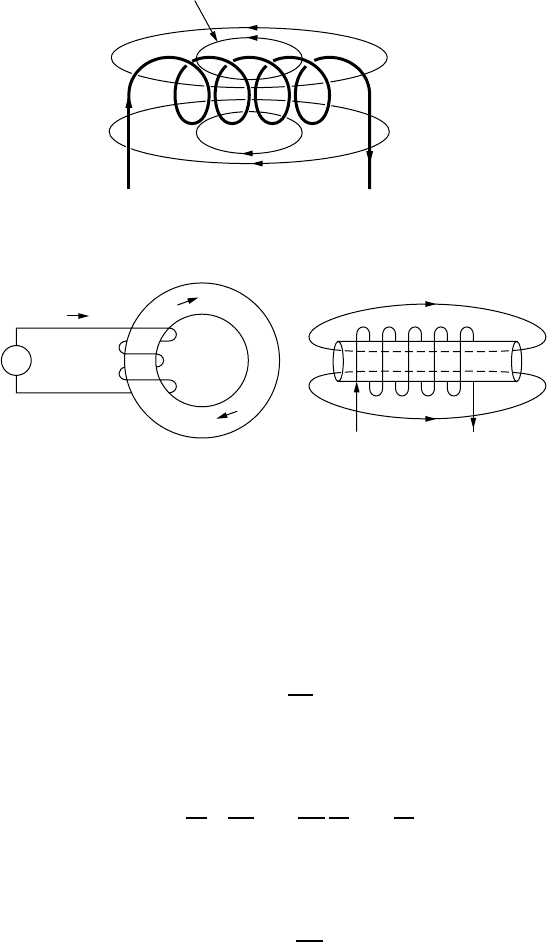
Consider a coil of wire carrying some current creating a magnetic field within the
coil. As shown in Fig 1.22, if the coil has an air core, the flux can pretty much
go where it wants to, which leads to the possibility that much of the flux will not
link all of the turns of the coil. To help guide the flux through the coil, so that
flux leakage is minimized, the coil might be wrapped around a ferromagnetic bar
or ferromagnetic core as shown in Fig. 1.23. The lower reluctance path provided
by the ferromagnetic material also greatly increases the flux φ.
We can easily analyze the magnetic circuit in which the coil is wrapped around
the ferromagnetic core in Fig. 1.23a. Assume that all of the flux stays within the
low-reluctance pathway provided by the core, and apply (1.28):
φ =
F
R
=
Ni
R
(1.36)
30 BASIC ELECTRIC AND MAGNETIC CIRCUITS
Leakage flux
Air core
Figure 1.22 A coil with an air core will have considerable leakage flux.
(a) (b)
i
f
Ne
v
+
+
−
−
i
+−
f
N
e
Figure 1.23 Flux can be increased and leakage reduced by wrapping the coils around
a ferromagnetic material that provides a lower reluctance path. The flux will be much
higher using the core (a) rather than the rod (b).
From Faraday’s law (1.26), changes in magnetic flux create a voltage e, called
the electromotive force (emf), across the coil equal to
e = N
dφ
dt
(1.26)
Substituting (1.36) into (1.26) gives
e = N
d
dt
Ni
R
=
N
2
R
di
dt
= L
di
dt
(1.37)
where inductance L has been introduced and defined as
Inductance L =
N
2
R
henries (1.38)
Notice in Fig. 1.23a that a distinction has been made between e,theemf
voltage induced across the coil, and v, a voltage that may have been applied
to the circuit to cause the flux in the first place. If there are no losses in the
INDUCTANCE 31
connecting wires between the source voltage and the coil, then e = v and we
have the final defining relationship for an inductor:
v = L
di
dt
(1.39)
As given in (1.38), inductance is inversely proportional to reluctance
R. Recall
that the reluctance of a flux path through air is much greater than the reluc-
tance if it passes through a ferromagnetic material. That tells us if we want a
large inductance, the flux needs to pass through materials with high permeability
(not air).
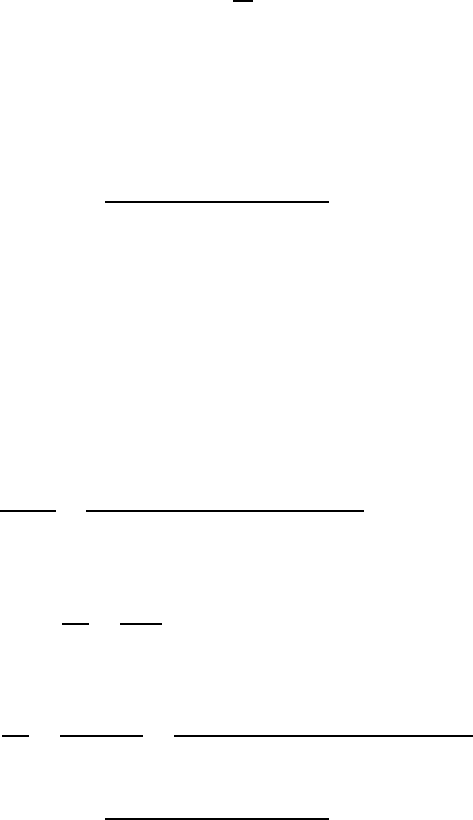
Example 1.9 Inductance of a Core-and-Coil. Find the inductance of a core
with effective length l = 0.1 m, cross-sectional area A = 0.001 m
2
, and relative
permeability µ
r
somewhere between 15,000 and 25,000. It is wrapped with N =
10 turns of wire. What is the range of inductance for the core?
Solution. When the core’s permeability is 15,000 times that of free space, it is
µ
core
= µ
r
µ
0
= 15,000 × 4π × 10
−7
= 0.01885 Wb/A-t-m
so its reluctance is
R
core
=
l
µ
core
A
=
0.1 m
0.01885 (Wb/A-t-m) × 0.001 m
2
= 5305 A-t/Wb
and its inductance is
L =
N
2
R
=
10
2
5305
= 0.0188 henries = 18.8mH
Similarly, when the relative permeability is 25,000 the inductance is
L =
N
2
R
=
N
2
µ
r
µ
0
A
l
=
10
2
× 25,000 ×4π × 10
−7
× 0.001
0.1
= 0.0314 H = 31.4mH
The point of Example 1.9 is that the inductance of a coil of wire wrapped
around a solid core can be quite variable given the imprecise value of the core’s
permeability. Its permeability depends on how hard the coil is driven by mmf
so you can’t just pick up an off-the-shelf inductor like this and know what its
inductance is likely to be. The trick to getting a more precise value of inductance
given the uncertainty in permeability is to sacrifice some amount of inductance by
32 BASIC ELECTRIC AND MAGNETIC CIRCUITS
building into the core a small air gap. Another approach is to get the equivalent
of an air gap by using a powdered ferromagnetic material in which the spaces
between particles of material act as the air gap. The air gap reluctance, which is
determined strictly by geometry, is large compared to the core reluctance so the
impact of core permeability changes is minimized.
The following example illustrates the advantage of using an air gap to
minimize the uncertainty in inductance. It also demonstrates something called
Amp`ere’s circuital law, which is the magnetic analogy to Kirchhoff’s voltage
law. That is, the rise in magnetomotive force (mmf) provided by N turns of
wire carrying current i is equal to the sum of the mmf drops
R φ around the
magnetic loop.
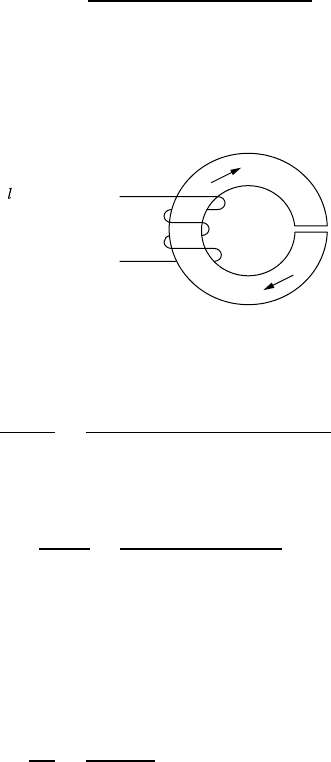
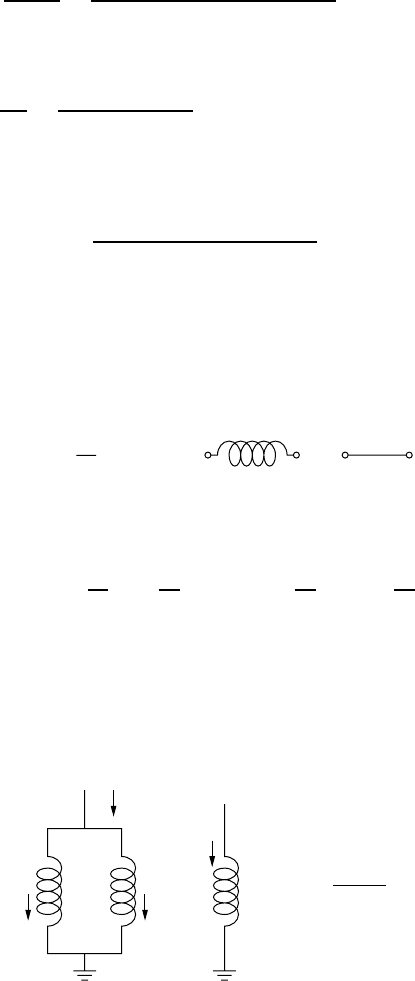
Example 1.10 An Air Gap to Minimize Inductance Uncertainty. Suppose
the core of Example 1.9 is built with a 0.001-m air gap. Find the range of induc-
tances when the core’s relative permeability varies between 15,000 and 25,000.
1-mm air
gap
core
= 0.099 m
N
= 10 turns
m
r
from 15,000 to 25,000
Solution. The reluctance of the ferromagnetic portion of the core when its rela-
tive permeability is 15,000 is
R
core
=
l
core
µ
core
A
=
0.099
15,000 ×4π × 10
−7
× 0.001
= 5252 A-t/Wb
And the air gap reluctance is
R
air gap
=
l
air gap
µ
0
A
=
0.001
4π × 10
−7
× 0.001
= 795,775 A-t/Wb
So the total reluctance of the series path consisting or core and air gap is
R
Total
= 5252 + 795,775 = 801,027 A-t/Wb
And the inductance is
L =
N
2
R
=
10
2
801,027
= 0.0001248 H = 0.1248 mH
INDUCTANCE 33
When the core’s relative permeability is 25,000, its reluctance is
R
core
=
l
core
µ
core
A
=
0.099
25,000 ×4π × 10
−7
× 0.001
= 3151 A-t/Wb
And the new total inductance is
L =
N
2
R
=
10
2
3151 + 795,775
= 0.0001251 H = 0.1251 mH
This is an insignificant change in inductance. A very precise inductance has been
achieved at the expense of a sizable decrease in inductance compared to the core
without an air gap.
1.7.2 Circuit Relationships for Inductors
From the defining relationship between voltage and current for an inductor (1.39),
we can note that when current is not changing with time, the voltage across the
inductor is zero. That is, for dc conditions an inductor looks the same as a
short-circuit, zero-resistance wire:
dc: v = L = L · 0 = 0 =
di
dt
(1.40)
When inductors are wired in series, the same current flows through each one
so the voltage drop across the pair is simply:
v
series
= L
1
di
dt
+ L
2
di
dt
= (L
1
+ L
2
)
di
dt
= L
series
di
dt
(1.41)
where L
series
is the equivalent inductance of the two series inductors. That is,
L
series
= L
1
+ L
2
(1.42)
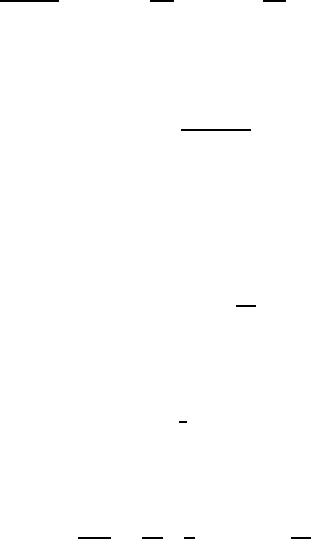
Consider Fig. 1.24 for two inductors in parallel.
i
i
1
i
2
v
+
L
1
L
2
i
L
parallel
=
=
L
1
L
2
L
1
+
L
2
Figure 1.24 Two inductors in parallel.
34 BASIC ELECTRIC AND MAGNETIC CIRCUITS
The total current flowing is the sum of the currents:
i
parallel
= i
1
+ i
2
(1.43)
The voltages are the same across each inductor, so we can use the integral form
of (1.39) to get
1
L
parallel
vdt =
1
L
1
vdt+
1
L
2
vdt (1.44)
Dividing out the integral gives us the equation for inductors in parallel:
L
parallel
=
L
1
L
2
L
1
+ L
2
(1.45)
Just as capacitors store energy in their electric fields, inductors also store
energy, but this time it is in their magnetic fields. Since energy W is the integral
of power P , we can easily set up the equation for energy stored:
W
L
=
Pdt=
vi dt =
L
di
dt
idt = L
idi (1.46)
This leads to the following equation for energy stored in an inductor’s mag-
netic field:
W
L
=
1
2
Li
2
(1.47)
If we use (1.47) to learn something about the power dissipated in an inductor,
we get
P =
dW
dt
=
d
dt
1
2
Li
2
= Li
di
dt
(1.48)
From (1.48) we can deduce another important property of inductors: The cur-
rent through an inductor cannot be changed instantaneously. For current to change
instantaneously, di/dt would be infinite, which (1.48) tells us would require infi-
nite power, which is impossible. It takes time for the magnetic field, which is
storing energy, to collapse. Inductors, in other words, make current act like it
has inertia.
Now wait a minute. If current is flowing in the simple circuit containing an
inductor, resistor, and switch shown in Fig 1.25, why can’t you just open the
switch and cause the current to stop instantaneously? Surely, it doesn’t take
infinite power to open a switch. The answer is that the current has to keep
going for at least a short interval just after opening the switch. To do so, current
momentarily must jump the gap between the contact points as the switch is
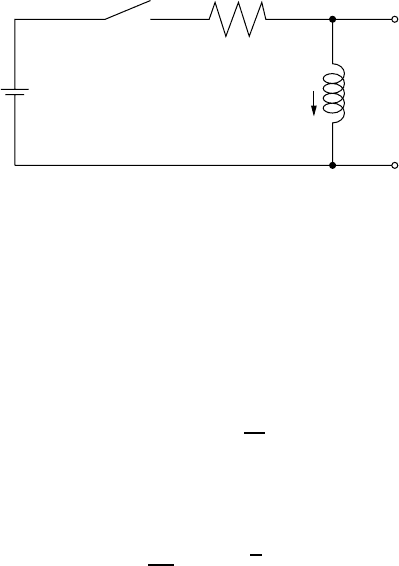
INDUCTANCE 35
i
switch
+
−
R
L
V
B
V
L
+
−
Figure 1.25 A simple R– L circuit with a switch.
opened. That is, the switch “arcs” and you get a little spark. Too much arc and
the switch can be burned out.
We can develop an equation that describes what happens when an open switch
in the R–L circuit of Fig. 1.25 is suddenly closed. Doing so gives us a little
practice with Kirchhoff’s voltage law. With the switch closed, the voltage rise due
to the battery must equal the voltage drop across the resistance plus inductance:
V
B
= iR + L
di
dt
(1.49)
Without going through the details the solution to (1.49), subject to the initial
condition that i = 0att = 0, is
i =
V
B
R
1 − e
−
R
L
t
(1.50)
Does this solution look right? At t = 0, i = 0, so that’s OK. At t =∞, i =
V
B
/R. That seems alright too since eventually the current reaches a steady-
state, dc value, which means the voltage drop across the inductor is zero (v
L
=
Ldi/dt = 0). At that point, all of the voltage drop is across the resistor, so
current is i = V
B
/R. The quantity L/R in the exponent of (1.50) is called the
time constant, τ .
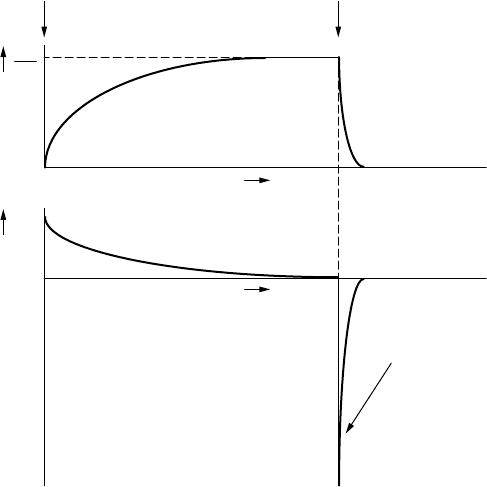
We can sketch out the current flowing in the circuit of Fig. 1.25 along with
the voltage across the inductor as we go about opening and closing the switch
(Fig 1.26). If we start with the switch open at t = 0
−
(where the minus suggests
just before t = 0), the current will be zero and the voltage across the inductor,
V
L
will be 0 (since V
L
= Ldi/dt and di/dt = 0).
At t = 0, the switch is closed. At t = 0
+
(just after the switch closes) the
current is still zero since it cannot change instantaneously. With zero current, there
is no voltage drop across the resistor (v
R
= iR), which means the entire battery
voltage appears across the inductor (v
L
= V
B
). Notice that there is no restriction
on how rapidly voltage can change across an inductor, so an instantaneous jump
is allowed. Current climbs after the switch is closed until dc conditions are
reached, at which point di/dt = 0sov
L
= 0 and the entire battery voltage is
dropped across the resistor. Current i asymptotically approaches V
B
/R.
36 BASIC ELECTRIC AND MAGNETIC CIRCUITS
0
i
0
V
L
Open
switch
Close
switch
0
Tt
0
Tt
BIG SPIKE !!
V
B
R
V
B
Figure 1.26 Opening a switch at t = T produces a large spike of voltage across
the inductor.
Now, at time t = T , open the switch. Current quickly, but not instantaneously,
drops to zero (by arcing). Since the voltage across the inductor is v
L
= Ldi/dt,
and di/dt (the slope of current) is a very large negative quantity, v
L
shows a
precipitous, downward spike as shown in Fig. 1.26. This large spike of voltage
can be much, much higher than the little voltage provided by the battery. In other
words, with just an inductor, a battery, and a switch, we can create a very large
voltage spike as we open the switch. This peculiar property of inductors is used
to advantage in automobile ignition systems to cause spark plugs to ignite the
gasoline in the cylinders of your engine. In your ignition system a switch opens
(it used to be the points inside your distributor, now it is a transistorized switch),
thereby creating a spike of voltage that is further amplified by a transformer coil
to create a voltage of tens of thousands of volts—enough to cause an arc across
the gap in your car’s spark plugs. Another important application of this voltage
spike is to use it to start the arc between electrodes of a fluorescent lamp.
1.8 TRANSFORMERS
When Thomas Edison created the first electric utility in 1882, he used dc to
transmit power from generator to load. Unfortunately, at the time it was not
possible to change dc voltages easily from one level to another, which meant
TRANSFORMERS 37
transmission was at the relatively low voltages of the dc generators. As we have
seen, transmitting significant amounts of power at low voltage means that high
currents must flow, resulting in large i
2
R power losses in the wires as well as
high voltage drops between power plant and loads. The result was that power
plants had to be located very close to loads. In those early days, it was not
uncommon for power plants in cities to be located only a few blocks apart.
In a famous battle between two giants of the time, George Westinghouse
solved the transmission problem by introducing ac generation using a transformer
to boost the voltage entering transmission lines and other transformers to reduce
the voltage back down to safe levels at the customer’s site. Edison lost the battle
but never abandoned dc—a decision that soon led to the collapse of his electric
utility company.
It would be hard to overstate the importance of transformers in modern electric
power systems. Transmission line power losses are proportional to the square of
current and are inversely proportional to the square of voltage. Raising voltages
by a factor of 10, for example, lowers line losses by a factor of 100. Modern
systems generate voltages in the range of 12 to 25 kV. Transformers boost that
voltage to hundreds of thousands of volts for long-distance transmission. At the
receiving end, transformers drop the transmission line voltage to perhaps 4 to
25 kV at electrical substations for local distribution. Other transformers then
drop the voltage to safe levels for home, office and factory use.
1.8.1 Ideal Transformers
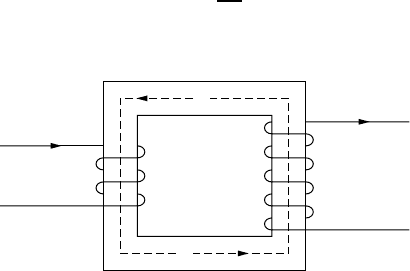
A simple transformer configuration is shown in Fig. 1.27. Two coils of wire are
wound around a magnetic core. As shown, the primary side of the transformer
has N
1
turns of wire carrying current i
1
, while the secondary side has N
2
turns
carrying i
2
.
If we assume an ideal core with no flux leakage, then the magnetic flux φ
linking the primary windings is the same as the flux linking the secondary. From
Faraday’s law we can write
e
1
= N
1
dφ
dt
(1.51)
Figure 1.27 An idealized two-winding transformer.
e
1
i
1
i
2
v
1
e
2
v
2
N
2
N
1
+
+
−
−
f
f