
Masters G.M. Renewable and Efficient Electric Power Systems
Подождите немного. Документ загружается.


18 BASIC ELECTRIC AND MAGNETIC CIRCUITS
TA BLE 1.3 Characteristics of Copper Wire
Wire Gage
(AWG No.)
Diameter
(inches)
Area
cmils
Ohms per
100 ft
a
Max Current
(amps)
000 0.4096 168,000 0.0062 195
00 0.3648 133,000 0.0078 165
0 0.3249 106,000 0.0098 125
2 0.2576 66,400 0.0156 95
4 0.2043 41,700 0.0249 70
6 0.1620 26,300 0.0395 55
8 0.1285 16,500 0.0628 40
10 0.1019 10,400 0.0999 30
12 0.0808 6,530 0.1588 20
14 0.0641 4,110 0.2525 15
a
dc, at 68
◦
F.
deforms, which eventually loosens connections. That, coupled with the high-
resistivity oxide that forms over exposed aluminum, can cause high enough I
2
R
losses to pose a fire hazard.
Wire size in the United States with diameter less than about 0.5 in. is specified
by its American Wire Gage (AWG) number. The AWG numbers are based on
wire resistance, which means that larger AWG numbers have higher resistance
and hence smaller diameter. Conversely, smaller gage wire has larger diameter
and, consequently, lower resistance. Ordinary house wiring is usually No. 12
AWG, which is roughly the diameter of the lead in an ordinary pencil. The
largest wire designated with an AWG number is 0000, which is usually written
4/0, with a diameter of 0.460 in. For heavier wire, which is usually stranded
(made up of many individual wires bundled together), the size is specified in the
United States in thousands of circular mills (kcmil). For example, 1000-kcmil
stranded copper wire for utility transmission lines is 1.15 in. in diameter and
has a resistance of 0.076 ohms per mile. In countries using the metric system,
wire size is simply specified by its diameter in millimeters. Table 1.3 gives some
values of wire resistance, in ohms per 100 feet, for various gages of copper wire
at 68
◦
F. Also given is the maximum allowable current for copper wire clad in
the most common insulation.
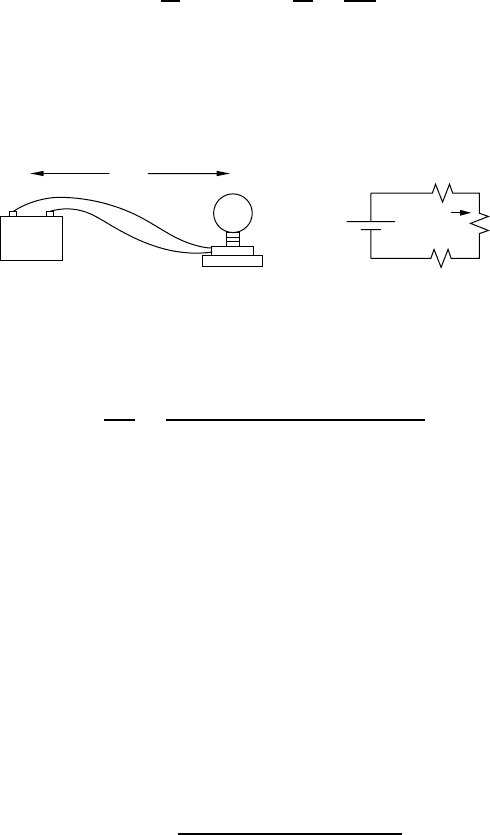
Example 1.6 Wire Losses. Suppose an ideal 12-V battery is delivering current
to a 12-V, 100-W incandescent lightbulb. The battery is 50 ft from the bulb, and
No. 14 copper wire is used. Find the power lost in the wires and the power
delivered to the bulb.
ELECTRICAL RESISTANCE 19
Solution. The resistance, R
b
, of a bulb designed to use 100 W when it is supplied
with 12 V can be found from (1.7):
P =
v
2
R
so R
b
=
v
2
P
=
12
2
100
= 1.44
From Table 1.3, 50 ft of 14 ga. wire has 0.2525 /100 ft, so since we have 50 ft
of wire to the bulb and 50 ft back again, the wire resistance is R
w
= 0.2525 .
The circuit is as follows:
12 V
50 ft
14 ga.
12 V
R
w
/2 = 0.12625 Ω
R
b
= 1.44 Ω
R
w
/2 = 0.12625 Ω
i
From Ohm’s law, the current flowing in the circuit is
i =
v
R
tot
=
12 V
(0.12625 +0.12625 +1.44)
= 7.09 A
So, the power delivered to the lightbulb is
P
b
= i
2
R
b
= (7.09)
2
· 1.44 = 72.4W
and the power lost in the wires is
P
w
= i
2
R
w
= (7.09)
2
· 0.2525 = 12.7W
Notice that our bulb is receiving only 72.4 W instead of 100 W, so it will not
be nearly as bright. Also note that the battery is delivering
P
battery
= 72.4 + 12.7 = 85.1W
of which, quite a bit, about 15%, is lost in the wires (12.7/85.1 = 0.15).
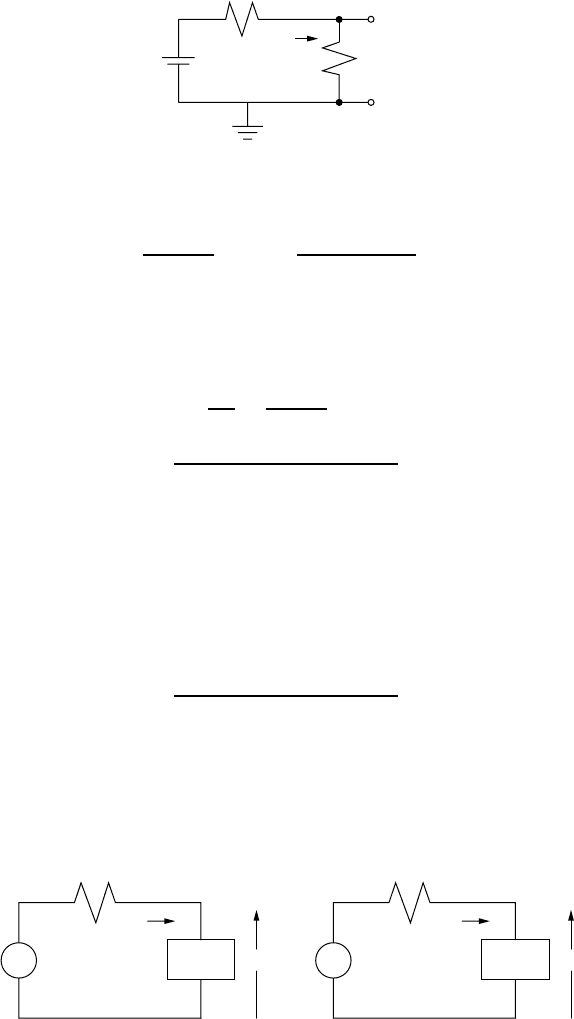
Alternate Solution: Let us apply the concept of a voltage divider to solve this
problem. We can combine the wire resistance going to the load with the wire
resistance coming back, resulting in the simplified circuit model shown below:
20 BASIC ELECTRIC AND MAGNETIC CIRCUITS
R
w
= 0.2525 Ω
R
b
= 1.44 Ω
i
V
b
12 V
Using (1.17), the voltage delivered to the load (the lightbulb) is
v
out
= v
in
R
2
R
1
+ R
2
= 12
1.44
0.2525 + 1.44
= 10.21 V
The 1.79-V difference between the 12 V supplied by the battery and the 10.21 V
that actually appears across the load is referred to as the voltage sag.
Power lost in the wires is thus
P
w
=
V
2
w
R
w
=
(1.79)
2
0.2525
= 12.7W
Example 1.6 illustrates the importance of the resistance of the connecting
wires. We would probably consider 15% wire loss to be unacceptable, in which
case we might want to increase the wire size (but larger wire is more expensive
and harder to work with). If feasible, we could take the alternative approach to
wire losses, which is to increase the supply voltage. Higher voltages require less
current to deliver a given amount of power. Less current means less i
2
R power
losses in the wires as the following example demonstrates.
Example 1.7 Raising Voltage to Reduce Wire Losses Suppose a load that
requires 120 W of power is located 50 ft from a generator. The load can be
designed to operate at 12 V or 120 V. Using No. 14 wire, find the voltage sag
and power losses in the connecting wire for each voltage.
(a) 12-V system (b) 120-V system
Vs
0.25 Ω
12 V
10 A
+
120-W
Load
Vs
0.25 Ω
120 V
1 A
+
120-W
Load

CAPACITANCE 21
Solution. There are 100 ft of No. 14 wire (to the load and back) with total
resistance of 0.2525 (Table 1.3).
At 12 V : To deliver 120 W at 12 V requires a current of 10 A, so the voltage
sag in the 0.2525- wire carrying 10 A is
V
sag
= iR = 10 A ×0.2525 = 2.525 V
The power loss in the wire is
P = i
2
R = (10)
2
× 0.2525 = 25.25 W
That means the generator must provide 25.25 + 120 = 145.25 W at a voltage of
12 + 2.525 = 14.525 V. Wire losses are 25.25/145.25 = 0.174 = 17.4% of the
power generated. Such high losses are generally unacceptable.
At 120 V : The current required to deliver 120 W is only 1 A, which means
the voltage drop in the connecting wire is only
Voltage sag = iR = 1A× 0.2525 = 0.2525 V
The power loss in the wire is
P
w
= i
2
R = (1)
2
× 0.2525 = 0.2525 W (1/100th that of the 12-V system)
The source must provide 120 W + 0.2525 W = 120.2525 W, of which the wires
will lose only 0.21%.
Notice that i
2
R power losses in the wires are 100 times larger in the 12-V
circuit, which carries 10 A, than they are in the 120-V circuit carrying only 1 A.
That is, increasing the voltage by a factor of 10 causes line losses to decrease
by a factor of 100, which is why electric power companies transmit their power
at such high voltages.
1.5 CAPACITANCE
Capacitance is a parameter in electrical circuits that describes the ability of a
circuit component to store energy in an electrical field. Capacitors are discrete
components that can be purchased at the local electronics store, but the capaci-
tance effect can occur whenever conductors are in the vicinity of each other. A
22 BASIC ELECTRIC AND MAGNETIC CIRCUITS
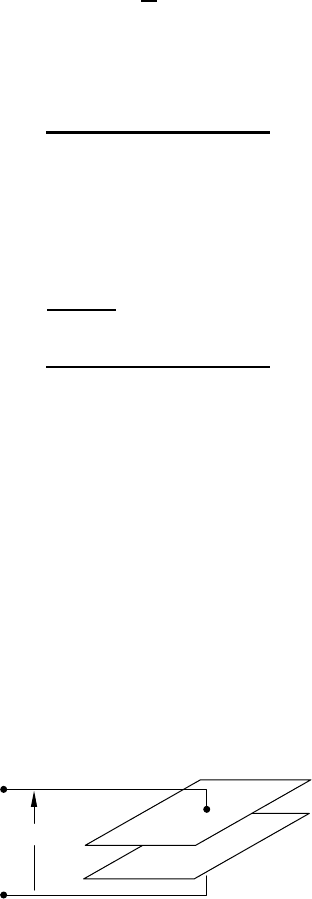
capacitor can be as simple as two parallel conducting plates (Fig. 1.15), separated
by a nonconducting dielectric such as air or even a thin sheet of paper.
If the surface area of the plates is large compared to their separation, the
capacitance is given by
C = ε
A
d
farads (1.20)
where C is capacitance (farads, F), ε is permittivity (F/m), A is area of one
plate (m
2
), and d is separation distance (m).
Example 1.8 Capacitance of Two Parallel Plates. Find the capacitance of two
0.5-m
2
parallel conducting plates separated by 0.001 m of air with permittivity
8.8 × 10
−12
F/m.
Solution
C = 8.8 × 10
−12
F/m ·
0.5 m
2
0.001 m
= 4.4 × 10
−9
F = 0.0044 µF = 4400 pF
Notice even with the quite large plate area in the example, the capacitance is
a very small number. In practice, to achieve large surface area in a small volume,
many capacitors are assembled using two flexible sheets of conductor, separated
by a dielectric, rolled into a cylindrical shape with connecting leads attached to
each plate.
Capacitance values in electronic circuits are typically in the microfarad
(10
−6
F = µF) to picofarad (10
−12
= pF) range. Capacitors used in utility power
systems are much larger, and are typically in the millifarad range. Later, we will
see how a different unit of measure, the kVAR, will be used to characterize the
size of large, power-system capacitors.
While Eq. (1.20) can be used to determine the capacitance from physical
characteristics, of greater importance is the relationship between voltage, current,
and capacitance. As suggested in Fig. 1.15, when charge q buildsuponthe
A
+
+
+
+
−
−
−
−
−
d
+
q
−
q
V
+
−
Figure 1.15 A capacitor can consist of two parallel, charged plates separated by a
dielectric.
CAPACITANCE 23
i
+
−
V
C
(a) Common
i
=
C
dv
dt
i
+
V
C
−
(b) Alternative
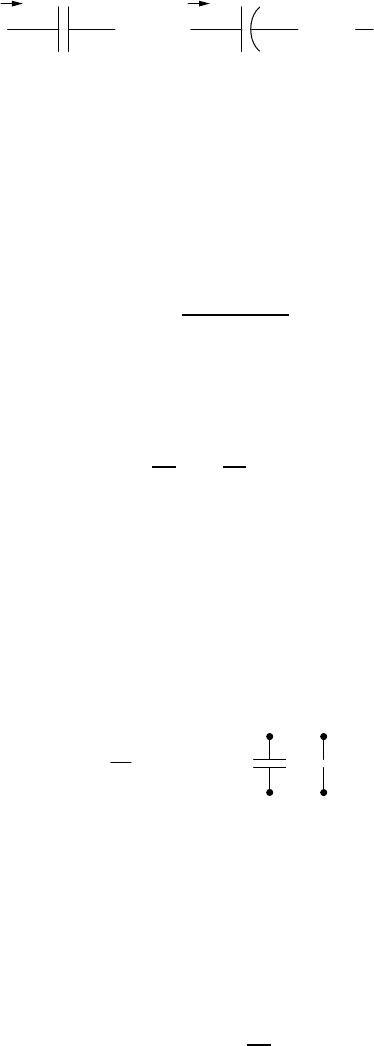
Figure 1.16 Two symbols for capacitors.
plates of a capacitor, a voltage v is created across the capacitor. This leads
to the fundamental definition of capacitance, which is that capacitance is equal
to the amount of charge required to create a 1-V potential difference between the
plates:
C(farads) =
q(coulombs)
v(volts)
(1.21)
Since current is the rate at which charge is added to the plates, we can rear-
range (1.21) and then take the derivative to get
i =
dq
dt
= C
dv
dt
(1.22)
The circuit symbol for a capacitor is usually drawn as two parallel lines, as
shown in Fig. 1.16a, but you may also encounter the symbol shown in Fig. 1.16b.
Sometimes, the term condenser is used for capacitors, as is the case in automobile
ignition systems.
From the defining relationship between current and voltage (1.22), it can be
seen that if voltage is not changing, then current into the capacitor has to be zero.
That is, under dc conditions, the capacitor appears to be an open circuit, through
whichnocurrentflows.
dc:
dv
dt
= 0, i = 0, =
(1.23)
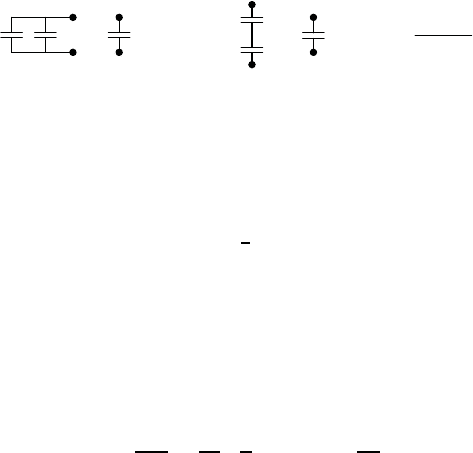
Kirchhoff’s current and voltage laws can be used to determine that the capac-
itance of two capacitors in parallel is the sum of their capacitances and that the
capacitance of two capacitors in series is equal to the product of the two over
the sum, as shown in Fig. 1.17.
Another important characteristic of capacitors is their ability to store energy
in the form of an electric field created between the plates. Since power is the
rate of change of energy, we can write that energy is the integral of power:
W
c
=
Pdt=
vi dt =
vC
dv
dt
dt = C
vdv
24 BASIC ELECTRIC AND MAGNETIC CIRCUITS
=
C
1
C
2
C
s
=
C
s
=
C
1
C
2
C
1
+
C
2
C
1
C
2
C
p
C
p
=
C
1
+
C
2
Figure 1.17 Capacitors in series and capacitors in parallel.
So, we can write that the energy stored in the electric field of a capacitor is
W
c
=
1
2
Cv
2
(1.24)
One final property of capacitors is that the voltage across a capacitor cannot
be changed instantaneously. To change voltage instantaneously, charge would
have to move from one plate, around the circuit, and back to the other plate
in zero time. To see this conclusion mathematically, write power as the rate of
change of energy,
P =
dW
dt
=
d
dt
1
2
Cv
2
= Cv
dv
dt
(1.25)
and then note that if voltage could change instantaneously, dv/dt would be
infinite, and it would therefore take infinite power to cause that change, which is
impossible—hence, the conclusion that voltage cannot change instantaneously.
An important practical application of this property will be seen when we look at
rectifiers that convert ac to dc. Capacitors resist rapid changes in voltages and
are used to smooth the dc voltage produced from such dc power supplies. In
power systems, capacitors have a number of other uses that will be explored in
the next chapter.
1.6 MAGNETIC CIRCUITS
Before we can introduce inductors and transformers, we need to understand the
basic concept of electromagnetism. The simple notions introduced here will be
expanded in later chapters when electric power quality (especially harmonic dis-
tortion), motors and generators, and fluorescent ballasts are covered.
1.6.1 Electromagnetism
Electromagnetic phenomena were first observed and quantified in the early nine-
teenth century—most notably, by three European scientists: Hans Christian Oer-
sted, Andr
´
eMarieAmp
`
ere, and Michael Faraday. Oersted observed that a wire
carrying current could cause a magnet suspended nearby to move. Amp
`
ere, in
MAGNETIC CIRCUITS 25
1825, demonstrated that a wire carrying current could exert a force on another
wire carrying current in the opposite direction. And Faraday, in 1831, discovered
that current could be made to flow in a coil of wire by passing a magnet close
to the circuit. These experiments provided the fundamental basis for the devel-
opment of all electromechanical devices, including, most importantly, motors
and generators.
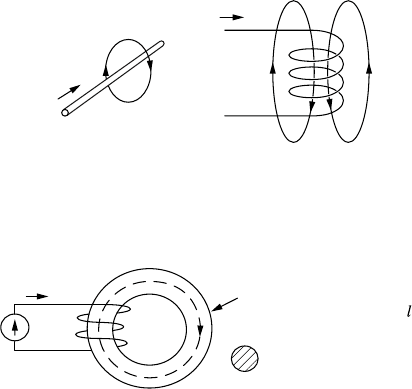
What those early experiments established was that electrical current flowing
along a wire creates a magnetic field around the wire, as shown in Fig. 1.18a. That
magnetic field can be visualized by showing lines of magnetic flux, which are
represented with the symbol φ. The direction of that field that can be determined
using the “right hand rule” in which you imagine wrapping your right hand
around a wire, with your thumb pointing in the direction of current flow. Your
fingers then show the direction of the magnetic field. The field created by a coil
of wire is suggested in Fig. 1.18b.
Consider an iron core wrapped with N turns of wire carrying current i as
shown in Fig. 1.19. The magnetic field formed by the coil will take the path of
least resistance—which is through the iron—in much the same way that electric
current stays within a copper conductor. In essence, the iron is to a magnetic
field what a wire is to current.
What Faraday discovered is that current flowing through the coil not only
creates a magnetic field in the iron, it also creates a voltage across the coil that
is proportional to the rate of change of magnetic flux φ in the iron. That voltage
is called an electromotive force, or emf, and is designated by the symbol e.
(a) (b)
i
f
i
f
Figure 1.18 A magnetic field is formed around a conductor carrying current.
i
Iron core
mean circumference,
Cross-sectional area A
eN
f
Figure 1.19 Current in the N-turn winding around an iron core creates a magnetic flux
φ. An electromotive force (voltage) e is induced in the coil proportional to the rate of
change of flux.
26 BASIC ELECTRIC AND MAGNETIC CIRCUITS
Assuming that all of the magnetic flux φ links all of the turns of the coil, we can
write the following important relationship, which is known as Faraday’s law of
electromagnetic induction:
e = N
dφ
dt
(1.26)
The sign of the induced emf is always in a direction that opposes the current that
created it, a phenomenon referred to as Lenz’s law.
1.6.2 Magnetic Circuits
Magnetic phenomena are described using a fairly large number of terms that are
often, at first, somewhat difficult to keep track of. One approach that may help is
to describe analogies between electrical circuits, which are usually more familiar,
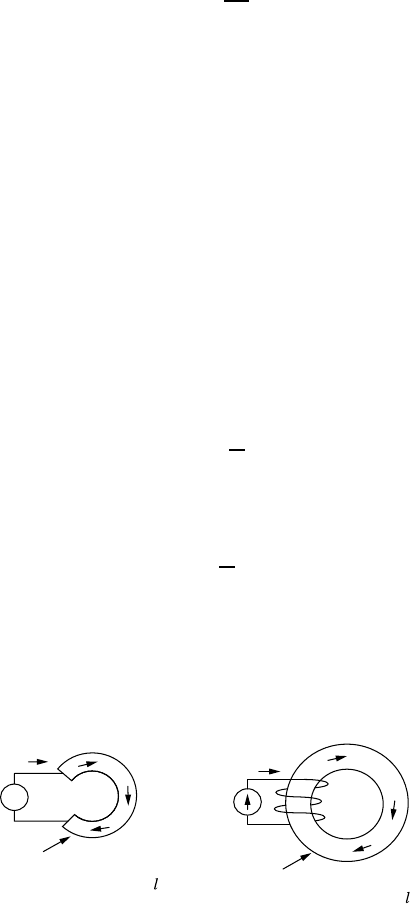
and corresponding magnetic circuits. Consider the electrical circuit shown in
Fig. 1.20a and the analogous magnetic circuit shown in Fig 1.20b. The electrical
circuit consists of a voltage source, v, sending current i through an electrical
load with resistance R. The electrical load consists of a long wire of length l,
cross-sectional area A, and conductance ρ.
The resistance of the electrical load is given by (1.18):
R = ρ
l
A
(1.18)
The current flowing in the electrical circuit is given by Ohm’s law:
i =
v
R
(1.5)
In the magnetic circuit of Fig. 1.20b, the driving force, analogous to voltage,
is called the magnetomotive force (mmf), designated by
F. The magnetomotive
force is created by wrapping N turns of wire, carrying current i, around a toroidal
Cross-sectional area A
Length
Conductance r
v
+
i
i
i
Cross-sectional area A
Length
Permeability m
f
N
(a) Electrical Circuit (b) Magnetic Circuit
Figure 1.20 Analogous electrical and magnetic circuits.

MAGNETIC CIRCUITS 27
core. By definition, the magnetomotive force is the product of current × turns,
and has units of ampere-turns.
Magnetomotive force (mmf )
F = Ni (ampere − turns)(1.27)
The response to that mmf (analogous to current in the electrical circuit) is
creation of magnetic flux φ, which has SI units of webers (Wb). The magnetic
flux is proportional to the mmf driving force and inversely proportional to a
quantity called reluctance
R, which is analogous to electrical resistance, resulting
in the “Ohm’s law” of magnetic circuits given by
F = R φ(1.28)
From (1.28), we can ascribe units for reluctance
R as amp-turns per weber
(A-t/Wb).
Reluctance depends on the dimensions of the core as well as its materials:
reluctance =
R =
l
µA
(A-t/Wb) (1.29)
Notice the similarity between (1.29) and the equation for resistance given in (1.18).
The parameter in (1.29) that indicates how readily the core material accepts
magnetic flux is the material’s permeability µ. There are three categories of
magnetic materials: diamagnetic, in which the material tends to exclude mag-
netic fields; paramagnetic, in which the material is slightly magnetized by a
magnetic field; and ferromagnetic, which are materials that very easily become
magnetized. The vast majority of materials do not respond to magnetic fields,
and their permeability is very close to that of free space. The materials that read-
ily accept magnetic flux—that is, ferromagnetic materials—are principally iron,
cobalt, and nickel and various alloys that include these elements. The units of
permeability are webers per amp-turn-meter (Wb/A-t-m).
The permeability of free space is given by
Permeability of free space µ
0
= 4π × 10
−7
Wb/A-t-m (1.30)
Oftentimes, materials are characterized by their relative permeability, µ
r
,which
for ferromagnetic materials may be in the range of hundreds to hundreds of thou-
sands. As will be noted later, however, the relative permeability is not a constant
for a given material: It varies with the magnetic field intensity. In this regard, the
magnetic analogy deviates from its electrical counterpart and so must be used
with some caution.
Relative permeability = µ
r
=
µ
µ
0
(1.31)