
Masters G.M. Renewable and Efficient Electric Power Systems
Подождите немного. Документ загружается.

348 WIND POWER SYSTEMS
TA BLE 6.5 Standard Wind Power Classifications
a
Wind
Power Class
Avg
Windspeed
at 10 m (m/s)
Avg
Windspeed
at 10 m (mph)
Wind Power
Density
at 10 m (W/m
2
)
Wind Power
Density
at 50 m (W/m
2
)
1 0–4.4 0–9.8 0–100 0–200
2 4.4–5.1 9.8–11.4 100–150 200–300
3 5.1–5.6 11.4–12.5 150–200 300–400
4 5.6–6.0 12.5–13.4 200–250 400–500
5 6.0–6.4 13.4–14.3 250–300 500–600
6 6.4–7.0 14.3–15.7 300–400 600–800
7 7.0–9.5 15.7–21.5 400–1000 800–2000
a
Assumptions include Rayleigh statistics, ground friction coefficient α = 1/7, sea-level 0
◦
Cair
density 1.225 kg/m
3
, 10-m anemometer height, 50-m hub height.
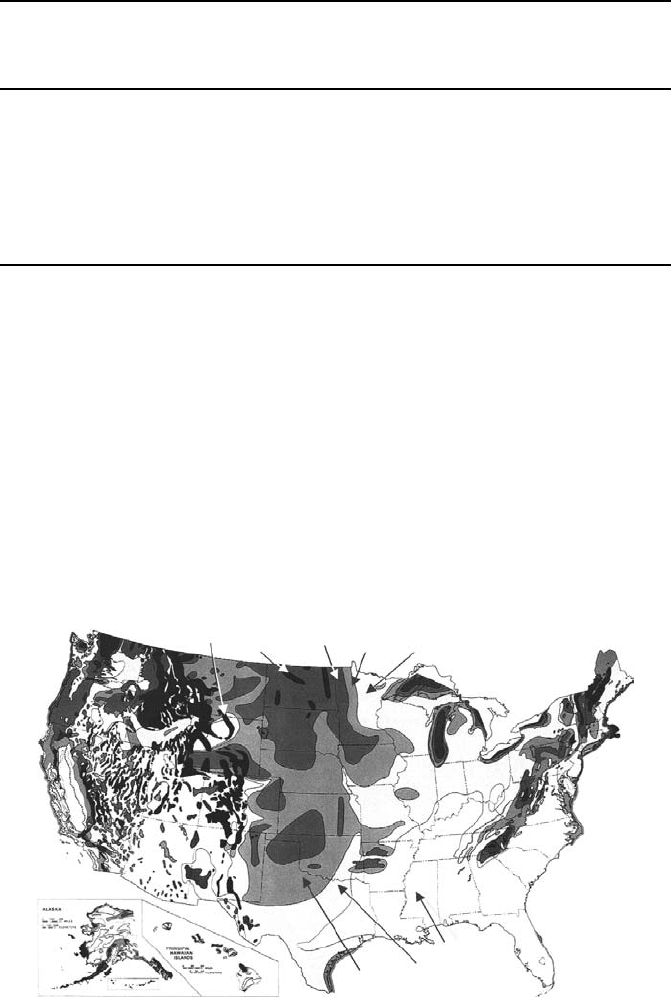
band of states stretching from Texas to North Dakota with especially high wind
power potential, including large areas with Class 4 or better winds (over 400 W/m
2
).
Translating available wind power from maps such as shown in Fig. 6.27 into
estimates of electrical energy that can be developed is an especially important
exercise for energy planners and policy makers. While the resource may be
available, there are significant land use questions that could limit the acceptability
of any given site. Flat grazing lands would be easy to develop, and the impacts
on current usage of such lands would be minimal. On the other hand, developing
sites in heavily forested areas or along mountain ridges, for example, would be
Class 6
Class 5
Class 4
Class 3
Class 2
Class 3
Class 2
Class 1
Figure 6.27 Av erage annual wind power density at 50-m elevation. From NREL Wind
Energy Resource Atlas of the United States.
SIMPLE ESTIMATES OF WIND TURBINE ENERGY 349
TABLE 6.6 Energy Potential for Class 3 or Higher Winds, in billion kWh/yr,
Including Environmental and Land Use Constraints
Percent of Percent of
Rank State Potential United States
a
Rank State Potential United States
a
1 North Dakota 1210 35% 11 Colorado 481 14%
2 Texas 1190 34%
12 New Mexico 435 12%
3 Kansas 1070 31%
13 Idaho 73 2%
4 South Dakota 1030 29%
14 Michigan 65 2%
5 Montana 1020 29%
15 New York 62 2%
6 Nebraska 868 25%
16 Illinois 61 2%
7 Wyoming 747 21%
17 California 59 2%
8 Oklahoma 725 21%
18 Wisconsin 58 2%
9 Minnesota 657 19%
19 Maine 56 2%
10 Iowa 551 16%
20 Missouri 52 1%
a
If totally utilized, the fraction of U.S. demand that wind could supply.
Source: Elliot et al. (1991).
much more difficult and environmentally damaging. Proximity to transmission
lines and load centers affects the economic viability of projects, although in the
future we could imagine wind generated electricity being converted, near the site,
into hydrogen that could be pipelined to customers.
One attempt to incorporate land-use constraints into the estimate of U.S. wind
energy potential was made by the Pacific Northwest Laboratory (Elliott et al.,
1991). Assuming turbine efficiency of 25% and 25% array and system losses,
the exploitable wind resource for the United States with no land-use restrictions is
estimated to be 16,700 billion kWh/yr and 4600 billion kWh/yr under the most
“severe” land use constraints. For comparison, the total amount of electricity
generated in the United States in 2002 was about 3500 billion kWh, which means
in theory that there is more than enough wind to supply all of U.S. electrical
demand. Distances from windy sites to transmission lines and load centers, along
with reliability issues, will constrain the total generation to considerably less than
that, but nonetheless the statistic is impressive.
The top 20 states for wind energy potential are shown in Table 6.6. Notice
that California, which in 2003 had the largest installed wind capacity, ranks only
seventeenth among the states for wind potential. At the top of the list is North
Dakota, with enough wind potential of its own to supply one-third of the total
U.S. electrical demand.
6.9 SIMPLE ESTIMATES OF WIND TURBINE ENERGY
How much of the energy in the wind can be captured and converted into electric-
ity? The answer depends on a number of factors, including the characteristics of
the machine (rotor, gearbox, generator, tower, controls), the terrain (topography,
350 WIND POWER SYSTEMS
surface roughness, obstructions), and, of course, the wind regime (velocity, tim-
ing, predictability). It also depends on the purpose behind the question. Are you
an energy planner trying to estimate the contribution to overall electricity demand
in a region that generic wind turbines might be able to make, or are you concerned
about the performance of one wind turbine versus another? Is it for a homework
question or are you investing millions of dollars in a wind farm somewhere?
Some energy estimates can be made with “back of the envelope” calculations,
and others require extensive wind turbine performance specifications and wind
data for the site.
6.9.1 Annual Energy Using Average Wind Turbine Efficiency
Suppose that the wind power density has been evaluated for a site. If we make
reasonable assumptions of the overall conversion efficiency into electricity by
the wind turbine, we can estimate the annual energy delivered. We already know
that the highest efficiency possible for the rotor itself is 59.3%. In optimum
conditions, a modern rotor will deliver about three-fourths of that potential. To
keep from overpowering the generator, however, the rotor must spill some of the
most energetic high-speed winds, and low-speed winds are also neglected when
they are too slow to overcome friction and generator losses. As Example 6.7
suggested, the gearbox and generator deliver about two-thirds of the shaft power
created by the rotor. Combining all of these factors leaves us with an overall
conversion efficiency from wind power to electrical power of perhaps 30%. Later
in the chapter, more careful calculations of wind turbine performance will be
made, but quick, simple estimates can be made based on wind classifications and
overall efficiencies.
Example 6.11 Annual Energy Delivered by a Wind Turbine. Suppose that
a NEG Micon 750/48 (750-kW generator, 48-m rotor) wind turbine is mounted
on a 50-m tower in an area with 5-m/s average winds at 10-m height. Assuming
standard air density, Rayleigh statistics, Class 1 surface roughness, and an overall
efficiency of 30%, estimate the annual energy (kWh/yr) delivered.
Solution. We need to find the average power in the wind at 50 m. Since “sur-
face roughness class” is given rather than the friction coefficient α,weneedto
use (6.16) to estimate wind speed at 50 m. From Table 6.4, we find the roughness
length z for Class 1 to be 0.03 m. The average windspeed at 50 m is thus
v
50
= v
10
ln(H
50
/z)
ln(H
10
/z)
= 5m/s·
ln(50/0.03)
ln(10/0.03)
= 6.39 m/s
Average power in the wind at 50 m is therefore (6.48)
P
50
=
6
π
·
1
2
ρ
v
3
= 1.91 × 0.5 × 1.225 × (6.39)
3
= 304.5W/m
2

SIMPLE ESTIMATES OF WIND TURBINE ENERGY 351
Since this 48-m machine collects 30% of that, then, in a year with 8760 hours,
the energy delivered would be
Energy = 0.3 × 304.5W/m
2
×
π
4
(48 m)
2
× 8760 h/yr ×
1kW
1000 W
= 1.45 × 10
6
kWh/yr
6.9.2 Wind Farms
Unless it is a single wind turbine for a particular site, such as an off-grid home
in the country, most often when a good wind site has been found it makes
sense to install a large number of wind turbines in what is often called a wind
farm or a wind park. Obvious advantages result from clustering wind turbines
together at a windy site. Reduced site development costs, simplified connections
to transmission lines, and more centralized access for operation and maintenance,
all are important considerations.
So how many turbines can be installed at a given site? Certainly wind turbines
located too close together will result in upwind turbines interfering with the wind
received by those located downwind. As we know, the wind is slowed as some of
its energy is extracted by a rotor, which reduces the power available to downwind
machines. Eventually, however, some distance downwind, the wind speed recov-
ers. Theoretical studies of square arrays with uniform, equal spacing illustrate
the degradation of performance when wind turbines are too close together. For
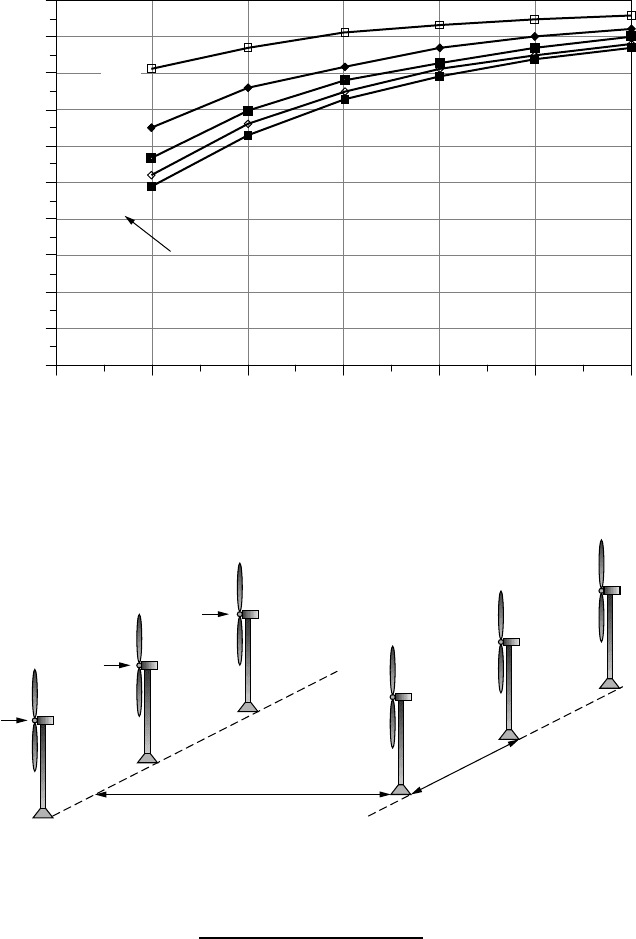
one such study, Figure 6.28 shows array efficiency (predicted output divided by
the power that would result if there were no interference) as a function of tower
spacing expressed in rotor diameters. The parameter is the number of turbines
in an equally-spaced array. That is, for example, a 2 × 2 array consists of four
wind turbines equally spaced within a square area, while an 8 × 8arrayis64
turbines in a square area. The larger the array, the greater the interference, so
array efficiency drops.
Figure 6.28 shows that interference out to at least 9 rotor diameters for all of
these square array sizes, but for small arrays performance degradation is modest,
less than about 20% for 6-diameter spacing with 16 turbines. Intuitively, an array
area should not be square, as was the case for the study shown in Fig. 6.28, but
rectangular with only a few long rows perpendicular to the prevailing winds,
with each row having many turbines. Experience has yielded some rough rules-
of-thumb for tower spacing of such rectangular arrays. Recommended spacing is
3–5 rotor diameters separating towers within a row and 5–9 diameters between
rows. The offsetting, or staggering, of one row of towers behind another, as
illustrated in Fig. 6.29 is also common.
We can now make some preliminary estimates of the wind energy potential
per unit of land area as the following example suggests.
352 WIND POWER SYSTEMS
9876543
0
10
20
30
40
50
60
70
80
90
100
Tower spacing (rotor diameters)
Array efficiency (percent)
4 × 4
6 × 6
8 × 8
10 × 10
Array size
2 × 2
Figure 6.28 Impact of tower spacing and array size on performance of wind turbines.
Source: Data in Milborrow and Surman (1987), presented in Grubb and Meyer (1993).
Prevailing wind
5−9 diameters 3−5 diameters
Figure 6.29 Optimum spacing of towers is estimated to be 3–5 rotor diameters between
wind turbines within a row and 5–9 diameters between rows.
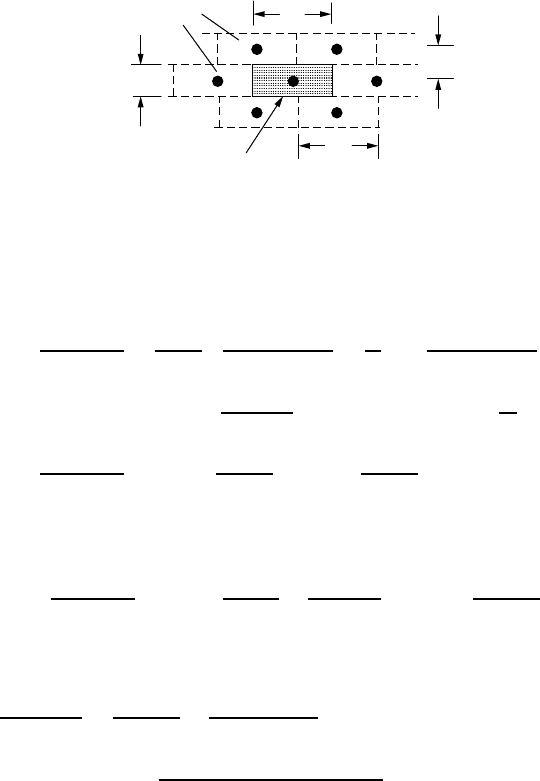
Example 6.12 Energy Potential for a Wind Farm. Suppose that a wind
farm has 4-rotor-diameter tower spacing along its rows, with 7-diameter spacing
between rows (4D × 7D). Assume 30% wind turbine efficiency and an array
efficiency of 80%.
SIMPLE ESTIMATES OF WIND TURBINE ENERGY 353
a. Find the annual energy production per unit of land area in an area with
400-W/m
2
winds at hub height (the edge of 50 m, Class 4 winds).
b. Suppose that the owner of the wind turbines leases the land from a rancher
for $100 per acre per year (about 10 times what a Texas rancher makes on
cattle). What does the lease cost per kWh generated?
4
D
7
D
7
D
4
D
Turbines
Area occupied by 1 turbine
Solution
a. As the figure suggests, the land area occupied by one wind turbine is
4D × 7D = 28D
2
,whereD is the diameter of the rotor. The rotor area is
(π/4)D
2
. The energy produced per unit of land area is thus
Energy
Land area
=
1
28D
2
Wind turbine
m
2
land
·
π
4
D
2
m
2
rotor
Wind turbine
× 400
W
m
2
rotor
× 0.30 × 0.80 × 8760
h
yr
Energy
Land area
= 23, 588
W · h
m
2
· yr
= 23.588
kWh
m
2
· yr
b. At 4047 m
2
per acre, the annual energy produced per acre is:
Energy
Land area
= 23.588
kWh
m
2
· yr
×
4047 m
2
acre
= 95, 461
kWh
acre · yr
so, leasing the land costs the wind farmer:
Land cost
kWh
=
$100
acre · yr
×
acre · yr
95, 461 kWh
= $0.00105/kWh = 0.1¢/kWh
The land leasing computation in the above example illustrates an important
point. Wind farms are quite compatible with conventional farming, especially
cattle ranching, and the added revenue a farmer can receive by leasing land to a
wind park is often more than the value of the crops harvested on that same land.
354 WIND POWER SYSTEMS
As a result, ranchers and farmers are becoming some of the strongest proponents
of wind power since it helps them to stay in their primary business while earning
higher profits.
6.10 SPECIFIC WIND TURBINE PERFORMANCE CALCULATIONS
The techniques already described that help us go from power in the wind to
electrical energy delivered have used only simple estimates of overall system
efficiency linked to wind probability statistics. Now we will introduce techniques
that can be applied to individual wind turbines based on their own specific per-
formance characteristics.
6.10.1 Some Aerodynamics
In order to understand some aspects of wind turbine performance, we need a brief
introduction to how rotor blades extract energy from the wind. Begin by consid-
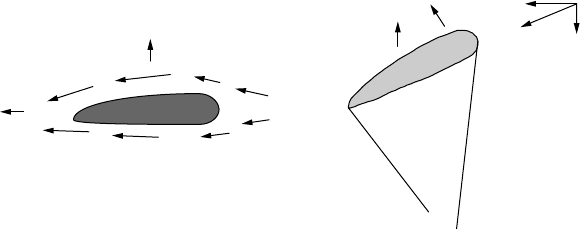
ering the simple airfoil cross section shown in Fig. 6.30a. An airfoil, whether it is
the wing of an airplane or the blade of a windmill, takes advantage of Bernoulli’s
principle to obtain lift. Air moving over the top of the airfoil has a greater dis-
tance to travel before it can rejoin the air that took the short cut under the foil.
That means that the air pressure on top is lower than that under the airfoil, which
creates the lifting force that holds an airplane up or that causes a wind turbine
blade to rotate.
Describing the forces on a wind turbine blade is a bit more complicated than
for a simple aircraft wing. A rotating turbine blade sees air moving toward it
not only from the wind itself, but also from the relative motion of the blade as
it rotates. As shown in Fig. 6.30b, the combination of wind and blade motion is
Lift
Drag
(a)
Blade motion
Wind
Relative
wind due to
blade motion
Resulting
wind
Lift
(b)
Figure 6.30 The lift in (a) is the result of faster air sliding over the top of the wind foil.
In (b), the combination of actual wind and the relative wind due to blade motion creates
a resultant that creates the blade lift.
SPECIFIC WIND TURBINE PERFORMANCE CALCULATIONS 355
like adding two vectors, with the resultant moving across the airfoil at the correct
angle to obtain lift that moves the rotor along. Since the blade is moving much
faster at the tip than near the hub, the blade must be twisted along its length to
keep the angles right.
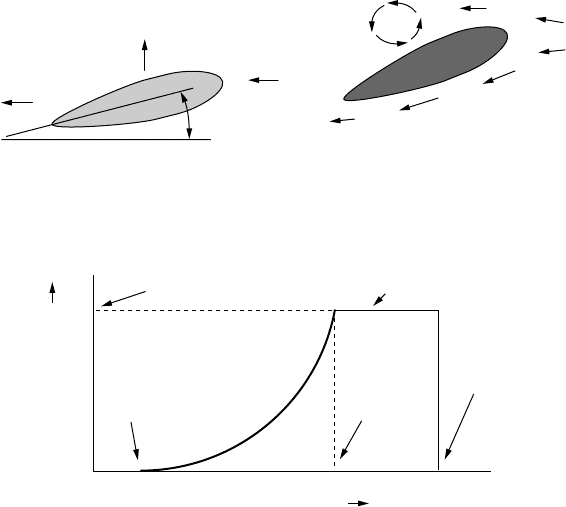
Up to a point, increasing the angle between the airfoil and the wind (called
the angle of attack), improves lift at the expense of increased drag. As shown
in Fig. 6.31, however, increasing the angle of attack too much can result in a
phenomenon known as stall. When a wing stalls, the airflow over the top no
longer sticks to the surface and the resulting turbulence destroys lift. When an
aircraft climbs too steeply, stall can have tragic results.
6.10.2 Idealized Wind Turbine Power Curve
The most important technical information for a specific wind turbine is the power
curve, which shows the relationship between windspeed and generator electrical
output. A somewhat idealized power curve is shown in Fig. 6.32.
Cut-in Windspeed. Low-speed winds may not have enough power to overcome
friction in the drive train of the turbine and, even if it does and the generator is
Lift
Drag
Wind
Angle of
attack
(a) ANGLE OF ATTACK (b) STALL
Figure 6.31 Increasing the angle of attack can cause a wing to stall.
Cut in windspeed
Rated
windspeed
Furling or
cut out
windspeed
Rated power
P
R
V
F
V
R
V
C
Power delivered (kW)
Windspeed (m/s)
Shedding the wind
Figure 6.32 Idealized power curve. No power is generated at windspeeds below V
C
;at
windspeeds between V
R
and V
F
, the output is equal to the rated power of the generator;
above V
F
the turbine is shut down.
356 WIND POWER SYSTEMS
rotating, the electrical power generated may not be enough to offset the power
required by the generator field windings. The cut-in windspeed V
C
is the mini-
mum needed to generate net power. Since no power is generated at windspeeds
below V
C
, that portion of the wind’s energy is wasted. Fortunately, there isn’t
much energy in those low-speed winds anyway, so usually not much is lost.
Rated Windspeed. As velocity increases above the cut-in windspeed, the
power delivered by the generator tends to rise as the cube of windspeed. When
winds reach the rated windspeed V
R
, the generator is delivering as much power
as it is designed for. Above V
R
, there must be some way to shed some of the
wind’s power or else the generator may be damaged. Three approaches are com-
mon on large machines: an active pitch-control system, a passive stall-control
design, and a combination of the two.
For pitch-controlled turbines an electronic system monitors the generator out-
put power; if it exceeds specifications, the pitch of the turbine blades is adjusted
to shed some of the wind. Physically, a hydraulic system slowly rotates the blades
about their axes, turning them a few degrees at a time to reduce or increase their
efficiency as conditions dictate. The strategy is to reduce the blade’s angle of
attack when winds are high.
For stall-controlled machines, the blades are carefully designed to automati-
cally reduce efficiency when winds are excessive. Nothing rotates—as it does in
the pitch-controlled scheme—and there are no moving parts, so this is referred to
as passive control. The aerodynamic design of the blades, especially their twist as
a function of distance from the hub, must be very carefully done so that a gradual
reduction in lift occurs as the blades rotate faster. The majority of modern, large
wind turbines use this passive, stall-controlled approach.
For very large machines, above about 1 MW, an active stall control scheme
may be justified. For these machines, the blades rotate just as they do in the active,
pitch-control approach. The difference is, however, that when winds exceed the
rated windspeed, instead of reducing the angle of attack of the blades, it is
increased to induce stall.
Small, kilowatt-size wind turbines can have any of a variety of techniques
to spill wind. Passive yaw controls that cause the axis of the turbine to move
more and more off the wind as windspeeds increase are common. This can be
accomplished by mounting the turbine slightly to the side of the tower so that
high winds push the entire machine around the tower. Another simple approach
relies on a wind vane mounted parallel to the plane of the blades. As winds get
too strong, wind pressure on the vane rotate the machine away from the wind.
Cut-out or Furling Windspeed. At some point the wind is so strong that
there is real danger to the wind turbine. At this windspeed V
F
, called the cut-
out windspeed or the furling windspeed (“furling” is the term used in sailing
to describe the practice of folding up the sails when winds are too strong), the
machine must be shut down. Above V
F
, output power obviously is zero.
For pitch-controlled and active stall-controlled machines, the rotor can be
stopped by rotating the blades about their longitudinal axis to create a stall. For
SPECIFIC WIND TURBINE PERFORMANCE CALCULATIONS 357
stall-controlled machines, it is common on large turbines to have spring-loaded,
rotating tips on the ends of the blades. When activated, a hydraulic system trips
the spring and the blade tips rotate 90
◦
out of the wind, stopping the turbine in a
few rotor revolutions. If the hydraulic system fails, the springs automatically
activate when rotor speed is excessive. Once a rotor has been stopped, by
whatever control mechanism, a mechanical brake locks the rotor shaft in place,
which is especially important for safety during maintenance.
6.10.3 Optimizing Rotor Diameter and Generator Rated Power
The idealized power curve of Fig. 6.32 provides a convenient framework within
which to consider the trade-offs between rotor diameter and generator size as
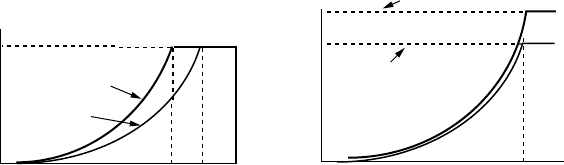
ways to increase the energy delivered by a wind turbine. As shown in Fig. 6.33a,
increasing the rotor diameter, while keeping the same generator, shifts the power
curve upward so that rated power is reached at a lower windspeed. This strategy
increases output power for lower-speed winds. On the other hand, keeping the
same rotor but increasing the generator size allows the power curve to continue
upward to the new rated power. For lower-speed winds, there isn’t much change,
but in an area with higher wind speeds, increasing the generator rated power is
a good strategy.
Manufacturers will sometimes offer a line of turbines with various rotor diam-
eters and generator ratings so that customers can best match the distribution of
windspeeds with an appropriate machine. In areas with relatively low wind-
speeds, a larger rotor diameter may be called for. In areas with relatively high
windspeeds, it may be better to increase the generator rating.
6.10.4 Wind Speed Cumulative Distribution Function
Recall some of the important properties of a probability density function for wind
speeds. The total area under a probability density function curve is equal to one,
Power (kW)
P
R
V
R
V
C
Windspeed (m/s)
Increased rotor
diameter
Original rotor
diameter
(a)
V
R
V
C
Power (kW)
P
R
Windspeed (m/s)
Original generator
Larger generator
(b)
Figure 6.33 (a) Increasing rotor diameter reduces the rated windspeed, emphasizing
lower speed winds. (b) Increasing the generator size increases rated power, emphasizing
higher windspeeds.