
Masters G.M. Renewable and Efficient Electric Power Systems
Подождите немного. Документ загружается.

318 WIND POWER SYSTEMS
Solution
a. From (6.13), P = 1atm× e
−1.185×10
−4
×2000
= 0.789 atm
From (6.7),
ρ =
P · M.W. · 10
−3
R · T
=
0.789(atm) × 28.97(g/mol) ×10
−3
(kg/g)
8.2056 × 10
−5
(m
3
· atm · K
−1
· mol
−1
) × 288.15 K
= 0.967 kg/m
3
b. At 5
◦
C and 2000 m, the air density would be
ρ =
0.789(atm) × 28.97(g/mol) ×10
−3
(kg/g)
8.2056 × 10
−5
(m
3
· atm · K
−1
· mol
−1
) × (273.15 + 5) K
= 1.00 kg/m
3
Table 6.2 summarizes some pressure correction factors based on (6.13). A
simple way to combine the temperature and pressure corrections for density is
as follows:
ρ = 1.225K
T
K
A
(6.14)
In (6.14), the correction factors K
T
for temperature and K
A
for altitude are
tabulated in Tables 6.1 and 6.2.
TABLE 6.2 Air Pressure at 15
◦
C as a Function
of Altitude
Altitude
(meters)
Altitude
(feet)
Pressure
(atm)
Pressure Ratio
(K
A
)
001 1
200 656 0.977 0.977
400 1312 0.954 0.954
600 1968 0.931 0.931
800 2625 0.910 0.910
1000 3281 0.888 0.888
1200 3937 0.868 0.868
1400 4593 0.847 0.847
1600 5249 0.827 0.827
1800 5905 0.808 0.808
2000 6562 0.789 0.789
2200 7218 0.771 0.771

IMPACT OF TOWER HEIGHT 319
Example 6.4 Combined Temperature and Altitude Corrections. Find the
power density (W/m
2
) in 10 m/s wind at an elevation of 2000 m and a temper-
ature of 5
◦
C.
Solution. Using K
T
and K
A
factors from Tables 6.1 and 6.2 along with (6.14)
gives
ρ = 1.225K
T
K
A
= 1.225 × 1.04 × 0.789 = 1.00 kg/m
3
which agrees with the answer found in Example 6.3. The power density in 10 m/s
winds is therefore
P
A
=
1
2
ρv
3
=
1
2
· 1.00 · 10
3
= 500 W/m
2
6.4 IMPACT OF TOWER HEIGHT
Since power in the wind is proportional to the cube of the windspeed, the eco-
nomic impact of even modest increases in windspeed can be significant. One
way to get the turbine into higher winds is to mount it on a taller tower. In the
first few hundred meters above the ground, wind speed is greatly affected by the
friction that the air experiences as it moves across the earth’s surface. Smooth
surfaces, such as a calm sea, offer very little resistance, and the variation of speed
with elevation is only modest. At the other extreme, surface winds are slowed
considerably by high irregularities such as forests and buildings.
One expression that is often used to characterize the impact of the roughness
of the earth’s surface on windspeed is the following:
v
v
0
=
H
H
0
α
(6.15)
where v is the windspeed at height H , v
0
is the windspeed at height H
0
(often
a reference height of 10 m), and α is the friction coefficient.
The friction coefficient α is a function of the terrain over which the wind
blows. Table 6.3 gives some representative values for rather loosely defined ter-
rain types. Oftentimes, for rough approximations in somewhat open terrain a
value of 1/7 (the “one-seventh” rule-of-thumb) is used for α.
While the power law given in (6.15) is very often used in the United States,
there is another approach that is common in Europe. The alternative formula-
tion is
v
v
0
=
ln(H/z)
ln(H
0
/z)
(6.16)

320 WIND POWER SYSTEMS
TA BLE 6.3 Friction Coefficient for Various Terrain
Characteristics
Terrain Characteristics
Friction Coefficient
α
Smooth hard ground, calm water 0.10
Tall grass on level ground 0.15
High crops, hedges and shrubs 0.20
Wooded countryside, many trees 0.25
Small town with trees and shrubs 0.30
Large city with tall buildings 0.40
TABLE 6.4 Roughness Classifications for Use in (6.16)
Roughness
Class Description
Roughness Length
z(m)
0 Water surface 0.0002
1 Open areas with a few windbreaks 0.03
2 Farm land with some windbreaks more than 1 km
apart 0.1
3 Urban districts and farm land with many windbreaks 0.4
4 Dense urban or forest 1.6
where z is called the roughness length. A table of roughness classifications and
roughness lengths is given in Table 6.4. Equation (6.16) is preferred by some
since it has a theoretical basis in aerodynamics while (6.15) does not.
∗
In this
chapter, we will stick with the exponential expression (6.15). Obviously, both
the exponential formulation in (6.15) and the logarithmic version of (6.16) only
provide a first approximation to the variation of windspeed with elevation. In
reality, nothing is better than actual site measurements.
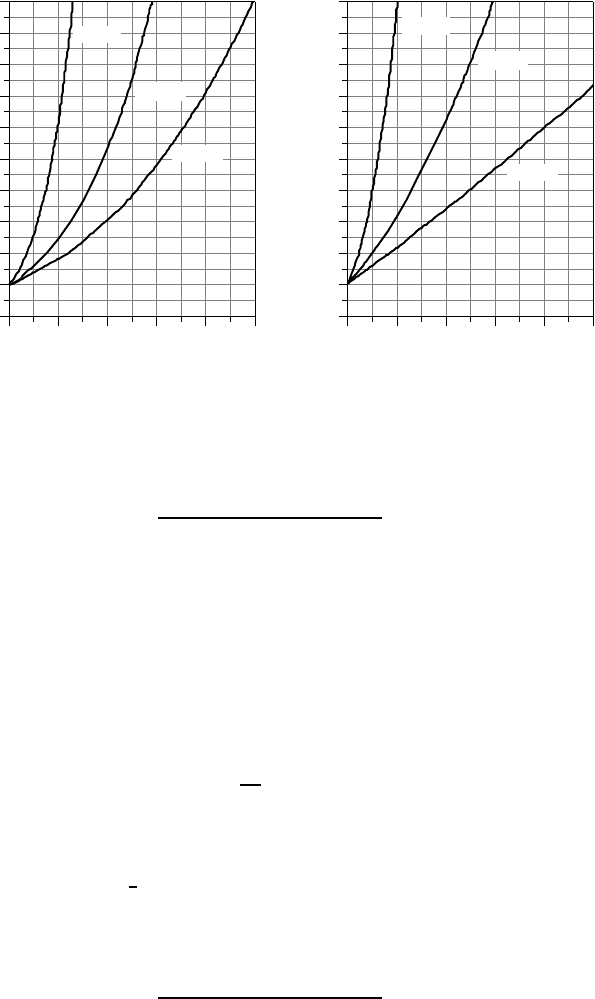
Figure 6.8a shows the impact of friction coefficient on windspeed assuming
a reference height of 10 m, which is a commonly used standard elevation for
an anemometer. As can be seen from the figure, for a smooth surface (α = 0.1),
the wind at 100 m is only about 25% higher than at 10 m, while for a site
in a “small town” (α = 0.3), the wind at 100 m is estimated to be twice that
at 10 m. The impact of height on power is even more impressive as shown in
Fig. 6.8b.
∗
When the atmosphere is thermally neutral—that is, it cools with a gradient of −9.8
◦
C/km—the air
flow within the boundary layer should theoretically vary logarithmically, starting with a windspeed
of zero at a distance above ground equal to the roughness length.
IMPACT OF TOWER HEIGHT 321
2.01.81.61.41.21.0
10
20
30
40
50
60
70
80
90
100
Windspeed ratio (
V
/
V
o
)
0
Height (m)
a = 0.1
a = 0.2
a = 0.3
654321
Power ratio
P
/
P
o
10
20
30
40
50
60
70
80
90
100
0
Height (m)
a = 0.1
a = 0.2
a = 0.3
(a) (b)
Figure 6.8 Increasing (a) windspeed and (b) power ratios with height for various friction
coefficients α using a reference height of 10 m. For α = 0.2 (hedges and crops) at 50 m,
windspeed increases by a factor of almost 1.4 and wind power increases by about 2.6.
Example 6.5 Increased Windpower with a Taller Tower. An anemometer
mounted at a height of 10 m above a surface with crops, hedges, and shrubs
shows a windspeed of 5 m/s. Estimate the windspeed and the specific power in
the wind at a height of 50 m. Assume 15
◦
C and 1 atm of pressure.
Solution. From Table 6.3, the friction coefficient α for ground with hedges, and
so on, is estimated to be 0.20. From the 15
◦
C, 1-atm conditions, the air density
is ρ = 1.225 kg/m
3
. Using (6.15), the windspeed at 50 m will be
v
50
= 5 ·
50
10
0.20
= 6.9m/s
Specific power will be
P
50
=
1
2
ρv
3
= 0.5 × 1.225 ×6.9
3
= 201 W/m
2
That turns out to be more than two and one-half times as much power as the
76.5 W/m
2
available at 10 m.
Since power in the wind varies as the cube of windspeed, we can rewrite (6.15)
to indicate the relative power of the wind at height H versus the power at the
322 WIND POWER SYSTEMS
reference height of H
0
:
P
P
0
=
1/2ρAv
3
1/2ρAv
3
0
=
v
v
0
3
=
H
H
0
3α
(6.17)
In Figure 6.8b, the ratio of wind power at other elevations to that at 10 m
shows the dramatic impact of the cubic relationship between windspeed and
power. Even for a smooth ground surface—f or instance, for an offshore site—the
power doubles when the height increases from 10 m to 100 m. For a rougher
surface, with friction coefficient α = 0.3, the power doubles when the height is
raised to just 22 m, and it is quadrupled when the height is raised to 47 m.
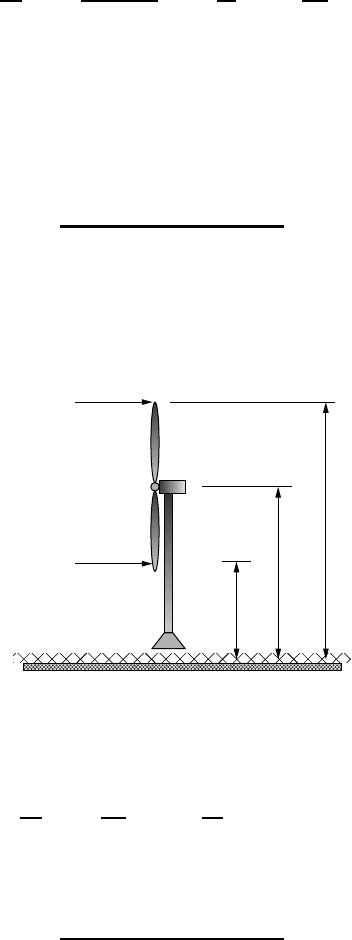
Example 6.6 Rotor Stress. A wind turbine with a 30-m rotor diameter is
mounted with its hub at 50 m above a ground surface that is characterized by
shrubs and hedges. Estimate the ratio of specific power in the wind at the highest
point that a rotor blade tip reaches to the lowest point that it falls to.
P
65
P
35
65 m
50 m
35 m
Crops, hedges, shrubs
Solution. From Table 6.3, the friction coefficient α for ground with hedges and
shrubs is estimated to be 0.20. Using (6.17), the ratio of power at the top of the
blade swing (65 m) to that at the bottom of its swing (35 m) will be
P
P
0
=
H
H
0
3α
=
65
35
3×0.2
= 1.45
The power in the wind at the top tip of the rotor is 45% higher than it is when
the tip reaches its lowest point.
Example 6.6 illustrates an important point about the variation in windspeed
and power across the face of a spinning rotor. For large machines, when a blade

MAXIMUM ROTOR EFFICIENCY 323
is at its high point, it can be exposed to much higher wind forces than when it
is at the bottom of its arc. This variation in stress as the blade moves through a
complete revolution is compounded by the impact of the tower itself on wind-
speed—especially for downwind machines, which have a significant amount of
wind “shadowing” as the blades pass behind the tower. The resulting flexing of
a blade can increase the noise generated by the wind turbine and may contribute
to blade fatigue, which can ultimately cause blade failure.
6.5 MAXIMUM ROTOR EFFICIENCY
It is interesting to note that a number of energy technologies have certain funda-
mental constraints that restrict the maximum possible conversion efficiency from
one form of energy to another. For heat engines, it is the Carnot efficiency that
limits the maximum work that can be obtained from an engine working between
a hot and a cold reservoir. For photovoltaics, we will see that it is the band gap
of the material that limits the conversion efficiency from sunlight into electrical
energy. For fuel cells, it is the Gibbs free energy that limits the energy conver-
sion from chemical to electrical forms. And now, we will explore the constraint
that limits the ability of a wind turbine to convert kinetic energy in the wind to
mechanical power.
The original derivation for the maximum power that a turbine can extract from
the wind is credited to a German physicist, Albert Betz, who first formulated the
relationship in 1919. The analysis begins by imagining what must happen to the
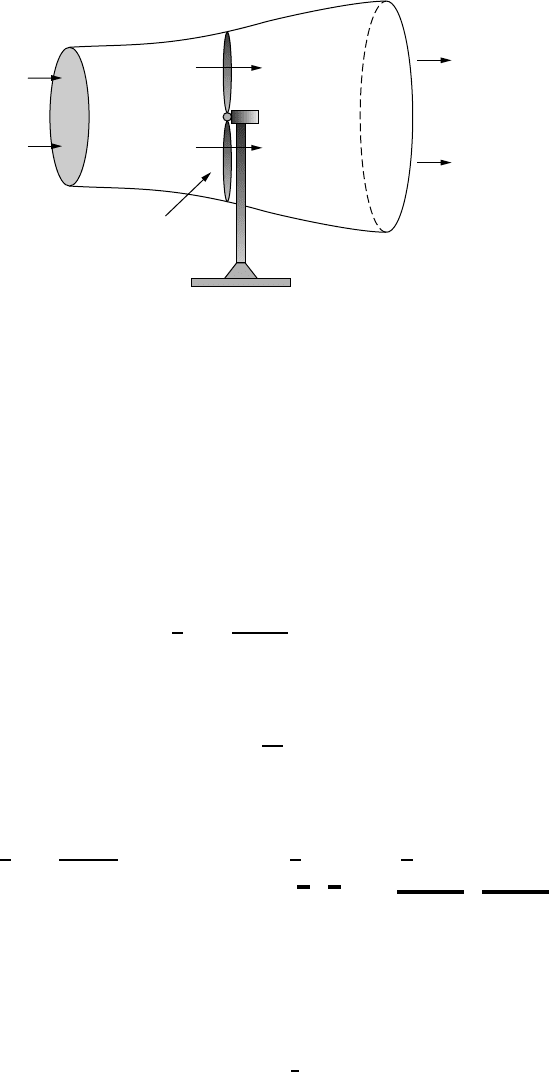
wind as it passes through a wind turbine. As shown in Fig. 6.9, wind approaching
from the left is slowed down as a portion of its kinetic energy is extracted by
the turbine. The wind leaving the turbine has a lower velocity and its pressure
is reduced, causing the air to expand downwind of the machine. An envelope
drawn around the air mass that passes through the turbine forms what is called
a stream tube, as suggested in the figure.
So why can’t the turbine extract all of the kinetic energy in the wind? If it
did, the air would have to come to a complete stop behind the turbine, which,
with nowhere to go, would prevent any more of the wind to pass through the
rotor. The downwind velocity, therefore, cannot be zero. And, it makes no sense
for the downwind velocity to be the same as the upwind speed since that would
mean the turbine extracted no energy at all from the wind. That suggests that
there must be some ideal slowing of the wind that will result in maximum power
extracted by the turbine. What Betz showed was that an ideal wind turbine would
slow the wind to one-third of its original speed.
In Fig. 6.9, the upwind velocity of the undisturbed wind is v, the velocity of
the wind through the plane of the rotor blades is v
b
, and the downwind velocity
is v
d
. The mass flow rate of air within the stream tube is everywhere the same,
call it ˙m. The power extracted by the blades P
b
is equal to the difference in
kinetic energy between the upwind and downwind air flows:
P
b
=
1
2
˙m(v
2
− v
2
d
)(6.18)
324 WIND POWER SYSTEMS
v
b
v
d
v
Upwind
Rotor area
A
Downwind
Figure 6.9 Approaching wind slows and expands as a portion of its kinetic energy is
extracted by the wind turbine, forming the stream tube shown.
The easiest spot to determine mass flow rate ˙m is at the plane of the rotor where
we know the cross-sectional area is just the swept area of the rotor A.Themass
flow rate is thus
˙m = ρAv
b
(6.19)
If we now make the assumption that the velocity of the wind through the plane
of the rotor is just the average of the upwind and downwind speeds (Betz’s
derivation actually does not depend on this assumption), then we can write
P
b
=
1
2
ρA
v + v
d
2
(v
2
− v
2
d
)(6.20)
To help keep the algebra simple, let us define the ratio of downstream to upstream
windspeed to be λ:
λ =
v
d
v
(6.21)
Substituting (6.21) into (6.20) gives
P
b
=
1
2
ρA
v + λv
2
(v
2
− λ
2
v
2
) =
1
2
ρAv
3
Power in the wind
·
1
2
(1 + λ)(1 − λ
2
)
Fraction extracted
(6.22)
Equation (6.22) shows us that the power extracted from the wind is equal to the
upstream power in the wind multiplied by the quantity in brackets. The quantity
in the brackets is therefore the fraction of the wind’s power that is extracted by
the blades; that is, it is the efficiency of the rotor, usually designated as C
p
.
Rotor efficiency = C
P
=
1
2
(1 + λ)(1 − λ
2
)(6.23)
MAXIMUM ROTOR EFFICIENCY 325
So our fundamental relationship for the power delivered by the rotor becomes
P
b
=
1
2
ρAv
3
· C
p
(6.24)
To find the maximum possible rotor efficiency, we simply take the derivative
of (6.23) with respect to λ and set it equal to zero:
dC
p
dλ
=
1
2
[(1 + λ)(−2λ) + (1 − λ
2
)] = 0
=
1
2
[(1 + λ)(−2λ) + (1 + λ)(1 − λ)] =
1
2
(1 + λ)(1 − 3λ) = 0
which has solution
λ =
v
d
v
=
1
3
(6.25)
In other words, the blade efficiency will be a maximum if it slows the wind to
one-third of its undisturbed, upstream velocity.
If we now substitute λ = 1/3 into the equation for rotor efficiency (6.23), we
find that the theoretical maximum blade efficiency is
Maximum rotor efficiency =
1
2
1 +
1
3
1 −
1
3
2
=
16
27
= 0.593 = 59.3%
(6.26)
This conclusion, that the maximum theoretical efficiency of a rotor is 59.3%, is
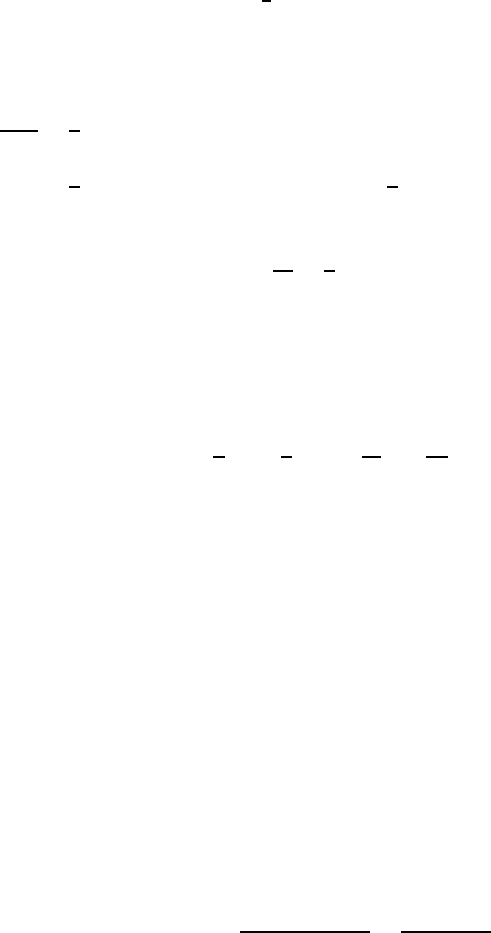
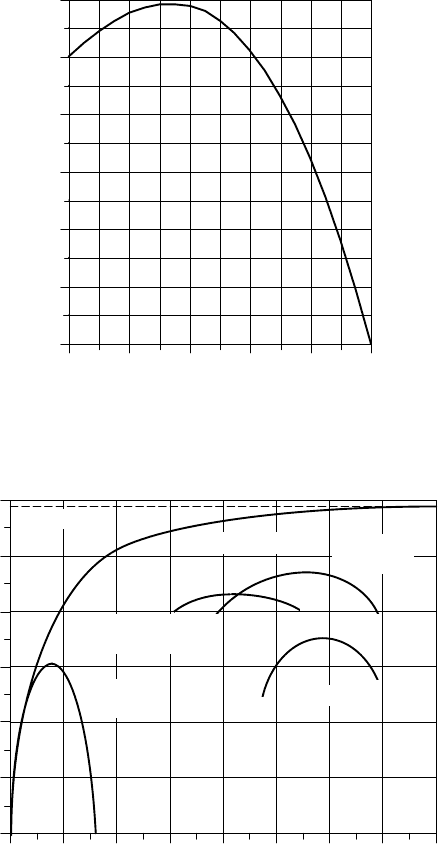
called the Betz efficiency or, sometimes, Betz’ law. A plot of (6.22), showing this
maximum occurring when the wind is slowed to one-third its upstream rate, is
showninFig.6.10.
The obvious question is, how close to the Betz limit for rotor efficiency of
59.3 percent are modern wind turbine blades? Under the best operating conditions,
they can approach 80 percent of that limit, which puts them in the range of about
45 to 50 percent efficiency in converting the power in the wind into the power
of a rotating generator shaft.
For a given windspeed, rotor efficiency is a function of the rate at which
the rotor turns. If the rotor turns too slowly, the efficiency drops off since the
blades are letting too much wind pass by unaffected. If the rotor turns too fast,
efficiency is reduced as the turbulence caused by one blade increasingly affects
the blade that follows. The usual way to illustrate rotor efficiency is to present
it as a function of its tip-speed ratio (TSR). The tip-speed-ratio is the speed at
which the outer tip of the blade is moving divided by the windspeed:
Tip-Speed-Ratio (TSR) =
Rotor tip speed
Wind speed
=
rpm × πD
60 v
(6.27)
where rpm is the rotor speed, revolutions per minute; D is the rotor diameter
(m); and v is the wind speed (m/s) upwind of the turbine.
326 WIND POWER SYSTEMS
1.00.80.60.40.20.0
0.0
0.1
0.2
0.3
0.4
0.5
0.6
Vd
/
V
Blade efficiency,
C
p
Figure 6.10 The blade efficiency reaches a maximum when the wind is slowed to
one-third of its upstream value.
876543210
0
10
20
30
40
50
60
Tip-speed ratio
Rotor efficiency (percent)
Modern
three-blade
American
multiblade
Betz limit
Darrieus rotor
Ideal efficiency
High-speed
two-blade
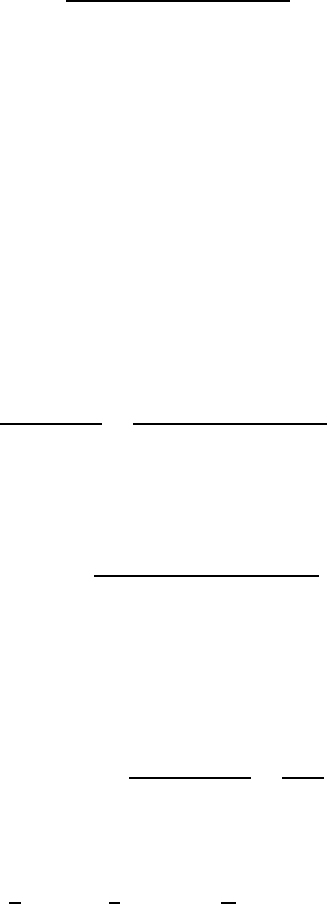
Figure 6.11 Rotors with fewer blades reach their optimum efficiency at higher rota-
tional speeds.
A plot of typical efficiency for various rotor types versus TSR is given in
Fig. 6.11. The American multiblade spins relatively slowly, with an optimal TSR
of less than 1 and maximum efficiency just over 30%. The two- and three-blade
rotors spin much faster, with optimum TSR in the 4–6 range and maximum
MAXIMUM ROTOR EFFICIENCY 327
efficiencies of roughly 40–50%. Also shown is a line corresponding to an “ideal
efficiency,” which approaches the Betz limit as the rotor speed increases. The
curvature in the maximum efficiency line reflects the fact that a slowly turning
rotor does not intercept all of the wind, which reduces the maximum possible
efficiency to something below the Betz limit.
Example 6.7 How Fast Does a Big Wind Turbine Turn? A 40-m, three-
bladed wind turbine produces 600 kW at a w indspeed of 14 m/s. Air density is
the standard 1.225 kg/m
3
. Under these conditions,
a. At what rpm does the rotor turn when it operates with a TSR of 4.0?
b. What is the tip speed of the rotor?
c. If the generator needs to turn at 1800 rpm, what gear ratio is needed to
match the rotor speed to the generator speed?
d. What is the efficiency of the complete wind turbine (blades, gear box,
generator) under these conditions?
Solution
a. Using (6.27),
rpm =
TSR × 60 v
πD
=
4 × 60 s/min ×14 m/s
40πm/rev
= 26.7rev/min
That’s about 2.2 seconds per revolution ... pretty slow!
b. The tip of each blade is moving at
Tip speed =
26.7 rev/min × π40 m/rev
60 s/ min
= 55.9m/s
Notice that even though 2.2 s/rev sounds slow; the tip of the blade is
moving at a rapid 55.9 m/s, or 125 mph.
c. If the generator needs to spin at 1800 rpm, then the gear box in the nacelle
must increase the rotor shaft speed by a factor of
Gear ratio =
Generator rpm
Rotor rpm
=
1800
26.7
= 67.4
d. From (6.4) the power in the wind is
P
w
=
1
2
ρAv
w
3
=
1
2
× 1.225 ×
π
4
× 40
2
× 14
3
= 2112 kW