
Masters G.M. Renewable and Efficient Electric Power Systems
Подождите немного. Документ загружается.

438 THE SOLAR RESOURCE
JAN FEB MAR APR MAY JUN JLY AUG SEP OCT NOV DEC
0
1
2
3
4
5
6
7
8
9
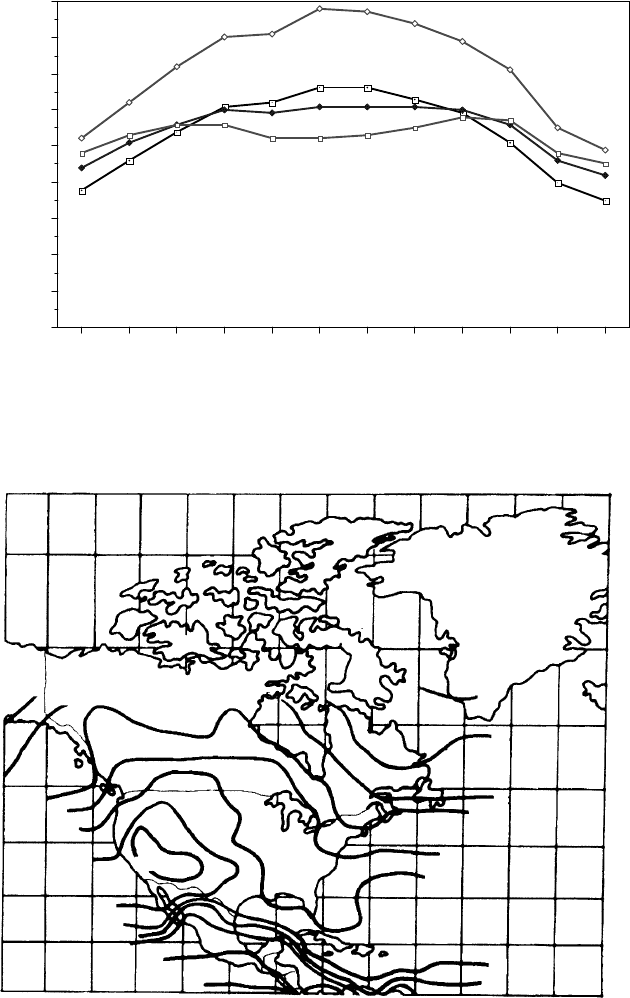
INSOLATION (kWh/m
2
-day)
1-Axis Tracking
(Annual 7.2 kWh/m
2
-d)
Lat + 15 (5.3 kWh)
Lat (5.5 kWh)
Lat − 15 (5.4 kWh)
Figure 7.35 Insolation on south-facing collectors in Boulder, CO, at tilt angles equal to
the latitude and latitude ±15
◦
. Values in parentheses are annual averages (kWh/m
2
-day).
The one-axis tracker with tilt equal to the latitude delivers about 30% more annual energy.
4.5
6.0
5.0
5.5
5.5
5.5
6.0
6.0
6.5
7.5
6.5
5.5
4.5
5.0
4.0
6.0
6.0
7.0
7.0
6.5
6.5
80
60
40
20
140 120 100 80 60 40 20
SUMMER
Figure 7.36 Solar radiation for south-facing collectors with tilt angle equal to L − 15
◦
in summer (kWh/m
2
-day). From Sandia National Laboratories (1987).
PROBLEMS 439
5.5 h of full sun. The units on these radiation maps can therefore be thought of
as “hours of full sun.” As will be seen in the next chapters on photovoltaics, the
hours-of-full-sun approach is central to the analysis and design of PV systems.
REFERENCES
The American Ephemeris and Nautical Almanac, published annually by the Nautical
Almanac Office, U.S. Naval Observatory, Washington, D.C.
ASHRAE, 1993, Handbook of Fundamentals, American Society of Heating, Refrigeration
and Air Conditioning Engineers, Atlanta.
Collares-Pereira, M., and A. Rabl (1979). The Average Distribution of Solar
Radiation—Correlation Between Diffuse and Hemispherical, Solar Energy, vol. 22,
pp. 155–166.
Kuen, T. H., J. W. Ramsey, and J. L. Threlkeld, 1998, Thermal Environmental Engineer-
ing, 3rd ed., Prentice-Hall, Englewood Cliffs, NJ.
Liu, B. Y. H., and R. C. Jordan (1961). Daily Insolation on Surfaces Tilted Toward the
Equator, Trans. ASHRAE, vol. 67, pp. 526–541.
NREL, 1994. Solar Radiation Data Manual for Flat-Plate and Concentrating Collectors,
NREL/TP-463-5607, National Renewable Energy Laboratory, Golden, CO.
Perez, R., P. Ineichen, R. Seals, J. Michalsky, and R. Stewart (1990). Modeling Day-
light Availability and Irradiance Components from Direct and Global Irradiance, Solar
Energy, vol. 44, no. 5, pp. 271–289.
Sandia National Laboratories (1987). Water Pumping, The Solar Alternative, SAND87-
0804, M. Thomas, Albuquerque, NM.
Threlkeld, J. L., and R. C. Jordan (1958). Trans. ASHRAE, vol. 64, p. 45.
U.S. Department of Energy (1978). On the Nature and Distribution of Solar Radiation,
Report No. HCP/T2552-01, UC-59, 62, 63A, March.
PROBLEMS
7.1 Using (7.5), determine the following:
a. The date on which the earth will be a maximum distance from the sun.
b. The date on which it will be a minimum distance from the sun.
7.2 What does (7.6) predict for the date of the following:
a. The two equinox dates
b. The two solstice dates
7.3 At what angle should a South-facing collector at 36
◦
latitude be tipped up
to in order to have it be normal to the sun’s rays at solar noon on the
following dates:
a. March 21
b. January 1
c. April 1
440 THE SOLAR RESOURCE
7.4 Consider June 21
st
(the solstice) in Seattle (latitude 47
◦
).
a. Use (7.11) to help find the time of day (solar time) at which the sun will
be due West.
b. At that time, what will the altitude angle of the sun be?
c. As a check on the validity of (7.11), use your answers from (a) and (b)
in (7.8) and (7.9) to be sure they yield an azimuth angle of 90
◦
.
7.5 Find the altitude angle and azimuth angle of the sun at the following (solar)
times and places:
a. March 1
st
at 10:00 A.M. in New Orleans, latitude 30
◦
N.
b. July 1
st
at 5:00 P.M. in San Francisco, latitude 38
◦
c. December 21
st
at 11 A.M. at latitude 68
◦
7.6 Suppose you are concerned about how much shading a tree will cause for a
proposed photovoltaic system. Standing at the site with your compass and
plumb bob, you estimate the altitude angle of the top of the tree to be about
30
◦
and the width of the tree to have azimuth angles that range from about
30
◦
to 45
◦
West of South. Your site is at latitude 32
◦
.
Using a sun path diagram (Appendix B), describe the shading problem the
tree will pose (approximate shaded times each month).
7.7 Suppose you are concerned about a tall thin tree located 100 ft from a
proposed PV site. You don’t have a compass or protractor and plumb bob,
but you do notice that an hour before solar noon on June 21, it casts a 30-ft
shadow directly toward your site. Your latitude is 32
◦
N.
a. How tall is the tree?
b. What is its azimuth angle with respect to your site?
c. What are the first and last days in the year when the shadow will land
on the site?
7.8 Using Figure 7.16, what is the greatest difference between local standard
time for the following locations and solar time? At approximately what date
would that occur?
a. San Francisco, CA (longitude 122
◦
, Pacific Time Zone)
b. Boston, MA (longitude 71.1
◦
, Eastern Time Zone)
c. Boulder, CO (longitude 105.3
◦
, Mountain Time Zone)
d. Greenwich, England (longitude 0
◦
, Local time meridian 0
◦
)
7.9 Using Figure 7.16, roughly what date(s) would local time be the same as
solar time in the cities described in Problem 7.8?
7.10 Find the local Daylight Savings Time for geometric sunrise in Seattle (lat-
itude 47
◦
, longitude 123
◦
W) on the summer solstice (n = 172).
7.11 Find the local Daylight Savings time at which the upper limb of the sun
will emerge at sunrise in Seattle (latitude 47
◦
, longitude 123
◦
)onthesum-
mer solstice.
PROBLEMS 441
7.12 Equations for solar angles, along with a few simple measurements and an
accurate clock, can be used for rough navigation purposes. Suppose you
know it is June 22 (n = 172, the solstice), your watch, which is set for
Pacific Standard Time tells you that (geometric) sunrise occurred at 4:23
A.M. and sunset was 15 hs 42 min later. Ignoring refraction and assuming
you measured geometric sunrise and sunset (mid-point in the sun), do the
following calculations to find your latitude and longitude.
a. Knowing that solar noon occurs midway between sunrise and sunset, at
what time would your watch tell you it is solar noon?
b. Use (7.14) to determine your longitude.
c. Use (7.17) to determine your latitude.
7.13 Following the procedure outlined in Example 7.7, you are to determine your
location if on January 1, the newspaper says sunrise is 7:50
A.M. and sunset
is at 3:50
P.M. (both Central Standard Time). Solar declination δ =−23.0
◦
and Figure 7.16 (or by calculation) E =−3.6 minutes.
a. What clock time is solar noon?
b. Use (7.14) to determine your longitude.
c. Using (7.16), estimate the latitude without using the Q correction
d. Estimate Q and from that find the clock time at which geometric sun-
rise occurs.
e. Use (7.17) to determine your latitude.
7.14 A south-facing collector at latitude 40
◦
is tipped up at an angle equal to its
latitude. Compute the following insolations for January 1
st
at solar noon:
a. The direct beam insolation normal to the sun’s rays.
b. Beam insolation on the collector.
c. Diffuse radiation on the collector.
d. Reflected radiation on the collector with ground reflectivity 0.2.
7.15 Create a “Clear Sky Insolation Calculator” for direct and diffuse radiation
using the following spreadsheet as a guide. In this example, the insolation
has been computed to be 964 W/m
2
for a South-facing collector tipped up
at 45
◦
at noon on November 7 at latitude 37.5
◦
. Note the third column
simply adjusts angles measured in degrees to radians.
Use the calculator to compute clear sky insolation under the following
conditions:
a. January 1, latitude 40
◦
, horizontal insolation, solar noon
b. March 21, latitude 20
◦
, South-facing collector with tilt 20
◦
, 11:00 A.M.
(solar time)
c. July 1, latitude 48
◦
, South-East facing collector (azimuth 45
◦
), tilt 20
◦
,
2
P.M. (solar time)

Clear Sky Insolation Calculator:
radians Radians = 0.017453292|×degrees
Day number n 311 ENTER (excel uses radians)
Latitude (L) 37.5 0.6545 ENTER
Collector azimuth (φ
C
) 0 0 ENTER (+ is east of south)
Collector tilt () 45 0.7854 ENTER
Solar time (ST) (24 h) 12 ENTER
Hour angle H 0 0 H = 15
◦
/h × (12 − ST) (7.10)
Declination (δ) −17.11 −0.2986 δ = 23.45 sin(360/365 (n − 81)) (7.6)
Altitude angle (β) 35.39 0.6177 β = ASIN((cos L cos δ cos H + sin L sin δ) (7.8)
Solar azimuth (φ
S
) 0.000 0 φ
S
= ASIN(cos δ sin H/ cos β) (7.9)
Air mass ratio (m) 1.727 m = 1 / sin β (7.4)
A (W/m
2
) 1204 A = 1160 + 75 sin(360/365 (n − 275)) (7.22)
k 0.158 k = 0.174 + 0.035 sin(360/365(n − 100)) (7.23)
I
B
(W/m
2
) 917 I
B
= A exp(−km) (7.21)
cos θ 0.986 cos θ = cos β cos(φ
s
− φ
c
) sin() + sin β cos() (7.26)
I
BC
(W/m
2
) 904 I
BC
= I
B
cos θ (7.24)
C 0.076 C = 0.095 + 0.04 sin(360/365(n − 100)) (7.28)
I
DC
(W/m
2
) 60 I
DC
= CI
B
(1 + cos )/2 (7.29)
I
C
= I
BC
+ I
DC
(W/m
2
) 964 I
C
= I
BC
+ I
DC
(ignoring reflection) (7.32)
442
PROBLEMS 443
7.16 Air Mass AM1.5 is supposedly the basis for a standard 1-sun insolation of
1kW/m
2
. To see whether this is reasonable, compute the following for a
clear day on March 21
st
:
a. What solar altitude angle gives AM1.5?
b. What would be the direct beam radiation normal to the sun’s rays?
c. What would be the diffuse radiation on a collector normal to the rays?
d. What would be the reflected radiation on a collector normal to the rays
with ρ = 0.2?
e. What would be the total insolation normal to the rays?
7.17 Consider a comparison between a south-facing photovoltaic (PV) array
with a tilt equal to its latitude located in Los Angeles versus one with
a polar-mount, single-axis tracker. Assuming the PVs are 10% efficient at
converting sunlight into electricity:
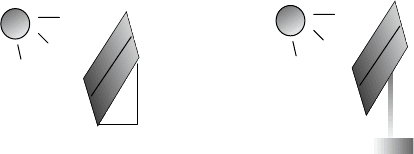
Fixed mount, tilt = L
Polar mount, 1-axis tracker
Figure P7.17
a. For a house that needs 4000-kWh per year, how large would each array
need to be?
b. If the PVs cost $400/m
2
and everything else in the two systems has the
same cost except for the extra cost of the tracker, how much can the
tracker cost ($) to make the systems cost the same amount? How much
per unit area of tracker ($/m
2
)?
c. Derive a general expression for the justifiable extra cost of a tracker per
unit area ($/m
2
) as a function of the PV cost ($/m
2
) and the ratio of
tracker insolation I
T
to fixed insolation I
F
.

CHAPTER 8
PHOTOVOLTAIC MATERIALS
AND ELECTRICAL CHARACTERISTICS
8.1 INTRODUCTION
A material or device that is capable of converting the energy contained in pho-
tons of light into an electrical voltage and current is said to be photovoltaic.
A photon with short enough wavelength and high enough energy can cause an
electron in a photovoltaic material to break free of the atom that holds it. If a
nearby electric field is provided, those electrons can be swept toward a metallic
contact where they can emerge as an electric current. The driving force to power
photovoltaics comes from the sun, and it is interesting to note that the surface of
the earth receives something like 6000 times as much solar energy as our total
energy demand.
The history of photovoltaics (PVs) began in 1839 when a 19-year-old French
physicist, Edmund Becquerel, was able to cause a voltage to appear when he
illuminated a metal electrode in a weak electrolyte solution (Becquerel, 1839).
Almost 40 years later, Adams and Day were the first to study the photovoltaic
effect in solids (Adams and Day, 1876). They were able to build cells made of
selenium that were 1% to 2% efficient. Selenium cells were quickly adopted by
the emerging photography industry for photometric light meters; in fact, they are
still used for that purpose today.
As part of his development of quantum theory, Albert Einstein published a
theoretical explanation of the photovoltaic effect in 1904, which led to a Nobel
Renewable and Efficient Electric Power Systems. By Gilbert M. Masters
ISBN 0-471-28060-7
2004 John W iley & Sons, Inc.
445
446 PHOTOVOLTAIC MATERIALS AND ELECTRICAL CHARACTERISTICS
Prize in 1923. About the same time, in what would turn out to be a cornerstone of
modern electronics in general, and photovoltaics in particular, a Polish scientist
by the name of Czochralski began to develop a method to grow perfect crystals
of silicon. By the 1940s and 1950s, the Czochralski process began to be used to
make the first generation of single-crystal silicon photovoltaics, and that technique
continues to dominate the photovoltaic (PV) industry today.
In the 1950s there were several attempts to commercialize PVs, but their cost
was prohibitive. The real emergence of PVs as a practical energy source came in
1958 when they were first used in space for the Vanguard I satellite. For space
vehicles, cost is much less important than weight and reliability, and solar cells
have ever since played an important role in providing onboard power for satellites
and other space craft. Spurred on by the emerging energy crises of the 1970s, the
development work supported by the space program began to pay off back on the
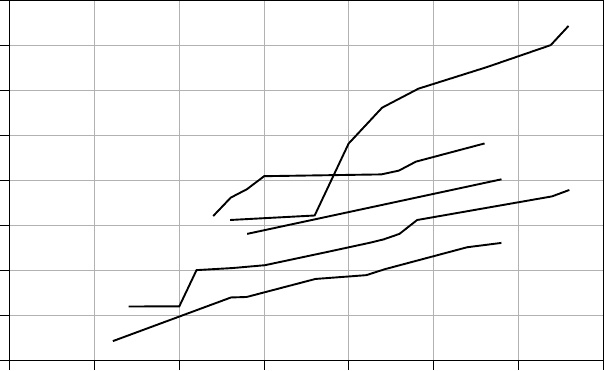
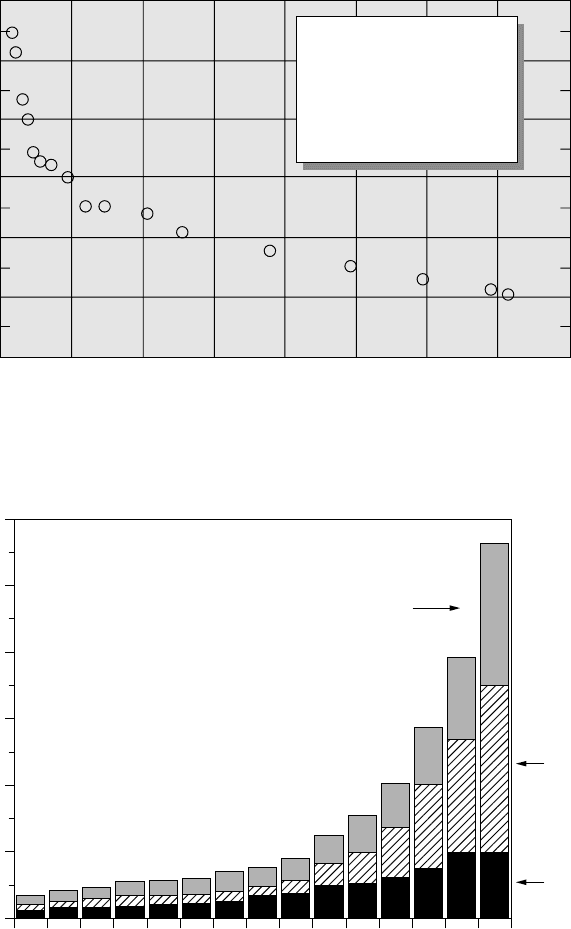
ground. By the late 1980s, higher efficiencies (Fig. 8.1) and lower costs (Fig. 8.2)
brought PVs closer to reality, and they began to find application in many off-
grid terrestrial applications such as pocket calculators, off-shore buoys, highway
lights, signs and emergency call boxes, rural water pumping, and small home
systems. While the amortized cost of photovoltaic power did drop dramatically
in the 1990s, a decade later it is still about double what it needs to be to compete
without subsidies in more general situations.
By 2002, worldwide production of photovoltaics had approached 600 MW per
year and was increasing by over 40% per year (by comparison, global wind power
sales were 10 times greater). However, as Fig. 8.3 shows, the U.S. share of this
rapidly growing PV market has been declining and was, at the turn of the century,
0
1970 1975 1980 1985 1990
Amorphous Si
Cu(In, Ga)Se
2
Multicrystaline Si
Single crystal Si
Multijunction Concentrators
Efficiency (%)
1995 2000 2005
5
10
15
20
25
30
35
40
Figure 8.1 Best laboratory PV cell efficiencies for various technologies. (From National
Center for Photovoltaics, www.nrel.gov/ncpv 2003).
INTRODUCTION 447
Total PV Manufacturing Capacity (MW/yr)
6
5
4
3
2
1
0
0 100 200 300 400 500 600 700 800
Average Module Manufacturing Cost ($/Wp)
1992
1993
1994
1995
1996
1997
1998
1999
2000
2001
2002
2003
2004
2005
2006
2007
2008
2002 Data
15 PV Manufacturing R&D
participants with active
manufacturing lines in 2002
Direct module manufacturing
cost only (2002 Dollars)
Figure 8.2 PV module manufacturing costs for DOE/US Industry Partners. Historical
data through 2002, projections thereafter (www.nrel.gov/pvmat).
600
500
400
300
200
100
0
Megawatts Produced
1988
1989
1990
1991
1992
1993
1994
1995
1996
1997
1998
1999
2000
2001
2002
Rest of world
Japan
U.S.
Figure 8.3 World production of photovoltaics is growing rapidly, but the U.S. share of
the market is decreasing. Based on data from Maycock (2004).