
Masters G.M. Renewable and Efficient Electric Power Systems
Подождите немного. Документ загружается.

468 PHOTOVOLTAIC MATERIALS AND ELECTRICAL CHARACTERISTICS
0.70.60.50.40.30.20.10.0
0.0
1.0
2.0
3.0
4.0
R
P
= 1.0 ,
R
S
= 0.05
R
P
= ∞ ,
R
S
= 0
Voltage
Current (A)
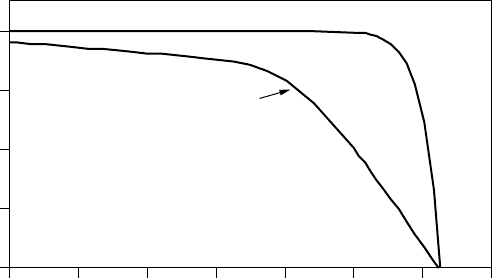
Figure 8.27 Series and parallel resistances in the PV equivalent circuit decrease both
voltage and current delivered. To improve cell performance, high R
P
and low R
S
are
needed.
8.4 FROM CELLS TO MODULES TO ARRAYS
Since an individual cell produces only about 0.5 V, it is a rare application for
which just a single cell is of any use. Instead, the basic building block for PV
applications is a module consisting of a number of pre-wired cells in series, all
encased in tough, weather-resistant packages. A typical module has 36 cells in
series and is often designated as a “12-V module” even though it is capable
of delivering much higher voltages than that. Some 12-V modules have only 33
cells, which, as will be seen later may, be desirable in certain very simple battery
charging systems. Large 72-cell modules are now quite common, some of which
have all of the cells wired in series, in which case they are referred to as 24-V
modules. Some 72-cell modules can be field-wired to act either as 24-V modules
with all 72 cells in series or as 12-V modules with two parallel strings having
36 series cells in each.
Multiple modules, in turn, can be wired in series to increase voltage and in
parallel to increase current, the product of which is power. An important element
in PV system design is deciding how many modules should be connected in
series and how many in parallel to deliver whatever energy is needed. Such
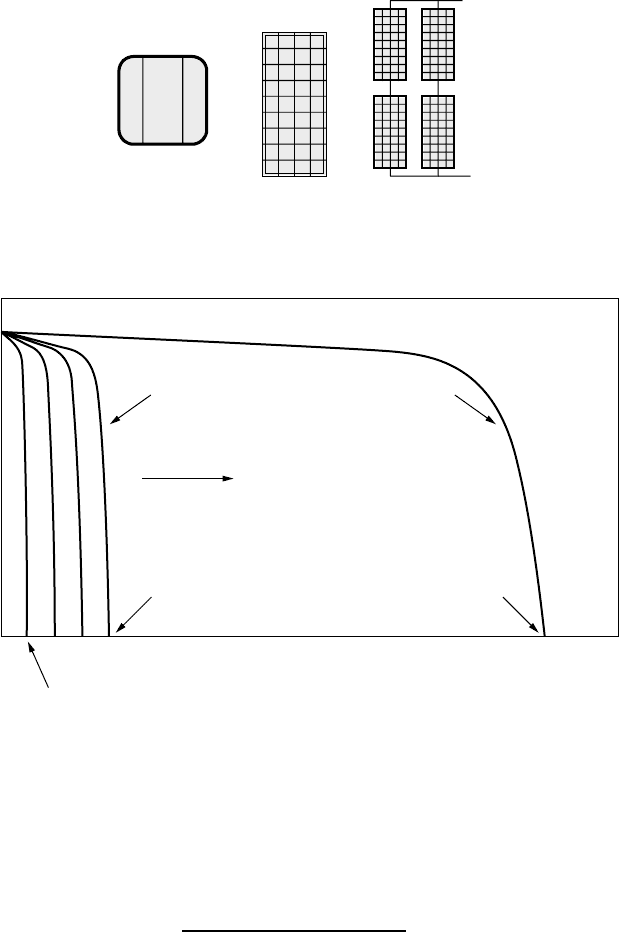
combinations of modules are referred to as an array. Figure 8.28 shows this
distinction between cells, modules, and arrays.
8.4.1 From Cells to a Module
When photovoltaics are wired in series, they all carry the same current, and at
any given current their voltages add as shown in Fig. 8.29. That means we can
continue the spreadsheet solution of (8.18) to find an overall module voltage
FROM CELLS TO MODULES TO ARRAYS 469
Cell Module Array
Figure 8.28 Photovoltaic cells, modules, and arrays.
I
SC
0
0.6 V for each cell
VOLTAGE (V)
CURRENT (A)
21.6 V
4 cells
Adding cells in series
36 cells
2.4 V
36 cells × 0.6 V = 21.6 V
Figure 8.29 For cells wired in series, their voltages at any given current add. A typical
module will have 36 cells.
V
module
by multiplying (8.21) by the number of cells in the module n.
V
module
= n(V
d
− IR
S
)(8.22)
Example 8.4 Voltage and Current from a PV Module. A PV module is made
up of 36 identical cells, all wired in series. With 1-sun insolation (1 kW/m
2
),
each cell has short-circuit current I
SC
= 3.4Aandat25
◦
C its reverse saturation
current is I
0
= 6 × 10
−10
A. Parallel resistance R
P
= 6.6 and series resistance
R
S
= 0.005 .
470 PHOTOVOLTAIC MATERIALS AND ELECTRICAL CHARACTERISTICS
a. Find the voltage, current, and power delivered when the junction voltage
of each cell is 0.50 V.
b. Set up a spreadsheet for I and V and present a few lines of output to show
how it works.
Solution.
a. Using V
d
= 0.50 V in (8.20) along with the other data gives current:
I = I
SC
− I
0
(e
38.9V
d
− 1) −
V
d
R
P
= 3.4 − 6 ×10
−10
(e
38.9×0.50
− 1) −
0.50
6.6
= 3.16 A
Under these conditions, (8.22) gives the voltage produced by the 36-cell
module:
V
module
= n(V
d
− IR
S
) = 36(0.50 − 3.16 × 0.005) = 17.43 V
Power delivered is therefore
P(watts) = V
module
I = 17.43 × 3.16 = 55.0W
b. A spreadsheet might look something like the following:
Number of cells,n = 36
Parallel resistance/cell R
P
(ohms) = 6.6
Series resistance/cell R
S
(ohms) = 0.005
Reverse saturation current I
0
(A) = 6.00E-10
Short-circuit current at 1-sun (A) = 3.4
V
d
I =
I
SC
− I
0
e
38.9V
d
− 1
−
V
d
R
p
V
module
=
n(V
d
− IR
S
)
P (watts)
= V
module
I
0.49 3.21 17.06 54.80
0.50 3.16 17.43 55.02
0.51 3.07 17.81 54.75
0.52 2.96 18.19 53.76
0.53 2.78 18.58 51.65
0.54 2.52 18.99 47.89
0.55 2.14 19.41 41.59
FROM CELLS TO MODULES TO ARRAYS 471
Notice that we have found the maximum power point for this module, which
is at I = 3.16 A, V = 17.43 V, and P = 55 W. This would be described as a
55-W module.
8.4.2 From Modules to Arrays
Modules can be wired in series to increase voltage, and in parallel to increase
current. Arrays are made up of some combination of series and parallel modules
to increase power.
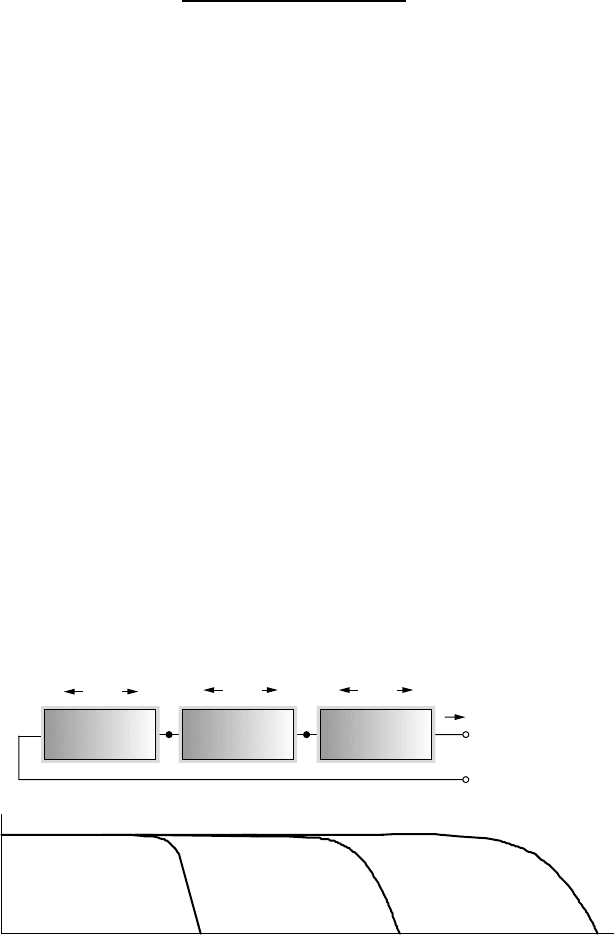
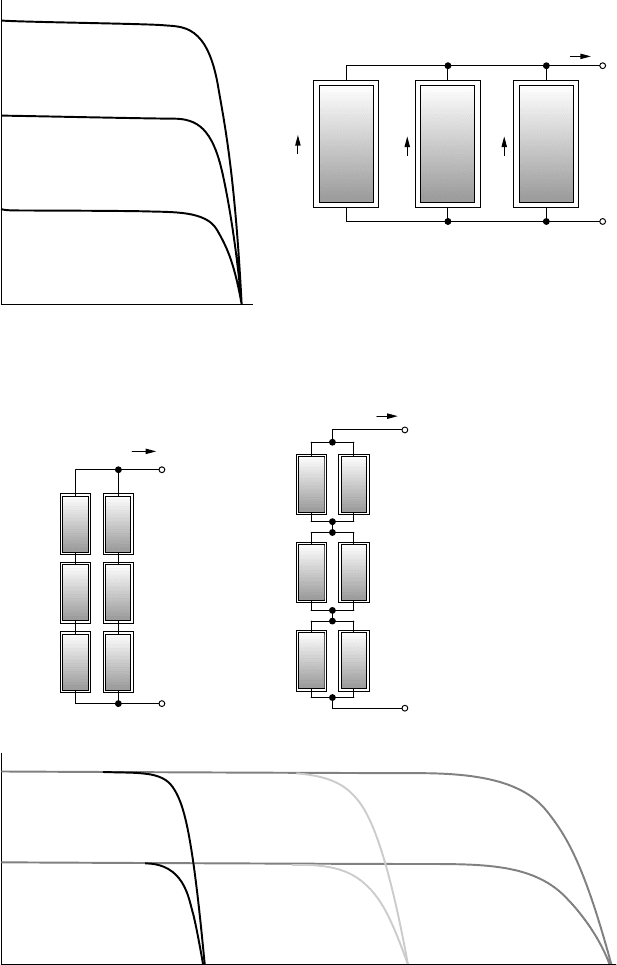
For modules in series, the I –V curves are simply added along the voltage
axis. That is, at any given current (which flows through each of the modules),
the total voltage is just the sum of the individual module voltages as is suggested
in Fig. 8.30.
For modules in parallel, the same voltage is across each module and the total
current is the sum of the currents. That is, at any given voltage, the I –V curve
of the parallel combination is just the sum of the individual module currents at
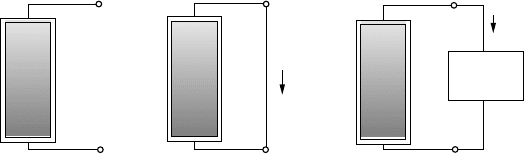
that voltage. Figure 8.31 shows the I –V curve for three modules in parallel.
When high power is needed, the array will usually consist of a combination
of series and parallel modules for which the total I –V curve is the sum of
the individual module I –V curves. There are two ways to imagine wiring a
series/parallel combination of modules: The series modules may be wired as
strings, and the strings wired in parallel as in Fig. 8.32a, or the parallel modules
may be wired together first and those units combined in series as in 8.32b.
The total I –V curve is just the sum of the individual module curves, which
is the same in either case when everything is working right. There is a reason,
however, to prefer the wiring of strings in parallel (Fig. 8.32a). If an entire string
is removed from service for some reason, the array can still deliver whatever
voltage is needed by the load, though the current is diminished, which is not the
case when a parallel group of modules is removed.
VOLTAGE
CURRENT
1 module 2 modules 3 modules
I
+
−
+−
V
1
+−
V
2
+−
V
3
V
=
V
1
+
V
2
+
V
3
Figure 8.30 For modules in series, at any given current the voltages add.
472 PHOTOVOLTAIC MATERIALS AND ELECTRICAL CHARACTERISTICS
VOLTAGE
CURRENT
1 module
2 modules
3 modules
I
=
I
1
+
I
2
+
I
3
+
−
V
I
1
I
2
I
3
Figure 8.31 For modules in parallel, at any given voltage the currents add.
VOLTAGE
CURRENT
(c)
(a)
(b)
I
+
−
V
I
V
+
−
Figure 8.32 Two ways to wire an array with three modules in series and two modules in
parallel. Although the I –V curves for arrays are the same, two strings of three modules
each (a) is preferred. The total I –V curve of the array is shown in (c).
THE PV I–V CURVE UNDER STANDARD TEST CONDITIONS (STC) 473
8.5 THE PV I–V CURVE UNDER STANDARD TEST CONDITIONS (STC)
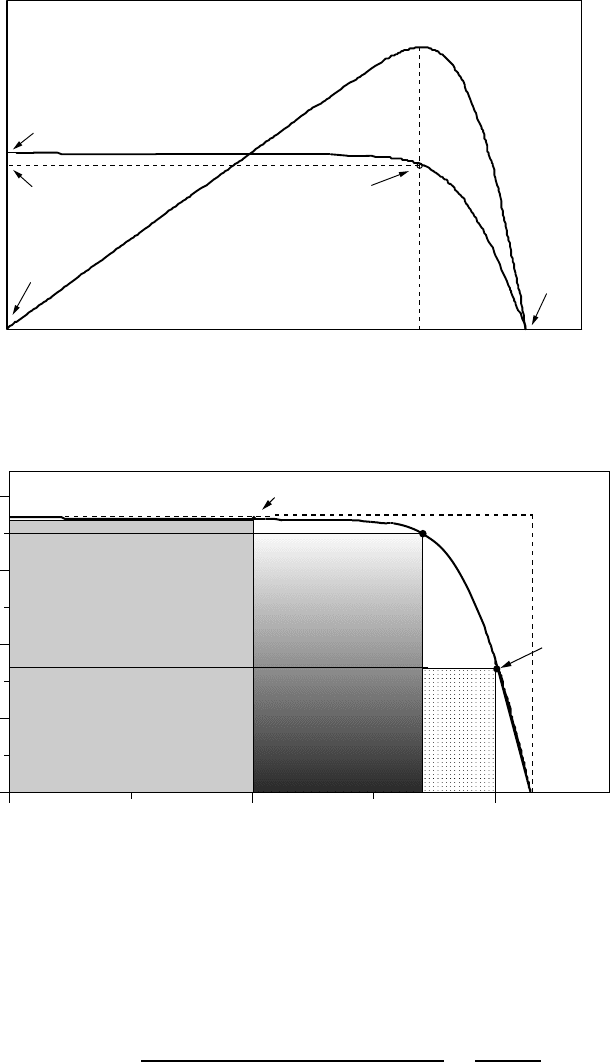
Consider, for the moment, a single PV module that you want to connect to some
sort of a load (Fig. 8.33). The load might be a dc motor driving a pump or it
might be a battery, for example. Before the load is connected, the module sitting
in the sun will produce an open-circuit voltage V
OC
, but no current will flow. If
the terminals of the module are shorted together (which doesn’t hurt the module
at all, by the way), the short-circuit current I
SC
will flow, but the output voltage
will be zero. In both cases, since power is the product of current and voltage, no
power is delivered by the module and no power is received by the load. When the
load is actually connected, some combination of current and voltage will result
and power will be delivered. To figure out how much power, we have to consider
the I –V characteristic curve of the module as well as the I –V characteristic
curve of the load.
Figure 8.34 shows a generic I –V curve for a PV module, identifying sev-
eral key parameters including the open-circuit voltage V
OC
and the short-circuit
current I
SC
. Also shown is the product of voltage and current, that is, power
delivered by the module. At the two ends of the I –V curve, the output power is
zero since either current or voltage is zero at those points. The maximum power
point (MPP) is that spot near the knee of the I –V curve at which the product of
current and voltage reaches its maximum. The voltage and current at the MPP
are sometimes designated as V
m
and I
m
for the general case and designated V
R
and I
R
(for rated voltage and rated current ) under the special circumstances that
correspond to idealized test conditions.
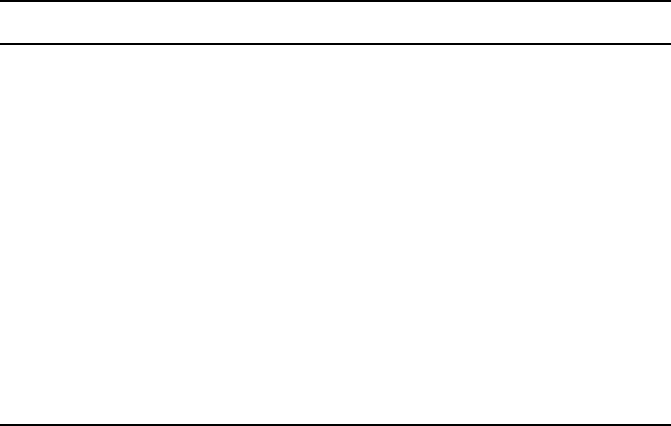
Another way to visualize the location of the maximum power point is by
imagining trying to find the biggest possible rectangle that will fit beneath the
I –V curve. As shown in Fig. 8.35, the sides of the rectangle correspond to
current and voltage, so its area is power. Another quantity that is often used to
characterize module performance is the fill factor (FF). The fill factor is the ratio
of the power at the maximum power point to the product of V
OC
and I
SC
,so
FF can be visualized as the ratio of two rectangular areas, as is suggested in
(a) (b) (c)
+
I
=
I
SC
V
= 0
−
P
= 0
Open circuit
V
=
V
OC
+
−
I
= 0
P
= 0
Short circuit Load connected
LOAD
V
I
−
P
=
V I
+
Figure 8.33 No power is delivered when the circuit is open (a) or shorted (b). When
the load is connected (c), the same current flows through the load and module and the
same voltage appears across them.
474 PHOTOVOLTAIC MATERIALS AND ELECTRICAL CHARACTERISTICS
VOLTAGE (V)
POWER ( W)
I
SC
Power
Current
Maximum Power Point
(MPP)
V
R
I
R
P
= 0
P
= 0
P
=
P
R
0
0
V
OC
CURRENT (A)
Figure 8.34 The I –V curve and power output for a PV module. At the maximum
power point (MPP) the module delivers the most power that it can under the conditions
of sunlight and temperature for which the I –V curve has been drawn.
20100
VOLTAGE (V)
CURRENT (A)
8
7
6
5
4
3
2
1
0
P
= 70 W
P
= 120 W
P
= 74 W
I
SC
= 7.5 A
V
OC
= 21.5 V
MPP
Figure 8.35 The maximum power point (MPP) corresponds to the biggest rectangle that
can fit beneath the I –V curve. The fill factor (FF) is the ratio of the area (power) at MPP
to the area formed by a rectangle with sides V
OC
and I
SC
.
Fig. 8.35. Fill factors around 70–75% for crystalline silicon solar modules are
typical, while for multijunction amorphous-Si modules, it is closer to 50–60%.
Fill factor (FF) =
Power at the maximum power point
V
OC
I
SC
=
V
R
I
R
V
OC
I
SC
(8.23)
IMPACTS OF TEMPERATURE AND INSOLATION ON I–V CURVES 475
TA BLE 8.3 Examples of PV Module Performance Data Under Standard Test
Conditions (1 kW/m
2
,AM1.5,25
◦
C Cell Temperature)
Manufacturer Kyocera Sharp BP Uni-Solar Shell
Model KC-120-1 NE-Q5E2U 2150S US-64 ST40
Material Multicrystal Polycrystal Monocrystal Triple junction a-Si CIS-thin film
Number of cells n 36 72 72 42
Rated Power P
DC,STC
(W)
120 165 150 64 40
Voltage at max
power (V)
16.9 34.6 34 16.5 16.6
Current at rated
power (A)
7.1 4.77 4.45 3.88 2.41
Open-circuit voltage
V
OC
(V)
21.5 43.1 42.8 23.8 23.3
Short-circuit current
I
SC
(A)
7.45 5.46 4.75 4.80 2.68
Length (mm/in.) 1425/56.1 1575/62.05 1587/62.5 1366/53.78 1293/50.9
Width (mm/in.) 652/25.7 826/32.44 790/31.1 741/29.18 329/12.9
Depth (mm/in.) 52/2.0 46/1.81 50/1.97 31.8/1.25 54/2.1
Weight (kg/lb) 11.9/26.3 17/37.5 15.4/34 9.2/20.2 14.8/32.6
Module efficiency 12.9% 12.7% 12.0% 6.3% 9.4%
Since PV I –V curves shift all around as the amount of insolation changes
and as the temperature of the cells varies, standard test conditions (STC) have
been established to enable fair comparisons of one module to another. Those test
conditions include a solar irradiance of 1 kW/m
2
(1 sun) with spectral distribution
shown in Fig. 8.10, corresponding to an air mass ratio of 1.5 (AM 1.5). The
standard cell temperature for testing purposes is 25
◦
C (it is important to note that
25
◦
is cell temperature, not ambient temperature). Manufacturers always provide
performance data under these operating conditions, some examples of which are
shown in Table 8.3. The key parameter for a module is its rated power; to help
us remember that it is dc power measured under standard test conditions, it has
been identified in Table 8.3 as P
DC,STC
. Later we’ll learn how to adjust rated
power to account for temperature effects as well as see how to adjust it to give
us an estimate of the actual ac power that the module and inverter combination
will deliver.
8.6 IMPACTS OF TEMPERATURE AND INSOLATION ON I–V CURVES
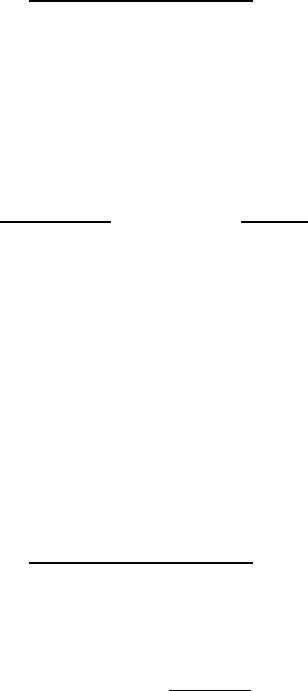
Manufacturers will often provide I –V curves that show how the curves shift
as insolation and cell temperature changes. Figure 8.36 shows examples for the
Kyocera 120-W multicrystal-silicon module described in Table 8.3. Notice as
insolation drops, short-circuit current drops in direct proportion. Cutting insola-
tion in half, for example, drops I
SC
by half. Decreasing insolation also reduces
476 PHOTOVOLTAIC MATERIALS AND ELECTRICAL CHARACTERISTICS
8
6
4
2
0
0 102030
8
6
4
2
0
0102030
IRRADIANCE: AM1.5, 1 kW/m
2
Voltage (V) Voltage (V)
Current (A)
1000 W/m
2
800 W/m
2
600 W/m
2
400 W/m
2
200 W/m
2
CELL TEMP. 25°C
75°C
50°C
25°C
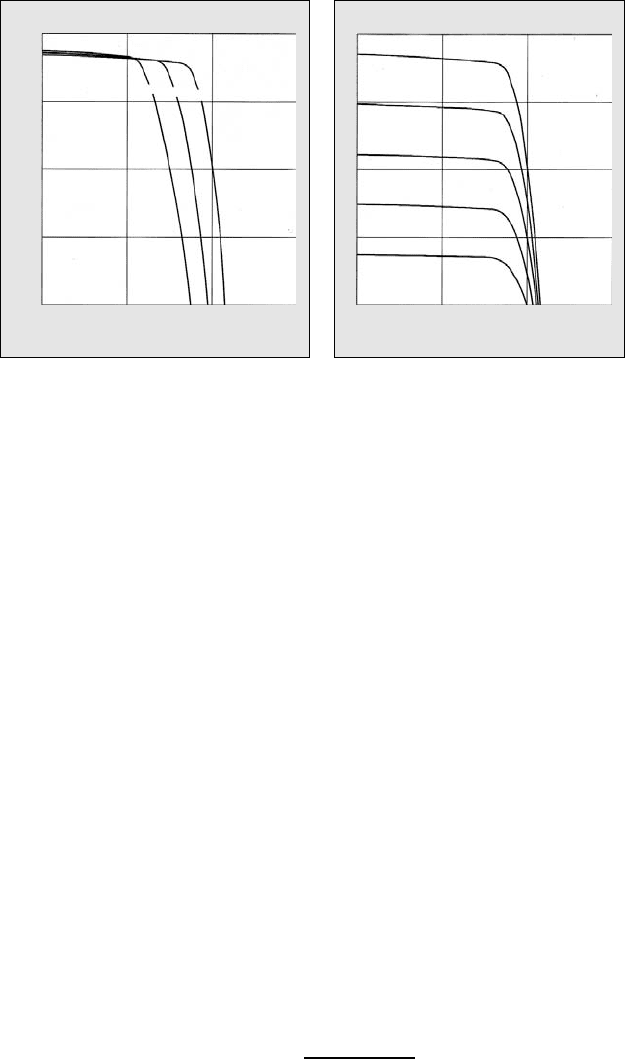
Figure 8.36 Current-voltage characteristic curves under various cell temperatures and
irradiance levels for the Kyocera KC120-1 PV module.
V
OC
, but it does so following a logarithmic relationship that results in relatively
modest changes in V
OC
.
As can be seen in Fig. 8.36, as cell temperature increases, the open-circuit
voltage decreases substantially while the short-circuit current increases only
slightly. Photovoltaics, perhaps surprisingly, therefore perform better on cold,
clear days than hot ones. For crystalline silicon cells, V
OC
drops by about 0.37%
for each degree Celsius increase in temperature and I
SC
increases by approx-
imately 0.05%. The net result when cells heat up is the MPP slides slightly
upward and toward the left with a decrease in maximum power available of
about 0.5%/
◦
C. Given this significant shift in performance as cell temperature
changes, it should be quite apparent that temperature needs to be included in any
estimate of module performance.
Cells vary in temperature not only because ambient temperatures change, but
also because insolation on the cells changes. Since only a small fraction of the
insolation hitting a module is converted to electricity and carried away, most of
that incident energy is absorbed and converted to heat. To help system designers
account for changes in cell performance with temperature, manufacturers often
provide an indicator called the NOCT, which stands for nominal operating cell
temperature. The NOCT is cell temperature in a module when ambient is 20
◦
C,
solar irradiation is 0.8 kW/m
2
, a nd windspeed is 1 m/s. To account for other
ambient conditions, the following expression may be used:
T
cell
= T
amb
+
NOCT − 20
◦
0.8
· S(8.24)
SHADING IMPACTS ON I–V CURVES 477
where T
cell
is cell temperature (
◦
C), T
amb
is ambient temperature, and S is solar
insolation (kW/m
2
).
Example 8.5 Impact of Cell Temperature on Power for a PV Module.
Estimate cell temperature, open-circuit voltage, and maximum power output for
the 150-W BP2150S module under conditions of 1-sun insolation and ambient
temperature 30
◦
C. The module has a NOCT of 47
◦
C.
Solution. Using (8.24) with S = 1kW/m
2
, cell temperature is estimated to be
T
cell
= T
amb
+
NOCT − 20
◦
0.8
· S = 30 +
47 − 20
0.8
· 1 = 64
◦
C
From Table 8.3, for this module at the standard temperature of 25
◦
C, V
OC
=
42.8V.SinceV
OC
drops by 0.37%/
◦
C, the new V
OC
will be about
V
OC
= 42.8[1 − 0.0037(64 − 25)] = 36.7V
With maximum power expected to drop about 0.5%/
◦
C, this 150-W module at
its maximum power point will deliver
P
max
= 150 W · [1 − 0.005(64 −25)] = 121 W
which is a rather significant drop of 19% from its rated power.
When the NOCT is not given, another approach to estimating cell temperature
is based on the following:
T
cell
= T
amb
+ γ
Insolation
1kW/m
2
(8.25)
where γ is a proportionality factor that depends somewhat on windspeed and
how well ventilated the modules are when installed. Typical values of γ range
between 25
◦
C and 35
◦
C; that is, in 1 sun of insolation, cells tend to be 25–35
◦
C
hotter than their environment.
8.7 SHADING IMPACTS ON I –V CURVES
The output of a PV module can be reduced dramatically when even a small
portion of it is shaded. Unless special efforts are made to compensate for shade
problems, even a single shaded cell in a long string of cells can easily cut