
Masters G.M. Renewable and Efficient Electric Power Systems
Подождите немного. Документ загружается.

588 PHOTOVOLTAIC SYSTEMS
the equivalent of 5.0 ft of pipe; the gate valve (assuming it is totally open) adds
the equivalent of 0.5 ft of pipe. The total equivalent length of pipe is therefore
240 + 6 + 5 + 0.5 = 251.5 ft.
From Table 9.17, 100 ft of 3/4-in. pipe at 4 gpm has a pressure drop of
4.2 ft/100
of tube. Our friction-head requirement is therefore 4.2 × 251.5/100 =
10.5 ft of water.
The water must be lifted 150 +10 = 160 ft (static head). Total head requirement
is the sum of static and friction heads, or 160 + 10.5 = 170.5 ft of water pressure.
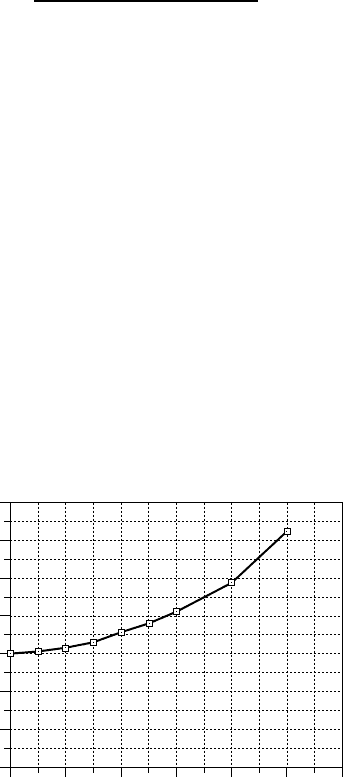
If the process followed in Example 9.21 is repeated for varying flow rates,
a plot of total dynamic head H (static plus friction) versus flow rate, called
the hydraulic system curve, can be derived. The hydraulic system curve for
Example 9.21 is given in Fig. 9.57.
9.6.2 Hydraulic Pump Curves
The hydraulic system curve tells us the amount of head that the pump must
provide to supply a given flow rate Q. To determine the actual flow that a given
pump will provide, we need to know something about the characteristics of the
pump that will be used. Pumps suitable for PV-powered systems generally fall
into one of two categories: centrifugal and positive displacement pumps.
Centrifugal pumps have fast-spinning impellers that literally throw the water
out of the pump, creating suction on the input side of the pump and creating
pressure on the delivery side. When these are installed above the water, they
are limited by the ability of atmospheric pressure to push water up into the
suction side of the pump—that is, to a theoretical maximum of about 32 ft. In
240
220
200
180
160
140
120
100
024681012
Flow Rate
Q
(gpm)
Total Dynamic Head H (ft of H
2
0)
Figure 9.57 The hydraulic system curve for Example 9.21.
PV-POWERED WATER PUMPING 589
practice, this is more like 20 ft. When the pump is installed below the water
line, however, the pump can push water up hundreds of feet. Submersible pumps
with waterproof housings for the motor are suspended in a well using the same
pipe that the water is pumped through. In this configuration, centrifugal pumps
can push water over 1000 vertical feet. One of the disadvantages of centrifugal
pumps, however, is that their speedy impellers are susceptible to abrasion and
clogging by grit in the water. When powered by PVs, they are also particularly
sensitive to changes in solar intensity during the day.
Positive displacement pumps come in several types, including helical pumps,
which use a rotating shaft to push water up a cavity, jack pumps, which have
an above-ground oscillating arm that pulls a long drive shaft up and down (like
the classic oil-rig pumper), and diaphragm pumps, which use a rotating cam to
open and close valves. The traditional hand pump as well as the wind-powered
water pumps are versions of jack pumps. Jack pumps use simple flap valves
that work very much like hydraulic diodes. During each upward stroke of the
shaft, a flap closes and a gulp of water is carried upward; during the downward
stroke, the valve opens and new water enters a chamber to be carried upward on
the next stroke. In general, positive displacement pumps pump at slower rates
so they are most useful in low volume applications. They easily handle high
heads, however, and they are much less susceptible to gritty water problems than
centrifugal pumps. They also are less sensitive to changes in solar intensity. A
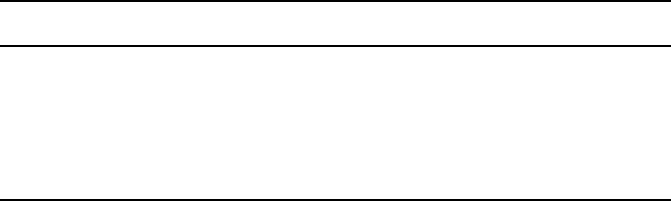
brief comparison of the two types of pumps is presented in Table 9.19.
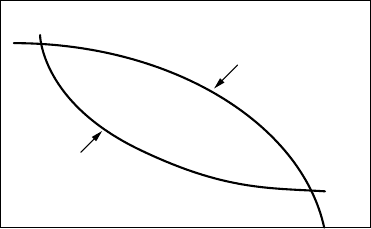
The graphical relationship between head and flow is called the hydraulic pump
curve, two examples of which are shown in Fig. 9.58. Notice that the fundamen-
tal difference in processes that produce the pumping for centrifugal and positive
displacement pumps yield quite different shapes to their pump curves. For a cen-
trifugal pump, as the height of the water column above the pump increases, more
and more of the pump’s energy is devoted to simply holding up the water so flow
rates rapidly diminish. For example, imagine a small centrifugal pump connected
to a hose. Raising the open end of the hose higher and higher (increasing the
head) will result in less and less flow until a point is reached at which there is no
flow at all. On the other hand, the flapper valve, diaphragm, or rotating screw in
TABLE 9.19 A Comparison Between Centrifugal and Positive-Displacement
Pumps
Centrifugal Positive Displacement
High-speed impellers Volumetric movement
Large flow rates Lower flow rates
Loss of flow with higher heads Flow rate less affected by head
Low irradiance reduces ability to achieve
head
Low irradiance has little effect on head
Potential grit abrasion Unaffected by grit
590 PHOTOVOLTAIC SYSTEMS
Centrifugal pump
Positive
displacement pump
Flow rate
Q
Head
H
Figure 9.58 The pump curves for positive displacement pumps and centrifugal pumps
have quite different shapes.
a positive displacement pump holds up the water column mechanically, so their
flow rates are much less affected by increasing head.
Electrical I –V curves and hydraulic Q–H curves share many similar features.
For example, recall that the electrical power delivered by a PV is the product of
I times V and the maximum power point is at the knee of the I –V curve. For
the hydraulic side, the power delivered by the pump to the fluid is given by
P = ρHQ (9.56)
where ρ is fluid density. In American units,
P(watts) = 8.34 lb/gal × H(ft) × Q(gal/ min) × (1min/60 s)
× 1.356 W/(ft-lb/s)
P(watts) = 0.1885 × H(ft) × Q(gpm) (9.57)
In SI units,
P(watts) = 9.81 × H(m) × Q(L/s)(9.58)
When Q is zero, there is no power delivered to the fluid; when the head H is
zero, there is no power delivered either.
To complicate matters, for directly coupled PV-to-pump systems the voltage
delivered to the pump will vary as insolation changes. In turn, the pump curve
will shift as the pump voltage changes, which means that the pump curves vary
with insolation. Many manufacturers of pumps intended for solar applications will
supply pump curves for voltages corresponding to nominal 12-V module voltages.
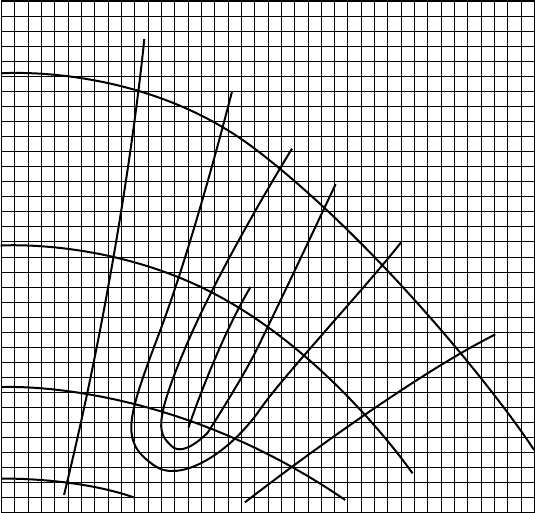
Figure 9.59 shows an example of a set of pump curves for the Jacuzzi SJ1C11
dc centrifugal pump, which is intended for use with photovoltaics. Individual
curves have been given for 15-V, 30-V, 45-V, and 60-V inputs. A typical “12-
V” PV module operating near the knee of its I –V curve delivers about 15 V,
PV-POWERED WATER PUMPING 591
350
300
250
200
150
100
50
0
Total Head (ft)
Flow rate (gpm)
0 2 4 6 8 10121416
60 V
45 V
30 V
15 V
30%
40%
43%
43%
44%
40%
30%
Figure 9.59 Pump curves for the Jacuzzi SJ1C11 pump showing pump efficiency for
various input voltages. Pump efficiencies are also shown, with the peak along the knee
of the curves.
so these pump voltages are meant to correspond to 1, 2, 3, and 4, typical “12-V”
PV modules wired in series. Also shown are indications of the efficiency of the
pump as a function of flow rate and head. Notice that the peak in efficiency (about
44%) occurs along the knee of the pump curves, which is exactly analogous to
the case for a PV I –V curve.
9.6.3 Hydraulic System Curve and Pump Curve Combined
Just as an I –V curve for a PV load is superimposed onto the I –V curves
for the photovoltaics, so too is the Q–H system curve superimposed onto the
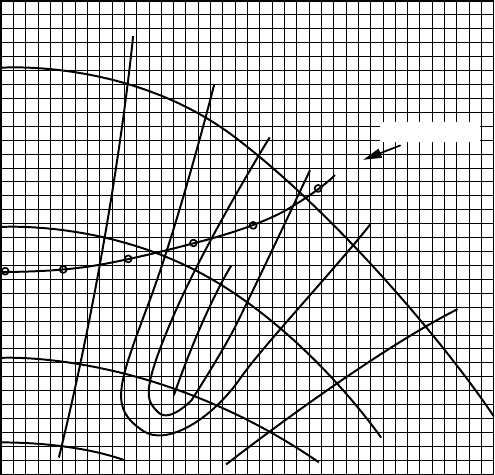
Q–H pump curve to determine the hydraulic operating point. For example,
superimposing the system curve of Fig. 9.57 onto the pump curves in Fig. 9.59
gives us the diagram in Fig. 9.60. A glance at the figure tells us a lot. For
example, this pump will not deliver any water unless the voltage applied to the
pump is at least about 36 V. At 45 V, about 5 gpm would be pumped, while at
60 V the flow would be about 9.5 gpm.
592 PHOTOVOLTAIC SYSTEMS
350
300
250
200
150
100
50
0
Total head (ft)
60 V
45 V
30 V
15 V
30%
40%
43%
43%
44%
40%
30%
0 2 4 6 8 10 12 14 16
Flow rate (gpm)
System curve
Figure 9.60 The system curve for the example, superimposed onto the pump curves for
the Jacuzzi SJ1C11. No flow occurs until pump voltage exceeds about 36 V.
9.6.4 A Simple Directly Coupled PV–Pump Design Approach
The easiest approach to estimating average performance of directly coupled
PV–pump systems is based on the familiar concept of “peak sun hours.” That is,
insolation expressed as kWh/m
2
-day is treated as if it is numerically equivalent
to “peak hours” at 1-sun. This lets us base the analysis of PV performance on
its 1-sun rated voltage, current, and power. And it lets us assume that the flow
rates on a pump curve are deliverable for the number of peak sun hours per day.
This procedure assumes that a linear current booster (LCB) is included in the
system to help start the pump in the morning and keep it running under conditions
of low insolation. Starting a pump requires high current at low voltage, but under
low-light conditions the maximum power point on the PV I –V curve has just
the opposite characteristic. An LCB is the clever dc-to-dc converter described
in Section 9.2.2 that enables the PVs to operate at their highest efficiency in
low light—that is, at low current and relatively high voltage—while providing
the pump with what it needs to start or keep running—that is, high current and
low voltage.
Usually manufacturers provide a nominal voltage and power for their pump
curves. From pump power (W) and 1-sun PV power (W/module) we can deter-
mine the needed number of photovoltaic modules. If pump voltage and efficiency

PV-POWERED WATER PUMPING 593
are given, as is the case with the pump curves in Fig. 9.60, pump power can be
determined using (9.57).
P
in
(W) to pump =
Power to fluid
Pump efficiency
=
0.1885 × H(ft) × Q(gpm)
η
p
(9.59)
The sizing procedure is based on the following simple steps (Thomas, 1987):
1. Determine the water production goal (gallons/day) in the design month
(highest water need and lowest insolation).
2. Use design-month insolation (hours @ 1-sun) as the hours of pumping to
find the pumping rate:
Q(gpm) =
Daily demand (gal/day)
Insolation(h/day@1-sun) × 60 min /h
(9.60)
3. Find the total dynamic head H @ Q (gpm). As a default, the friction head
maybeassumedtobe5%ofthestatichead.
4. Find a pump capable of delivering the desired head H and flow Q.Note
its input power P
in
and nominal voltage. Pump input power can also be
estimated from (9.59) along with estimated pump efficiency η
P
(defaults:
suction pumps 25%; submersible pumps 35%)
5. The number of PV modules in series (assuming that modules will operate
at about 15 V) is an integer number based on
Modules in series =
Pump voltage(V)
15 V/module
(9.61)
6. The number of PV strings in parallel will be an integer number based on
# strings =
Pump input power P
in
(W)
# mods in series × 15 V/mod ×I
R
(A) × de-rating
(9.62)
where I
R
is the PV rated current at STC. The de-rating factor takes into
account dirt and temperature effects. A reasonable default value is 0.80.
7. After having sized the system, the water pumped can be estimated by
rearranging (9.59) and adding in the de-rating factor:
Q(gal/day) = 15 V/mod × I
R
(A) × (# mods) ×(Peak h/day) × 60 min /h
× de-rating × η
P
/[0.1885 × H(ft)] (9.63)
Example 9.22 Sizing an Array for a 150-ft Well in Santa Maria, Califor-
nia. Suppose that the goal is to pump at least 1200 gallons per day from the
594 PHOTOVOLTAIC SYSTEMS
150-ft well described in Example 9.21 using the Jacuzzi SJ1C11 pump. Size the
PV array based on Siemens SR100 modules with rated current 5.9 A, mounted
at an L + 15
◦
tilt.
Solution. From the solar radiation tables given in Appendix E, the worst month
is December, with an insolation of 4.9 kwh/m
2
-day. From (9.60)
Q =
1200 gal/day
4.9 (h/day @1-sun) × 60 min /h
= 4.1 gpm
From Fig. 9.60, at 4.1 gpm the total dynamic head is about 170 ft and the pump
efficiency is about 34%. From (9.59), the estimated pump input power is
P
in
(W) =
0.1885 × H(ft) × Q(gpm)
Pump efficiency
=
0.1885 × 170 × 4.1
0.34
= 386 W
From Fig. 9.60, at 4.1 gpm and 170 ft of head, the pump voltage is a little under
45 V, which means that at 15 V per module, three modules in series should
be sufficient.
Using (9.62), we can decide upon the number of parallel strings of modules
# strings =
386 W
3 modules string × 15 V/module × 5.9 A × 0.80
= 1.8
so choose two parallel strings.
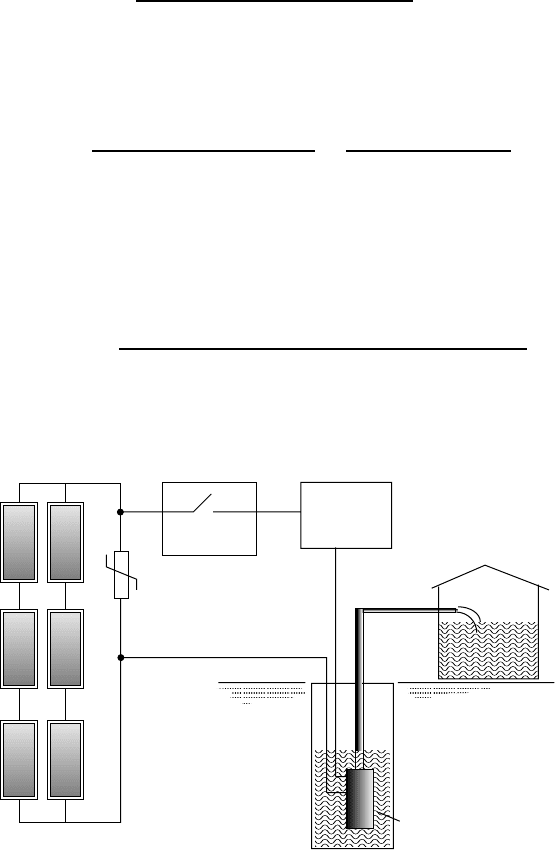
−−
−−
++
−−
+
++
+
Array
disconnect
Linear
current
booster
Surge
protector
Well
Pump
Storage
tank
Figure 9.61 PV water pumping system for Example 9.22.

PROBLEMS 595
From (9.63), estimated delivery in January with two strings of three modules
would be
Q ≈
15 V × 5.9 A × 6 modules × 4.9 h/day × 60 min /h × 0.80 × 0.34
0.1885 × 170 ft
= 1325 gal/day
A system diagram is shown in Fig. 9.61.
REFERENCES
Applebaum, J. (1981). Performance Analysis of D.C. Motor Photovoltaic Converter Sys-
tem II, Solar Energy, vol 27, no. 5, pp. 421–431.
Chang, A. (2000). Residential Systems Summary Report: Analysis of TEAM-UP Residen-
tial Installations, Utility Photovoltaic Group, Washington, D.C.
Linden, D. (1995). Handbook of Batteries, McGraw-Hill, New York.
Patel, M. R. (1999). Wind and Solar Power Systems, CRC Press, Boca Raton, FL.
Real Goods Trading Corporation (2002). Solar Living Source Book,Ukiah,CA.
Roger, J. A. (1979). Theory of the Direct Coupling Between D. C. Motors and Photo-
voltaic Solar Arrays, Solar Energy, vol 23, pp 193–198.
Rosen, K., and A. Meier (1999). Energy Use of Televisions and Videocasette Recorders in
the U.S., Lawrence Berkeley National Labs, LBNL-42393.
Rosen, K., and A. Meier (2000). Energy Use of U.S. Consumer Electronics At the End of
the 20th Century, Lawrence Berkeley National Labs, LBNL-46212.
Sandia National Laboratories (1991). Maintenance and Operation of Stand-Alone Photo-
voltaic Systems, U.S. Department of Energy, Albuquerque, NM.
Sandia National Laboratories (1995). Stand-Alone. Photovoltaic Systems Handbook of
Recommended Design Practices, U.S. Department of Energy, Albuquerque, NM.
Scheuermann, K., D. R. Boleyn, P. N. Lilly, and S. Miller (2002). Measured Output for
nineteen residential PV systems: Updated analysis of actual system Performance and
net metering impacts, Proceedings of the 31st American Solar Energy Society Annual
Conference, Reno, NV.
Thomas, M. G. (1987), Water Pumping, the Solar Alternative, Sandia National Laborato-
ries, SAND87-0804, Albuquerque, NM.
Wiles, J. (2001). Photovoltaic Power Systems and the National Electrical Code: Suggested
Practices, Sandia National Laboratories, SAND2001-0674, Albuquerque, NM.
PROBLEMS
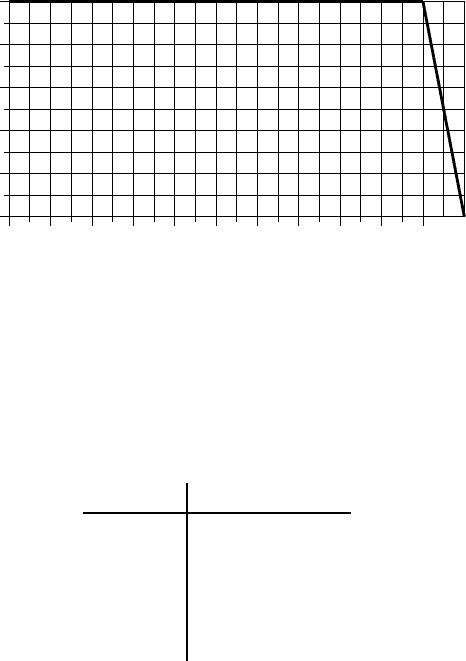
9.1 Suppose the I –V curve for a PV module exposed to 1-sun (1 kW/m
2
)of
insolation is as shown below:
596 PHOTOVOLTAIC SYSTEMS
20181614121086420
V (volts)
0
2
1
3
4
5
Current (amps)
1-sun = 1000 w/m
2
22
Figure P9.1
a. What load resistance R would result in the maximum power delivered
to the panel at 1-sun? How much power would that be (watts)?
b. Suppose the hour-by-hour insolation striking this single panel is given
in the following table (e.g., from 7:30
A.M. to 8:30 A.M. the insolation
averages 200 W/m
2
):
Time
Insolation (W/m
2
)
8A.M.,4P.M. 200
9, 3
400
10, 2
600
11, 1
800
noon
1000
Daily total
5000 W-hr/m
2
If current (at any given voltage) is directly proportional to insolation,
carefully draw the hour-by-hour I –V curves for the module. For the
resistive load determined in (a), what would be the energy (watt-hr)
delivered by this panel in a day’s time?
c. If the module is equipped with a maximum-power-point tracker, what
energy would be delivered in a day’s time? What percentage improve-
ment does it provide?
9.2 Consider a single PV module supplying power to a resistance load. The
hour-by-hour I –V curves for the PV module are shown below along
with the I –V curve for the resistance. For simplicity, consider each I –V
curve to apply for one hour (e.g., the “8-
A.M.” curve is from 7:30 A.M. to
8:30
A.M.).
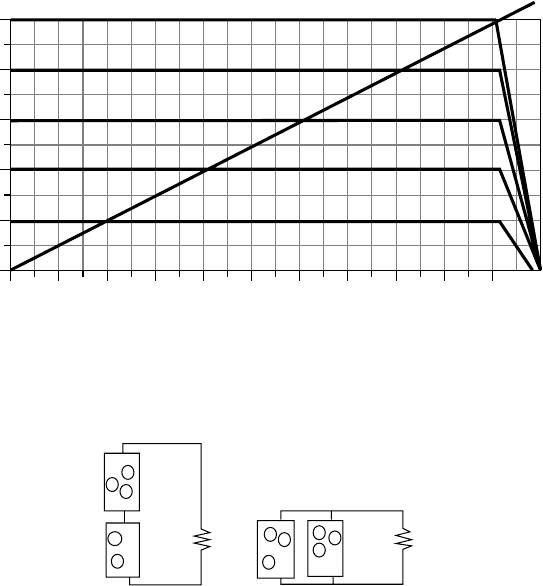
PROBLEMS 597
20181614121086420
0
2
1
3
4
5
Current (amps)
1-sun = 1000 w/m
2
Noon
22
11am and 1 pm
10 am and 2 pm
9 am and 3 pm
8 am and 4 pm
Resistance load
V (volts)
Figure P9.2a
a. What is the resistance of the load?
R
+
−
+
−
Modules in series
(b)
+
−
R
Modules in parallel
(c)
Figure P9.2b
b. Suppose the same resistive load is connected to two such modules wired
together in series (so their voltages add). Draw the I –V curves for the
pair of modules and from that, determine the daily energy delivered
(W-hr). Compare that with the energy that would have been delivered
with just a single module.
c. If two modules are connected in parallel (so their currents add), what
would be the daily energy delivered to the same resistive load?
9.3 A dc pump connected to a PV module runs a garden water fountain. The
pump I –V curve and the hourly I –V curves for the module are shown.
Once the pump starts running, it needs 8 V to keep spinning. At what
time in the morning will the pump start running? At what time will it stop
running?