
Masters G.M. Renewable and Efficient Electric Power Systems
Подождите немного. Документ загружается.


558 PHOTOVOLTAIC SYSTEMS
TA BLE 9.13 Steady-State and Surge Power
Requirements for Example Loads
Load
Steady State
(watts)
Surge
(watts)
Refrigerator (ac) 300 1500
Refrigerator (dc) 58 700
Dishwasher 700 1400
Jet pump (1/3 hp) (ac) 750 1400
Submersible pump (ac) 1000 6000
Clothes washer (vertical axis) 650 1150
Clothes washer (horizontal
axis)
250 750
Dryer (gas) 500 1800
Furnace fan 1/4 hp 600 1000
Furnace fan 1/3 hp 700 1400
Furnace fan 1/2 hp 875 2350
Air conditioner, window
10 kBtu
1200 1500
Worm drive 7 1/4
saw 1800 3000
Table saw, 10
1800 4500
Source: Real Goods (2002).
TABLE 9.14 Rough Comparison of Battery Characteristics
a
Energy
Density
Cycle Calendar
Efficiencies
Max Depth
Life Life
Cost
Battery Discharge (Wh/kg) (cycles) (years) Ah % Wh % ($/kWh)
Lead-acid, SLI 20% 50 500 1–2 90 75 50
Lead-acid, golf cart 80% 45 1000 3–5 90 75 60
Lead-acid, deep-cycle 80% 35 2000 7–10 90 75 100
Nickel–cadmium 100% 20 1000–2000 10–15 70 60 1000
Nickel–metal hydride 100% 50 1000–2000 8–10 70 65 1200
a
Actual performance depends greatly on how they are used.
Source: Linden (1995) and Patel (1999).
lead-acid batteries, but this may change in the near future due to the surge of
interest and development in new battery technologies for electric and hybrid
vehicles. Table 9.14 summarizes typical values of some of the important char-
acteristics of these battery technologies. Lead-acid batteries are listed in three
categories: conventional automobile batteries for engine starting, vehicle light-
ing, and engine ignition (SLI); low-cost, deep-cycle batteries typically used in
golf carts; and longer-lifetime, true deep-cycle batteries. Two other battery types
STAND-ALONE PV SYSTEMS 559
are shown, nickel–cadmium (or Nicads) and nickel–metal hydride batteries,
which are beginning to be used in some hybrid-electric vehicles. As can be seen,
lead-acid batteries are by far the least expensive option, they have the highest
efficiencies, and the more expensive ones, when used properly, can last nearly as
long as their competitors. Nicads are much more expensive, but they last longer.
Nicads also perform better in harsh climates; and since they can be discharged
nearly 100% without damage, they are far more forgiving when abused.
9.5.4 Basics of Lead-Acid Batteries
Lead-acid batteries date back to the 1860s when inventor Raymond Gaston Plant
´
e
fabricated the first practical cells made with corroded lead-foil electrodes and a
dilute solution of sulfuric acid and water. Many advances since then have lead
to a global market that now exceeds $30 billion in annual retail sales, with
about three-fourths of that being starting, lighting, and ignition (SLI) automobile
batteries. Lead-acid batteries are used in everything from small electronic devices
such as cell phones, to car batteries, to enormous utility battery banks, the largest
of which, in Chino, California, is capable of delivering 4 h of 10 MW power
(5000 A at 2000 V) into the grid.
Automobile SLI batteries have been highly refined to perform their most
important task, which is to start your engine. To do so, they have to provide
short bursts of very high current (400–600 A!). Once the engine has started, its
alternator quickly recharges the battery, which means that under normal circum-
stances the battery is almost always at or near full charge. SLI batteries are not
designed to withstand deep discharges, and in fact they will fail after only a few
complete-discharge cycles. This makes them inappropriate for most PV systems,
in which slow, but deep, discharges are the norm. If they must be used, as is
sometimes the case in developing countries where they may be the only batteries
available, daily discharges of less than about 20% can yield approximately 500
cycles, or a year or two of operation.
In comparison with SLI batteries, deep discharge batteries have thicker plates,
which are housed in bigger cases that provide greater space both above and
beneath the plates. Greater space below allows more debris to accumulate without
shorting out the plates, and greater space above lets there be more electrolyte
in the cell to help keep water losses from exposing the plates. Thicker plates
and larger cases mean that these batteries are big and heavy. A single 12-V
deep-discharge battery can weigh several hundred pounds. They are designed to
be discharged repeatedly by 80% of their capacity without harm, although such
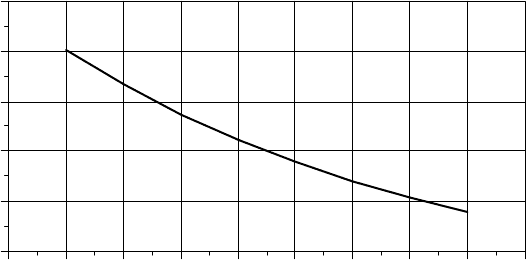
deep discharges result in a lower lifetime number of cycles. Figure 9.38 suggests
that a typical deep-cycle, lead-acid battery can be cycled about 4000 times when
discharged by 25% of its rated capacity, which would give it a lifetime of over
10 years. At a daily discharge of 80%, about 1800 cycles could be expected,
which suggests a lifetime of around 5 years. While Fig. 9.38 provides a rough
indication of battery life, other factors, including quality of battery, frequency of
maintenance, charge rates, and final charging cut-off voltages, are also important.
560 PHOTOVOLTAIC SYSTEMS
9080706050403020100
1000
2000
3000
4000
5000
6000
DEPTH OF DISCHARGE
CYCLES
Figure 9.38 Impact of depth of discharge on the number of cycles a typical deep-cycle
lead-acid battery might be able to provide. An automobile SLI battery delivers only around
500 cycles at 20% discharge.
To understand some of the subtleties in sizing battery systems, we need a
basic understanding of their chemistry. Very simply, an individual 2-V cell in a
lead-acid battery consists of a positive electrode made of lead dioxide (PbO
2
)
and an negative electrode made of a highly porous, metallic lead (Pb) structure,
both of which are completely immersed in an electrolyte consisting of a dilute
solution of sulfuric acid and water. Thin lead plates are structurally very weak
and would not hold up well to physical abuse unless alloyed with a strengthening
material. Automobile SLI batteries use calcium for strengthening, but calcium
does not tolerate discharges of more than about 25 percent very well. Deep
discharge batteries use antimony instead, and so are often referred to as lead-
antimony batteries.
The chemical reactions taking place while the battery discharges are as follows:
Positive plate : PbO
2
+ 4H
+
+ SO
2−
4
+ 2e
−
→ PbSO
4
+ 2H
2
O (9.21)
Negative plate : Pb +SO
2−
4
→ PbSO
4
+ 2e
−
(9.22)
It is, by the way, simpler to refer to the terminals by their charge (positive or
negative) rather than as the anode and cathode. Strictly speaking, the anode is the
electrode at which oxidation occurs, which means that during discharge the anode
is the negative terminal, but during charging the anode is the positive terminal.
As can be seen from (9.22), during discharge the electrons are released at the
negative electrode, which then flow through the load to the positive plate where
they enter into the reaction given by (9.21). The key feature of both reactions is
that sulfate ions (SO
2−
4
) that start out in the electrolyte when the battery is fully
charged end up being deposited onto each of the two electrodes as lead sulfate
(PbSO
4
) during discharge. This lead sulfate, which is an electrical insulator, blan-
kets the electrodes, leaving less and less active area for the reactions to take place.
STAND-ALONE PV SYSTEMS 561
As the battery approaches its fully discharged state, the cell voltage drops sharply
while its internal resistance rises abruptly. Meanwhile, during discharge the spe-
cific gravity of the electrolyte drops as sulfate ions leave solution, providing an
accurate indicator of the battery’s state of charge. The battery is more vulnerable
to freezing in its discharged state since the anti-freeze action of the sulfuric acid
is diminished when there is less of it present. A fully discharged lead-acid battery
will freeze at around −8
◦
C(17
◦
F), while a fully charged one won’t freeze until
the electrolyte drops below −57
◦
C(−71
◦
F). In very cold conditions, concern
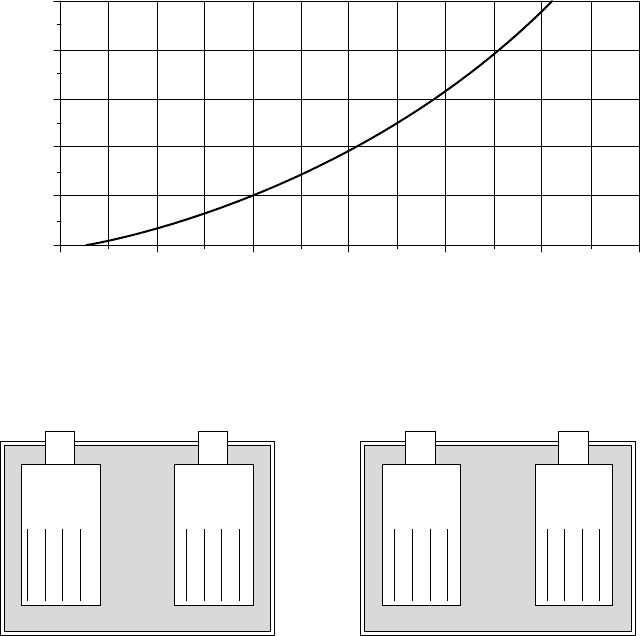
for freezing may limit the maximum allowable depth of discharge, as shown in
Fig. 9.39.
The opposite reactions occur during charging. Battery voltage and specific
gravity rise, while freeze temperature and internal resistance drop. Sulfate is
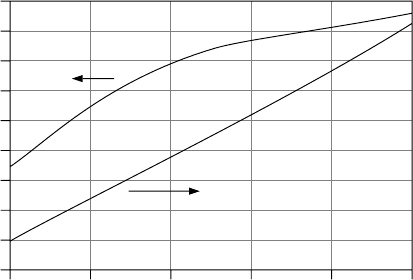
removed from the plates and reenters the electrolyte as sulfate ions (Fig. 9.40).
Unfortunately, not all of the lead sulfate returns to solution, and each battery
charge/discharge cycle leaves a little more sulfate permanently attached to the
0−10−20−30−40−50
−60
0
20
40
60
80
100
Lowest Battery Temperature (°C)
Maximum Depth of Discharge
Figure 9.39 Concern for battery freezing may limit the allowable depth of discharge of
a lead-acid battery.
PbO
2
Pb
++−−
H
+
SO
4
=
PbSO
4
PbSO
4
H
2
O
H
+
CHARGED
DISCHARGED
Figure 9.40 A lead-acid battery in its charged and discharged states.
562 PHOTOVOLTAIC SYSTEMS
plates. This sulfation is a primary cause of a battery’s finite lifetime. The amount
of lead sulfate that permanently bonds to the electrodes depends on the length of
time that it is allowed to exist, which means that for good battery longevity it is
important to keep batteries as fully charged as possible and to completely charge
them on a regular basis. This suggests that a generator back-up system to top up
batteries is an important consideration.
As batteries cycle between their charged and partially discharged states, the
voltage as measured at the terminals and the specific gravity of the electrolyte
changes. While either may be used as an indication of the state of charge (SOC)
of the battery, both are tricky to measure correctly. To make an accurate voltage
reading, the battery must be at rest, which means that at least several hours
must elapse after any charging or discharging. Specific gravity is also difficult
to measure since stratification of the electrolyte means that a sample taken from
the liquid above the plates may not be an accurate average value. Bearing those
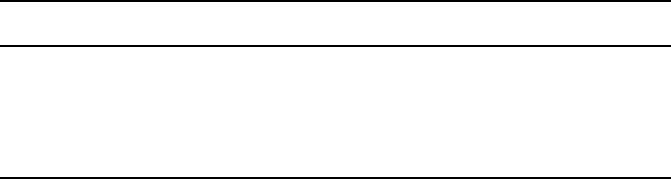
complications in mind, Fig. 9.41 shows voltage for a nominal lead-acid 12-V
battery at rest along with the specific gravity for a well-mixed electrolyte, as a
function of the state of charge. It is interesting to note that a 12-V battery is only
about 20% charged when its terminal voltage is 12 V.
9.5.5 Battery Storage Capacity
Energy storage in a battery is typically given in units of amp-hours (Ah) at some
nominal voltage and at some specified discharge rate. A lead-acid battery, for
example, has a nominal voltage of 2 V per cell (e.g., 6 cells for a 12-V battery),
and manufacturers typically specify the amp-hour capacity at a discharge rate
that would drain the battery down to 1.75 V over a specified period of time at a
temperature of 25
◦
C. For example, a fully charged 12-V battery that is specified
to have a 10-h, 200-Ah capacity could deliver 20 A for 10 h, at which point the
12.80
12.60
12.40
12.20
12.00
11.80
11.60
11.40
11.20
11.00
02040
SG
STATE OF CHARGE (%)
VOLTAGE (V)
SPECIFIC GRAVITY
V
60 80 100
1.10
1.14
1.18
1.22
1.26
Figure 9.41 Voltage and specific gravity for a typical deep-cycle lead-acid 12-V battery.
Data from Sandia National Laboratories (1991)..
STAND-ALONE PV SYSTEMS 563
battery would have a voltage of 10.5 V (6 × 1.75 = 10.5) and be considered to
be fully discharged. Notice how tricky it would be to specify how much energy
the battery delivered during its discharge. Energy is volts × amps × hours, but
since voltage varies throughout the discharge period, we can’t just say 12 V ×
20 A × 10 h = 2400 Wh. To avoid that ambiguity, almost everything having to
do with battery storage capacity is specified in amp-hours rather than watt-hours.
A 200-Ah battery that is delivering 20 A is said to be discharging at a C/10
rate, where the C refers to Ah of capacity and the 10 is hours it would take to
deplete (C/10 = 200 Ah/10 h = 20 A). That same 200-Ah battery won’t be able
to deliver 50 A for a full 4 h (C/4), however, and it will actually deliver 10 A
for more than 20 h (C/20). In other words, the amp-hour capacity depends on the
rate at which current is withdrawn. Rapid draw-down of a battery results in lower
Ah capacity, while long discharge times result in higher Ah capacity. Deep-cycle
batteries intended for photovoltaic systems are often specified in terms of their
20-h discharge rate (C/20), which is more or less of a standard, as well as in
terms of the much longer C/100 rate that is more representative of how they are
actually used. Table 9.15 provides some examples of such batteries, including
their C/20 and C/100 rates as well as their voltage and weight.
The amp-hour capacity of a battery is not only rate-dependent, but also depends
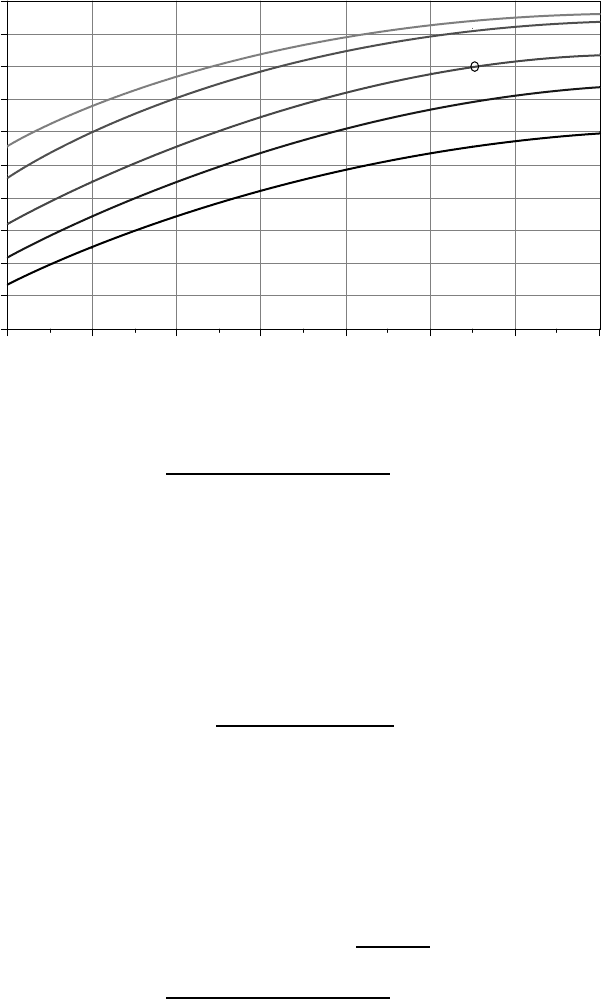
on temperature. Figure 9.42 captures both of these phenomena by comparing
capacity under varying temperature and discharge rates to a reference condition
of C/20 and 25
◦
C. These curves are approximate for typical deep-cycle lead-acid
batteries, so specific data available from the battery manufacturer should be used
whenever possible. As shown in Fig. 9.42, battery capacity decreases dramatically
in colder conditions. At −30
◦
C(−22
◦
F), for example, a battery that is discharged
at the C/20 rate will have only half of its rated capacity. The combination of
cold temperature effects on battery performance—decreased capacity, decreased
output voltage, and increased vulnerability to freezing when discharged—mean
that lead-acid batteries need to be well protected in cold climates. Nicad batteries,
by the way, don’t suffer from these cold weather effects, which is the main reason
they are sometimes used instead of lead-acid batteries in cold climates. Also, the
apparent improvement in battery capacity at high temperatures does not mean
that heat is good for a battery. In fact, a rule-of-thumb estimate is that battery
life is shortened by 50% for every 10
◦
C above the optimum 25
◦
C operating
temperature.
TA BLE 9.15 Example Deep-Cycle Lead-Acid Battery Characteristics
BATTERY Voltage Weight (lbs) Ah @ C/20 Ah @ C/100
Concorde PVX 5040T 2 57 495 580
Trojan T-105 6 62 225 250
Trojan L16 6 121 360 400
Concorde PVX 1080 12 70 105 124
Surette 12CS11PS 12 272 357 503
564 PHOTOVOLTAIC SYSTEMS
403020100−10−20−30
20
30
40
50
60
70
80
90
100
110
120
Battery Temperature (°C)
Capacity/(Rated Capacity) %
C
/72
C
/48
C
/20
C
/10
C
/5
Figure 9.42 Lead-acid battery capacity depends on discharge rate and temperature. Ratio
is based on a rated capacity at C/20 and 25
◦
C.
Example 9.16 Battery Storage Calculation in a Cold Climate. Suppose that
batteries located at a remote telecommunications site may drop to −20
◦
C. If they
must provide 2 days of storage for a load that needs 500 Ah/day at 12 V, how
many amp-hours of storage should be specified for the battery bank?
Solution. From Fig. 9.39, to avoid freezing, the maximum depth of discharge at
−20
◦
C is about 60%. For 2 days of storage, with a discharge of no more than
60%, the batteries need to store
Battery storage =
500 Ah/day × 2days
0.60
= 1667 Ah
Since the rated capacity of batteries is likely to be specified at an assumed
temperature of 25
◦
CataC/20 rate, we need to adjust the battery capacity to
account for our different temperature and discharge period. From Fig. 9.42, the
actual capacity of batteries at −20
◦
C discharged over a 48-h period is about
80% of their rated capacity. This means that we need to specify batteries with
rated capacity
Battery storage (25
◦
C, 10-hour rate) =
1667 Ah
0.8
= 2083 Ah
Most PV–battery systems are based on 6-V or 12-V batteries, which may be
wired in series and parallel combinations to achieve the needed Ah capacity and
STAND-ALONE PV SYSTEMS 565
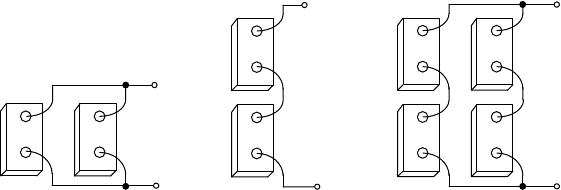
voltage rating. For batteries wired in series, the voltages add, but since the same
current flows through each battery, the amp-hour rating of the string is the same
as it is for each battery. For batteries wired in parallel the voltage across each
battery is the same, but since currents add, the amp-hour capacity is additive.
Figure 9.43 illustrates these notions.
Since there is no difference in energy stored in the two-battery series and
parallel example shown in Fig. 9.43, the question arises as to which is better.
The key difference between the two is the amount of current that flows to deliver a
given amount of power. Batteries in series have higher voltage and lower current,
which means more manageable wire sizes without excessive voltage and power
losses, along with smaller fuses and switches, and slightly easier connections
between batteries. On the other hand, a storage system consisting of batteries in
parallel is easy to expand, one battery at a time. In series, a whole new string of
batteries must be added to increase storage.
9.5.6 Coulomb Efficiency Instead of Energy Efficiency
As mentioned earlier, almost everything having to do with batteries is described
in terms of currents rather than voltage or energy. Battery capacity C is given
in amp-hours rather than watt-hours; charging and discharging are expressed in
C/T rates, which are amps. And, as we shall see, even battery efficiency is more
easily expressed in terms of current efficiency than in terms of energy efficiency.
The reason, of course, is that battery voltage is so ambiguous without specifying
whether it is a “rest” voltage measured some time after charging or discharging, a
voltage during charging, or a voltage during discharge. And even those charging
and discharging voltages depend on the rate at which current is entering or leaving
the battery as well as the state of charge of the battery, its temperature, age, and
general condition.
Imagine charging a battery with a constant current I
C
over a period of time
T
C
during which time applied voltage is V
C
. The energy input to the battery
(a) Parallel, Amp-Hrs add
(b) Series, Voltages add
(c) Series/Parallel
24 V, 200 Ah
+
−
+
−
+
−
+
−
+
−
12 V, 200 Ah
+
−
+
−
+
−
12 V
100 Ah
12 V
100 Ah
24 V, 100 Ah
+
−
+
−
+
−
12 V
100 Ah
12 V
100 Ah
Figure 9.43 For batteries wired in parallel, amp-hours add (a). For batteries in series,
voltages add (b). For series/parallel combinations, both add.

566 PHOTOVOLTAIC SYSTEMS
is thus
E
in
= V
C
I
C
T
C
(9.23)
Suppose that the battery is discharged at current I
D
and voltage V
D
over a period
of time T
D
, delivering energy
E
out
= V
D
I
D
T
D
(9.24)
The energy efficiency of the battery would be
Energy efficiency =
E
out
E
in
=
V
D
I
D
T
D
V
C
I
C
T
C
(9.25)
If we recognize that current (A) times time (h) is Coulombs of charge expressed
as Ah, then
Energy efficiency =
V
D
V
C
I
D
T
D
I
C
T
C
=
V
D
V
C
coulombs out, Ah
out
coulombs in, Ah
in
(9.26)
The ratio of discharge voltage to charge voltage is called the voltage efficiency
of the battery, and the ratio of Ah
out
to Ah
in
is called the Coulomb efficiency.
Energy efficiency = (Voltage efficiency) × (Coulomb efficiency)(9.27)
A typical 12-V lead-acid battery might be charged at a voltage of around
14 V, and its discharge voltage might be around 12 V. Its voltage efficiency
would therefore be
Voltage efficiency =
12 V
14 V
= 0.86 = 86% (9.28)
The Coulomb efficiency is the ratio of coulombs of charge out of the battery to
coulombs that went in. If they don’t all come back out, where did they go? When
a battery approaches full charge, its cell voltage gets high enough to electrolyze
water, creating hydrogen and oxygen gases that may be released. Among the
negative effects of this gassing is loss of some of those charging electrons along
with the escaping gases. While the battery state of charge (SOC) is low, little
gassing occurs and the Coulomb efficiency is nearly 100%, but it can drop below
90% during the final stages of charging. Over a full charge cycle, it is typically
between 90% and 95%. As we shall see later, when it comes to sizing batteries,
the Coulomb efficiency will be the measure that is most appropriate.
Assuming a 90% Coulomb efficiency, the overall energy efficiency of a lead-
acid battery with 86% voltage efficiency would be about
Energy efficiency = 0.86 × 0.90 = 0.77 = 77% (9.29)
STAND-ALONE PV SYSTEMS 567
+
V
B
R
i
I
−
V
+
−
Discharging:
V
<
V
B
Charging:
V
>
V
B
Figure 9.44 Thevenin equivalent circuit for a battery.
which is close to the commonly quoted estimate of 75% for lead-acid battery
energy efficiency.
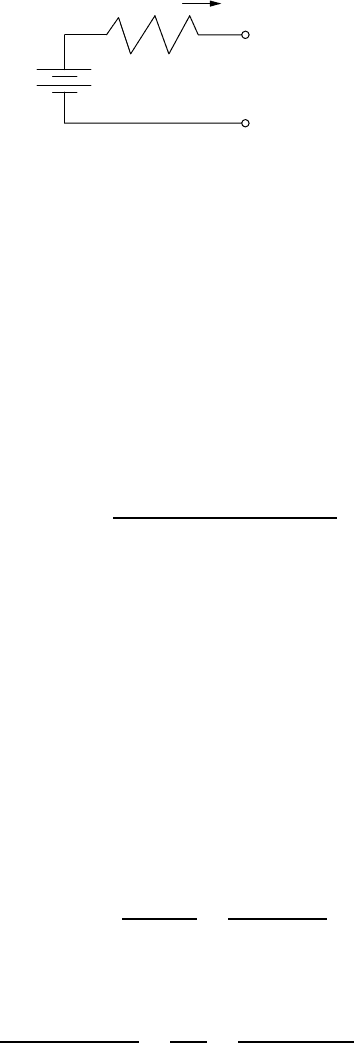
To help understand where that energy loss occurs, consider the simple Thevenin
equivalent for a battery consisting of an ideal battery of voltage V
B
in series with
an internal resistance, R
i
(Fig. 9.44). Voltage V
B
can be considered to be the open-
circuit “rest” voltage of the battery as measured some hours after either charging or
discharging has occurred. To charge the battery, the voltage applied to the terminals
must be greater than V
B
; when the battery is discharging, the output voltage will
be less than V
B
. During those charge and discharge times, there are I
2
R power
losses in the internal resistance. Since those losses go as the square of current,
faster charge or discharge times result in much higher losses.
Example 9.17 Losses at High and Low Charging Rates. A 100-Ah, 12-V
battery with a r est voltage of 12.5 V (at its current SOC) is charged at a C/5
rate, during which time the applied voltage is 13.2 V. Using a simple Thevenin
equivalent:
a. Estimate the internal resistance of the battery.
b. What fraction of the input power is lost in the internal resistance of the
battery?
c. If the charging is done at a C/20 rate, what fraction of the input power
would be lost due to the internal resistance?
Solution
a. At C/5, the current is 100 Ah/5 h = 20 A. The internal resistance must
have been
R
i
=
V
in
− V
B
I
=
13.2 − 12.5
20
= 0.035
b. So the I
2
R losses as a fraction of the input power would be
Power lost in R
i
Input power
=
I
2
R
V
in
I
=
(20)
2
× 0.035
13.2 × 20
= 0.053 = 5.3%