
Masters G.M. Renewable and Efficient Electric Power Systems
Подождите немного. Документ загружается.

598 PHOTOVOLTAIC SYSTEMS
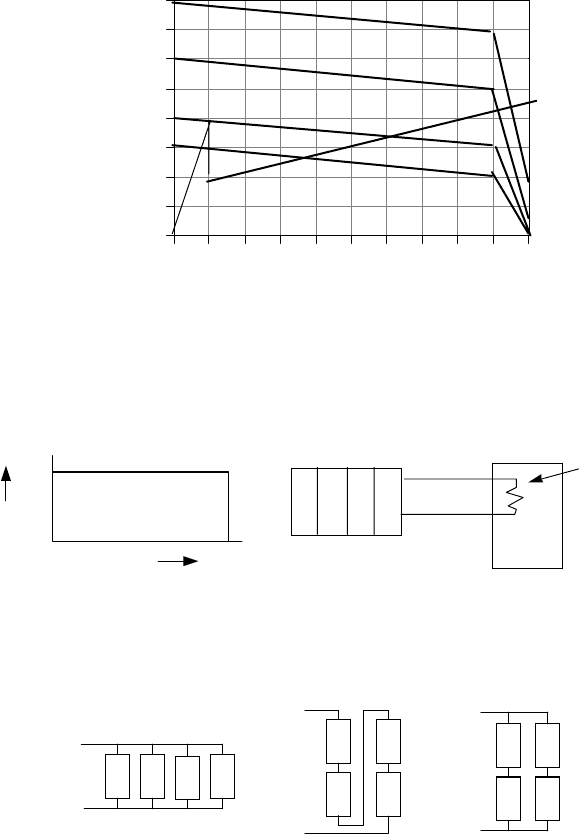
20181614121086420
0.0
0.5
1.0
1.5
2.0
2.5
3.0
3.5
4.0
VOLTAGE (V)
CURRENT (A)
NOON
11 am, 1 pm
10, 2
9, 3
Pump
I
−
V
Figure P9.3
9.4 Imagine a very simple, reliable solar water heater using PVs directly con-
nected to the electric resistance heating element of a small electric water
heater. The water heater is one that would deliver 2.88 kW if it were wired
to normal 120 V ac.
amps
volts
R
4 PV modules
Idealized
I
−
V
curve
for 1 module
2
0
0
20
1-sun
Electric
water
heater
rated at
2.88 kW
and 120V
Figure P9.4a
Suppose you have 4 identical PV modules, each with an idealized, 1-sun,
I –V curve as shown above. Three ways that you can wire up the PVs are
A, B, and C as shown.
+
−
+
−
+
−
+
−
+
−
+
−
+
−
+
−
+
−
+
−
+
−
+
−
(c)(b)(a)
Figure P9.4b
Plot the I –V curves for the three combinations (A, B, and C) and decide
which one delivers the most energy in a day’s time. Explain your answer.
9.5 A clean, 15-%-efficient module (STC), 1 m
2
in size, has its own 90% effi-
cient inverter. Its NOCT is 44
◦
C and its rated power degrades by 0.5%/
◦
C
above the 25
◦
C STC.
PROBLEMS 599
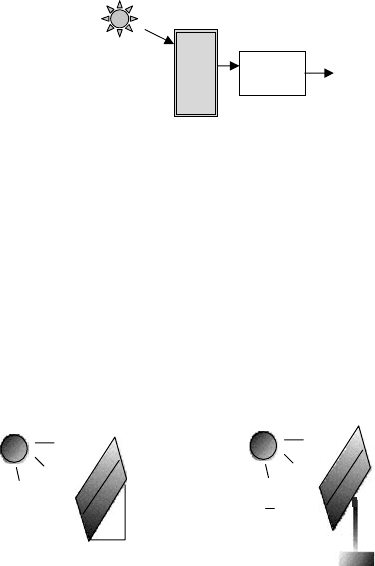
6 kWh/m
2
1 m
2
h = 15%
T
amb
= 15°C
90% eff
dc-to-ac
kWh?
Figure P9.5
a. What would its STC rated power be?
b. Find the kWh that it would be expected to deliver on a 15
◦
C day with
daylong insolation equal to 6 kWh/m
2
?
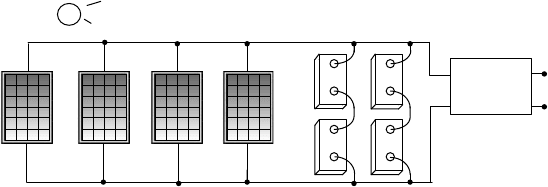
9.6 You have decided to enter the business of selling single-axis, polar mount,
trackers and want to know how much you can sell them for on a dollar-
per-square meter basis to make the resulting PV system no more expensive
than when using a fixed mount system. Using simple dc, STC ratings along
with the following assumptions, how much can the trackers cost $/m
2
?
Fixed mount
Polar mount, 1-axis tracker
S
3
S
4
Figure P9.6
1. Trackers see one-third more insolation.
2. Modules cost $4/W and have conversion efficiencies of 10%.
3. Inverters cost $1 per W of module.
4. Installation cost is the same for fixed mount and trackers.
9.7 You are to size a grid-connected south-facing PV system for Las Vegas to
deliver 4000 kWh/yr. Use a tilt equal to latitude minus 15
◦
.
a. What should be the ac-rated power of the PV/inverter system?
b. What temperature derating should you use if the modules have an NOCT
of 45
◦
C, the maximum power drops by 0.36%/
◦
C, and for ambient the
average annual daily high given in Appendix E is appropriate.
c. For 3% dirt, 3% mismatched modules, and a 92% efficient inverter,
what should the DC, STC rated power of the modules?
d. If the modules are 13% efficient, what area of PVs would be required?
e. If the installed system cost is $6 per dc, STC W, what is the total cost
of the system?
600 PHOTOVOLTAIC SYSTEMS
f. Suppose the system is paid for with a 6%, 30-year loan with interest
being tax deductible, The customer is married and has a taxable income
around $200,000/yr, which puts them in the 35.5% marginal tax bracket.
Nevada has no state income tax. There is a renewable energy credit
(Green Tag program) that will pay the owner 5¢/kWh generated. What
would be the first year cost of PV electricity for this customer (¢/kWh)?
9.8 A grid-connected PV array consisting of sixteen Shell SP150 modules
(Table 9.4) can be arranged in a number of series and parallel combina-
tions: (16S, 1P), (8S, 2P), (4S, 4P), (2S, 8P), (1S, 16P). The array delivers
power to a Sunny Boy SB2500 inverter (Table 9.5). Using the input volt-
age range of the maximum power point tracker (MPPT) and the maximum
input voltage of the inverter as design constraints, what series/parallel com-
bination of modules would best match the PVs to the inverter?
9.9 A 1.5 V AA battery that costs $1 is rated at 1.8 Ah. What is its cost
per kWh?
9.10 Suppose a 12-V battery bank rated at 200 Ah under standard conditions
needs to deliver 600 Wh over a 12-h period each day. If they operate at
−10
◦
C, how many days of use would they be able to supply?
9.11 A small cabin needs 2.4-kWh per day, all of which is used in the evening
from 7 pm to 11 pm. If you decide to supply only enough 12-V battery
storage to cover each evening, what should the minimum rated A-hr of
batteries be if they shouldn’t be discharged more than 80 percent? Assume
battery temperature is 25
◦
C.
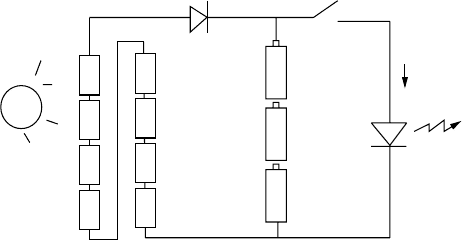
9.12 Analyze this PV/battery system (ignore battery discharge rate and temper-
ature constraints):
1. PV Module characteristics: P
R
= 100 W, V
R
= 20.0 V, V
OC
= 22 V,
I
R
= 5.0 A, I
SC
= 6A
2. Battery characteristics: 6 V, 100 Ah (each)
3. Coulomb efficiency 90%; Maximum discharge 80%
4. Insolation: 6 kWh/m
2
day
5. Inverter efficiency: 80%;
6. Dirt, etc, efficiency: 90% (10% loss)
6V,
100 Ah
+
+
−
+
−
+
−
+
−
80%
efficient
Inverter
−
AC
Output
6 kW/m
2
-day
Figure P9.12
PROBLEMS 601
a. Find the watt-hours/day that would reach the loads (assume all PV
current passes through the batteries):
b. If the load requires 600 Wh/day, for how many cloudy days in a row
can fully-charged batteries supply the load?
9.13 Consider the design of a small PV-powered light-emitting-diode (LED)
light. The PV array consists of 8 series cells, each with rated current 0.3 A
@ 0.6 V. Storage is provided by three series AA batteries that each store
2 Ah at 1.2 V when fully charged. The LED provides full brightness when
it draws 0.4 A @ 3.6 V.
3.6 V
light
LED
3 AA
batteries
0.4A
On/Off
+
+
−
−
Blocking diode
Figure P9.13
The batteries have a Coulomb efficiency of 90% and for maximum cycle
life can be discharged by up to 80%. Ignore any complications associated
with temperature, dirt, discharge rate, etc.
a. How many hours of light could this design provide each evening if the
batteries are fully charged during the day?
b. How many kWh/m
2
-day of insolation would be needed to provide the
amount of light found in (a)?
c. With 12-%-efficiency cells, what PV area would be required?
9.14 Consider a PV a rray charging batteries for an off-the-grid, stand-alone
system near Boulder, Colorado You plan to run everything in the house on
120 V ac.
a. Suppose the load is estimated to consist of the following 120 V ac appli-
ances. Supplement load data given below with values from Table 9.10.
A 19-cu. ft. refrigerator/freezer.
A 1000-W microwave used 15 min./day.
Five 20-W compact fluorescent lamps, each used 8 hrs/day.
A horizontal-axis washing machine used 3 hrs/week
A 24-V well pump that delivers 288 gal/day at 1.6 gpm of water from
100-ft depth
602 PHOTOVOLTAIC SYSTEMS
A 19-inch color TV used 2 hrs/day and drawing standby power the other
22 hrs/day
A satellite receiver system for the TV, used 2 hours/day and in standby
mode 22 hrs.
A laptop computer used 4 hrs/day,
Six 3-W transformer units for chargers that run all day long
Find the total watt-hrs per day needed by these appliances.
b. Pick an appropriate system voltage.
c. How many amp-hours/day would the battery bank have to deliver if
the loads are all ac provided by an 85% efficient inverter?
d. How many Ah/d would have to be delivered to the batteries if they
have a Coulomb efficiency of 90%?
e. Suppose 5% of the PV output is lost due to dirt, etc. How many Ah/d
should the PVs provide before that derating?
f. Using the worst month in Boulder with south-facing panels tilted at
L + 15, how many AstroPower APex 90-W modules with DC, STC
rated current 5.3 A and rated voltage 17.1 volts would be needed in
series and parallel? If they cost $400 each, what is the cost of PVs?
g. What is the maximum current that you might expect in the wires con-
necting the array to battery system (just use the rated current)? What
gage wire would you suggest using (Table 1.3)?
h. If your design goal is to provide needed electricity 95% of the time,
about how many days of usable battery storage would you need?
i. If the coldest temperature the batteries might experience is −20
◦
C,
what is the maximum depth of discharge that lead-acid batteries could
tolerate without freezing (Figure 9.39)?
j. If a C/72 discharge rate is assumed along with −20
◦
C and the results
from (c), what should be the rated (nominal) Ah capacity of the battery
bank? (use Figure 9.42 and Eq. 9.32)?
k. Suppose you use Concorde PVX 1080 batteries (Table 9.15). How
many batteries in series and how many in parallel would you rec-
ommend (round up if necessary). At $160 each, how much would the
batteries cost?
l. Assume a power control unit with inverter costs $1/watt and they come
in 500 W increments (1 kW, 1.5 kW, 2 kW, 2.5 kW, etc). You want
one big enough to cover all your appliances on at once. Pick an inverter
and how much would it cost?
m. Draw the system “wiring” diagram showing series/parallel combina-
tions of the PV modules and batteries, similar to Figure 9.51.
n. What would the total system cost be?
o. Using the annual insolation in Boulder, estimate the average Amp-
hours/day (at the system voltage) that the PVs could deliver all year
PROBLEMS 603
long. If all of that electricity is run through the batteries and inverter
and ends up being used in the house, how many kWh/year would be
delivered (i.e., in the better months you use all of the kWh not just the
design load specified in (a))?
p. Paying for the system with a 15-year, 5% loan, find the first-year cost
of electricity ($/kWh) for someone in the 36% marginal tax bracket if
the loan interest is tax deductible (see Section 5.3.8).
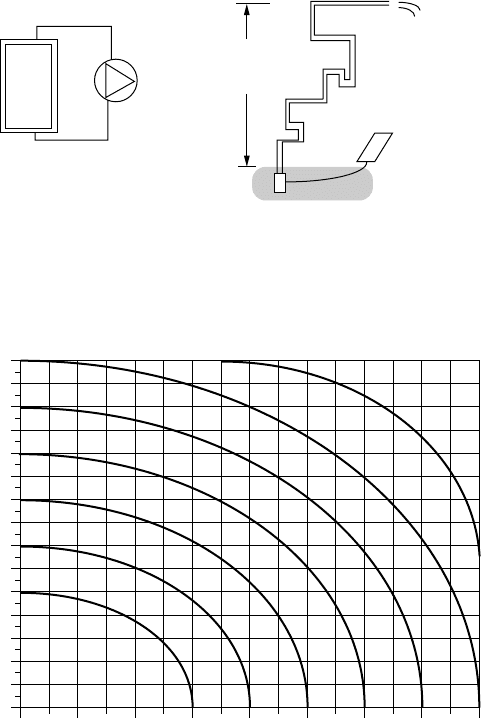
9.15 A PV module is directly connected to a water pump that needs to raise
water 10-ft high through 70 ft of 1/2
plastic tubing with twenty 90
◦
ells
(Figure P9.15a).
20 90° ells
70 ft of 1/2" pipe
pump
10 ft
PV
PV
+
−
Pump
Figure P9.15a
The pump curves of head H versus flow Q as a function of input voltage
are shown in Figure P9.15b.
30
28
26
24
22
20
18
16
14
12
10
8
6
4
2
0
4.03.53.02.52.01.51.00.50.0
FLOW RATE (gpm)
HEAD (ft of water)
8 V
10 V
12 V
14V
16 V
18 V
20 V
Figure P9.15b Pump curves.
604 PHOTOVOLTAIC SYSTEMS
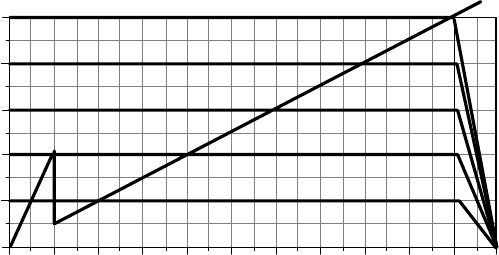
The hour-by-hour I –V curves for the PV module are shown in
Figure P9.19c along with the pump I –V curve:
20181614121086420
V
(volts)
0
2
1
3
4
5
Current (amps)
1-sun = 1000 w/m
2
Noon
22
11am and 1 pm
10 am and 2 pm
9 am and 3 pm
8 am and 4 pm
Figure P9.15c
Using Table 9.19, find the equivalent length of the pipe and ells to create a
hydraulic system curve similar to that in Figure 9.56. Remember to include
the 10 feet of static head. Plot that system curve on top of the pump curves
in Figure P9.15b. Now find the hour-by-hour pumping rate Q (gpm) that
will result.
9.16 Your client wants a quick design for a system to pump on the order of
1800 gallons per day from a depth of 200 ft. You decide to use a 45-V
submersible pump with an estimated efficiency of 35% along with PV mod-
ules having rated current of 5 A at a rated voltage of 16 V. The insolation
is estimated to be 6 kWh/m
2
day in the design month. Since this is only a
quick estimate, piping friction losses will be estimated at 5% of the static
head. Design the PV system.

APPENDICES
Appendix A: Useful Conversion Factors
Appendix B: Sun-Path Diagrams
Appendix C: Hourly Clear-Sky Insolation Tables
Appendix D: Monthly Clear-Sky Insolation Tables
Appendix E: Solar Insolation Tables by City
Appendix F: Maps of Solar Insolation
Renewable and Efficient Electric Power Systems. By Gilbert M. Masters
ISBN 0-471-28060-7
2004 John W iley & Sons, Inc.
605

606 USEFUL CONVERSION FACTORS
APPENDIX A
USEFUL CONVERSION FACTORS
LENGTH
1inch = 2.540 cm
1 foot = 0.3048 m
1yard = 0.9144 m
1 mile = 1.6093 km
1meter = 3.2808 ft
= 39.37 in.
1 kilometer = 0.6214 mile
AREA
1 square inch = 6.452 cm
2
= 0.0006452 m
2
1 square foot = 0.0929 m
2
1acre = 43,560 ft
2
= 0.0015625 sq mile
= 4046.85 m
2
= 0.404685 ha
1 square mile = 640 acre
= 2.604 km
2
= 259 ha
Renewable and Efficient Electric Power Systems. By Gilbert M. Masters
ISBN 0-471-28060-7
2004 John W iley & Sons, Inc.
USEFUL CONVERSION FACTORS 607
1 square meter = 10.764 ft
2
1hectare = 2.471 acre
= 0.00386 sq mile
= 10,000 m
2
VOLUME
1 cubic foot = 0.03704 cu yd
= 7.4805 gal (U.S.)
= 0.02832 m
3
= 28.32 L
1 acre foot = 43,560 ft
3
= 1233.49 m
3
= 325,851 gal (U.S.)
1gallon(U.S.) = 0.134 ft
3
= 0.003785 m
3
= 3.785 L
1 cubic meter = 8.11 × 10
−4
Ac ft
= 35.3147 ft
3
= 264.172 gal (U.S.)
= 1000 L
= 10
6
cm
3
LINEAR VELOCITY
1 foot per second = 0.6818 mph
= 0.3048 m/s
1 mile per hour = 1.467 ft/s
= 0.4470 m/s
= 1.609 km/h
1 meter per second = 3.280 ft/s
= 2.237 mph
MASS
1 pound (avoirdupois) = 0.453592 kg
1 kilogram = 2.205 lb (avoirdupois)
= 35.27396 oz (avoirdupois)
1 ton (short) = 2000 lb (avoirdupois)
= 907.2 kg
= 0.9072 ton (metric)