
Moulson A.J., Herbert J.M. Electroceramics: Materials, Properties, Applications
Подождите немного. Документ загружается.

72 ELEMENTARY SOLID STATE SCIENCE
(a)
(b)
(c)
TEAMFLY
Team-Fly
®
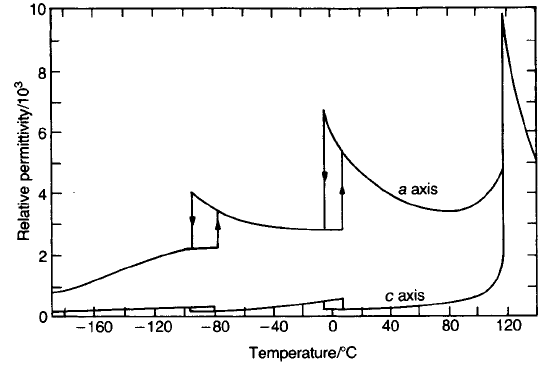
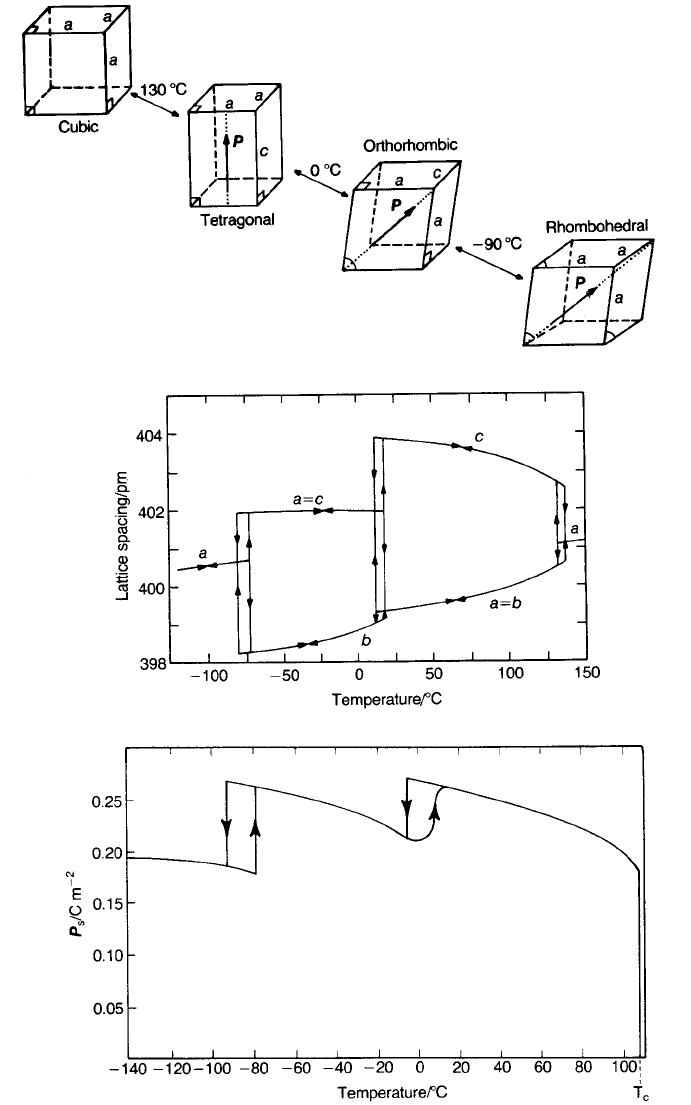
The transformations are illustrated in Fig. 2.40(a), and the corresponding
changes in the values of the lattice parameters, the spontaneous polarization and
the relative permittivity are shown in Fig. 2.40(b–d).
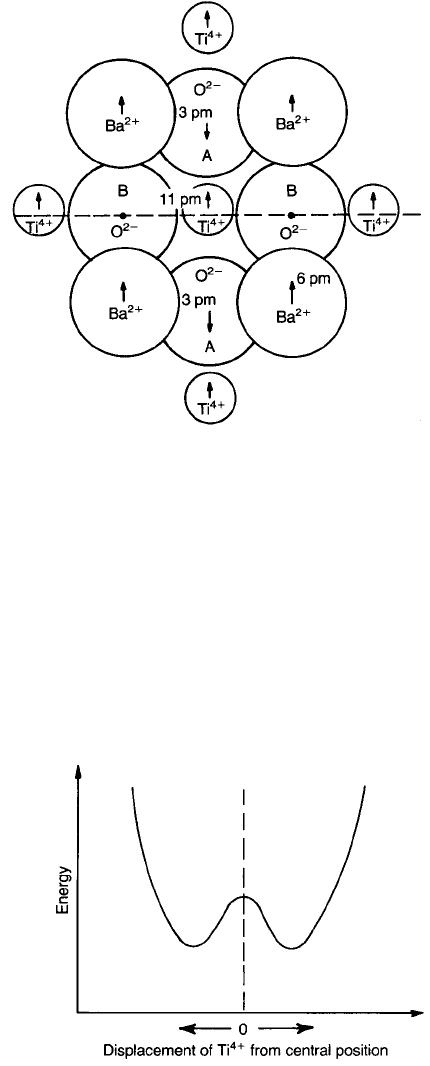
A consideration of the ion displacements accompanying the cubic–tetragonal
transformation can give insight into how the spontaneous polarization might be
coupled from unit cell to unit cell. X-ray studies have established that in the
tetragonal form, taking the four central (B) oxygen ions in the cubic phase as
origin, the other ions are slightly shifted as shown in Fig. 2.41. It is evident that if
the central Ti
4þ
ion is closer to one of the O
2
ions marked A, it will be
energetically favourable for the Ti
4þ
ion on the opposite side of A to be located
more distantly from that O
2
ion, thus engendering a similar displacement of all
the Ti
4þ
ions in a particular column in the same direction. Coupling between
neighbouring columns occurs in BaTiO
3
so that all the Ti
4þ
ions are displaced in
the same direction. In contrast, in the orthorhombic perovskite PbZrO
3
the Zr
4þ
ions in neighbouring columns are displaced in opposite senses so that the overall
dipole moment is zero. Such a structure is termed antiferroelectric if the material
shows a Curie point.
In tetragonal BaTiO
3
the energy of the Ti
4þ
ion in terms of its position along
the c axis takes the form of two wells (Fig. 2.42). An applied field in the opposite
direction to the polarization may enable a Ti
4þ
ion to pass over the energy
barrier between the two states and so reverse the direction of the polarity at that
point. When this happens the energy barriers for neighbouring ions are reduced
and the entire region affected by the field will eventually switch into the new
CHARGE DISPLACEMENT PROCESSES 73
(d)
Fig. 2.40 Properties of single-crystal BaTiO
3
: (a) unit-cell distortions of the polymorphs; (b)
lattice dimensions versus temperature (after R. Clarke J. Appl. Cryst. 9, 335, 1976); (c)
spontaneous polarization versus temperature; (d) relative permittivities measured in the a and
c directions versus temperature (after W.J. Merz Phys. Rev. 76, 1221, 1949).
direction. A similar mechanism is available for changes of polarity through 908
but in this case there is an accompanying dimensional change because the polar c
axis is longer than the non-polar a axis (Fig. 2.40(b)). Switching through 908 can
be induced through the ferroelastic effect by applying a compressive stress along
the polar axis without an accompanying electric field. Mechanical stress does not
induce 1808 switching.
An immediate consequence of the onset of spontaneous polarization in a body
is the appearance of an apparent surface charge density and an accompanying
depolarizing field E
D
as shown in Fig. 2.43(a). The energy associated with the
74 ELEMENTARY SOLID STATE SCIENCE
Fig. 2.41 Approximate ion displacements in the cubic–tetragonal distortion in BaTiO
3
.
Fig. 2.42 Variation in the potential energy of Ti
4+
along the c axis.
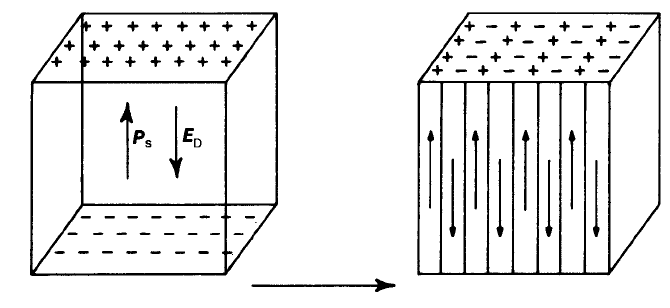
polarization in the depolarizing field is minimized by twinning, a process in
which the crystal is divided into many oppositely polarized regions, as shown in
Fig. 2.43(b). These regions are called domains and the whole configuration shown
comprises 1808 domains. Thus the surface consists of a mosaic of areas carrying
apparent charges of opposite sign, resulting in a reduction in E
D
and in energy.
This multidomain state can usually be transformed into a single domain by
applying a field parallel to one of the polar directions. The domains with their
polar moment in the field direction grow at the expense of those directed
oppositely until only a single domain remains. The presence of mechanical stress
in a crystal results in the development of 908 domains configured so as to
minimize the strain. For example, as ceramic BaTiO
3
cools through the Curie
temperature individual crystallites are subjected to large mechanical stresses
leading to the development of 908 domains. The configurations can be modified
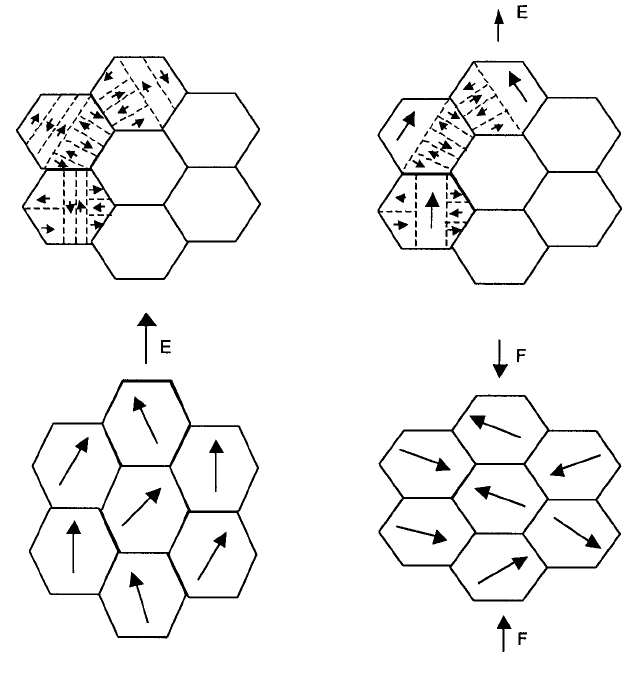
by imposing either an electric or a mechanical stress. A polycrystalline ceramic
that has not been subjected to a static field behaves as a non-polar material even
though the crystals comprising it are polar. One of the most valuable features of
ferroelectric behaviour is that ferroelectric ceramics can be transformed into
polar materials by applying a static field. This process is called ‘poling’. The
ceramic can be depoled by the application of appropriate electric fields or
mechanical stresses. These poling and depoling processes are illustrated in
Fig. 2.44.
The random directions of the crystallographic axes of the crystallites of a
ceramic limit the extent to which spontaneous polarization can be developed. It
has been calculated that the fractions of the single-crystal polarization value that
can be attained in a ceramic in which the polar axes take all possible alignments
CHARGE DISPLACEMENT PROCESSES 75
Fig. 2.43 (a) Surface charge associated with spontaneous polarization; (b) formation of 1808
domains to minimize electrostatic energy.
(a) (b)
are 0.83, 0.91 and 0.87 for perovskites with tetragonal, orthorhombic or
rhombohedral structures respectively. In ceramic tetragonal BaTiO
3
the
saturation polarization is about half the single-crystal value. The value attainable
is limited by the inhibition of 908 switching because of the strains involved,
although 1808 switching can be almost complete.
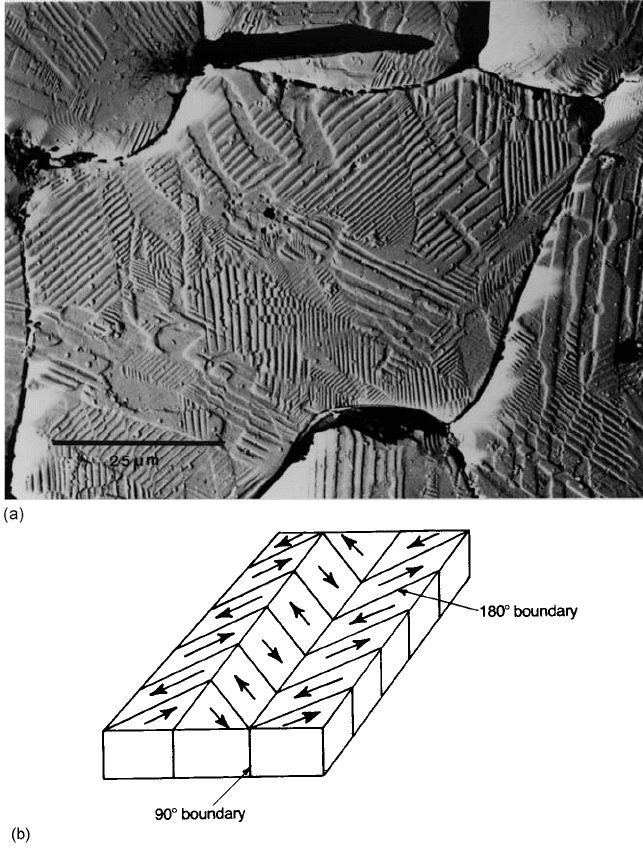
The domain structure revealed by polishing and etching an unpoled ceramic
specimen is shown in Fig. 2.45(a). The principal features in the form of parallel
lines are due to 908 changes in the polar direction. The orientations occurring in
a simple domain structure are shown schematically in Fig. 2.45(b). The thickness
76 ELEMENTARY SOLID STATE SCIENCE
Fig. 2.44 Schematic illustrating the changes accompanying the application of electrical and
mechanical stresses to a polycrystalline ferroelectric ceramic: (a) stress-free – each grain is
non-polar because of the cancellation of both 1808 and 908 domains; (b) with applied electric
field – 1808 domains switch producing net overall polarity but no dimensional change; (c) with
increase in electric field 908 domains switch accompanied by small (1%) elongation; (d)
domains disorientated by application of mechanical stress. (Note the blank grains in (a) and
(b) would contain similar domain structures.)
(a) (b)
(c)
(d)
of the layer separating the domains, i.e. the domain wall, is of the order of 10 nm
but varies with temperature and crystal purity. The wall energy is of the order
10 mJ m
2
. The physics of domain formation and stress-relief is reviewed by
G. Arlt [13].
The detailed geometry and dynamics of changes in domain configuration in a
single crystal accompanying changes in applied field are complex and there is
CHARGE DISPLACEMENT PROCESSES 77
Fig. 2.45 (a) Polished and etched surface of unpoled ceramic; (b) schematic diagram of 1808
and 908 domains in barium titanate.
marked hysteresis between induced polarization and an applied field of sufficient
strength. Conditions in a crystallite clamped within a ceramic are even more
complex.
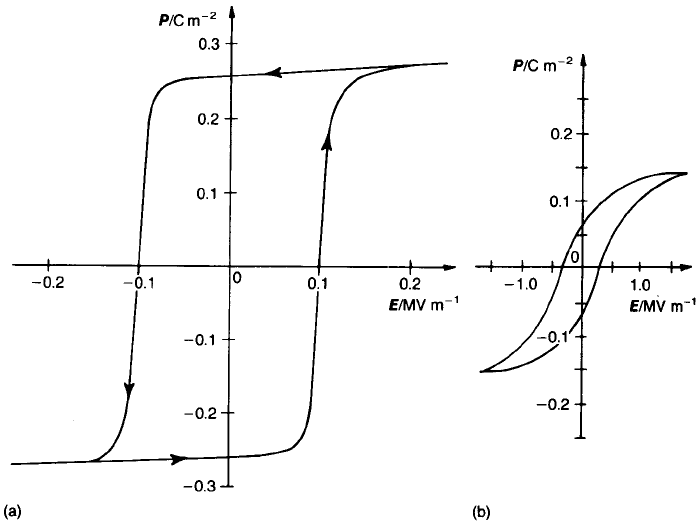
The hysteresis loop of a single-domain single crystal of BaTiO
3
is shown in
Fig. 2.46(a). The almost vertical portions of the loop are due to the reversal of
the spontaneous polarization as reverse 1808 domains nucleate and grow. The
almost horizontal portions represent saturated states in which the crystal is single
domain with a permittivity e
r
of 160 (see Fig. 2.40(d)) measured in the polar
direction. The coercive field at room temperature when the loop is developed by
a 50 Hz supply is 0.1 MV m
1
and the saturation polarization is 0.27 C m
2
. For
fields in the approximate range 10 to 100 V mm
71
the hysteresis loop takes the
form of a narrow ellipse, a Rayleigh loop, with its major axis parallel to the
almost horizontal part of the fully developed loop.
The hysteresis loop of a ceramic varies according to composition and ceramic
structure but is typically of the form shown in Fig. 2.46(b). The coercive field is
higher and the remanent polarization is lower than for a single crystal. Changes
in both 1808 and 908 domain configurations take place during a cycle and are
impeded by the defects and internal strains within the crystallites.
In discussing dielectric losses in ferroelectrics it is necessary to distinguish
78 ELEMENTARY SOLID STATE SCIENCE
Fig. 2.46 Hysteresis loops for (a) a single-domain single crystal of BaTiO
3
and (b) BaTiO
3
ceramic.
between three mechanisms. The first involves the vibrating domain wall, the
second a limited translation of the wall and the third the switching of the
polarization direction of an entire domain. These three mechanisms are now
discussed in a little more detail when it is assumed that the driving electric field is
sinusoidal and that when field strengths are referred to it is the amplitude which
is the relevant parameter.
Considering first the vibrating domain wall, the losses have their origin in the
emission of acoustic shear waves resulting from small changes in domain shape
induced by the applied field. These losses are present at all frequencies extending
up to the GHz range. At around 1 GHz there is a marked Debye-like relaxation
effect with the losses reaching a maximum. (The process bears a formal similarity
to that discussed earlier (see Section 2.7.2 in the context of dielectric losses in a
glass). At this frequency the wavelength of an acoustic wave is of the same order
of size as that of the domains ( i.e. 1mm) and there will be strong scattering.
The topic is discussed by G.Arlt and co-workers (e.g. [14]).
This loss mechanism is dominant up to a ‘threshold field’ (E
th
) the strength of
which depends upon the ‘softness’ or ‘hardness’ of the ferroelectric. Anticipating
the later discussion (see Section 6.3.2) of the family of piezoelectric ceramics
(PbZrO
3
– PbTiO
3
[‘PZT’]) ‘hardness’ is engineered through specific doping
which has the effect of ‘pinning’ the domain walls. The losses (tan d) of a ‘hard’
and ‘soft’ PZT in the low field region (below E
th
) are typically 0.003 and 0.02
respectively.
Above E
th
the field is sufficiently strong to cause limited translation of the
domain wall without disturbing to any significant extent the overall domain
structure. This process is described as ‘reversible’ (more correctly as ‘nearly
reversible’) to distinguish it from the very hysteretic and clearly irreversible
process evidenced by the hysteresis loop (Fig. 2.46). In this regime the P-E
characteristic is a narrow loop, the Rayleigh loop referred to above (c.f. Fig. 6.9).
When a critical field (E
c
) is reached, which is near to the coercive field, the
domains switch direction as a whole involving considerable hysteresis loss. This
loss is proportional to the area of the loop, so that for the single crystal in
Fig 2.46(a) it amounts to about 0.1 MJ m
73
. At 100 Hz the power dissipated as
heat would be 100 MW m
73
, which would result in a very rapid rise in
temperature. The dissipation factor (tan d) is also very high at high field
strengths, but becomes small at low field strengths, as described above.
Modifications to the composition diminish the loss still further.
Dielectric hysteresis in the commercially important ferrolectric piezoceramics
(e.g. ‘PZT’; c.f. Section 6.3.1) is comprehensively reviewed by D. Hall [15].
A further unusual characteristic of ferroelectric materials is that their
properties change with time in the absence of either external mechanical or
electrical stresses or temperature changes. This ageing is due to a diminution of
domain wall mobility through the gradual build-up of inhibiting causes. These
may be internal fields due to the alignment of dipoles formed from lattice defects
CHARGE DISPLACEMENT PROCESSES 79

and impurity ions, the redistribution of internal strains due to crystal anisotropy
or the accumulation of defects in the domain walls.
The rate of change @p=@t of a property with time is approximately inversely
proportional to the time after a specimen has cooled from above its Curie point
to room temperature:
@p
@t
¼
a
0
t
ð2:123Þ
On integration Eq. (2.123) yields
p ¼ a log
10
t
t
0
ð2:124Þ
where a ¼ a
0
log
e
10 and t
0
is an arbitrary zero for the time. a is usually less
than 0.05 for most properties of commercial materials. It varies in sign
according to the property and, for instance, is negative for permittivity and
positive for Young’s modulus. The value of a is often given as a percentage per
decade, which implies that the change in a property will be the same between 1
and 10 days as between 100 and 1000 days. The effect therefore becomes
negligible after a sufficient lapse of time provided that the component is not
subjected to high mechanical or electrical stresses or to temperatures near to or
exceeding the Curie point. Such stresses will disturb the domain structure and
consequently the ageing rate will increase to a value above that expected from
Eq. (2.123).
One very significant advantage of ceramic ferroelectrics is the ease with which
their properties can be modified by adjusting the composition and the ceramic
microstructure. Additions and the substitution of alternative cations can have
the following effects:
1. shift the Curie point and other transition temperatures;
2. restrict domain wall motion;
3. introduce second phases or compositional heterogeneity;
4. control crystallite size;
5. control the oxygen content and the valency of the Ti ion.
The effects are important for the following reasons.
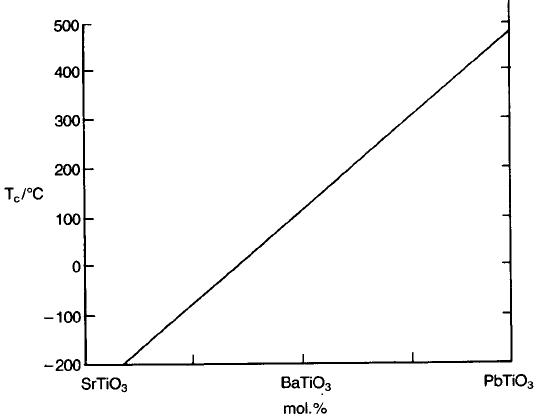
1. Changing the Curie point enables the peak permittivity to be put in a
temperature range in which it can be exploited. The substitution of Sr
2þ
for
Ba
2þ
in BaTiO
3
lowers T
c
whilst the substitution of Pb
þ
increases it, as
shown in Fig. 2.47.
80 ELEMENTARY SOLID STATE SCIENCE
2. A number of transition ions (Fe
3þ
,Ni
2þ
,Co
3þ
) that can occupy Ti
4þ
sites
reduce that part of the dissipation factor due to domain wall motion.
3. Broadening of the permittivity–temperature peak can be effected by making
additions, such as CaZrO
3
to BaTiO
3
. The resultant materials may contain
regions of variable composition that contribute a range of Curie points so
that the high permittivity is spread over a wider temperature range, although
at a somewhat lower level than that of the single peak.
4. Cations that have a higher valency than those they replace, when present at
levels exceeding about 0.5 cation percent, e.g. La
3þ
in place of Ba
2þ
or Nb
5þ
in place of Ti
4þ
, generally inhibit crystal growth. This has the effect of raising
the permittivity level below the Curie point as shown in Fig. 2.48. Crystal size
is also controlled by sintering conditions. It has important effects on the
electro-optical behaviour.
5. Higher-valency substituents at low concentrations (50.2 cation percent) in
BaTiO
3
lead to low resistivity. However, lower-valency substituents, such as
Mn
3þ
on Ti
4þ
sites, act as acceptors and enable high-resistivity dielectrics to
be sintered in atmospheres with low oxygen contents.
Ferroelectric ceramics find applications in capacitors, infrared detection,
sound detection in air and water, the generation of ultrasonic energy, light
switches, current controllers and small thermostatic devices. In all these cases
CHARGE DISPLACEMENT PROCESSES 81
Fig. 2.47 The approximate effect on the Curie point of the substitution of either strontium or
lead for barium in BaTiO
3
.