
Moulson A.J., Herbert J.M. Electroceramics: Materials, Properties, Applications
Подождите немного. Документ загружается.

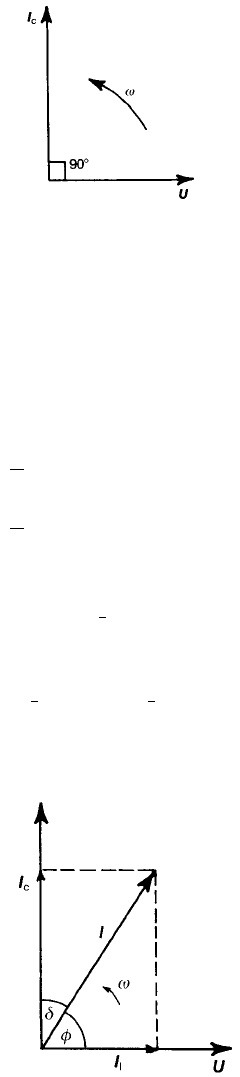
as they rotate in an anticlockwise sense with angular frequency o, maintaining a
constant phase difference, in this case 908.
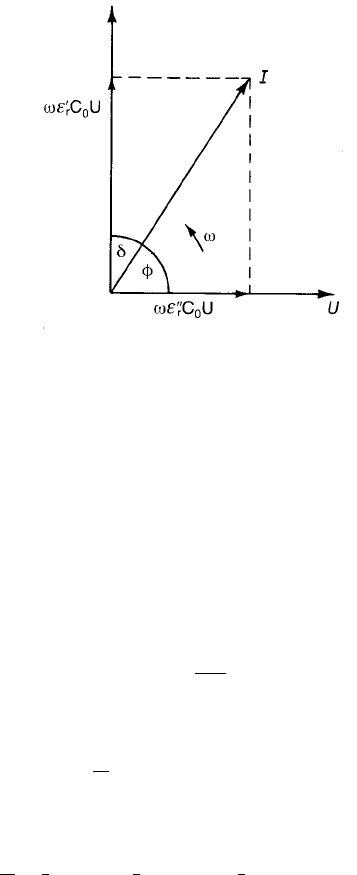
If there is to be a net extraction of power from the source, there must be a
component I
1
of I in phase with U, as shown in Fig. 2.31; I
1
leads to power loss,
whereas the capacitative component I
c
does not. Therefore the time average
power loss is
PP ¼
1
T
ð
T
0
UIdt
¼
1
T
ð
T
0
U
0
sinðotÞI
0
cosðot dÞdt
ð2:94Þ
Integrating Eq. (2.94) gives
PP ¼
1
2
U
0
I
0
sind ð2:95Þ
Since I
0
¼ I
c
=cosd and I
c
¼ oU
0
C,
PP ¼
1
2
U
0
I
c
tand ¼
1
2
U
2
0
oCtan d ð2:96Þ
U
0
/
ffiffiffi
2
p
and I
0
/
ffiffiffi
2
p
being respectively the rms voltage and rms current:
62 ELEMENTARY SOLID STATE SCIENCE
Fig. 2.31 Phasor diagram for a real capacitor.
Fig. 2.30 Phasor diagram for a perfect capacitor.
TEAMFLY
Team-Fly
®

It can be seen from Eq. (2.95) that sin d (or cos f) represents the fraction of the
current–voltage product that is dissipated as heat. It is termed the ‘power factor’.
From Eq. (2.96) the ‘dissipation factor’ tand is the fraction of the product of the
capacitive current (the component 908 out of phase with the voltage) and the
voltage, dissipated as heat. In most cases of interest d is small enough for
sind tan d.
Eq. (2.96) can be put in terms of dielectric material parameters by substituting
E
0
h for U
0
, e
r
e
0
A=h for C and V for Ah (see Fig. 2.27), leading to the equation for
the dissipated power density in the dielectric:
PP
V
¼
1
2
E
2
0
oe
0
e
r
tand ð2:97Þ
e
r
tand is termed the ‘loss factor’ of the dielectric and oe
0
e
r
tand is the ‘dielectric
(or a.c.) conductivity’:
s
a:c:
¼ oe
0
e
r
tand ð2:98Þ
The complex permittivity
The behaviour of a.c. circuits can conveniently be analysed using complex
quantities. The method makes use of the identity
expðjyÞ¼cos y þ jsin y where j ¼
p
ð1Þð2:99Þ
Thus U ¼ U
0
expðjotÞ can represent a complex sinusoidal voltage. The time
differential of U is given by
_
UU ¼ joU
0
expðjotÞ¼joU
where the j multiplier indicates that
_
UU is 908 in advance of U. In linear equations
U ¼ U
0
expðjotÞ can be used to represent U
0
cosðotÞ, although more correctly it
should be represented by U
0
RefexpðjotÞg where Re stands for ‘real part of’. The
latter form must be used in higher-order equations.
The method can be demonstrated by repeating the preceding analysis for a
lossy dielectric. The instantaneous charge on a ‘lossless’ vacuum capacitor C
0
is
Q ¼ UC
0
and
I ¼
_
QQ ¼
_
UUC
0
¼ joC
0
U ð2:100Þ
If the capacitor is now filled with a lossy dielectric, its effect can be taken into
account by introducing a complex relative permittivity e
r
* ¼ e
0
r
je@
r
, where e
0
r
and
e@
r
are respectively the real and imaginary parts of the relative permittivity. It
follows that
CHARGE DISPLACEMENT PROCESSES 63
I ¼ joe
r
*C
0
U
¼ joe
0
r
C
0
U þ oe@
r
C
0
U
ð2:101Þ
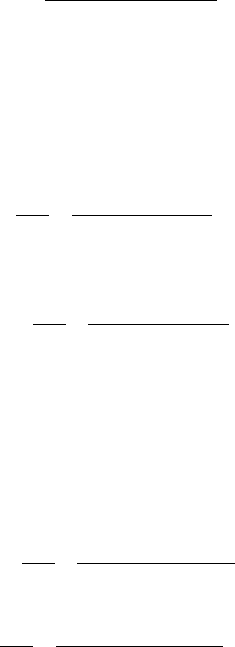
The current is made up of two components, one capacitive and ‘lossless’ and the
other in phase with U and ‘lossy’, as indicated in Fig. 2.32. It can be seen from
the figure that
e@
r
=e
0
r
¼ tand ð2:102Þ
The current I
1
in phase with U can be written
I
1
¼ oe@
r
e
0
A
h
U
so that the current density is given by
I
1
A
¼ oe@
r
e
0
E ¼ oe@E ð2:103Þ
It follows that the average dissipated power density is given by
PP
V
¼
1
2
E
2
0
s
AC
¼
1
2
E
2
0
oe
0
e@
r
¼
1
2
E
2
0
oe
0
e
0
r
tand ð2:104Þ
which is identical in meaning with Eq. (2.97).
Frequency and temperature dependence of dielectric properties
Resonance effects Because charges have inertia, polarization does not occur
instantaneously with the application of an electric field. In the case of atomic and
ionic polarization, the electrons and ions behave, to a first approximation, as
64 ELEMENTARY SOLID STATE SCIENCE
Fig. 2.32 Capacitative and ‘loss’ components of total current I.
though bound to equilibrium positions by linear springs so that the restoring force is
proportional to displacement x. Because the polarization process is accompanied by
energy dissipation, a damping factor g is included in the equation of motion. If the
damping (resistive) force is assumed to be proportional to the velocity
_
xx of the
moving charged particle, the equation becomes
mx
..
þ mg
_
xx þ mo
2
0
x ¼ QE
0
expðjotÞð2:105Þ
in which m, Q and o
0
are respectively the mass, charge and natural angular
frequency of the particle and E
0
expðjotÞ is the sinusoidal forcing field. The
appropriate field is of course the local field and only in the case of a gas would
this be approximately equal to the applied field. For the present, attention is
restricted to a gas consisting of N hydrogen-like atoms per unit volume, for
which Q ¼e.
Solving Eq. (2.105) and ignoring the transient term yields
xðtÞ¼
eE
0
expðjotÞ
mfðo
2
0
o
2
Þþjgog
ð2:106Þ
Since exðtÞ is the induced dipole moment per atom, the complex polarization
P* is given by
P* ¼ NðeÞxðtÞð2:107Þ
and
w*
e 1
¼
Ne
2
me
0
1
ðo
2
0
o
2
Þþjgo
ð2:108Þ
so that
e*
r 1
¼ 1 þ
Ne
2
me
0
1
ðo
2
0
o
2
Þþjgo
ð2:109Þ
where the asterisks indicate complex quantities. Because the resonances of
electrons in atoms and of ions in crystals occur at optical frequencies (about
10
15
s
1
and 10
13
s
1
respectively), the susceptibility and permittivity are written
with the additional subscript 1 to distinguish them from values measured at
lower frequencies. It follows from Eq. (2.109), by equating real and imaginary
parts, that
e
0
r 1
1 ¼
Ne
2
me
0
o
0
2
o
2
ðo
2
0
o
2
Þ
2
þ g
2
o
2
ð2:110Þ
e@
r 1
¼
Ne
2
me
0
go
ðo
0
2
o
2
Þ
2
þ g
2
o
2
ð2:111Þ
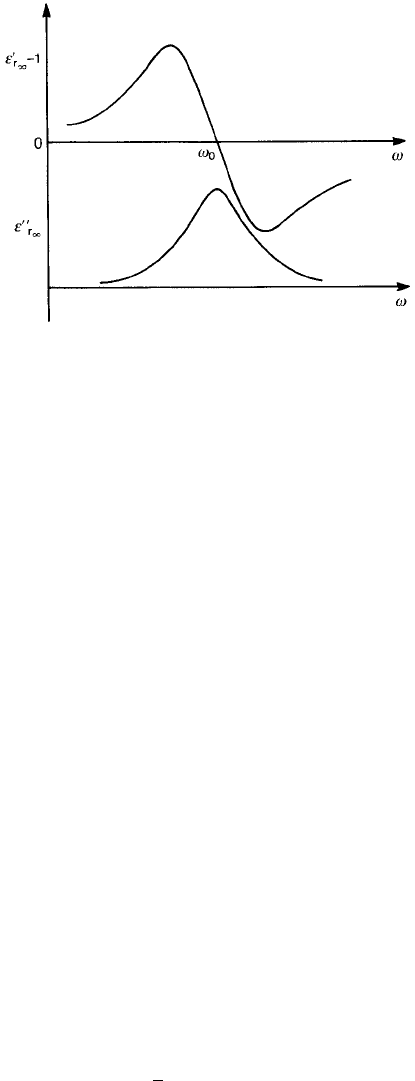
which are shown graphically in Fig. 2.33.
CHARGE DISPLACEMENT PROCESSES 65
As already mentioned, the above analysis would be valid for a gas; for a solid a
properly calculated local field would have to be used in Eq. (2.105). Fortunately,
doing this does not change the general forms of Eqs (2.110) and (2.111) but leads
only to a shift in o
0
. Furthermore, because the restoring forces are sensibly
independent of temperature, so too are the resonance curves.
Relaxation effects Polarization processes occur in ceramics for which the
damped, forced harmonic motion approach is inappropriate. For example,
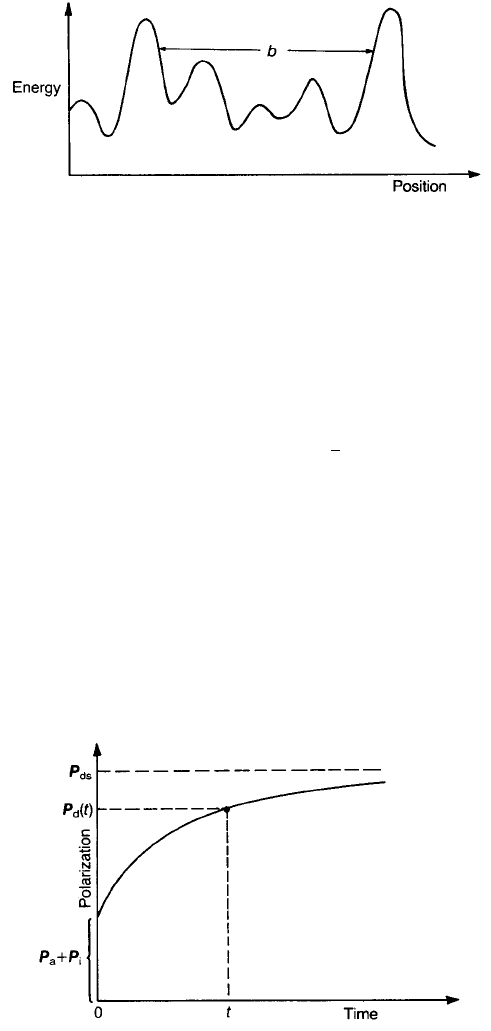
because of the random structure of glass the potential energy of a cation moving
through a glass can be shown schematically as in Fig. 2.34. The application of an
alternating electric field causes ions to diffuse over several atomic distances, over
a length such as b for example, surmounting the smaller energy barriers en route.
It therefore takes a considerable time for the new charge distribution to establish
itself after the application of the field.
In contrast to the atomic and ionic polarization processes, the diffusional
polarization and depolarization processes are relatively slow and strongly
temperature dependent. Temperature-activated diffusional polarization
processes also occur in ionic crystals and can involve ionic migration and
changes in the orientation of defect complexes.
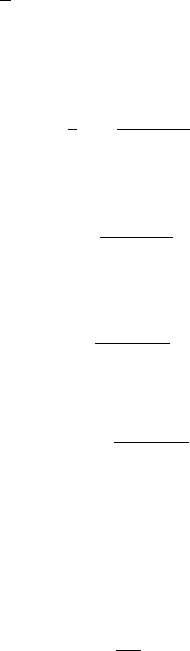
Figure 2.35 illustrates how, on the application of a field and following the
initial instantaneous atomic and ionic polarization, the slow diffusional
polarization P
d
approaches its final static value P
ds
. It is assumed that at time
t the polarization P
d
ðtÞ develops at a rate proportional to P
ds
P
d
ðtÞ:
_
PP
d
¼
1
t
fP
ds
P
d
ðtÞg ð2:112Þ
66 ELEMENTARY SOLID STATE SCIENCE
Fig. 2.33 Variation in e
0
r 1
and e
00
r 1
with frequency close to a resonance frequency o
0
.
o
0
in which 1=t is a proportionality constant. Integrating Eq. (2.112) with the initial
condition P
d
¼ 0 when t ¼ 0 gives
P
d
¼ P
ds
1 exp
t
t
ð2:113Þ
where t is a relaxation time.
The extension of this analysis to account for alternating applied fields is not
straightforward. P
ds
will now depend upon the instantaneous value of the
applied field and so will be time dependent. Furthermore, because the local field
is a function of both position and time, its estimation would be extremely
difficult. However, to make progress, if it is assumed that the polarizing field is
E* ¼ E
0
expðjotÞ, it can be shown that Eq. (2.112) is modified to
CHARGE DISPLACEMENT PROCESSES 67
Fig. 2.34 Schematic one-dimensional representation of the variation in the electrostatic
potential in a glass.
Fig. 2.35 Development of polarization by slow diffusional processes; P
a
and P
i
are the
‘instantaneous’ atomic and ionic polarization processes capable of responding to very high
frequency (1) fields.
_
PP
d
¼
1
t
fe
0
rs
e
0
r1
Þe
0
E* P
d
ðtÞg ð2:114Þ
in which e
0
rs
is the value of the relative permittivity measured at low frequencies
or with a static field applied. Eq. (2.114) can be integrated to give
P
d
¼ Cexp
t
t
þ
e
0
rs
e
0
r1
1 þ jot
e
0
E* ð2:115Þ
If the transient C expðt=tÞ is neglected, Eq. (2.115) leads to
e*
r
¼ e
0
r 1
þ
e
0
rs
e
0
r1
1 þ jot
ð2:116Þ
or, equating the real and imaginary parts, to
e
0
r
e
0
r 1
¼
e
0
rs
e
0
r1
1 þ o
2
t
2
ð2:117Þ
and
e@
r
¼ðe
0
rs
e
0
r1
Þ
ot
1 þ o
2
t
2
ð2:118Þ
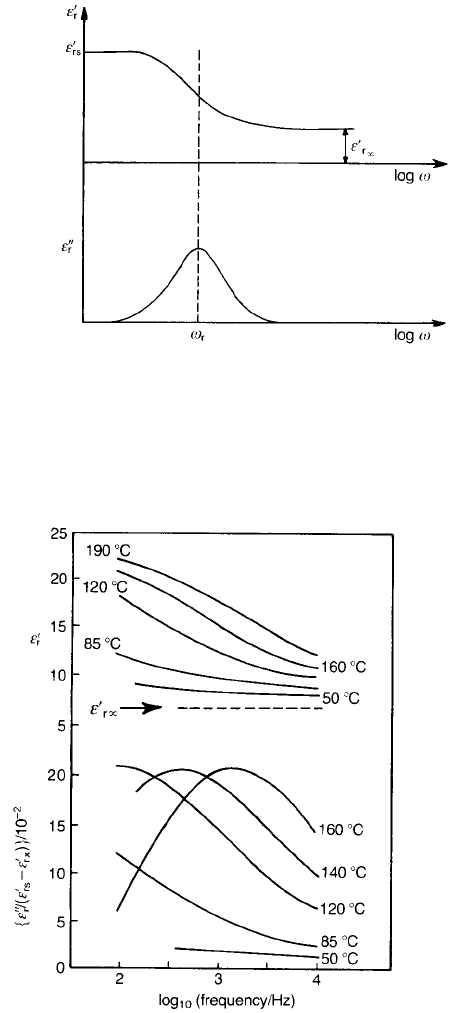
Eqs (2.117) and (2.118), which are known as the Debye equations, are shown
graphically in Fig. 2.36; the relaxation frequency is o
r
¼ 1=t. Because the
polarization occurs by the same temperature-activated diffusional processes
which give rise to d.c. conductivity (see Eq. (2.68)), t depends on temperature
through an exponential factor:
t ¼ t
0
exp
E
A
kT
ð2:119Þ
Figure 2.37 shows the dielectric dispersion and absorption curves for a
common soda lime silica glass and their general form is seen to be consistent with
the predictions (Fig. 2.36 and Eqs (2.117) and (2.118)).
It has been experimentally demonstrated, for a wide range of glass types that
values of the activation energy E
A
derived from (2.119) are in close agreement
with those obtained from d.c. conductivity measurements and so support the
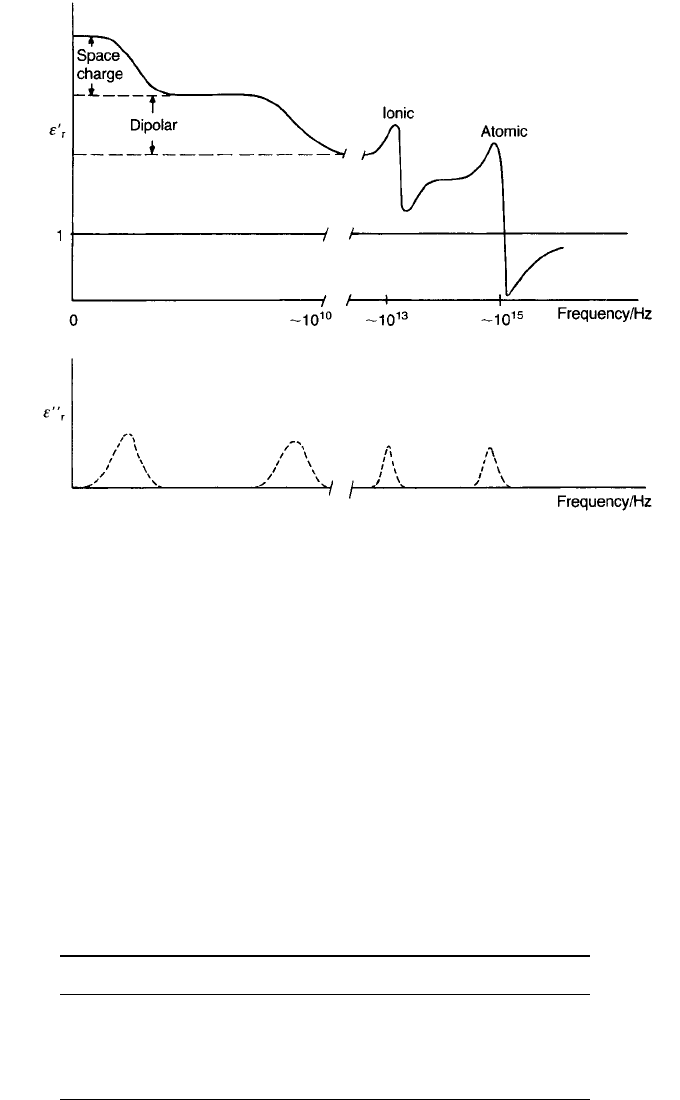
model as outlined. The various polarization processes which lead to dielectric
dispersion and attendant energy dissipation are summarized in Fig. 2.38.
In conclusion, it is opportune to mention the relationship between the
refractive index n and e
r
for a non-magnetic dielectric (m
r
¼ 1Þ, i.e.
e
r
¼ n
2
ð2:120Þ
which is a consequence of Maxwell’s electromagnetic theory. It is only valid, of
course, when the same polarization processes occur during the measurement of
both e
r
and n. This would be so for elemental solids such as diamond and silicon
68 ELEMENTARY SOLID STATE SCIENCE
CHARGE DISPLACEMENT PROCESSES 69
Fig. 2.36 Variation in permittivity with frequency for a dielectric showing ‘Debye’ relaxation.
Fig. 2.37 Permittivity dispersion and dielectric loss for a glass: 18 Na
2
O10CaO72SiO
2
(after
Taylor, H.E., J. Soc. Glass Tech., 43, 124T, 1959. Also see Rawson, H. Properties and
Applications of Glass. Elsevier, Amsterdam, p. 266, 1980).
for which there is only a single polarization process, i.e. atomic, across the
frequency spectrum. In the case of water, however, optical refraction measured
at 10
15
Hz, say, involves only atomic polarization, whereas during the
measurement of e
r
, usually at a much lower frequency of typically 10
5
Hz,
both atomic and dipolar polarization processes are occurring and therefore
Eq. (2.120) would not be expected to apply. Illustrative data are given in
Table 2.6.
70 ELEMENTARY SOLID STATE SCIENCE
Fig. 2.38 Variation of e
0
r
and e
00
r
with frequency. Space charge and dipolar polarizations are
relaxation processes and are strongly temperature dependent; ionic and electronic
polarizations are resonance processes and sensibly temperature independent. Over critical
frequency ranges energy dissipation is a maximum as shown by peaks in e
00
r
ðoÞ:
Table 2.6 Relationship between e
r
and n
2
e
r
nn
2
Diamond 5.68 2.42 5.85
Germanium 16 4.09 16.73
NaCl 5.9 1.54 2.37
H
2
O 80 1.33 1.77
2.7.3 Barium titanate ^ the proto type ferroelectric ceramic
Barium titanate, the first ceramic material in which ferroelectric behaviour was
observed, is the ideal model for a discussion of the phenomenon from the point
of view of crystal structure and microstructure; see also [10] and [11].
BaTiO
3
is isostructural with the mineral perovskite (CaTiO
3
) and so is referred
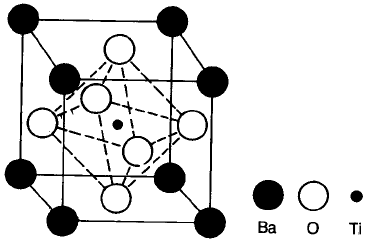
to as ‘a perovskite’. The generalized perovskite structure ABO
3
, is visualized as
based on a cubic close-packed assembly (see Fig. 2.1) of composition AO
3
with
the A-ion cordinated with 12 oxygen ions and the B-ion in the octahedral
interstices (see Fig. 2.39). A consideration of the geometry shows that for a
prefect fit the following relationship between the ionic radii holds [12].
R
A
þ R
O
¼ 2ðR
B
þ R
O
Þð2:121Þ
For the many compounds having the perovskite structure the relationship will
not hold exactly because of small variations in the sizes of the A and B ions.
Therefore, to allow for this Eq. (2.121) is written
R
A
þ R
O
¼ t 2ðR
B
þ R
O
Þð2:122Þ
in which ‘t’ is termed the ‘tolerance factor’ with a value typically in the range
0.955t51.06. In the case of SrTiO
3
t ¼ 1. When t 6¼ 1 then small lattice
distortions (the octahedra tilt) occur in order to minimize lattice energy. These
distortions have a significant effect on dielectric properties.
Above its Curie point (approximately 130 8C) the unit cell is cubic with the
ions arranged as in Fig. 2.39. Below the Curie point the structure is slightly
distorted to the tetragonal form with a dipole moment along the c direction.
Other transformations occur at temperatures close to 0 8C and 80 8C: below
0 8C the unit cell is orthorhombic with the polar axis parallel to a face diagonal
and below 80 8C it is rhombohedral with the polar axis along a body diagonal.
CHARGE DISPLACEMENT PROCESSES 71
Fig. 2.39 The unit cell of BaTiO
3
.