
Moulson A.J., Herbert J.M. Electroceramics: Materials, Properties, Applications
Подождите немного. Документ загружается.

2.7 Charge Displacement Processes
2.7.1 Dielectrics in static electric ¢elds
Macroscopic parameters
When an electric field is applied to an ideal dielectric material there is no long-
range transport of charge but only a limited rearrangement such that the
dielectric acquires a dipole moment and is said to be polarized. Atomic
polarization, which occurs in all materials, is a small displacement of the
electrons in an atom relative to the nucleus; in ionic materials there is, in
addition, ionic polarization involving the relative displacement of cation and
anion sublattices. Dipolar materials, such as water, can become polarized
because the applied electric field orients the molecules. Finally, space charge
polarization involves a limited transport of charge carriers until they are stopped
52 ELEMENTARY SOLID STATE SCIENCE
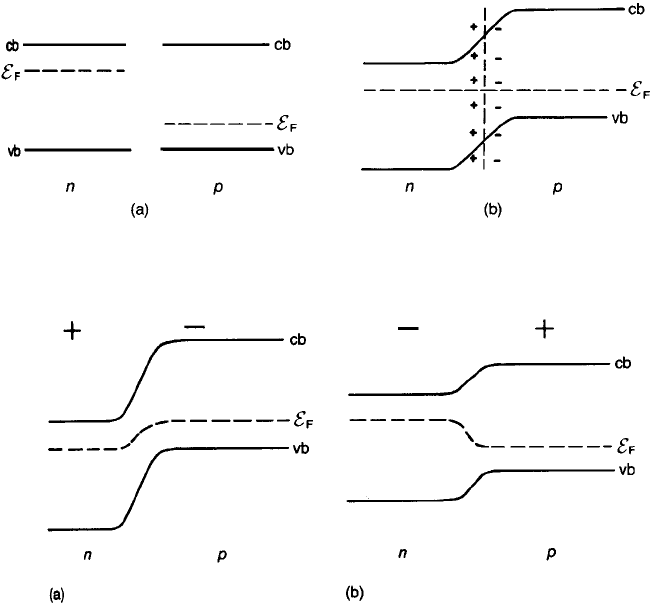
Fig. 2.23 Junction between an n-type and a p-type semiconductor (a) before contact and (b)
after contact.
Fig. 2.24 n–p junction: (a) reverse biased; (b) forward biased.
TEAMFLY
Team-Fly
®
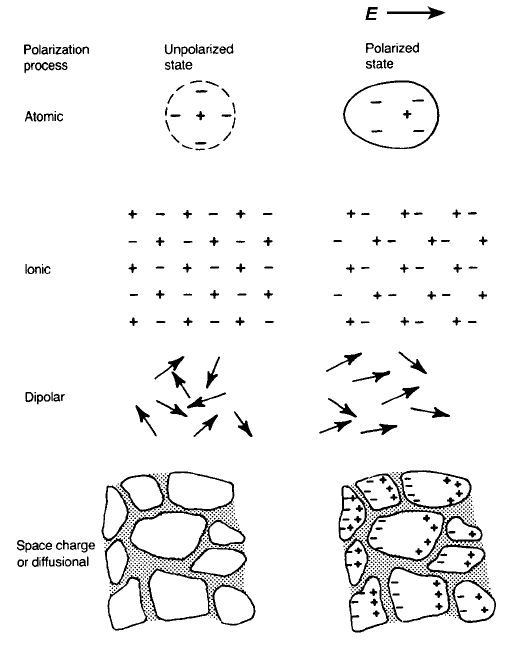
at a potential barrier, possibly a grain boundary or phase boundary. The various
polarization processes are illustrated in Fig. 2.25.
In its most elementary form an electric dipole comprises two equal and
opposite point charges separated by a distance dx. The dipole moment p of the
dipole, defined as
p ¼ Qdx ð2:70Þ
is a vector with its positive sense directed from the negative to the positive
charge.
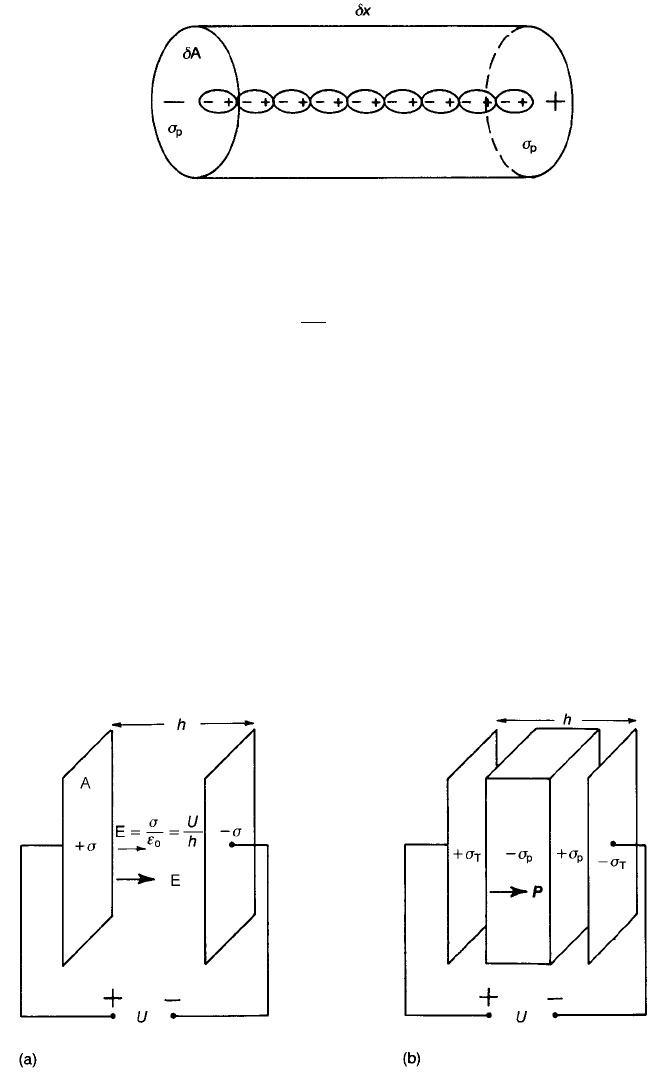
A polarized material can be regarded as made up of elementary dipolar prisms,
the end faces of which carry surface charge densities of þs
p
and s
p
as shown in
Fig. 2.26. The dipole moment per unit volume of material is termed the
polarization P and can vary from region to region. From Fig. 2.26 the
magnitudes of the vectors are given by
dp ¼ s
p
dAdx ¼ s
p
dV
CHARGE DISPLACEMENT PROCESSES 53
Fig. 2.25 Various polarization processes.
or
dp
dV
¼ P ¼ s
p
ð2:71Þ
In general s
p
¼ n.P where n is the unit vector normal to the surface enclosing the
polarized material and directed outwards from the material.
Important relationships can be developed by considering the effect of filling
the space between the plates of a parallel-plate capacitor with a dielectric
material, as shown in fig. 2.27. From Gauss’s theorem the electric field E between
and normal to two parallel plates carrying surface charge density s and separated
by a vacuum is
E ¼ s=e
0
ð2:72Þ
Since the same voltage is applied in both situation (a) and situation (b), E
remains the same. However, in (b) the polarization charge density s
p
appearing
on the surfaces of the dielectric compensates part of the total charge density s
T
54 ELEMENTARY SOLID STATE SCIENCE
Fig. 2.26 Elementary prism of polarized material.
Fig. 2.27 The role of the dielectric in a capacitor.

carried by the plates. Thus the effective charge density giving rise to E is reduced
to s
T
s
p
so that
E ¼
s
T
s
p
e
0
ð2:73Þ
The total charge density s
T
is equivalent to the magnitude of the electric
displacement vector D, so that
D ¼ e
0
E þ P ð2:74Þ
If the dielectric is ‘linear’, so that polarization is proportional to the electric field
within the material, which is commonly the case,
P ¼ w
e
e
0
E ð2:75Þ
where the dimensionless constant w
e
(chi, pronounced ‘ky’ as in ‘sky’) is the
electric susceptibility. In general w
e
is a tensor of the second rank. Unless
otherwise stated it will be assumed in the following discussions that P and E are
collinear, in which case w
e
is simply a scalar.
It follows from Eq. (2.74) and Eq. (2.75) that
D ¼ e
0
E þ w
e
e
0
E ¼ð1 þ w
e
Þe
0
E ð2:76Þ
and, since D ¼ s
T
,
Q
T
A
¼ð1 þ w
e
Þe
0
U
h
ð2:77Þ
in which Q
T
is the total charge on the capacitor plate. Therefore the capacitance
is
C ¼
Q
T
U
¼ð1 þ w
e
Þe
0
A
h
ð2:78Þ
Since vacuum has zero susceptibility, the capacitance C
0
of an empty parallel-
plate capacitor is
C
0
¼ e
0
A
h
ð2:79Þ
If the space between the plates is filled with a dielectric of susceptibility w
e
, the
capacitance is increased by a factor 1 þ w
e
.
The permittivity e of the dielectric is defined by
e ¼ e
0
ð1 þ w
e
Þð2:80Þ
where
e
e
0
¼ 1 þw
e
¼ e
r
ð2:81Þ
CHARGE DISPLACEMENT PROCESSES 55
and e
r
is the relative permittivity (often, unfortunately, referred to as the
‘dielectric constant’) of the dielectric.
From induced elementary dipoles to macroscopic properties
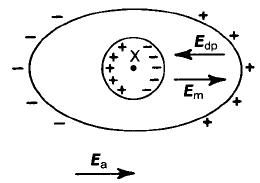
An individual atom or ion in a dielectric is not subjected directly to an applied
field but to a local field which has a very different value. Insight into this rather
complex matter can be gained from the following analysis of an ellipsoidal solid
located in an applied external field E
a
, as shown in Fig. 2.28. The ellipsoid is
chosen since it allows the depolarizing field E
dp
arising from the polarization
charges on the external surfaces of the ellipsoid to be calculated exactly. The
internal macroscopic field E
m
is the resultant of E
a
and E
dp
, i.e. E
a
E
dp
.
It is assumed that the solid can be regarded as consisting of identifiable
polarizable entities on the atomic scale. It is then necessary to know the electric
field experienced by an entity; this is termed the local field E
L
. It was recognized
in the early part of the last century that E
L
differs from E
m
since the latter is
arrived at by considering the dielectric as a continuum. In reality the atomic
nature of matter dictates that the local field, which is also known as the Lorentz
field, must include contributions from the adjacent, individual dipoles.
Furthermore, the local field arises from the charges in their displaced positions,
and because it is also doing the displacing, calculation of it is by no means
straightforward!
Lorentz calculated E
L
in the following way. A spherical region within the
dielectric, centred on the point X at which E
L
is required, is selected. The radius
is chosen so that, as viewed from X, the region external to the spherical boundary
can be regarded as a continuum, whereas within the boundary the discontinuous
atomic nature of the dielectric must be taken into consideration. E
L
can then be
written
E
L
¼ E
m
þ E
p
þ E
d
ð2:82Þ
in which E
p
is the contribution from the charges at the surface of the spherical
cavity (imagining for the moment that the sphere of material is removed) and E
d
56 ELEMENTARY SOLID STATE SCIENCE
Fig. 2.28 The ‘local’ field in a dielectric.
is due to the dipoles within the boundary. E
p
can be shown to be P=3e
0
, but E
d
must be calculated for each particular site chosen and for each type of dielectric
material. However, for certain crystals of high symmetry and glasses it can be
shown that E
d
¼ 0, and so for these cases
E
L
¼ E
m
þ
P
3e
0
ð2:83Þ
In the more general case it is assumed that
E
L
¼ E
m
þ gP ð2:84Þ
in which g is the ‘internal field constant’.
The dipole moment p induced in the entity can now be written
p ¼ aE
L
ð2:85Þ
in which a is the polarizability of the entity, i.e. the dipole moment induced per
unit applied field. If it is assumed that all entities are of the same type and have a
density N, then
P ¼ Np ¼ NaðE
m
þ gPÞð2:86Þ
or
P
e
0
E
m
¼ w
e
¼
Na=e
0
1 Nag
ð2:87Þ
In the particular cases for which g ¼ 1=3e
0
rearrangement of Eq. (2.87) leads to
the Clausius–Mosotti relationship, here in SI units
e
r
1
e
r
þ 2
¼
Na
3e
0
ð2:88Þ
Using the cgs system the Clausius–Mossotti relation becomes
ðe
r
1Þ=ðe
r
þ 2Þ¼4pNa
cgs
=3 ð2:89Þ
and this form, with a
cgs
measured in A
˚
3
and N the number of ‘molecules’ per A
˚
3
,
has been widely used in calculating polarizabilities.
Eqs (2.88) and (2.89) cannot be applied to all solids but they are valid for the
many high symmetry ionic structures that are non-polar and non-conductive.
Also it has to be borne in mind that in the case of ceramics, grain boundaries can
give rise to anomalies in the applied field distribution, and occluded layers of
water can contribute to increased permittivities. R.D. Shannon [9] and others
have calculated polarizabilities using Eq. (2.89) with the established values of
molecular volume (V
m
¼1/ N) and permittivity. They find that each constituent
ion can be assigned a unique polarizability which is the same whatever other ions
they are associated with. Table 2.5 gives the polarizabilities of a wide selection of
ions and using these it is possible to calculate the permittivity of any combination
CHARGE DISPLACEMENT PROCESSES 57

58 ELEMENTARY SOLID STATE SCIENCE
Table 2.5
Ion dielectric polarizabilities (in units of A
˚
3
)
Li
1.20
Be
0.19
B
0.05
CNO
2.01
F
1.62
Ne
Na
1.80
Mg
1.32
Al
0.79
Si
0.87
P
(5+)
1.22
SCl
K
3.83
Ca
3.16
Sc
2.81
Ti
(4+)
2.93
V
(5+)
2.92
Cr
(3+)
1.45
Mn
(2+)
2.64
Fe
(2+)2.23
(3+)2.29
Co
(2+)
1.65
Ni
(2+)
1.23
Cu
(2+)
2.11
Zn
2.04
Ga
1.50
Ge
1.63
As
(5+)
1.72
Se Br
Rb
5.29
Sr
4.24
Y
3.81
Zr
3.25
Nb
3.97
Mo Tc
Ag Cd
3.40
In
2.62
Sn
2.83
Sb
(3+)
4.27
Te
(4+)
5.23
I
Cs
7.43
Ba
6.40
La
6.07
Hf Ta
4.73
WRe
AuHgTl
(1+)
7.28
Pb
(2+)
6.58
Bi
6.12
Ce
(3+)6.15
(4+)3.94
Pr
5.32
Nd
5.01
Pm Sm
4.74
Eu
(2+)4.83
(3+)4.53
Gd
4.37
Tb
4.25
Dy
4.07
Ho
3.97
Er
3.81
Tm
3.82
Yb
3.58
Lu
3.64
Th
4.92
Pa U
(4+)
4.45
After R.D. Shannon [9].

of ion that yields compounds with structures within the limitations stated above.
Such compounds are said to be ‘well behaved’. If reliable experimental values do
not agree with prediction then the cause may be that the solid is not ‘well
behaved’ because of one or more of the reasons stated above. It may of course be
that ‘extrinsic’ factors such as pores, microcracks and chemical impurities are
responsible for lack of agreement; it may also be that poor experimental
procedures are partly responsible.
Measurements must be made at frequencies in the 10 kHz to 1 MHz range so
as to confine the response to ionic and electronic polarizations.
Plots of ionic polarizability against ionic volume are approximately linear with
the slope a/V
m
increasing with cation charge.
Eq. (2.87) also suggests the possibility of ‘spontaneous polarization’, i.e. lattice
polarization in the absence of an applied field. Considering Eq. (2.87), w
e
!1
as Nag! 1, implying that under certain conditions lattice polarization
produces a local field which tends to further enhance the polarization – a
‘feedback’ mechanism. Such spontaneously polarized materials do exist and, as
mentioned in Section 2.3, ‘ferroelectrics’ constitute an important class among
them.
Ferroelectric behaviour is limited to certain materials and to particular
temperature ranges for a given material. As shown for barium titanate in Section
2.7.3, Fig. 2.40(c), they have a Curie point T
c
, i.e. a temperature at which the
spontaneous polarization falls to zero and above which the properties change to
those of a ‘paraelectric’ (i.e. a normal dielectric). A few ferroelectrics, notably
Rochelle Salt (sodium potassium tartrate tetrahydrate (NaKC
4
O
6
.4H
2
O)) which
was the material in which ferroelectric behaviour was first recognized by J.
Valasek in 1920, also have lower transitions below which ferroelectric properties
disappear.
Many ferroelectrics possess very high permittivity values which vary
considerably with both applied field strength and temperature. The permittivity
reaches a peak at the Curie point and falls off at higher temperatures in
accordance with the Curie–Weiss law
e
r
¼
A
T y
c
ð2:90Þ
where A is a constant for a given material and y
c
is a temperature near to but not
identical with the Curie point T
c
. This behaviour is illustrated for barium titanate
ceramic in Section 2.7.3, Fig. 2.48.
The reason for coining the term ‘ferroelectric’ is that the relation between field
and polarization for a ferroelectric material bearing electrodes takes the form of
a hysteresis loop similar to that relating magnetization and magnetic field for a
ferromagnetic body (see Figs 2.46 and 9.10). There are some other analogies
between ferroelectric and ferromagnetic behaviour, but the two phenomena are
CHARGE DISPLACEMENT PROCESSES 59
so fundamentally different that a comparison does not greatly assist under-
standing.
Various models have been suggested to explain why some materials are
ferroelectric. The most recent and successful involves a consideration of the
vibrational states of the crystal lattice and does not lend itself to a simple description.
Lattice vibrations may be acoustic or optical: in the former case the motion
involves all the ions, in volumes down to that of a unit cell, moving in unison,
while in the optical mode cations and anions move in opposite senses. Both
acoustic and optical modes can occur as transverse or longitudinal waves.
From the lattice dynamics viewpoint a transition to the ferroelectric state is
seen as a limiting case of a transverse optical mode, the frequency of which is
temperature dependent. If, as the temperature falls, the force constant
controlling a transverse optical mode decreases, a temperature may be reached
when the frequency of the mode approaches zero. The transition to the
ferroelectric state occurs at the temperature at which the frequency is zero. Such
a vibrational mode is referred to as a ‘soft mode’.
The study of ferroelectrics has been greatly assisted by so-called ‘phenomen-
ological’ theories which use thermodynamic principles to describe observed
behaviour in terms of changes in free-energy functions with temperature. Such
theories have nothing to say about mechanisms but they provide an invaluable
framework around which mechanistic theories can be constructed. A.F.
Devonshire was responsible for much of this development between 1949 and
1954 at Bristol University.
There is as yet no general basis for deciding whether or not a particular
material will be ferroelectric. Progress in discovering new materials has been
made by analogy with existing structures or by utilizing simple tests that allow
the rapid study of large numbers of materials.
The detailed discussion of the prototype ferroelectric ceramic barium titanate
in Section 2.7.3 provides the essential background to an understanding of the
later discussion in the text.
2.7.2 Dielectrics in alternating electric ¢elds
Power dissipation in a dielectric
The discussion so far has been concerned with dielectrics in steady electric fields;
more commonly they are in fields that change with time, usually sinusoidally.
This is clearly the case for capacitors in most ordinary circuit applications, but
there are less obvious instances. For example, because electromagnetic waves
have an electric field component it would be the case for dielectric resonators in
microwave devices and also for light passing through a transparent material.
Fortunately, no matter how the field may vary with time, the variation can be
60 ELEMENTARY SOLID STATE SCIENCE
synthesized from its Fourier components and therefore there is no loss of
generality if the response of a dielectric to a field changing sinusoidally with time
is discussed in detail.
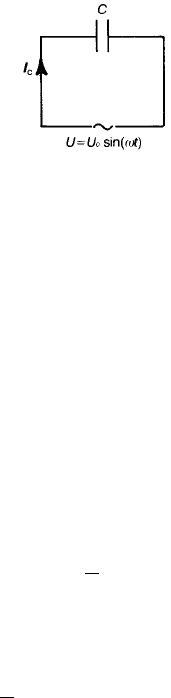
The earlier discussion can be extended by considering a capacitor to which a
sinusoidal voltage is applied (Fig. 2.29). At a time when the voltage is U, the
charge on C is Q ¼ UC and, since the current I
c
¼
_
QQ, it follows that
I
c
¼ C
_
UU ð2:91Þ
Thus, with the usual notation, if the voltage is described by U
0
sinðotÞ then the
current is U
0
CocosðotÞ and leads U by 908. Since the instantaneous power drawn
from the voltage source is I
c
U, the time average power dissipated is
PP where
PP ¼
1
T
ð
T
0
I
c
Udt ð2:92Þ
or
PP ¼
1
T
ð
T
0
U
0
I
0
sinðotÞcosðotÞdt ¼ 0 ð2:93Þ
where T ¼ 2p=o is the time period.
The average power drawn from the voltage source is zero because during one
half-cycle the capacitor is charged and during the next it releases its charge
reversibly (i.e. without loss of energy) back into the source. Put another way,
during one half-cycle the source does work on the capacitor and during the next
the discharging capacitor does work on the source. The mechanical analogy is a
mass oscillating under gravity on a perfect spring for which there is no loss of
energy from the system but only an exchange between elastic energy in the spring
and gravitational potential energy of the mass.
The current–voltage relationship for the charging and discharging capacitor
can be described with the help of a ‘phasor’ diagram (Fig. 2.30) in which the
applied voltage at a given time is represented by a horizontal line and the
instantaneous current by a vertical line since it leads the voltage by 908. The
‘phasor’ diagram is an instantaneous snapshot of the voltage and current vectors
CHARGE DISPLACEMENT PROCESSES 61
Fig. 2.29 Sinusoidal voltage applied to a perfect capacitor.