
Moulson A.J., Herbert J.M. Electroceramics: Materials, Properties, Applications
Подождите немного. Документ загружается.

Polaron conduction
The band model is not always appropriate for some oxides and the electron or
hole is regarded as ‘hopping’ from site to site. ‘Hopping’ conduction occurs when
ions of the same type but with oxidation states differing by unity occur on
equivalent lattice sites and is therefore likely to be observed in transition metal
oxides. Doping of transition metal oxides to tailor electrical properties (valency-
controlled semiconduction) is extensively exploited in ceramics technology, and
an understanding of the principles is important. These can be outlined by
reference to NiO, the detailed study of which has taught physicists much
concerning the hopping mechanism.
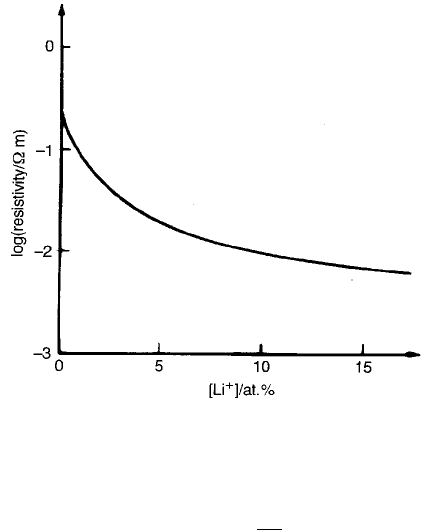
The addition of Li
2
O to NiO leads to an increase in conductivity, as illustrated
in Fig. 2.16. The lithium ion Li
þ
(74 pm) substitutes for the nickel ion Ni
2þ
(69 pm) and, if the mixture is fired under oxidizing conditions, for every added
Li
þ
one Ni
2þ
is promoted to the Ni
3þ
state, the lost electron filling a state in the
oxygen 2p valence band. The lattice now contains Ni
2þ
and Ni
3þ
ions on
equivalent sites and is the model situation for conduction by ‘polaron hopping’,
which is more often referred to simply as ‘electron hopping’.
The Ni
3þ
ion behaves like a perturbing positive charge and polarizes the lattice
in its immediate surroundings; the polaron comprises the Ni
3þ
ion together with
the polarized surrounding regions of the ionic lattice. Polarons can be thermally
excited from Ni
3þ
ions to Ni
2þ
ions; the equivalent electron transfer is from Ni
2þ
ions to Ni
3þ
ions. This conduction mechanism contrasts with the band
conduction observed in silicon, for example, in two respects. In the case of
‘hopping’ the concentration of carriers is determined solely by the doping level
and is therefore temperature independent, whereas the carrier mobility is
temperature activated:
42 ELEMENTARY SOLID STATE SCIENCE
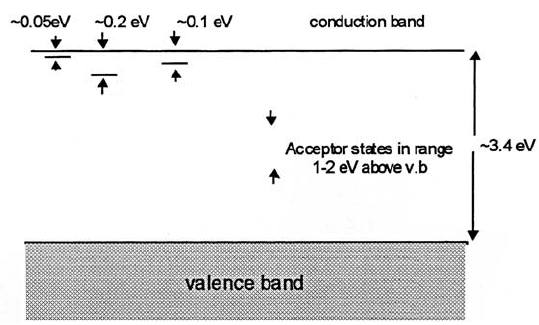
Fig. 2.15 Tentative band diagram for doped BaTiO
3
.
Vo
.
Vo
..
La
.
TEAMFLY
Team-Fly
®
u / exp
E
A
kT
ð2:61Þ
Thus it follows that the temperature dependence of conductivity is similar to that
for band conduction (Eq. (2.37)), but for different reasons.
Because the room temperature hopping mobility is low (510
5
m
2
V
1
s
1
)in
contrast to that typical for band conduction ( 10
1
m
2
V
1
s
1
), hopping
conductors are sometimes referred to as ‘low-mobility semiconductors’. Another
important distinction between band and hopping conductors is the very different
doping levels encountered. Whereas doping levels for silicon are usually in the
parts per million range, in the case of hopping conductors they are more typically
parts per hundred.
Although the mechanism of conduction in lithium-doped NiO and other ‘low-
mobility semiconductors’ is a controversial matter, the simple polaron hopping
model outlined above serves well as a basis for understanding conduction
processes in many of the systems discussed later (eg Section 4.4.1).
2.6.3 Ionic conduction
Crystals
Ionic conduction depends on the presence of vacant sites into which ions can
move. In the absence of a field, thermal vibrations proportional to kT may cause
ELECTRICAL CONDUCTION 43
Fig. 2.16 Resistivity of NiO as a function of lithium content.

ions and vacancies to exchange sites. The Nernst–Einstein equation links this
process of self-diffusion with the ion drift s
i
caused by an electric field:
s
i
D
i
¼
N
i
Q
i
kT
ð2:62Þ
where D
i
is the self- or tracer-diffusion coefficient for an ion species i, Q
i
is the
charge it carries and N
i
is its concentration.
Features that contribute to ionic mobility are small charge, small size and
favourable lattice geometry. A highly charged ion will polarize, and be polarized
by the ions of opposite charge as it moves past them, and this will increase the
height of the energy barrier that inhibits a change of site. The movement of a
large ion will be hindered in a similar way by the interaction of its outer electrons
with those of the ions it must pass between in order to reach a new site. Some
structures may provide channels which give ions space for movement.
The presence of vacant sites assists conduction since it offers the possibility of
ions moving from neighbouring sites into a vacancy which, in consequence,
moves in the opposite direction to the ions (Fig. 2.17). This is particularly likely
in the case of the oxygen lattice since the smaller cations do not present large
energy barriers impeding the process. However, the cations usually have to pass
through the relatively small gap between three O
2
ions to reach any
neighbouring cation vacancy.
NaCl is a suitable material for further discussion since it has been extensively
investigated. The lattice contains Schottky defects but the V
Na
(Na
þ
has
r
6
¼ 102 pm) moves more readily than the V
Cl
(Cl
has r
6
¼ 181 pm) so that
charge transport can be taken as almost wholly due to movement of V
0
Na
.
In the absence of an electric field the charged vacancy migrates randomly,
and its mobility depends on temperature since this determines the ease with
which the Na
þ
surmounts the energy barrier to movement. Because the crystal
is highly ionic in character the barrier is electrostatic in origin, and the ion in
its normal lattice position is in an electrostatic potential energy ‘well’
(Fig. 2.17).
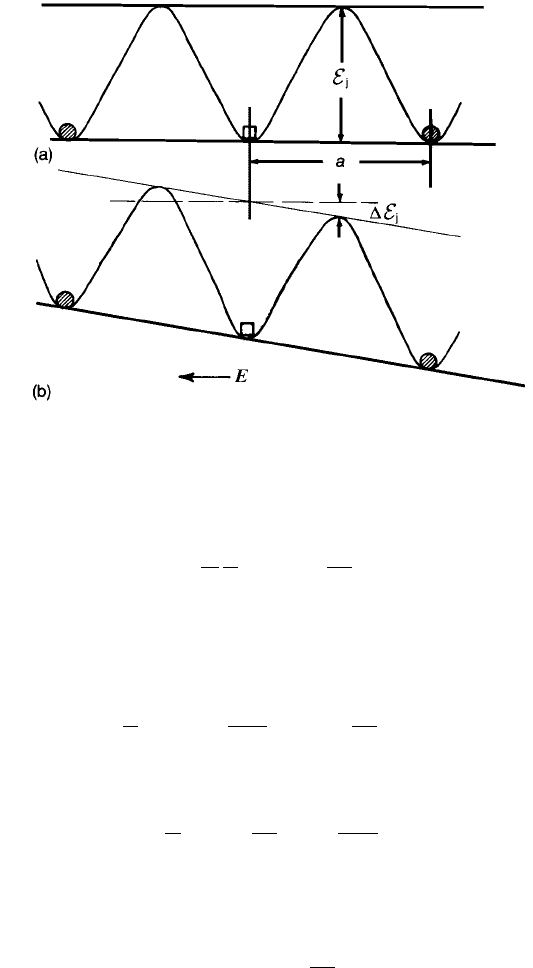
It is clear from Fig. 2.17 that in the simplified one-dimensional representation
and in the absence of an electric field the vacancy would have equal probability
of jumping to the right or to the left, because the barrier height E
j
is the same in
both directions. However, when an electric field E is imposed the barrier heights
are no longer equal, and the jump probability is higher for the jump across the
lower barrier (in the illustrated case, to the right) of height E
j
DE
j
where
DE
j
¼ eE
a
2
ð2:63Þ
Since we know the bias in jump probability in one direction, it is not difficult to
arrive at the following expression for the current density:
44 ELEMENTARY SOLID STATE SCIENCE
j ¼
n
v
N
A
T
E exp
E
j
kT
ð2:64Þ
in which n
v
=N is the fraction of Na
þ
sites that are vacant and A is a constant
describing the vibrational state of the crystal. Since it is assumed that the vacancy
is part of the Schottky defect, then n
v
¼ n
S
and hence, using Eq. (2.12), we obtain
j ¼
A
T
E exp
DH
S
2kT
exp
E
j
kT
¼ sE ð2:65Þ
or
s ¼
A
T
exp
1
kT
E
j
þ
DH
S
2
ð2:66Þ
Because the temperature dependence of s is dominated by the exponential
term, the expression for conductivity is frequently written
s ¼ s
0
exp
E
i
kT
ð2:67Þ
in which E
i
¼E
j
þ DH
S
=2 is an activation energy and s
0
is regarded as
approximately temperature independent.
Vacancies might also be introduced into the crystal extrinsically by the
addition of impurities. For example, the addition of SrCl
2
to NaCl would
ELECTRICAL CONDUCTION 45
Fig. 2.17 Energy barriers to ionic transport in a crystal (a) in the absence of a field and (b)
with applied field E .
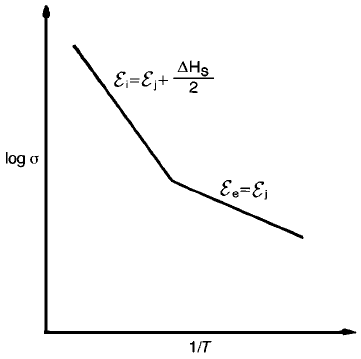
introduce an Na vacancy for every Sr ion added. Under these circumstances, and
depending upon the dopant level and the temperature, the concentration of
extrinsic defects might be orders of magnitude greater than that of the intrinsic
vacancies and independent of temperature. The sðTÞ relationship would
therefore be as shown in Fig. 2.18 where the steep slope in the high-temperature
(intrinsic) regime reflects the energy E
i
required both to create and to move
defects, and the shallower slope in the lower-temperature (extrinsic) regime
reflects the energy E
j
required only to move defects.
Glasses
The glass formers SiO
2
,B
2
O
3
and Al
2
O
3
provide a fixed random three-
dimensional network in the interstices of which are located the modifier ions such
as Li
þ
,Na
þ
,K
þ
,Ca
2þ
and Mg
2þ
. Some of these ions, particularly Li
þ
and Na
þ
,
are very mobile whereas others, such as Ca
2þ
and Mg
2þ
, serve only to block the
network. A little reflection leads to the following reasonable expectations which
are borne out by observation:
1. Conductivity s depends upon temperature through an exponential term, as in
Eq. (2.67), because mobile ions need to be ‘activated’ to squeeze their way
past oxygen ions in moving from one site to the next.
2. For a given temperature and alkali ion concentration, s decreases as the size
of the mobile ion increases (e.g. s
Li
þ
4 s
Na
þ
4 s
K
þ
, where the corresponding
sizes of the three ion types are in the ratio 1:1.5:2).
46 ELEMENTARY SOLID STATE SCIENCE
Fig. 2.18 Extrinsic and intrinsic regimes in the log s versus 1/T relation.

3. For a given temperature and mobile ion content, s decreases as the
concentration of blocking ions (Ca
2þ
,Mg
2þ
) increases.
Mixed-phase materials
In practice ceramics are usually multiphase, consisting of crystalline phases,
glasses and porosity. The overall behaviour depends on the distribution as well as
the properties of these constituents. A minor phase that forms a layer round each
crystallite of the major phases, and therefore results in a 3–0 connectivity system
(see Section 2.7.4), can have a major effect. If the minor phase is conductive it can
greatly reduce the resistivity of the composite or, if insulating, it can reduce its
conductivity. Also, an abrupt change in the mode of conduction at the main
phase–intercrystalline phase boundary may introduce barriers to conduction that
dominate the overall electrical behaviour. In contrast, minor phases present as
small discrete particles, or porosity present as empty cavities, can only modify
properties to a minor extent as indicated by one of the mixture relations such as
Lichtenecker’s rule (see Section 2.7.4).
2.6.4 Summary
In the technology of ceramics, electronic conductors (semiconductors), ionic
conductors (solid electrolytes) and mixed electronic–ionic conductors are
encountered. In all cases the conductivity is likely to vary with temperature
according to
s ¼ s
0
exp
E
A
kT
ð2:68Þ
In the case of intrinsic band conduction the ‘experimental activation energy’ E
A
is
identified with half the band gap (Eq. (2.37)); in the case of ‘extrinsic’ or
‘impurity’ semiconductivity, E
A
is either half the gap between the donor level and
the bottom of the conduction band or half the gap between the acceptor level and
the top of the valence band, depending upon whether the material is n or p type.
In such cases the temperature dependence is determined by the concentration of
electronic carriers in the appropriate band, and not by electron or hole mobility.
In ceramics containing transition metal ions the possibility of hopping arises,
where the electron transfer is visualized as occurring between ions of the same
element in different oxidation states. The concentration of charge carriers
remains fixed, determined by the doping level and the relative concentrations in
the different oxidation states, and it is the temperature-activated mobility, which
is very much lower than in band conduction, that determines s.
ELECTRICAL CONDUCTION 47

In crystalline ionic conductors charge transport occurs via lattice defects,
frequently vacancies, and again the same dependence of conductivity on
temperature is observed. For pure compounds E
A
is identified with the energy
to form defects together with the energy to move them; if defects are introduced
by doping, then the thermal energy is required only to move them and E
A
is
correspondingly lower.
The common glassy or vitreous materials encountered, either as window glass
or as the glass phase in ceramics, conduct by the migration of ions, often Na
þ
,
through the random glass network. (The chalcogenide glasses, which are based
on arsenic, selenium or tellurium, conduct electronically by a hopping
mechanism.) Again conductivity depends upon temperature through the familiar
exponential term, but the experimental activation energy E
A
is interpreted
differently depending on the mechanism. For ionic conduction, it is identified
with the energy to activate an ion to move from one lattice site to an adjacent
site, together with, possibly, the formation energy of the defect which facilitates
the move. (In the case of chalcogenide glasses it is identified with the energy to
activate the electron hopping process.)
Finally, it is important to appreciate that, for most ceramics encountered, the
conduction mechanism is far from fully understood. Probably it will involve a
combination of ionic and electronic charge carriers, and the balance will depend
upon temperature and ambient atmosphere. The effects of impurity atoms may
well dominate the conductivity and there is also the complication of
contributions, perhaps overriding, from grain boundaries and other phases –
glass, crystalline or both. Only through long and painstaking study can a true
understanding of the conduction mechanisms emerge, and advances in
technology can seldom wait for this. Such advances are therefore made through
a combination of systematic research and intuitive development work, based on
an appreciation of underlying principles.
2.6.5 Schottky barriers to conduction
As discussed in Section 2.6.2 electrons in a solid in thermal equilibrium obey
Fermi–Dirac statistics in which the probability FðEÞ that a state of energy E is
occupied is given by the Fermi–Dirac function
FðEÞ
exp
EE
F
kT
þ 1
1
ð2:69Þ
where E
F
is the Fermi energy. An important property of E
F
is that, for a system
in thermal equilibrium, it is constant throughout the system.
In a metal at 0 K the electrons occupy states up to the Fermi energy and so the
most energetic electrons have kinetic energy E
F
. The energy f
m
required to
remove an electron with the Fermi energy to a point outside the metal with zero
48 ELEMENTARY SOLID STATE SCIENCE
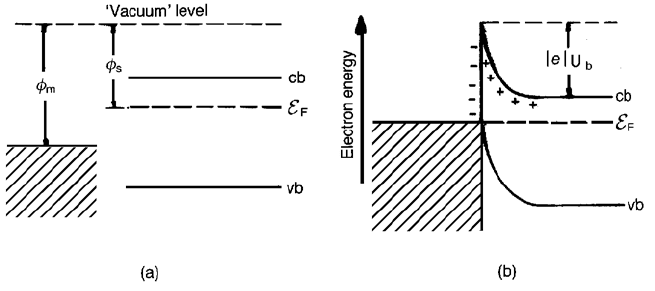
kinetic energy (the ‘vacuum’ level) is called the ‘work function’ of the metal.
When electrons are thermally excited out of a semiconductor, the effective work
function f
s
of the semiconductor is the energy difference between the Fermi
energy and the vacuum level.
Important ideas are well illustrated by considering the consequences of making
a junction between a metal and an n-type semiconductor and, for the sake of
argument, it is assumed that f
m
4 f
s
. The situation before and after contact is
illustrated in Fig. 2.19. When contact is made electrons flow from the
semiconductor into the metal until the Fermi energy is constant throughout
the system. It should be noted that, since the ordinate on the diagrams represents
electron energies, the more negative the higher the location on the energy
diagram. In the vicinity of the junction, typically within 10
6
–10
8
m depending
on the concentration of n dopant, the donors are ionized. This gives rise to a
positive space charge and consequently to a difference between the potential of
cb near the junction and the value at a point well removed from it. Electrons
moving up to the junction from the semiconductor then encounter an energy
barrier – a Schottky barrier – of height jejU
b
. The electrons have a greater
barrier to overcome in moving from the metal to the semiconductor. At
equilibrium the thermally excited electron currents from metal to semiconductor
and from semiconductor to metal are equal: the combination of a very large
population of electrons in the metal trying to cross a large barrier matches the
relatively small electron population in the semiconductor attempting to cross a
smaller barrier.
If a voltage difference is established across the junctions by a battery in the
sense that the semiconductor potential is made less positive, the barrier height is
lowered and electrons are more readily excited over it. The rate of passage of
ELECTRICAL CONDUCTION 49
Fig. 2.19 Metal–n-type semiconductor junction (f
m
4 f
s
) (cb, bottom of the conduction
band; vb, top of the valence band; E
F
, Fermi energy): (a) before contact and (b) after contact.
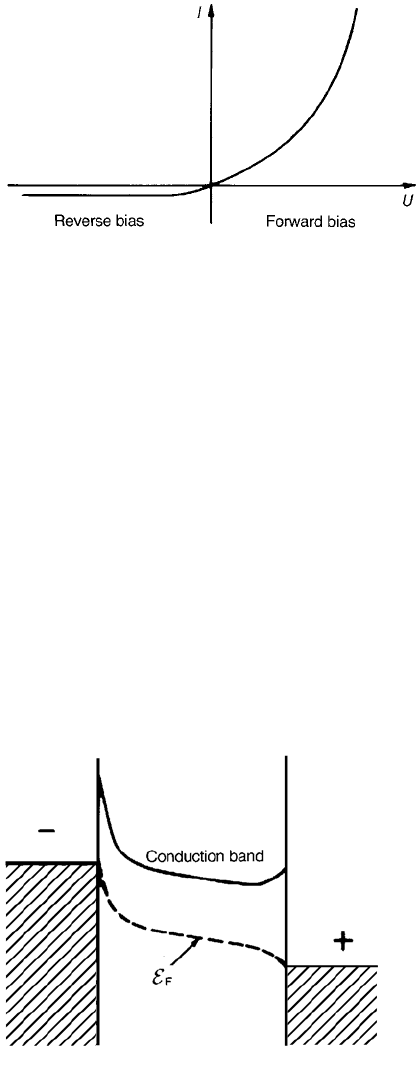
electrons crossing the barrier, i.e. the current, depends exponentially on the
barrier height. If, however, the semiconductor is positively biased, the barrier
height is increased and the junction is effectively insulating. The two cases are
referred to as ‘forward’ and ‘reverse’ biasing respectively, and the current–
voltage characteristic is shown in Fig. 2.20.
A sandwich comprising a semiconductor between two metallic electrodes
presents the same effective barrier irrespective of the sense of an applied voltage.
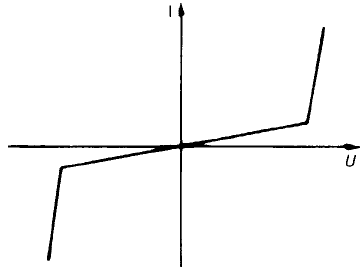
The situation is illustrated in Fig. 2.21. The resistance will be high at low
voltages, because few electrons cross the barriers, but will be low once a voltage
is reached which enables electrons to cross the metal–semiconductor barrier at a
significant rate. The resulting characteristic is shown in Fig. 2.22 and is similar to
that for two rectifiers back to back.
In the case of wide band gap insulators the current will be low at all voltages
but will initially exceed that to be expected under equilibrium conditions because
of a redistribution of charges in the vicinity of the junctions. This makes it
50 ELEMENTARY SOLID STATE SCIENCE
Fig. 2.20 Current–voltage characteristic for a metal–semiconductor rectifying junction.
Fig. 2.21 n-type semiconductor sandwiched between two metal electrodes.
difficult to measure the resistivity of insulators at temperatures below 150–200 8C
because of the prolonged period over which the discharge of the space charges
may mask the true conduction current.
A complicating matter disregarded in the discussion concerns ‘surface states’.
At a semiconductor surface, because of the discontinuity, the atomic arrange-
ment is quite different from that in the interior of the crystal. In consequence the
electrons on the surface atoms occupy localized energy states quite different from
those in the interior. As an added complication impurity atoms carrying their
own localized energy states will e adsorbed on the semiconductor surface.
Barriers of the Schottky type control the behaviour of voltage-dependent
resistors (VDRs), PTC resistors and barrier-layer capacitors. Their behaviour is
by no means as well understood as that occurring in semiconductors such as
silicon but, where appropriate in the text, simplified models will be presented to
indicate the principles involved.
Another important type of junction is that between n and p types of the
same semiconductor. The situation before and after contact is illustrated in
Fig. 2.23. The n-type material has a higher concentration of electrons than the
p-type material so that electrons will diffuse down the concentration gradient
into the p-type material. Similarly ‘holes’ will diffuse into the n-type material.
These diffusions result in a positive space charge on the n side and a negative
space charge on the p side. The space charge generates a field that transfers
carriers in the opposite direction to the diffusion currents and, at equilibrium,
of equal magnitude to them. When a voltage is applied to the junction the
barrier is either raised or lowered depending on the polarity. The former case
is ‘reversed biased’ and the latter is ‘forward biased’. They are illustrated in
Fig. 2.24. The U–I characteristic is very similar to that shown in Fig. 2.20.
The junction has a rectifying action which is the basis of the bipolar (p–n–p
or n–p–n) transistor.
ELECTRICAL CONDUCTION 51
Fig. 2.22 Current–voltage characteristic for back-to-back Schottky barriers.