
Moulson A.J., Herbert J.M. Electroceramics: Materials, Properties, Applications
Подождите немного. Документ загружается.

152 CERAMIC CONDUCTORS
(a)
(b)
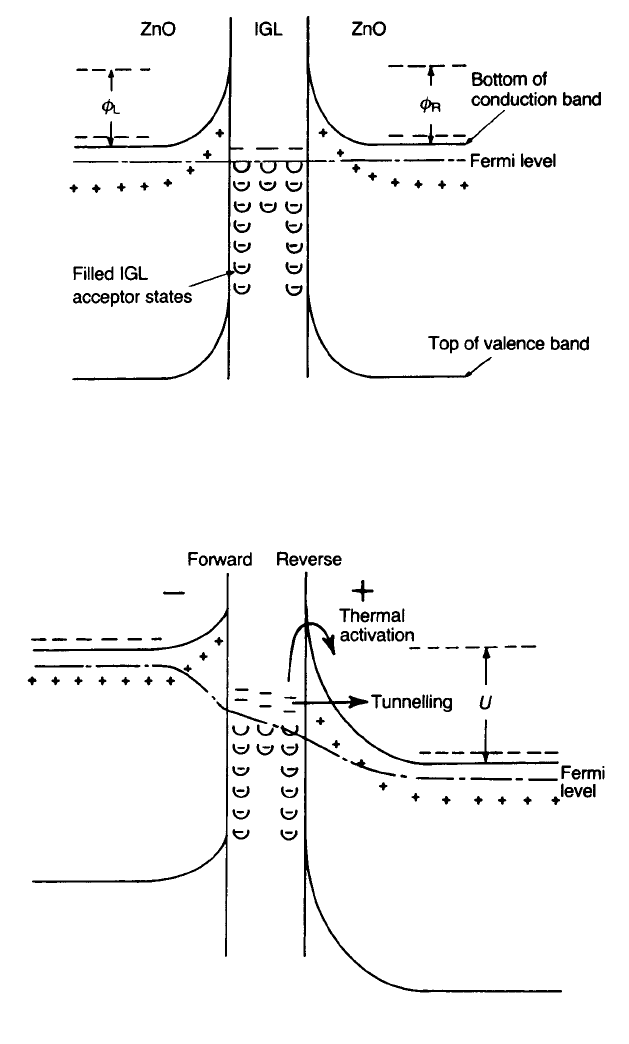
Fig. 4.10 Proposed electronic structure at a junction between semiconducting ZnO grains: (a)
no voltage applied; (b) with applied voltage.
TEAMFLY
Team-Fly
®
activated currents pass over the reverse biased junction, and at high fields
tunnelling through the junction will occur, accounting for the low resistance. The
behaviour is similar in some respects to that of Zener diodes, and VDR
characteristics are similar to those of two Zener diodes connected back to back.
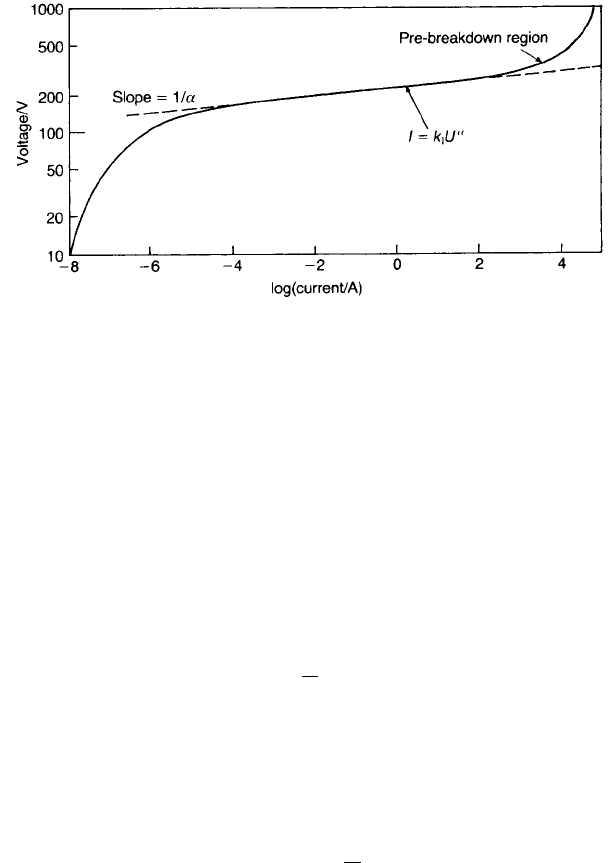
A typical varistor voltage–current characteristic is shown in Fig. 4.11. The
linear part can be represented by the relation
I ¼ k
I
U
a
ð4:1Þ
where k
I
is a constant and a falls off at low voltages. If I
1
and I
2
are the currents
at voltages that differ by a factor of 10,
a ¼ log
10
I
1
I
2
I
1
4 I
2
Alternatively
U ¼ k
V
I
b
ð4:2Þ
where b ¼ 1=a and k
V
¼ k
1=a
I
. The resistance at a given voltage is
R ¼ k
V
I
b1
¼
1
k
I
U
ða1Þ
ð4:3Þ
and the power dissipated is
P ¼ IU ¼ k
I
U
aþ1
ð4:4Þ
Eq. (4.4) indicates that the voltage permanently applied to a VDR must be
carefully limited. For instance with a ¼ 25 a 10% increase in voltage would
increase the power dissipation by a factor of about 2.5. Since VDRs usually have
negative temperature coefficients of resistivity, it can be seen that a runaway
condition can easily be precipitated.
VOLTAGE-DEPENDENT RESISTORS (VARISTORS) 153
Fig. 4.11 Typical varistor voltage–current characteristic.
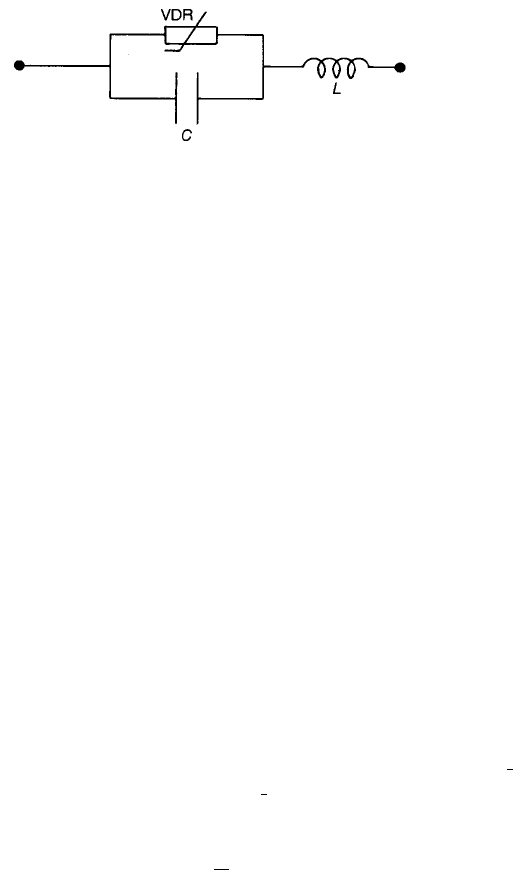
Certain limitations on the performance of a VDR arise from its secondary
properties. It has a capacitance derived from its electrodes and its permittivity,
and an inductance due to the length of its leads and the area of its electrodes. Its
equivalent circuit is shown in Fig. 4.12.
The effectiveness with which a VDR absorbs the very rapid transients that may
occur accidentally in a power supply depends on its speed of response. The
response time of the voltage-sensitive material is generally adequate, being
typically 0.5 ns. The capacitance in parallel with the VDR will partially absorb
the transient and delay the rise in voltage, but this will not affect the protective
action of the device. The inductance may have an important effect because the
steep rise time of a transient results in the presence of very high frequency voltage
components so that the impedance due to even a small inductance in series with a
VDR becomes significant. The leads to the VDR must therefore be as short as
possible.
Another use for VDRs is the suppression of sparks in switches and relay
contacts in highly inductive circuits, and it is instructive to outline the principle
of operation.
If the inductance L in the simple circuit shown in Fig. 4.13 has a d.c. resistance
of 100 O, the current through it with the switch closed is 0.24 A. Opening the
switch sets the charge in the LC loop oscillating, and the peak instantaneous
current is 0.24 A. Because the maximum energy stored in the capacitor (
1
2
CU
2
)
must be equal to that stored in the inductor (
1
2
LI
2
), it follows that
U ¼ I
L
C
1=2
ð4:5Þ
Thus, if L ¼ 0:05 H and C ¼ 100 pF, the maximum instantaneous voltage
developed is 5366 V, which is sufficient to cause a spark to be struck across the
switch contacts with consequent damage.
Figure 4.13 shows the introduction of a VDR with a ¼ 5 and a characteristic
such that the current through it with the switch closed is 0.024 A so that
k
1
¼ 0:024=24
5
. When the switch is opened the instantaneous current through
the VDR is approximately 0.24 A since the impedance of the capacitor and
154 CERAMIC CONDUCTORS
Fig. 4.12 Equivalent circuit of a VDR.
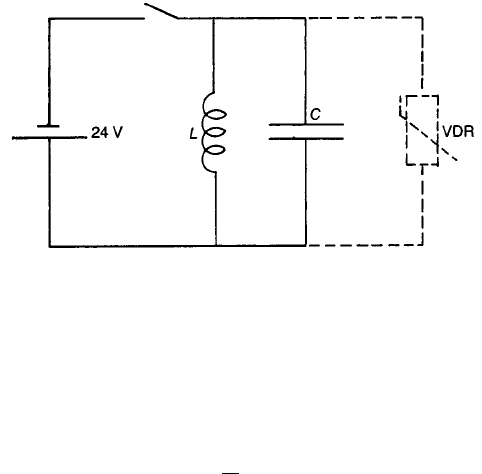
inductor at the resonant frequency is very large (about 22 kO). The resulting
voltage across the VDR is
U ¼
I
k
I
1=a
¼ 38 V ð4:6Þ
The total voltage across the switch will now be 38 V þ24 V ¼ 62V which is
insufficient to cause sparking.
The earlier pre-1970 VDRs were based on SiC and had a values up to about 5.
These are still used to some extent where large amounts of energy are to be
dissipated, as in lightning arresters. In general VDRs are based on ZnO and have
a values up to about 70, but more commonly in the range 25–45. They are widely
used to protect circuits against transients.
4.3.2 Silicon carbide
SiC VDRs are made from selected grades of the material produced primarily as
an abrasive. The first basis of selection is colour: the blacker material is a p-type
semiconductor and is preferred for VCRs. Particle size is usually in the range
50–150 mm. The SiC powder is mixed with clay and other siliceous components,
shaped by pressing and fired at about 1300 8C. The final body consists of SiC
particles closely bonded by a siliceous glassy matrix. The final properties depend
on empirically determined details of the processing. Additions such as graphite
may be made and the firing atmosphere may be air, nitrogen or hydrogen.
Metal electrodes are usually applied by flame-spraying, and the unit is then
subjected to a series of high current pulses (about 10 MA m
2
for 10 ms) with
alternating polarity – a treatment that stabilizes the properties. Units are usually
VOLTAGE-DEPENDENT RESISTORS (VARISTORS) 155
Fig. 4.13 Use of a VDR to suppress sparking in a highly inductive circuit.
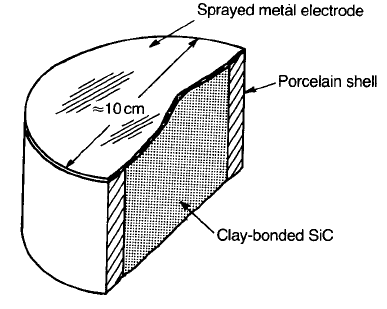
sealed into porcelain shells with an epoxy resin to prevent the ingress of moisture
(Fig. 4.14).
While there is no doubt that the VDR behaviour of SiC units is derived from
the contact areas between the particles, which very probably contain a thin layer
of silica, the precise mechanism is uncertain although the tunnelling of carriers
through potential barriers is likely to be involved.
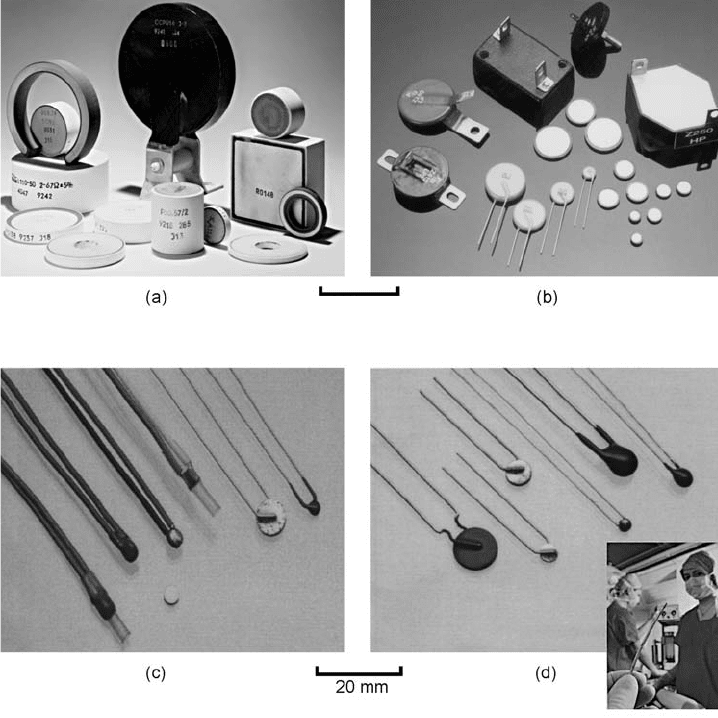
A range of SiC varistors is shown in Fig. 4.15.
4.3.3 Zinc oxide
Zinc oxide (ZnO) can exhibit a wide range of electrical properties depending on
minor constituents and sintering conditions. It is also remarkable for the ease
with which high-density ceramics can be achieved over a wide range of sintering
temperatures and for its excellent resistance to thermal shock.
Zinc oxide has the wurtzite (ZnS) structure comprising hexagonal close-
packed oxygen ions with half the tetrahedral interstices containing Zn
2þ
ions. On
heating to high temperatures in air it loses oxygen, thus creating oxygen
vacancies, and early models attributed the resulting non-stoichiometry to the
formation of zinc atoms on interstitial sites. It is now accepted that the defect is a
neutral oxygen vacancy and that thermal energy at room temperature is sufficient
to ionize the vacancy, thus promoting electrons into the conduction band. The
energy gap at room temperature for a crystal free from donors is approximately
3.2 eV. Conductivities exceeding 10
2
Sm
1
can be obtained in ceramics that have
been cooled sufficiently rapidly after sintering to preserve a high concentration of
oxygen vacancies.
Varistor compositions based on ZnO contain a number of dopants at a level of
approximately 1 mol.%; a typical formulation is (in mol.%) 96.5ZnO–0.5Bi
2
O
3
–
156 CERAMIC CONDUCTORS
Fig. 4.14 Section through a commercial SiC surge arrester.
1.0CoO–0.5MnO–1.0Sb
2
O
3
–0.5Cr
2
O
3
. The standard ceramic powder processing
procedure is followed, although calcination at about 800 8C is sometimes
omitted. Sintering takes place at about 1250 8C in air. Reducing conditions must
be avoided because zinc boils at 913 8C and is therefore rapidly lost if it is formed
at high temperatures. The rate of cooling after sintering affects the non-linearity:
quenching to room temperature from 900 8C reduces the a value.
Electrodes usually consist of fired-on silver paint with a small glaze content. It
may be necessary to remove a high-resistivity surface layer from the ceramic
before silvering. The contacts formed in this way are unlikely to be ohmic, but
VOLTAGE-DEPENDENT RESISTORS (VARISTORS) 157
Fig. 4.15 (a) Silicon carbide varistors, and (b) zinc oxide varistors. (Courtesy of P.D. Devices
Ltd. UK.) (c) PTC thermistors for motor protection and (d) NTC thermistors: inset, catheter
fitted with biomedical NTC thermistor for measuring blood temperature. (Courtesy of
Thermometrics.)
100 mm

their non-ohmic behaviour is not perceptible compared with the extremely non-
linear behaviour of the bulk of the ceramic.
The structure of the ceramic consists of ZnO grains of diameter 10–50 mm with
an intergranular phase varying in thickness between 1 nm and 1 mm. The
intergranular phase, which usually has a high bismuth content, is insulating with
a resistivity of the order of 10
6
O m.
Conduction seems to take place through the ZnO grains and from grain to
grain in places where the grains are either in direct contact or only have a very
thin layer of intergranular material between them. The minor constituents are
divided between the two phases. Manganese appears to be the most significant of
the additives, probably present as Mn
2þ
and Mn
3þ
ions in the ZnO lattice. It may
control the concentration of oxygen vacancies, particularly at the surface of the
grains, since during firing there will be a supply of oxygen gas in the grain
boundary regions. Thus reactions such as
2Mn
2þ
! 2Mn
3þ
þ 2e
0
ð4:7Þ
1
2
O
2
ðgÞþ2e
0
! O
2
ð4:8Þ
may compensate for the loss of oxygen from the ZnO lattice:
O
2
!
1
2
O
2
ðgÞþV
O
ð4:9Þ
Mn
2þ
and Mn
3þ
may also behave as acceptors for electrons liberated from
oxygen vacancy traps and so prevent them from entering the conduction band.
Cobalt and chromium may also contribute to reactions of this type through the
coexistence of Co
2þ
and Co
3þ
and of Cr
3þ
and Cr
4þ
ions, but they appear to be
less effective in the absence of manganese. Such mechanisms may lead to the
presence of a layer on the ZnO grains that has a higher resistivity than that of the
interior, which is an essential part of the model outlined earlier, but the precise
mechanism has yet to be determined.
Bi
2
O
3
,Sb
2
O
3
and other constituents provide a liquid phase that may assist
sintering and control the grain size. It may also lead to a distribution of
intergranular contacts that enhances the VDR effect. It has been found that
subjecting ZnO VDRs to a.c. or d.c. fields of order 10–100 V mm
1
results in a
significant change in their characteristics. Since the change results in an increase
in current and in power dissipated as heat, so that a catastrophic runaway
condition becomes possible, the process is termed ‘degradation’. The units can be
stabilized by annealing for 2 h in air at 700–800 8C. The treatment results in a fall
in resistivity at low voltages but the altered characteristic is stable.
The degradation has been attributed to the diffusion of interstitial zinc ions
Zn
þ
i
in the depletion region near the surface of the ZnO grains. These ions
migrate to the grain surface under the influence of a field and neutralize part of
the negative charge at the interface with the formation of neutral Zn
i
interstitials.
This lowers the effective height of the interface barrier and so lowers the
158 CERAMIC CONDUCTORS
resistivity. The annealing treatment allows the diffusion of ions to lower energy
states which are not affected by the subsequent application of a field.
While ZnO is outstanding for the high a values that can be attained, other
systems that contain barrier layers, for instance the positive temperature
coefficient resistors based on BaTiO
3
, also show the effect, but alternatives to
ZnO have not been developed commercially.
4.4 Temperature-sensitive Resistors
There are numerous uses for resistors with high values of the temperature
coefficient of resistance (TCR) and they may be negative (NTC) or positive
(PTC). An obvious application is in temperature indicators that use negligible
power to monitor resistance changes. Compensation for the variation of the
properties of other components with temperature may sometimes be possible; in
this case the applied power may be appreciable and the resulting effect on the
temperature-sensitive resistor (TSR) must be taken into account.
There will be a time interval between the application of a voltage to a TSR and
the establishment of its equilibrium temperature and resistance. Thus NTC
resistors can be used to delay the establishment of a final current and power level,
while PTC units can be used to give an initially high current that falls back to a
required level. PTC units can be used to maintain a comparatively constant
current from a source of variable voltage since the increase in resistance resulting
from power increase due to a voltage increase may be sufficient to inhibit any
current increase.
Both NTC and PTC units can be used to indicate changes in ambient
conditions since the power they draw from a source depends on the heat that
they can dissipate into their surroundings. PTC units have the advantage that
they are unlikely to overheat since an increase in temperature cuts down the
power that they need to dissipate. Precautions must be taken with NTC units to
ensure that runaway conditions cannot arise, because an increase in their
temperature increases the power that they can draw from a constant voltage
source (see Section 5.2.2).
In a ceramic a large temperature coefficient of resistivity can arise from three
causes:
1. the intrinsic characteristic of a semiconductor which leads to an exponential
fall in resistivity over a wide temperature range;
2. a structural transition which is accompanied by a change in the conduction
mechanism from semiconducting to metallic (this usually results in a large fall
in resistivity over a small temperature range);
TEMPERATURE-SENSITIVE RESISTORS 159

3. a rapid change in dielectric properties in certain ceramics which affects the
electronic properties in the intergranular region to give rise to a large increase
in resistivity with temperature over small temperature ranges.
The choice of material exhibiting mechanisms 2 and 3 is limited to those in
which the effect occurs at a practically useful temperature, usually somewhat
above the normal ambient. The second mechanism has not led to significant
applications and is discussed only briefly below. Mechanism 3 has led to
important PTC devices, and familiarity with the ground covered in the sections
concerned with BaTiO
3
is a prerequisite to an understanding of the PTC effect
(see Sections 2.6.2 and 2.7.3).
4.4.1 Negative temperature coe⁄cient resistors
(NTC Thermistors)
The TCR of a semiconductor is expected to be negative (see Section 2.6) whether
the conducting electrons move in a conduction band, as for example in SiC, or
‘hop’ between localized sites as is believed to occur in lithium-doped NiO (see
Section 2.6.2). In each case the resistivity r depends on temperature according to
rðTÞ¼r
1
exp
B
T
ð4:10Þ
where r
1
is approximately independent of temperature and B is a constant
related to the energy required to activate the electrons to conduct. Differentiating
Eq. (4.10) leads to the TCR value a
R
:
a
R
¼
1
r
dr
dT
¼
B
T
2
ð4:11Þ
For example, if B ¼ 2700 K, a
R
¼3% K
1
at 300 K; alternatively a
R
can be
expressed as 30 000 p.p.m. 8C
1
or 30 000 MK
1
. It follows that the larger is the
value of B, the greater is the temperature coefficient; in contrast, the resistivity
will be high at low temperatures because of the paucity of carriers, which is a
disadvantage in many practical applications. There is a large choice of NTC
materials, but those most used in practice are based on solid solutions of oxides
with the spinel structure, e.g. Fe
3
O
4
–ZnCr
2
O
4
and Fe
3
O
4
–MgCr
2
O
4
. A series
that gives favourable combinations of low resistivity and high coefficients is
based on Mn
3
O
4
with a partial replacement of the Mn by Ni, Co and Cu, as
shown in Table 4.1.
Mn
3
O
4
is a normal spinel with Mn
2þ
on tetrahedral sites and Mn
3þ
on
octahedral sites. Therefore it is not very conductive since it does not contain ions
of the same element with differing charges on similar sites, as required for
electron hopping. The substitution of Ni for Mn increases the conductivity. Ni
2þ
160 CERAMIC CONDUCTORS
occupies octahedral sites and the charge balance is maintained by the conversion
of Mn
3þ
to Mn
4þ
, thus providing a basis for hopping. Co
2þ
and Cu
þ
and Cu
2þ
have similar effects, but the site occupancies and ion charges are difficult to
predict or determine in the more complex mixtures.
Components in the form of rods and discs are produced by the normal ceramic
route, but the firing schedule and atmosphere have to be precisely controlled in
order to obtain the required oxidation states. For instance, a prolonged delay
when cooling in air through the range 700–500 8C could promote the formation
of an excess of Mn
4þ
. Also, the operational temperature range for the device
during use is specified as 50 to þ250 8C. At higher temperatures a slow
interchange of oxygen with the atmosphere takes place, causing a permanent
change in the resistance value and its temperature characteristic.
Mixtures of the rare earth oxides, e.g. 70 cat.% Sm and 30 cat.% Tb, can be
used at temperatures up to 1000 8C as they have no tendency to lose or gain
oxygen. Since their room temperature resistivity is of the order of 10
7
O m, they
are not convenient for room temperature use. At 600 8C the resistivity is about
25 O m with B ¼ 6500 K, giving a
R
¼0:9% K
1
.
Electrodes are commonly silver fired on with an admixture of glaze, but
electroless nickel and vacuum-deposited metals can also be used. A final coating
of a glaze over the whole body improves the long-term stability.
Miniature ‘bead’ thermistors, which are particularly valuable as temperature
sensors, can be made by arranging two sets of fine platinum wires at right angles
with a separation of a fraction of a millimetre between the sets. The intersections
of the wires are then enclosed by small beads of paste containing the thermistor
material in powder form. The beads are dried out and sintered in the same way as
bulk units or fused individually with a laser beam or an oxidizing flame and
annealed. The beads are then separated with two platinum lead wires which can
be attached to a probe. Their small mass enables them to reach a rapid thermal
equilibrium with their surroundings.
The behaviour of an NTC resistor on load is complicated by its increase in
internal temperature when it passes a current. As a rough approximation it can
TEMPERATURE-SENSITIVE RESISTORS 161
Table 4.1 Properties of thermistor compositions based on Mn
3
O
4
at 25 8C
Composition (cat.%) r
25
=O m B/K a
R
/%K
1
Mn Co Ni Cu
56 8 16 20 10
1
2580 2:9
65 9 19 7 1 2000 2:2
70 10 20 10 3600 4:0
85 15 10
2
4250 4:7
94 6 10
3
4600 5:1
25
is the value at 25 8C.