
Moulson A.J., Herbert J.M. Electroceramics: Materials, Properties, Applications
Подождите немного. Документ загружается.

However, the introduction in 1913 by Ford of the mass-produced car completely
ousted the battery for vehicle traction. The reason is clearly demonstrated in Fig.
4.25. More precise data well illustrate the comparison; for example, one litre of a
modern lead/acid battery weighs 2.4 kg and can store 0.07 kW h, sufficient to
drive a vehicle a few hundred metres. By comparison one litre of petrol weighs
0.85 kg and stores 11 kW h of energy, sufficient to drive the vehicle approximately
10 km.
Strong contenders for automotive power are the sodium/sulphur and sodium/
nickel chloride batteries, the latter known as the ZEBRA cell. ‘ZEBRA’ was
originally (c. 1979) an acronym devised for commercial security reasons but now
it stands for the very apt ‘Zero Emissions Batteries Research Activity’. Several
European car manufacturers including BMW and Mercedes have incorporated
the ZEBRA cell into prototype cars, vans and buses. The performance of the
battery far outstrips that of the lead/acid counterpart, as is evident from Fig.
4.25. Its technical performance coupled to features relating to safety and overall
economics give grounds for optimism concerning its future as an automotive
power source. It should prove especially attractive for applications such as in the
‘neighbourhood electric vehicle’ (NEV) where reasonable range and not
acceleration is the significant attribute. Such vehicles would be used for
shopping, taking children to school, leisure pursuits, etc.
A further possible and important application for the Na/S and ZEBRA cells is
in ‘load levelling’. By this is meant the storage of electrical energy from power
supply generators when demand is relatively low and its release into the supply
network (the ‘grid’) at peak demand times. In this way the generators can be run
continuously at their optimal efficiency speeds.
The Na/S and ZEBRA batteries, which incorporate ceramic electrolytes, will
be discussed in detail below but first the elementary basic science is summarized.
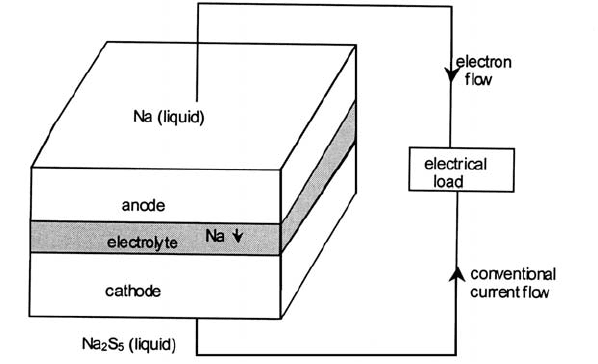
Elementary Na/S battery science The basic science of the Na/S cell is
identical to that of the fuel cell. In both cases the essential is an electrolyte. On
one side of the electrolyte membrane there is a source of sodium ions at a
particular chemical potential, and on the other side a ‘sink’ for the ions at a
relatively lower chemical potential. The elements of the process are illustrated in
Fig. 4.28.
The ideal electrolyte has a high conductivity with Na ions being the only
charge-carrier, that is, the transport number for Na is unity. (The ‘transport
number’ for a particular mobile charged species is defined as the conductivity
contributed by the species expressed as a fraction of the total conductivity.)
Consider the discharge of the cell. At the anode two Na ions enter the electrolyte
having given up an electron each; that is the sodium is chemically oxidized. At
the cathode a polysulphide unit gains two electrons and is chemically
reduced.
182 CERAMIC CONDUCTORS
TEAMFLY
Team-Fly
®
This process leads to the development of a voltage difference between anode
and cathode and when the external circuit is ‘open’, this potential difference is the
‘electromotive force’ (the e.m.f.) of the cell. When there is an electrical load in the
external circuit, for example a motor, then a current will flow and
electrochemical energy is converted into mechanical energy.
Just as in the case of the fuel cell, current also has to flow through the
electrolyte doing work against its electrical resistance, generating heat and
leading to a terminal p.d. value lower than the e.m.f.
It follows from this brief outline that if maximum useful power is to be
extracted from the cell then the electrolyte resistance must be kept to a minimum.
This is dependent not only on the material but also on the geometry of the
membrane which must be as thin as is practicable. As in the case of the fuel cell,
the e.m.f can be calculated from thermodynamic principles. In fact the chemical
reactions occurring when the sodium ions react with the sulphur are rather
complex and the sodium:sulphur ratios change as the battery discharges. The
first product as the cell discharges is the compound Na
2
S
5
.
At the anode the half cell reaction may be written:
2Na ! 2Na
.
þ 2e
0
(4:34Þ
and at the cathode
5S þ 2e
0
þ 2Na
.
! Na
2
S
5
(4:35Þ
The overall cell reaction is, therefore
2Na þ 5S ! Na
2
S
5
(4:36Þ
FUEL CELLS AND BATTERIES 183
Fig. 4.28 Elements of the Na/S battery.
Na
.
When all the sulphur has been converted to Na
2
S
5
this compound is gradually
converted to Na
2
S
3
as the discharge proceeds. The sodium/sulphur cell operates
at a temperature of approximately 350 8C (the melting points of both Na
2
S
5
and
Na
2
S
3
are close to 240 8C).
There has been a reduction in free energy of the chemical system which is
manifested as electrical energy. Under the assumption that the chemical reaction
occurs reversibly, that is no energy is ‘lost’ but only exchanged between chemical
and electrical forms, the cell e.m.f. can be calculated. The change in free energy
(DG) for reaction (4.36) at 350 8C is approximately 400 kJ. For each mole of the
sulphide formed two moles of Na
þ
ions are transported across the cell. The
calculation (Eq. (4.33)) leads to a cell e.m.f. of 2.08 V.
As with the fuel cell this small voltage must be multiplied up by connecting
many cells in series, and in parallel to increase current availability and battery
reliability. This is a relatively straightforward procedure with the separately
packaged individual cells being connected with metallic conductors to form a
battery.
Elementary ‘ZEBRA’ battery science There is no new principle involved.
The basic reaction is:
2Na þ NiCl
2
! Ni þ 2NaCl (4:37Þ
The open circuit e.m.f., calculated from the free energy change for the reaction at
250 8C is approximately 2.59 V.
4.5.3 Electroceramics for fuel cells and batteries
Solid fast-ion conductors
Fast-ion conductors: general comments The essential element of ceramics-
based fuel cells and batteries is the electrolyte, a solid, fast-ion conductor.
Ionic transport under an applied field takes place to some extent in all ionic
solids but generally involves the movement of ions into vacant sites over large
energy barriers resulting in very low mobilities, even at high temperatures.
Certain materials known as ‘fast-ion conductors’ or ‘superionic conductors’,
exhibit higher ionic mobilities and opened up the possibility of practical
applications, particularly in fuel-cell, battery and sensor technologies. In liquid
ionic conductors both positive (cations) and negative (anions) ions act as
current-carriers, although one or the other may dominate with a higher transport
number. In solids there is usually only one species of mobile ion, and it may be a
cation or anion.
The precise structural conditions for fast-ion conduction have yet to be
established (especially when the effects of microstructure are involved), but there
184 CERAMIC CONDUCTORS
clearly must be a high concentration of sites into which the mobile ion can move
(see Section 2.6.3). These may be lattice vacancies or they may be features of the
crystal structure such as tunnels or under populated planes within which specific
ions can move by a mechanism with a low activation energy.
The size and charge of mobile ions and the size of the spaces within a lattice
through which they may move are important factors. Small singly charged
cations such as Li
þ
and Na
þ
are mobile in a number of environments, in contrast
to the more highly charged and smaller cations. The reason for this is the
polarization of the surrounding anions by the smaller more highly charged
cations. This interaction constitutes a high-energy barrier to the movement of the
cations. However, there are factors other than geometry and size that have
important effects. For example, on a rigid sphere model, the interstices between
the anions (radius r
A
) in a face-centred cubic lattice would only allow penetration
of a cation of radius 0.15 r
A
. However, in the case of I
of radius 220 pm, where
the interstices offer an aperture of only 34 pm radius, the transport number of
Li
þ
(r
3
55 pm) is significant, and the room temperature ionic conductivity of LiI
is 510
5
Sm
1
. This can be attributed to the following factors:
. ions are not rigid spheres,
. simple concepts relating to the interaction of massive bodies are not
applicable in detail to the interaction of ions; and
. thermal energy will lead to random enlargements of the interstices and to the
creation of anion and cation vacancies facilitating the movement of ions.
With respect to the last point, it is significant that room temperature (300 K) is
approximately 0.4 the melting point of LiI (723 K) and so the concentration of
thermally induced lattice vacancies will be high. LiI, which is used as a solid
electrolyte in cardiac pacemakers, can be contrasted with RbAg
4
I
5
, a fast-ion
conductor that, in polycrystalline form, has an ionic conductivity due to Ag
þ
ions of 21 S m
1
at 25 8C. Even though silver has a large radius (r
6
¼115 pm), the
RbAg
4
I
5
structure is such as to offer apertures approaching this diameter for the
Ag
þ
ions.
The fast-ion ceramic conductors of interest here are cubic stabilized zirconia
(CSZ), an oxygen ion conductor, and a sodium aluminate (b@-alumina), a
sodium ion conductor. Both are discussed in detail below. The overview by
T.A. Ramanarayanan et al. [8] covering CSZ and its applications is
recommended.
Cubic stabilized zirconia (CSZ) Pure zirconia (ZrO
2
) is either chemically
extracted and purified from the mineral zircon (ZrSiO
4
) or purified from
baddeleyite. It occurs as three crystalline polymorphs with monoclinic,
tetragonal and cubic structures. The monoclinic form is stable up to 1170 8C
FUEL CELLS AND BATTERIES 185
when it transforms to the tetragonal modification, which remains stable up to
2370 8C; from 2370 8C to the melting point (2680 8C) the cubic form is stable.
The monoclinic-tetragonal conversion is accompanied by a contraction in
volume of approximately 5% which can cause mechanical failure in ceramic
pieces. This difficulty is overcome in CSZ by stabilizing the cubic form down to
room temperature by substituting lower-valence cations for some of the
zirconium.
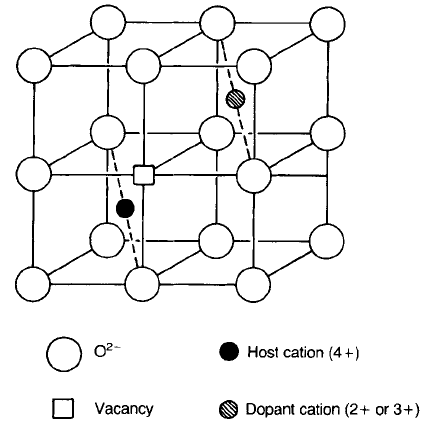
Cubic ZrO
2
has the fluorite structure with the O
2
ions arranged in simple
cubic packing and half the interstices in this lattice occupied by Zr
4þ
ions (Fig.
4.29); the substitution of lower-valence cations leads to O
2
ion vacancies as
indicated. The vacancies which stabilize the structure also lead to high mobility
in the oxygen sub-lattice and to behaviour as a fast-ion conductor.
The elements that stabilize the cubic fluorite structure in zirconia include all
the lanthanides, scandium, yttrium, magnesium, calcium, manganese and
indium. The main qualification would appear to be an ionic radius close to
that of Zr
4þ
(r
8
¼84 pm). Ce
3þ
with r
8
¼114 pm is one of the largest ions fulfilling
this function. Ca
2þ
(r
8
¼112 pm) is the most commonly used substituent at about
the 15 mol.% level. Yttrium (r
8
¼101 pm) stabilizes the cubic phase when present
in the 13–68 mol.% range, but maximum conductivity is obtained with 7–
8 mol.% which results in some admixture of tetragonal and monoclinic phases
with the cubic. Calcium is also sometimes used at the 7–8 mol.% level, resulting
186 CERAMIC CONDUCTORS
Fig. 4.29 The ideal fluorite structure showing half a unit cell including a dopant cation and a
charge-compensating oxygen vacancy.
in a partially stabilized zirconia. Scandium has been found to give a material with
a higher conductivity, which is particularly valuable at lower temperatures. From
the fact that the conductivity reaches its maximum at an intermediate
concentration of lower-valence ions, it appears that only a fraction of the
vacant O
2
sites contribute to O
2
mobility when the concentration of vacant
sites is high. Ions of variable valence need to be excluded if the electronic
conductivity is to be minimized. Thorium is added to yttria-containing bodies as
a grain growth inhibitor.
For refractory applications, when the ‘mixed oxide’ route is followed,
temperatures as high as 1900 8C are necessary to sinter to high density. The
high interest in SOFCs has stimulated efforts to develop novel fabrication routes
to zirconia ceramics and yttria-stabilized sub-micron sized powders have been
prepared which sinter to 95% theoretical density at a temperature as low as
1150 8C [4].
Chemically prepared, highly reactive and uniform zirconia powders are
commercially available. One production route is the co-precipitation of a mixed
solution of ZrOCl
2
(derived from zircon) and YCl
3
(derived from yttria) solution
followed by calcinations, milling and spray-drying. The best commercially
available, chemically prepared, powders of 8% Y
2
O
3
/ZrO
2
(8YSZ) can be
sintered to full density at 1400 8C.
Careful attention has to be given to the purity of the precursors to avoid
detrimental effects on conductivity. In a polycrystalline ceramic the conductiv-
ities of grain boundaries and bulk contribute to overall conductivity. In the case
of polycrystalline YSZ, because of its unusually high intrinsic (bulk) conductivity
the grain boundaries are far less conductive than the crystal, typically by a factor
of 100. The effect the grain boundaries have on overall conductivity will
depend on grain size and, of course, on impurity content (e.g. silica), since
impurities tend to concentrate there. It is the effort to understand more of the
various contributors to overall conductivity which has led to the application of
impedance spectroscopy (see Section 2.7.5).
b@-alumina The b-aluminas are a family of non-stoichiometric aluminates of
which the most important have the approximate formulae equivalent to
Na
2
O11Al
2
O
3
(b-alumina), and Na
2
O5Al
2
O
3
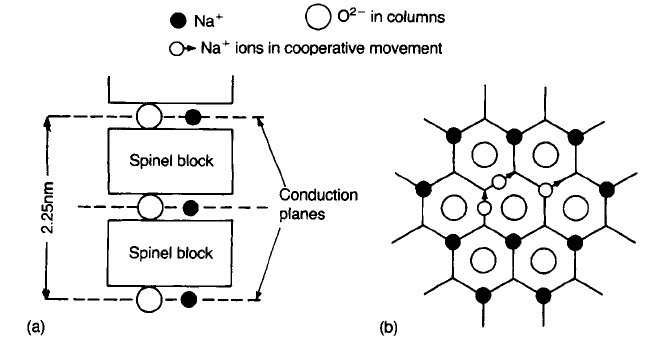
(b@-alumina). They have a layer
structure (Fig. 4.30 (a)) with layers approximately 1 nm thick consisting of blocks
of close-packed O
2
ions in which the Al
3þ
ions occupy octahedral and
tetrahedral interstices in the same arrangement as the Mg
2þ
and the Al
3þ
in the
spinel structure. The spinel layers are separated by mirror planes containing Na
þ
and O
2
ions. The Na
þ
ions can move quite freely within this plane with the sort
of concerted motion indicated in Fig 4.30(b); as a result the conductivity is high
in these planes but negligible in the perpendicular direction.
It is instructive to write the compositions of the b- and b@-aluminas with the
oxygen lattice content the same in both cases, that is Na
3
Al
33
O
51
and
FUEL CELLS AND BATTERIES 187
Na
6
Al
32
V
Al
O
51
, respectively. This suggests that compared to b-alumina the b@
modification contains an aluminium vacancy compensated by three extra
sodium ions in the conduction plane. The consequent higher conductivity of
the b@ modification makes it favoured for battery electrolytes. The conductivity
of polycrystalline b-alumina at 350 8C (the temperature appropriate to
battery operation) is about 5 S m
1
and for polycrystalline b@-alumina about
50 S m
1
.
The preparation of ‘pure’ b@-alumina is not easy and dopants (e.g. Mg and Li)
are added to stabilize the modification. The dopants have the added advantage of
reducing interstitial oxygen in the conduction plane and therefore facilitating the
movement of the sodium ions.
A route described by J.L. Sudworth et al. [9] for the commercial production of
an almost pure b@-alumina tube starts with the mineral boehmite {AlO(OH)}
which is calcined at 800 8C to produce a microcrystalline mixture of the g-, d-
and y-forms of alumina. The calcined powder is mixed with sodium carbonate
and lithium hydroxide and fired at 1200 8C when complete conversion to b@-
alumina occurs having a composition close to (wt%) 90Al
2
O
3
, 9.2Na
2
O and
0.8Li
2
O. The b@-alumina is wet-ground to a particle size of approximately
1–2 mm after which the slurry is spray-dried to produce a free-flowing powder
suited to forming the tubes by isostatic pressing.
Sintering is a critical step with schedules extending over typically 24 h and a
peak temperature of approximately 1600 8C. At this temperature there is an
appreciable sodium vapour pressure over beta aluminas and special precautions
are taken to maintain the required composition. The component may be enclosed
in a sealed spinel (MgAl
2
O
4
) saggar which can be re-used.
188 CERAMIC CONDUCTORS
Fig. 4.30 Structure of b@-alumina: (a) alternating spinel blocks and conduction planes;
(b) migration pathway of Na
þ
ions indicating paths of concerted motion.
b@-Alumina tends to suffer from discontinuous grain-growth during sintering
with the result that an undesirable duplex (excessively large grains embedded in a
small grain-sized matrix) develops. Since mechanical strength is reduced by the
presence of large grains the sintering schedule must be adjusted so that the rate of
densification is very much greater than the rate of grain-growth. In this way a
uniformly small grain-sized ceramic can be made and the necessary optimal
technical strength (200 MPa) achieved.
Other fabrication routes have been tried including forming by electrophoretic
deposition and densification by ‘fast-firing’. In ‘fast-firing’ (or ‘zone-sintering’)
the tubes may be fed sequentially through an inductively-heated furnace with the
peak temperature approximately 1700 8C. The sintering takes only a few minutes
and so Na-loss is negligible, and the tube is rotated as it passes through the
furnace to prevent bending.
The solid oxide fuel cell (SOFC)
Details of the ceramics and approaches to fabrication involved in SOFC
technology are many and complex and well beyond the scope of the present text.
The following summary provides the framework to which the details can be
added. The articles by N.Q. Minh [10], B.C.H. Steele [11,12], B.C.H. Steele and
A. Heinzel [3, pp. 345–52], and S.C. Singhal [13] serve as good entries to the more
specialized literature.
Electroceramics exploited The four major functions electroceramics perform
in the present generation of SOFCs are as the electrolyte, the anode, the cathode
and the interconnect. The favoured ceramics are discussed below.
Electrolyte–cubic stabilized zironia Almost without exception cubic stabilized
zirconia is the chosen ceramic for the electrolyte in SOFCs. This is because of its
adequate conductivity and almost total absence of electronic conductivity, and
because it is stable against the wide range of oxygen partial pressures (1 atm. to
10
20
atm.) encountered in a fuel cell. Also, because of a combination of
availability and cost the favoured compound is yttria-stabilized zirconia,
ZrO
2
þ8–10 mol.% Y
2
O
3
(YSZ).
The ceramic is required in the form of dense, polycrystalline layers, as thin as
practicable to minimise cell resistance, consistent with the need to ensure
mechanical integrity. Adopted layer thickness is, of course, also determined by
the operating temperature of the cell. Self-supporting plates 150 mm thick can be
used at 900–1000 8C and supported thick films (down to 15 mm) to as low as
700 8C.
Fig. 4.31 shows Arrhenius plots for YSZ together with other candidate
electrolyte ceramics illustrating how the combination of temperature and ceramic
FUEL CELLS AND BATTERIES 189
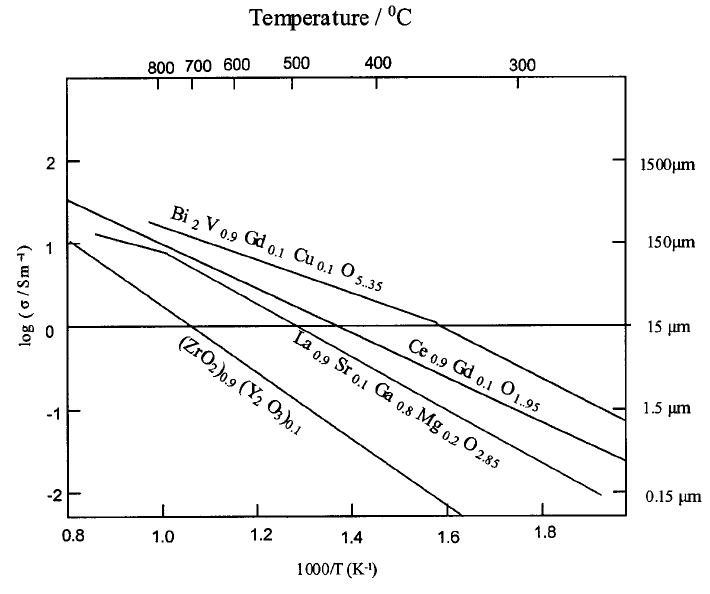
type influences the electrolyte thickness for a given areal resistance value,
arbitrarily but realistically set at 15 mO m
2
.
Anode The anode, or fuel electrode, must be stable against reduction, be
electronically conducting, have a high specific surface area and a connected
porosity allowing free passage of the fuel gases to the anode/electrolyte interface;
it must also facilitate the counter flow of the oxidation products away from the
interface. Although the temperature and reducing atmosphere conditions permit
the use of partially sintered metallic nickel as an anode, prolonged use would
lead to further sintering and undesirable microstructural changes; there is also
the need to match thermal expansivities. Coating the partially sintered nickel
with YSZ gives a better thermal expansion match between anode and electrolyte,
190 CERAMIC CONDUCTORS
Fig. 4.31 Ionic conductivities for candidate electrolyte ceramics. The arbitrary assumption
that for a planar cell format a resistance of 515 mO m
2
is required places an upper limit on
the permitted thickness of the electrolyte; lower values of conductivity demand thinner
membranes whilst higher values permit correspondingly thicker membranes. Electrolyte
thicknesses greater than approximately 150 mm are considered mechanically self-supporting.
After B.C.H. Steele [11].
reducing thermal fatigue during operation and improving adhesion between
anode and electrolyte. A further advantage is that the microstructure offers an
increase in reactive area at the three-phase boundary where oxidation of the fuel
occurs.
Cathode In contrast to the anode the cathode operates in an oxidizing
environment but, like the anode, it must have high electronic conductivity and a
pore structure enabling the gaseous oxidant to reach the cathode/electrolyte
interface.
The favoured material is modified lanthanum manganite (e.g. La
0.8
Sr
0.2
MnO
3þx
)
which has the perovskite structure. It is a p-type semiconductor the electron
transport occurring by electron-hopping (see Section 2.6.2) between the þ3 and
þ4 states of the Mn ion. The strontium-doping enhances the conductivity.
Interconnect The property requirements for the interconnect ceramic are the
most demanding. The conductivity should be as high as possible and, ideally,
100% electronic. This is necessary to reduce internal resistance and to avoid
severe problems which would arise were ionic space-charge polarization (see
Section 2.7.1) to develop.
Because the interconnect is exposed to high temperatures and oxidizing
environments it must be stable against both. It must also serve as an effective
barrier to the oxidant and fuel gases so that direct reaction is avoided, and it is
required to be chemically inert with respect to the cathode, anode and the inter-
cell connector material, for example nickel (see Fig. 4.32(a)).
These requirements are satisfied by a doped lanthanum chromite (see Section
4.1.3) e.g. La (Ca, Mg, Sr, etc.) CrO
3
. However for SOFCs operating in the
temperature range 500–750 8C a stainless steel interconnect plate can be used.
Geometries and construction The two basic geometries for the SOFC are
planar and tubular.
Planar geometry Although there are variations in detail, the design of the
planar or ‘flat plate’ cell, and how cells are interconnected are essentially as
illustrated in Fig. 4.27. The construction may involve a self-supporting, coated
electrolyte or, if the operating temperature permits, the anode–electrolyte–
cathode structure may be supported on a stainless steel bipolar plate.
Brief summaries of the various processing technologies used in fabricating cell
components are given in Section 3.6.9.They include tape-casting, calendering,
screen-printing, electrophoretic deposition, electrochemical vapour deposition,
chemical vapour deposition, spray-pyrolysis and sol–gel.
As an example the electrolyte may be tape-cast or calendered. Flat and dense
plates of YSZ having thickness down to 150 mm are readily fabricated. The anode
and cathode materials can then be applied (by a slurry) to the faces of the
electrolyte and fired on. Alternatively the anode, electrolyte and cathode layers
FUEL CELLS AND BATTERIES 191