
Moulson A.J., Herbert J.M. Electroceramics: Materials, Properties, Applications
Подождите немного. Документ загружается.

evident that the possible range of properties was extremely wide. For example,
the ceramic form of the mineral magnetite, known to the early navigators as
‘lodestone’, was recognized as having a useful electrical conductivity in addition
to its magnetic properties. This, combined with its chemical inertness, made it of
use as an anode in the extraction of halogens from nitrate minerals. Also,
zirconia, combined with small amounts of lanthanide oxides (the so called ‘rare
earths’) could be raised to high temperatures by the passage of a current and so
formed, as the Nernst filament, an effective source of white light. It was
recognized that some ceramics, the ‘fast-ion conductors’, conduct electricity well,
and predominantly by the transport of ions, and over the last two decades
interest in them has intensified because of their crucial roles in fuel cell, battery
and sensor technologies.
The development from 1910 onwards of electronics accompanying the
widespread use of radio receivers and of telephone cables carrying a multiplicity
of speech channels led to research into ferrites in the period 1930–1950. Nickel–
zinc and manganese–zinc ferrites, closely allied in structure to magnetite, were used
as choke and transformer core materials for applications at frequencies up to and
beyond 1 MHz because of their high resistivity and consequently low susceptibility
to eddy currents. Barium ferrite provided permanent magnets at low cost and in
shapes not then achievable with ferromagnetic metals. From 1940 onwards
magnetic ceramic powders formed the basis of recording tapes and then, as toroids
of diameter down to 0.5 mm, were for some years the elements upon which the
mainframe memories of computers were based. Ferrites, and similar ceramics with
garnet-type structures, remain valuable components in microwave technology.
From the 1920s onwards conductive ceramics found use, for instance, as
silicon carbide rods for heating furnaces up to 1500 8C in air. Ceramics with
higher resistivities also had high negative temperature coefficients of resistivity,
contrasting with the very much lower and positive temperature coefficients
characteristic of metals. They were therefore developed as temperature indicators
and for a wide range of associated applications. Also, it was noticed at a very
early stage that the resistivity of porous specimens of certain compositions was
strongly affected by the local atmosphere, particularly by its moisture content
and oxidation potential. Latterly this sensitivity has been controlled and put to
use in detectors for toxic or flammable components.
It was also found that the electrical resistivity of ceramics based on silicon
carbide, and, more recently, zinc oxide could be made sensitive to the applied
field strength. This has allowed the development of components that absorb
transient surges in power lines and suppress sparking between relay contacts. The
non-linearity in resistivity is now known to arise because of potential barriers
between the crystals in the ceramic.
Ceramics as dielectrics for capacitors have the disadvantage that they are not
easily prepared as self-supporting thin plates and, if this is achieved, are
extremely fragile. However, mica (a single-crystal mineral silicate) has been
2 INTRODUCTION
TEAMFLY
Team-Fly
®
widely used in capacitors and gives very stable units. Thin-walled (0.1–0.5 mm)
steatite tubes have been extruded for use in low-capacitance units. The low
relative permittivity of steatite (e
r
6) has limited its use but the introduction of
titania (e
r
100) in the 1930s led to the development of capacitors having values
in the 1000 pF range in convenient sizes but with a high negative temperature
coefficient. Relative permittivities near to 30 with low temperature coefficients
have since been obtained from titanate and zirconate compositions.
The situation was altered in the late 1940s with the emergence of high-
permittivity dielectrics based on barium titanate (e
r
2000–10 000). For a wide
range of applications small plates or tubes with thicknesses of 0.2–1 mm gave
useful combinations of capacitance and size. The development of transistors and
integrated circuits led to a demand for higher capacitance and small size which
was met by monolithic multilayer structures. In these, thin films of organic
polymer filled with ceramic powder are formed. Patterns of metallic inks are
deposited as required for electrodes and pieces of film are stacked and pressed
together to form closely adhering blocks. After burning out the organic matter
and sintering, robust multilayer units with dielectrics of thicknesses down to
55 mm have been obtained. Such units fulfil the bypass, coupling and decoupling
functions between semiconductor integrated circuits in thick-film semiconductor
circuitry. The monolithic multilayer structure can be applied to any ceramic
dielectric, and multilayer structures for a variety of applications are the subject of
continuous development effort. In particular ‘low temperature co-fired ceramic’
(LTCC) technology is intensively pursued for electronics packaging, especially
for mainframe computer and telecommunications systems.
The basis for the high permittivity of barium titanate lies in its ferroelectric
character which is shared by many titanates, niobates and tantalates of similar
crystal structure. A ferroelectric possesses a unique polar axis that can be switched in
direction by an external field. The extent of alignment of the polar axes of the
crystallites in a ceramic is limited by the randomness in orientation of the crystallites
themselves but is sufficient to convert a polycrystalline isotropic body into a polar
body. This polarity results in piezoelectric, pyroelectric and electro-optic behaviour
that can be utilized in sonar, ultrasonic cleaners, infrared detectors and light
processors. Ceramics have the advantage, over the single crystals that preceded them
in such applications, of greater ease of manufacture. Ferroelectrics in thin film form
are now becoming established as one type of digital memory element.
Barium titanate can be made conductive by suitable substitutions and/or by
sintering in reducing atmospheres, which has led to two developments: firstly,
high-capacitance units made by reoxidizing the surface layers of conductive
plates and using the thin insulating layers so formed; secondly, high positive
temperature coefficient (PTC) resistors since the resistivity of suitably doped and
fired bodies increases by several orders of magnitude over a narrow temperature
range close to the transition from the ferroelectric to the paraelectric states. Uses
for PTC resistors include thermostatic heaters, current controllers, degaussing
INTRODUCTION 3
devices in television receivers and fuel-level indicators. As with voltage-sensitive
resistors, the phenomenon is based on electrical potential barriers at the grain
boundaries. Finally, superconducting ceramics with transition temperatures of
over 100 K have been discovered. This enables the development of devices
operable at liquid nitrogen temperatures, in particular cables for electric power
distribution and permanent magnets capable of producing exceptionally high
magnetic field strengths for a variety of applications, including magnetically
levitated transport systems.
The evolution of ferrimagnetic, ferroelectric and conductive ceramics has
required the development of compositions almost entirely free from natural
plasticizers such as clays. They require organic plasticizers to enable the ‘green’
shapes to be formed prior to sintering. Densification is no longer dependent on the
presence of large amounts of fusible phases (fluxes) as is the case with the siliceous
porcelains. Instead it depends on small quantities of a liquid phase to promote
‘liquid phase sintering’ or on solid state diffusional sintering or on a combination
of these mechanisms. Crystal size and very small amounts of secondary phases
present at grain boundaries may have a significant effect on properties so that close
control of both starting materials and preparation conditions is essential. This has
led to very considerable research effort devoted to the development of so-called
‘wet chemical’ routes for the preparation of starting powders.
Ceramics comprise crystallites that may vary in structure, perfection and
composition as well as in size, shape and the internal stresses to which they are
subjected. In addition, the interfaces between crystallites are regions in which
changes in lattice orientation occur, often accompanied by differences in
composition and attendant electrical effects. As a consequence it is very difficult,
if not impossible, to account precisely for the behaviour of ceramics. The study of
single-crystal properties of the principal components has resulted in valuable
insights into the behaviour of ceramics. However, the growth of single crystals is
usually a difficult and time-consuming business while the complexities of ceramic
microstructures renders the prediction of properties of the ceramic from those of
the corresponding single crystal very uncertain. Consequently, empirical observa-
tion has usually led to the establishment of new devices based on ceramics before
there is more than a partial understanding of the underlying physical mechanisms.
In the following chapters the elementary physics of material behaviour has been
combined with an account of the preparation and properties of a wide range of
ceramics. The physical models proposed as explanations of the observed phenomena
are often tentative and have been simplified to avoid mathematical difficulties but
should provide a useful background to a study of papers in contemporary journals.
Bibliography
1. Kingery, W.D., Bowen, H.K. and Uhlmann, D.R. (1976) Introduction to Ceramics, 2nd
edn, Wiley, New York.
4 INTRODUCTION

2
ELEMENTARY SOLID STATE
SCIENCE
2.1 Atoms
The atomic model used as a basis for understanding the properties of matter
has its origins in the a-particle scattering experiments of Ernest Rutherford
(1871–1937). These confirmed the atom to be a positively charged nucleus, of
radius of order 10
714
m, in which the mass of the atom is largely concentrated
and around which negatively charged electrons are distributed. The radius of the
atom is of order 10
710
m and thus much of it is empty space. The total negative
charge of the electrons compensates the positive charge of the nucleus so that the
atom is electrically neutral.
A dynamic model of the atom has to be adopted, as a static model would be
unstable because the electrons would fall into the nucleus under the electrostatic
attraction force. Niels Bohr (1885–1962) developed a dynamic model for the
simplest of atoms, the hydrogen atom, using a blend of classical and quantum
theory. In this context the term ‘classical’ is usually taken as meaning pre-
quantum theory.
The essentials of the Bohr theory are that the electron orbits the nucleus just as
a planet orbits the sun. The problem is that an orbiting particle is constantly
accelerating towards the centre about which it is rotating and, since the electron
is a charged particle, according to classical electromagnetic theory it should
radiate electromagnetic energy. Again there would be instability, with the
electron quickly spiralling into the nucleus. To circumvent this problem Bohr
introduced the novel idea that the electron moved in certain allowed orbits
without radiating energy. Changes in energy occurred only when the electron
made a transition from one of these ‘stationary’ states to another. In a stationary
state the electron moves so that its angular momentum is an integral multiple of
Electroceramics: Materials, Properties, Applications. 2nd Edition. Edited by A. J. Moulson and J. M. Herbert.
& 2003 John Wiley & Sons, Ltd: ISBN 0 471 49747 9 (hardback) 0 471 49748 7 (paperback)

h
=
¼ h=2p where h is the Planck constant (h
=
¼ 1:055 10
34
J s), i.e. the angular
momentum is quantized.
If the electron is moving in a circular orbit of radius r then the electrostatic
attraction force it experiences is balanced by the centripetal force:
e
2
4pe
0
r
2
¼ m
e
v
2
r
¼ m
e
o
2
r ð2:1Þ
in which
v is the linear velocity of the electron and o is its angular frequency.
The total energy E of the electron is made up of its kinetic energy E
k
and its
electrostatic potential energy E
p
. The value of E
p
is taken as zero when the
electron is so far removed from the nucleus, i.e. at ‘infinity’, that interaction is
negligible. Hence
E¼E
p
þE
k
ð2:2Þ
E¼
e
2
4pe
0
r
þ
1
2
m
e
v
2
Substituting from Eq. (2.1) gives
E¼
e
2
8pe
0
r
ð2:3Þ
From the quantum condition for angular momentum,
m
e
or
2
¼ nh
=
ð2:4Þ
which, together with Eq. (2.1), leads to
o
2
¼
e
2
4pm
e
e
0
r
3
¼
n
2
h
=
2
m
2
e
r
4
or
1
r
¼
m
e
e
2
4pe
0
n
2
h
=
2
ð2:5Þ
which substitutes into Eq. (2.3) to give
E¼
m
e
e
4
32p
2
e
2
0
h
=
2
1
n
2
ð2:6Þ
The integer n (1, 2, 3 etc.) is called the ‘principal quantum number’ and defines
the energy of the particular electron state. Although the situation for
multielectron atoms is complicated by the repulsive interaction between
electrons, the energy of a particular electron is still defined by its principal
quantum number. In general, the smaller the value of n, the lower is the energy,
with the energy differences between states defined by successive n values
decreasing with increasing n.
6 ELEMENTARY SOLID STATE SCIENCE
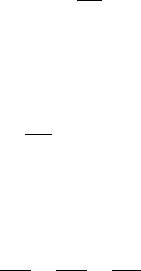
The Bohr theory of the atom was further developed with great ingenuity to
explain the complexities of atomic line spectra, but the significant advance came
with the formulation of wave mechanics.
It was accepted that light has wave-like character, as evidenced by diffraction
and interference effects; the evidence that light has momentum, and the
photoelectric effect, suggested that it also has particle-like properties. A ray of
light propagating through free space can be considered to consist of a stream of
‘photons’ moving with velocity 2:998 10
8
ms
71
. The kinetic energy of a photon
is given by E
k
¼ hv where v is the frequency of the light according to the wave
model. The converse idea that particles such as electrons exhibit wave-like
properties (the electron microscope is testimony to its correctness) was the first
step in the development of wave mechanics. It turns out that the ‘de Broglie
wavelength’ of a particle moving with momentum m
v is given by
l ¼
h
m
v
ð2:7Þ
Electron states are described by the solutions of the following equation which
was developed by Erwin Schro
¨
dinger (1887–1961) and which bears his name:
5
2
c þ
2m
h
=
2
ðE E
p
Þc ¼ 0 ð2:8Þ
This form of the Schro
¨
dinger equation is independent of time and so is applicable
to steady state situations. The symbol 5
2
denotes the operator
@
2
@x
2
þ
@
2
@y
2
þ
@
2
@z
2
cðx,y,zÞ is the wave function, and Eðx,y,zÞ and E
p
ðx,y,zÞ are respectively the total
energy and the potential energy of the electron. The value of jcj
2
dV is a measure
of the probability of finding an electron in a given volume element dV.
To apply Eq. (2.8) to the hydrogen atom it is first transformed into polar
coordinates (r,y,fÞ and then solved by the method of separation of the variables.
This involves writing the solution in the form
cðr,y,fÞ¼RðrÞYðyÞFðfÞð2:9Þ
in which RðrÞ, Y ðyÞ and FðfÞ are respectively functions of r, y and f only.
Solution of these equations leads naturally to the principal quantum number n
and to two more quantum numbers, l and m
l
. The total energy of the electron is
determined by n, and its orbital angular momentum by the ‘azimuthal’ quantum
number l. The value of the total angular momentum is flðl þ 1Þg
1=2
h
=
. The angular
momentum vector can be oriented in space in only certain allowed directions
with respect to that of an applied magnetic field, such that the components along
the field direction are multiples of h
=
; the multiplying factors are the m
l
quantum
ATOMS 7

numbers which can take values l, l þ 1, l þ2, :::, þ l. This effect is
known as ‘space quantization’.
Experiments have demonstrated that the electron behaves rather like a
spinning top and so has an intrinsic angular momentum, the value of which is
fsðs þ 1Þg
1=2
h
=
¼ð
p
3=2Þh
=
, in which sð¼
1
2
Þ is the spin quantum number. Again,
there is space quantization, and the components of angular momentum in a
direction defined by an ‘internal’ or applied magnetic field are +
1
2
h
=
.
The set of quantum numbers n, l, m
l
and s define the state of an electron in an
atom. From an examination of spectra, Wolfgang Pauli (1900–1958) enunciated
what has become known as the Pauli Exclusion Principle. This states that there
cannot be more than one electron in a given state defined by a particular set of
values for n, l, m
l
and s. For a given principal quantum number n there are a
total of 2n
2
available electronic states.
The order in which the electrons occupy the various n and l states as atomic
number increases through the Periodic Table is illustrated in Table 2.1. The
prefix number specifies the principal quantum number, the letters s, p, d and f
respectively
{
specify the orbitals for which l ¼ 0, 1, 2 and 3, and the superscript
specifies the number of electrons in the particular orbital. For brevity the
electron configurations for the inert gases are denoted [Ar] for example.
An important question that arises is how the orbital and spin angular
momenta of the individual electrons in a shell are coupled. One possibility is that
the spin and orbital momenta for an individual electron couple into a resultant
and that, in turn, the resultants for each electron in the shell couple. The other
extreme possibility is that the spin momenta for individual electrons couple
together to give a resultant spin quantum number S, as do the orbital momenta
to give a resultant quantum number L; the resultants S and L then couple to give
a final resultant quantum number J. In the brief discussion that follows the latter
coupling is assumed to occur.
In most cases the ‘ground’ state (lowest energy) of the electron configuration
of an atom is given by the Hund rules, according to which electrons occupy states
fulfilling the following conditions.
1. The S value is the maximum allowed by the Pauli Exclusion Principle, i.e. the
number of unpaired spins is a maximum.
2. The L value is the maximum allowed consistent with rule 1.
3. The value of J is jL Sj when the shell is less than half-full and L þ S when it
is more than half-full. When the shell is just half-full, the rules require L ¼ 0,
so that J ¼ S.
The way in which the rules operate can be illustrated by applying them to, in
turn, an isolated Fe atom and isolated Fe
2þ
and Fe
3þ
ions.
8 ELEMENTARY SOLID STATE SCIENCE
{
The letters s, p, d and f are relics of early spectroscopic studies when certain series were designated
‘sharp’, ‘principal’, ‘diffuse’ or ‘fundamental’.

ATOMS 9
Table 2.1
Electronic structures of the elements
HH
e
1s
1
1s
2
¼[He]
Li
Be
B
C
N
O
F
Ne
[He]2s
1
[He]2s
2
[He]2s
2
p
1
[He]2s
2
p
2
::: ::: :::
[He]2s
2
p
6
¼[Ne]
Na
Mg
Al
Si
P
S
Cl
Ar
[Ne]3s
1
[Ne]3s
2
[Ne]3s
2
p
1
[Ne]3s
2
p
2
::: ::: :::
[Ne]3s
2
p
6
¼[Ar]
KC
a
[Ar]4s
1
[Ar]4s
2
to Sc, Ti etc. and filling of 3d states
Sc
Ti
V
Cr
Mn
Fe
Co
Ni
[Ar]3d
1
4s
2
[Ar]3d
2
4s
2
[Ar]3d
3
4s
2
[Ar]3d
5
4s
1
[Ar]3d
5
4s
2
[Ar]3d
6
4s
2
[Ar]3d
7
4s
2
[Ar]3d
8
4s
2
etc.

The electron configuration for an Fe atom is [Ar]3d
6
4s
2
. Because completed
shells ([Ar] and 4s
2
) have a zero resultant angular momentum, only the partially
filled 3d shell need be considered. A d shell can accommodate a total of 10
electrons and application of the rules to the six electrons can be illustrated.
Rule 1. Spin:
1
2
1
2
1
2
1
2
1
2
; S ¼ 2
1
2
Rule 2. Orbit: 2 1 0 1 2; L ¼ 2
2
Rule 3. J ¼ 4
The total angular momentum of the electrons is given by
fJðJ þ 1Þg
1=2
h
=
¼
p
ð20Þh
=
In the case of Fe
2þ
the result is the same since all that has changed is that two 4s
electrons which contributed nothing have been lost.
For an isolated Fe
3þ
ion with configuration [Ar]3d
5
the situation is different.
Rule 1. Spin:
1
2
1
2
1
2
1
2
1
2
; S ¼ 5/2
Rule 2. Orbit: 2 1 0 1 2; L ¼ 0
Rule 3. J ¼ LþS ¼ 5/2
Hence the total angular momentum of the electrons is fJðJ þ 1Þg
1=2
h
=
¼
1
2
ffiffiffiffiffi
35
p
h
=
.
It must be stressed that the above examples serve only to illustrate the way in
which the Hund rules are applied. When ions are in crystal lattices the basic
coupling between spin momenta and orbital momenta differs from what has been
assumed above, and under certain conditions the rules are not obeyed. For
instance six-coordinated Fe
2þ
and Co
3þ
ions contain six d electrons which most
commonly have one pair with opposed spins and four with parallel spins but, in
exceptional circumstances, have three pairs with opposed spins and two unfilled
states. These differences have a marked effect on their magnetic properties
(cf. Section 9.1) and also alter their ionic radii (Table 2.2). The possibility of
similar behaviour exists for six-coordinated Cr
2þ
,Mn
3þ
,Mn
2þ
and Co
2þ
ions but
occurs only rarely [1].
2.2 The Arrangement of Ions in Ceramics
When atoms combine to form solids their outer electrons enter new states whilst
the inner shells remain in low-energy configurations round the positively charged
nuclei.
The relative positions of the atoms are determined by the forces between them.
In ionic materials, with which we are mainly concerned, the strongest influence is
10 ELEMENTARY SOLID STATE SCIENCE
the ionic charge which leads to ions of similar electrical sign having their lowest
energies when as far apart as possible and preferably with an ion of opposite sign
between them. The second influence is the relative effective size of the ions which
governs the way they pack together and largely determines the crystal structure.
Finally there are quantum-mechanical ‘exchange’ forces, fundamentally electro-
static in origin, between the outer electrons of neighbouring ions which may have
a significant influence on configuration. In covalently bonded crystals the outer
electrons are shared between neighbouring atoms and the exchange forces are the
main determinants of the crystal structure. There are many intermediate states
between covalent and ionic bonding and combinations of both forms are
common among ceramics, particularly in the silicates. The following discussion
of crystal structure is mainly devoted to oxides, and it is assumed that the ionic
effects are dominant.
Ionic size is determined from the distances between the centres of ions in
different compounds and is found to be approximately constant for a given
element in a wide range of compounds provided that account is taken of the
charge on the ion and the number of oppositely charged nearest neighbours (the
coordination number). Widely accepted values, mostly as assessed by R.D.
Shannon and C.T. Prewitt [2], are given in Table 2.2.
It must be realized that the concept of ions in solids as rigid spheres is no more
than a useful approximation to a complex quantum wave-mechanical reality. For
instance, strong interactions between the outer electrons of neighbouring ions,
i.e. covalent effects, reduce the ionic radius while the motion of ions in ionic
conduction in solids often requires that they should pass through gaps in the
structure that are too small for the passage of rigid spheres. Nevertheless, the
concept allows a systematic approach to the relation of crystal structure to
composition. For convenience radii are given the symbol r
j
, where j is the
coordination number.
The effect of atomic number on r
j
can be seen by comparing Sr
2þ
(Z ¼ 38,
r
6
¼ 116 pm) with Ca
2þ
(z ¼ 20, r
6
¼ 100 pm). However, for Z 4 56, the
‘lanthanide contraction’ greatly reduces the effect of nuclear charge; for instance
both Nb
5þ
(Z ¼ 41) and Ta
5þ
(Z ¼ 73) have r
6
¼ 64 pm. The contraction is due
to the filling of the 4f levels in the lanthanides which reduces their radii as their
atomic numbers increase. The radius increases with coordination number; for
example, for Ca
2þ
, r
8
¼ 112 pm and r
12
¼ 135 pm. The radius decreases when the
positive charge increases; for example, Pb
4þ
has r
6
¼ 78 pm and Pb
2þ
has
r
6
¼ 118 pm. Values of the radii not included in Table 2.2 can be evaluated
roughly by comparison with ions of approximately the same atomic number,
charge and coordination. Some of the transition elements can have various
electronic configurations in their d shells owing to variations in the numbers of
unpaired and paired electrons. These result in changes in ionic radius with the
larger number of unpaired electrons (high spin state indicated by the superscript
h) giving larger ions.
THE ARRANGEMENT OF IONS IN CERAMICS 11