
Moulson A.J., Herbert J.M. Electroceramics: Materials, Properties, Applications
Подождите немного. Документ загружается.


defect, named after Y. Frenkel, is a misplaced ion, and so a crystal having only
Frenkel disorder contains the same concentrations of interstitial ions and
corresponding vacant sites. Frenkel defects depend on the existence in a crystal
lattice of empty spaces that can accommodate displaced ions. Ti
4þ
ions occur
interstitially in rutile (see Section 5.6.1) and F
ions can occupy interstitial sites
in the fluorite structure (see Fig. 4.29).
The equilibrium concentrations of point defects can be derived on the basis of
statistical mechanics and the results are identical to those obtained by a less
fundamental quasi-chemical approach in which the defects are treated as reacting
chemical species obeying the law of mass action. The latter, and simpler,
approach is the one widely followed.
The equilibrium concentrations of defects in a simple binary oxide MO are
given by
n
S
N exp
DH
S
2kT
ð2:12Þ
n
F
ðNN
0
Þ
1=2
exp
DH
F
2kT
ð2:13Þ
where n
S
and n
F
are the Schottky and Frenkel defect concentrations respectively
and DH
S
and DH
F
are the enthalpy changes accompanying the formation of the
associated defects (cation vacancy+anion vacancy and ion vacancy+interstitial
ion); N is the concentration of anions or cations and N
0
is the concentration of
available interstitial sites.
If DH
S
2 eV (0.32 aJ) then, at 1000 K, n
S
=N 10
6
, i.e. 1 ppm. High defect
concentrations can be retained at room temperature if cooling is rapid and the
rate at which the defect is eliminated is slow.
The notation of Kro
¨
ger and Vink is convenient for describing a defect and the
effective electrical charge it carries relative to the surrounding lattice. A defect
that carries an effective single positive electronic charge bears a superscript dot
(
.
), and a defect that carries an effective negative charge bears a superscript prime
(
0
). Neutral defects have no superscript. These effective charges are to be
distinguished from the real charges on an ion, e.g. Al
3þ
,O
2
. An atom or ion A
occupying a site normally occupied by an atom or ion B is written A
B
.An
interstitial ion is denoted A
I
.
The effective charge on a defect is always balanced by other effective or real
charges so as to preserve electrical neutrality. The notation and ideas are
conveniently illustrated by considering the ionization of an anion and cation
vacancy in the metal oxide MO.
Consider first an oxygen vacancy. Its effective charge of 2e can be neutralized by a
cation vacancy with an effective charge 2e; an example of such ‘vacancy
compensation’ is an associated Schottky pair. Alternatively, an oxygen vacancy
might be electron-compensated by being associated with two electrons. Similarly a
22 ELEMENTARY SOLID STATE SCIENCE
TEAMFLY
Team-Fly
®
divalent cation vacancy might be compensated by association with two positive
‘holes’.
In the case of electron compensation, the neutral defect can be progressively
ionized according to
V
O
! V
.
O
þ e
0
V
.
O
! V
..
O
þ e
0
V
M
! V
0
M
þ h
.
etc:
ð2:14Þ
Whereas the defect chemistry of pure stoichiometric compounds is largely of
academic interest, the effects of the introduction of foreign ions are of crucial
significance to electroceramics. The defect chemistry of barium titanate itself
and, in particular, the effect of lanthanum doping are of such importance that
they are discussed in detail in Section 2.6.2. It is for these reasons that the system
is chosen here to illustrate basic ideas relating to the aliovalent substitution of
one ion for another.
When a small amount (5 0.5 cation % (cat. %)) of La
2
O
3
is added to BaTiO
3
and fired under normal oxidizing conditions, the La
3þ
ions substitute for Ba
2þ
and the defect La
.
Ba
is compensated by an electron in the conduction band
derived from the Ti 3d states (see Eq. (2.19)).
La
.
Ba
and, in general, any substituent ion with a higher positive charge than the
ion it replaces is termed a ‘donor’. In some circumstances La
.
Ba
can be
compensated by V
Ba
@ species, two dopant ions to every vacancy, or by one V
Ti
@@ to
every four La
.
Ba
.
An ion of lower charge than the one it replaces is called an ‘acceptor’, e.g.
Ga
3þ
on a Ti
4þ
site. Ga
Ti
0
will have an effective negative charge, which can be
compensated by a positively charged oxygen vacancy or an interstitial positively
charged cation or a ‘hole’ in the valence band.
In summary, a chemical equation involving defects must balance in three
respects:
4. the total charge must be zero;
5. there must be equal numbers of each chemical species on both sides;
6. the available lattice sites must be filled, if necessary by the introduction of
vacant sites.
Vacancies do not have to balance since as chemical species they equate to zero,
but account must be taken of their electrical charges. Thus the introduction of an
acceptor Mn
3þ
on a Ti
4þ
site in BaTiO
3
can be expressed as
Mn
2
O
3
þ 2BaO Ð 2Ba
Ba
þ 2Mn
0
Ti
þ 5O
O
þ V
..
O
ð2:15Þ
which replaces the equilibrium equation for the pure crystal:
2TiO
2
þ 2BaO Ð 2Ba
Ba
þ 2Ti
Ti
þ 6O
O
DEFECTS IN CRYSTALS 23

Since BaO ¼ Ba
Ba
þ O
O
, Eq. (2.15) simplifies to
Mn
2
O
3
Ð 2Mn
0
Ti
þ 3O
O
þ V
..
O
ð2:16Þ
where it is understood that only Ti and the corresponding O sites are under
consideration.
The equilibrium constant for Eq. (2.16) is
K
A
¼
½Mn
0
Ti
2
½V
..
O
½Mn
2
O
3
ð2:17Þ
since the activity of O
O
, and any other constituent of the major phase, can be
taken as unity.
K
A
is expressed as a function of temperature by
K
A
¼ K
0
A
exp
DH
A
kT
ð2:18Þ
where DH
A
is the change in enthalpy for the reaction and K
0
A
is a temperature-
insensitive constant.
The replacement of Ba
2þ
in BaTiO
3
by the donor La
3þ
is represented by
La
2
O
3
Ð 2La
.
Ba
þ 2O
O
þ
1
2
O
2
ðgÞþ2e
0
ð2:19Þ
and the equilibrium constant K
D
is
K
D
¼ K
0
D
exp
DH
D
kT
¼
½La
.
Ba
2
n
2
p
O
2
1=2
½La
2
O
3
ð2:20Þ
where n is the electron concentration.
2.6 Electrical Conduction
The electrical conduction characteristics of ceramics can range from those of
superconductors through those of metals to those of the most resistive of
materials; in between the extremes are characteristics of semi-conductors and
semi-insulators. It is the purpose of this section to provide a framework for an
understanding of this very diverse behaviour of apparently basically similar
materials. The monographs by C. Kittel [5] and B.I. Bleaney and B. Bleaney [6]
are recommended to supplement the discussion.
2.6.1 Charge t ransport parameters
If a material containing a density, n, of mobile charge carriers, each carrying a
charge Q, is situated in an electric field E, the charge carriers experience a force
24 ELEMENTARY SOLID STATE SCIENCE
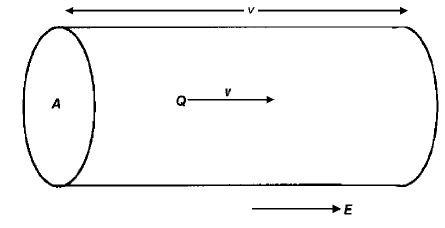
causing them to accelerate but, because of the interaction with the lattice owing
to thermal motion of the atoms or to defects, they quickly reach a terminal
velocity, referred to as their drift velocity
vvv. All the carriers contained in a prism
of cross section A, and length
v (Fig. 2.5) will move through its end face in unit
time. The current density j will therefore be given by
j ¼ nQ
vvv ð2:21Þ
If the drift velocity of the charges is proportional to the force acting on them,
then
vvv ¼ uE ð2:22Þ
where u is the mobility, which is defined as the magnitude of the drift velocity per
unit electric field E. It follows from Eqs (2.21) and (2.22) that
j ¼ nQuE ð2:23Þ
For materials for which nQu is constant at constant temperature, this is a
statement of Ohm’s law:
j ¼ sE ð2:24Þ
where
s ¼ nQu ð2:25Þ
is the conductivity of the material.
The resistivity r, like the conductivity, is a material property and the two are
related by
r ¼ 1=s ð2:26Þ
In practice it is often the conductive or resistive characteristics of a specimen of
uniform section A and length l which are relevant. The resistance R, conductance
G and specimen dimensions are related as follows:
ELECTRICAL CONDUCTION 25
Fig. 2.5 Flow of charge in a prism.
.
26 ELEMENTARY SOLID STATE SCIENCE
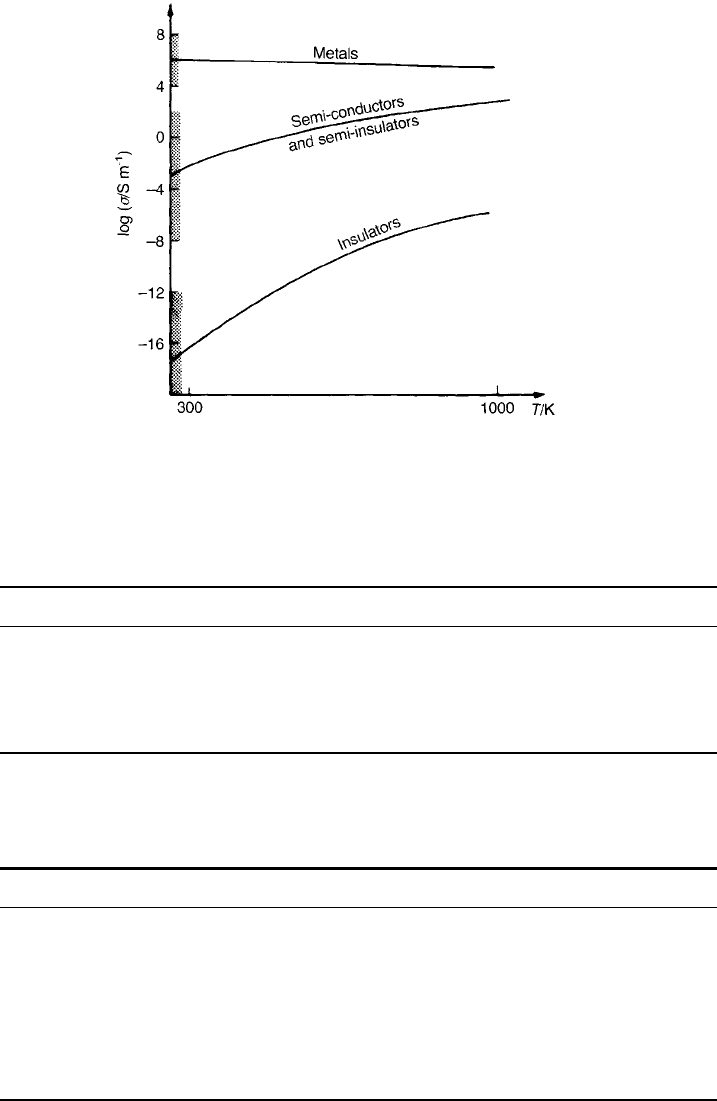
Fig. 2.6 Conductivities of the various classes of material: shading indicates the range of
values at room temperature.
Table 2.3 Conductivity characteristics of the various classes of material
Material class Example Conductivity level ds/dT Carrier type
Metals Ag, Cu High Small, negative Electrons
Semiconductors Si, Ge Intermediate Large, positive Electrons
Semi-insulators ZrO
2
Intermediate Large, positive Ions or electrons
Insulators Al
2
O
3
Very low Very large, positive Ions or electrons;
frequently ‘mixed’
Table 2.4 Electrical quantities introduced so far
Quantity Symbol Unit
Electric charge Q coulomb (C)
Electric field E volt per metre (Vm
1
)
Current density j ampere per square metre (Am
2
)
Mobility u drift velocity/electric field (m
2
V
1
s
1
)
Conductivity s siemen per metre (S m
1
)
Resistivity r reciprocal conductivity (O m)
Conductance G siemen (S)
Resistance R ohm (O)
R ¼ G
1
¼ rl=A
G ¼ R
1
¼ sA=l
ð2:27Þ
It should be emphasised that from Eq. (2.24) s is in general a tensor of the
second rank. Unless otherwise stated it will be assumed in the discussions that
follow that materials are isotropic, so that j and E are collinear and s is a scalar.
It follows from Eq. (2.25) that, to understand the behaviour of s for a given
material, it is necessary to enquire into what determines n, Q and u separately; in
particular, the variation of s with temperature T is determined by the manner in
which these quantities depend on T.
No reference has been made to the type of charge carrier and the equations
developed so far in no way depend upon this. However, the electrical behaviour
of solids depends very much on whether the charge carriers are electrons, ions or
a combination of both.
At this point it will be helpful to summarize the charge transport
characteristics of the various types of material so that those of the ceramics
can be seen in proper perspective. Figure 2.6 shows the room temperature values
of conductivity characteristic of the broad categories of material together with
typical dependencies of conductivity on temperature. What is immediately
striking is the large difference between the room temperature values of
conductivity for the metallic and insulating classes of material, which span
about 30 orders of magnitude.
Table 2.3, which should be considered in conjunction with Fig. 2.6, completes
the general picture. Table 2.4 summarizes the quantities introduced so far
together with the units in which they are measured.
In the following sections closer attention is given to the two principal
mechanisms whereby charge is transported in a solid, i.e. ‘electronic’ and ‘ionic’
conduction.
2.6.2 Electronic conduction
Band conduction
So far we have considered atoms in isolation and in their ground state. There
exist a large number of higher energy states into which electrons can be promoted
thermally or by interaction with external energy sources such as photons.
When a large number of atoms condense to form a crystal, quantum
mechanics dictates that the discrete sharply defined electron energy levels
associated with a free atom broaden into bands of discrete levels situated close
together in the energy spectrum. The multiplication of possible energy states as
atoms approach one another is shown diagrammatically in Fig. 2.7. In general
each band is separated by a ‘forbidden zone’ – a region in the energy spectrum
ELECTRICAL CONDUCTION 27
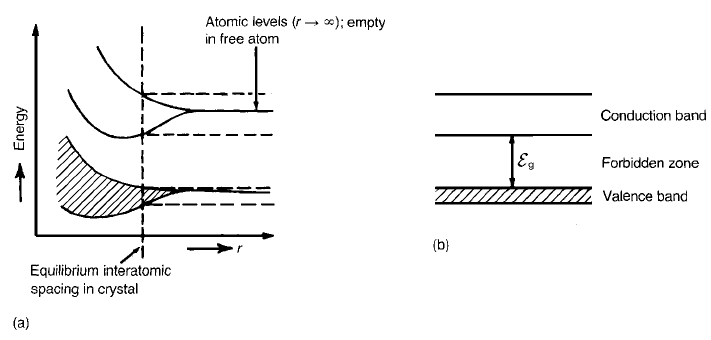
forbidden to electrons – although there are instances where the bands overlap.
The problem of determining the electronic properties of a solid becomes a matter
of finding the distribution of electrons among the available energy states making
up the bands, and this is achieved with the help of Fermi statistics. It turns out
that, at the absolute zero of temperature, some bands are completely filled with
electrons and some are completely empty. It is also possible for a band to be only
partly filled. Fortunately it is only bands associated with the outer electronic
shells, or valence electrons, which need be considered since the deeper core
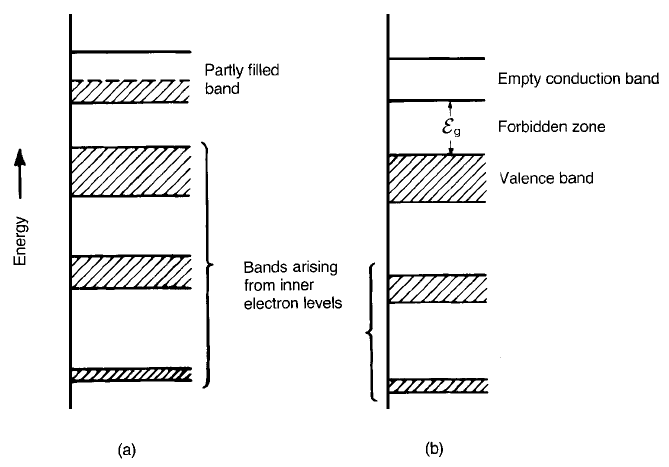
electrons play no part in the conduction process. The possible situations outlined
above are shown schematically in Fig. 2.8.
If an energy band is only partly filled the electron population is able to move
into the higher energy states available to it. Therefore in an electric field the
electrons are able to acquire additional kinetic energy and, as in the case of a
metal, a current will flow. However, if the band is full, then at zero temperature
the electrons cannot normally acquire energy from an electric field and so no
current flows. However, if the energy gap (e.g. Figs 2.7 and 2.8(b)) is not too
wide (say about 1 eV or 0.16 aJ), then at around room temperature (where
kT 0:025 eV) some electrons can be thermally excited across the gap into an
empty band where they can conduct. In addition to electrons excited into the so-
called ‘conduction band’, there are also empty electronic states in the previously
full ‘valence band’, allowing the valence electron population as a whole to accept
energy from the field. The description of this redistribution of energy in the
valence band is simply accomplished with the aid of the concept of the ‘positive
hole’; attention is then focused on the behaviour of the empty state – the positive
hole – rather than on that of the electron population as a whole. (This is
analogous to focusing attention on a rising air bubble in a liquid in preference to
the downwards motion of the water as a whole.)
28 ELEMENTARY SOLID STATE SCIENCE
Fig. 2.7 (a) Atomic levels having identical energies merging to a broad band of levels
differing slightly in energy as free atoms condense to form a crystal; (b) band structure at
equilibrium interatomic spacing in a crystal.
In metals the conduction band is partly filled with electrons derived from the
outer quantum levels of the atoms. The atoms become positive ions with the
remaining electrons in low energy states, e.g. as complete eight-electron shells in
the case of the alkaline and alkaline earth elements. Since the valence electrons
are in a partly filled band they can acquire kinetic energy from an electric field
which can therefore cause a current to flow. Conduction is not limited by paucity
of carriers but only by the interaction of the conducting electrons with the crystal
lattice. The thermal motion of the lattice increases with temperature and so
intensifies electron–phonon interactions and consequently reduces the conduc-
tivity. At temperatures above 100–200 8C the resistivity of most metals is
approximately proportional to the absolute temperature. Silver is the most
conductive metal with s ¼ 68 10
6
Sm
1
at 0 8C; manganese, one of the least
conductive, has s ¼ 72 10
4
Sm
1
. Magnetite (Fe
3
O
4
) is one of the most
conductive oxides with s 10
4
Sm
1
, but it does not have the positive
temperature coefficient of resistivity typical of metals.
In covalently bonded non-polar semiconductors the higher levels of the
valence band are formed by electrons that are shared between neighbouring
atoms and which have ground state energy levels similar to those in isolated
atoms. In silicon, for instance, each silicon atom has four sp
3
electrons which it
shares with four similar atoms at the corners of a surrounding tetrahedron. As a
result each silicon atom has, effectively, an outer shell of eight electrons. The
ELECTRICAL CONDUCTION 29
Fig. 2.8 Schematic electron energy band structures for (a) a metallic crystal and (b) a
semiconducting or insulating crystal.

energy states that constitute the silicon conduction band are derived from the
higher excited states of the silicon atoms but relate to motion of the electrons
throughout the crystal. This contrasts with the organic molecular crystals in
which all the electrons remain bound within individual molecules and are only
transferred from one molecule to another under exceptional conditions.
Magnesium oxide can be regarded as typical of an ionic solid. In this case the
valence electrons attached to anions have minimal interactions with the electrons
attached to the cations. The energy states that constitute the conduction band are
derived from the higher excited 3s state of the magnesium atoms; the valence
band is derived from the 2p states of the oxygen atoms. An energy diagram of the
form shown in Fig. 2.8(b) is applicable for both covalent and ionic crystals.
If the temperature dependence of the electronic conductivity of a semi-
conductor is to be accounted for, it is necessary to analyse how the density of
charge carriers and their mobilities each depend upon T (see Eq. (2.25)). In the
first place attention will be confined to the density n of electrons in the conduction
band and the density p of ‘holes’ in the valence band. When the ‘intrinsic’
properties of the crystal are under consideration, rather than effects arising from
impurities or, in the case of compounds, from departures from stoichiometry, the
corresponding conductivity is referred to as ‘intrinsic conductivity’. The approach
to the calculation of n and p in this instance is as follows.
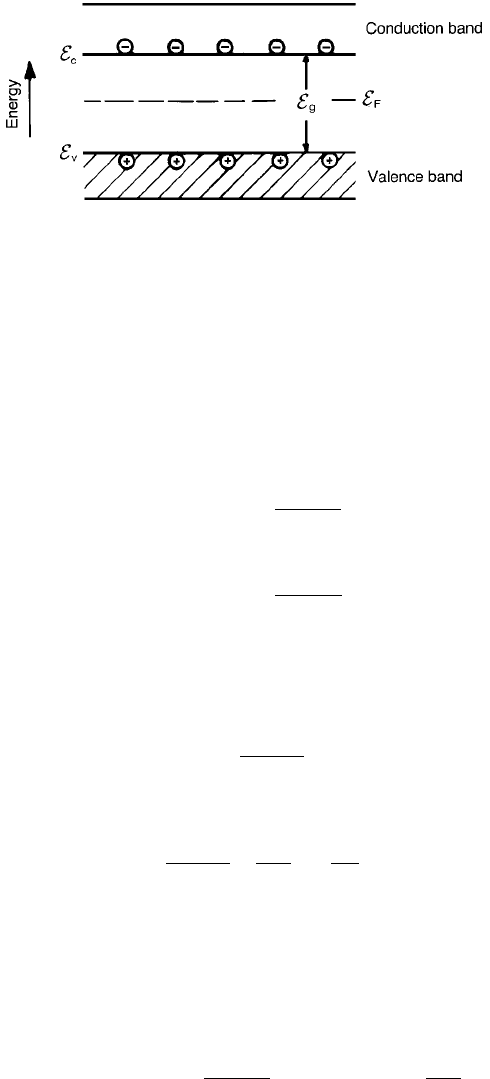
Figure 2.9 illustrates the situation in which a small fraction of the valence
electrons in an intrinsic semiconductor have been thermally excited into the
conduction band, with the system in thermal equilibrium. Since the only source
of electrons is the valence band p
i
¼ n
i
, where the subscript indicates intrinsic.
Formally, the electron density in the conduction band can be written
n
i
¼
ð
E
top
E
c
ZðEÞFðEÞdEð2:28Þ
in which ZðEÞdE represents the total number of states in the energy range dE
around E per unit volume of the solid, and the Fermi–Dirac function FðEÞ
represents the fraction of states occupied by an electron. FðEÞ has the form
FðEÞ ¼ exp
EE
F
kT
þ 1
1
ð2:29Þ
where E
F
is the Fermi energy, which is a characteristic of the particular system
under consideration.
The evaluation of n
i
is readily accomplished under certain simplifying
assumptions. The first is that EE
F
kT, which is often the case since kT is
approximately 0.025 eV at room temperature and EE
F
is commonly greater
than 0.2 eV. If this condition is met the term þ1 can be omitted from Eq. (2.29);
if it is not met then the electron distribution is said to be degenerate and the full
Fermi function must be used. The second assumption is that the excited electrons
30 ELEMENTARY SOLID STATE SCIENCE
and holes occupy states near the bottom of the conduction band and the top of
the valence band respectively. Under these circumstances the electrons and holes
behave as free particles for which the state distribution function is known.
Thirdly, the upper limit of the integration in Eq. (2.28) is taken as infinity since
the probability of occupancy of a state by an electron rapidly approaches zero as
the energy increases through the band. Under these assumptions it is readily
shown that
n
i
¼ N
c
exp
E
c
E
F
kT
ð2:30Þ
p
i
¼ N
v
exp
E
F
E
v
kT
ð2:31Þ
The form of Eqs (2.30) and (2.31) suggests that N
c
and N
v
are effective state
densities for electrons in the conduction band and holes in the valence band
respectively. It turns out that N
c
N
v
10
25
m
3
. If we put n
i
¼ p
i
,
E
F
E
c
þE
v
2
ð2:32Þ
A more rigorous treatment shows that
E
F
¼
E
c
þE
v
2
þ
3kT
4
ln
m
e
*
m
h
*
ð2:33Þ
in which m
e
* and m
h
* are respectively the effective electron and hole masses. The
electrons and holes move in the periodic potential of the crystal as though they
are charged particles with masses which can differ markedly from the free
electron mass m
e
. Under conditions in which m
e
* m
h
*, E
F
is approximately at
the centre of the band gap. Therefore it follows that
n
i
¼ p
i
10
25
exp
E
c
E
F
kT
10
25
exp
E
g
2kT
ð2:34Þ
ELECTRICAL CONDUCTION 31
Fig. 2.9 Band structure with electrons promoted from the valence to the conduction band.