
Moulson A.J., Herbert J.M. Electroceramics: Materials, Properties, Applications
Подождите немного. Документ загружается.

12 ELEMENTARY SOLID STATE SCIENCE
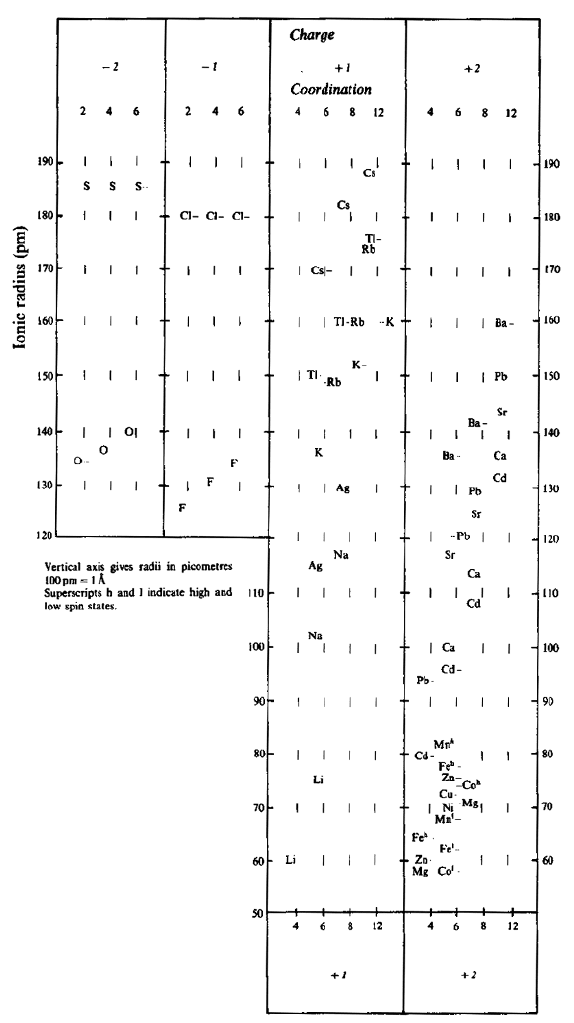
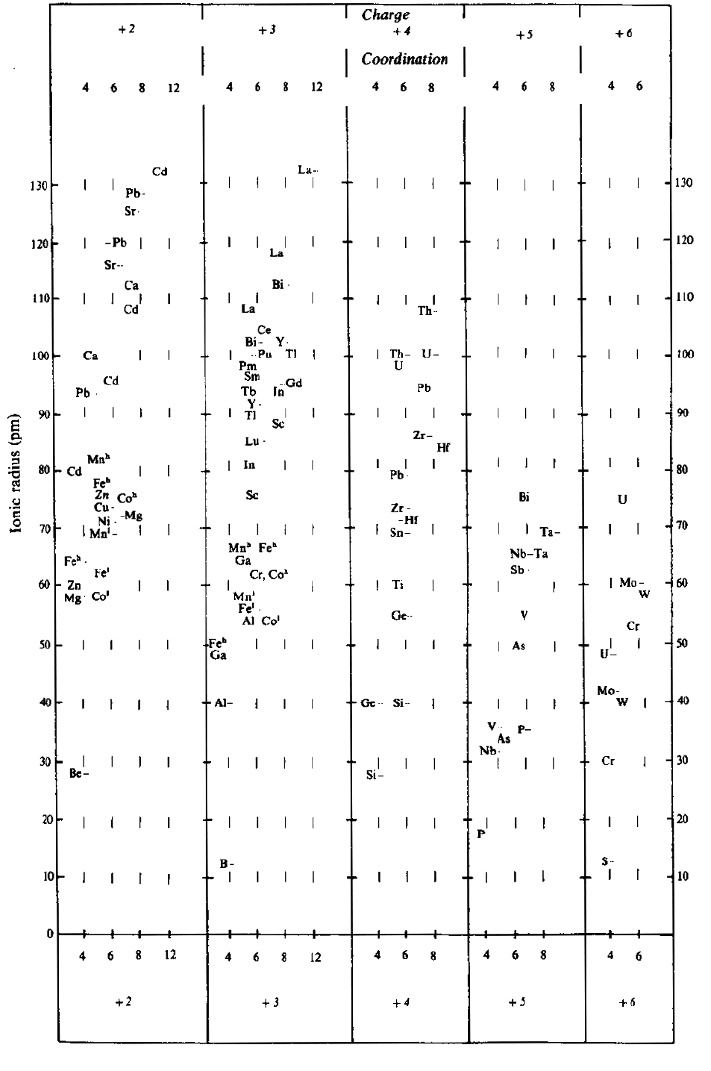
Table 2.2 Ionic radii
TEAMFLY
Team-Fly
®
THE ARRANGEMENT OF IONS IN CERAMICS 13
The structure of oxides can be visualized as based on ordered arrays of O
2
ions in which cations either replace O
2
ions or occupy interstices between them.
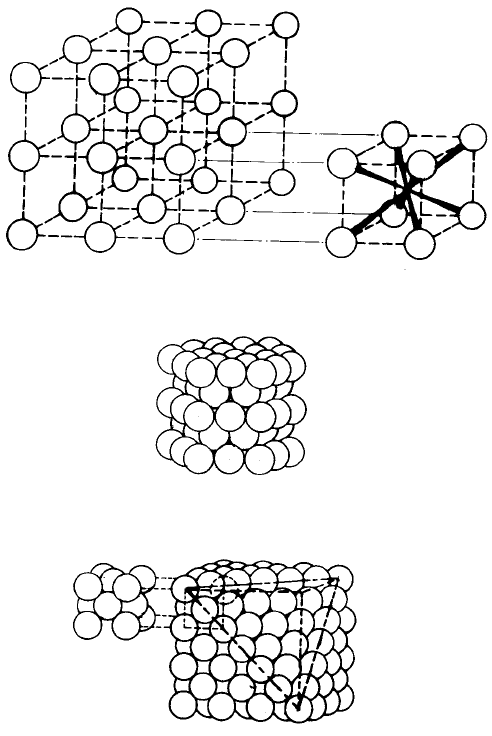
In simple cubic packing (Fig. 2.1(a)) the centres of the ions lie at the corners of
cubes formed by eight ions. In the case of O
2
ions with r
6
¼ 140 pm in contact
with one another the interstice would accommodate a cation of radius 103 pm.
Such a structure is found for ThO
2
and ZrO
2
.Th
4þ
has r
8
¼ 106 pm, indicating
that O
2
must be slightly separated, whilst Zr
4þ
has r
8
¼ 84 pm. It is generally
found that anion lattices will accommodate oversize cations more readily than
undersize cations so that the tolerance to the relatively small Zr
4þ
ion is
exceptional; in fact it is only sustained by a distortion from the simple cubic form
that reduces the coordination of Zr
4þ
to approximately 7. The general tolerance
to oversize ions is understandable on the basis that the resulting increase in
distance between the anions reduces the electrostatic energy due to the repulsive
force between like charges.
The oxygen ions are more closely packed together in the close-packed
hexagonal and cubic structures (Fig. 2.1(b and c)). These structures are identical
as far as any two adjacent layers are concerned but a third layer can be added in
two ways, either with the ions vertically above the bottom layer (hexagonal close
packing) or with them displaced relative to both the lower layers (cubic close
packing). Thus the layer sequence can be defined as ab, ab, . . . etc. in the
hexagonal case and as abc, abc, . . . etc. in the cubic case. Both close-packed
structures contain the same two types of interstice, namely octahedral
surrounded by six anions and tetrahedral surrounded by four anions. The ratios
of interstice radius to anion radius are 0.414 and 0.225 in the octahedral and
tetrahedral cases, so that in the case of O
2
lattices the radii of the two interstices
are 58 pm and 32 pm. It can be seen that most of the ions below 32 pm in radius
are tetrahedrally coordinated in oxide compounds but there is a considerable
covalent character in their bonding, e.g. ðSO
4
Þ
2
, ðPO
4
Þ
3
and ðSiO
4
Þ
4
in
sulphates, phosphates and silicates.
In many of the monoxides, such as MgO, NiO etc., the cations occupy all the
octahedral sites in somewhat expanded close-packed cubic arrays of O
2
ions. In
the dioxides TiO
2
, SnO
2
and MnO
2
the cations occupy half the octahedral sites in
hexagonal close-packed O
2
arrays. In corundum (Al
2
O
3
) the O
2
ions are in
hexagonal close packing with cations occupying two-thirds of the octahedral
sites. In spinel (MgAl
2
O
4
) the O
2
ions form a cubic close-packed array with
Mg
2
ions occupying an eighth of the tetrahedral sites and Al
3þ
ions occupying
half of the octahedral interstices. NiFe
2
O
4
has a similar structure but half the
Fe
3þ
ions occupy tetrahedral sites while the other half and the Ni
2þ
ions occupy
octahedral sites. This is known as an inverse spinel structure.
In perovskite (CaTiO
3
) and its isomorphs such as BaTiO
3
, the large alkaline
earth ions replace O
2
ions in the anion lattice and the Ti
4þ
ions occupy all the
octahedral interstices that are surrounded only by O
2
ions, i.e. no Ti
4þ
ions are
immediately adjacent to divalent cations.
14 ELEMENTARY SOLID STATE SCIENCE
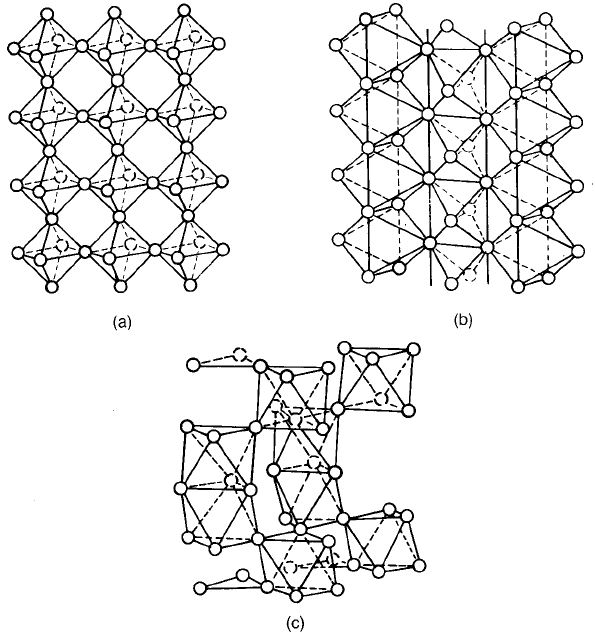
In many cases the arrangement of structural units gives a more enlightening
view of crystals than do considerations based on close packing. Thus perovskite-
type crystals can be viewed as consisting of a simple cubic array of corner-
sharing octahedral MO
6
groups with all the interstices filled by divalent ions
(Fig. 2.2(a)). On this basis the rutile form of TiO
2
consists of columns of edge-
sharing TiO
6
octahedra linked by shared corners of the TiO
6
units (Fig. 2.2(b)).
A hexagonal form of BaTiO
3
, where the BaO
3
lattice is hexagonal close packed,
contains layers of two face-sharing TiO
6
groups linked by single layers of corner-
sharing TiO
6
groups (Fig. 2.2(c)).
THE ARRANGEMENT OF IONS IN CERAMICS 15
Fig. 2.1 Packing of ions: (a) simple cubic packing showing an interstice with eightfold
coordination; (b) hexagonal close packing; (c) cubic close packing showing a face-centred
cubic cell.
(a)
(b)
(c)
The ionic radius concept is useful in deciding which ions are likely to be
accommodated in a given lattice. It is usually safe to assume that ions of similar
size and the same charge will replace one another without any change other than
in the size of the unit cell of the parent compound. Limitations arise because
there is always some exchange interaction between the electrons of neighbouring
ions.
In the case of the crystalline silicates an approach which takes account of the
partly covalent character of the Si–O bond is helpful. The ½SiO
4
4
tetrahedron is
taken as a basic building unit, and in most of the silicates these tetrahedra are
linked together in an ordered fashion to form strings as in diopside
(MgCaðSiO
3
Þ
2
), sheet structures as in clay minerals, or three-dimensional
frameworks as in quartz and the feldspars. Within these frameworks isomorphic
replacement of one cation type for another is extensive. For example, the
replacement of Si
4þ
by Al
3þ
is common, with the necessary lattice charge balance
being maintained either by the incorporation of interstitial cations such as Na
þ
16 ELEMENTARY SOLID STATE SCIENCE
Fig. 2.2 MO
6
octahedra arrangements in (a) perovskite-type structures, (b) TiO
2
and (c)
hexagonal BaTiO
3
.
and K
þ
, as in the case of the feldspars, or by ‘exchangeable’ cations such as Ca
2þ
,
which are a feature of clays. The exchangeable ions are held on the surfaces of
the small (typically 10
6
m) clay particles and can be easily exchanged for other
ions.
Silicates readily form glasses which are vitreous materials in which the atoms
do not have the long-range order characteristic of the crystalline state. Thus
vitreous silica consists of a three-dimensional network of (SiO
4
Þ
4
tetrahedra
joined at their corners, in which the Si–O–Si bond angles vary randomly
throughout the structure. Alkali and alkaline earth ions can be introduced into
silica in variable amounts, up to a certain limit, without a crystalline phase
forming. One effect of these ions is to cause breaks in the Si–O–Si network
according to the following reaction:
n
n
n
n
—Si—O—Si— þNa
2
O ! 2Na
þ
þ—Si—O
þ O
—Si—
n
n
n
n
Although there are important exceptions, a characteristic feature of the
crystalline state is that compositions are stoichiometric, i.e. the various types of
ion are present in numbers which bear simple ratios one to the other. In contrast,
glass compositions are not thus restricted, the only requirement being overall
electrical neutrality.
Vitreous materials do not have the planes of easy cleavage which are a feature
of crystals, and they do not have well-defined melting points because of the
variable bond strengths that result from lack of long-range order.
A wide variety of substances, including some metals, can be prepared in the
vitreous state by cooling their liquid phases very rapidly to a low temperature. In
many cases the glasses so formed are unstable and can be converted to the
crystalline state by annealing at a moderate temperature. An important class of
material, the ‘glass-ceramics’, can be prepared by annealing a silicate glass of
suitable composition so that a large fraction of it becomes crystalline. Strong
materials with good thermal shock resistance can be prepared by this method.
2.3 Spontaneous Polarization
In general, because the value of a crystal property depends on the direction of
measurement, the crystal is described as anisotropic with respect to that
property. There are exceptions; for example, crystals having cubic symmetry are
optically isotropic although they are anisotropic with respect to elasticity. For
these reasons, a description of the physical behaviour of a material has to be
based on a knowledge of crystal structure. Full descriptions of crystal systems
are available in many texts and here we shall note only those aspects of particular
SPONTANEOUS POLARIZATION 17

relevance to piezoelectric, pyroelectric and electro-optical ceramics. The
monograph by R.E. Newnham [3] is recommended for further study.
For the present purpose it is only necessary to distinguish polar crystals, i.e.
those that are spontaneously polarized and so possess a unique polar axis, from
the non-polar variety. Of the 32 crystal classes, 11 are centrosymmetric and
consequently, non-piezoelectric. Of the remaining 21 non-centrosymmetric
classes, 20 are piezoelectric and of these 10 are polar. An idea of the distinction
between polar and non-polar structures can be gained from Fig. 2.3 and
Eqs (2.70) and (2.71).
The piezoelectric crystals are those that become polarized or undergo a change
in polarization when they are stressed; conversely, when an electric field is
applied they become strained. The 10 polar crystal types are pyroelectric as well
as piezoelectric because of the polarization inherent in their structure. In a
pyroelectric crystal a change in temperature produces a change in polarization.
A limited number of pyroelectric materials have the additional property that
the direction of the polarization can be changed by an applied electric field or
mechanical stress. Where the change is primarily due to an electric field the
material is said to be ferroelectric; when it is primarily due to a stress it is said to
be ferroelastic. These additional features of a pyroelectric material cannot be
predicted from crystal structure and have to be established by experiment.
Because a ceramic is composed of a large number of randomly oriented
crystallites it would normally be expected to be isotropic in its properties. The
possibility of altering the direction of the polarization in the crystallites of a
ferroelectric ceramic (a process called ‘poling’) makes it capable of piezoelectric,
pyroelectric and electro-optic behaviour. The poling process – the application of
a static electric field under appropriate conditions of temperature and time –
aligns the polar axis as near to the field direction as the local environment and
the crystal structure allow.
The changes in direction of the polarization require small ionic movements in
specific crystallographic directions. It follows that the greater is the number of
possible directions the more closely the polar axes of the crystallite in a ceramic
can be brought to the direction of the poling field. The tetragonal (4mm)
structure allows six directions, while the rhombohedral (3m) allows eight and so
should permit greater alignment. If both tetragonal and rhombohedral
18 ELEMENTARY SOLID STATE SCIENCE
Fig. 2.3 (a) Non-polar array; (b), (c) polar arrays. The arrows indicate the direction of
spontaneous polarization P
s
.

crystallites are present at a transition point, where they can be transformed from
one to the other by a field, the number of alternative crystallographic directions
rises to 14 and the extra alignment attained becomes of practical significance (cf.
Section 6.3.1).
2.4 Phase Transitions
Effective ionic sizes and the forces that govern the arrangement of ions in a
crystal are both temperature dependent and may change sufficiently for a
particular structure to become unstable and to transform to a new one. The
temperature at which both forms are in equilibrium is called a transition
temperature. Although only small ionic movements are involved, there may be
marked changes in properties. Crystal dimensions alter and result in internal
stresses, particularly at the crystallite boundaries in a ceramic. These may be
large enough to result in internal cracks and a reduction in strength. Electrical
conductivity may change by several orders of magnitude. In some respects crystal
structure transitions are similar to the more familiar phase transitions, melting,
vaporization and sublimation when, with the temperature and pressure constant,
there are changes in entropy and volume.
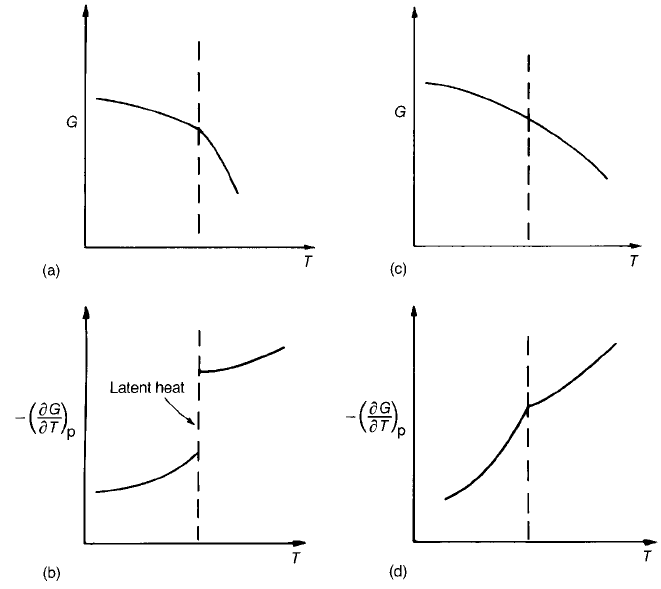
If a system is described in terms of the Gibbs function G then a change in G
can be written
dG ¼SdT þ Vdp ð2:10Þ
where S, V and P are respectively entropy, volume and pressure. During an
isothermal structural change G is continuous, but there may be discontinuities in
the derivatives of G. It follows from Eq. (2.10) that
S ¼
@G
@T
p
ð2:11Þ
and so if there is a discontinuity in the first derivative of G(T) there is a change in
entropy at constant temperature, which implies latent heat. This is a
characteristic of a ‘first-order’ transition. A ‘second-order’ transition occurs
when the first derivative of the Gibbs function is continuous but the second
derivative is discontinuous. The definitions are illustrated in Fig. 2.4.
An important transition which will be discussed later is that between the
ferroelectric and paraelectric states which involves changes in crystal symmetry.
In the case of magnetic materials the transition between the spontaneously
magnetized and magnetically disordered states that occurs at the Curie or Ne
´
el
temperatures does not involve changes in crystal structure but only small
dimensional changes that result from changes in the coupling forces between the
outer electrons of neighbouring magnetic ions.
PHASE TRANSITIONS 19
2.5 Defects in Crystals
Early chemists believed that inorganic compounds obeyed the law of definite
proportions under which they had invariable compositions determined by the
valence of the constituent atoms. From the early part of the twentieth century
views began to change when many compounds were found experimentally to be
non-stoichiometric, and theoretical predictions by Wagner and Schottky
demonstrated that exact stoichiometric compositions are the exception rather
than the rule. The literature contains many treatments of the topic; the text by
D.M. Smyth [4] is recommended.
2.5.1 Non-stoichiometry
The ratio between anions and cations can vary from a simple integral value
because of the variable valence of a cation. Thus manganese dioxide is a
20 ELEMENTARY SOLID STATE SCIENCE
Fig. 2.4 Free-energy changes at transitions: (a) first-order transition; (b) change in S at
constant T and, consequently, latent heat; (c) second-order transition; (d) continuous change
in entropy and so no latent heat (discontinuity in @
2
G=@T
2
).
well-established compound but it always contains less than the stoichiometric
amount of oxygen. Iron monoxide, however, always contains an excess of
oxygen. Such deviations can be accounted for by the presence of Mn
3þ
in the first
case and Fe
3þ
in the second case. The positive charge deficiency in the first case
can be balanced by vacant oxygen sites, and the charge excess in the second case
can be balanced by cation vacancies.
Where there are two species of cation present in a compound the ratio between
them may vary. This occurs in LiNbO
3
which has a structure based on face-
sharing MO
6
octahedra. The O
2
ions are hexagonally close packed with a third
of the octahedral sites occupied by Nb
5þ
, a third by Li
þ
and a third empty. This
compound can be deficient in lithium down to the level Li
0:94
Nb
1:012
O
3
. There is
no corresponding creation of oxygen vacancies; instead the Nb
5þ
content
increases sufficiently to preserve neutrality. The withdrawal of five Li
þ
ions is
compensated by the introduction of one Nb
5þ
ion and so leaves four additional
electrically neutral empty octahedral sites. LiNbO
3
can only tolerate a very small
excess of lithium (see Section 6.4.5). The LiNbO
3
type of non-stoichiometry can
be expressed as limited solid solubility; it could be said that LiNbO
3
and Nb
2
O
5
form solid solutions containing up to 3.8 mol.% Nb
2
O
5
.
In most compounds containing two cation types some variability in
composition is possible. This varies from less than 0.1% in compounds such
as BaTiO
3
, in which there is a marked difference in charge and size between the
two cations corresponding to differences between their lattice sites, to complete
solid solutions over the whole possible range where the ions are identical in
charge and close in size and can only occupy one type of available lattice site
such as, for instance, Zr
4þ
and Ti
4þ
in PbðZr
x
Ti
1x
ÞO
3
.
2.5.2 Point defects
Crystals contain two major categories of defect: ‘point’ defects and ‘line’ defects.
Point defects occur where atoms are missing (vacancies) or occupy the interstices
between normal sites (interstitials); ‘foreign’ atoms are also point defects. Line
defects, or dislocations, are spatially extensive and involve disturbance of the
periodicity of the lattice.
Although dislocations have a significant effect on some of the important
properties of electroceramics, especially those depending on matter transport,
our understanding of them is, at best, qualitative. In contrast, there is a sound
basis for understanding the effects of point defects and the relevant literature is
extensive. It is for these reasons that the following discussion is confined to point
defects and, because of the context, to those occurring in oxides.
Schottky defects, named after W. Schottky, consist of unoccupied anion and
cation sites. A stoichiometric crystalline oxide having Schottky disorder alone
contains charge-equivalent numbers of anion and cation vacancies. A Frenkel
DEFECTS IN CRYSTALS 21