
Moulson A.J., Herbert J.M. Electroceramics: Materials, Properties, Applications
Подождите немного. Документ загружается.

From Eq. (2.25) the conductivity can be written
s ¼ nu
e
e þ pu
h
e ð2:35Þ
in which u
e
and u
h
are the electron and hole mobilities respectively and e is the
electronic charge. Therefore
s ¼ n
i
eðu
e
þ u
h
Þ
10
25
eðu
e
þ u
h
Þexp
E
g
2kT
ð2:36Þ
Both theory and experiment show a temperature dependence for u lying typically
in the range T
1:5
–T
2:5
, which is so weak compared with that for n (and p) that
for most purposes it can be ignored. Therefore the conductivity is written
s ¼ Bexp
E
g
2kT
ð2:37Þ
It is usual to show sðTÞ data as a plot of log s versus T
1
– the Arrhenius plot –
where the slope of the straight line is proportional to the band gap.
The theory outlined above was developed for group IV semiconducting
elements such as silicon and germanium; some of the compounds of group III
and V elements, the III–V compounds, are also covalently bonded and have
similar electrical properties which can be described in terms of a band model.
The best known semiconducting III–V compound is GaAs, which is exploited for
both its photonic and semiconducting properties.
The same model can be applied to an ionic solid. In this case, for the example
of MgO, Fig. 2.9 represents the transfer of electrons from anions to cations
resulting in an electron in the conduction band derived from the Mg
2þ
3s states
and a hole in the valence band derived from the 2p states of the O
2
ion. Because
the width of the energy gap is estimated to be approximately 8 eV, the
concentration of thermally excited electrons in the conduction band of MgO is
low at temperatures up to its melting point at 2800 8C. It is therefore an excellent
high-temperature insulator.
Apart from the wider band gaps, electrons and holes in ionic solids have
mobilities several orders lower than those in the covalent semiconductors. This is
due to the variation in potential that a carrier experiences in an ionic lattice.
The e¡ect of dopants
The addition of small quantities of impurity atoms to a semiconductor has a
dramatic effect on conductivity. It is, of course, such extrinsic effects that are the
basis on which silicon semiconductor technology has developed. Their origins
can be understood by considering a silicon crystal in which a small fraction of the
32 ELEMENTARY SOLID STATE SCIENCE
TEAMFLY
Team-Fly
®
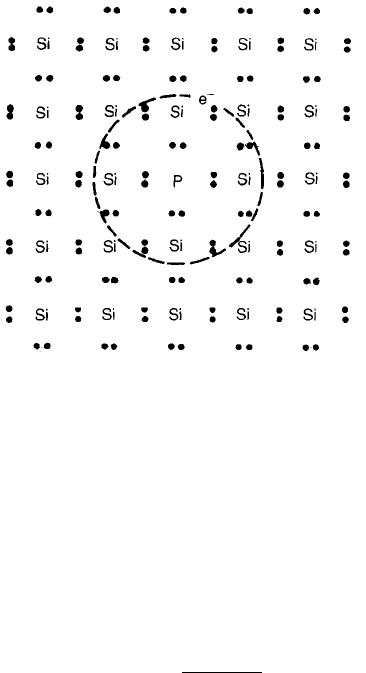
Si atoms is replaced by, say, P atoms. A P atom has five valence electrons of
which only four are required to form the four electron-pair bonds with
neighbouring Si atoms. The ‘extra’ electron is not as strongly bound as the others
and an estimate of its binding energy can be arrived at as follows. The electron
can be regarded as bound to an effective single positive charge (þe), which is the
P
5þ
ion on a Si
4þ
lattice site, as shown in Fig. 2.10. The configuration therefore
resembles a hydrogen atom for which the ground state (n ¼ 1) energy is
E¼
m
e
e
4
32p
2
e
2
0
h
2
ð2:38Þ
and has a value of about 13.5 eV (see Eq. (2.6)).
In the case when the electron is bound to the P
5þ
ion, Eq. (2.38) needs
modifying to take account of the relative permittivity of the material separating
the two charges. For a crude approximation the relative permittivity of bulk
silicon (about 12) is used, leading to an ionization energy of approximately
0.09 eV. Another modification is necessary to allow for the effective mass of the
electron being approximately 0:2 m
e
, further reducing the estimate of the
ionization energy E
i
to about 0.01 eV, a value consistent with experiment. The
doping of silicon with phosphorus therefore leads to the introduction of localized
donor states about 0.01 eV below the conduction band, as shown in Fig. 2.11,
and to n-type semiconductivity.
The addition of a trivalent atom (e.g. boron) to silicon leads to an empty
electron state, or positive hole, which can be ionized from the effective single
negative charge e on the B atom. The ionization energy is again about 0.01 eV,
as might be expected. Therefore the doping of silicon with boron leads to the
ELECTRICAL CONDUCTION 33
Fig. 2.10 Planar representation of a silicon crystal doped with P
5þ
giving rise to a P
Si
defect.
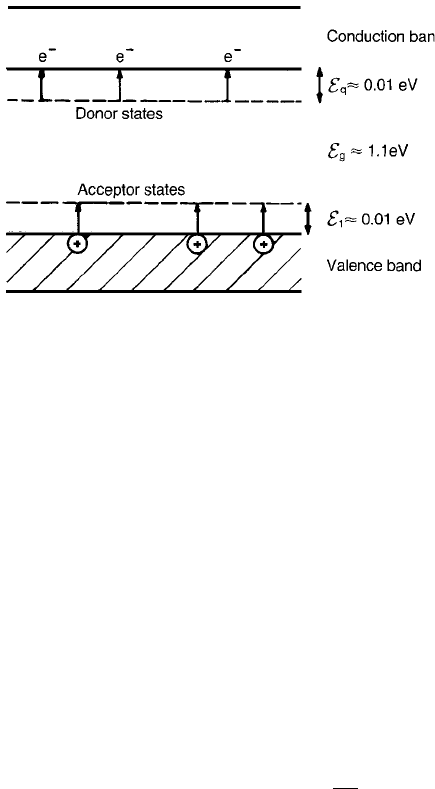
introduction of acceptor states about 0.01 eV above the top of the valence band,
as shown in Fig. 2.11, and to p-type semiconductivity. In the case of n- or p-type
semiconductivity the temperature dependence of the conductivity is similar to
that in Eq. (2.37) with E
g
replaced by E
i
.
In practice, doping concentrations in silicon technology range from 1 in 10
9
to
1in10
3
; B and Al are the usual acceptor atoms and P, As and Sb the usual donor
atoms, the choice depending on the particular function that the doped silicon has
to perform.
Because of doping n 6¼ p, but the equilibrium relation
e
0
þ h
.
Ð nil ð2:39Þ
still holds, where ‘nil’ indicates a perfect crystal with all electrons in their lowest
energy states. From Eq. (2.39) it follows that
½e
0
½h
.
¼np ¼ KðTÞ¼K
0
exp
E
g
kT
ð2:40Þ
where E
g
is the band gap (at 0K) and K
0
is independent of temperature.
Semiconductivity in oxides
The discussion draws on the extensive studies by Philips’ researchers [7] and [8]
and by D.M. Smyth and co-workers [4]. Several cases of oxide systems in which
the conductivity is controlled by the substitution of aliovalent cations are given
in Chapter 4. For instance, Sb
5þ
can replace Sn
4þ
in SnO
2
and be compensated
by an electron in the conduction band conferring n-type conductivity (see Section
4.1.4). However, models for oxide systems are generally more complex than for
34 ELEMENTARY SOLID STATE SCIENCE
Fig. 2.11 Effect of n- and p-type doping on the band structure of a semiconductor (e.g.
silicon).
silicon and have been studied far less intensively. An important limitation to
present research is the non-availability of oxides that approach the parts in 10
9
purity of available silicon crystals. The term ‘high purity’ applied to oxides
usually implies less than 1 in 10
4
atoms of impurities which consist mainly of the
more generally abundant elements magnesium, aluminium, silicon, phosphorus,
calcium and iron, and a much smaller content of the less abundant elements such
as niobium, tantalum, cerium, lanthanum etc. The bulk of the predominant
impurities in BaTiO
3
are cations such as Mg
2þ
,Al
3þ
,Fe
3þ
and Ca
2þ
that form
acceptors when substituted on Ti
4þ
sites. The resulting deficit in charge is
compensated by oxygen vacancies which may therefore be present in concentra-
tions of order 1 in 10
4
, a far greater concentration than would be expected from
Schottky defects in intrinsic material (cf. Section 2.5.2).
One consequence of the high impurity levels is the use of high dopant
concentrations to control the behaviour of oxides. The dopant level is seldom
below 1 in 10
3
moles and may be as high as 1 in 10 moles so that defects may
interact with one another to a far greater extent than in the covalent
semiconductors silicon, GaAs etc.
The study of semiconduction in oxides has necessarily been carried out at high
temperatures (4500 8C) because of the difficulties of making measurements
when they have become highly resistive at room temperature. However, the form
and magnitude of conductivity at room temperature will depend on the
difference in energy between the sources of the electronic current carriers from
the conduction and valence bands. Thus while n- and p-type conduction can be
observed in BaTiO
3
at high temperatures, p-type BaTiO
3
is a good insulator at
room temperature whereas n-type is often conductive. The cause lies in the
structures of the orbital electrons in Ti
4þ
and O
2
which correspond to those of
the inert elements argon and neon. The transfer of an electron from the stable
valence bands of the ions to a defect requires energy of over 1 eV, which is
available only at high temperatures. Recombination occurs at room temperature
and only a very low level of p-type conductivity remains. However, the Ti
4þ
ion
possesses empty 3d orbitals from which a conduction band is derived which
allows occupancy by electrons transferred from defects at low energy levels so
that appreciable n-type conductivity can persist at room temperature.
There are also oxides in which p-type conduction persists at lower
temperatures than n-type does. For instance, Cr
4þ
in LaCrO
3
has two electrons
in its d levels and one of these can be promoted with a relatively small
expenditure of energy to give p-type conduction. The addition of an electron to
the d levels requires greater energy so that n-type material is less conductive than
p-type at room temperature.
BaTiO
3
: the effects of oxygen pressure One of the most important features
of oxide semiconductors is the effect on their behaviour of the external oxygen
pressure. This has only been examined at high temperatures because the
ELECTRICAL CONDUCTION 35
establishment of equilibrium at low temperatures is very slow. It will be discussed
here for the case of BaTiO
3
with acceptor and donor substituents since this is one
of the most important systems in terms of applications and so has been well
researched (see Section 5.6.1 for discussion of TiO
2
).
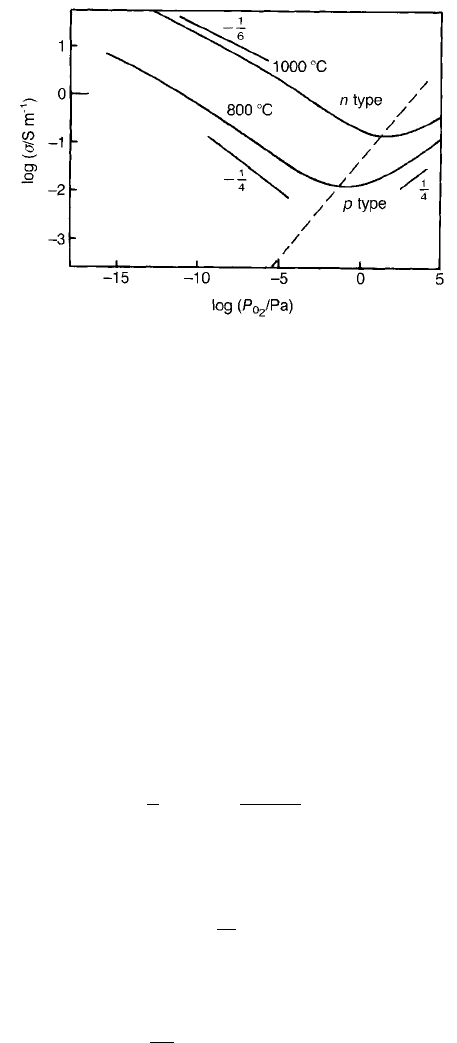
Figure 2.12 shows the electrical conductivity of BaTiO
3
containing only
dopants, predominantly acceptors present as natural impurities, as a function of
oxygen pressure p
O
2
at high temperatures. The conductivity is n type at low p
O
2
and p type at high p
O
2
. The general shape of the curves in Fig. 2.12 can be
explained under the assumption that the observed conductivity is determined by
the electron and hole concentrations, and that the electron and hole mobilities
are independent of p
O
2
. Under these assumptions information concerning the
relative concentrations of electrons and holes under given conditions and an
estimate of KðTÞ can be arrived at as follows.
Combining Eqs (2.35) and (2.40) leads to
s
e
¼ u
e
n þ
u
h
KðTÞ
n
ð2:41Þ
It follows from differentiating Eq. (2.41) that the value n
m
of n corresponding to
a minimum s
m
in s is given by
n
2
m
¼
u
h
u
e
KðTÞð2:42Þ
which, on substituting in Eq. (2.41), gives
s
m
e
2
¼ 4u
e
u
h
KðTÞð2:43Þ
Combining Eqs (2.35) and (2.43) gives
36 ELEMENTARY SOLID STATE SCIENCE
Fig. 2.12 Conductivity of undoped BaTiO
3
as a function of p
O
2
and T (adapted from Smyth
[4]).

s
s
m
¼
1 þ a
2a
1=2
ð2:44Þ
where a ¼ u
h
p=u
e
n.
Eq. (2.44) enables the relative contributions of electrons and holes to the
conductivity to be estimated from the ratio of the conductivity to its minimum
value, without having to determine KðTÞ. In estimating s and s
m
an allowance
must be made for contributions from current carriers other than e
0
and h
.
, such
as V
..
O
.
It can be seen from Eq. (2.44) that, when s ¼ s
m
, a ¼ 1 and
u
h
p
m
¼ u
e
n
m
ð2:45Þ
It is also clear from Eq. (2.41) that when n is large
s
e
e
¼ u
e
n ð2:46Þ
and, using Eq. (2.40), that when p is large
s
h
e
¼ u
h
p ð2:47Þ
Eq. (2.43) shows that KðTÞ can be estimated from the minima in the conductivity
isotherms and a knowledge of the mobilities. u
e
has been estimated to be
0:808T
3=2
expðE
u
=kTÞ m
2
V
1
s
1
, where E
u
¼ 2:02 kJ mol
1
(0.021 eV). This
gives u
e
¼ 15 10
6
m
2
V
1
s
1
at 1000 8C and 24 10
6
m
2
V
1
s
1
at 600 8C.
There are few data on u
h
but it is likely to be about 0:5u
e
:
The further analysis of the dependence of s on p
O
2
for BaTiO
3
is mainly based
on work by Smyth [4]. It is assumed that the conductive behaviour is controlled
by the equilibrium between p
O
2
,V
..
O
, n, p and cation vacancies, most probably
V
Ti
@@ rather than V
Ba
@ . All the vacancies are assumed to be fully ionized at high
temperatures. Under these assumptions, a schematic diagram of the dependence
of [V
..
O
], [V
Ti
@@], n and p on p
O
2
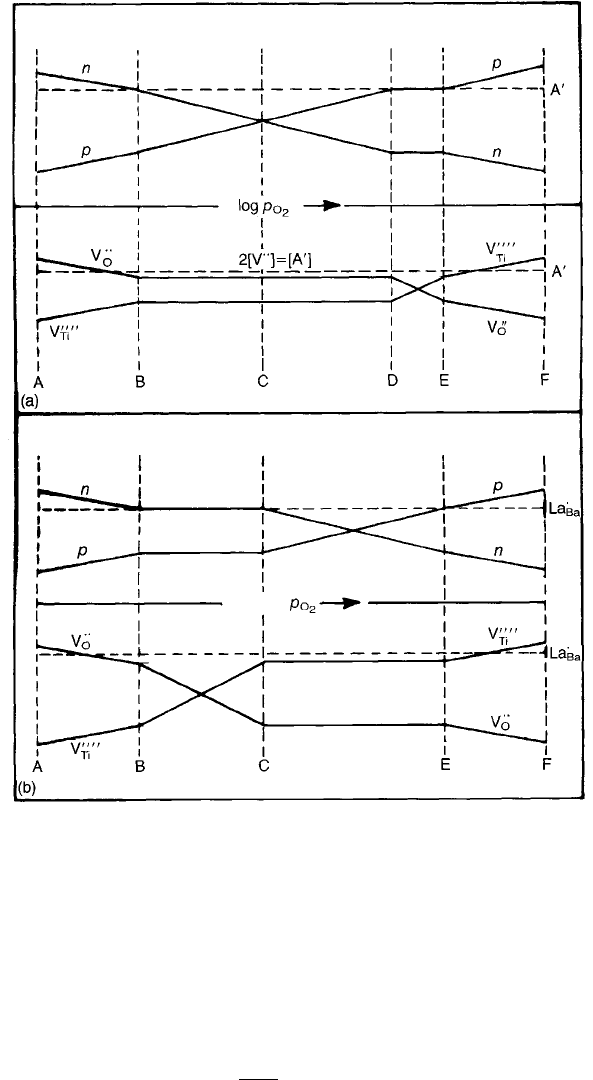
at constant T can be deduced (Fig. 2.13(a)). The
various p
O
2
regions are now considered separately for the 1000 8C isotherm of
acceptor-doped (ie nominally pure) BaTiO
3
.
p
O
2
5 10
10
Pa (AB in Fig. 2.13(a)) The equilibrium reduction equation is
O
O
Ð
1
2
O
2
ðgÞþV
..
O
þ 2e
0
ð2:48Þ
which, by the law of mass action, leads to
K
n
¼ n
2
½V
..
O
p
O
2
1=2
ð2:49Þ
where K
n
is the equilibrium constant.
At these low oxygen pressures the acceptor-compensating oxygen vacancy
concentration is regarded as insignificant compared with that arising through
loss of oxygen according to Eq. (2.48). Therefore, since n 2½V
..
O
,
ELECTRICAL CONDUCTION 37
n ð2K
n
Þ
1=3
p
O
2
1=6
ð2:50Þ
10
10
Pa 5 p
O
2
5 10
5
Pa ðBDÞ The oxygen vacancy concentration now deter-
mined by the acceptor impurity concentration [A
0
], is little affected by changes in
p
O
2
and remains sensibly constant. It follows from Eq. (2.49) that
n ¼
K
n
½V
..
O
1=2
p
O
2
1=4
ð2:51Þ
38 ELEMENTARY SOLID STATE SCIENCE
Conce
ntrat
ion —
—
"
Fig. 2.13 Schematic representation of the dependence of n, p, ½V
Ti
@@ and ½V
..
O
on p
O
2
for (a)
acceptor-doped and (b) donor-doped BaTiO
3
.
log

The p-type contribution to semiconductivity arises through the oxidation
reaction involving take-up of atmospheric oxygen by the oxygen vacancies
according to
V
..
O
þ
1
2
O
2
ðgÞÐO
O
þ 2h
.
ð2:52Þ
leading to
p ¼½V
..
O
1=2
K
1=2
p
p
O
2
1=4
ð2:53Þ
At p
O
2
100 Pa, n ¼ p, s ¼ s
m
and the material behaves as an intrinsic
semiconductor.
p
O
2
4
10
5
Pa ðDFÞ Over this p
O
2
regime the discussion is more speculative since
measurements against which the model can be checked have not been made.
In the region DE the dominating defect changes from V
..
O
to V
Ti
@@ since the
oxygen vacancies due to the acceptors are now filled. The conductivity is largely
governed by acceptor concentration and may be independent of p
O
2
over a small
pressure range.
In the EF region the equilibrium is
O
2
ðgÞÐV
Ti
@@ þ 2O
O
þ 4h
.
ð2:54Þ
so that
K
0
p
¼ p
4
½V
Ti
@@p
O
2
1
ð2:55Þ
which, because
p 4½V
Ti
@@
leads to
p ¼ð4K
p
0
Þ
1=5
p
O
2
1=5
ð2:56Þ
Measurements in the region 10
17
Pa 5 p
O
2
5 10
5
Pa as shown in Fig. 2.12
show good agreement between the s–p
O
2
slopes and the calculated n–p
O
2
and p–
p
O
2
relations given above. Increased acceptor doping moves the minimum in the
s–p
O
2
towards lower pressures (see Fig. 5.49).
Intentionally donor-doped BaTiO
3
The effect of p
O
2
on the conductivity of a
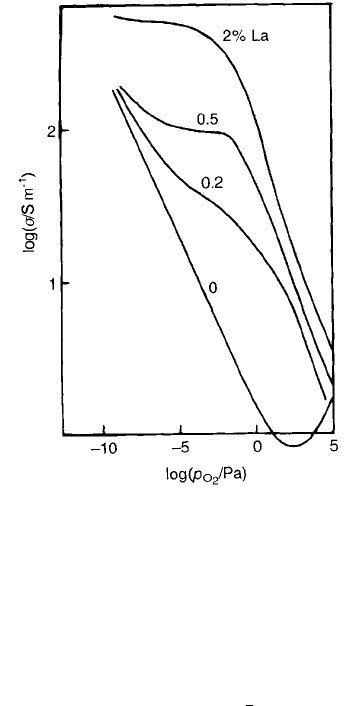
donor-doped system has been studied for lanthanum-doped BaTiO
3
as shown in
Fig. 2.14 for 1200 8C. The behaviour differs from that shown in Fig. 2.12 for
acceptor-doped material. Firstly, there is a shift of the curves towards higher
oxygen pressures. Secondly, at intermediate p
O
2
there is a region, particularly at
higher lanthanum contents, where the conductivity becomes independent of p
O
2
.
At sufficiently low pressures the curves coincide with those of the ‘pure’ ceramic.
Figure 2.13(b) is a schematic diagram of the proposed changes in charge
carrier and ionic defect concentrations as p
O
2
is increased from very low values
ELECTRICAL CONDUCTION 39
(below about 10
10
Pa). At the lowest p
O
2
values (AB) loss of oxygen from the
crystal is accompanied by the formation of V
..
O
and electrons according to
Eq. (2.48) and (2.50). As p
O
2
is increased, n falls to the level controlled by the
donor concentration so that n ½La
.
Ba
as shown in the following equation:
La
2
O
3
Ð 2La
.
Ba
þ 2O
O
þ
1
2
O
2
ðgÞþ2e
0
ð2:57Þ
When n is constant over BC, corresponding to the plateau in the curves of
Fig. 2.14, there are changes in the energetically favoured Schottky disorder so
that ½V
..
O
/p
O
2
1=2
, according to Eq. (2.49), and ½V
Ti
0000
/p
O
2
1=2
. At C the
condition
4½V
Ti
0000
¼½La
.
Ba
ð2:58Þ
is established from the equilibrium
2La
2
O
3
þ 4TiO
2
Ð 4La
.
Ba
þ 3Ti
Ti
þ V
Ti
@@ þ 12O
O
þ ‘TiO
2
’ ð2:59Þ
where ‘TiO
2
’ indicates incorporation in a separate phase.
Both ½V
Ti
@@ and ½V
..
O
remain sensibly constant over the range CE so that,
according to Eq. (2.55),
p ¼ K
p
@p
O
2
1=4
and n ¼ K
p
@p
O
2
1=4
ð2:60Þ
40 ELEMENTARY SOLID STATE SCIENCE
Fig. 2.14 Dependence of s on p
O
2
for lanthanum-doped BT ceramics at 1200 8C [8].
At still higher values of p
O
2
(EF), the dependence of p on p
O
2
would be expected
to follow Eq. (2.56) for the same reasons.
This model can be applied to BaTiO
3
containing Nb
5þ
or Sb
5þ
on the Ti site or
trivalent ions of similar ionic radius to La
3þ
on the Ba site. Because the donors
shift the change to p-type conductivity to pressures above atmospheric the n-type
conductivity may be high at room temperature after sintering in air; this is
accompanied by a dark coloration of the ceramic. The conductivity diminishes as
the donor concentration is increased beyond 0.5 mol.% and at levels in the range
2–10 mol.% the ceramics are insulators at room temperature and cream in
colour. This is an instance of a change in regime that may occur at high dopant
concentrations. The structural cause has not yet been determined but it is notable
that the grain size is diminished.
Band model for BaTiO
3
A primary objective of studies of semiconductors is
the development of appropriate band models. In the case of elemental
semiconductors such as silicon or germanium, and for the covalently bonded
compound semiconductors such as GaAs and GaP, there is confidence that the
essential features of the band models are correct. There is less confidence in the
band models for the oxide semiconductors because sufficiently precise physical
and chemical characterization of the materials is often extremely difficult. In
addition, measurements are necessarily made at high temperatures where
knowledge of stoichiometry, impurity levels, dislocation content, defect
association and other characteristics is poor. Figure 2.15 shows a tentative
band model diagram for doped barium titanate.
Doping and barium titanate technology The n- and p-type substituents, at
low concentrations, have important effects on the room temperature behaviour
of BaTiO
3
. Acceptor-doped material can be fired at low oxygen pressures
without losing its high resistivity at room temperature because of the shift of the
s–p
O
2
characteristic to low pressures (Fig. 5.49) which makes it possible to co-fire
the ceramic with base metal electrodes (see Section 5.7.3). The acceptors also
cause the formation of oxygen vacancies which affect the changes in properties
with time (‘ageing’, see Section 2.7.3) and the retention of piezoelectric properties
under high compressive stress (see Section 6.4.1). Oxygen vacancies are also
associated with the fall in resistance that occurs at temperatures above 85 8C
under high d.c. fields (‘degradation’, see Section 5.6.2).
Donor-doped BaTiO
3
is the basis of positive temperature coefficient (PTC)
resistors (see Section 4.4.2). The insulating dielectrics formed with high donor
concentrations have a low oxygen vacancy content and are therefore less prone
to ageing and degradation.
The effects of aliovalent substituents in PbTiO
3
and PbðTi,ZrÞO
3
are, broadly
speaking, similar to those in BaTiO
3
.
ELECTRICAL CONDUCTION 41