
Moulson A.J., Herbert J.M. Electroceramics: Materials, Properties, Applications
Подождите немного. Документ загружается.

If the temperature changes, then the resonance frequency f
r
will also change
because of changes in e
r
and D. Differentiating Eq. (5.35) with respect to
temperature gives
1
f
r
@f
r
@T
¼
1
D
@D
@T
1
2
1
e
r
@e
r
@T
ð5:36Þ
1
f
r
@f
r
@T
is the temperature coefficient of resonance frequency TC
f
,
1
D
@D
@T
is the
temperature coefficient of linear expansion a
L
and
1
e
r
@e
r
@T
is the temperature
coefficient of permittivity TC
e
. Substitution into Eq. (5.36) gives
TC
f
¼ð
1
2
TC
e
þ a
L
Þð5:37Þ
In the microwave dielectrics context TC
f
is usually written t
f
. It follows from Eq.
(5.37) that achievement of a temperature-independent resonance frequency, i.e.
t
f
¼ 0, requires balanced control over TC
e
and a
L
.
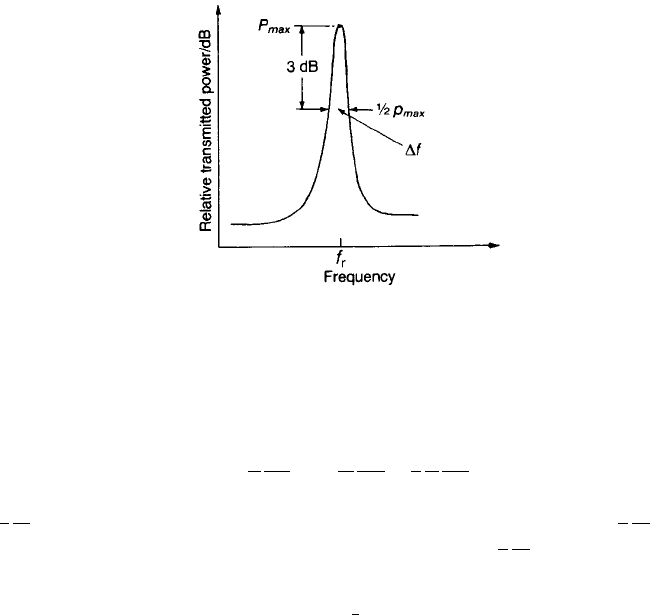
The frequency response of a DR coupled to a microwave circuit is shown in
Fig. 5.34. The selectivity Q of the resonator is given by f
r
=Df and, under
conditions where the energy losses are confined to the dielectric and not to effects
such as radiation loss or surface conduction Q ðtan dÞ
1
where tan d is the loss
factor for the dielectric.
The requirements for DR ceramics are now clear.
1. In order to miniaturize the resonator and to ensure that the electromagnetic
energy is adequately confined to the resonator, e
r
must be large and is usually
in the range 30 5 e
r
5 100.
2. To ensure stability against frequency drift with temperature, the temperature
coefficient t
f
must be close to zero, which implies control over TC
e
and a
L
.
3. To optimize frequency selectivity, Q ¼ðtan dÞ
1
must be maximized and is
usually greater than 1000.
302 DIELECTRICS AND INSULATORS
Fig. 5.34 Frequency response of a microwave resonator.
TEAMFLY
Team-Fly
®
Microwave engineers find it helpful to characterize a microwave dielectric by
the product Qf ( f measured in GHz) which, as a rough ‘rule of thumb’, is
assumed to be constant. The theoretical justification for this is as follows.
Figure 2.38 illustrates that in the case of an ionic solid the optical mode of the
lattice vibration resonates at an angular frequency, o
o
, in the region of 10
13
Hz.
In the frequency range from approximately 10
9
–10
11
Hz dielectric dispersion
theory shows the contribution to permittivity from the ionic displacement to be
nearly constant and the losses to rise with frequency according to
tan d ¼ðgo
o
Þ
2
f or Qf ¼ðgo
o
Þ
2
constant (5:38Þ
in which g is a damping factor (see Eq. (2.105)).
It has to be stressed that the relationship is at best a rough guide. There will
almost certainly be contributions to dielectric loss occurring at frequencies
between the microwave region and the ionic lattice resonance frequency that
complicate the Q( f ) relationship. For example, such contributions may arise
through polarization processes associated with dislocations and microstructural
features. There is no alternative to making the measurement if reliable loss data
at a particular frequency are required.
Ceramic compositions
The following discussion outlines the historical path taken in the development of
microwave ceramics combining high permittivity, high Q and zero t
f
with long
term stability and at an economic cost. Key references are given in the overview
by R. Freer [10].
Titania (TiO
2
) first attracted attention because of its high relative permittivity
(e
r
100) and low loss (tan d 3 10
4
). However, a very high t
f
400 MK
1
renders it totally unsuited.
MEDIUM-PERMITTIVITY CERAMICS 303
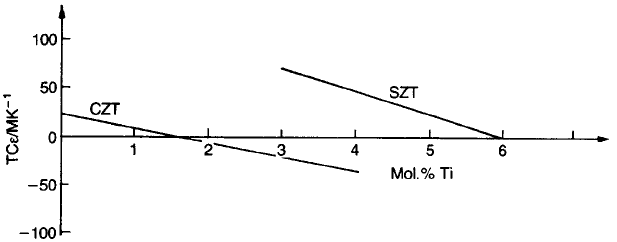
Fig. 5.35 TC
e
of zirconate compositions with varying titanium contents (CZT; CaZrO
3
–
CaTiO
3
:SZT; SrZrO
3
–SrTiO
3
(measured at 4 GHz).
Interest turned to compositions of high permittivity titanates and zirconates in
which one member exhibited a negative and the other a positive TC
e
, the
objective being to achieve t
f
¼ 0. The effect of composition on TC
e
for two such
systems is shown in Fig. 5.35. Another system which attracted interest is
MgTiO
3
–CaTiO
3
in which the end members have the dielectric properties shown
in Table 5.7. The composition Mg
0.95
Ca
0.05
TiO
3
yields t
f
0, e
r
¼ 21 and
Q ¼ 8000 at 7 GHz.
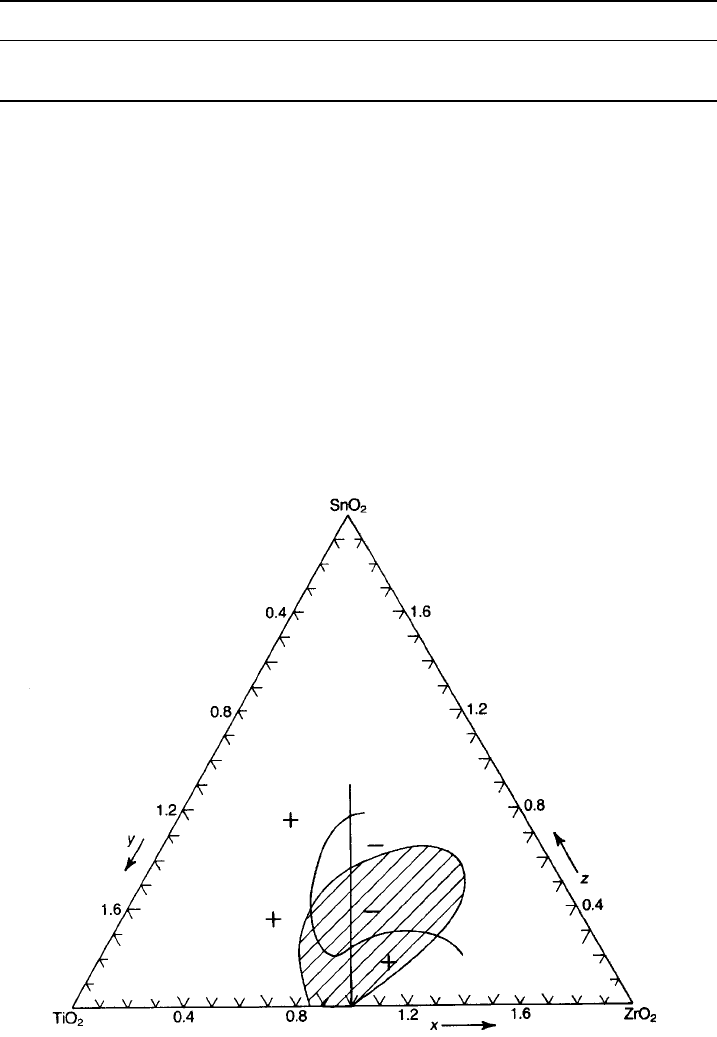
As early as 1952 the ZrO
2
–TiO
2
–SnO
2
(ZTS) system was being investigated for
possible exploitation in capacitors with low TCCs and in the 1970s [11] it
attracted interest for microwave applications. Figure 5.36 shows the region
established as single phase ZTS having the orthorhombic ZrTiO
4
structure after
firing and annealing mixtures of ZrO
2
, TiO
2
and SnO
2
powders at 1400 8C. The
locus of compositions for which t
f
¼ 0 is shown.
304 DIELECTRICS AND INSULATORS
Table 5.7 Dielectric properties measured at 7 GHz (after [10])
e
r
Q t
f
=MK
1
MgTiO
3
17 22 000 45
CaTiO
3
170 1800 800
Fig. 5.36 The Zr
x
Ti
y
Sn
z
O
4
(ZTS) system: the shaded area indicates the single-phase
microwave ceramic field (after [11]).
t
f
=0
In the 1970s barium nonatitanate (Ba
2
Ti
9
O
20
or ‘B
2
T
9
’) was identified as a
candidate. Although not easy to process to a reproducible product because of the
existence of many BaO-TiO
2
phases (see Fig. 5.41) it is manufactured on a
commercial basis.
The modified perovskite, barium zinc tantalate (Ba(Zn
1/3
Ta
2/3
)O
3
) (‘BZT’),
was reported in the 1980s to offer a combination of high permittivity coupled
with exceptionally high Q. It was established that the high Q resulted from long
anneals at high temperatures (41400 8C, 100 h) and that this was accompanied
by increased ordering of ions on the B-sites. Unfortunately zinc evaporation and
grain-growth also occurred, well illustrating the difficulties encountered in
attempting to unambiguously establish correlations between losses and
compositional, structural and microstructural changes in electroceramics.
Subsequent research established a firm correlation between Q-value and B-site
order although the underlying reasons for the correlation remained unclear. A
significant advance made in the mid-1980s, especially from the commercial
standpoint, was the discovery that small (55 mol.%) additions of BaZrO
3
led to
very high Q-values being achieved with relatively short annealing times
(1500 8C, 4 h). There is experimental evidence that the structure consists of
B-site ordered domains at the nanometre size scale [12] similar to that occurring
in the case of the relaxor ferroelectrics (see Section 5.7.2). The role of the Zr ion
in influencing the ordering kinetics is not understood but it is suggested that the
increase in Q is, at least in part, a consequence of its segregation to the domain
boundaries where it has a stabilizing effect; ‘mobile’ domain boundaries would be
expected to contribute to losses.
The t
f
value for BZT can be tailored to be near zero by the substitution of Ni
for some of the Zn so that there are commercial compositions based on
(1 x)Ba[(Zn,Ni)
1=3
Ta
2=3
]O
3
–xBaZrO
3
system with the Ni: Zn atom ratio
approximately 1:7 and x ¼0:03.
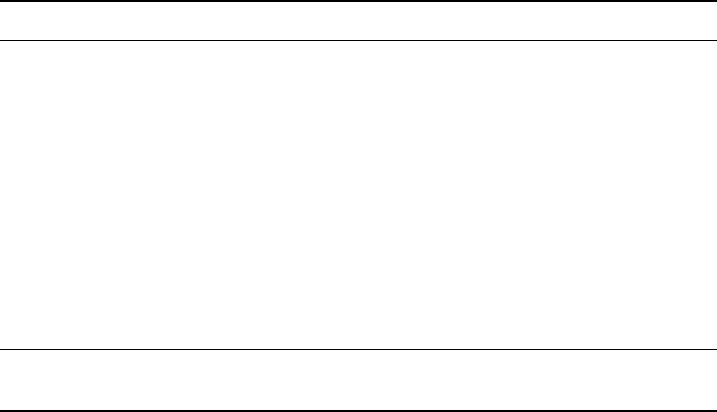
Other microwave dielectrics have been identified and developed into
commerical products and those currently exploited are listed in Table 5.8. The
modified neodymium titanates are particularly important because of their high
permittivity values and the reduction in resonator size this offers.
Broadly speaking microwave dielectrics are all processed in conventional ways,
that is by mixing starting materials, calcining, comminution, pressing and firing.
Somtimes hot-pressing is used. DRs have to be made to close dimensional
tolerances and this requires diamond machining as a final step.
There are many factors which contribute to dielectric loss and in the case of
the complex ceramic compounds discussed above, to achieve a satisfying
understanding of the relative magnitudes of the various loss mechanisms is
challenging. There will be contributions to loss intrinsic to the idealized structural
chemistry of the material and it is now clear that this is complicated by a domain
structure. There will also be contributions of an extrinsic nature, particularly
those associated with departures from the ideal structure, point defects and
MEDIUM-PERMITTIVITY CERAMICS 305
‘dislocations’ and of course, various microstructural features, grain size, grain
boundaries and second phases. Even though second phases may in toto be
present in extremely small amounts, the manner in which they are distributed can
have an effect on properties disproportionate to the amounts (see Chapter 3,
Question 19). A clear and unambiguous understanding of dielectric loss
mechanisms will only result from research in which impurities are controlled
to the p.p.m. level, or lower. All the above variables, particularly the
introduction of impurities, depend strongly on all aspects of ‘processing’,
especially those involving high temperatures.
In contrast to dielectric losses permittivity is not, in general, sensitive to small
amounts of impurities and for homogeneous dielectrics values can be calculated
as described in Section 2.7.1, and the various ‘mixture’ rules allow good estimates
to be made for multiphase dielectrics. For Ba- and Sr-based dielectrics having the
perovskite structure the variation of permittivity with temperature, which
determines t
f
(see Eq. (5.37)), can be correlated with the ‘tolerance factor’ t (see
Section 2.7.3) [13] providing guidance for tailoring ceramics to have t
f
¼ 0.
Measurement of dielectric properties
The development of improved microwave ceramics, and especially research into
loss mechanisms, necessitates reliable methods for characterizing properties,
particularly Q. A popular method is that described by Hakki and Coleman [14]
306 DIELECTRICS AND INSULATORS
Table 5.8 Commercial microwave ceramics
Ceramic e
r
Q(2 GHz)Q(f/GHz)
Mg
0.95
Ca
0.05
TiO
3
20 – 8000 (7)
Ba[Sn
x
(Mg
1/3
Ta
2/3
)
1x
O
3
25 – 43 000 (10)
Ba(Zn
1/3
Ta
2/3
)O
3
‘BZT’ 30 45 000 14 000 (12)
Zr-modified ‘BZT’ 30 – 10 000 (10)
(Zr
x
Sn
1x
)TiO
4
‘ZTS’ 35–38 18 500 10 000 (5)
Ba
2
Ti
9
O
20
‘B
2
T
9
’ 39 20 000 10 500 (5)
Ca titanate–Nd aluminate ‘CTNA’ 45 21 000 11 000 (5)
Zr-titanate–Zn-niobate ‘ZTZN’ 45 21 000 11 000 (5)
BaNd
2
Ti
4
O
12
77 3800 4000 (1.8)
(Ba,Pb) Nd
2
Ti
4
O
12
90 2000 2000 (1.8)
Ceramic e
r
Q(f/GHz) t
f
=MK
1
TiO
2
100 17 000 (3) 400
Al
2
O
3
10 33 000 (10) 50
In all cases, through minor compositional changes, the t
f
can be adjusted to + a few MK
1
. Data for
titania and alumina are included for comparison.
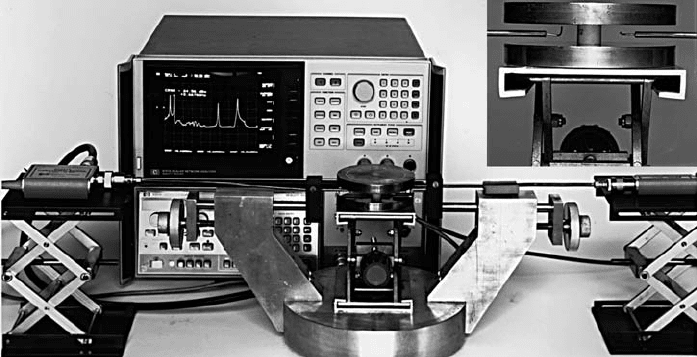
and Courtney [15]. A dielectric cylinder, typically 15 mm in diameter and
5–10 mm long, is placed between two parallel conducting planes forming, in
effect, a shorted waveguide (Fig. 5.37). Two antennas, which are loosely
electromagnetically coupled to the system, radiate power into and extract power
from the cavity. Essentially, e
r
is determined from the resonance frequency f
r
,
and Q from f
r
=Df, where Df is the 3 dB bandwidth. Such measurements are by no
means straightforward to make, but are capable of yielding e
r
and Q values with
an accuracy to about 1% and about 10%, respectively.
Sometimes the DR carries a fired-on silver coating. This is so with coaxial DRs
when the outer and inner surfaces of a hollow cylinder are silvered. The Q of the
DR can be written
1=Q ¼ 1=Q
d
þ 1=Q
s
þ 1=Q
rad
(5:39Þ
where 1=Q
d
,1=Q
s
and 1=Q
rad
are respectively the contributions to total loss from
the dielectric, from the conducting surface and from radiated power. Usually
1=Q
rad
can be neglected, and it can be shown that even for a coating of pure silver
Q
s
is not greater than approximately 1000 at 900 MHz. For such an application
there is little point in striving to obtain Q
d
values greater than approximately
5000 since they would have a relatively insignificant effect on Q. What may be
beneficial is giving the dielectric surface a high polish before being silver coated.
Dielectric resonators are extensively used in mobile communications
technology. As far as selectivity and temperature drift are concerned the
requirements for hand-held units are far less demanding than for those used in
the base stations, and for the more general filter applications. For example, for
MEDIUM-PERMITTIVITY CERAMICS 307
Fig. 5.37 Apparatus for measuring the microwave characteristics of dielectrics. Inset, detail
showing specimen between conducting planes, and antennas.
hand-held units the resonators are silver plated whereas for base station filters
much higher Q-values (e.g. 420 000 at 2 GHz) are essential.
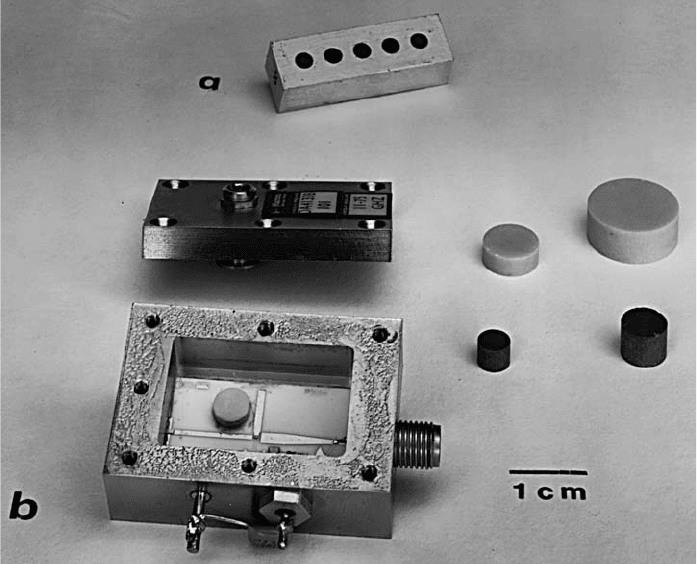
Figure 5.38 shows a microwave oscillator built on to a ceramic substrate and
incorporating a dielectric resonator.
LTCC and microwave technology
LTCC technology is extensively exploited in microwave technology and the
following discussion should be read in conjunction with Section 5.5.5.
Microwave LTCC materials are essentially established microwave ceramic
compositions fluxed to allow processing to a glass-ceramic at temperatures lower
than 900 8C. For example, the microwave dielectric BaNd
2
Ti
4
O
12
(see
Table 5.8) mixed with a glass (B
2
O
3
27 mol.%, Bi
2
O
3
35 mol.%, SiO
2
6 mol.%
ZnO 32%), both in finely powdered form, compacted and processed at 900 8C for
3 h produced a glass-ceramic with values for e
r
, t
f
and Q of approximately 67,
4MK
1
and 41000 (at 6 GHz), respectively [16].
308 DIELECTRICS AND INSULATORS
Fig. 5.38 Microwave ceramic components: (a) metallized ceramic ‘engine block’ for 40 MHz
pass band filter at 1.4 GHz; (b) 11.75 GHz oscillator incorporating ceramic dielectric resonator
together with various resonator pucks.
MEDIUM-PERMITTIVITY CERAMICS 309
Table 5.9 Dielectric properties of microwave LTCCs [17]
Ceramic e
r
Q(6–7 GHz)
Commercial MgTiO
3
–CaTiO
3
* 21.4 3700
Commercial LTCC 7.4 320
LTCC** 8.5 41000
*Composition approximately that given in Table 5.8.
**No prior glass melting – see text.
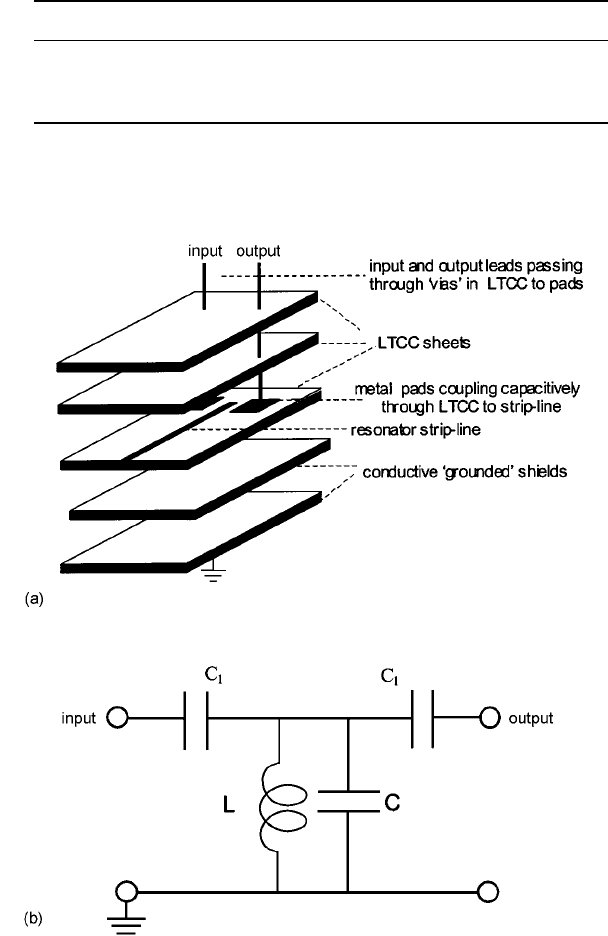
Fig. 5.39 (a) Schematic of a l=4 strip line resonator ‘pass-band’ filter exploiting LTCC
technology; the approximate overall dimensions are: 1561061 mm. (b) Equivalent circuit: C
1
is the ‘pad-to-strip-line’ capacitance and L and C the inductance and capacitance of the strip-
line.
In a similar study [17] a commercial microwave dielectric, MgTiO
3
–CaTiO
3
,was
fluxed with SiO
2
,B
2
O
2
and ZnO powders avoiding the prior glass-melting step.
After firing at 900 8C the final product was a crystalline glass ceramic with no
detectable amorphous phase and offering useful dielectric properties (Table 5.9).
Oscillators and filters do not always take the form of the ‘puck’ as illustrated in
Fig. 5.38 but also as ‘strip-lines’. Figure 5.39 illustrates a structure for a l=4 strip
line resonator exploiting LTCC technology.
The principle of the resonator is the same as that of a vibrating string and in
the illustrated example one end of the line is maintained at ‘ground’ potential
(the node) and the other is the antinode. The permittivity of the surroundings
determine the length of the line for a particular resonance frequency and, in this
case, also serves to capacitively couple energy into and out of the resonator.
To tailor the stop- or pass-band to requirements more than one line will be
involved (coupled resonators), and the geometries will depart from the simple
form illustrated.
The constant drive to miniaturize components for communications devices is
stimulating efforts to develop LTCC technology into three dimensional circuitry
in which passive components (resistors, capacitors and inductors) are packaged
into the structure with the active, integrated circuits, bonded to the outer surface.
The technology is reviewed by W. Wersing et al. [18].
5.7 High-permittivity Ceramics
Dielectrics with relative permittivities exceeding 1000 are based on ferroelectric
materials and are more sensitive to temperature, field strength and frequency
than lower-permittivity dielectrics. Development in the past 50 years has resulted
in improvements in stability whilst retaining the desirable high-permittivity
310 DIELECTRICS AND INSULATORS
Table 5.10 Coding for temperature range and capacitance variation for Class II/III
capacitors
EIA Code Temperature range/8C EIA Code Capacitance change/%
X5 755 to +85 D +3.3
X7 755 to +125 E +4.7
X8 755 to +150 F +7.5
Y5 730 to +85 P +10
Z5 +10 to +85 R +15
S +22
T +22 to 733
U +22 to 756
V +22 to 782
Example: a capacitor is required for which the capacitance value at 25 8C changes by no more than +7.5%
in the temperature range 730 8C to +85 8C; the EIA Code will be Y5F. EIA codes D–R; Class II: Codes
S–V; Class III.
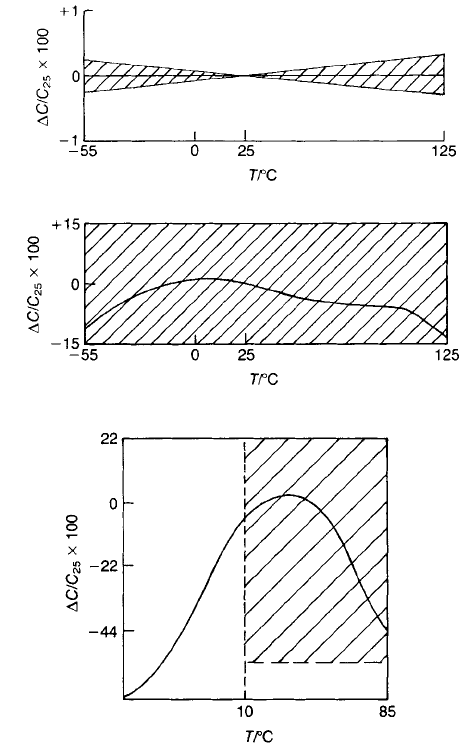
feature. The Electronics Industries Alliance (EIA) of the United States has
devised a scheme for specifying the variability of capacitance with temperature in
the ranges of practical interest. The coding is defined in Table 5.10, and Fig. 5.40
shows typical characteristics compared with those of Class I controlled
temperature coefficient dielectrics.
5.7.1 Modi¢ed barium titanate dielectrics
The dielectric characteristics of barium titanate ceramics with respect to
temperature, electric field strength, frequency and time (ageing) are very
dependent on the substitution of minor amounts of other ions for Ba or Ti.
HIGH-PERMITTIVITY CERAMICS 311
Fig. 5.40 Variation of capacitance with temperature for (a) Class I C0G, (b) Class II X7R
and (c) Class III Z5U dielectrics.
(a)
(b)
(c)