
Moulson A.J., Herbert J.M. Electroceramics: Materials, Properties, Applications
Подождите немного. Документ загружается.

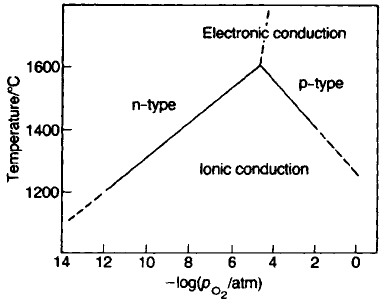
The defect concentrations and their dependence on p
O
2
and temperature are
derived from the law of mass action by procedures essentially the same as those
outlined in Section 2.6.2. In the case of polycrystalline high-purity alumina, the
electronic conductivity increases with decreasing grain size and is attributed to
hole transport along grain boundaries.
The conductivity of debased aluminas is dominated by that of the usually
continuous silicate phase, and the ideas concerning charge transport through
glasses (Section 2.6.3) are therefore appropriate. Debased aluminas are typically
more conductive than the high-purity varieties, as illustrated in Fig. 5.21.
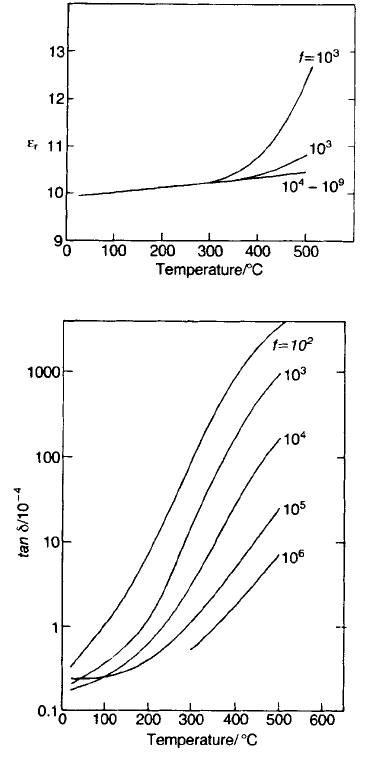
The effects of temperature and frequency on the permittivity and dissipation
factor of a high-purity alumina ceramic are shown in Fig. 5.24. The discrepancies
between the permittivity levels in Fig. 5.24 and values given elsewhere are probably
due to differences in microstructure and measurement technique. Reliable room
temperature values for e
r
for single-crystal sapphire at 3.4 GHz are 9.39
perpendicular to the c axis and 11.584 parallel to it, which are close to the values
measured optically. The average e
r
to be expected for a fully dense ceramic form is
therefore 10.12, and values close to this have been determined. Nothwithstanding
the uncertainties there is no doubt that the general behavioural pattern indicated
by Fig. 5.24 is correct and typical of ceramic dielectrics.
As the temperature increases defects and charge carriers become more
responsive to applied fields, causing both permittivity and loss to increase.
However their inertia prevents them from responding effectively at high
frequencies so that the loss falls, particularly at higher temperatures. An
intergranular phase will clearly have a considerable effect on both the resistivity
and the dissipation factor.
It is an advantage that alumina can be fired in hydrogen without degradation
of the electrical properties since this allows the use of molybdenum heating
elements in the high-temperature furnaces required for sintering the high-purity
282 DIELECTRICS AND INSULATORS
Fig. 5.23 Speculative diagram describing the dependence of charge transport mechanisms in
alumina on temperature and oxygen pressure.
TEAMFLY
Team-Fly
®
grades. Also, the success of the ‘moly-manganese’ metal–ceramic joining process
rests on resistance to degradation in a hydrogen atmosphere at high temperature
(see Section 3.8).
Applications
Alumina ceramics are used wherever exceptionally good dielectric properties,
high mechanical strength and high thermal conductivity, coupled with a reliable
ceramic–metal joining technology such as the moly-manganese process, are
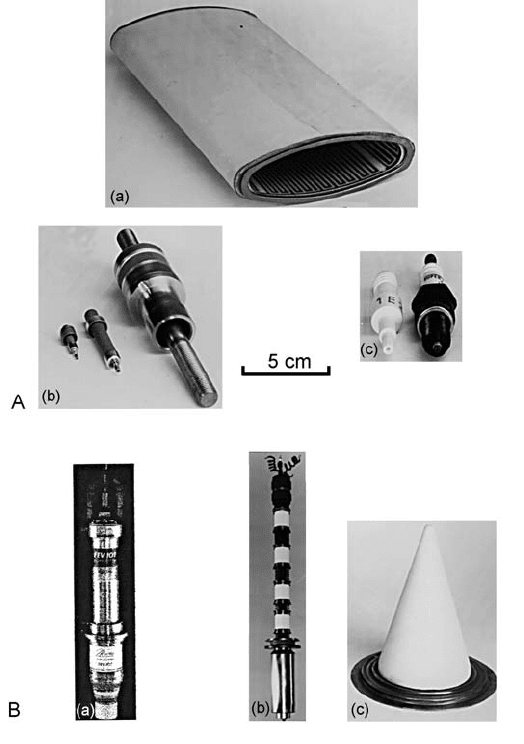
demanded. Examples of components are illustrated in Fig. 5.25.
LOW-PERMITTIVITY CERAMIC DIELECTRICS AND INSULATORS 283
Fig. 5.24 Dependence of (a) e
r
and (b) tan d on temperature and frequency for a high-purity
Al
2
O
3
ceramic.
(a)
(b)
The best known use for a 95% alumina ceramic is in spark plugs, mass-
produced components which illustrate well the need for a combination of good
thermomechanical and electrical properties. They must be strong to withstand
not only rough treatment meted out by garage mechanics but also the
thermomechanical shocks experienced each time the engine fires, with
284 DIELECTRICS AND INSULATORS
Fig. 5.25 Alumina-metal components: (A) Components for which a combination of high
mechanical strength, gas-tightness and good electrical insulation are prime requirements: (a)
section of 100 m diameter vacuum-tight ring for an electron synchrotron with internal printed
heater for out-gassing; (b) electrical power lead-throughs; (d) isostatically pressed alumina part
of spark plug together with plug. (B) High power microwave components: (a) Inductive Output
Tube suited to digital TV service and capable of handling 130 kW peak output power, equating
to 30 kW mean power (82 cm long); (b) a 4-cavity klystron generating 20 kW continuous power
at 470–860 MHz for analogue TV transmission (125 cm long); (c) a conical microwave
‘window’ for effecting a vacuum-tight seal between, for example, a microwave generator and
antenna (approx. 20 cm high). ((B) Courtesy of ‘E2V Technologies’ UK.)
temperatures and pressures as high as 900 8C and 10 MPa (100 atm) being
generated. The alumina must also provide adequate insulation against electrical
stresses of the order of 1 MV m
71
, and the glazed surface can be kept clean so as
to reduce the risk of tracking.
Another important application is in klystrons and magnetrons – devices for
the generation of electromagnetic energy, sometimes at very high power levels.
For example, the impressive operating characteristics of a large klystron for a
1.3 GHz radar transmitter are as follows: an electron gun voltage of 278 kV and a
beam current of 324 A providing a pulse peak power of 30 MW, a pulse length of
35 ms and an average power level of 150 kW. At the other end of the power
spectrum are generators for domestic microwave ovens, operating typically at
power levels of 1.2 kW at 2.45 GHz. The high gun voltages used in large
klystrons necessitate very good insulation and, just as for the electron guns in
electron microscopes, it is provided by alumina. A microwave generator,
however, makes a further unique demand. Microwave power is passed from the
vacuum interior of the device to the outside world through a ‘window’ as
transparent as possible to the radiation. Because of the finite power factor of the
window material heat is developed which must be removed to a suitable sink.
Therefore requirements for a good microwave window material are a low power
factor at the operating frequency, high thermal conductivity, vacuum tightness,
high strength and the capability of being joined effectively to a metal. Alumina
ceramics meet most of the requirements, but beryllia may be used for the highest
power levels because of its unrivalled thermal conductivity. This is so in the case
of a particular commercial ‘gyrotron’ in which a beryllia output window of
diameter 2 in passes 200 kW continuously at 60 GHz.
Where the ceramics form part of a precision engineering structure, as in the
above examples, it is necessary to bring them to the correct dimensions by
diamond machining. They are usually joined to the metal parts by variants of the
moly-manganese process. It is worth noting that the manufacture of metal–
ceramic components has been so successfully developed that it can replace the
metal–glass technology where production costs rather than the technical merits of
the alumina ceramic are the deciding factor. The metal–ceramic technology
dispenses with the highly skilled and expensive glass blower necessary for the
manufacture of devices based on glass envelopes and is suited to mass production.
Alumina ceramics are widely used for thick-film circuit substrates and for
integrated circuit packaging. This aspect is discussed in Section 5.5.5.
5.5.3 Beryllia
Beryllia has broadly similar properties to alumina (Table 5.3) but its thermal
conductivity is 5–10 times greater. It is therefore used when thermal dissipation
combined with electrical isolation is of major importance, e.g. in high-power
LOW-PERMITTIVITY CERAMIC DIELECTRICS AND INSULATORS 285
klystrons and power diodes. Because beryllium is one of the rare elements the
oxide is inevitably more expensive than alumina, which limits its use.
The technology developed to produce dense BeO ceramics is similar to that
employed for Al
2
O
3
. Sintering must be carried out at somewhat higher
temperatures since the melting point of BeO is higher at 2570 8C. The
atmosphere during sintering or other high-temperature (41000 8C) treatment
of BeO must be moisture free since otherwise a volatile hydroxide is formed
which is toxic if inhaled as fumes. Sintering and metallization can be carried out
in dry hydrogen. Sintered pieces only give rise to a health hazard when they are
abraded or heated in moist atmospheres without suitable precautions.
5.5.4 Aluminium nitride
AlN (Table 5.3) has recently been introduced as a substrate because it combines
a high thermal conductivity with a thermal expansion coefficient close to that of
silicon. Its resistivity is somewhat lower than that of BeO and Al
2
O
3
but is
sufficient for most substrate applications.
AlN dissociates into its elements at 2500 8C. It is formed by the reaction of
aluminium powder with nitrogen and can be sintered in a nitrogen atmosphere.
AlN replaces BeO in many applications since it is competitive in price and does
not present the problems of toxicity in manufacture. It may replace Al
2
O
3
as a
substrate for silicon chips because of its better heat conductivity and its closer
match in thermal expansion.
5.5.5 Ceramic ‘packaging’ technology
Electronic circuits are ‘packaged’ using substrates of one form or another
ranging from the plastic-based laminate through to the sophisticated multilayer
ceramic (MLC) substrate. Laminates are dominant in relatively low technologies
such as radio, TV and other consumer products, and thick film circuits carried on
ceramic (Al
2
O
3
, BeO, AlN) substrates are extensively used for a wide range of
more demanding applications including communications, automotive control
and military and space technologies.
The substrates carrying the circuits shown in Fig. 4.5 are a 95–96% alumina.
This ceramic has been adopted for its combination of physical and chemical
characteristics and, importantly, low cost. It offers a combination of mechanical,
thermal and electrical properties which meet the in-service requirements, and
compositional and microstructural characteristics suited to thick film printing
(see Section 4.2.2). Alumina substrates are manufactured on a very large scale
making the unit costs a small fraction of the total circuit cost.
286 DIELECTRICS AND INSULATORS
Over the past two decades MLC technology has been progressively developed
for advanced packaging, especially by main frame computer manufacturers, and
it is increasingly exploited for microwave communications. Especially significant
is the emergence of low temperature co-fired ceramic (LTCC) technology.
The ‘alumina^molybdenum’ IBM thermal conduction module (TCM)
In the 1980s computer circuit designers turned to MLC technology in an effort to
increase component packing density so reducing interconnect lengths. A major
mile-stone was the development of the IBM thermal conduction module (TCM)
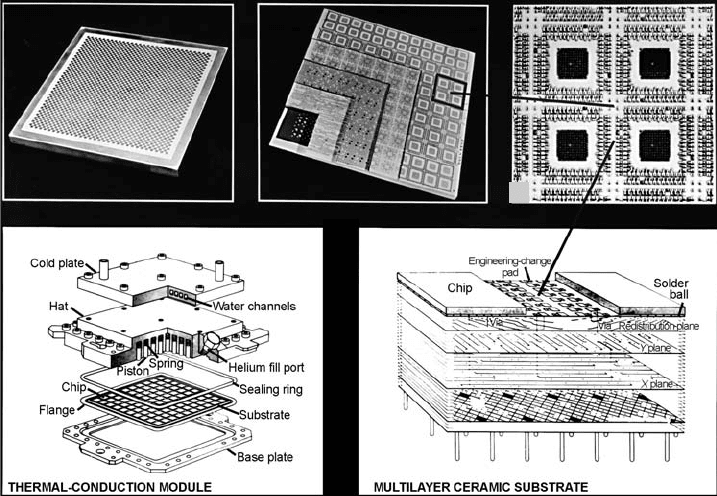
used in 308X type computers and illustrated in Fig. 5.26. The following
discussion outlines the general development trends and reasons for them; the
technical details are, presumably, continually changing.
In the manufacture of the multilayer structure for the TCM, square sheets are
stamped from a roll of ‘green’ tape loaded with a debased alumina powder.
Many small (about 150 mm diameter) holes (‘vias’) are punched through the tape
at predetermined positions. Electrical ‘wiring’ patterns with line widths and
LOW-PERMITTIVITY CERAMIC DIELECTRICS AND INSULATORS 287
Fig. 5.26 Multilayer ceramic thermal conduction module: (a) underside showing connector
pads – substrate size 9069066 mm; (b) multilayer construction; (c) silicon chip mounting
positions; (d) schematic diagram illustrating buried interconnections; (e) thermal conduction
module. (Courtesy of IBM Corp., East Fishkill.)
(a) (b)
(c)
(e)
(d)
spacing of about 100 mm are then screen-printed onto each sheet, and the vias
filled with a molybdenum-based metallizing ink. After the printing stage the
sheets are laminated by warm-pressing and then sintered in a reducing
atmosphere. The final structure is an alumina (92% Al
2
O
3
) tile of dimensions
9069065 mm made of up to approximately 33 layers of ceramic with buried
three-dimensional circuitry, as illustrated in Fig. 5.26. The top and bottom
surfaces of the tile are nickel and gold plated with patterns onto which the
semiconductor integrated circuits are subsequently bonded.
In the TCM removal of heat is effected directly from the back of each
semiconductor chip through a spring-loaded piston, assisted by immersing the
multilayer structure in helium gas and by flowing water in the top cover.
In parallel with the development of the TCM intensive efforts were being made
to improve on the technology. The alumina–molybdenum system has the
disadvantage that the requirement to sinter at high temperature (1400 8C) and
in a low oxygen potential atmosphere to maintain the molybdenum in the
metallic state is expensive. A further disadvantage is that the high resistivity of
molybdenum, coupled with the relatively high permittivity of alumina,
significantly slows signal transit time. The efforts to lower the sintering
temperature allowing the use of relatively highly conductive copper for the
interconnections led to the adoption of LTCC technology. The following
discussion should be read in conjunction with Section 3.7.4.
Low temperature co-¢red ceramic technology (LTCC)
Essentially LTCC technology is based on glass-ceramics specially formulated to
meet the operational demands. Substrates must be strong enough to withstand
mechanical stressing during processing and in service. Ideally thermal
conductivity would be high so that heat produced in the components is quickly
dissipated without attendant large temperature gradients in the assembly. This is
significant in cases where the component density is high or where power
components (rather than ‘signal’) are involved. As the technology has developed
thermal conductivity has become far less important, especially in the case of the
sophisticated IBM multilayer substrates discussed above in which thermal
management does not rely significantly on the ceramic.
As far as electrical properties are concerned most attention is focused on
permittivity and dissipation factor. A high permittivity carries two penalties. One
is dielectric coupling between closely spaced ‘wires’ leading to ‘cross-talk’, and
the other signal transit time, the velocity of an electromagnetic wave being
inversely proportional to the square root of the relative permittivity (see
Eq. (2.120)). Signal transit time is important in so far as it is a factor determining
the speed of a computer.
288 DIELECTRICS AND INSULATORS
LTCC technology starts with a glass powder carried in an organic- (or water)-
based vehicle and cast into a tape. The circuit is printed onto the tape using
highly conducting metals such as silver (m.p. 961 8C), gold (m.p. 1064 8C) or
copper (m.p. 1084 8C) with line widths and separations of 75 mm. Whilst in
the case of silver and gold sintering is carried out in air, in the case of the copper
circuitry, to avoid oxidation of the metal, the co-firing must be in a protective
atmosphere, normally wet nitrogen/hydrogen, adding to processing costs. The
layers are stacked and laminated and fired in the temperature range 850–950 8C
when the glass devitrifies to a glass-ceramic. ‘Vias’ punched through the tape
prior to laminating, and filled with conductor paste effect the electrical
connections between layers. The final part is a dense, fully integrated substrate
having optimum mechanical and electrical characteristics onto which other
components, ‘passive’ and ‘active’, can be mounted and interconnected.
For this application the glass-ceramic should completely devitrify during
processing to ensure dimensional and shape stability, have a low relative
permittivity (55), and a thermal expansivity close to that of silicon (3MK
71
)
so as to avoid the development of temperature-induced stresses in the
semiconductor devices bonded to the finished substrate. By careful choice of
composition, thermal expansivity and electrical properties can be tailored, as
discussed in Section 3.7.4. Cordierite (see Fig. 5.18) and b-spodumene
(Li
2
OAl
2
O
3
4ASi
2
O
2
) have suitable properties. The thermal expansivity of
cordierite can be tailored by small modifications to composition, for example
by adjusting the alumina content and making minor additions of boric oxide and
phosphorus pentoxide. To achieve a fully dense final product the glass powder
must completely sinter prior to devitrification and so the presence of
‘mineralizers’ (crystal nucleating agents) are avoided.
Multilayer, LTCC technology is now exploited in high speed digital circuitry
for computer main frame equipment, the general form of the modules being still
essentially as illustrated in Fig. 5.26. R.R. Tummala [5] and S.H. Knickerbocker
et al. [6] review the glass-ceramic aspects of IBM TCM technology.
The explosive growth in wireless technologies has been accompanied by a
demand for specially tailored ‘microwave dielectrics’, and very recently by the
exploitation of multilayer LTCC-based circuitry (see Section 5.6.5).
5.6 Medium-permittivity Ceramics
Medium-permittivity ceramics are widely used as Class I dielectrics, and in order
to be in this category they need to have low dissipation factors. This precludes
the use of most ferroelectric compounds in their composition since ferroelectrics
have high losses (tan d40.003), particularly when subjected to high a.c. fields.
Low-loss materials can be obtained with relative permittivities exceeding 500
but accompanied by high negative temperature coefficients, generally exceeding
MEDIUM-PERMITTIVITY CERAMICS 289
71000 MK
71
. For most purposes medium-permittivity ceramics have e
r
in the
range 15–100.
There are three principal areas in which these dielectrics are applied.
1. High-power transmitter capacitors for the frequency range 0.5–50 MHz for
which the main requirement is low loss: a negative temperature coefficient of
permittivity is tolerable since it limits the power through the unit when its
temperature increases.
2. Stable capacitors for general electronic use: a stability better than +1% is
needed over the operational temperature and voltage ranges, and the
frequency lies mainly in the 1 kHz to 100 MHz range.
3. Microwave resonant devices: these operate between 0.5 and 50 GHz and
require stabilities of better than +0.05% over the operational temperature
range with dissipation factors better than 2610
74
.
The applications have been listed in order of increasingly stringent
specifications so that a material satisfactory for 3 would also satisfy 1 and 2,
although it might be unnecessarily expensive.
Medium-permittivity dielectrics are based on interlinked MO
6
groups, where
M is either a quadrivalent ion such as Ti, Zr or Sn or a mixture of divalent,
trivalent and pentavalent ions with an average charge of 4+. The oxygen
octahedra share corners, edges or faces (see Fig. 2.2) in such a way that the O
27
ions form a close-packed structure. Sites in the O
27
lattice may be occupied by
divalent cations that lie in interstices between the MO
6
octahedra, as in
perovskite-type materials. TiO
6
octahedra are the most commonly found groups
in medium- and high-permittivity dielectrics. The behaviour of rutile (TiO
2
)
ceramic is typical of these classes of dielectric in several respects.
5.6.1 Rutile ceramic
Titania occurs in three crystalline modifications: anatase, brookite and rutile.
Because above approximately 800 8C both anatase and brookite have
transformed to rutile it is the only form of significance in the ceramics context
and attention here is limited to it.
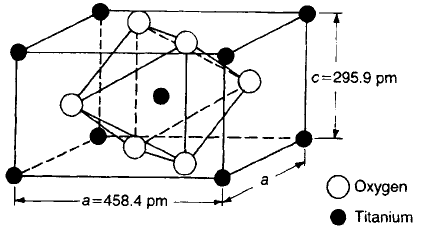
The rutile structure (Fig. 5.27) is based on nearly close-packed oxygen ions
with Ti
4+
ions occupying half the octahedral sites. The tetragonal unit cell
contains two formula units, and the Ti
4+
is at the centre of a distorted oxygen
octahedron.
Rutile is anisotropic, with the values of e
r
at room temperature being
approximately 170 and 90 in the c and a directions respectively. In the
polycrystalline ceramic form e
r
averages to intermediate values with a
290 DIELECTRICS AND INSULATORS
temperature coefficient of approximately 7750 MK
71
. The e
r
ðo,TÞ and
tan dðo,TÞ characteristics of a titania-based ceramic are shown in Fig. 5.28.
Pure rutile is an excellent insulator at room temperature with an optical band
gap between the filled O 2p valence band and the empty Ti 3d conduction band
probably in the range 3.5–4.0 eV. A thermal energy of approximately 1.7–2.0 eV
can transfer electrons from the valence to the conduction band leading to
semiconductivity. Figure 5.29 shows typical conductivity data for a high-purity
titania ceramic (499.95 wt% TiO
2
) measured in oxygen at 1 atm.
An important feature of TiO
2
is the extent to which it can be chemically
reduced above approximately 900 8C with accompanying significant changes in
electrical conductivity, as shown in Fig. 5.30. The fall in resistivity is
accompanied by a loss of oxygen and the movement of Ti ions onto interstitial
sites, probably the empty octahedral sites in the rutile structure:
2O
O
þ Ti
Ti
! O
2
ðgÞþTi
I
....
þ 4e
0
ð5:18Þ
The law of mass action leads to
½Ti
I
....
n
4
¼ K
n
p
O
2
1
ð5:19Þ
and, since n 4½Ti
I
....
,
n ¼ð4K
n
Þ
1=5
p
O
2
1=5
ð5:20Þ
Measurements of conductivity at 1000 8C and oxygen pressures below 101 mPa
(10
710
atm) have confirmed Eq. (5.20) (see Section 2.6.2).
The presence of interstitial Ti ions is confirmed by other research and is
consistent with the structural change that occurs with larger oxygen deficiencies
(e.g. in TiO
1.95
). This involves a process of crystallographic shear that
accommodates the oxygen loss and results in the Ti ions on one side of the
shear plane being in interstitial positions relative to those on the other side.
Therefore, in reality, a grossly non-stoichiometric phase is made up of
stoichiometric regions separated by a series of regularly spaced crystal shear
MEDIUM-PERMITTIVITY CERAMICS 291
Fig. 5.27 The crystal structure of rutile.