
Moulson A.J., Herbert J.M. Electroceramics: Materials, Properties, Applications
Подождите немного. Документ загружается.


@D
@X
!
E,T
¼ d
@E
@X
!
D,T
¼ g
@D
@x
!
E,T
¼ e
@E
@x
!
D,T
¼ h
ð6:8Þ
The converse-effect coefficients are properly defined similarly:
@x
@E
!
X,T
¼ d*
@x
@D
!
X,T
¼ g*
@X
@E
!
x,T
¼ e*
@X
@D
!
x,T
¼ h*
ð6:9Þ
It is instructive to outline the thermodynamic argument proving that
d ¼ d*, g ¼ g*, e ¼ e* and h ¼ h*. The First Law states that the addition of an
increment of heat dq to a system produces a change in the internal energy dU and
causes the system to do work dW on its surroundings. Thus
dq ¼ dU þ dW ð6:10Þ
If the changes are performed reversibly, dq ¼ TdS, and
TdS ¼ dU þ dW ð6:11Þ
where S is the entropy. In the case of an isolated piezoelectric material the
mechanical and electrical work is done on the system, and hence
TdS ¼ dU dW ¼ dU Xdx EdD ð6:12Þ
It is possible to define the thermodynamic state of a system in terms of groups
of certain independent variables, and T, X, x, D and E are available in the
present case. For example, the equilibrium could be expressed in terms of the
342 PIEZOELECTRIC CERAMICS
TEAMFLY
Team-Fly
®

independent variables (T, x, D) when the appropriate starting point would be the
energy function
A ¼ U TS ð6:13Þ
Now
dA ¼ dU TdS SdT
which, on substituting for dU TdS from Eq. (6.12), becomes
dA ¼ Xdx þ EdD SdT ð6:14Þ
Because dA is a perfect differential it follows that
@X
@D
!
x,T
¼
@E
@x
!
D,T
ð6:15Þ
Similarly, if attention is focused on the independent variables (T, X, E), the
appropriate function is
G ¼ U TS Xx ED ð6:16Þ
which leads to
dG ¼SdT xdX DdE ð6:17Þ
and to the relationship
@x
@E
!
X,T
¼
@D
@X
!
E,T
ð6:18Þ
Similarly, the function
G
1
¼ U TS ED ð6:19Þ
leads to
@X
@E
!
x,T
¼
@D
@x
!
E,T
ð6:20Þ
and
G
2
¼ U TS Xx ð6:21Þ
leads to
@x
@D
!
x,T
¼
@E
@X
!
D,T
ð6:22Þ
BACKGROUND THEORY 343

Thus the equalities d ¼ d* etc. are proved, and the relationships can be
summarized as follows:
@D
@X
!
E,T
¼
@x
@E
!
X,T
¼ d ð6:23Þ
@E
@X
!
D,T
¼
@x
@D
!
X,T
¼ g ð6:24Þ
@D
@x
!
E,T
¼
@X
@E
!
x,T
¼ e ð6:25Þ
@E
@x
!
D,T
¼
@X
@D
!
x,T
¼h ð6:26Þ
6.2 Parameters for Piezoelectric Ceramics and
their Measurement
The discussion is now restricted to matters relevant to the technology of
piezoceramics. If it is assumed that the quantities d, g, e, and s are constants and,
furthermore, the tensor nature of the various parameters (see below) is not taken
into account, then equations of state can be written as follows.
D ¼ dX þe
X
E ð6:27aÞ
x ¼ s
E
X þ dE ð6:27bÞ
E ¼gX þD/e
X
ð6:28aÞ
x ¼ s
D
X þ gD ð6:28bÞ
Where s
E
, s
D
are the elastic compliances and the superscripts denote the
parameters held constant; similarly e
X
denotes the permittivity measured at
constant stress (the usual condition); to measure the permittivity at constant
strain e
x
is more difficult to accomplish.
Because ferroelectric ceramics have non-linear characteristics the effects are
more correctly described by the equations,
344 PIEZOELECTRIC CERAMICS

dD ¼ ddX þe
X
dE ð6:29aÞ
dx ¼ s
E
dX þ ddE ð6:29bÞ
dE ¼gdX þ dD=e
X
ð6:30aÞ
dx ¼ s
D
dX þ gdD ð6:30bÞ
dE ¼hdx þdD=e
x
ð6:31aÞ
dX ¼ c
D
dx hdD ð6:31bÞ
dD ¼ edx þ e
x
dE ð6:32aÞ
dX ¼ c
E
dx edE ð6:32bÞ
in which the coefficients are recognized as being functions of the independent
variables, that is dðX,EÞ, gðX,DÞ, etc.
The various coefficients which appear in electromechanical equations of state
such as (6.29a) to (6.32b) are not all independent. For example, from Eqs (6.23)
and (6.24)
d/g ¼ð@x/@EÞ
X
/ð@x/@DÞ
X
¼ð@D/@EÞ
X
¼ e
X
ð6:33Þ
It is understood that in all cases the temperature is maintained constant.
In a similar way, from Eqs (6.24), (6.25) and (6.26), it follows that
e/h ¼ e
x
and g/h ¼ s
D
ð6:34Þ
The electromechanical coupling coefficient (k) is a measure of the ability of a
piezoelectric material to transform mechanical energy into electrical energy, and
vice versa. It is defined [5] by
k
2
¼ W
2
12
/W
1
W
2
ð6:35Þ
in which W
12
, W
1
and W
2
are respectively the piezoelectric, mechanical and
electrical energy densities. In the piezoceramics’ context an effective coupling
coefficient k
eff
, defined below, is in common usage.
There are important relationships which follow from the above equations of
state. When a piezoelectric material is stressed, electrically or mechanically, the
developed energy densities are, from Eqs (6.29a) and (6.29b).
1
2
dD dE ¼
1
2
d dXdE þ
1
2
e
X
ðdEÞ
2
ð6:36Þ
1
2
dx dX ¼
1
2
s
E
ðdXÞ
2
þ
1
2
d dEdX ð6:37Þ
PARAMETER S FOR PIEZOELECTRIC CERAMICS AND THEIR MEASUREMENT 345

The terms involving (dE)
2
and (dX)
2
are the electrical and mechanical energy
densities, and those involving dEdX the piezoelectric energy densities. It follows
from Eq. (6.35) that
k
2
¼fd dX dEddE dX/s
E
ðdXÞ
2
e
X
ðdEÞ
2
g
1=2
ð6:38Þ
or
k
2
¼ d/ðs
E
e
X
Þ
1=2
ð6:39Þ
The elastic compliance s, (and stiffness c) has very different values depending
upon whether the electric field E within the material is maintained at zero (the
component is ‘short-circuited’), or whether the electric displacement D remains
constant (the component is ‘open-circuited’). The ‘short circuit’ value is specified
by the superscript E and the ‘open circuit’ condition by the superscript D.
Similarly the permittivity can be measured with the specimen free to deform, that
is at constant stress e
X
, or in the clamped state, e
x
.
Important relationships between s
E
and s
D
(and between c
E
and c
D
) can be
derived as follows.
Equating Eqs (6.29b) and (6.30b) leads to
s
E
dX þ d dE ¼ s
D
dX þ g dD
After substituting for dD and dE from Eqs (6.29a) and (6.30a) and noting from
Eq. (6.33) that g ¼ d/e
X
it follows, after a little manipulation that
s
D
¼ s
E
ð1 d
2
/s
E
e
X
Þ
or, from Eq. (6.39)
s
D
¼ s
E
ð1 k
2
Þð6:40Þ
Also, because c ¼ 1/s
c
E
¼ c
D
ð1 k
2
Þð6:41Þ
In a similar way, but now equating Eqs (6.30a) and (6.31a) and substituting for
dx from Eq. (6.30b), it follows that
e
x
e
X
ð1 k
2
Þð6:42Þ
[the approximation rests on k
4
1]
Rearranging Eq. (6.42) leads to k
2
¼ðe
X
e
x
Þ/e
X
or to
k
2
¼ð
1
2
E
2
e
X
1
2
E
2
e
x
Þ/
1
2
E
2
e
X
ð6:43Þ
When an electric field is applied to an unconstrained piezoelectric body then both
electrical and mechanical energies are stored. If the body is mechanically
346 PIEZOELECTRIC CERAMICS

clamped then only electrical energy is stored. Eq. (6.43) is the basis of the
definition of the ‘effective coupling coefficient’ k
eff
, namely
k
2
eff
¼
input electrical energy converted into mechanical energy
input electrical energy
ð6:44Þ
Similarly from Eq. (6.40)
k
2
eff
¼
input mechanical energy converted into electrical energy
input mechanical energy
ð6:45Þ
In practice the energy transfer electrical-to-mechanical (or vice versa) occurs in a
complex 3-dimensional way. The strains caused by applied electrical or
mechanical stresses have components in three orthogonal directions necessitating
the description of the piezoelectric effect in terms of tensors, as outlined below.
The state of strain in a body is fully described by a second-rank tensor, a
‘strain tensor’, and the state of stress by a stress tensor, again of second rank.
Therefore the relationships between the stress and strain tensors, i.e. the Young
modulus or the compliance, are fourth-rank tensors. The relationship between
the electric field and electric displacement, i.e. the permittivity, is a second-rank
tensor. In general, a vector (formally regarded as a first-rank tensor) has three
components, a second-rank tensor has nine components, a third-rank tensor has
27 components and a fourth-rank tensor has 81 components.
Not all the tensor components are independent. Between Eqs (6.29a) and
(6.29b) there are 45 independent tensor components, 21 for the elastic
compliance s
E
, six for the permittivity e
X
and 18 for the piezoelectric coefficient
d. Fortunately crystal symmetry and the choice of reference axes reduces the
number even further. Here the discussion is restricted to poled polycrystalline
ceramics, which have 1-fold symmetry in a plane normal to the poling direction.
The symmetry of a poled ceramic is therefore described as 1mm, which is
equivalent to 6mm in the hexagonal symmetry system.
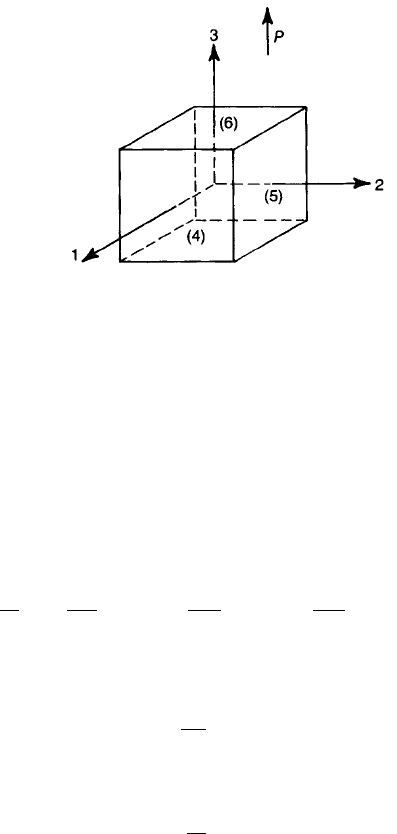
The convention is to define the poling direction as the 3-axis, as illustrated in
Fig. 6.2. The shear planes are indicated by the subscripts 4, 5 and 6 and are
perpendicular to directions 1, 2 and 3 respectively. For example, d
31
is the
coefficient relating the field along the polar axis to the strain perpendicular to it,
whilst d
33
is the corresponding coefficient for both strain and field along the polar
axis. Shear can only occur when a field is applied at right angles to the polar axis
so that there is only one coefficient, d
15
. There are also piezoelectric coefficients
corresponding to hydrostatic stress, e.g. d
h
¼ d
33
þ 2d
31
(see Section 6.4.6).
Since the elastic compliance (s) and stiffness (c) are tensor properties, in
general c
jk
6¼ 1/s
jk
; the exact relations are given in Eq. (6.54) and in the Appendix.
Since s
jk
¼ s
kj
and c
jk
¼ c
kj
, only six terms (s
11
, s
12
, s
13
, s
33
, s
44
, s
66
or c
11
, c
12
, c
13
,
c
33
, c
44
, c
66
) are needed for poled ceramics. Of these, s
66
and c
66
are irrelevant
because shear in the plane perpendicular to the polar axis produces no
PARAMETER S FOR PIEZOELECTRIC CERAMICS AND THEIR MEASUREMENT 347
piezoelectric response. Two sets of elastic constants are needed, one for short-
circuit and the other for open-circuit conditions, as indicated by superscripts E or
D respectively.
The Poisson ratios n are given
n
12
¼s
E
12
=s
E
11
v
13
¼s
E
13
=s
E
33
ð6:46Þ
Following the above conventions, Eqs (6.33) and (6.34) become
d
ij
g
ij
¼
@x
j
@E
i
!
X,T
,
@x
j
@D
i
!
X,T
¼
@D
i
@E
i
!
X,T
¼ e
X
ii
ð6:47Þ
For example,
d
31
g
31
¼ e
X
33
ð6:48Þ
Similarly
e
ij
h
ij
¼ e
x
ii
ð6:49Þ
Also, Eq. (6.29a) is expanded to
dD
1
¼ d
15
dX
5
þ e
X
1
dE
1
ð6:50aÞ
dD
2
¼ d
15
dX
4
þ e
X
1
dE
2
ð6:50bÞ
dD
3
¼ d
31
ðdX
1
þ dX
2
Þþd
33
dX
3
þ e
X
3
dE
3
ð6:50cÞ
The coefficients e
33
and e
31
can be expressed in terms of d
33
and d
31
from
Eq. (6.50c):
348 PIEZOELECTRIC CERAMICS
Fig. 6.2 Labelling of reference axes and planes for piezoceramics.

e
33
¼
@D
3
@x
3
!
E
¼ 2d
31
c
E
13
þ d
33
c
E
33
ð6:51Þ
e
31
¼
@D
3
@x
1
!
E
¼ d
31
ðc
E
11
þ c
E
12
Þþd
33
c
E
13
ð6:52Þ
A combination of Eqs (6.48), (6.49), (6.51) and (6.52) enables the coefficients e
and h to be calculated from the more usually quoted coefficients d and g.
The indirect effect given in Eq. (6.29b) expands to
dx
1
¼ s
E
11
dX
1
þ s
E
12
dX
2
þ s
E
13
dX
3
þ d
31
dE
3
ð6:53aÞ
dx
2
¼ s
E
11
dX
2
þ s
E
12
dX
1
þ s
E
13
dX
3
þ d
31
dE
3
ð6:53bÞ
dx
3
¼ s
E
13
ðdX
1
þ dX
2
Þþs
E
33
dX
3
þ d
33
dE
3
ð6:53cÞ
dx
4
¼ s
E
44
dX
4
þ d
15
dE
2
ð6:53dÞ
dx
6
¼ 2ðs
E
11
s
E
12
ÞdX
6
ð6:53eÞ
The stiffness coefficients can be derived from the compliances using the
following relations which hold for either open- or closed-circuit conditions and
also with the symbols c and s interchanged:
c
11
¼
s
11
s
33
s
2
13
fðsÞ
c
12
¼
s
12
s
33
s
2
13
f ðsÞ
c
13
¼
s
13
ðs
11
s
12
Þ
f ðsÞ
c
33
¼
s
2
11
s
2
12
f ðsÞ
c
44
¼
1
s
44
ð6:54Þ
where f ðsÞ¼ðs
11
s
12
Þfs
33
ðs
11
þ s
12
Þ2s
2
13
g.
For convenience the various property relationships are summarized in an
appendix to this chapter.
The values of the piezoelectric properties of a material can be derived from the
resonance behaviour of suitably shaped specimens subjected to a sinusoidally
varying electric field. To a good approximation the behaviour of the piezoelectric
PARAMETER S FOR PIEZOELECTRIC CERAMICS AND THEIR MEASUREMENT 349
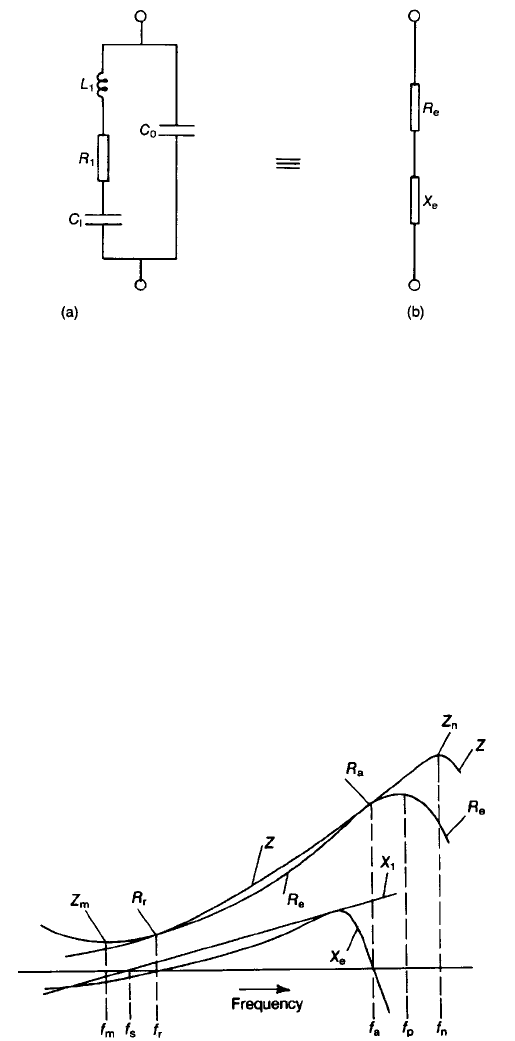
specimen close to its fundamental resonance can be represented by the equivalent
circuit shown in Fig. 6.3(a) [6].
There is an equivalence between the differential equations describing a
mechanical system which oscillates with damped simple harmonic motion and
driven by a sinusoidal force, and the series L
1
, C
1
, R
1
arm of the circuit driven by
a sinusoidal e.m.f. The inductance L
1
is equivalent to the mass (inertia) of the
mechanical system, the capacitance C
1
to the mechanical stiffness and the
resistance R
1
accounts for the energy losses; C
o
is the electrical capacitance of the
specimen. Fig. 6.3(b) is the equivalent series circuit representing the impedance of
the parallel circuit.
350 PIEZOELECTRIC CERAMICS
Fig. 6.3 (a) Equivalent circuit for a piezoelectric specimen vibrating close to resonance; (b)
the equivalent series components of the impedance of (a).
Fig. 6.4 The characteristic frequencies of the equivalent circuit exaggerating the differences
between f
m
, f
s
and f
r
and between f
a
, f
p
and f
n
.

The form of the frequency response of the electrical circuit, shown in Fig. 6.4,
has the following characteristic frequencies:
1. f
m
and f
n
when the impedance is, respectively, a minimum and a maximum,
and
2. the resonance frequency f
r
and antiresonance frequency f
a
when the reactance
of the circuit is zero.
The reactance of the mechanical arm is zero at the ‘series’ resonance frequency f
s
when joL
1
¼ 1/joC
1
; the parallel resonance f
p
occurs when the currents flowing
in the two arms are in antiphase, that is when jðoL
1
1/oC
1
Þ
1
¼1/joC
0
,or
when o ¼fðC
0
þ C
1
Þ/L
1
C
0
C
1
g
1=2
.
It follows from Eq. (6.44) and the equivalent circuit that
k
2
eff
¼ C
1
/ðC
1
þ C
0
Þð6:55Þ
and it can be shown that
k
2
eff
¼ C
1
/ðC
1
þ C
0
Þ¼ðf
2
p
f
2
s
Þ/ f
2
p
ðf
2
a
f
2
r
Þ/ f
2
a
ðf
2
n
f
2
m
Þ/ f
2
n
ð6:56Þ
Provided that the mechanical quality factor (see Fig. 5.34 for analogy) for the
resonator is sufficiently high (Q
m
5 100) the approximations apply.
Values for f
n
and f
m
are readily measured using an impedance analyser.
Specific (‘33’) coupling coefficient, compliance and permittivity values can be
measured on appropriately dimensioned specimens from which the correspond-
ing d and g coefficients can be calculated; the following examples illustrate how
this is accomplished.
In the case of a piezoelectric ceramic rod ( 5 mm diam. and 15 mm long)
electroded on its end faces and poled along its length, for the fundamental
resonance condition when there is a standing elastic longitudinal wave along the
length with antinodes at the ends and the centre a node, it can be shown that
k
33
¼
p
2
f
s
f
p
tan
p
2
f
p
f
s
f
p
(6:57)
The appropriate permittivity e
X
33
is easily determined from the capacitance C of
the specimen at a frequency well below resonance:
e
X
33
¼
Cl
A
ð6:58Þ
where l and A are the length and cross-sectional area of the rod respectively. The
elastic compliance s
D
33
is related to the parallel resonance frequency by
PARAMETER S FOR PIEZOELECTRIC CERAMICS AND THEIR MEASUREMENT 351