
Moulson A.J., Herbert J.M. Electroceramics: Materials, Properties, Applications
Подождите немного. Документ загружается.

1
s
D
33
¼ 4rf
2
p
l
2
ð6:59Þ
where r is the density of the material.
The other ‘33’ parameters can be calculated from the measured values of
k
33
, s
D
33
and e
X
33
and using Eqs (6.33), (6.39), (6.40) and (6.42).
A more common geometry is a thin disc of diameter d electroded over both
faces and poled in a direction perpendicular to the faces. The resonance on which
attention is focused is that of a radial mode, excited through the piezoelectric
effect across the thickness of the disc. In this case the route from the resonant
frequencies to the coefficients d and g is the same as in the case of the rod,
although the expressions are more complex.
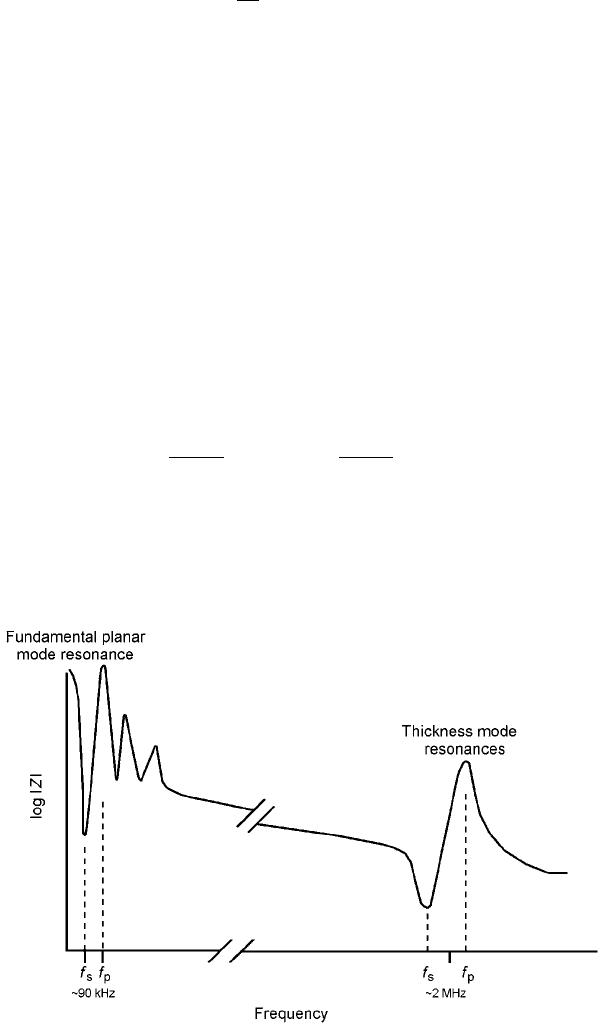
Figure 6.5 shows the typical frequency response for such a disc. The lower
frequency responses are radial resonances and the higher frequency response the
thickness mode resonance.
The planar coupling coefficient k
p
is related to the parallel and series resonant
frequencies by
k
2
p
1 k
2
p
¼ f
J
0
, J
1
,n
f
p
f
s
f
s
ð6:60Þ
where J
0
and J
1
are Bessel functions and n is Poisson’s ratio. The relationship
between k
p
and ( f
p
f
s
)/f
s
is shown in Fig. 6.6 for the case in which v ¼ 0:3.
Fortunately, the curve is very insensitive to v, and in the range 0.275n50.35 the
352 PIEZOELECTRIC CERAMICS
Fig. 6.5 A typical ‘impedance–frequency’ characteristic for a piezoelectric disc specimen
having diameter 25 mm and thickness 1 mm and poled through the thickness.
TEAMFLY
Team-Fly
®
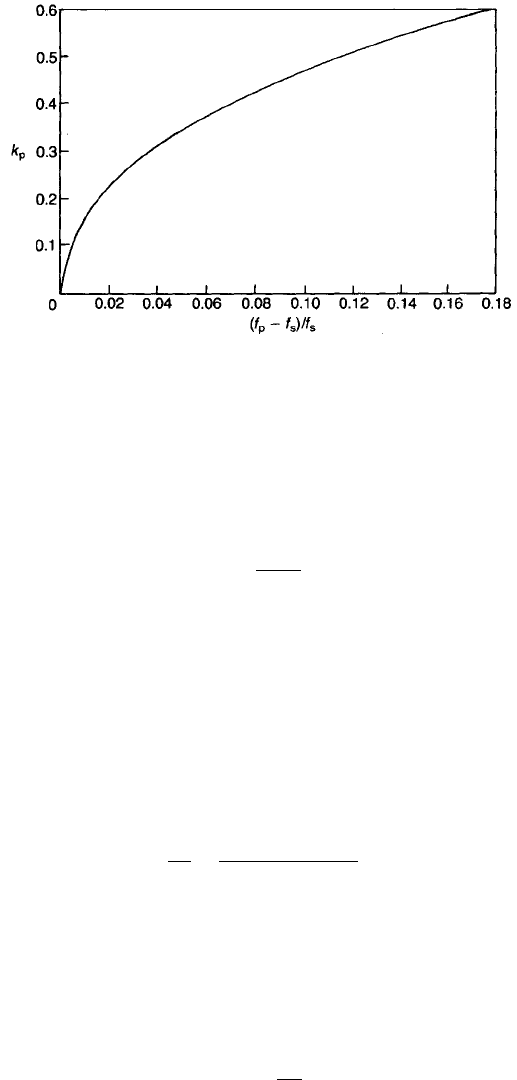
differences cannot easily be discerned; for the common piezoelectric ceramics
0.285v50.32.
With an assumed value for n k
31
can be calculated from
k
2
31
¼
1 v
2
k
2
p
ð6:61Þ
Alternatively, using Eq. (6.62), k
31
may be determined directly from the
resonance and antiresonance frequencies of a bar poled across its thickness and
using Eq. (6.62)
k
2
31
/ð1 k
2
31
Þ¼ðp/2Þð f
p
/f
s
Þtan fðp/2Þ½ð f
p
f
s
Þ/f
s
g ð6:62Þ
The measured k
31
and k
p
values, together with Eq. (6.61), then permit the
calculation of n.
The compliance, s
E
11
can be calculated using
1
s
E
11
¼
p
2
d
2
f
2
s
ð1 n
2
Þr
Z
2
1
ð6:63Þ
where Z
1
is a root of an equation involving the Bessel functions and the Poisson
ratio; it has a value of approximately 2. Then (cf. Eq. (6.39))
d
31
¼ k
31
ðe
X
33
s
E
11
Þ
1=2
ð6:64Þ
and (cf. Eq. (6.48))
g
31
¼
d
31
e
X
33
ð6:65Þ
PARAMETER S FOR PIEZOELECTRIC CERAMICS AND THEIR MEASUREMENT 353
Fig. 6.6 The planar coupling coefficient k
p
as a function of ðf
p
f
s
Þ=f
s
.

If the minimum impedance jZ
m
j at resonance is known, the mechanical Q
factor Q
m
can be obtained from the following equation:
1
Q
m
¼ 2pf
s
jZ
m
jðC
0
þ CÞ
f
2
p
f
2
s
f
2
p
4pDf jZ
m
j(C
0
þ CÞ
ð6:66Þ
The dielectric Q factor is the reciprocal of the dielectric dissipation factor tan d
(see Section 2.7.2).
Figure 6.5 shows the thickness resonances from which the coupling coefficient
(k
t
) can be calculated. This usually has a value in the range 0.45 to 0.5, that is
much smaller than typical k
33
values which lie in the range 0.65–0.75. The reason
for this is that in the case of a disc the thickness (‘longitudinal’) vibrations are in
effect partially clamped since they must be accompanied by planar distortions.
The longitudinal coupling coefficient k
33
is measured on more appropriately
dimensioned rods (see Eq. (6.57)) to minimize this clamping.
6.3 General Characteristics and Fabrication
of ‘PZT’
6.3.1 E¡ects of domains
The first piezoceramic to be developed commercially was BaTiO
3
, the model
ferroelectric discussed earlier (see Section 2.7.3). By the 1950s the solid solution
system Pb(Ti,Zr)O
3
(PZT), which also has the perovskite structure, was found to
be ferroelectric and PZT compositions are now the most widely exploited of all
piezoelectric ceramics. The following outline description of their properties and
fabrication introduces important ideas for the following discussion of the
tailoring of piezoceramics, including PZT, for specific applications. It is assumed
that the reader has studied Sections 2.3 and 2.7.3.
The Pb(Zr
17x
Ti
x
)O
3
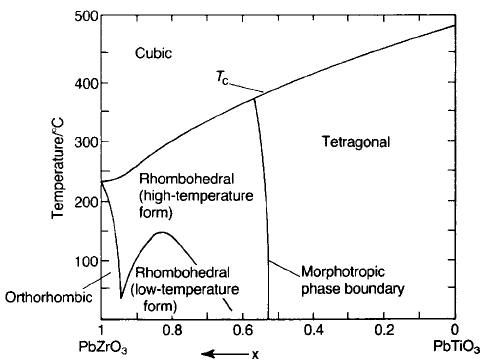
phase diagram [1] is shown in Fig. 6.7. The morphotropic
phase boundary (MPB) defines the composition at which there is an abrupt
structural change, the composition being almost independent of temperature.
That is the phase boundary between the high temperature rhombohedral and
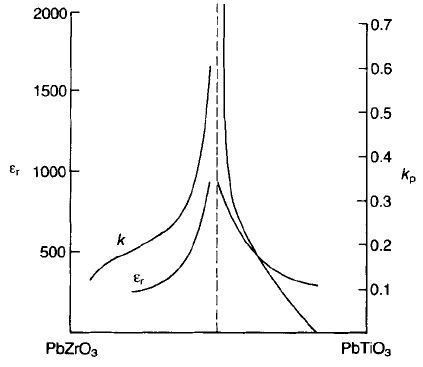
tetragonal forms is, practically speaking, a vertical line. As shown in Fig. 6.8, the
piezoelectric activity peaks in the region of the MPB composition and
considerable effort has been directed to elucidating the reason(s) for this
technically very important phenomenon.
The current understanding is that the MPB is not a sharp boundary but rather
a temperature-dependent compositional range over which there is a mixture of
tetragonal and monoclinic phases. At room temperature (300 K) the two phases
coexist over the range 0.4554x40.48 [7]. The enhanced piezoelectric activity of
354 PIEZOELECTRIC CERAMICS
the commercial compositions (x 0:48) can be rationalised in terms of the
relatively large ionic displacements associated with stress (electrical or
mechanical) – induced rotation of the monoclinic polar axis [8].
As a ferroelectric perovskite in ceramic form cools through its Curie point it
contracts isotropically since the orientations of its component crystals are
random. However, the individual crystals will have a tendency to assume the
anisotropic shapes required by the orientation of their crystal axes. This tendency
will be counteracted by the isotropic contraction of the cavities they occupy. As a
consequence a complex system of differently oriented domains that minimizes the
elastic strain energy within the crystals will become established.
The application of a sufficiently strong field will orient the 1808 domains in the
field direction, as nearly as the orientation of the crystal axes allows (see
Section 2.7.3). The field will also have an orienting effect on 908 domains in
tetragonal material and on 718 and 1098 domains in the rhombohedral form, but
the response will be limited by the strain situation within and between the crystals.
There will be an overall change in the shape of the ceramic body with an expansion
in the field direction and a contraction at right angles to it. When the field is
removed the strain in some regions will cause the polar orientation to revert to its
previous direction, but a substantial part of the reorientation will be permanent.
An externally applied stress will affect the internal strain and the domain
structures will respond; this process is termed the ferroelastic effect. Compression
will favour polar orientations perpendicular to the stress while tension will
favour a parallel orientation. Thus the polarity conferred by a field through 908
domain changes can be reversed by a compressive stress in the field direction.
Stress will not affect 1808 domains except in so far as their behaviour may be
coupled with other domain changes.
GENERAL CHARACTERISTICS AND FABRICATION 355
Fig. 6.7 Phase stabilities in the system Pb(Ti
17x
Zr
x
)O
3
. (After Jaffe et al. [1].)
A polar axis can be conferred on the isotropic ceramic by applying a static
field of 1–4 MV m
71
for periods of several minutes at temperatures usually
somewhat above 100 8C when domain alignment occurs. More rapid domain
movement takes place at higher temperatures but the maximum alignment of
908 domains takes some time to be established. The temperature is limited by
the leakage current which can lead to an increase in the internal temperature
and to thermal breakdown (see Section 5.2.2); the field is limited by the
breakdown strength. If the applied voltage exceeds about 1 kV it is necessary
to ensure very clean surfaces between the electrodes and to immerse the pieces
to be poled in an insulating oil. Surface breakdown takes place very readily
between electrodes on the surface of a high-permittivity material when it is
exposed to air.
Depoling can be achieved by applying a field in the opposite direction to that
used for poling or, in some cases, by applying a high a.c. field and gradually
reducing it to zero, but there is a danger of overheating because of the high
dielectric loss at high fields. Some compositions can be depoled by applying a
compressive stress (10–100 MPa). Complete depoling is achieved by raising the
temperature to well above the Curie point and cooling without a field.
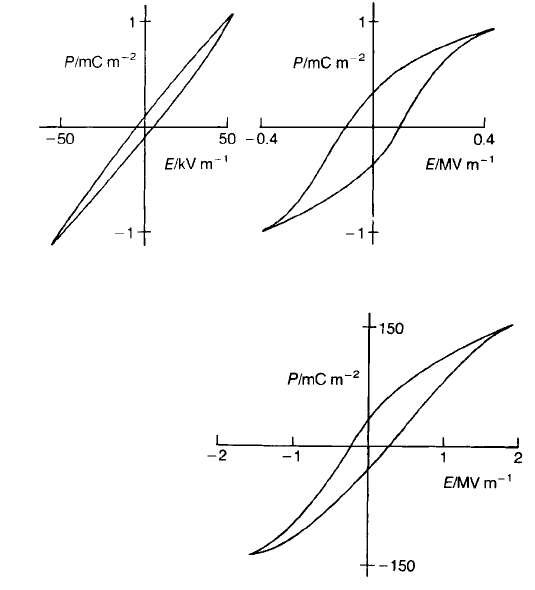
Alternating fields cause domain walls to oscillate. At low fields the excursions
of 908,718 or 1098 walls result in stress–strain cycles that lead to the conversion
of some electrical energy into heat and therefore contribute to the dielectric loss.
When peak fields are sufficient to reverse the spontaneous polarization the loss
becomes very high, as shown by a marked expansion of the hysteresis loop
(Fig. 6.9).
356 PIEZOELECTRIC CERAMICS
Fig. 6.8 Coupling coefficient k
p
and permittivity e
r
values across the PZT compositional
range. (After Jaffe et al. [1].)
‘Ageing’ (see Section 2.7.3) affects many of the properties of piezoelectric
ceramics. Most of the piezoelectric coefficients fall by a few per cent per decade
although the frequency constant increases. Ageing can be accelerated and
properties stabilized by heating to temperatures of about 80 8C in the case of
BaTiO
3
and rather higher for PZT.
Ageing effects are known to be significantly changed when the concentration
of vacant oxygen sites is increased either by doping or by heating in mildly
reducing atmospheres. It has been suggested that dipoles are formed between
negatively charged defects (e.g. Co
3+
on Ti
4+
sites) and the positively charged
V€
OO
, and that these are aligned in the polar direction by movement of the V €
OO
as a
result of the combined action of the local field associated with P
s
and thermal
energy. The dipoles then provide an internal field stabilizing the domain
configuration thereby reducing ageing rate.
An alternative mechanism is based on the local stresses that are caused by the
development of axial anisotropy within the grains as they cool below T
C
. Lower-
energy domain configurations may be generated by phonon action at room
temperature and might be assisted by a high concentration of V
O
. Another
GENERAL CHARACTERISTICS AND FABRICATION 357
Fig. 6.9 P–E loops with increasing peak field strengths at 50 Hz for a ceramic ferroelectric.

suggestion has been that defects such as V
O
may diffuse to the domain walls and
stabilize them. The first of these mechanisms, dipole formation and rotation, is
assumed in the next section.
6.3.2 E¡ects of aliovalent substituents
The effect of substituents is a complex matter but, with caution, a number of
important generalizations can be made regarding aliovalent substituents in
perovskites.
Donor dopants, i.e. those of higher charge than that of the ions they replace,
are compensated by cation vacancies; acceptors, i.e. dopants of lower charge
than that of the replaced ions, are compensated by oxygen vacancies. Each
dopant type tends to suppress the vacancy type that the other promotes. The
common dopants in perovskite-type ceramics are listed in Table 6.1. The effects
of aliovalent substituents are discussed in Section 2.6.2.
The significant difference between oxygen vacancies and cation vacancies in
perovskite-type structures is the higher mobility of the former. Cations and
cation vacancies tend to be separated by oxygen ions so that there is a
considerable energy barrier to be overcome before the ion and its vacancy can be
interchanged. Oxygen ions, however, form a continuous lattice structure so that
oxygen vacancies have oxygen ion neighbours with which they can easily
exchange.
Typical concentrations of dopants (0.05–5 at.%) must result in the formation
of dipolar pairs between an appreciable fraction of the dopant ions and the
vacancies, e.g. 2La_
A
–V
00
A
or 2Fe
3þ
0
B
–V€
OO
. Donor–cation vacancy combinations can
be assumed to have a stable orientation so that their initially random state is
unaffected by spontaneous polarization or applied fields. Acceptor–oxygen
vacancy combinations are likely to be less stable and thermally activated
reorientation may take place in the presence of local or applied fields. The
dipoles, once oriented in a common direction, will provide a field stabilizing the
domain structure. A reduction in permittivity, dielectric and mechanical loss and
an increase in the coercive field will result from the inhibition of wall movement.
Since the compliance is affected by the elastic movement of 908 walls under
stress, it will also be reduced by domain stabilization.
358 PIEZOELECTRIC CERAMICS
Table 6.1 Common aliovalent substituents
A-site donors La
3+
,Bi
3+
,Nd
3+
B-site donors Nb
5+
,Ta
5+
,Sb
5+
A-site acceptors K
+
,Rb
+
B-site acceptors Co
3+
,Fe
3+
,Sc
3+
,Ga
3+
,Cr
3+
,Mn
3+
,Mn
2+
,Mg
2+
,Cu
2+
Donor doping in PZT would be expected to reduce the concentration of oxygen
vacancies, leading to a reduction in the concentration of domain-stabilizing defect
pairs and so to lower ageing rates. The resulting increase in wall mobility causes
the observed increases in permittivity, dielectric losses, elastic compliance and
coupling coefficients, and reductions in mechanical Q and coercivity.
The introduction of oxygen vacancies through acceptor doping also leads to a
slight reduction in unit-cell size, which tends to reinforce the effects referred to
above.
Some indication of the real complexities is afforded by the different responses
of BaTiO
3
and PZT to the addition of donors such as La
3+
(see Section 2.6.2). In
PZT PbO lost by volatilization during sintering can be replaced in the crystal by
La
2
O
3
. For example, if the excess positive charge of the La
3+
is balanced by lead
site vacancies,
0.01La
2
O
3
þ PbðTi,ZrÞO
3
!ðPb
0:97
La
0:02
V
0:01
ÞðTi,ZrÞO
3
þ 0.03PbO "
Thus the lanthanum dopant is vacancy compensated and no electronic charge
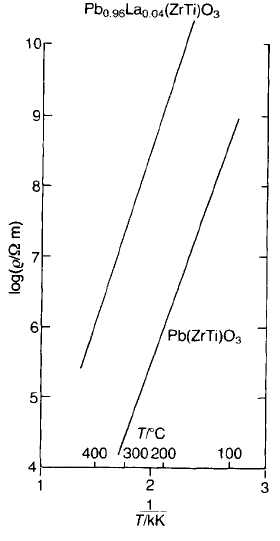
carriers are generated. As shown in Fig. 6.10, La substitution results in a marked
increase in the resistivity of PZT.
GENERAL CHARACTERISTICS AND FABRICATION 359
Fig. 6.10 The effect of lanthanum addition on the resistivity of PZT. (After J.C. Jaffe et al. [1].)
Lead lanthanum zirconate titanates (PLZT) containing 3–12 mol.% La and 5–
30 mol.% Ti form a class of ceramics with important dielectric, piezoelectric and
electro-optic properties. They may contain vacancies on B as well as A sites and
have a remarkable facility for changing their polar states under the influence of
applied fields.
In contrast, in BaTiO
3
, in which the volatility of the constituents during
sintering is low, small concentrations (51 mol.%) of donors are compensated by
electrons in the conduction band with an accompanying change of colour from
pale yellow to grey or black. However, higher donor concentrations lead to two
effects: a decrease in crystal size in ceramics sintered to full density, and an
increase in resistivity above that for undoped BaTiO
3
together with a reversion to
the pale colour. The enhancement of permittivity and piezoelectric coupling
coefficient that occurs with PZT does not occur with donor-doped BaTiO
3
.It
appears that at higher donor concentrations the formation of cation vacancies
becomes energetically favoured. At present there is no widely accepted
explanation of this very pronounced difference in behaviour between PZT and
BaTiO
3
.
360 PIEZOELECTRIC CERAMICS
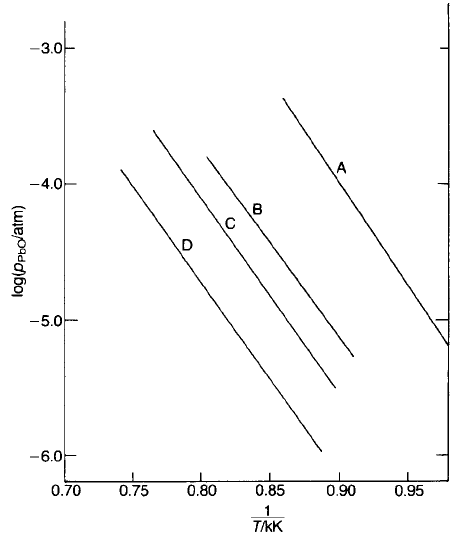
Fig. 6.11 Vapour pressure of PbO over lead-containing ceramics: curve A, solid PbO; curve
B, PbZrO
3
; curve C, Pb(Ti
0.45
Zr
0.55
)O
3
; curve D, PbTiO
3
.
6.3.3 Fabrication of PZT
Normal powder technology is used in the fabrication of piezoelectric ceramics.
The highest values of the coefficients are obtained when the composition is near
stoichiometric, the content of fluxing reagents and impurities is minimal, and the
density is as high as possible. Contamination during milling is kept low by using
zirconia-based milling media.
Most of the compositions used at present contain PbO as a major constituent.
Despite its volatility above 800 8C (Fig. 6.11), the PbO must be retained during
sintering at temperatures up to 1300 8C. A.I. Kingon and B. Clark [9] address in
some detail the matter of ‘atmosphere control’ with regard to firing PZT, and the
effect of PbO content on densification kinetics. Calcination is usually carried out
in lidded alumina pots. For the final sintering the ‘work’ is surrounded by a lead-
rich powder, such as PbZrO
3
, and again placed in closed saggars. Because of the
limited access to the atmosphere that results and the ease with which PbO is
reduced to metallic lead, all organic constituents must be removed before
sintering by a preliminary firing at about 600 8C in air. The final firing is usually
carried out in batch-type electric kilns well filled with ‘work’. Despite
precautions, there is normally a loss of 2–3% of the initial PbO content which
is compensated by an addition to the starting materials.
An alternative to firing in closed vessels is very rapid firing in which the material,
carried on a moving belt, is exposed to a high peak temperature for a brief period
in a special kiln. This procedure is applicable to thin sheets of material.
A further difficulty with compositions containing substantial amounts of ZrO
2
results from the low reactivity of some grades of the material. The TiO
2
powders,
developed as pigments, react rapidly with PbO, and the resulting titanates only
take up Zr
4+
ions slowly from unreacted ZrO
2
. Grades of ZrO
2
are available
which have not been calcined at high temperatures during their preparation and
which therefore react more rapidly with PbO so that a mixed Pb(Zr,Ti)O
3
is
formed at an early stage. The problem can also be alleviated by prolonged
milling during the mixing stage and by a second calcination after milling the
product of an initial firing.
All the constituents of a PZT composition can be precipitated from nitrate
solutions to yield highly homogeneous reactive powders. Such powders can also
be prepared by calcining citrates that contain the A- and B-site ions in a 1:1 ratio.
It is possible to sinter at lower temperatures using these materials and, apart
from the economy in energy, this has the advantage of lessening the loss of PbO
through volatilization. However, sintered bodies adequate for the majority of
piezoelectric applications are obtained by the lower-cost route starting from a
mixture of oxides or carbonates.
Simple shapes are formed by die-pressing, long bodies of uniform section are
formed by extrusion, thin plates are formed by band-casting or calendering, and
large rings and more intricate shapes are formed by slip-casting.
GENERAL CHARACTERISTICS AND FABRICATION 361