
Moulson A.J., Herbert J.M. Electroceramics: Materials, Properties, Applications
Подождите немного. Документ загружается.

of Li
2
O from the crystals. They are poled by applying pulsed fields of about
1kVm
71
whilst cooling through the Curie point.
LiNbO
3
is grown in a similar manner but using a pure platinum crucible in air.
Rhodium, with which platinum is usually alloyed to improve its high-
temperature strength, dissolves to some extent in LiNbO
3
. Poling can be carried
out by passing a current of a few milliamperes through the crystal during growth
or by applying a field of about 0.3 kV m
71
at 1190 8C for 10 min.
The congruent melt composition for both LiTaO
3
and LiNbO
3
is low in
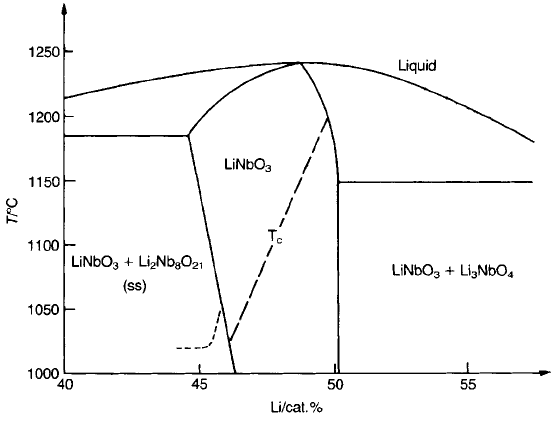
lithium. The phase diagram near the stoichiometric composition for LiNbO
3
is
shown in Fig. 6.18. The congruent composition Li
0.95
TaO
2.975
is satisfactory for
piezoelectric applications. Growth from melts with higher lithium contents has
the problem that the lithium concentration in the melt increases during growth.
However, as the solid solubility of Li
2
O in crystals is low, highly homogeneous
crystals with Li/Ta and Li/Nb ratios close to unity can be grown from melts with
high Li
2
O contents. 1% MgO is often added to LiNbO
3
melts as it assists the
growth of crack-free crystals and improves their non-linear optical behaviour.
Suitably oriented slices cut from LiTaO
3
crystals have low-temperature
coefficients of shear mode resonant frequency and have been made into
high-stability wave filters. The surface of single-crystal LiNbO
3
, which is readily
prepared with a high degree of smoothness, can be used as the substrate for surface
acoustic wave devices such as the intermediate frequency stages in television
receivers. The high Curie point of LiNbO
3
makes it a valuable high-temperature
vibration detector, for instance in the heat exchangers of nuclear reactors.
372 PIEZOELECTRIC CERAMICS
Fig. 6.18 Phase diagram for LiNbO
3
as determined for crystal growth.
TEAMFLY
Team-Fly
®
LiNbO
3
possesses a useful combination of piezoelectric and electro-optical
properties that enable the development of devices using visible or near-infrared
radiation for the logical processing of information and the routing of channels in
telecommunications (see Section 8.3.5).
6.4.6 Piezoceramic^polymer composites
General background
The following discussion should be supplemented by reference to the article by
T.R. Gururaja et al. [4], one of the contributing authors being R.E. Newnham, a
pioneer in the field of piezoelectric composites.
It is instructive to compare the basic properties of the piezoelectric polymer,
polyvinylidene fluoride (PVDF) with those of ‘PZT’. The flexibility and low
density of the polymer contrasts with the stiffness, brittleness and high density of
‘PZT’. On the other hand the piezoelectric ‘d ’ coefficient for PVDF is relatively
small (30 pC N
1
; the mechanisms by which the polarisation in PVDF
changes differ from those in PZT accounting for the different algebraic sign).
However, because the relative permittivity of PVDF is low (10) compared to
that of ‘PZT’ the voltage coefficients are similar in value.
Composite technology in general sets out to combine materials in such a way
that the properties of the composite are the optimum for a particular
application. The property, whether mechanical, thermal, electrical etc., is
determined by the choice of component and their relative amounts and, most
importantly, the ‘connectivity’, that is the manner in which the components are
interconnected.
Piezoceramic–polymer composites are a relatively recent addition to the range
of composite materials and have been developed principally because their
properties offer advantages, especially for sonar and medical ultrasonic imaging
technologies, over those of the piezoceramics alone. For these applications the
transducer is usually interfacing with water or soft tissue, for example body skin.
The advantages include relatively good acoustic matching between transducer
and medium, improved electromechanical coupling coefficient and higher band-
width, the last allowing the engineering of well-defined ultrasonic pulses and in
consequence good temporal and spatial resolution.
Sonar and imaging transducers transmit into and receive ultrasound energy
from the surrounding medium and so are generating and experiencing
hydrostatic pressure changes. The corresponding coefficients of significance are
d
h
and g
h
, the former being a measure of the effectiveness of the transducer as a
transmitter and the latter as a receiver. Because the transducer is required to be
effective in both modes it is customary to introduce the product d
h
g
h
as a ‘figure
of merit’ useful for comparing materials for this application. There are other
IMPORTANT COMMERCIAL PIEZOCERAMICS 373

critical considerations including the sharpness of the rise-time of the emitted
pulse and the extent of the ‘ringing’ following the pulse. Unacceptably long
‘ringing’ would interfere with receiving a well-defined echo. The low mechanical
Q of a polymer plays an important role in achieving good pulse characteristics.
It follows from a consideration of Fig. 6.2, assuming cylindrical symmetry
about the poling direction, that
d
h
¼ d
33
þ 2d
31
ð6:67Þ
and, from Eq. (6.33)
g
h
¼ d
h
/e ð6:68Þ
It is apparent from Eq. (6.67) and the data in Table 6.5 that because of the strong
‘cross-coupling’ (this term describes the coupling of the piezoelectric effects in the
‘3’ and ‘1’ (or ‘2’) directions) and consequently the magnitude and sign of the d
31
coefficients relative to those of the d
33
, the hydrostatic coefficients for the
common ‘PZT’ family of piezoceramics are small. It is also clear that because of
the large values of permittivity the g
h
coefficients also tend to be small. However,
through appropriate composite design it is possible to very significantly increase
the figure of merit, d
h
g
h
.
The other important consideration concerns the transmission of ultrasound
(and other forms of energy) from one medium to another and the importance of
‘impedance matching’. When wave energy is transferred from one medium to
another then a part is transmitted and the rest reflected. The ratio of reflected to
transmitted energies depends on the characteristic impedances of the two media
and the transmission is total if these are matched. In the case of acoustic waves the
specific impedance (Z) of a medium is given by the product of the density r and the
velocity of sound
v*. that is
Z ¼ r
v ð6:69Þ
Z is measured in ‘rayl’ (after Lord Rayleigh) and for water it has the value
approximately 1.5 Mrayl (r ¼ 1000 kg m
3
and v 1500 m
2
s
1
); in the case of a
typical ‘PZT’, Z is approximately 35 Mrayl and so the two are poorly matched.
In contrast, for polymers Z is typically approximately 3.5 Mrayl and so the
acoustic match with water is far better. A further disadvantage of PZT is the high
Q
m
which is unsuited to the detection of sharp pulses because of the associated
and troublesome ‘ringing’ effects.
The concept of ‘connectivity’ is discussed in Section 2.7.4 and in [4]. There are
10 different ways of connecting the phases in a two-phase composite, each
described by two numbers, the first defining (in the present context) how the
active ceramic phase is connected and the second how the passive polymer phase
374 PIEZOELECTRIC CERAMICS
* It is customary for transducer engineers to use c for the velocity of sound; in the present text c is
reserved for the velocity of light.
is connected. Here attention is confined to the two most commonly encountered
connectivities, 0–3 and 1–3.
A 0–3 composite consists of discrete piezoceramic particles dispersed in a
polymer; the isolated particles have zero connectivity and the polymer matrix 3-
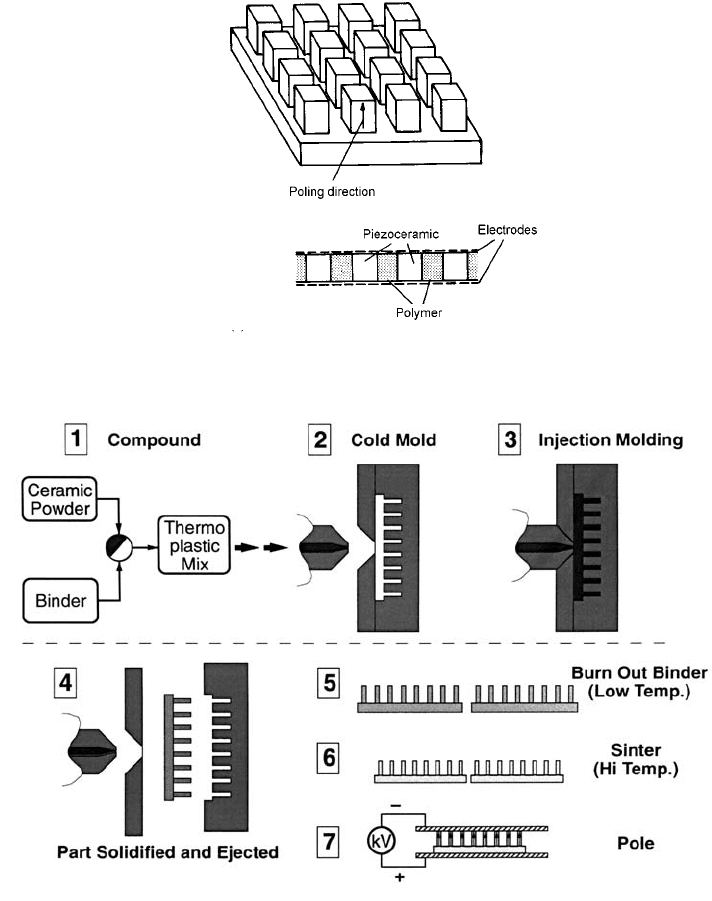
dimensional connectivity. A 1–3 composite consists of piezoceramic rods
extending from electrode to electrode and embedded in a polymer, as shown
in Fig. 6.19. The rods have one-dimensional connectivity and the polymer again
3-dimensional connectivity. Some important considerations concerning the two
types are summarized below.
0^3 composites
Probably the major positive attributes of 0–3 composites are their ease of
manufacture and conformability, and in the latter respect they are similar to
PVDF. As the volume fraction of piezoceramic particles, poled in the same
direction, is increased so too, of course the d coefficient of the composite
increases. However the increase in permittivity accompanying the loading of high
permittivity particles in a low permittivity matrix leads to a progressive decrease
in the g coefficient. Consequently there is an optimum particle loading as far as
maximizing d
h
g
h
is concerned.
Poling a high permittivity particle embedded in a low permittivity matrix
presents a technical problem. When an electric field is applied to such a composite
the local field is high in the low permittivity component and low in the high
permittivity component (the student should recall that the normal component of
the electric displacement vector D (eE) does not change in value as a boundary
between two different dielectrics is crossed). For a ‘PZT’ particle in a polymer
matrix the electric field experienced by the particle – the poling field – might well
be between a factor of a 100 and 1000 (depending upon its shape and orientation
with respect to the field) lower than that in its surroundings. Ways have been
found to overcome this problem [4].
Although 0–3 composites are relatively little used they can be exploited for low
technology applications such as pressure-sensitive pads.
1^3 composites
Composites having 1–3 connectivity are successfully exploited in sonar (‘sound
navigation and ranging’), medical imaging technologies, NDT, etc. Important
matters crucial to the satisfactory functioning of a 1–3 composite are briefly
summarized below where, to illustrate the ideas, it is assumed the composite is
operating as a sonar device, that is under ‘hydrostatic’ conditions. The subject
matter is discussed in detail by W.A. Smith [16].
IMPORTANT COMMERCIAL PIEZOCERAMICS 375
1. The composite is one part of a system and has to interface with and properly
match the ‘drive’ and ‘sensing’ circuitry. This requires the electrical
capacitance of the composite component to be tailored.
2. Because the piezoceramic rods are continuous from electrode to electrode
(Fig. 6.19(a)) poling presents no problem.
3. Because of the very large differences in mechanical compliance between the two
phases, the hydrostatic pressures experienced by the polymer phase transferforces
to the rods magnifying the stress in them in the poled direction. This magnified
stress increases the charge induced on to the electrode tending to compensate for
the inactive polymer. As a result, in typical practical cases, the piezoelectric charge
coefficient (d
33
) is not very sensitive to volume fraction of ‘PZT’.
Also, because the polymer bears a fraction of the forces due to the lateral pressure,
the ‘negative’ d
31
-effect is reduced compared to that which would be experienced
by the ceramic alone and subjected to the same hydrostatic pressure. To enhance
this advantage ways are found to engineer an increase in stiffness of the composite
in the ‘1’ and ‘2’ directions.
A further significant related benefitderives fromthe fact that the rods are long and
thin. As discussed in Section 6.2, a thin rod is not as laterally self-clamped as a
cylinder of smaller length-to-diameter ratio (in the extreme, a disc).
4. In contrast to d
33
, the permittivity of the composite is strongly dependent
upon volume fraction of ‘PZT’ (see Eq. 2.127) and therefore so too is the
voltage coefficient (g
33
).
5. It follows that the ‘figure of merit’ d
h
g
h
can be significantly increased in
comparison to that for the PZT alone.
6. The size-scale of the structure is critical for two reasons:
(a) it influences the effectiveness of the stress-transfer referred to in 3 above,
and
(b) it determines the way in which the vibrational energy is distributed within
the transducer and how this depends upon frequency. (The reader should
have in mind that the attenuation (and hence range) of a sound wave
propagating in water depends upon the frequency; also the resolution
with regard to detecting a reflecting object depends upon wavelength, and
so too on frequency.)
With regard to 6(a), it is self evident that at a large rod-spacing much of the
energy received by the composite is wasted deforming the inactive polymer. In
the case of 6(b) the matter is more complex. When the composite is active in
376 PIEZOELECTRIC CERAMICS
the ‘receive’ mode, that is when vibrational energy is incident on the
composite, or when it is energized in the ‘transmit’ mode, ideally the energy is
located entirely in the thickness vibration, the composite disc vibrating in a
piston-like manner. But as the rods vibrate longitudinally they excite the
propagation of unwanted transverse (shear) waves in the polymer and it is
necessary to consider how these waves interact with a periodic structure. (The
student might recognize that the essential underlying physics is the same as
that describing X-ray diffraction, and also the propagation of electron waves
in a crystal.) As expected, there are frequencies for which the waves cannot
propagate in the plane of the composite because of interference effects. The
periodicity of the lattice of rods introduces frequency ‘stop-bands’, that is
frequency ranges over which the shear waves in the polymer cannot be
sustained. If the rod spacing is d then the first stop-band occurs at a wave
number p/d the second at 2p/d and so on. ‘Wave number’ is simply the
reciprocal of the wavelength and so the first stop band occurs for a wavelength
d/p and the second at half this wavelength, and so on. The dimensions of the
transducer, and the periodicity of the array of rods, are chosen so that the
shear waves are suppressed.
Preventing the excitation of the transverse waves not only reduces the wastage
of acoustic energy but, more importantly, prevents the development of
spurious signals.
It follows therefore that the higher the operating frequency of the composite
plate, the finer must be the size scale of the rod array.
7. Sonar and imaging technologies are based on sending out ultrasound pulses
and receiving the echoes. The resolution capabilities depend upon the emitted
pulses being sharp, and the sharper the pulse the more Fourier components it
has. Therefore, for a transducer to emit and detect a sharp pulse it must be
able to respond to a wide frequency range – that is it must have the ‘broad
band’ characteristic associated with low mechanical Q. The very ‘lossy’ nature
of the polymer phase endows the composite with this (Q510).
Fabrication of piezoceramic^polymer composites
The fabrication of a 0–3 composite is straightforward involving essentially the
dispersal of piezoceramic particles in a polymer and forming the mix into a shape
by casting, moulding, extrusion, tape-casting, calendering, etc. However, the
variables are many and include composition of the ceramic particle, its shape and
volume fraction; in the case of non-equiaxed particles then texture (the
orientation of the particles with respect to the poling direction) is very significant
IMPORTANT COMMERCIAL PIEZOCERAMICS 377
and so too is the incorporation of porosity to tailor compliance in a controlled
way. These matters are discussed in reference [4].
In the case of 1–3 composites the variety of approaches to fabrication depend
very much on the imagination and ingenuity of the fabrication technologist. For
378 PIEZOELECTRIC CERAMICS
(b)
Fig. 6.19 (a) 1–3 piezoceramic–polymer composite. (b) Fabricating the rod array for a 1–3
piezoceramic–polymer composite by injection-moulding. (Courtesy of Materials Systems Inc.
Littleton MA; the ‘MSI’ website: www.matsyinc.com is an excellent source of information.)
(a)

a comprehensive discussion the reader is referred to the paper by V.E. Janas and
A. Safari [17].
An obvious fabrication approach is the ‘dice-and-fill’. A piezoceramic plate is
diced into an array of square-section pillars standing on the undiced base of the
plate. The structure is then in-filled with the chosen polymer after which the base
is ground away to produce the structure shown in Fig. 6.19(a). Typically rods of
thickness down to approximately 100 mm can be diamond-machined in this way.
In another approach extruded and sintered rods in reasonable lengths
(100 mm) are arranged in a jig, in-filled with the polymer the composite then
being sliced into individual transducer plates. Again the lower limit on the rod
diameter is approximately 100 mm.
Fine-scale arrays (550 mm) have been produced by first making a metal
master by hard X-ray lithography. This constitutes the mould from which a
polymer ‘negative’ array is made. The piezoceramic powder slurry or paste is
formed in the ‘sacrificial’ polymer mould which is subsequently burnt away in a
presintering heating stage.
The most successful approach and the one suited to economic mass production
is by injection-moulding (see Section 3.6.8), as illustrated in Fig. 6.19(b), and
composites having rod diameters down to 100 mm are produced by this route.
The high values of the ‘d
h
g
h
’ figure of merit offered by piezoceramic–polymer
composites can be appreciated from Table 6.4.
6.4.7 Summary of properties
The useful properties of some of the important single-phase piezoceramics are
summarized in Table 6.5. The values for BaTiO
3
and the PZT range are taken
from manufacturers’ data sheets where precise compositions are, of course, not
revealed; other values are from the literature.
IMPORTANT COMMERCIAL PIEZOCERAMICS 379
Table 6.4 Comparison of the properties of piezoelectric materials
Composite/piezoceramic Connectivity Relative
permittivity
g
h
/mV m N
1
d
h
/pC N
1
d
h
g
h
/10
15
Pa
1
‘PZT’ (Navy type VI) – 3200 1.5 45 68
PbTiO
3
ceramic * – 230 23 47 1080
PbNb
2
O
6
ceramic * – 225 33 67 2200
15 vol.%PZT rods–
polyurethane
1–3 460 66 268 17 700
PbTiO
3
–rubber 0–3 45 100 40 4000
PVDF – 10 150 14 2100
* Modified compositions.

380 PIEZOELECTRIC CERAMICS
Table 6.5
Typical values of the properties of some piezoelectric materials
Property Unit
a-Quartz
a
BaTiO
3
PZT A
b
PZT B
b
PbNb
2
O
6
Na
1/2
K
1/2
NbO
3
LiNbO
3
a
LiTaO
3
a
PbTiO
3
c
Density Mg m
3
2.65
5.7 7.9 7.7 5.9
4.5 4.64 7.46 7.12
T
c
8C
130 315 220 560
420
d
1210 665 494
e
X
r33
4.6
1900 1200 2800 225
400 29 43 203
e
X
r11
1600 1130 – –
600 85 53 –
tan
d 10
3
7 3 16 10
10 –
– 22
k
p
0.38 0.56 0.66 0.07
0.45 0.035 0.1 –
k
31
0.21 0.33 0.39 0.045
0.27 0.02 0.07 0.052
k
33
0.49 0.68 0.72 0.38
0.53 0.17 0.14 0.35
k
15
0.44 0.66 0.65 –
– 0.61 – 0.36
(11)
e
0.1
k
jk
(14)
e
0.05
d
31
-79
119
234 11
50
0.85
3.0
7.4
d
33
pC N
1
190 268 480 80
160 6
5.7 47
d
15
270 335 – –
– 69 26 –
d
jk
(11)
e
2.3
(14)
e
0.67
Q
m
410
6
500 1000 50 11
240 –
– 326
s
E
11
12.8
8.6 12.2 14.5 29
9.6 5.8 4.9 11
s
E
12
mm
2
N
1
1.8
2.6 4.1
5.0 –
– 1.2
0.52 –
s
E
13
1.2
2.9 5.8
6.7
5to8–
1.42
1.28 –
s
E
33
9.6
9.1 14.6 17.8 25
10 5.0 4.3 11
s
E
44
20.0
23 32 – –
– 17.1 10.5 –
a
Single crystals.
b
PZT A and PZT B are two typical PZT materials illustrating
, in particular, the wide range of achievable
Q
m
values.
c
+5 mol.% Bi
2/3
Zn
1/3
Nb
2/3
O
3
.
d
Depoles above 1808
C.
e
Numbers in parentheses are
jk
values.
6.5 Applications
Devices exploiting piezoceramics have been developed for the generation of high
voltages, electromechanical actuators and sensors, frequency-control and the
generation and detection of acoustic and ultrasonic energy. In the following
sections some typical examples are chosen for detailed descriptions, not only
because of their technical importance but also because they provide the
opportunity to illustrate important ideas. Reference to the monographs by
J.M. Herbert [2] and K. Uchino [18] is recommended to supplement the
discussions.
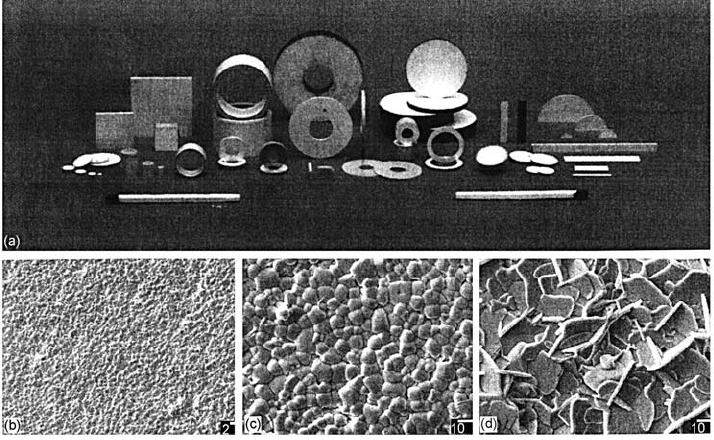
A selection of piezoceramic pieces and components is shown in Fig. 6.20.
APPLICATIONS 381
Fig. 6.20 (a) Piezoceramic parts for a range of applications including accelerometers,
underwater acoustics, pressure and liquid level sensors, medical diagnostics and therapeutics
and NDT; the ultrasound focusing bowls are for medical imaging and for producing high-
intensity focused ultrasound.
High-quality, pore-free microstructures of PZ – PT piezoceramic, (b) and (c), are essential
for reliable, high-performance applications, e.g. composites and arrays where very small
elements are cut from larger pieces (e.g. see Fig. 6.36); (d) the layer–structured bismuth
titanate ferroelectric (Bi
4
Ti
3
O
12
); T
c
6508C; the crystal structure consists of ‘perovskite layers’
separated by bismuth oxide layers) is exploited in high-temperature applications, including
accelerometers and flow-meters (reproduced with permission of Ferroperm Piezoceramics A/S,
Denmark).