
Moulson A.J., Herbert J.M. Electroceramics: Materials, Properties, Applications
Подождите немного. Документ загружается.

The sintered product usually has a density higher than 95% of theoretical and
a crystallite size in the 5–30 mm range. Both an excess and a deficiency of PbO
result in inferior piezoelectric properties so that careful control of all aspects of
the manufacturing process is essential.
Electrodes are applied after any necessary machining to shape or finishing. For
the majority of applications a suitably formulated silver-bearing paint is fired on
at 600–800 8C. In the case of thin pieces, Ni–Cr or gold electrodes can be applied
by sputtering or evaporation.
Poling takes place with the specimens immersed in transformer oil at 100–
150 8C and with an applied field of 1–4 MV m
71
. In the case of BaTiO
3
the field
must be maintained whilst cooling to some 50 8C below the Curie point. For PZT
the temperature and voltage are optimized to give the maximum piezoelectric
coefficients without allowing the leakage current to reach levels that could result
in thermal runaway and electrical breakdown. Higher fields can be used if they
are applied as a succession of short pulses.
Corona poling can also be used. In this case voltages of order 10
4
V are applied
to either a single needle or an array of needles with their points a few millimetres
from the ceramic surface; the opposite side of the ceramic is earthed. In this way
a high field is established in the ceramic. The advantage that corona poling offers
is a diminished risk of electrical breakdown. This is because the poling charge
cannot be quickly channelled to a ‘weak spot’, as it could be if it were to be
carried on a metallic electrode.
6.4 Important Commercial Piezoceramics
Compositions, composites and devices have been developed for the four main
uses of piezoceramics:
1. the generation of voltages;
2. electromechanical actuation;
3. frequency control;
4. the generation and detection of acoustic and ultrasonic energy.
The specific requirements to optimize performance for the various applications
are discussed in the following sections.
6.4.1 Barium titanate
BaTiO
3
was the first material to be developed as a piezoceramic and was used on
a large scale for application 4 above. For most commercial purposes it has been
362 PIEZOELECTRIC CERAMICS
TEAMFLY
Team-Fly
®
superseded by PZT, although its ‘lead-free’ composition is attractive from the
‘health and safety’ perspective.
The structural transitions which occur in BaTiO
3
(see Section 2.7.3) are
accompanied by changes in almost all electrical and mechanical properties. The
transition temperatures can be altered by substitutions on the A and B sites, and
for many applications it is necessary to move them away from the working
temperature ranges so that the associated large temperature coefficients are
avoided. The cubic–tetragonal and orthorhomic–rhombohedral transitions occur
well away from normal working temperatures, but the tetragonal–orthorhombic
transition occurs close to them. The substitution of Pb and Ca for Ba lowers this
transition temperature and has been used to control piezoelectric properties
around 0 8C which is important for underwater detection and echo sounding.
The substitution of Zr or Sn for Ti raises both the tetragonal–orthorhomic and
orthorhomic–rhombohedral transitions. Raising the former to above the
working-temperature range yields enhanced piezoelectric properties provided
that the poling is effected below this temperature range and that it is not
subsequently exceeded. In the past such compositions have found widespread use
as bimorphs for record-player pick-up cartridges.
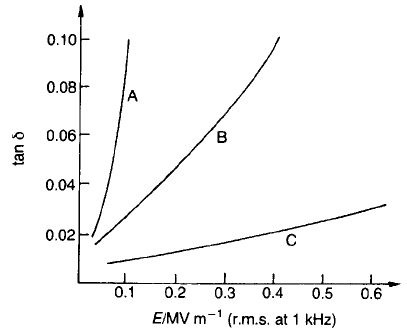
Technically pure BaTiO
3
(Fig. 6.12), or BaTiO
3
doped with isovalent
substituents, generally has too high a loss at the high field strengths (0.2–
0.4 MV m
71
) required to generate useful ultrasonic powers. The dielectric loss
arises largely from the movement of domain walls. The control of the high-field
loss is therefore a matter of controlling domain wall movement.
As discussed above, the introduction of acceptor dopants leads to domain wall
clamping. Manganese reduces the low-field loss (see Section 5.7.1) but has little
effect at high fields. Co
3+
substituted for Ti at the 1–2at.% level is particularly
effective, as shown in Fig. 6.12. Compositions containing cobalt must be fired in
a fully oxidizing atmosphere since Co
3+
is easily reduced to Co
2+
. This change in
oxidation state is accompanied by a change in colour from blue-black to green
and ultimately to yellow, and an almost complete loss of piezoelectric properties.
Since the polar axes in barium titanate and PZT (see Fig. 2.40(b) and Fig. 2.44)
are longer than the perpendicular axes, ceramics expand in the polar direction
during poling. The application of a high compressive stress in the polar direction
to a poled ceramic causes depoling since the 908 domains switch direction as a
result of the ferroelastic effect and the polar directions of the crystallites become
randomized.
In BaTiO
3
less than 10% of 908 domains are permanently altered in their polar
direction by poling, whereas some 40%–50% of 908,718 and 1098 domains are
affected in PZT compositions. It is therefore understandable that BaTiO
3
shows
a greater resistance than PZT to depoling by compressive stresses, and this
resistance is particularly strong in cobalt-doped material, especially after a
period of ageing. This further illustrates the clamping effect of Co
3+
ions on
domain walls (see Section 6.3.2). Although iron doping has a similar effect in
IMPORTANT COMMERCIAL PIEZOCERAMICS 363
PZT it has not been found possible to obtain a PZT ceramic as resistant to high
pressures as BaTiO
3
. For this reason the use of cobalt-doped BaTiO
3
for
producing high acoustic powers has continued in some applications, despite its
inferior piezoelectric activity.
6.4.2 Lead zirconate^lead titanate (‘PZT’)
PbTiO
3
(Curie point, 495 8C) has a similar tetragonal structure to BaTiO
3
but
with a c axis approximately 6% longer than its a axis at room temperature. The
high internal stresses developed on cooling a sintered ceramic through Tc cause
disintegration. PbZrO
3
(Curie point 234 8C) is orthorhombic with a structure
similar to that of orthorhombic BaTiO
3
but is antiferroelectric, i.e. the dipoles
due to a displacement of the Zr
4+
ions from the geometric centre of the
surrounding six O
27
ions are alternatively directed in opposite senses so that the
spontaneous polarization is zero.
The replacement of zirconium by isovalent hafnium has little effect apart from
shifting the morphotropic boundary (see Fig. 6.7) to 52mol.% PbTiO
3
.
Replacement by tin causes a slight loss in piezoelectric activity, shifts the
morphotropic boundary to 42 mol.% PbTiO
3
and lowers the Curie point from
370 to 250 8C.
The isovalent A-site substituents barium, strontium and calcium lower the
Curie point and have a small influence on the morphotropic composition. At the
5–10 mol.% level they enhance the permittivity and piezoelectric properties.
Pb
0.94
Sr
0.06
Ti
0.47
Zr
0.53
for instance has a relative permittivity of 1300, a k
p
of 0.58
364 PIEZOELECTRIC CERAMICS
Fig. 6.12 Dependence of tan d on the applied field strength for barium titanates: curve A,
technically pure barium titanate; curve B, barium titanate containing lead and 1–2 at.% Ti
4
replaced by Co
3+
, unpoled; curve C as B but poled.
and a Curie point of 328 8C compared with values of 730, 0.53 and 386 8C for the
unsubstituted composition.
The mechanism whereby aliovalent substituents may affect properties has
already been discussed. Doping PZT with iron restricts domain movement in
much the same way as cobalt in BaTiO
3
does and results in the low loss at high
fields necessary in the generation of high-energy vibrations. Uniaxial compressive
stresses below the level that cause depoling raise the permittivity and dissipation
factor in iron-doped PZT, presumably as a result of the response of the
additional 908 walls generated by the applied stress.
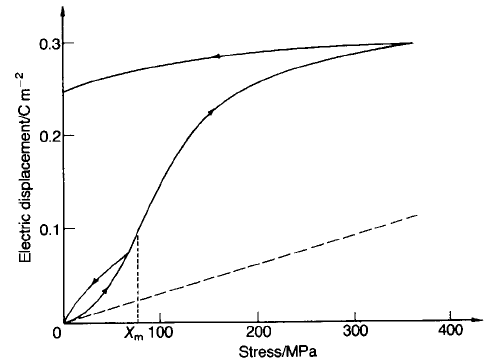
Figure 6.13 shows a plot of charge against compressive stress for donor-doped
PZT. The output is considerably in excess of what would be expected from the
piezoelectric coefficient determined at low stress. The excess charge is to be
attributed to the switching of 908 domains. Up to a limiting stress X
m
, the charge
is reabsorbed on releasing the stress, indicating that the 908 domain wall
movement is reversible, but at higher stresses only a part is reabsorbed and the
low-stress piezoelectric coefficient is correspondingly progressively diminished.
The longer the time a stress is applied, the greater is the charge released and the
smaller is the fraction of it that is reabsorbed. The extra output due to the
reversible movement of 908 walls is made use of in high-voltage generators used
for the ignition of gas by sparks (see Section 6.5.1).
Donor-doped PZTs have higher permittivities and d coefficients than acceptor-
doped materials and are therefore more suitable for converting mechanical into
electrical vibrations. They have higher dissipation factors than acceptor-doped
materials and are therefore not as suitable for wave filters. If this were not the
case, their low ageing coefficients would be an advantage.
IMPORTANT COMMERCIAL PIEZOCERAMICS 365
Fig. 6.13 Electric displacement as a function of compressive stress for donor-doped PZT: - - -,
output expected from a low-stress piezoelectric constant.
Low temperature coefficients of the resonant frequency can be obtained by
substituting small amounts of an alkaline earth for lead in acceptor-doped
material and adjusting the ratio of zirconium to titanium, which governs the
ratio of tetragonal to rhombohedral phases in the ceramic. The ageing that
accompanies acceptor doping can be greatly reduced by substituting small
amounts (51%) of Cr or U on the B site, although the mechanism has not been
elucidated. The ions are probably present as Cr
4+
and U
4+
or U
6+
and, since
they slightly reduce the permittivity and piezoelectric activity, it can be assumed
that they accelerate the orientation of the acceptor ion–oxygen vacancy dipoles
so that it is virtually completed during poling.
Some applications require low mechanical as well as low dielectric losses
combined with high piezoelectric activity. This seems to be best achieved by
substituting a mixture of B-site donors and acceptors such as Nb and Mg in 2:1
atomic proportions.
6.4.3 Lead-based relaxor piezoelectric and electrostrictive
ceramics
There are many factors which determine the suitability of a particular
piezoceramic for a given transducer application. As a general rule the higher
the Curie point (T
c
) the lower are the room temperature values of permittivity
and charge (or strain) coefficient. However, the low transition temperatures,
which favour high piezoelectric coefficients, carry with them the risk of depoling
during the processing steps, for example machining, electroding and soldering,
usually necessary to engineer the material into a device.
The lead-based perovskite relaxor ferroelectrics, Pb(B’B’’)O
3
, (see Section
5.7.2) have exceptionally high permittivity values and therefore, from Eq. (6.7)
are expected to be strongly electromechanically active and especially suited to
transducer applications.
The search for piezoceramics having optimum electromechanical properties
has been extended to cover MPB compositions of PbTiO
3
with various relaxors.
The search is assisted by using a relationship established between the Curie point
of the MPB composition and the tolerance factor (see Section 2.7.3) for the
relaxor component [10].
The article by S.-E. Park and T.R. Shrout [11] provides a valuable supplement
to the discussion.
Polycrystalline ceramics
The ternary diagram (Fig. 6.14) is essentially the PZT binary diagram extended
to take account of additions of a relaxor of the type Pb(B’ B’’)O
3
.
366 PIEZOELECTRIC CERAMICS
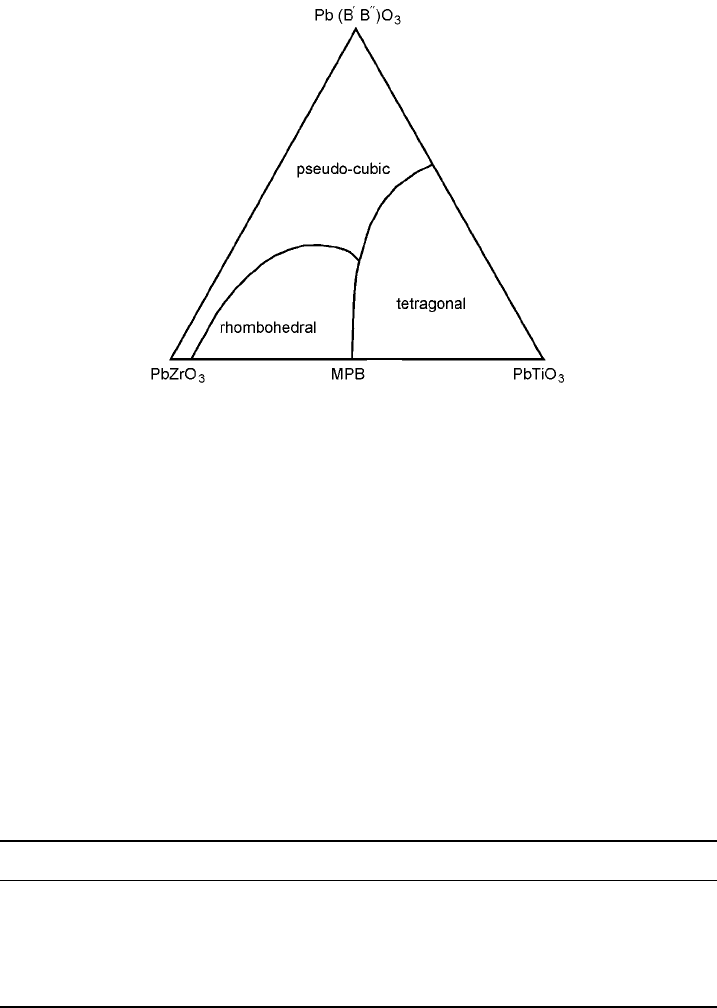
The system now shows two morphotropic phase boundaries, the one already
discussed on the PZ–PT join, and the other on the PT–Pb(B’B’’ )O
3
join.
Compositions close to that of the MPB (II) have attracted considerable interest
because of their potential for electromechanical applications. The properties of
some selected systems are given in Table 6.2 together with those for the ‘PZT’
system for comparison.
As discussed in Section 5.7.2, in the case of niobium-containing perovskites it
is necessary to avoid the formation of pyrochlore-type phases if reproducible and
optimum dielectric and piezoelectric properties are to be achieved. G. Roberts
et al. [13] developed a modification of the B-site precursor (‘columbite’ process)
route to produce high quality PNN–PZT ceramics.
IMPORTANT COMMERCIAL PIEZOCERAMICS 367
MPB (II)
Fig. 6.14 Room temperature ternary showing structural phase-fields in the PZ–PT–relaxor
system.
(I)
Table 6.2 Piezoelectric properties of some ‘relaxor based’ compositions close to the MPB(II)
(data taken from [11])
Composition x at MPB(II) k
33
d
33
/pC N
71
e
X
r
/10
3
T
c
/8C
(1 x) PMN–xPT 0.33 0.73 690 5 160
(1 x) PST–xPT 0.45 0.73 655 4 205
(1 x) PSN–xPT 0.43 0.76 504 2.5 248
0.5 PNN–0.345 PT–0.155PZ
a
0.40 0.80 900 7 (90
b
)
(1 x) PZ–xPT
c
0.48 MPB (I) 0.64–0.75 220–600 1–3.4 195–365
PMN ¼Pb(Mg
1/3
Nb
2/3
)O
3
; PST ¼Pb(Sc
1/2
Ta
1/2
)O
3
; PSN ¼Pb(Sc
1/2
Nb
1/2
)O
3
;
PNN ¼Pb (Ni
1/3
Nb
2/3
)O
3
;PZ¼PbZrO
3
;PT¼PbTiO
3
.
(a) Taken from [12].
(b) Estimated.
(c) The quoted property value ranges are based on data taken from a leading manufacturer’s brochure.
Although the polycrystalline relaxor-based compositions have useful piezo-
electric characteristics, taking their properties overall into account they do not
offer significant advantages over the well established PZT system. Their high
electrostriction coefficients make them attractive for certain actuator applica-
tions (see Section 6.5.2), but the potentially important advance has been the
production of single crystals.
Through additions of PbTiO
3
to the prototype relaxor Pb(Mg
1/3
Nb
2/3
)O
3
the
temperature at which the permittivity peaks can be adjusted and, close to the
composition 0.9 PMN–0.1 PT, it occurs at around room temperature. This is a
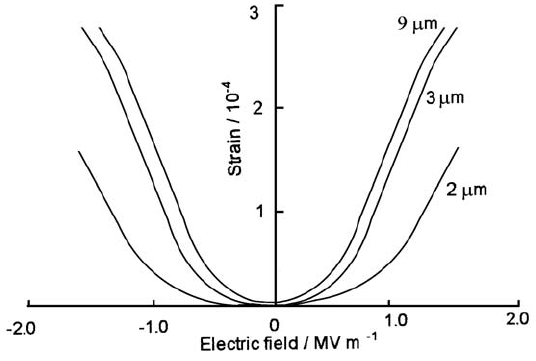
composition suited to actuator applications. The dependence of electrostriction
on grain size (Fig. 6.15) [14] is believed to be linked to the dependence of the size
of the nanosized ordered regions on grain size (T. Mishima et al. [15]).
Single crystals
Efforts to grow usefully sized PZT single crystals with the prospect of their
offering significantly enhanced electromechanical properties compared to those
of the polycrystalline counterparts, have not been successful. However, in the
case of the ‘relaxor-PT’ systems large single crystals can be flux-grown (see
Section 3.11) and these do offer exceptionally good electromechanical properties
(Table 6.3) which are, of course, dependent upon the ‘cut’ of the piece with
respect to the crystallographic axes of the single crystal.
368 PIEZOELECTRIC CERAMICS
Fig. 6.15 Electrostriction in 0.93 PMN 0.07 PT showing the dependence on grain size (after
T.R. Shrout et al. [14]).
6.4.4 Lead niobate
The ferroelectric polymorph of lead niobate (PbNb
2
O
6
) is metastable at room
temperature. Above 1200 8C the structure is tetragonal tungsten bronze. On
cooling slowly below 1200 8C it transforms to an orange-brown rhombohedral
form that is paraelectric at room temperature. Rapid cooling from 1200 to
700 8C, combined with additions such as 2 wt% ZrTiO
4
, allows the tetragonal
form to persist at lower temperatures. It is bluish-green in colour with a Curie
point at 560 8C below which it undergoes a small orthorhombic distortion in the
c plane and becomes ferroelectric. The tungsten bronze structure is typified by
certain alkali metal compounds of tungstic oxide, e.g. K
5.7
W
10
O
30
.
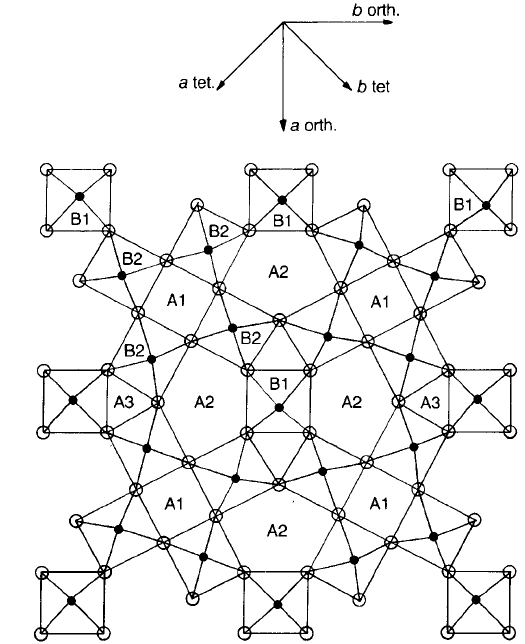
The spaces between the MO
6
(MW, Ta, Nb, Ti etc.) form tunnels. In the
section shown in Fig. 6.16 the largest tunnels, A2, have five O
27
ions round their
periphery. The somewhat smaller tunnels, A1, have four peripheral O
27
ions,
while the smallest, A3, have three. Lower-valency cations are located in sites in
these tunnels above and below the plane shown. The MO
6
groups provide two
distinguishable B sites shown as B1 and B2. The general formula for a tungsten
bronze is
½ðA1)
2
ðA2Þ
4
A3½ðB1Þ
2
ðB2Þ
8
O
30
The A3 sites are vacant unless small (r
6
¼50–70 pm) ions such as Li
+
or Mg
2+
are present. A large number of compounds are known in which one in six of the
A1 and A2 sites is also vacant, giving rise to the simpler formula AB
2
O
6
of which
PbNb
2
O
6
is an example.
In the majority of ferroelectric tungsten bronzes the polar axes are parallel to
the A-site tunnels. PbNb
2
O
6
is an exception; below the Curie point it undergoes
an orthorhombic distortion in the plane perpendicular to the A-site tunnels as
indicated in Fig. 6.16. It possesses four possible polar directions and can be poled
successfully in ceramic form.
Although it is difficult to obtain a ceramic with less than 7% porosity and the
piezoelectric coefficients are smaller than those of BaTiO
3
, PbNb
2
O
6
has
advantages in certain applications. Its Q
m
value is approximately 11, which is
IMPORTANT COMMERCIAL PIEZOCERAMICS 369
Table 6.3 Electromechanical properties of some relaxor-based single crystals (data taken
from [11])
Crystal Cut e
r
k
33
d
33
/pC N
71{
Pb(Zn
1/3
Nb
2/3
)O
3
111 900 0.38 83
001 3600 0.85 1100
PZN–8 mol.% PT* 111 2150 0.40 82
001 4200 0.94 2070
PMN–35 mol.% PT 001 3100 0.92 1240
*The MPB lies at 10 mol.% PT.
{
Effective d-coefficient.
advantageous in broad-band applications, it can be heated up to 500 8C without
losing its polarity and its transverse coefficients are low (d
31
¼9pCN
1
). The
latter property favours low sideways coupling between detecting elements
formed side by side on the same piece of ceramic and results in a hydrostatic
coefficient d
h
of useful magnitude (d
h
¼ d
33
þ 2d
31
). It also has the advantage of a
lower PbO vapour pressure during sintering so that guarding against lead loss is
less of a problem than with PZT.
The substitution of lead by barium enhances the piezoelectric properties which
peak when Pb/Ba 1. At this and higher barium contents the structure changes
to tetragonal with the polar axis parallel to the A-site tunnels. There is a
morphotropic boundary, similar to that found in PZT compositions, and peak
values of piezoelectric properties are found near the Pb
1/2
Ba
1/2
Nb
2
O
6
composi-
tion. d
33
rises to 220 pC N
71
and d
31
rises to 790 pC N
71
, while Q
m
increases to
300 and the Curie point falls to 250 8C; thus most of the features peculiar to
370 PIEZOELECTRIC CERAMICS
Fig. 6.16 Projection of the tungsten bronze structure in the c plane. The inset shows the polar
directions in orthorhombic PbNb
2
O
6
: . M; *O [P.B. Jamieson et al. (1968) J. Chem. Phys.
48, 5048–57].
PbNb
2
O
6
are lost. The properties are intermediate between those of BaTiO
3
and
PZT but there has been little attempt to exploit the material commercially.
6.4.5 Lithium niobate and lithium tantalate
Lithium niobate and lithium tantalate have similar properties and their crystal
structure is similar to that of ilmenite. It consists of corner-sharing MO
6
groups
(MNb or Ta) that share one face with an LiO
6
group and an opposite face with
an empty O
6
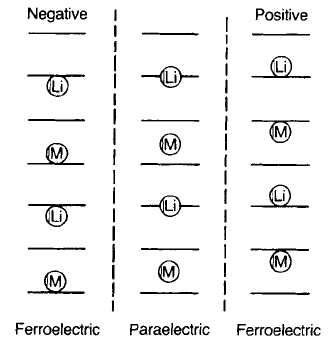
octahedron. Figure 6.17 shows diagrammatically the positions of
Li
+
and M
5+
ions between layers of hexagonally close-packed O
27
ions. The
M
5+
and Li
+
ions are displaced from the centres of their octahedra in opposite
directions in the ferroelectric phases. When the polarization is reversed both
cations move in the same direction, the M
5+
ion to the other side of the midplane
between the O
27
ions and the Li
+
ion through to the other side of the adjacent
O
27
plane. There are only two possible polar directions and they are at 1808 to
one another. As a consequence only limited piezoelectric activity can be induced
in ceramic preparations by poling.
Large crystals of both LiNbO
3
and LiTaO
3
can be grown by the Czochralski
method (see Fig. 3.11). Their principal properties are given in Table 6.5 below.
The high melting point of LiTaO
3
necessitates the use of an iridium crucible
when growing crystals. This in turn makes it necessary to have a nitrogen
atmosphere to prevent the formation of IrO
2
which is volatile at 1650 8C. As a
result the crystals are dark in colour and conductive as grown and must be
embedded in LiTaO
3
powder and annealed at 1400 8C in air to render them
colourless and of high resistivity. The LiTaO
3
powder prevents the volatilization
IMPORTANT COMMERCIAL PIEZOCERAMICS 371
Fig. 6.17 The position of Li
+
and M (Nb
5+
,Ta
5+
) ions relative to the O
27
planes (horizontal
lines) in LiNbO
3
and LiTaO
3
in the two ferroelectric states and the paraelectric state.