
Moulson A.J., Herbert J.M. Electroceramics: Materials, Properties, Applications
Подождите немного. Документ загружается.

6.5.1 Generation of voltages
Gas igniter
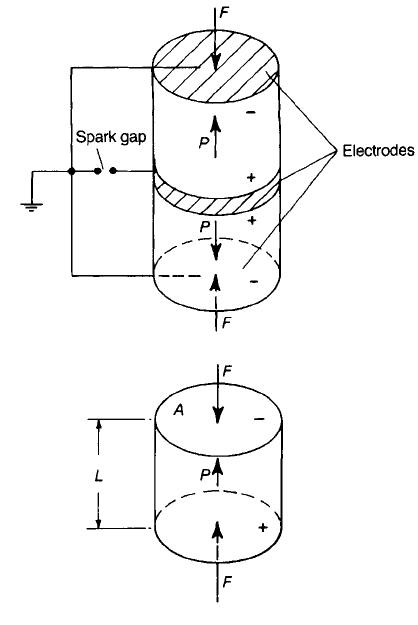
The principle of a gas igniter is illustrated in Fig. 6.21(a). It is usual to use two
poled cylinders back to back, rather than one, so as to have twice the charge
available for the spark. It is necessary to apply the force F quickly otherwise the
voltage generated disappears as charge leaks away through the piezoceramic,
across its surfaces and via the apparatus.
The following argument is developed for a single element of cross-sectional
area A and length L, as shown in Fig. 6.21(b). The material parameters are d
33
,
g
33
, e
X
33
, e
x
33
and k
33
. The generation of a spark can be seen as consisting of two
stages. Firstly the compressive force F on an area A will alter the length L of the
cylinder by – dL. This happens under open-circuit conditions and so
382 PIEZOELECTRIC CERAMICS
(a)
Fig. 6.21 (a) A piezoelectric spark generator. (b) A piezoceramic cylinder under axial
compressive force.
(b)
TEAMFLY
Team-Fly
®

x ¼
dL
D
L
¼s
D
33
F
A
ð6:70Þ
The mechanical work done is
w
m
¼
1
2
F d L
D
¼
1
2
s
D
33
F
2
L
A
ð6:71Þ
The available electrical energy w
el
is, from the definition of k
2
,
w
el
¼
1
2
k
2
33
s
D
33
F
2
L
A
ð6:72Þ
At this stage the cylinder has an electric potential difference U between its ends
and is in a clamped state so that the electric potential energy is (C is the
capacitance)
w
el
¼
1
2
CU
2
¼
1
2
U
2
e
x
33
A
L
ð6:73Þ
Since k
2
33
¼ g
2
33
e
X
/s
E
33
, e
x
33
e
X
33
(1 – k
2
33
) and s
D
33
¼ s
E
33
(1 – k
2
33
), Eqs (6.72) and
(6.73) yield the expected result:
U ¼ g
33
FL
A
ð6:74Þ
For a spark to occur U must exceed the breakdown voltage of the gap. It is
assumed that the voltage given by Eq. (6.74) is established when breakdown
occurs. At this stage the field in the ceramic is in the same direction as the poling
field and assists in maintaining the domain orientations in the poled sense.
When the spark gap breaks down the second stage in energy generation is
initiated. The spark discharge results in a change from open- to closed-circuit
conditions with the voltage dropping to a lower level. The compliance changes
from s
D
33
to s
E
33
and the drop in field strength now allows 908,718 and 1098 domain
wall movement. If only the first of these effects is considered, the increase in
compliance will allow a further compression of the ceramic and a movement
dL
E
– dL
D
of the applied force. dL
E
is the movement that would have occurred
had the force been applied under short-circuit conditions in the first place.
Therefore
dL
E
dL
D
¼ðs
E
33
s
D
33
Þ
FL
A
¼ k
2
33
s
E
33
FL
A
ð6:75Þ
The additional strain will result in an increase w
ex
in the electrical energy
available:
w
ex
¼
1
2
k
4
33
s
E
33
F
2
L
A
ð6:76Þ
APPLICATIONS 383

Therefore the total energy that can be dissipated in the spark is
w
T
¼ w
el
þ w
ex
¼
1
2
k
2
33
ðk
2
33
s
E
33
þ s
D
33
Þ
F
2
L
A
ð6:77Þ
or
w
T
¼
1
2
k
2
33
s
E
33
F
2
L
A
¼
1
2
d
33
g
33
F
2
L
A
ð6:78Þ
In practice, with most PZT compositions, Eq. (6.78) may underestimate the
energy released because domain reorientation associated with ferroelasticity will
contribute significantly to the charge developed (cf. Fig. 6.13). However, the
magnitude and duration of the applied force must be such that the changes in
polarization due to ferroelasticity are reversible if the output of the igniter is not
to deteriorate with usage.
Consider the following simple example. A force of 1000 N acts on a cylinder
6 mm in diameter and 15 mm long with d
33
¼ 265 pC N
71
, e
X
33
¼ 1500e
0
and
k
33
¼ 0.7. In this case U ¼ 10.4 kV, w
el
¼ 0.72 mJ and w
ex
¼ 0.66 mJ. The total
energy from a single cylinder is 1.38 mJ so that, if a pair is used, the energy
available for ignition should be ample since, under average conditions, about
1 mJ is sufficient. The stress applied is 35 MPa, which will result in a significant
enhancement in output from reversible domain reorientation.
Transformer
The transfer of energy from one set of electrodes to another on a piezoceramic
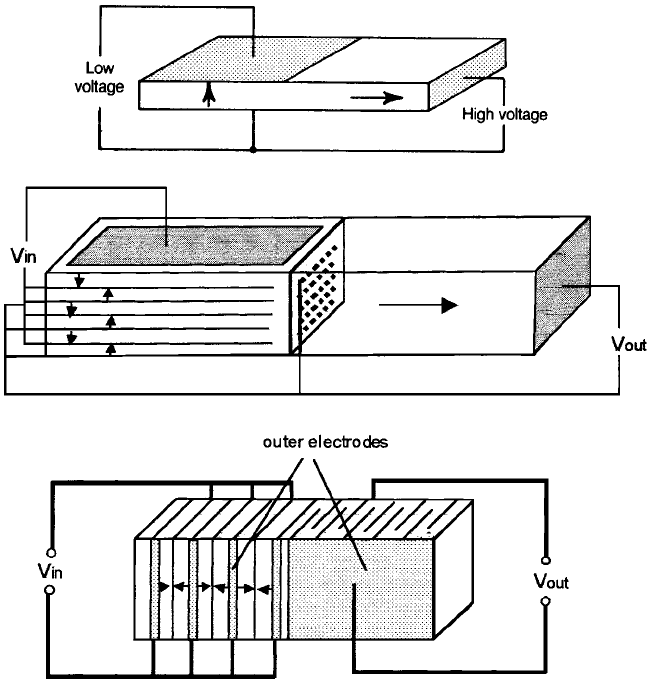
body can be used for voltage transformation. In Fig. 6.22(a) a flat plate carries
electrodes on half its major surfaces and on an edge. The regions between the
larger electrodes, and between them and the edge electrode, are poled
separately. A low a.c. voltage is applied to the larger-area electrodes at a
frequency which excites a length mode resonance. A high-voltage output can
then be taken from the small electrode and the common of the larger ones. The
transformation can, very approximately, be in the ratio of the input to output
capacitances but depends strongly on the output load, as does the efficiency.
The ceramic needs to combine high k
31
and k
33
coupling coefficients with a high
Q
m
, preferably exceeding 1500. Very significant gains in voltage and
amplification can be made by adopting a multilayered structure for the
primary, as illustrated in Fig. 6.22(b), and for both primary and secondary in
(c) when the efficiency depends upon k
2
33
.
384 PIEZOELECTRIC CERAMICS
In addition to suitability to cheap mass production, piezoelectric transformers
offer the advantage of a low profile when mounted on printed circuit boards.
Over recent years they have found a commercially significant application for
powering fluorescent lamps for back-lighting the screen in lap-top computers and
electronic notebooks with liquid crystal displays. For these applications the
output voltage and power are typically approximately 1 kV (rms) and 5 W,
respectively.
The literature contains [19] impressive performance data for multilayer
transformers, made more impressive by the low sintering temperature (960 8C) of
the ‘PZT’ fluxed with small amounts (3 wt.%) of mixes of B
2
O
3
,Bi
2
O
3
and CdO.
Open circuit voltage step-up ratios as high as 9000 are claimed.
APPLICATIONS 385
(a)
(b)
(c)
Fig. 6.22 (a) Simple form of piezoelectric transformer; (b) transformer incorporating
multilayered primary; (c) transformer with multilayered primary and secondary.
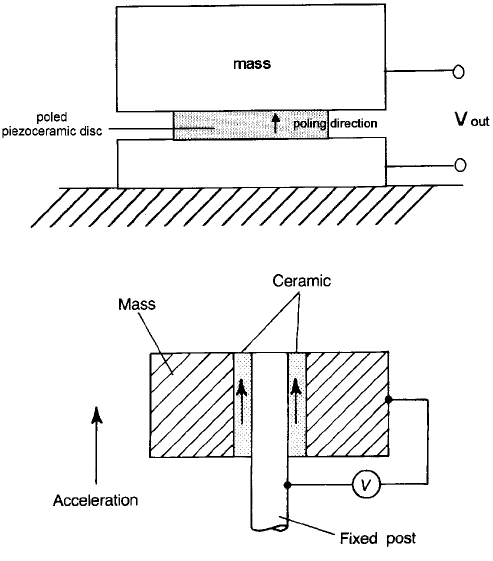
A simple form of accelerometer is shown in Fig. 6.23(a). During acceleration
in the direction of poling the mass exerts a force, F (¼ M acc
n
) on the
piezoceramic disc and therefore a stress of F/A where A is the area of the disc.
The measured voltage output is proportional to the acceleration.
Accelerometers have been designed which use ceramics in the shear mode. The
transducer is a cylinder poled along its axis but with the poling electrodes
removed and sensing electrodes applied to the inner and outer major surfaces.
The cylinder is cemented to a central post and has a cylindrical mass cemented to
its outer surface (Fig. 6.23(b)). The cylinder is subjected to a shearing action
between the mass and the supporting post when accelerated axially. Motion in
perpendicular directions has very little effect, since first the average stress in the
ceramic will be small, and second the d
11
coefficient is very close to zero. The
device is therefore very highly directional.
Cantilever bimorphs (see Section 6.5.2 below) with small masses attached to
their free end can be used as accelerometers provided that the frequency of the
vibrations to be detected is well below the resonance frequency of the transducer.
386 PIEZOELECTRIC CERAMICS
(a)
(b)
Fig. 6.23 (a) Simple form of accelerometer; (b) shear-mode accelerometer.
There are many applications for accelerometers, an important one being to
control the stability of a car during emergency braking and steering. Another is
to sense the onset of a car crash when appropriate measures need to be activated,
for example the release of air-bags.
6.5.2 Generation of displacement ^ ‘actuators’
Overview
In advanced precision engineering there is a need for a variety of types of
actuator. For example, in the fabrication of semiconductor chips, circuit
components have to be precisely positioned for the various processing steps. In
optical equipment lenses and mirrors require micropositioning, and even the
shapes of mirrors are adjusted to correct image distortions arising from, for
example, atmospheric effects. In autofocusing cameras there are actuators
capable of producing precise rotational displacements. Actuators are also
required for ink-jet printers, for positioning videotape-recording heads and for
micromachining metals. The certainty that the range of applications and demand
for actuators will grow has stimulated intensive research into piezoelectric and
electrostrictive varieties.
When compared with piezoelectric/electrostrictive transducers, the electro-
magnetically driven variety suffer shortcomings in ‘backlash’, in the relatively
low forces that can be generated and in their relatively low response speeds.
Piezoelectric/electrostrictive actuators are capable of producing displacements of
10+0.01 mm in a time as short as 10 ms, even when the transducer is subjected to
high (100 kgf) opposing forces.
There is an increasing interest in materials showing a strong electrostrictive
effect for actuators. In the case of electrostriction the sign of the strain is
independent of the sense of the electric field, and the effect is exhibited by all
materials. In contrast, with the piezoelectric effect the strain is proportional to
the applied field and so changes sign when the field is reversed. Generally
speaking, the piezoelectric effect is significantly greater than the electrostrictive
effect. However, in the case of high-permittivity materials, and especially
ferroelectrics just above their Curie points, the electrostrictive effect is large
enough to be exploited.
Electrostrictive materials offer important advantages over piezoelectric
ceramics in actuator applications. They do not contain domains (of the usual
ferroelectric type), and so return to their original dimensions immediately a field
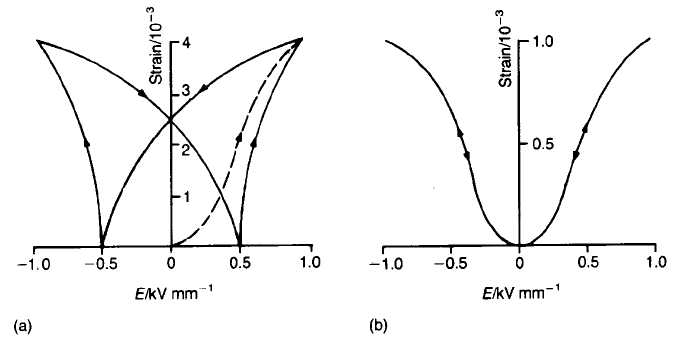
is reduced to zero, and they do not age. Figure 6.24(a) shows the strain–electric
field characteristic for a PLZT (7/62/38) piezoelectric and Fig. 6.24(b) the
absence of significant hysteresis in a PMN (0.9 Pb(Mg
1/3
Nb
2/3
O
3
–0.1 PbTiO
3
)
electrostrictive ceramic.
APPLICATIONS 387
Recently single crystal relaxors have become available offering very high
electrostrictive strains (see Table 6.3). There are many forms of actuator
exploiting the different types of piezoelectric/electrostrictive response and the
following choice is made to illustrate principles.
Stack actuator and ‘Moonie’
Multilayer stack actuators can be made in much the same way as described for
a multilayer capacitor (see Section 5.4.3). However, because of the design of a
MLCC each layer is clamped at its edges resulting in the development of electric
field-induced mechanical stresses which can be a cause of eventual failure. In
the case of the actuator the objective is to achieve maximum strain and if the
same construction were applied as in the case of the MLCC dangerously large
stresses would be developed which not only would detract from the desired
movement but would constitute a serious failure risk. The problem is avoided
by extending the electrodes to the edge of each layer and devising a means of
connecting up alternate layers without the risk of shorting to adjacent layers.
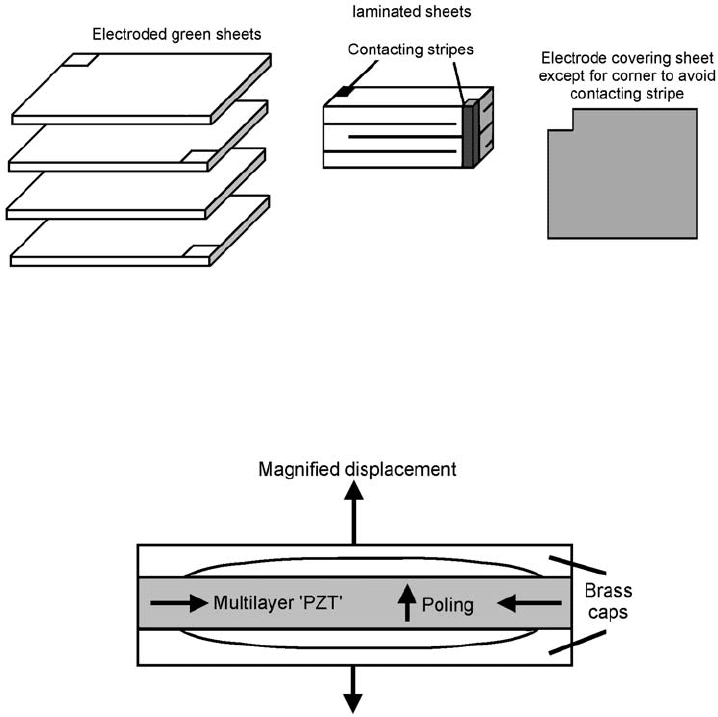
This can be achieved in a variety of ways and one strategy is illustrated in
Fig. 6.25.
The attractive features of a piezoelectric/electrostrictive actuator are
mentioned above, but a penalty is the small displacements generated. For a d
33
value of 500 pC N
1
(or, more appropriately in the present context, pm V
1
)a
voltage of 1000 V applied across a 1 mm thick poled disc would produce a
388 PIEZOELECTRIC CERAMICS
Fig. 6.24 Dependence of strain on electric field for (a) a readily poled and depoled
piezoelectric PLZT and (b) electrostrictive PMN.
displacement of only 0.5 mm. A multilayer stack of the same piezoceramic
comprising 10 layers each 100 mm thick would produce a displacement of 5 mm
for the same applied voltage. Alternatively, the multilayer stack allows lower
operating voltages for a given displacement.
Various designs have been developed to magnify the small displacements, at
the cost of reduced blocking force. A well known design, the ‘Moonie’, is
illustrated in Fig. 6.26. The brass end-caps not only follow the d
33
-controlled
displacement but also redirect the d
31
displacement into the 3-direction. This
magnified displacement can be as much as 20 mm on a 3 mm thick actuator for an
applied voltage of as little as 50 V.
APPLICATIONS 389
Fig. 6.25 The multilayer stack actuator showing one strategy for electroding to avoid
clamping stresses.
Fig. 6.26 The ‘Moonie’ actuator.

Bi-morph
Piezoceramics have high Young moduli so that large forces are required
to generate strains that produce easily measured electrical responses from
solid blocks of material. Compliance can be greatly increased by making
long thin strips or plates of material and mounting them as cantilevers or
diaphragms, the latter the basis of the widely exploited ‘buzzer’.
Bending a plate causes one half to stretch and the other to compress so that, to
a first approximation, there can be no electrical output from a homogeneous
body by bending. This is overcome in the bimorph by making the two halves of
separate beams with an intervening electrode, as well as electrodes on the outer
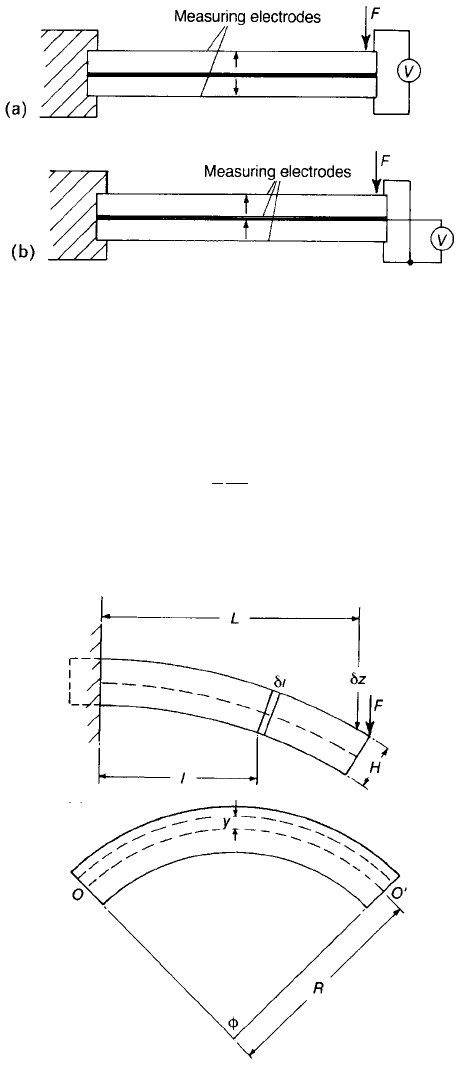
surfaces, as shown in Fig. 6.27. If the beams are poled from the centre outwards
(or from the surfaces inwards) the resulting polarities will be in opposite
directions and the voltages generated on the outer electrodes by bending will be
additive (Fig. 6.27(a)). Alternatively, if the beams are poled in the same direction,
output from bending can be obtained between the outer electrodes, connected
together, and the centre electrode (Fig. 6.27(b)).
In order to calculate the voltage generated when the device is bent, the
cantilever arrangement shown in Fig. 6.28(a) is chosen to illustrate the
principles. The force F produces a bending moment varying linearly along the
length of the beam, being a maximum at the fixed end and zero at the free end.
The central plane OO
0
is the neutral plane and, as is evident from Fig. 6.28(b),
the strain in a filament a distance y from it is y/R, and is tensile in the upper half
and compressive in the lower half.
The radius of curvature R at a distance l from the fixed end is related to the
end deflection dz by
R ¼
L
3
3ðL lÞdz
ð6:79Þ
Therefore the average strain x
l
at l in the upper half of the beam is
x
l
H
4R
¼
H
4
3ðL lÞ
L
3
dz ð6:80Þ
Since the open-circuit voltage is developed, the electromechanical effects take
place at constant D. Therefore, from
@E
3
@x
1
!
D
¼h
31
ð6:81Þ
the field E
3
(l) developed at l is given by
390 PIEZOELECTRIC CERAMICS
E
3
ðlÞ¼h
31
x
l
or
E
3
ðlÞ¼h
31
3
4
H
L
3
ðL lÞdz ð6:82Þ
The total charge density sðlÞ appearing on each surface of the bimorph half is
APPLICATIONS 391
(a)
Fig. 6.28 Strains in a bent rectangular section cantilever of width w and depth H.
(b)
Fig. 6.27 Cantilever bimorphs showing (a) series connection and (b) parallel connection of
beams.