
Moulson A.J., Herbert J.M. Electroceramics: Materials, Properties, Applications
Подождите немного. Документ загружается.


sðlÞ¼e
x
33
E
3
ðlÞð6:83Þ
The charge Q
dl
on the element dl is
Q
dl
¼ e
x
33
E
3
ðlÞwdl ð6:84Þ
and the total charge is
Q
T
¼
ð
L
0
Q
dl
dl ð6:85Þ
From Eqs (6.83), (6.85) and (6.86)
Q
T
¼
3
4
Hw
L
3
dze
x
3
h
31
ð
L
0
ðL lÞdl ð6:86Þ
so that
Q
T
¼
3
8
Hw
L
e
x
3
h
31
dz ð6:87Þ
If C
x
is the clamped capacitance of one of the bimorph plates, then the voltage
across it is U ¼ Q
T
=C
x
and that across two oppositely poled plates connected in
series is U
T
¼ 2U. Therefore
U
T
¼
3
8
H
L
2
h
31
dz ð6:88Þ
If L ¼ 10 mm, H ¼ 1 mm, dz ¼ 1 mm and h
31
¼6.2 10
8
Vm
71
,
U
T
¼ 2.3 V
Although, by the converse effect, a bimorph will bend when a voltage is applied
to it, this will not be according to the inverse of Eq. (6.88) because the
deformation due to an applied field is governed by d ¼ð@x=@EÞ
X
which is not the
inverse of h ¼ð@E=@xÞ
D
. Furthermore, the applied field will produce uniform
strains along the length of the bimorph so that it will be bent in the form of a
circular arc, in contrast with the more complex shape given by Eq. (6.79).
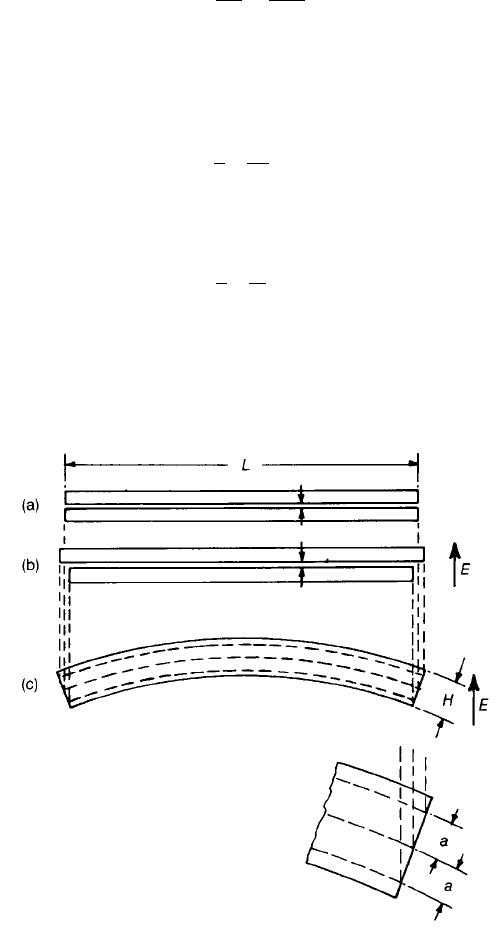
Under an applied voltage the stress-free filaments in a bent bimorph will be in
two planes, one above and one below the central plane and at equal distances a
from it. The centre plane is strain free because the stresses on opposite sides of
the joining layer are equal and opposed to one another. The steps in the
argument are illustrated in Fig. 6.29 and the stress system is similar to that set up
in a heated bimetallic strip, as analysed by S. Timoshenko [20].
If y in Fig. 6.28 is replaced by a, the strain at the neutral planes is a/R which,
from Fig. 6.21, is Ed
31
, i.e.
a=R ¼ Ed
31
ð6:89Þ
392 PIEZOELECTRIC CERAMICS
TEAMFLY
Team-Fly
®
For a circular arc the depression of the free end of a bimorph relative to the
clamped end is
dz ¼
L
2
2R
¼
L
2
E
2a
d
31
ð6:90Þ
a can be determined by taking moments in a cross-section of the bimorph and,
provided that the thickness of the material joining the two plates is less than a
fifth of the beam thickness, a H=3, so that
d ¼
3
2
L
2
H
Ed
31
ð6:91Þ
In terms of the applied voltage,
dz ¼
3
2
L
H
2
d
31
U ð6:92Þ
With the same dimensions as before, and with d
31
¼80 pC N
71
, a voltage of
84 V must be applied to produce a deflection of 1 mm.
APPLICATIONS 393
Fig. 6.29 A bimorph under an applied field: (a) the two free halves of the bimorph; (b) the
free halves in a field; (c) behaviour when the two halves shown in (a) are joined to form a
bimorph and the neutral planes have lengths equivalent to those in (b).
It is clear that useful movements for most purposes can only be obtained
for moderate voltages if L/H is made large, but this leads to a fragile
component. One solution is to replace one of the ceramic plates by a metal
strip. This will at least halve the deflection per volt, but it can also be
arranged that the bending always compresses the ceramic and the sense of the
applied field will then coincide with the poling direction so that depoling
effects are avoided. Higher maximum voltages can be used since the ceramic is
stronger in compression than in tension. Since the fields must be high to
obtain large movements it is advantageous to use electrostrictive materials,
and this also eliminates the hysteretic behaviour to which piezoelectric
materials are prone.
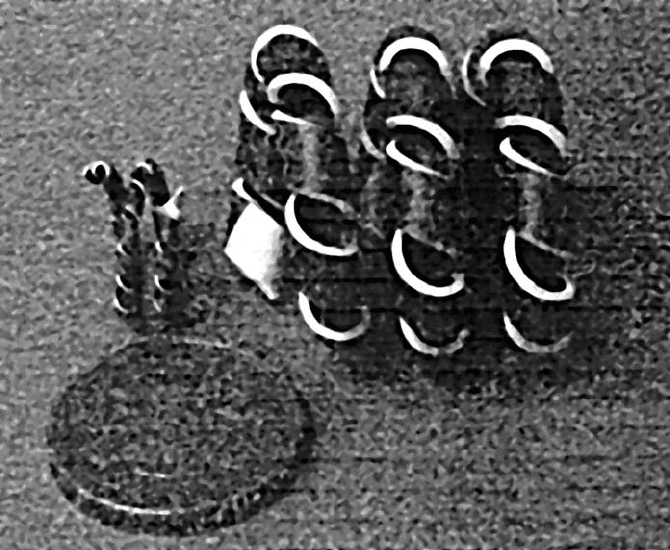
Very recently the viscous polymer processing route (see Section 3.6.7) has been
exploited by D.H. Pearce and co-workers [21] to fabricate a helical form of the
bimorph, the ‘Helimorph’, illustrated in Fig. 6.30. Both axial and rotational
actuations are developed which have potential for a variety of applications in the
mechanical, optical and acoustical fields.
394 PIEZOELECTRIC CERAMICS
Fig. 6.30 ‘Helimorph’
#
actuators. (Courtesy of ‘1Limited’ Cambridge, UK.)

Rotary motion
The direct generation of rotary motion can be achieved by the use of surface
wave transducers based on the generation of acoustic waves confined to a thin
layer near to the surface of a solid. The basic theory of surface acoustic waves
(SAWs) was established by Lord Rayleigh in 1885. The waves are due to a
combination of longitudinal and shear motions governed by the stress-free
boundary conditions at the surface. The particles of the surface layer of the solid
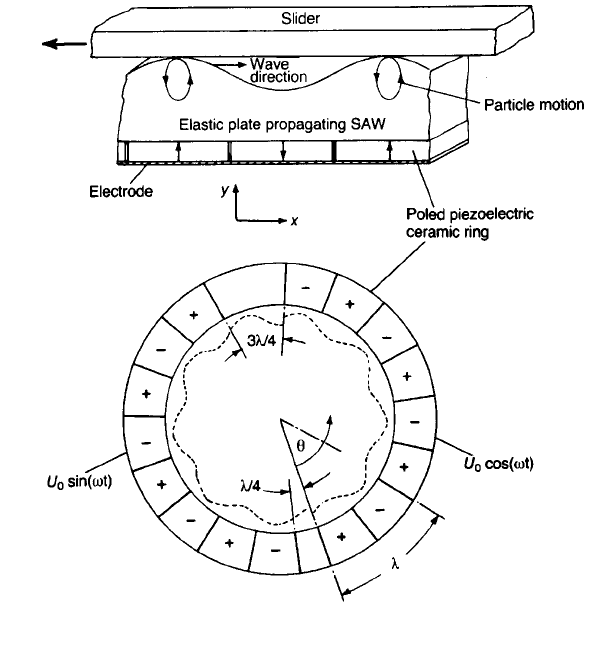
describe elliptical motions as indicated in Fig. 6.31(a), with the amplitude
decreasing with distance from the surface until, at a depth of approximately
1 mm, it is negligible. The velocity of SAWs is approximately 300 m s
71
, a little
lower than the velocity of bulk waves, and so they require times of the order of
microseconds to travel 1 cm.
Because of the horizontal component of the motions of the surface particles
the ‘slider’ in contact with the surface experiences a force tending to move it in a
direction opposite to that of the travelling wave, as indicated in Fig. 6.31(a).
Rotary motion is achieved by propagating a SAW round an elastic ring driving a
contacting ring slider. Correctly phased vibrations are propagated into the elastic
ring from an appropriately poled and energized piezoelectric ring (Fig. 6.31(b)).
The SAW is generated by superimposing two standing waves of equal
amplitude but differing in phase by p/2 with respect to both time and space. The
time phase difference results from one wave being generated by the voltage
U
0
sin(ot) and the other by U
0
cos(ot); the spatial phase difference results from
the 3l/4 and l/4 gaps between the two poled segments. The two standing waves
can be written
y
1
¼ y
0
cosðnyÞcosðotÞð6:93Þ
and
y
2
¼ y
0
cos
ny
p
2
cos
o
p
2
in which y
1
and y
2
represent the vertical displacements of the ring surface, y is the
angular displacement round the ring and n is the number of wavelengths
accommodated round the ring. The resultant wave is given by
y ¼ y
1
þ y
2
¼ y
0
fcosðnyÞcosðotÞþsinðnyÞsinðotÞg
¼ y
0
cosðot nyÞ
ð6:94Þ
which represents a surface wave travelling with velocity o=n.
APPLICATIONS 395
Miscellaneous
There are a variety of actuators which are the products of the ingenuity of the
engineer, such as the ‘Inchworm’, which develops precise linear motion and the
‘walking’ variety. These and others are described by K. Uchino [18].
6.5.3 High frequency applications
These applications can be divided into those which demand high power (e.g.
ultrasonic cleaner) intermediate power (e.g. ‘Tweeter’) and signal power (e.g.
Delay line). Some examples are briefly described below.
396 PIEZOELECTRIC CERAMICS
(a)
(b)
Fig. 6.31 Principle of the rotary actuator: (a) side view; (b) plan view showing poled segments
and how temporal and spatial phase differences are established.
Ultrasonic cleaner
For high-power ultrasonic applications, such as ultrasonic cleaning, the
transducers are operated at frequencies typically in the range 20–50 kHz. A
PZT disc having its fundamental thickness mode frequency in this range would
be large; for example, the thickness for 20 kHz would be about 12 cm! The
production of such large pieces would present difficulties, and so too would
coping with the energy dissipation. The problems are overcome by adopting a
composite structure comprising the piezoceramic together with carefully chosen
metal end-pieces.
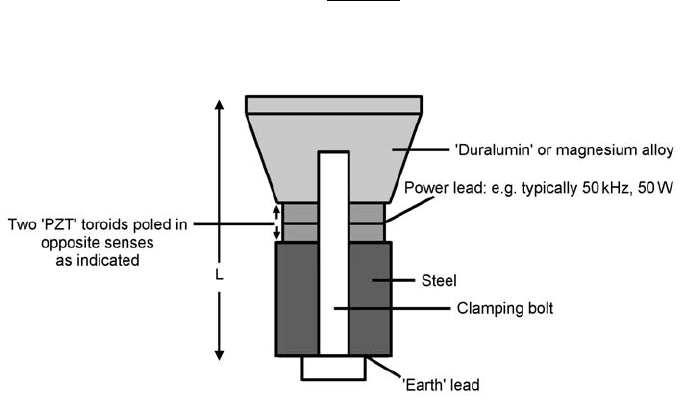
The structure of a typical composite power transducer for ultrasonic cleaning
is illustrated in Fig. 6.32. The ‘PZT’ toroids are kept in compression (stress
25 MPa) by the bolt to reduce the risk of their fracturing under the high drive
fields. The ‘PZT’ will be of the ‘hard’ variety (‘acceptor’-doped; see Section 6.3.2)
so as to minimize the risk of depolarization under the high mechanical stresses
experienced. The associated high Q
m
value and low electrical tan d ensure that
the losses are kept within acceptable limits. The structure has the added
advantage that any heat developed in the ceramic can be dissipated through the
massive metal end pieces.
The device must be dimensioned so that at resonance a half-wavelength is
accommodated in the distance L. The amplitude of motion at the outer metal
surface will be related to that of the ceramic through the ratio q of their acoustic
impedances:
q ¼
r
c
v
c
A
c
r
m
v
m
A
m
ð6:95Þ
APPLICATIONS 397
Fig. 6.32 The essentials of a power transducer for ultrasonic cleaning (the component is
cylindrically symmetrical about the vertical axis).
where r
c
, r
m
, v
c
, v
m
, A
c
and A
m
are the density, sound velocity and sectional areas
of the metal and the ceramic respectively. By making one end-piece of
magnesium, for which r
m
v
m
¼ 8.4 10
6
kg m
72
s
71
(8.4 Mrayl) and the other
of steel with r
m
v
m
¼ 41 Mrayl, and suitably adjusting the sectional areas of the
components, about 15 times the amplitude of motion can be obtained at the
magnesium surface than at the steel surface, so that the major part of the
acoustic energy is emitted in only one direction.
A final benefit of this type of structure is that the acoustic behaviour is
primarily governed by the properties and dimensions of the metal parts and only
to a minor extent by those of the ceramic, so that small variations in the ceramic
properties become unimportant.
For efficient transfer of power from the generator to the medium, usually
water, the two must be acoustically matched. The discontinuity can be smoothed
by fixing a l/4 thick layer of material having an acoustic impedance intermediate
between that of the radiating surface material and water, and polymers having
impedances of about 3.5 Mrayl are readily available. The velocity of sound
in them is approximately 2500 m s
1
so that the thickness required at 50 kHz
is about 12 mm. In practice the transducer is often bonded to an ultrasonic
cleaning tank and then the tank and water become a complicating part of the
transducer.
‘Tweeter’
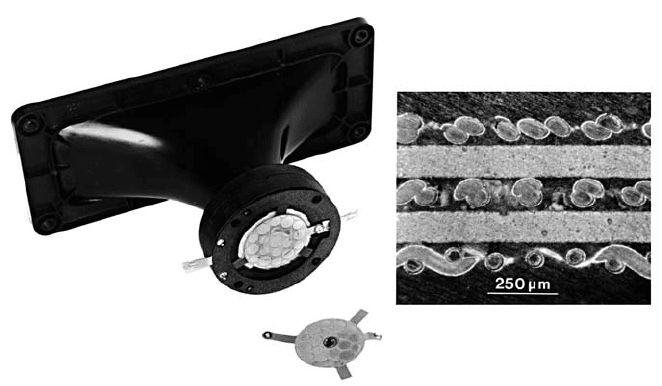
Perhaps the best-known example of the use of piezoceramics for the generation
of sonic energy is in the ‘tweeter’. The active element is a lightly supported
circular bimorph. An alternating voltage causes the disc to flex which, in turn,
drives a light-weight cone. Compared with other shapes the circular bender offers
the advantages of a high compliance suited to radiating power into air, a high
capacitance necessary for delivering power to the speaker and a high
electromechanical coupling coefficient. A typical bimorph construction is
shown in Fig. 6.33. The frequency response is nearly flat from about 4 to
about 30 kHz. It is evident from the dimensions of the bimorph that to
manufacture the piezoceramic plates to an acceptably high standard presents a
challenge which has been successfully met.
Simple ‘buzzers’ are made in very large numbers for all types of tone
generators used in phones, smoke alarms, toys etc. The device comprises a poled
PZT disc cemented to a thin metal disc which vibrates at the frequency of the
applied voltage.
398 PIEZOELECTRIC CERAMICS
Wave ¢lters and delay lines
Piezoelectric crystals, notably quartz, are used to control or limit the operating
frequency of electrical circuits. A well-known example is their use in ‘quartz
clocks’. The fact that a dielectric body vibrating at a resonant frequency can
absorb considerably more energy than at other frequencies provides the basis for
piezoelectric wave filters. The equivalent circuit for a piezoelectric body vibrating
at frequencies close to a natural frequency is given in Fig. 6.3. At resonance the
impedance due to L
1
and C
1
falls to zero and, provided that R
1
is small, the
overall impedance is small.
A filter is required to pass a certain selected frequency band, or to stop a given
band. The passband for a piezoelectric device is proportional to k
2
, where k is the
appropriate coupling coefficient. The very low k value of about 0.1 for quartz
only allows it to pass frequency bands of approximately 1% of the resonant
frequency. However, the PZT ceramics, with k values of typically about 0.5, can
readily pass bands up to approximately 10% of the resonant frequency. Quartz
has a very high Q
m
(about 10
6
) which results in a sharp cut-off to the passband.
This, coupled with its very narrow passband, is the reason why the frequency of
quartz oscillators is very well defined. In contrast PZT ceramics have Q
m
values
in the range 10
2
–10
3
and so are unsuited to applications demanding tightly
specified frequency characteristics.
The simplest of resonators is a thin (about 400 mm) disc electroded on its plane
faces and vibrating radially. For a frequency of 450 kHz the diameter needs to be
APPLICATIONS 399
Fig. 6.33 Hi-fi ‘tweeter’ showing ceramic bimorph plate element. Inset, cross-section of
element showing piezoceramic plates sandwiched between metallized glass fibre mesh.
about 5.6 mm. However, if the required resonant frequency is 10 MHz then the
diameter would need to be reduced to about 250 mm, which is impracticable.
Therefore other modes of vibration, e.g. the thickness compression mode, are
exploited for the higher-frequency applications. Unfortunately the overtone
frequencies are not sufficiently removed from the fundamental for filter
applications, but the problem is solved by exploiting the ‘trapped-energy’
principle to suppress the overtones.
The plate is partly covered with electrodes of a specific thickness. Because of
the extra inertia of the electrodes the fundamental frequency of the thickness
modes beneath the electrodes is less than that of the unelectroded thickness.
Therefore the longer wave characteristic of the electroded region cannot
propagate in the unelectroded region; it is said to be trapped. In contrast, the
higher-frequency overtones can propagate away into the unelectroded region
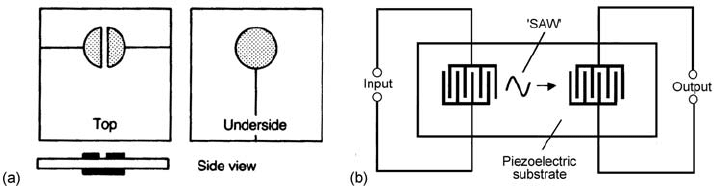
where their energy is dissipated. If the top electrode is split, coupling between the
two parts will only be efficient at resonance. A trapped-energy filter of this type is
illustrated in Fig. 6.34(a).
Filters based on this principle made from PZT ceramic have been widely used in
the intermediate frequency stages of FM radio receivers. More stable units suitable
for telecommunication filters are made from single-crystal LiTaO
3
and quartz.
Filters and delay lines of the form shown in Fig. 6.34(b) are made which
exploit the surface acoustic wave (see Section 6.5.2 above). The SAW is
propagated in the direction normal to the overlap of the interdigitated electrodes,
the wavelength launched being related to the electrode spacing and width. For a
combined space and half-width of 15 mm(l
surface
¼ 30 mm) the structure will
propagate a centre frequency of 100 MHz. That is it operates as a filter.
The transit time of the SAW between the launch and receiving electrodes can
be tailored to introduce a specific time delay into a microwave circuit.
A delay line can also be formed from a slice of a special glass designed so
that the velocity of sound is as nearly as possible independent of temperature.
(The term ‘isopaustic’ has been coined to describe such a material.) PZT
ceramic transducers are soldered on two 458 metallized edges of the slice. The
input transducer converts the electrical signal to a transverse (‘shear’) acoustic
400 PIEZOELECTRIC CERAMICS
Fig. 6.34 (a) Trapped-energy filter. (b) Surface acoustic wave (SAW) filter.
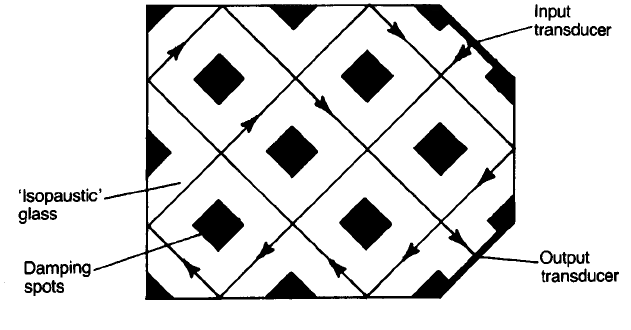
wave which travels through the slice and is reflected at the edges as shown in
Fig. 6.35. At the output transducer the signal is reconverted into an electrical
signal delayed by the length of time taken to travel around the slice. Unwanted
reflections inside the slice are suppressed by the damping spots which are
screen-printed epoxy resin loaded with tungsten powder. By grinding the slice
to precise dimensions the delay time can be controlled with an accuracy to
better than 1 in 10
4
.
Such delay lines are used in colour television sets to introduce a delay of
approximately 64 ms, the time taken for the electron beam to travel once across
the screen. The delayed signal can be used to average out variations in the colour
signal that occur during transmission and so improve picture quality. Similar
delay lines are used in videotape recorders.
The intravascular catheter
The intravascular catheter, used on a routine basis to image arterial tissue, is an
essential medical tool enabling the surgeon to identify disease type and to take
appropriate steps to combat it, and the demand is for very large numbers
(currently approximately 175 000 p.a.).
In a typical design the transducer head, illustrated in Fig. 6.36(b), comprises
an array of 64 ‘PZT’ bars (approximate dimensions 5003070 mm) arranged
around the catheter tip.
To form the array a 70 mm thick poled sheet (50.6 mm) of PZT is bonded
between two metallized polymer sheets. The PZT is sliced into the 64 elements by
diamond-cutting, the cut just penetrating the bottom polymer layer so allowing
the whole to be wrapped around the catheter tip. The outer polymer film, about
20 mm thick, serves as a l/4 acoustic matching layers and also carries the thin
copper tracks to electrically address each element.
APPLICATIONS 401
Fig. 6.35 A signal delay device.