
Moulson A.J., Herbert J.M. Electroceramics: Materials, Properties, Applications
Подождите немного. Документ загружается.

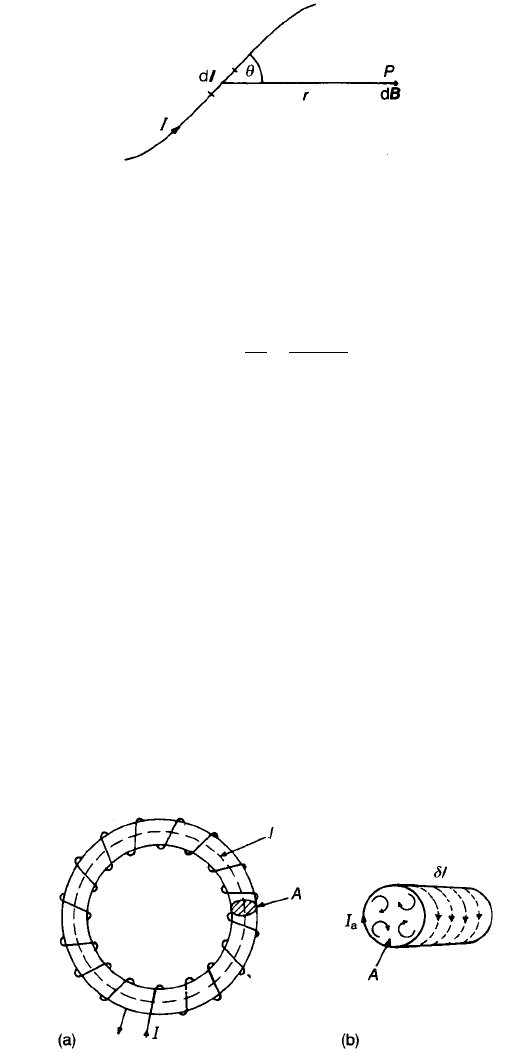
calculated for any system of currents in vacuo by the vector summation of
induction elements dB, arising from current elements Idl (Fig. 9.2), where
dB ¼
m
0
4p
Idl r
r
3
ð9:3Þ
The magnitude of dB is ðm
0
=4pÞðIdl sin yÞ=r
2
in which m
0
, which is termed the
permeability of a vacuum, has the value 4p 10
7
Hm
71
.
An additional field vector, the magnetic field intensity H measured in ampe
`
res
per metre, is defined so that in a vacuum H ¼ B=m
0
. Therefore, whereas B
depends upon the medium surrounding the wire (a vacuum in the present case),
H depends only upon the current.
In Chapter 2 (Eq. (2.74)) an important relation between D, E and P was
derived by considering the effects of polarization in the dielectric of a parallel-
plate capacitor. An analogous relationship is now derived by considering the
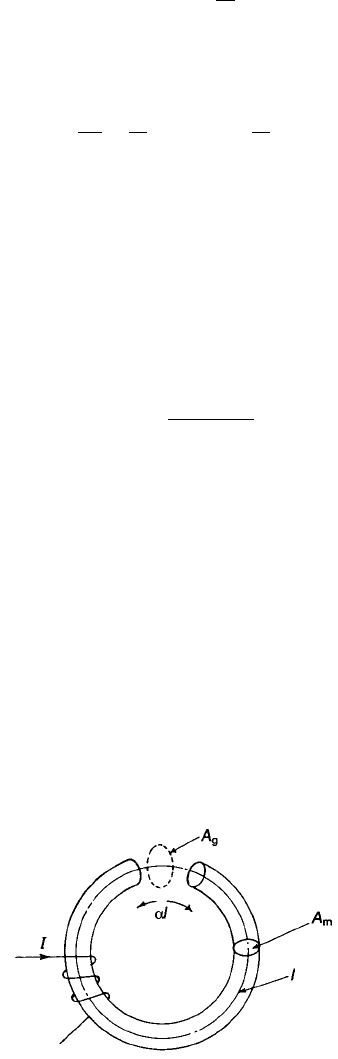
magnetization of a material of a wound toroid of cross-section A and mean
circumference l (Fig. 9.3(a)). Because there is no break in the toroid, and so no
free poles and consequent demagnetizing fields (see Section 9.1.3), H in the
material must be due to the real currents only. The material becomes magnetized,
i.e. it acquires a magnetic moment per unit volume or magnetization M, and the
472 MAGNETIC CERAMICS
Fig. 9.3 Effects arising from the presence of a magnetic material; I
a
is the amperian current
per unit length of toroid.
Fig. 9.2 Magnetic induction arising from a current element.
TEAMFLY
Team-Fly
®
magnetic moment of a volume element arises from microscopic currents, the
‘amperian’ currents.
Application of Ampe
`
re’s circuit theorem
Þ
B dl ¼ m
0
I
total
to the dotted path
(Fig. 9.3(a)) around the coil wound on non-magnetic material gives B ¼ m
0
nI,
where I is the current and n is the number of turns per unit length. However, if
the coil is wound on magnetic material then, because amperian currents are now
also involved,
B ¼ m
0
nI þ m
0
I
a
ð9:4Þ
Furthermore, from Fig. 9.3(b), because I
a
dlA ¼ MdlA, it follows that
B ¼ m
0
ðH þ MÞð9:5Þ
and, if the magnetization is assumed to be proportional to the magnetizing field,
B ¼ m
0
ðH þ w
m
HÞð9:6Þ
where w
m
is the volume magnetic susceptibility. Therefore
B ¼ m
0
ð1 þ w
m
ÞH ¼ m
0
m
r
H or mH ð9:7Þ
where m is the permeability and m
r
¼ 1 þw
m
is the relative permeability of the
material (the latter is a dimensionless quantity).
In general, the permeability and susceptibility are tensors; an implicit
assumption made throughout the remainder of the chapter is that the vectors
are collinear when the vector notation is dropped.
9.1.3 Shape anisotropy: demagnetization
Measurements of permeability and associated magnetic properties are usually
made on toroids of uniform section when, to a close approximation, the flux
density B is uniform throughout the material and lies entirely within it. In most
practical applications the magnetic circuit is more complex, and variations in
component section and permeability give rise to variations in flux density.
Important effects arise from air gaps, which may be intentionally introduced or
may be cracks or porosity.
The effect of the shape of a specimen on its magnetic behaviour, ‘shape
anisotropy’, is expressed by a demagnetization factor N
D
. A field H
a
applied to a
solid of arbitrary shape is reduced by a factor proportional to its magnetization
M, so that the effective field H
e
within the body is given by
H
e
¼ H
a
N
D
M ð9:8Þ
It follows from Eq. (9.5) that
MAGNETIC CERAMICS: BASIC CONCEPTS 473
H
e
¼ H
a
N
D
B
m
0
H
e
Multiplying this equation through by m
0
=B and putting m
re
¼ B=m
0
H
a
, where m
re
is the effective relative permeability, gives
1
m
re
¼
1
m
r
þ N
D
1
1
m
r
ð9:9Þ
N
D
can only be calculated simply if the field within the magnetized body is
uniform, and it can be shown that this is the case only when the body is
ellipsoidal. In ferromagnetic or ferrimagnetic bodies the permeability and
magnetization vary markedly with field strength (cf. Section 9.1.10), so that M in
Eq. (9.8) will vary in different parts of a body if the field is not uniform. For a
sphere an exact calculation gives N
D
¼1/3. A long rod with a length-to-diameter
ratio of r can be approximated by a prolate ellipsoid with a large ratio r between
the major and minor axes. Then
N
D
lnð2rÞ1
r
2
ð9:10Þ
If r ¼ 10, N
D
¼ 0:02, so that for m
r
¼ 1000, m
re
50, while for r ¼ 100,
m
re
700.
The magnetic field which emanates from regions near the ends of magnets
leads to the concept of magnetic poles which is useful in providing an
approximate model in complex magnetic structures.
A thin flat disc magnetized normally to its plane will have a demagnetization
factor close to unity so that its real permeability must be very high if its effective
permeability is to be appreciable. Minor structural defects, such as fine cracks
normal to the direction of magnetization, set up demagnetizing fields which can
also markedly reduce effective permeability. The effect of such a crack can be
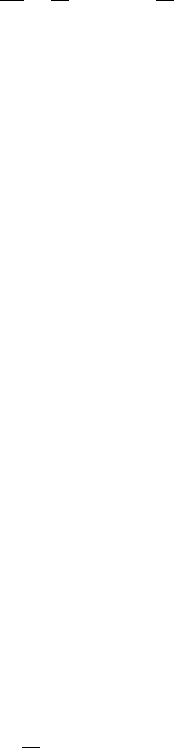
calculated by considering a toroid of overall length l containing an air gap of
length al, as shown in Fig. 9.4; al is assumed to be very small so that the effective
cross-section A
g
of the gap, is approximately equal to the cross-section A
m
of the
toroid. If the toroid carries nI ampe
`
re turns, then, by Ampe
`
re’s theorem,
474 MAGNETIC CERAMICS
Fig. 9.4 The effect of an air gap in a toroid.
nI ¼
þ
Hdl ¼ H
m
lð1 aÞþH
g
al ¼ H
e
l ð9:11Þ
where H
m
and H
g
are the fields in the material and the gap respectively and H
e
is
the effective field. Under the assumption that the total flux through the circuit
remains constant, i.e. B
m
A
m
¼ B
g
A
g
¼ B
e
A
e
, and that A
e
¼ A
m
¼ A
g
, where the
subscripts have the same meanings as before, it follows that
1
m
re
¼
1
m
r
þ a
1
1
m
r
ð9:12Þ
From a comparison of Eqs (9.9) and (9.12) it can be seen that a corresponds to
N
D
and that, for m
re
to be close to m
r
a must be small compared with 1/m
r
. For
example, suppose that, for a given material, m
r
¼1000 and m
re
is required not to
be less than 0.9m
r
. Then the maximum permitted crack width in a toroid of length
10 cm, say, is 10 mm. It is evident that if high-permeability ceramics are to be fully
exploited they must be free from cracks normal to the intended flux direction.
9.1.4 Magnetic materials in alternating ¢elds
The opening comments made in the corresponding section on dielectric materials
(Section 2.7.2) apply equally here. Magnetic materials are used extensively as
inductor and transformer cores where they are subjected to alternating magnetic
fields. There are also many instances where an electromagnetic wave interacts
with a magnetic material, as in microwave devices of various types. Under these
conditions energy is dissipated in the material by various mechanisms and,
analogously to the dielectric case, overall behaviour can be described with the
help of a complex permeability m* ¼ m
0
jm@, in which m
0
and m@ are respectively
the real and imaginary parts of m*. The complex relative permeability is
m*
r
¼ m
0
r
jm@
r
.
Important relationships can be derived by reference to the wound toroid (Fig.
9.3(a)) where the current I is now regarded as sinusoidal and represented by
I
0
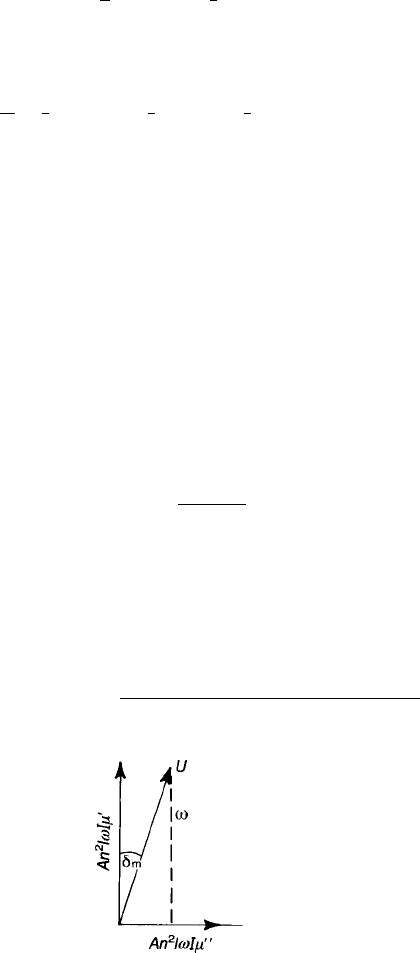
exp(jot). The appropriate phasor diagram is shown in Fig. 9.5. If the
instantaneous current is I, the corresponding field is nI and the flux linking the
circuit is m
0
n
2
IAl. For a current varying sinusoidally the e.m.f. is
U ¼
d
dt
ðm*n
2
AlIÞ
¼ jom*n
2
AlI
¼ jAln
2
oIm
0
þ Aln
2
oIm@ ð9:13Þ
Since m@ is small, from Fig. 9.5 d
m
ð¼ tan
1
ðm@=m
0
ÞÞ is also small and therefore the
voltage leads the current by nearly 908.
MAGNETIC CERAMICS: BASIC CONCEPTS 475
The mean power
PP dissipated over a cycle of period t is the mean value of the
product of the current and the ‘in-phase’ voltage component U
i
, i.e.
PP ¼
1
t
ð
t
0
IU
i
dt ¼
1
2
I
2
0
An
2
lom@ ð9:14Þ
or
PP
V
¼
1
2
I
2
0
n
2
om@ ¼
1
2
H
2
0
om@ ¼
1
2
H
2
0
om
0
tan d
m
ð9:15Þ
where V is the volume of the toroid. m
0
tan d
m
is a material constant proportional
to the heat generated per unit volume in a magnetic body in an alternating field.
It is not of great practical use unless the field at which it is measured is also
specified, since both m
0
and tan d
m
are strongly field dependent except at very low
fields. The behaviour is similar to that of ferroelectric dielectrics with respect to
electric fields.
In the pot-cores used in inductors (see Section 9.5.1) for LC filter circuits, the
fields are low enough for m
0
and tan d
m
to vary only gradually with the field and
the ratio (tan d
m
)/m
0
is sensibly constant. These cores are designed with small
gaps of variable width so that their effective permeability can be adjusted in
accordance with Eq. (9.12). If m
r
1 Eq. (9.12) can be expressed in complex
form to take account of losses and rearranged to give
m*
re
¼
m*
r
1 þ am*
r
ð9:16Þ
If m*
re
and m*
r
are put in the complex form
m*
re
¼ m
0
re
ð1 j tan d
me
Þð9:17Þ
and correspondingly for m*
r
, Eq. (9.16) becomes
m
0
re
ð1 j tan d
me
Þ¼
m
0
r
f1 þ am
0
r
ð1 þ tan
2
d
m
Þj tan d
m
g
1 þ 2am
0
r
þ a
2
m
0
2
r
ð1 þ tan
2
d
m
)
ð9:18Þ
476 MAGNETIC CERAMICS
Fig. 9.5 Phasor diagram showing the components of the voltage U in phase and out of phase
with the driving current I.
Since low loss is essential in pot-core applications, tan
2
d
m
1 and can be
neglected. Separating real and imaginary parts then gives
m
0
re
¼
m
0
r
1 þ am
0
r
m
0
re
tan d
me
¼
m
0
r
tan d
m
ð1 þ am
0
r
Þ
2
ð9:19Þ
so that
tan d
me
m
0
re
¼
tan d
m
m
0
r
ð9:20Þ
Eq. (9.20) shows that, for a small gap and at low field strengths, the ratio (tan d)/
m of a high-permeability low-loss material is independent of the gap width and is
therefore a useful material constant in the pot-core context. It is often referred to
as the magnetic loss factor but is clearly quite different in character from the
dielectric loss factor (see Section 2.7.2). It indicates that a reduction in
permeability due to the introduction or enlargement of a gap is accompanied
by a proportionate reduction in tan d
m
(or increase in Q
m
).
9.1.5 Classi¢cation of magnetic materials
There are various types of magnetic material classified by their magnetic
susceptibilities w
m
. Most materials are diamagnetic and have very small negative
susceptibilities (about 10
76
). Examples are the inert gases, hydrogen, many
metals, most non-metals and many organic compounds. In these instances the
electron motions are such that they produce zero net magnetic moment. When a
magnetic field is applied to a diamagnetic substance the electron motions are
modified and a small net magnetization is induced in a sense opposing the
applied field. As already mentioned, the effect is very small and of no practical
significance in the present context, and is therefore disregarded.
Paramagnetics are those materials in which the atoms have a permanent
magnetic moment arising from spinning and orbiting electrons. An applied field
tends to orient the moments and so a resultant is induced in the same sense as
that of the applied field. The susceptibilities are therefore positive but again
small, usually in the range 10
73
–10
76
. An important feature of many
paramagnetics is that they obey Curie’s law w
m
/ 1=T, reflecting the ordering
effect of the applied field opposed by the disordering effect of thermal energy.
The most strongly paramagnetic substances are compounds containing
transition metal or rare earth ions and ferromagnetics and ferrites above their
Curie temperatures.
MAGNETIC CERAMICS: BASIC CONCEPTS 477
Ferromagnetic materials are spontaneously magnetized below a temperature
termed the Curie point or Curie temperature (the two terms are synonymous).
The spontaneous magnetization is not apparent in materials which have not been
exposed to an external field because of the formation of small volumes (domains)
of material each having its own direction of magnetization (see Section 9.1.9). In
their lowest energy state the domains are so arranged that their magnetizations
cancel. When a field is applied the domains in which the magnetization is more
nearly parallel to the field grow at the expense of those with more nearly
antiparallel magnetizations. Since the spontaneous magnetization may be several
orders of magnitude greater than the applied field, ferromagnetic materials have
very high permeabilities. When the applied field is removed some part of the
induced domain alignment remains so that the body is now a ‘magnet’ in the
ordinary sense of the term. The overall relation between field strength and
magnetization is the familiar hysteresis loop as illustrated in Fig. 9.10 below.
Spontaneous magnetization is due to the alignment of uncompensated electron
spins by the strong quantum-mechanical ‘exchange’ forces. It is a relatively rare
phenomenon confined to the elements iron, cobalt, nickel and gadolinium and
certain alloys. One or two ferromagnetic oxides are known, in particular CrO
2
which is used in recording tapes. These ferromagnetic oxides show metallic-type
conduction and the mechanism underlying their magnetic behaviour is probably
similar to that of magnetic metals.
In antiferromagnetic materials the uncompensated electron spins associated
with neighbouring cations orient themselves, below a temperature known as the
Ne
´
el point, in such a way that their magnetizations neutralize one another so that
the overall magnetization is zero. Metallic manganese and chromium and many
transition metal oxides belong to this class. Their susceptibilities are low (about
10
73
) except when the temperature is close to the Ne
´
el point when the
antiferromagnetic coupling breaks down and the materials become paramagnetic.
Finally, there are the important ferrimagnetic materials, the subject of much of
this text. In these there is antiferromagnetic coupling between cations occupying
crystallographically different sites, and the magnetization of one sublattice is
antiparallel to that of another sublattice. Because the two magnetizations are of
unequal strength there is a net spontaneous magnetization. As the temperature is
increased from 0 K the magnetization decreases, reaching zero at what strictly
speaking is the Ne
´
el point (see Fig. 9.7 below); however, it is commonly called
the Curie point because of the generally close similarity of ferrimagnetic to
ferromagnetic behaviour.
9.1. 6 The paramagnetic e¡ect and spontaneous magnetization
In the interests of simplicity, attention is confined to a crystal consisting of N
atoms per unit volume for which the magnetic moment per atom arises from a
478 MAGNETIC CERAMICS
spinning electron only and the values resolved in the direction of an applied
magnetic field are +1 m
B
. Some of the moments will be directed parallel and
some antiparallel to the field and, because there is an energy difference 2m
B
B
between the two states, the relative populations in them will depend upon
temperature in accordance with Boltzmann statistics.
If n" denotes the number of atoms per unit volume with moments in the
direction of B and n# the number in the antiparallel sense, the net induced
magnetization is M ¼ðn"n#Þm
B
. It follows that
n#
n"
¼ exp
2m
B
B
kT
ð9:21Þ
and, since N ¼ n"þn#, it is straightforward to show that
M ¼ Nm
B
tanh
m
B
B
kT
ð9:22Þ
Under most practical conditions m
B
B kT, and then (using the approxima-
tion e
x
1 þ x for x 1) it follows that
M
Nm
2
B
B
kT
or w
m
¼
Nm
2
B
m
0
kT
¼
C
T
ð9:23Þ
which is Curie’s law. It should be noted that in the derivation B has been equated
with m
0
H since m
0
r
1.
In 1907 Weiss suggested that the magnetic field H
i
‘seen’ by an individual
dipole in a solid was the macroscopic internal field H modified by the presence of
dipoles in the neighbourhood of the individual. This idea was expressed by
H
i
¼ H þ wM, (c.f. Eq. (2.84)) where w is known as the ‘molecular field
constant’. Under this assumption Eq. (9.22) is modified to
M ¼ Nm
B
tanh
m
B
m
0
kT
ðH þ wMÞ
ð9:24Þ
MAGNETIC CERAMICS: BASIC CONCEPTS 479
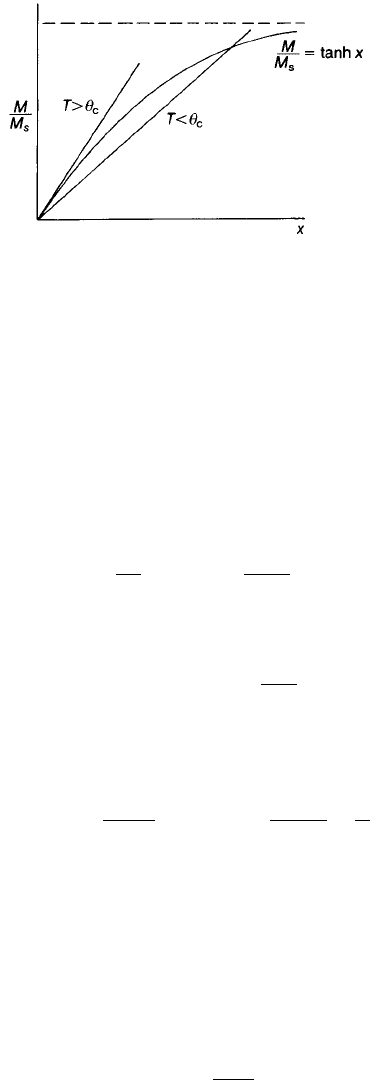
Fig. 9.6 Graphs illustrating the possibility of spontaneous magnetization below a critical
temperature y
c
.
Spontaneous magnetization implies a value for M when H ¼ 0, and the practical
feasibility of this can be explored by putting H ¼ 0 in Eq. (9.24) and then
examining whether the equation can be satisfied by non-trivial values for M.
Therefore, putting Nm
B
¼ M
s
, where M
s
is the saturation magnetization, we can
write Eq. (9.24) as
M
M
s
¼ tanh
m
B
m
0
wM
kT
or, more conveniently,
M
M
s
¼ tanh x ð9:25Þ
where
x ¼
m
B
m
0
wM
kT
ð9:26Þ
It follows from Eq. (9.26) that
M
M
s
¼
kT
m
2
B
m
0
wN
x ¼
T
y
c
x ð9:27Þ
in which y
c
has the dimensions of temperature and is the Curie temperature.
Figure 9.6 shows the graphs of Eqs (9.25) and (9.27).
It is clear that, for spontaneous magnetization to be possible in principle, Eqs
(9.25) and (9.27) must be consistent, i.e. both must be simultaneously satisfied for
particular values of M/M
s
and x. Also, for small values of x , tanh x x and so,
near to the origin, M=M
s
¼ x; therefore for T ¼ y
c
the equations have the same
slope at the origin. This defines a temperature y
c
such that if T4y
c
(slope greater
than unity) there is no intersection at non-zero values of x and, in consequence,
no spontaneous magnetization is possible. For T5y
c
there is an intersection and
spontaneous magnetization is a possibility. It follows that, for temperatures up
480 MAGNETIC CERAMICS
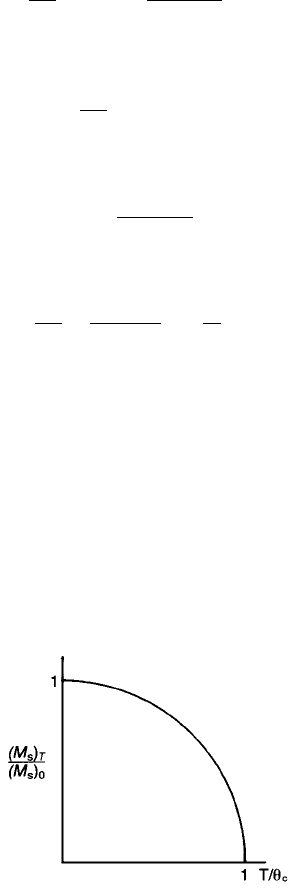
Fig. 9.7 The variation of the ratio of saturation magnetization at T K to that at 0 K with the
ratio of the temperature to the Curie temperature.
to T ¼ y
c
, the M/M
s
value corresponding to the intersection can be found,
leading to Fig. 9.7 which shows good agreement with experiment for iron, cobalt
and nickel.
According to the Weiss theory just outlined, ferromagnetism is caused by a
strong internal magnetic field aligning the magnetic moments on individual ions.
The physical origin of the internal field is now known to be quantum mechanical
in nature and to involve the ‘exchange forces’ which determine the relative
orientation of the spins on adjacent electrons. The exchange energy arising from
exchange forces plays a dominating role in determining the nature of the
important magnetic materials. In some instances, e.g. the metals iron, cobalt and
nickel, the exchange energy is minimized for parallel spins; this is exceptional
since, generally, the exchange energy is minimized when adjacent spins are
antiparallel. In the non-metallic antiferromagnetics and ferrites the ordering is
antiparallel through superexchange forces, so-called because they act between
the spins of neighbouring cations with the involvement of an intermediate ion
which, in the case of the ferrites, is oxygen.
9.1.7 Magnetocrystalline anisotrophy
A spinning electron, free from any restraints, can be aligned by an infinitely small
field, implying an infinite permeability. A restraint leading to finite permeabilities
in magnetic materials is caused by a coupling between the spins and the crystal
lattice through the agency of the orbital motion of the electron. This spin–orbit
lattice coupling results in orientation of the spins relative to the crystal lattice in a
minimum energy direction, the so-called ‘easy direction’ of magnetization.
Aligning the spins in any other direction leads to an increase in energy, the
anisotropy energy E
K
. For a cubic lattice, such as a spinel, E
K
is related to two
anisotropy constants K
1
and K
2
by
E
K
¼ K
1
ða
2
1
a
2
2
þ a
2
2
a
2
3
þ a
2
3
a
2
1
ÞþK
2
a
2
1
a
2
2
a
2
3
ð9:28Þ
where a
1
, a
2
and a
3
are the direction cosines of the magnetization vector relative
to the crystallographic axes.
The approximate expression for E
K
(Eq. (9.28)) leaves out all but two of the
terms of an infinite power series, and even the term involving K
2
can often be
safely neglected. If it is assumed that K
2
is negligible and K
1
is positive, then E
K
has a minimum value of zero if any two of the direction cosines are zero, i.e. the
anisotropy energy is a minimum along all three crystal axes and these are
therefore the ‘easy’ directions. If K
1
is negative, the minimum occurs for
a
1
¼ a
2
¼ a
3
¼ 1=
p
3, i.e. the body diagonal is the ‘easy’ direction.
The anisotropy constants listed in Table 9.1, which anticipate the discussion of
ferrites (Section 9.2 et seq.), indicate that the easy directions for cubic crystals are
[111] except for those containing cobalt, in which case they are [100]. For
MAGNETIC CERAMICS: BASIC CONCEPTS 481