
Moulson A.J., Herbert J.M. Electroceramics: Materials, Properties, Applications
Подождите немного. Документ загружается.

can be sintered in fully oxidizing atmospheres since their magnetic properties do
not depend on the presence of lower-valency ions such as Fe
2+
or Mn
2+
. Other
properties, including lattice dimensions, temperature coefficients of magnetiza-
tion and expansion and magnetic anisotropy, can be tailored by adjustments to
composition. Garnets can be grown as single crystals, and thin films of complex
composition, once the basis of ‘bubble’ memories, now attract considerable
interest for magneto-optical applications (see Section 9.5.4).
9.3 Properties In£uencing Magnetic Behaviour
9.3.1 Soft ferrites
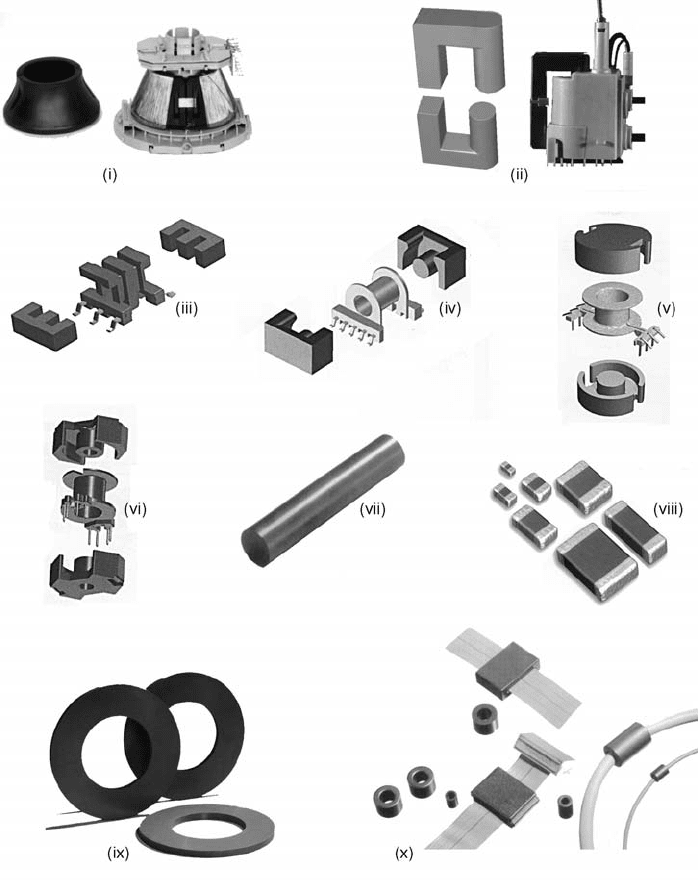
Soft ferrites are used for the manufacture of inductor cores (pot cores) for
telecommunications, low-power transformers and high-flux transformers such
as television line output transformers, and as television tube scanning yokes
(Fig. 9.17). The more important material characteristics for these and other
applications are now discussed with emphasis on the influence of composition
and microstructure. The review paper by A. Broese van Groenou et al. [9] and
the monograph by E.C. Snelling [10] are recommended to supplement the
discussion.
Initial permeability (m
ri
)
High initial permeability is achieved through control of composition and
microstructure. It depends in a complex manner on high saturation magnetiza-
tion, low magnetic anisotropy and low magnetostriction. The magnetic
anisotropy falls off very rapidly as the saturation magnetization falls to a low
value near the Curie temperature, so that the net result is a peak in permeability
just below the Curie temperature followed by a steep fall to a value close to unity
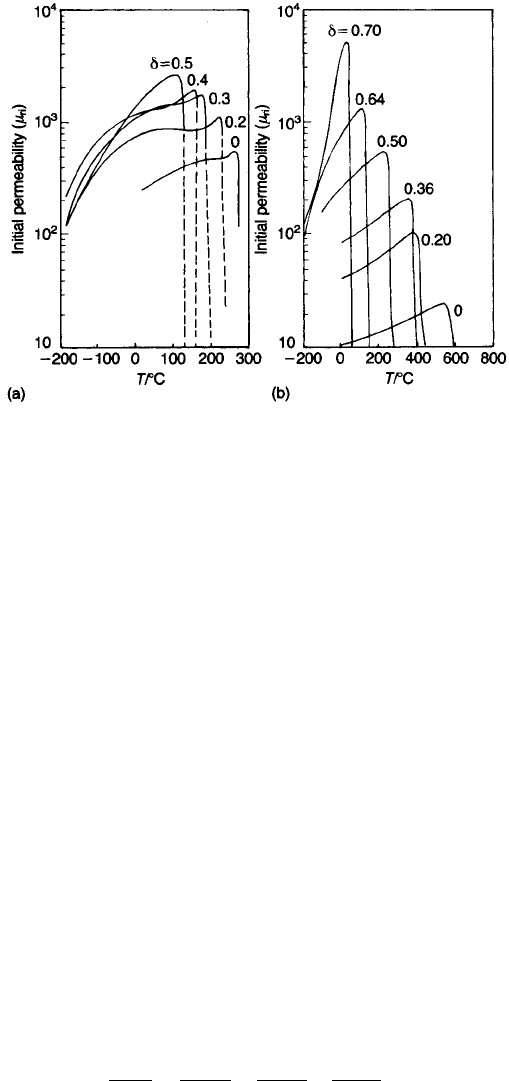
as the magnetization falls to zero. Figure 9.18 shows the variation of m
ri
with
temperature for MnZn and NiZn ferrites with a range of zinc contents; it also
illustrates the change in Curie temperature with zinc content mentioned earlier
(Section 9.2.1). The dependence of the permeability of the NiZn system on
frequency is discussed in Section 9.3.1. Magnetic anisotropy is low in the MnZn
ferrites and can be adjusted in the NiZn system by substituting small amounts of
cobalt for the nickel, since the anisotropy constant for cobalt ferrite is opposite in
sign to that of most ferrites (see Table (9.1).
Magnetostriction can be reduced by adjusting the sintering atmosphere during
the application of the maximum temperature and afterwards so that a small
amount of Fe
2+
is formed, thus taking advantage of the opposite sign of the
magnetostriction constant for Fe
3
O
4
compared with that for most other ferrites
492 MAGNETIC CERAMICS
TEAMFLY
Team-Fly
®
PROPERTIES INFLUENCING MAGNETIC BEHAVIOUR 493
Fig. 9.17 Range of soft ferrite components: (i) TV scanning yoke (components kindly
supplied by Philips Components Ltd.); (ii) UR core and TV line output transformer; (iii) E
core for switched mode power supply; (iv) wide band transformer core; (v) core giving good
magnetic shielding; (vi) high Q (adjustable) filter core (cf. Fig. 9.48); (vii) precision ferrite
antenna for transponder; (viii) multilayer EMI suppressors; (ix) toroids for laser and radar
pulse applications; (x) typical EMI shields for cables. ((ii)–(x) Courtesy of ‘Ferroxcube UK’.)
(see Table 9.2). The introduction of Fe
2+
has the disadvantage of lowering the
resistivity of the ferrite, but a high permeability can be obtained without
excessive penalty in this respect.
Because a major contribution to m
ri
is from Bloch wall movements,
microstructure has a significant influence. High magnetic anisotropy implies
high-energy walls readily ‘pinned’ by microstructural defects. Thus, for a high-
permeability polycrystalline ferrite, very mobile domain walls are required,
demanding in turn large defect-free grains coupled with low magnetic
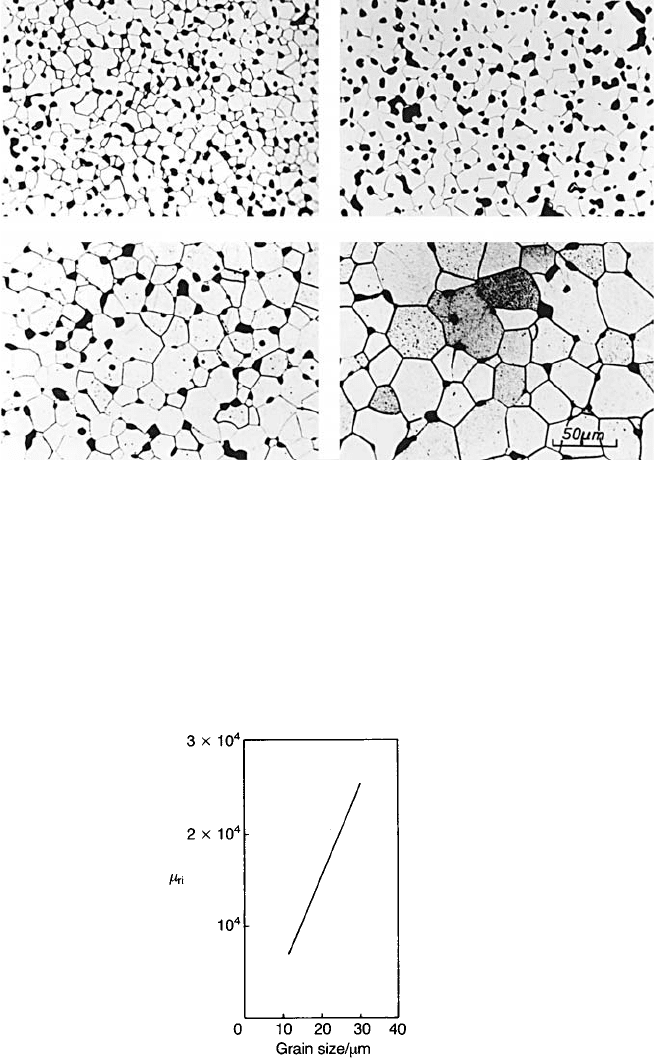
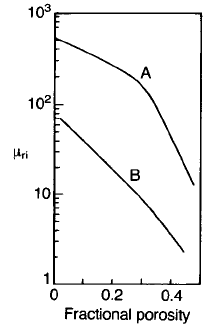
anisotropy. Figures 9.19 and 9.20 illustrate the sensitivity of permeability to
grain size, and Fig. 9.21 shows how porosity leads to reduced permeability,
presumably because of domain wall pinning.
The loss factor (tan d)/m
ri
The way in which magnetic loss in a material is expressed depends upon the
particular application. For example, in the case of pot cores, when currents are
small and hence the flux density is also small (typically less than 1 mT), the loss
factor used is (tan d)/m
ri
or its reciprocal m
ri
Q where Q is the quality factor.
The loss factor is usually expressed in terms of three main contributions,
namely
tan d
m
ri
¼
tan d
h
m
ri
þ
tan d
e
m
ri
þ
tan d
r
m
ri
ð9:31Þ
494 MAGNETIC CERAMICS
Fig. 9.18 The variation with temperature of the initial relative permeability m
ri
for different d
values in (a) Mn
17d
Zn
d
Fe
2
O
4
and (b) Ni
17d
Zn
d
Fe
2
O
4
(after [10]).
in which tan d
h
, tan d
e
and tan d
r
are the hysteresis, eddy current and ‘residual’
loss tangents. The processes contributing to residual loss are difficult to identify
but include ferrimagnetic resonance and domain wall resonance (see below). In
low-current high-frequency applications of high-resistivity ferrites, when
hysteresis and eddy current losses are low, residual losses may dominate.
PROPERTIES INFLUENCING MAGNETIC BEHAVIOUR 495
Fig. 9.19 Microstructure of high permeability Mn–Zn ferrites with a range of grain sizes: (a)
m
ri
¼ 6500; (b) m
ri
¼ 10 000; (c) m
ri
¼ 16 000; (d) m
ri
¼ 21 500. (Courtesy of Philips Technical
Review.)
Fig. 9.20 Dependence of the initial relative permeability on grain size.
P.J. van der Zaag [11] discusses loss mechanisms in soft ferrites and shows that
a significant contribution to residual losses over the frequency range 500 kHz to
10 MHz originates from domain wall motion in multi-domain grains. This is
evidenced by a predicted and observed decrease in ‘intragranular’ loss
accompanying a transition from two-domain to mono-domain grains as the
grain size is decreased in the range 0.2 to 5 mm).
It is shown (Section 9.1.4) that the loss factor is independent of gaps
introduced in the magnetic circuit. In the case of pot cores (Fig. 9.48), where air
gaps are introduced both intentionally and because of the imperfect join, the loss
factor is a particularly useful parameter.
In the case of ferrites operating at high amplitudes (e.g. above 10 mT) and in
the typical frequency range 15–100 kHz power is dissipated mainly through
hysteresis, although eddy current loss may also contribute significantly. Losses in
materials intended for such high-power applications are usually expressed in
terms of power-loss density (Eq. (9.15)) measured directly from the alternating
voltage across the winding on a toroid, the in-phase component of the current
and the toroid volume.
Electrical resistivity
The resistivity r of an inductor core material is important because it determines
eddy current losses. In general room temperature resistivities of ferrites lie in the
range 10
71
710
6
O m, many orders of magnitude higher than that of the most
resistive of the ferromagnetic alloys (about 8610
77
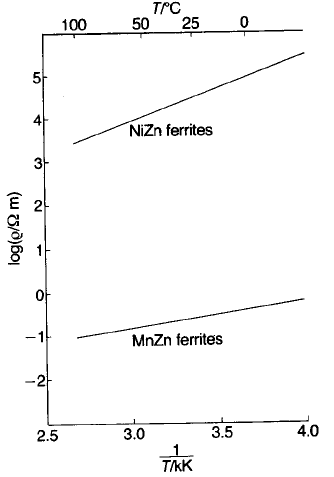
O m). Typical resistivity–
temperature data for MnZn and NiZn ferrites are shown in Fig. 9.22. For both
496 MAGNETIC CERAMICS
Fig. 9.21 Dependence of the initial relative permeability on porosity: curve A,
Ni
0.5
Zn
0.5
Fe
2
O
4
; curve B, NiFe
2
O
4
(after [6]).
types the conductivity mechanism is believed to be electron hopping between
ions of the same type on equivalent lattice sites, e.g. Fe
3+
$Fe
2+
,Mn
3+
$Mn
2+
or Ni
3+
$Ni
2+
(see Section 2.6.2). In the ideal inverse spinel structures NiFe
2
O
4
and MnFe
2
O
4
there is no opportunity for hopping. However, as mentioned
above, in practice the structures are not ideal and ions of the same type but
differing oxidation states do occur on equivalent lattice sites. In the case of
MnZn ferrite, for example, in order to maintain a major proportion of the Mn in
the Mn
2+
state so as to achieve the required magnetic properties, sintering is
carried out in a slightly reducing atmosphere which carries with it the risk of
converting some of the Fe
3+
to Fe
2+
; this must be carefully controlled for
otherwise hopping conductivity could rise to an unacceptable level. In contrast,
the NiZn ferrite family can be fired in air without oxidizing a significant
proportion of Ni
2+
to Ni
3+
and ensuring that the concentration of Fe
2+
is
negligible. Therefore the opportunity for electron hopping is very much lower
than in the case of the MnZn ferrites. As always, the chosen composition and
fabrication steps are a compromise to achieve optimum properties for particular
applications. The extent to which electrical conductivity is sensitive to
composition, firing conditions and microstructure is illustrated by the following
examples.
Figure 9.23 shows electrical resistivity data for Ni
0.3
Zn
0.7
Fe
2+d
O
47x
in which d
measures the amount of iron over the normal stoichiometric amount. For d ¼ 0
PROPERTIES INFLUENCING MAGNETIC BEHAVIOUR 497
Fig. 9.22 Temperature dependence of the resistivity for NiZn and MnZn ferrites.
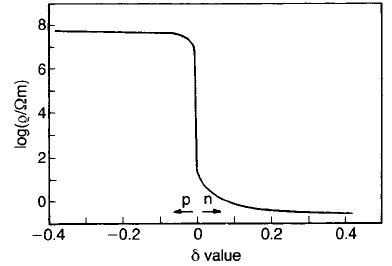
all iron is assumed to be in the Fe
3+
state and so no hopping occurs. Positive d
implies the presence of some Fe
2+
and the conditions for n-type electron hopping
(Fe
2+
!Fe
3+
). With negative d the charge balance can be restored by the
formation of Ni
3+
; however, the conversion of Ni
2+
to Ni
3+
requires greater
energy than the conversion of Fe
2+
to Fe
3+
when d is positive. The charge
balance when d is negative may in part be maintained by the formation of oxygen
vacancies. In addition, the concentration of Ni ions is only one-seventh that of
Fe ions. The net result is a very large increase in resistivity when the iron content
is reduced (see Section 2.6.2).
The addition of cobalt to a nickel ferrite has been employed to increase
resistivity, as illustrated in Fig. 9.24. For an explanation it is necessary to
consider the third ionization potentials of chromium, iron, manganese, cobalt
and nickel, which increase in this order. The addition of cobalt tends to maintain
the iron in the Fe
3+
state by virtue of the equilibrium
Fe
2þ
þ Co
3þ
¼ Fe
3þ
þ Co
2þ
Similarly the presence of Ni
3+
is discouraged because of the equilibrium
Ni
3þ
þ Co
2þ
¼ Ni
2þ
þ Co
3þ
It appears that the small amounts of Co
2+
and Co
3+
which occur, probably on
equivalent lattice sites, have little effect upon conductivity because of the large
hopping distances.
The importance of the rate of cooling from the sintering temperature is
apparent from the following data for a ferrite of composition Ni
0.4
Zn
0.6
Fe
2
O
4
.
After sintering in air at 1300 8C followed by rapid cooling, the resistivity was
10 O m. Analysis showed the FeO content to be 0.42%. When the same sample
was reheated and then cooled slowly, the FeO content was 0.07% and the
resistivity was more than 1000 O m. The explanation is that at high temperatures
Fe
2+
is favoured and is quenched in by the rapid cooling. During slow cooling,
498 MAGNETIC CERAMICS
Fig. 9.23 Dependence of the resistivity of the ferrite Ni
0.3
Zn
0.7
Fe
2+d
O
47x
on the iron content.
PROPERTIES INFLUENCING MAGNETIC BEHAVIOUR 499
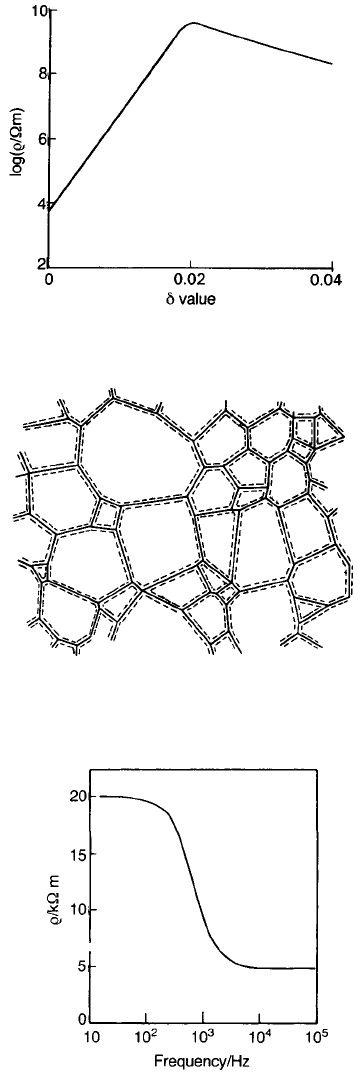
Fig. 9.25 Schematic diagram of a ferrite with semiconducting grains surrounded by
insulating grain boundaries.
Fig. 9.24 Dependence of the resistivity of the ferrite NiFe
1.9
Co
d
O
4
on the cobalt content.
Fig. 9.26 Dependence of the resistivity of the ferrite Ni
0.4
Zn
0.6
Fe
2
O
4
on frequency.
reoxidation can occur, and the resulting lower Fe
2+
content restricts the
opportunity for electron hopping.
Microstructure can also play an important role in determining electrical
resistivity. If the cooling rate is arranged so that, because of the high oxygen
diffusivity along grain boundaries compared with that in the single crystal, the
grain boundaries oxidize preferentially, it results in each semiconducting grain
being surrounded by a grain boundary region of relatively high resistance
(Fig. 9.25). This configuration of zones of differing conductivities can be
represented by an equivalent electrical circuit (see Section 2.7.5) comprising a
series connection of shunted capacitors, where one capacitor type represents the
grain and the other the grain boundary zone, and the shunts are the resistances of
the two regions. An analysis of the model predicts frequency dispersion of both
resistivity (Fig. 9.26) and permittivity (Fig. 9.27).
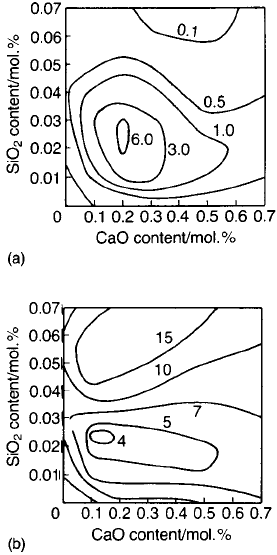
Another way of modifying the resistivity of the grain boundary region is to
add small amounts of CaO and SiO
2
. Figure 9.28 shows the effect of such
additions on the resistivity and loss factor of a ferrite. Studies of the grain
boundary show that the Si and Ca ions substitute in the ferrite crystal lattice
close to the boundary, rendering the region insulating.
500 MAGNETIC CERAMICS
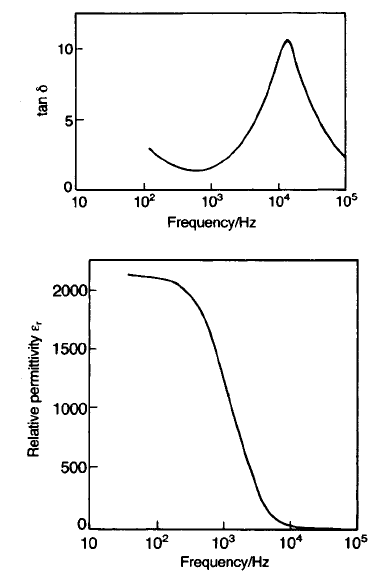
Fig. 9.27 Dependence of tan d and e
r
on frequency for the ferrite Ni
0.4
Zn
0.6
Fe
2
O
4
.
Permittivity (e
r
)
Above a frequency of 1 GHz the permittivity of MnZn ferrites is around 10, but
at 1 kHz it can reach values in the range 10
4
–10
6
. The dispersion is caused by the
relatively insulating grain boundaries referred to above. The same effect occurs in
the NiZn ferrites, although to a less marked extent, and Fig. 9.27 shows the
frequency dispersion of e
r
and the dielectric loss tangent for the ferrite
Ni
0.4
Zn
0.6
Fe
2
O
4
. If an equivalent circuit is used, and reasonable values for the
resistivity, relative permittivity and dimensions are assigned to the grain and
grain boundary phases, a relaxation frequency of approximately 20 kHz is
estimated, which agrees quite well with experimental data.
Resonance e¡ects
The replacement of the MnZn ferrite family by the NiZn ferrites as the
application frequency rises is partly due to the higher resistivities of the NiZn
PROPERTIES INFLUENCING MAGNETIC BEHAVIOUR 501
Fig. 9.28 Influence of SiO
2
and CaO additions to the ferrite Mn
0.68
Zn
0.2
Fe
2
O
4
on (a)
resistivity (O m) and (b) loss factor ((tan d)/m
0
ri
10
6
) at 100 kHz (after [9]).